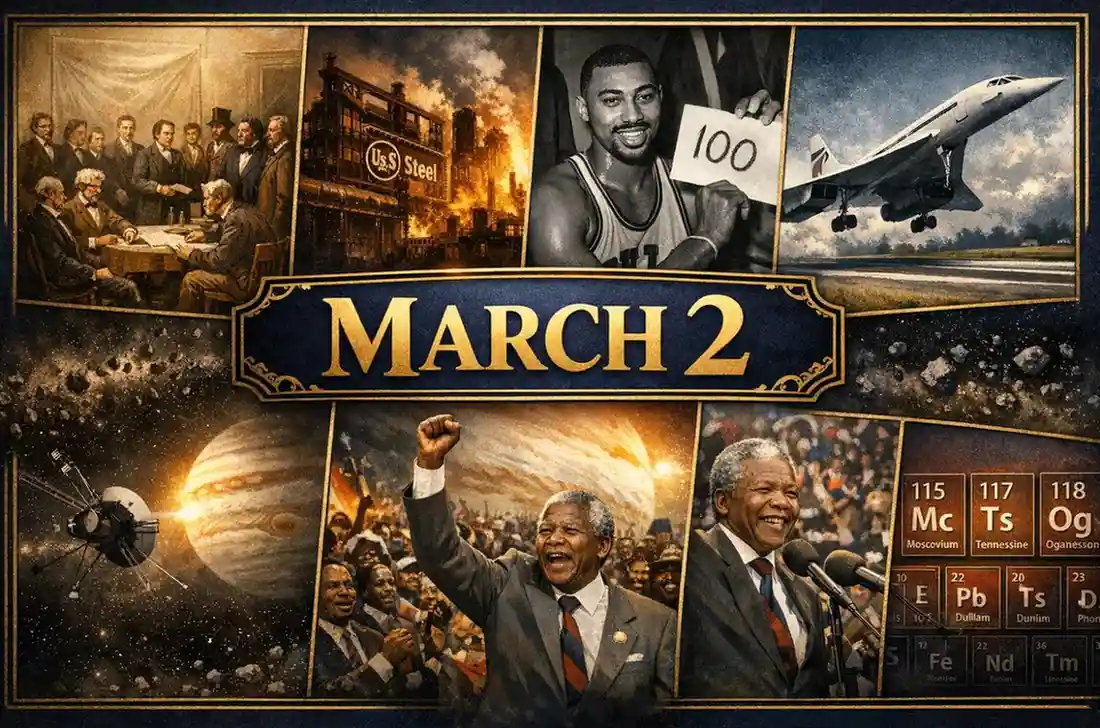
As the frost of winter begins to yield, the chronicle of what happened on this day in history March 2 reveals a date defined by the fierce pursuit of independence and the forging of modern industry. It is a day that saw the Republic of Texas declare its freedom and the United States Steel Corporation become the world’s first billion-dollar entity. From the supersonic roar of the Concorde’s first flight to the quiet introduction of the compact disc, today reminds us that human progress is driven by a restless desire to break boundaries, whether they be political, economic, or technological.
Important Events That Happened On March 2 In History
537 – The Siege of Rome Begins
The Ostrogoth army, commanded by King Vitiges, began a massive siege of Rome in an attempt to reclaim the city from the Byzantine Empire. The legendary general Belisarius led a desperate delaying action outside the Flaminian Gate, where he and his elite personal guard were nearly surrounded and cut off. This engagement marked the start of a grueling year-long struggle that would eventually see the Byzantine forces successfully defend the ancient capital against overwhelming odds.
986 – Accession of Louis V
Louis V became the King of West Francia following the death of his father, King Lothaire, marking a somber milestone in European royal lineage. He would unfortunately go on to be the final monarch of the Carolingian dynasty, a line of rulers that had begun with the great Charlemagne centuries earlier. His short and troubled reign ended with his death just a year later, paving the way for the rise of the Capetian dynasty and the birth of modern France.
1331 – Fall of Nicaea
The strategic city of Nicaea fell to the Ottoman Turks under Orhan I after a prolonged siege that exhausted the Byzantine defenders. The loss of this major ideological and political stronghold was a devastating blow to the Byzantine Empire’s presence in Anatolia. This victory allowed the Ottomans to further consolidate their power in the region, eventually using it as a springboard for their future expansion into Europe and the Mediterranean.
1444 – Formation of the League of Lezhë
The Albanian hero Skanderbeg successfully organized a group of rival nobles to form the League of Lezhë, a military and political alliance aimed at resisting Ottoman expansion. This unification was a rare feat of diplomacy among the fractured Albanian clans and created a centralized defense force that held off the Ottoman Empire for decades. The League is celebrated today as the foundational moment of Albanian national unity and organized resistance against foreign rule.
1458 – Election of George of Poděbrady
George of Poděbrady was chosen as the King of Bohemia by the estates of the realm, becoming the first Hussite monarch in a predominantly Catholic Europe. His election represented a significant challenge to the authority of the Papacy and the Holy Roman Empire during the religious tensions of the 15th century. Despite constant pressure from outside powers, George worked to promote peace and religious tolerance throughout his kingdom during his influential reign.
1476 – Battle of Grandson
During the Burgundian Wars, the disciplined infantry of the Old Swiss Confederacy handed Charles the Bold, Duke of Burgundy, a humiliating and major defeat at the Battle of Grandson. The Swiss forces captured the Duke’s massive camp and his legendary treasury, which contained some of the most valuable jewels and artworks in Europe. The defeat shattered the reputation of the Burgundian army and marked the beginning of the end for Charles the Bold’s imperial ambitions.
1484 – Incorporation of the College of Arms
King Richard III of England signed a Royal Charter formally incorporating the College of Arms, the official authority on heraldry and pedigrees. This institution was tasked with regulating the use of coats of arms and maintaining the genealogical records of the English nobility and gentry. Today, the College remains an active part of the British sovereign’s household, continuing to grant new armorial bearings and oversee matters of royal ceremonial protocol.
1498 – Vasco da Gama Visits Mozambique
The fleet of Portuguese explorer Vasco da Gama reached the Island of Mozambique during his historic first voyage to find a sea route to India. This landing brought the Portuguese into contact with the established Arab and Swahili trade networks that dominated the East African coastline. The encounter was initially peaceful but soon turned tense, marking the beginning of centuries of Portuguese colonial presence and maritime dominance in the Indian Ocean.
1657 – The Great Fire of Meireki
One of the most catastrophic urban fires in history, the Great Fire of Meireki, broke out in Edo, the city known today as Tokyo. The conflagration was fueled by strong winds and traditional wooden architecture, claiming more than 100,000 lives and destroying nearly 70% of the city. The disaster led to a massive reconstruction effort that fundamentally changed Edo’s layout, introducing wider streets and firebreaks to prevent such a tragedy from recurring.
1776 – Battle of the Rice Boats
During the American Revolutionary War, Patriot militia units in Georgia engaged a small fleet of the Royal Navy in a struggle known as the Battle of the Rice Boats. The American forces attempted to prevent the British from capturing vital supply ships anchored in the Savannah River by setting several vessels on fire to create a blockade. While the British managed to seize some rice, the skirmish effectively pushed royal authority out of Georgia for several years.
1791 – First Semaphore Line Demonstration
Claude Chappe conducted the first successful demonstration of his semaphore telegraph system near Paris, using a series of mechanical towers to transmit a message. This visual communication network allowed for the rapid relay of information across long distances much faster than a messenger on horseback could travel. Chappe’s invention was the first practical telecommunications system of the modern age, revolutionizing military and administrative coordination across the French Republic.
1797 – First One-Pound and Two-Pound Notes
Faced with a severe gold shortage during the Napoleonic Wars, the Bank of England issued the first one-pound and two-pound banknotes to the public. Known as the “Restriction Period,” this move allowed the bank to preserve its precious metal reserves while still facilitating commerce and government spending. The introduction of these low-denomination paper notes was initially met with skepticism but eventually paved the way for the modern fiat currency systems used today.
1807 – Act Prohibiting Importation of Slaves
The U.S. Congress passed a landmark act that officially banned the importation of new enslaved people into the United States, taking effect on January 1 of the following year. While the act did not end the existing domestic slave trade or the institution of slavery itself, it represented a significant legislative victory for the abolitionist movement. The law sought to align the nation with growing international efforts, such as those in Great Britain, to curtail the transatlantic slave trade.
1811 – Battle of San Nicolás
A royalist naval fleet from Montevideo defeated a small flotilla of revolutionary ships in the Battle of San Nicolás on the River Plate. This engagement was a major setback for the Argentine independence movement, as it gave the Spanish loyalists control over the vital river systems leading to the interior. The defeat forced the revolutionaries to rethink their naval strategy and focus more heavily on land-based campaigns to achieve their eventual liberation.
1815 – The Kandyan Convention
British colonial invaders and the leaders of the Kingdom of Kandy signed the Kandyan Convention, a treaty that ended the sovereignty of the last independent kingdom in Sri Lanka. The agreement deposed the reigning King Sri Vikrama Rajasinha and transferred control of the Kandyan provinces to the British Crown. This moment completed the British conquest of the entire island, leading to over a century of colonial rule that profoundly altered the region’s social and political structure.
1836 – Texas Declaration of Independence
In a historic convention at Washington-on-the-Brazos, delegates from across the territory formally adopted the Texas Declaration of Independence from Mexico. The document cited the failure of the Mexican government to protect the rights of its citizens and its transition toward an absolute military dictatorship. This bold act officially birthed the Republic of Texas, setting the stage for the decisive military conflicts that would ultimately secure the new nation’s borders.
1855 – Alexander II Becomes Tsar
Following the death of his father, Nicholas I, Alexander II ascended the throne as the Emperor of Russia during the height of the Crimean War. Known as “Alexander the Liberator,” his reign was characterized by sweeping reforms, most notably the emancipation of the serfs in 1861. His accession marked a shift toward modernization and social change in Russia, though he would ultimately struggle to balance the demands of radicals and conservative elites.
1859 – The Great Slave Auction Begins
The “Great Slave Auction,” widely regarded as the largest single sale of enslaved people in American history, began at a racetrack outside of Savannah, Georgia. Over two days, 436 men, women, and children from the estates of Pierce Mease Butler were sold to cover his massive gambling debts. The heartbreaking event was documented by a journalist from the New York Tribune, providing a chilling and widely read account of the human cost of the institution of slavery.
1865 – The Völkner Incident
During the East Cape War in New Zealand, a missionary named Carl Völkner was captured and executed by members of the Pai Mārire movement in Opotiki. The incident was a response to Völkner’s perceived role as a government spy during the ongoing conflicts between the colonial government and Māori tribes. The execution led to a severe military retaliation by the colonial forces, further inflaming the tensions of the New Zealand Wars.
1867 – First Reconstruction Act
The U.S. Congress passed the first Reconstruction Act over the veto of President Andrew Johnson, marking a radical shift in how the South was to be governed following the Civil War. The law divided the former Confederate states into five military districts and mandated that they ratify the 14th Amendment and grant voting rights to Black men. This legislation was a key driver of the “Radical Reconstruction” era, which aimed to secure civil rights for formerly enslaved people.
1877 – Hayes Declared Presidential Winner
Just two days before the scheduled inauguration, the U.S. Congress officially declared Rutherford B. Hayes the winner of the disputed 1876 presidential election. This decision followed the “Compromise of 1877,” which awarded Hayes the contested electoral votes in exchange for the withdrawal of federal troops from the South. The outcome ended the Reconstruction era, despite his opponent, Samuel J. Tilden, having won the national popular vote.
1882 – Assassination Attempt on Queen Victoria
Queen Victoria narrowly escaped death at Windsor railway station when a man named Roderick Maclean fired a pistol at her carriage. Maclean was quickly subdued by bystanders, including two schoolboys from Eton College who beat him with their umbrellas. The Queen’s composure during the attack and the public’s outrage led to a surge in her popularity, though Maclean was later found not guilty by reason of insanity.
1901 – Foundation of U.S. Steel
The United States Steel Corporation was officially founded through a massive merger between the Carnegie Steel Company and the Federal Steel Company. Orchestrated by financier J.P. Morgan, the new entity became the first corporation in world history to have a market capitalization exceeding $1 billion. This consolidation of industrial power fundamentally changed the American economy, establishing a dominant monopoly that fueled the nation’s infrastructure and construction booms.
1901 – The Platt Amendment
The U.S. Congress passed the Platt Amendment as an addition to an army appropriations bill, setting the terms for the withdrawal of American troops from Cuba. The amendment severely limited Cuba’s autonomy by giving the United States the right to intervene in Cuban affairs and mandating the lease of naval bases, such as Guantanamo Bay. This policy established a long-term pattern of American political and military influence over the newly independent island nation.
1903 – Opening of the Martha Washington Hotel
The Martha Washington Hotel opened its doors in New York City as the first hotel in the United States designed exclusively for women. During an era when it was socially difficult for unaccompanied women to stay in public hotels, the Martha Washington provided a safe and professional environment. It became a popular residence for female artists, professionals, and travelers, reflecting the growing independence and social mobility of women in the early 20th century.
1917 – Jones–Shafroth Act
President Woodrow Wilson signed the Jones–Shafroth Act into law, which granted United States citizenship to the inhabitants of Puerto Rico. The act also reorganized the local government, creating a bill of rights and a bicameral legislature, though the U.S. maintained significant control over the island’s executive branch. This change in status was particularly significant as the U.S. prepared to enter World War I, making Puerto Ricans eligible for the military draft.
1919 – First Communist International
The first congress of the Communist International, also known as the Comintern, convened in Moscow under the leadership of Vladimir Lenin. The organization aimed to coordinate the efforts of communist parties worldwide and promote international proletarian revolution. This meeting marked the formal beginning of a global network that would influence political movements and spark Cold War tensions across every continent for decades to come.
1932 – End of the Mäntsälä Rebellion
Finnish President P. E. Svinhufvud delivered a powerful radio speech that effectively signaled the end of the Mäntsälä Rebellion. He appealed to the rebelling members of the far-right Lapua Movement to return to their homes, promising that only the leaders would face legal consequences. His calm and authoritative address successfully de-escalated the crisis, preserving Finland’s democratic institutions against the threat of a fascist coup.
1933 – King Kong Premieres
The groundbreaking monster film King Kong premiered at Radio City Music Hall and the RKO Roxy in New York City, captivating audiences with its revolutionary special effects. Using pioneering stop-motion animation by Willis O’Brien, the film brought the giant ape to life in a way that had never been seen on screen before. The movie became an immediate cultural phenomenon and remains one of the most iconic and influential films in the history of cinema.
1937 – Unionization of U.S. Steel
In a historic victory for American labor, the Steel Workers Organizing Committee signed a collective bargaining agreement with the massive United States Steel Corporation. The deal, known as the “Taylor-Lewis Agreement,” granted workers a wage increase and a 40-hour workweek, while formally recognizing the union. This breakthrough led to the rapid unionization of the entire steel industry and significantly empowered the organized labor movement during the Great Depression.
1939 – Election of Pope Pius XII
Cardinal Eugenio Pacelli was elected as the leader of the Catholic Church, taking the name Pope Pius XII on his 63rd birthday. His papacy began on the eve of World War II, a period that would see him navigate the extreme challenges of the Holocaust and the destruction of Europe. His legacy remains a subject of intense historical discussion, particularly regarding his diplomatic efforts and public silence concerning the Nazi regime’s atrocities.
1941 – German Units Enter Bulgaria
The first German military units crossed the border into Bulgaria after the nation officially joined the Axis Pact during World War II. This move allowed the Wehrmacht to use Bulgarian territory as a staging ground for their upcoming invasions of Greece and Yugoslavia. While Bulgaria avoided declaring war on the Soviet Union, its alignment with Nazi Germany brought the country into the center of the devastating conflict in the Balkans.
1943 – Battle of the Bismarck Sea
During the Battle of the Bismarck Sea, Allied aircraft launched a devastating series of attacks on a Japanese naval convoy attempting to transport troops to New Guinea. Using a new tactic called “skip-bombing,” the Allied pilots sank most of the transport ships and several escorting destroyers. The battle was a major victory that crippled Japanese efforts to reinforce their positions in the southwest Pacific and demonstrated the growing power of Allied air superiority.
1949 – First Non-Stop Flight Around the World
Captain James Gallagher and his crew landed their B-50 Superfortress, Lucky Lady II, in Fort Worth, Texas, completing the first non-stop flight around the globe. The journey took 94 hours and one minute and was made possible by four mid-air refuelings conducted over the Atlantic, the Pacific, and the Indian Oceans. This achievement demonstrated the incredible reach of American strategic air power and revolutionized the possibilities of long-distance aviation.
1955 – Abdication of King Norodom Sihanouk
King Norodom Sihanouk of Cambodia surprised his nation by abdicating the throne in favor of his father, Norodom Suramarit. Sihanouk stepped down so that he could directly participate in the country’s politics as a private citizen, eventually forming his own political party. This unconventional move allowed him to maintain significant influence over Cambodian affairs for decades, alternating between roles as king, prime minister, and head of state.
1962 – Ne Win Seizes Power in Burma
General Ne Win led the Burmese army in a successful coup d’état, overthrowing the democratically elected government of Prime Minister U Nu. The coup marked the beginning of decades of direct military rule in Burma, during which the country was isolated from the international community and its economy was nationalized. Ne Win’s “Burmese Way to Socialism” led to long-term stagnation and the suppression of political dissent across the nation.
1962 – Wilt Chamberlain Scores 100 Points
In a performance that remains the pinnacle of professional basketball, Wilt Chamberlain of the Philadelphia Warriors scored exactly 100 points in a single game against the New York Knicks. Playing in Hershey, Pennsylvania, Chamberlain shattered the existing record by making 36 field goals and 28 free throws. His incredible feat is considered one of the greatest individual achievements in sports history, a record that many believe will never be broken.
1965 – Operation Rolling Thunder Begins
The United States and the Republic of Vietnam Air Force launched Operation Rolling Thunder, a massive and sustained aerial bombardment campaign against North Vietnam. The operation was intended to destroy North Vietnamese infrastructure and pressure the government in Hanoi to stop its support for the insurgency in the south. The campaign lasted for over three years, representing a major escalation of American involvement in the Vietnam War.
1968 – Baggeridge Colliery Closes
The Baggeridge Colliery in the West Midlands officially ceased operations, marking the symbolic end of over 300 years of coal mining in the region known as the Black Country. The closure followed the national trend of declining coal production in the United Kingdom as the energy sector shifted toward oil, gas, and nuclear power. The site has since been transformed into a popular country park, serving as a reminder of the area’s rich industrial heritage.
1969 – First Flight of the Concorde
The Anglo-French supersonic airliner, the Concorde, conducted its first successful test flight from the airport in Toulouse, France. Piloted by André Turcat, the aircraft stayed aloft for 27 minutes, reaching a maximum altitude of 10,000 feet and a speed of 250 knots. This flight was a monumental achievement in aerospace engineering, signaling the beginning of a new era where passengers could travel at twice the speed of sound across the Atlantic.
1970 – Rhodesia Declares Itself a Republic
The white-minority government of Rhodesia officially declared the country a republic, severing its final constitutional links with the British Crown. This move followed the unilateral declaration of independence in 1965, which had been ruled illegal by the United Kingdom and condemned by the international community. The declaration intensified the internal conflict known as the Bush War as Black nationalist groups fought to end minority rule and establish Zimbabwe.
1972 – Launch of Pioneer 10
The Pioneer 10 space probe was successfully launched from Cape Canaveral on a mission to explore the outer reaches of the solar system. It was the first spacecraft to travel through the asteroid belt and provided the first close-up images of the planet Jupiter and its moons. Pioneer 10 also carried a famous golden plaque designed to communicate the origin and nature of humanity to any extraterrestrial civilizations that might encounter it.
1977 – Libya Becomes the Jamahiriya
The General People’s Congress of Libya adopted the “Declaration on the Establishment of the Authority of the People,” officially transforming the country into a Socialist People’s Libyan Arab Jamahiriya. This new system, envisioned by Muammar Gaddafi, claimed to eliminate traditional government in favor of direct rule by the masses through local committees. In reality, it consolidated Gaddafi’s absolute power under a unique and often unpredictable revolutionary ideology.
1978 – Vladimír Remek Goes into Space
Czech cosmonaut Vladimír Remek was launched into space aboard the Soyuz 28 mission, becoming the first person who was not a citizen of the Soviet Union or the United States to orbit the Earth. His flight was part of the Interkosmos program, which allowed Soviet allies to participate in space exploration. Remek’s journey was a major source of pride for Czechoslovakia and demonstrated the broadening of human presence in the final frontier.
1978 – Charlie Chaplin’s Coffin Stolen
In a bizarre and macabre crime, the coffin containing the body of legendary actor Charlie Chaplin was stolen from its grave in a cemetery in Corsier-sur-Vevey, Switzerland. The thieves, who were later identified as two mechanics from Eastern Europe, demanded a massive ransom from Chaplin’s widow for the return of the remains. After a ten-week investigation, the police recovered the coffin in a nearby field and returned it to a more secure grave.
1983 – Release of Compact Discs in the U.S.
Compact discs (CDs) and their corresponding players were officially released for the first time in the United States and several other major international markets. Previously available only in Japan, the CD promised a revolution in audio quality, offering digital sound with no background hiss or wear from play. The technology quickly gained popularity, eventually replacing vinyl records and cassette tapes as the primary format for music consumption for nearly two decades.
1986 – Aeroflot Flight F-77 Crash
An Aeroflot passenger aircraft crashed during its approach to Bugulma Airport in the Soviet Union, resulting in the deaths of all 38 people on board. The investigation determined that the crash was caused by a combination of severe weather conditions and pilot error during a period of poor visibility. The disaster was one of several accidents that prompted a review of safety protocols and navigational equipment within the Soviet civil aviation industry.
1989 – Ban on CFC Production Agreed
Twelve member nations of the European Community reached a landmark agreement to completely ban the production of all chlorofluorocarbons (CFCs) by the end of the century. The decision followed scientific evidence that these chemicals were responsible for the depletion of the Earth’s protective ozone layer. This agreement was a critical step in the implementation of the Montreal Protocol, representing one of the most successful examples of international environmental cooperation.
1990 – Nelson Mandela Elected ANC Deputy President
Shortly after his release from prison, Nelson Mandela was officially elected as the deputy president of the African National Congress (ANC). This position placed him at the forefront of the negotiations to end the apartheid system and transition South Africa toward a multiracial democracy. His leadership during this period was essential in maintaining peace and unity among the various factions within the anti-apartheid movement.
1991 – Kuwait Democratic Forum Established
The Kuwait Democratic Forum was established as a center-left political organization in Kuwait, advocating for democratic reforms and social justice following the liberation of the country. The group brought together various intellectual and political figures who sought to modernize Kuwait’s political system and increase the role of the parliament. Its formation was part of a broader push for political openness in the aftermath of the Gulf War.
1991 – Battle at Rumaila Oil Field
The 1991 Gulf War came to its final conclusion following the Battle at the Rumaila oil field, where American forces engaged retreating Iraqi armored units. The lopsided engagement resulted in the destruction of hundreds of Iraqi vehicles and the final cessation of hostilities in the theater. The end of the combat operations paved the way for the liberation of Kuwait and the implementation of a permanent ceasefire agreement under United Nations supervision.
1992 – War in Transnistria Begins
Armed conflict broke out in Transnistria, a breakaway region of Moldova, following tensions regarding the region’s desire to remain closely aligned with Russia rather than the newly independent Moldovan state. The fighting involved local paramilitary groups and elements of the Russian 14th Army against the Moldovan police and military. While a ceasefire was eventually reached, the region remains a “frozen conflict” zone with unrecognized sovereignty to this day.
1992 – Former Soviet Republics Join the UN
In a historic expansion of the international community, eight former Soviet republics—Armenia, Azerbaijan, Kazakhstan, Kyrgyzstan, Moldova, Tajikistan, Turkmenistan, and Uzbekistan—along with San Marino, officially joined the United Nations. This mass admission reflected the dramatic geopolitical changes following the dissolution of the Soviet Union. The new member states were recognized as sovereign nations, taking their places in the General Assembly to participate in global diplomacy.
1995 – Discovery of the Top Quark
Researchers at the Fermilab particle accelerator in Illinois officially announced the discovery of the top quark, the final and most elusive of the six fundamental building blocks of matter predicted by the Standard Model of physics. The discovery was the result of decades of research and the analysis of millions of high-energy particle collisions. Finding the top quark was a monumental achievement that confirmed scientists’ understanding of the subatomic world.
1995 – Launch of STS-67
The Space Shuttle Endeavour was launched from the Kennedy Space Center on mission STS-67, carrying the ASTRO-2 spacelab observatory. During the 16-day mission—the longest shuttle flight to date—the crew used three ultraviolet telescopes to study the chemical composition of stars, galaxies, and planetary nebulae. The mission provided astronomers with a wealth of new data that was impossible to obtain from beneath the Earth’s atmosphere.
1998 – Evidence of Water on Europa
Data transmitted from the Galileo spacecraft provided strong evidence that Jupiter’s moon Europa possesses a liquid water ocean beneath its thick, icy crust. Scientists observed unusual magnetic field readings and surface fracture patterns that suggested the presence of a vast, salty interior ocean kept warm by tidal forces. This discovery immediately made Europa one of the most promising locations in the solar system for the search for extraterrestrial life.
2002 – Operation Anaconda Begins
U.S. and coalition forces launched Operation Anaconda in the Shahi-Kot Valley of eastern Afghanistan, targeting a large concentration of Taliban and Al-Qaeda fighters. The operation was one of the first major conventional battles of the war and involved intense mountain warfare and air support. By the time it ended weeks later, hundreds of insurgents had been killed, representing a significant tactical victory in the early stages of the conflict.
2004 – Ashoura Massacre in Iraq
In a coordinated series of suicide bombings and mortar attacks, Al-Qaeda militants targeted Shia pilgrims celebrating the holiday of Ashura in Karbala and Baghdad. The attacks killed over 170 people and wounded more than 500, marking one of the deadliest days of violence since the beginning of the Iraq War. The massacre was designed to spark sectarian conflict and remains one of the most tragic examples of civilian targeting by extremist groups.
2006 – The Cumbres Case
A double murder in Monterrey, Mexico, involving the death of two children and the attempted murder of a young woman named Erika, shocked the nation in what became known as the “Cumbres case.” The perpetrator, Diego Santoy Riveroll, was the ex-boyfriend of Erika and was captured days later after a nationwide manhunt. The case became a sensation in the Mexican media, leading to intense public debate regarding domestic violence and the criminal justice system.
2012 – Southern U.S. Tornado Outbreak
A massive and deadly tornado outbreak swept across a large section of the Southern United States and the Ohio Valley, resulting in 40 fatalities and widespread property damage. The storms produced numerous violent tornadoes, some of which stayed on the ground for long distances, obliterating several small towns and communities. The disaster led to a massive emergency response and highlighted the ongoing need for improved early warning systems in the region.
2014 – The Oscar Selfie
During the 86th Academy Awards, host Ellen DeGeneres took a “selfie” with a group of A-list celebrities that became the most retweeted image in history at the time. Featuring stars like Meryl Streep, Brad Pitt, and Jennifer Lawrence, the photo captured a rare moment of candid Hollywood glamour and crashed the Twitter servers for several minutes. The image is now regarded as a cultural milestone in the history of social media and digital communication.
2017 – New Elements Added to the Periodic Table
At a formal conference in Moscow, the IUPAC officially added three new elements—Moscovium, Tennessine, and Oganesson—to the periodic table. These superheavy elements were synthesized in laboratories through the collision of lighter atoms and exist for only fractions of a second. Their addition completed the seventh row of the periodic table, representing a major achievement in experimental nuclear chemistry and physics.
2022 – Capture of Kherson
During the early stages of the Russian invasion of Ukraine, Russian military forces successfully captured the city of Kherson. As the only regional capital to be taken by Russia in the initial phase of the war, its fall was a significant strategic loss for Ukraine and marked the beginning of a months-long military-civilian occupation. The city would later become the focus of a major Ukrainian counteroffensive that eventually liberated the area later that year.
Read Also: This day in history March 1 Republic Radio Revelation
Famous People Born On March 2
| Name | Description | Date |
|---|---|---|
| Bedřich Smetana | Bohemian composer | March 2, 1824 – May 12, 1884 |
| Marcel Hirscher | Austrian alpine skier | March 2, 1989 – Present |
| Adrian VI | Pope of the Catholic Church | March 2, 1459 – September 14, 1523 |
| DeWitt Clinton | American politician | March 2, 1769 – February 11, 1828 |
| Carl Schurz | German-American politician | March 2, 1829 – May 14, 1906 |
| Camille Desmoulins | French revolutionary journalist | March 2, 1760 – April 5, 1794 |
| Ken Salazar | American lawyer and politician | March 2, 1955 – Present |
| William Murray, 1st Earl of Mansfield | British jurist | March 2, 1705 – March 20, 1793 |
| Joel R. Poinsett | American statesman and diplomat | March 2, 1779 – December 12, 1851 |
| Martin Ritt | American film director | March 2, 1914 – December 8, 1990 |
| Mel Ott | American baseball player | March 2, 1909 – November 21, 1958 |
| Henry Dreyfuss | American industrial designer | March 2, 1904 – October 5, 1972 |
| Daniel Craig | English actor | March 2, 1968 – Present |
Famous People Died On March 2
| Name | Description | Date |
|---|---|---|
| Emily Carr | Canadian painter and author | December 13, 1871 – March 2, 1945 |
| Wayne Shorter | American jazz musician | August 25, 1933 – March 2, 2023 |
| Horace Walpole | English writer | September 24, 1717 – March 2, 1797 |
| Charlie Christian | American jazz guitarist | July 29, 1916 – March 2, 1942 |
| Władysław I | King of Poland | 1260/1261 – March 2, 1333 |
| Lothar | King of France | 941 – March 2, 986 |
| Dusty Springfield | British singer | April 16, 1939 – March 2, 1999 |
| Philip K. Dick | American science-fiction writer | December 16, 1928 – March 2, 1982 |
Observances & Institutional Dates
- Texas Independence Day: Commemorating the 1836 signing of the declaration from Mexico.
- Adwa Victory Day (Ethiopia): Celebrating the 1896 defeat of the Italian army, a symbol of African sovereignty.
- Baloch Culture Day: A celebration of the rich history, language, and traditions of the Baloch people in Pakistan and beyond.
- National Read Across America Day (USA): An initiative to encourage reading among children, often coinciding with the birthday of Dr. Seuss.
- Peasants’ Day (Myanmar): A day dedicated to honoring the role of farmers and agricultural workers in the nation’s history.
Frequently Asked Questions
- What was the first billion-dollar company?
- The United States Steel Corporation became the world’s first billion-dollar company when it was founded on March 2, 1901.
- Why is March 2 important in Texas history?
- It marks the adoption of the Texas Declaration of Independence from Mexico in 1836 at Washington-on-the-Brazos.
- Who scored 100 points in an NBA game?
- Wilt Chamberlain set this legendary record on March 2, 1962, while playing for the Philadelphia Warriors.
- What was the “Great Slave Auction”?
- It was a massive sale of 436 enslaved people in Georgia in 1859, the largest such event in American history.