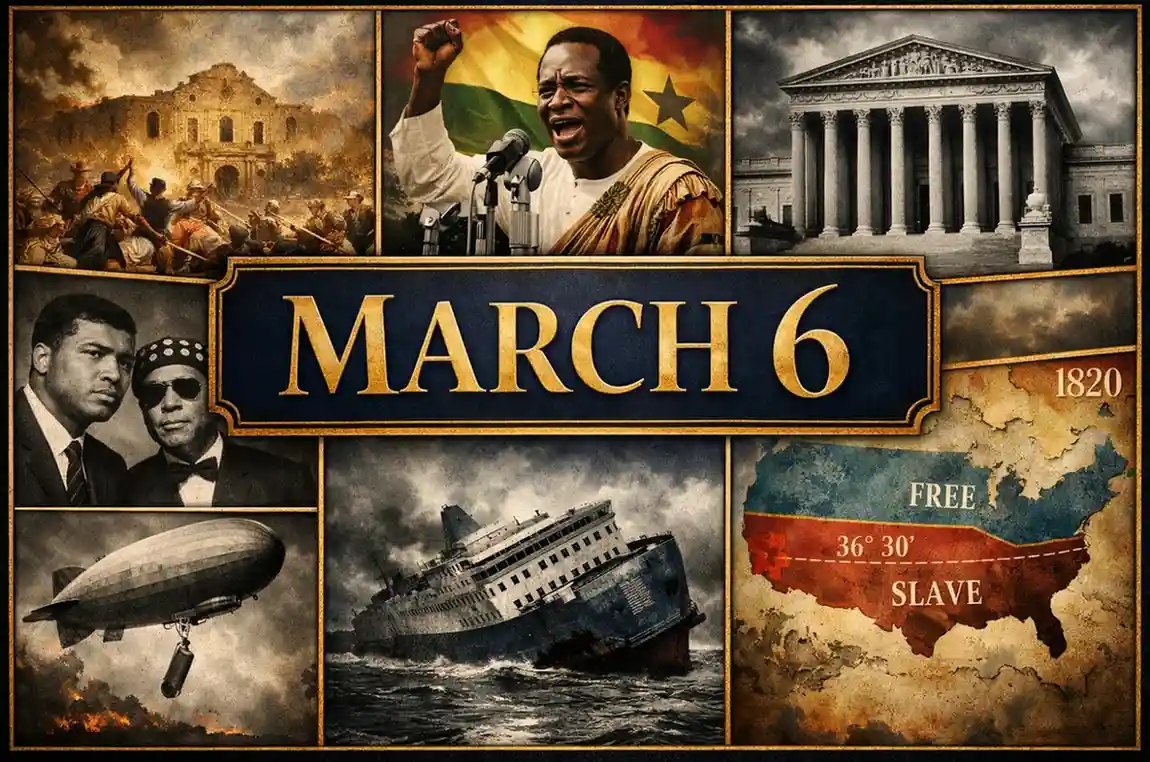
As we look at the timeline of what happened on this day in history March 6, we find a day deeply defined by the shifting boundaries of power and the heavy price of liberty. It is a date that bookends the American experience of the 19th century—from the legislative maneuvering of the Missouri Compromise to the tragic finality of the Battle of the Alamo and the landmark injustice of the Dred Scott decision. Across the globe, the day echoes with the birth of a new nation in Ghana and the high-stakes trials of the Cold War, reminding us that the structures of our modern world are often built upon the echoes of historic defiance and difficult resolutions.
Important Events That Happened On March 6 In History
12 BCE – Augustus Named Pontifex Maximus
The Roman Emperor Augustus was officially named Pontifex Maximus, the high priest of the College of Pontiffs. This was a critical step in the consolidation of his power, as it incorporated the highest religious office in Rome into the role of the Emperor. By holding this title, Augustus became the ultimate authority on both secular and spiritual matters, a precedent followed by nearly every subsequent Roman Emperor and a key element in the cult of the imperial office.
845 – The 42 Martyrs of Amorium
Following the fall of the Byzantine city of Amorium to the Abbasid Caliphate, 42 high-ranking Byzantine officials were taken as prisoners to Samarra. After seven years of captivity and repeated refusals to convert to Islam, they were executed on this day. They are venerated in the Eastern Orthodox Church as the 42 Martyrs of Amorium, symbolizing the intense religious and military friction between the Byzantine Empire and the Caliphate during the 9th century.
1204 – Fall of Château Gaillard
The Siege of Château Gaillard ended in a decisive French victory as King Philip II Augustus captured the “impregnable” fortress built by Richard the Lionheart. The fall of this strategic castle allowed Philip to sweep through the rest of the region, leading to King John of England losing total control of Normandy. This event effectively ended the “Angevin Empire” in France and shifted the balance of power toward the French monarchy for generations.
1323 – Treaty of Paris Signed
The Treaty of Paris of 1323 was signed, aiming to resolve the long-standing territorial disputes between the Count of Flanders and the Count of Holland. The agreement saw the Count of Flanders renounce his claims over the islands of Zeeland, recognizing them as part of the County of Holland. While it brought a temporary peace to the Low Countries, the treaty illustrated the complex, shifting feudal loyalties that characterized medieval European politics.
1447 – Election of Pope Nicholas V
Following the death of Pope Eugene IV, Tommaso Parentucelli was elected as Pope Nicholas V. His papacy was marked by a great commitment to the Renaissance; he was a profound patron of the arts and letters, famously founding the Vatican Library. Nicholas V worked to restore the city of Rome as a center of culture and sought to heal the divisions within the Western Church following the Great Schism.
1651 – Founding of Kajaani
The town of Kajaani, then known as Cajanaburg, was officially founded by Count Per Brahe, the Governor-General of Finland. Established as a strategic trading post near the Kajaani Castle, the town was intended to strengthen Swedish influence in the northern regions. Count Brahe’s administration is remembered for promoting education and urban development, helping to integrate the remote Finnish interior into the broader Swedish Empire.
1788 – First Settlement of Norfolk Island
The First Fleet, under the command of Lieutenant Philip Gidley King, arrived at Norfolk Island to establish a secondary convict settlement for the new British colony in Australia. The island was chosen for its fertile soil and the potential for its flax and pines to provide resources for the British Navy. This date is still celebrated as “Foundation Day” on the island, marking the beginning of its unique and often isolated history.
1820 – Missouri Compromise Signed
President James Monroe signed the Missouri Compromise into law, a landmark piece of legislation intended to balance the power between slave and free states. The compromise allowed Missouri to enter the Union as a slave state while admitting Maine as a free state. Crucially, it prohibited slavery in the remainder of the Louisiana Purchase territory north of the $36^{\circ} 30’$ parallel, a temporary fix that delayed but did not resolve the growing national tension over the institution of slavery.
1836 – Battle of the Alamo
After a thirteen-day siege, Mexican forces under General Antonio López de Santa Anna launched a final assault on the Alamo mission in San Antonio. All 187 Texan defenders, including legendary figures like Davy Crockett and Jim Bowie, were killed in the brutal hand-to-hand combat. The fall of the Alamo became a powerful rallying cry—”Remember the Alamo!”—for the Texas Revolution, leading to the eventual defeat of Santa Anna at San Jacinto.
1857 – Dred Scott v. Sandford Decision
In one of the most controversial rulings in its history, the U.S. Supreme Court ruled 7–2 that Black people, whether enslaved or free, could not be citizens of the United States. Chief Justice Roger Taney further declared that Congress had no authority to prohibit slavery in federal territories, effectively striking down the Missouri Compromise. The decision outraged abolitionists and is widely cited as a major catalyst for the American Civil War.
1901 – Assassination Attempt on Wilhelm II
An anarchist named Dietrich Weiland attempted to assassinate German Emperor Wilhelm II in Bremen. The attacker threw a heavy iron object at the Emperor’s carriage, striking Wilhelm in the face and causing a significant wound below his eye. Although the Emperor survived the attack, the incident fueled his paranoia regarding revolutionary movements and led to a crackdown on political dissidents within the German Empire.
1904 – Discovery of Coats Land
During the Scottish National Antarctic Expedition, William Speirs Bruce and his crew aboard the Scotia discovered a previously unknown stretch of the Antarctic coast, which Bruce named Coats Land. The discovery was part of a broader scientific mission to map the Weddell Sea and conduct meteorological observations. Coats Land provided vital geographic data that helped fill in the “blank spots” of the Antarctic continent during the Heroic Age of Antarctic Exploration.
1912 – Airships Drop Bombs in Libya
In an early example of aerial warfare during the Italo-Turkish War, two Italian dirigibles dropped bombs on Turkish troops encamped at Janzur. Operating from an altitude of 1,800 meters, the airships provided a new dimension to military strikes, allowing for attacks on ground positions that were difficult to reach by land. This mission followed the world’s first aerial reconnaissance flights, marking Italy as a pioneer in the military application of aviation.
1930 – International Unemployment Day
The Comintern (Communist International) initiated a series of global demonstrations known as International Unemployment Day to protest the devastating effects of the Great Depression. Thousands of workers marched in cities across the United States, Europe, and Asia, demanding unemployment insurance and government relief. In several cities, including New York and Berlin, the protests led to violent clashes between marchers and police, highlighting the era’s intense social and economic unrest.
1943 – Battle of Medenine
Generalfeldmarschall Erwin Rommel launched his final offensive in Africa, known as the Battle of Medenine, in an attempt to disrupt the British Eighth Army’s advance into Tunisia. However, the British had intercepted German communications via Ultra, allowing them to prepare a devastating anti-tank defense. The attack failed miserably, and a frustrated Rommel left the African continent just three days later, signaling the beginning of the end for the Axis presence in North Africa.
1943 – Battle of Fardykambos Ends
The Battle of Fardykambos, a major victory for the Greek Resistance (ELAS), concluded with the surrender of an entire Italian battalion. This success forced the Axis forces to abandon the town of Grevena, which was fully liberated shortly after. The battle demonstrated the growing strength and coordination of the Greek partisans and was a significant blow to Italian morale in the occupied Balkan territories.
1944 – Bombing of Narva
Soviet Air Forces conducted a devastating bombing raid on the town of Narva in German-occupied Estonia. Though the town had been largely evacuated, the firestorm created by the bombing destroyed almost the entire historical center, including unique architecture from the Swedish era. The destruction of Narva is remembered as a cultural tragedy for Estonia, as one of the most beautiful Baroque towns in Northern Europe was reduced to rubble.
1945 – Capture of Cologne
American troops of the 1st Army officially captured the city of Cologne, Germany, after days of heavy urban fighting. The fall of this major industrial and cultural hub on the Rhine River was a significant psychological blow to the Nazi regime. On the same day, the German military launched Operation Spring Awakening in Hungary—their final major offensive of the war—which ultimately failed to stop the Soviet advance toward Austria.
1946 – Ho Chi Minh’s Agreement with France
Ho Chi Minh signed a preliminary agreement with French representative Jean Sainteny, in which France recognized Vietnam as an “autonomous state” within the Indochinese Federation. The deal was intended to prevent a full-scale war and allowed French troops to replace Chinese forces in the north. However, the agreement was short-lived, as mutual distrust and differing interpretations of “autonomy” led to the outbreak of the First Indochina War later that year.
1951 – Trial of the Rosenbergs Begins
The espionage trial of Ethel and Julius Rosenberg began in New York City, with the couple accused of passing atomic secrets to the Soviet Union. The trial took place at the height of the Second Red Scare and became a global sensation. While the Rosenbergs maintained their innocence, they were convicted based largely on the testimony of Ethel’s brother, David Greenglass, leading to their controversial execution in 1953.
1953 – Malenkov Succeeds Stalin
Following the death of Joseph Stalin, Georgy Malenkov was named the Premier of the Soviet Union and the First Secretary of the Communist Party. Malenkov was part of a “collective leadership” that emerged in the immediate power vacuum. However, his tenure at the top of the party would be brief, as he was quickly outmaneuvered by Nikita Khrushchev, who took over the role of First Secretary just months later.
1957 – Independence of Ghana
Ghana, formerly the British colony of the Gold Coast, officially became the first sub-Saharan African nation to gain independence from colonial rule. Led by Kwame Nkrumah, the new nation became a symbol of hope and a catalyst for decolonization movements across the continent. Nkrumah’s vision of Pan-Africanism and socialist development sought to transform Ghana into a modern, industrial state, though the path ahead would prove challenging.
1964 – Cassius Clay Becomes Muhammad Ali
One day after winning the heavyweight boxing title, Cassius Clay was officially given the name Muhammad Ali by Elijah Muhammad, the leader of the Nation of Islam. Ali had recently converted to the faith, and his name change reflected his rejection of what he called his “slave name” and his commitment to Black pride and religious identity. The move was highly controversial at the time but solidified Ali’s role as a transformative social and political figure.
1964 – Constantine II Becomes King of Greece
Following the death of his father, King Paul, the 23-year-old Constantine II ascended to the Greek throne. His reign was immediately plagued by political instability and tension with the government of Georgios Papandreou. Constantine would eventually become the last King of Greece, as he was forced into exile following a military coup in 1967 and the monarchy was officially abolished by referendum in 1973.
1965 – Tom Playford Loses Power
Sir Tom Playford, the Premier of South Australia, lost power after an unprecedented 27 years in office. His long tenure, known as “Playfordism,” was characterized by state-led industrialization and social conservatism. His defeat by the Labor Party under Frank Walsh marked the end of the longest continuous term for a democratically elected government leader in the British Commonwealth at that time.
1967 – Defection of Svetlana Alliluyeva
In a major Cold War propaganda blow to the Soviet Union, Svetlana Alliluyeva, the only daughter of Joseph Stalin, defected to the United States. She walked into the U.S. Embassy in New Delhi and requested asylum, later moving to America where she wrote her memoirs. Her defection and public criticism of her father’s regime provided a unique and personal perspective on the inner workings of the Soviet leadership.
1968 – Executions in Rhodesia
The white-minority government of Rhodesia executed three Black rebels, marking the first judicial executions since the country’s Unilateral Declaration of Independence (UDI) from Britain in 1965. The move defied a royal reprieve from Queen Elizabeth II and was met with intense international condemnation and a tightening of economic sanctions. The executions underscored the deepening racial conflict that would eventually lead to the Rhodesian Bush War.
1970 – Weather Underground Safe House Explosion
A massive explosion occurred at a townhouse in Greenwich Village, New York, which was being used as a safe house by the radical militant group Weather Underground. Three members were killed when a bomb they were constructing—intended for a dance at a nearby army base—accidentally detonated. The incident forced the remaining members of the group to go deeper into hiding and significantly increased the FBI’s efforts to dismantle domestic extremist organizations.
1975 – Zapruder Film Shown on National TV
For the first time since the 1963 assassination of John F. Kennedy, the famous Zapruder film was shown in motion to a national television audience on the ABC show Good Night America. Hosted by Robert J. Groden and Dick Gregory, the broadcast shocked the public and reignited intense debate over the “single bullet theory.” The resulting public outcry led directly to the formation of the House Select Committee on Assassinations to re-examine the case.
1975 – Algiers Accord
During an OPEC summit in Algiers, the Shah of Iran and Saddam Hussein of Iraq announced a settlement of their long-standing border dispute over the Shatt al-Arab waterway. In exchange for territorial concessions, Iran agreed to stop providing military support to Kurdish rebels in northern Iraq. While the accord brought a temporary peace, its eventual collapse in 1980 would serve as the primary pretext for the devastating eight-year Iran-Iraq War.
1984 – Start of the UK Miners’ Strike
A walkout at the Cortonwood Colliery in Yorkshire signaled the beginning of a massive, year-long strike by the National Union of Mineworkers (NUM) against planned pit closures. Led by Arthur Scargill, the strike became a defining battle between the labor movement and the Conservative government of Margaret Thatcher. The conflict was characterized by violent picket line clashes and deep social division, ultimately ending in a defeat for the union and the permanent decline of the British coal industry.
1987 – Sinking of the Herald of Free Enterprise
The British roll-on/roll-off ferry MS Herald of Free Enterprise capsized just minutes after leaving the port of Zeebrugge, Belgium, killing 193 people. The disaster occurred because the bow doors had been left open, allowing water to flood the car deck and causing the ship to lose stability. It was the deadliest peacetime maritime disaster involving a British ship since 1919 and led to major improvements in ferry safety regulations and operational procedures.
1988 – Operation Flavius
In a controversial anti-terrorist operation in Gibraltar, three members of the Provisional Irish Republican Army (IRA) were shot dead by the British Special Air Service (SAS). The British government claimed the trio was planning a car bomb attack, though no explosives were found on the scene. The “shoot-to-kill” allegations led to a landmark case in the European Court of Human Rights and sparked a cycle of retaliatory violence in Northern Ireland.
1992 – Michelangelo Virus Outbreak
The Michelangelo computer virus, a logic bomb designed to overwrite the master boot record of infected PCs, began to activate on the anniversary of the artist’s birth. While initial media reports predicted a global “digital apocalypse,” the actual damage was relatively limited due to widespread public awareness and the use of antivirus software. However, the event was a major turning point in public perception of computer security and the potential threat of malware.
2003 – Air Algérie Flight 6289 Crash
An Air Algérie Boeing 737 crashed shortly after taking off from Tamanrasset, Algeria, resulting in the deaths of 102 people. The accident was caused by an engine failure followed by the pilot’s decision to take over manual control at a critical altitude, leading to a stall. There was only one survivor—a soldier seated in the back of the aircraft. The crash remains the deadliest aviation accident on Algerian soil and led to a review of pilot training and emergency procedures.
2008 – Baghdad and Jerusalem Attacks
In a day of tragic violence in the Middle East, a suicide bomber killed 68 people in a commercial district of Baghdad, including several first responders who were attending to the initial blast site. On the same day, a Palestinian gunman opened fire at the Mercaz HaRav yeshiva in Jerusalem, killing eight students before being shot dead. The dual tragedies highlighted the ongoing volatility and the devastating human cost of the conflicts in Iraq and the Holy Land.
2018 – Jeff Bezos Named World’s Richest Person
Forbes magazine officially named Amazon founder Jeff Bezos as the richest person in the world for the first time, with an estimated net worth of $112 billion. Bezos unseated Bill Gates, who had held the top spot for 18 of the previous 24 years. The milestone reflected the explosive growth of e-commerce and cloud computing, as well as the increasing concentration of wealth within the global tech industry.
2020 – Kabul Ceremony Shooting
Gunmen opened fire on a crowded political ceremony in Kabul, Afghanistan, killing 32 people and injuring 82 others. The attack targeted a gathering of the Hazara minority community, which was attending a memorial service for a slain leader. The Islamic State (ISIS) claimed responsibility for the massacre, which took place during a fragile period of peace negotiations between the United States and the Taliban, underscoring the persistent threat of extremist violence in the region.
Want To Read About Pervious Day Facts? Click Here March 5 Moments
Famous People Born On March 5
| Name | Description | Date |
|---|---|---|
| Louis I | King of Hungary & Poland | 1326 – 1382 |
| Étienne-Jules Marey | French physiologist | 1830 – 1904 |
| Howard Pyle | American author & illustrator | 1853 – 1911 |
| Karl Rahner | German theologian | 1904 – 1984 |
| James Tobin | American economist | 1918 – 2002 |
| Leslie Marmon Silko | American author | 1948 – |
| Charles Goodnight | American cattleman | 1836 – 1929 |
| Frank Norris | American novelist | 1870 – 1902 |
| Laurent Schwartz | French mathematician | 1915 – 2002 |
| Charles Fuller | American playwright | 1939 – 2022 |
| Randy Matson | American athlete | 1945 – |
| Ennio Flaiano | Italian author & critic | 1910 – 1972 |
| Sir C. Wyville Thomson | Scottish naturalist | 1830 – 1882 |
| Oh Eun-Sun | South Korean mountaineer | 1966 – |
| John George I of Saxony | Elector of Saxony | 1585 – 1656 |
| Sir John Ross Marshall | Prime Minister of New Zealand | 1912 – 1988 |
| Jan van der Heyden | Dutch painter | 1637 – 1712 |
| Constance Fenimore Woolson | American writer | 1840 – 1894 |
| Isaac Israel Hayes | American explorer | 1832 – 1881 |
| Subroto Mukerjee | Indian Air Force officer | 1911 – 1960 |
| Sutan Sjahrir | Prime Minister of Indonesia | 1909 – 1966 |
| Sir Hugh Charles Clifford | British colonial governor | 1866 – 1941 |
| Frederick IV | Elector Palatine | 1574 – 1610 |
| Michael von Faulhaber | German cardinal | 1869 – 1952 |
| Johann Michael Moscherosch | German satirist | 1601 – 1669 |
| Kurihara Harumi | Japanese chef & TV personality | 1947 – |
| Vasily Kirillovich Trediakovsky | Russian writer & poet | 1703 – 1768 |
| Julian Przyboś | Polish poet | 1901 – 1970 |
| Teodor Parnicki | Polish historical novelist | 1908 – 1988 |
| Édouard Belin | French engineer | 1876 – 1963 |
Famous People Died On March 5
| Name | Description | Date |
|---|---|---|
| Pierre-Simon, marquis de Laplace | French mathematician & scientist | 1749 – 1827 |
| Anna Akhmatova | Russian poet | 1889 – 1966 |
| Bohemond I | Prince of Antioch & Otranto | c.1050 – 1109 |
| Correggio | Italian Renaissance painter | 1489 – 1534 |
| Hippolyte Taine | French critic & historian | 1828 – 1893 |
| William Cameron Menzies | American set designer | 1896 – 1957 |
| Max Jacob | French poet | 1876 – 1944 |
| Flora Macdonald | Scottish Jacobite heroine | 1722 – 1790 |
| Mary Lyon | American educator | 1797 – 1849 |
| Thomas Arne | British composer | 1710 – 1778 |
| Edgar Lee Masters | American poet | 1868 – 1950 |
| Marie de Flavigny, countess d’Agoult | French author | 1805 – 1876 |
| Allan Nevins | American historian | 1890 – 1971 |
| St. Lucius I | Pope | – 254 |
| Luis de Requesens y Zúñiga | Spanish governor | 1528 – 1576 |
| Ernest von Koerber | Austrian prime minister | 1850 – 1919 |
| François de Callières | French diplomat & author | 1645 – 1717 |
| Mary Louise Booth | American journalist | 1831 – 1889 |
| Dan Takuma | Japanese industrialist | 1858 – 1932 |
| Richard Kuklinski | American criminal | 1935 – 2006 |
| Georges Arnaud | French writer & activist | 1917 – 1987 |
| Hugo Chávez | President of Venezuela | 1954 – 2013 |
| Joseph Weizenbaum | American computer scientist | 1923 – 2008 |
| Winifred Wagner | German cultural figure | 1897 – 1980 |
| E.Y. Harburg | American composer & lyricist | 1896 – 1981 |
| John Belushi | American actor & comedian | 1949 – 1982 |
| William Powell | American actor | 1892 – 1984 |
| Clément Ader | French inventor | 1841 – 1926 |
| Claude-Louis Mathieu | French astronomer & mathematician | 1783 – 1875 |
| Alfredo Casella | Italian composer | 1883 – 1947 |
Observances & Institutional Dates
- Independence Day (Ghana): Celebrating the nation’s 1957 liberation from British colonial rule.
- European Day of the Righteous: A day to honor those who risked their lives to protect others from genocide and totalitarianism.
- Norfolk Island Foundation Day: Commemorating the 1788 arrival of the First Fleet on the island.
- Magellan Day (Guam): (Observed locally to mark the 1521 arrival of Ferdinand Magellan).
Frequently Asked Questions
- What was the Missouri Compromise?
- A 1820 law that admitted Missouri as a slave state and Maine as a free state while banning slavery in the north.
- Who won the Battle of the Alamo?
- The Mexican army, led by Santa Anna, defeated the Texan defenders on March 6, 1836.
- Why is Ghana’s independence significant?
- It was the first sub-Saharan African nation to gain independence from a European colonial power (1957).
- What did the Dred Scott decision rule?
- The Supreme Court ruled in 1857 that Black people could not be U.S. citizens and that Congress could not ban slavery in territories.