Introduction
Across centuries, countless turning points have taken place on this date, shaping politics, science, and culture in ways that still resonate. In fact, when we look at Today in History – August 29, we uncover stories of groundbreaking discoveries, dramatic conflicts, and events that left a lasting mark on the world. From the struggles for freedom to milestones in human achievement, this day carries a legacy worth remembering.
Major Events on August 29
70 CE — Fall of Jerusalem
Roman forces captured Jerusalem after a brutal siege, and the Second Temple was destroyed. The loss devastated Jewish religious life and displaced many communities. That catastrophe shaped Jewish memory for centuries and is still marked by the fast of Tisha b’Av. The event also altered Roman rule in Judea and intensified the Jewish diaspora.
1261 — Urban IV Becomes Pope
Urban IV, who had served as Patriarch of Jerusalem, succeeded Alexander IV as pope. His short papacy focused on reinforcing papal authority and attention to the affairs of the Eastern Mediterranean. He attempted to rally support for the Latin states in the Levant and manage political pressures in Europe. His time in office reflects the tangled mix of religion and politics in the 13th century.
1782 — Sinking of HMS Royal George
While at anchor undergoing routine maintenance, the warship Royal George suddenly capsized and sank, taking more than 800 people with her. Many sailors, officers, and visitors were aboard, and the scale of loss shocked Britain. The disaster prompted inquiries and led to changes in naval procedures and safety awareness. It remains one of the worst peacetime losses in Royal Navy history.
1825 — Treaty of Rio de Janeiro
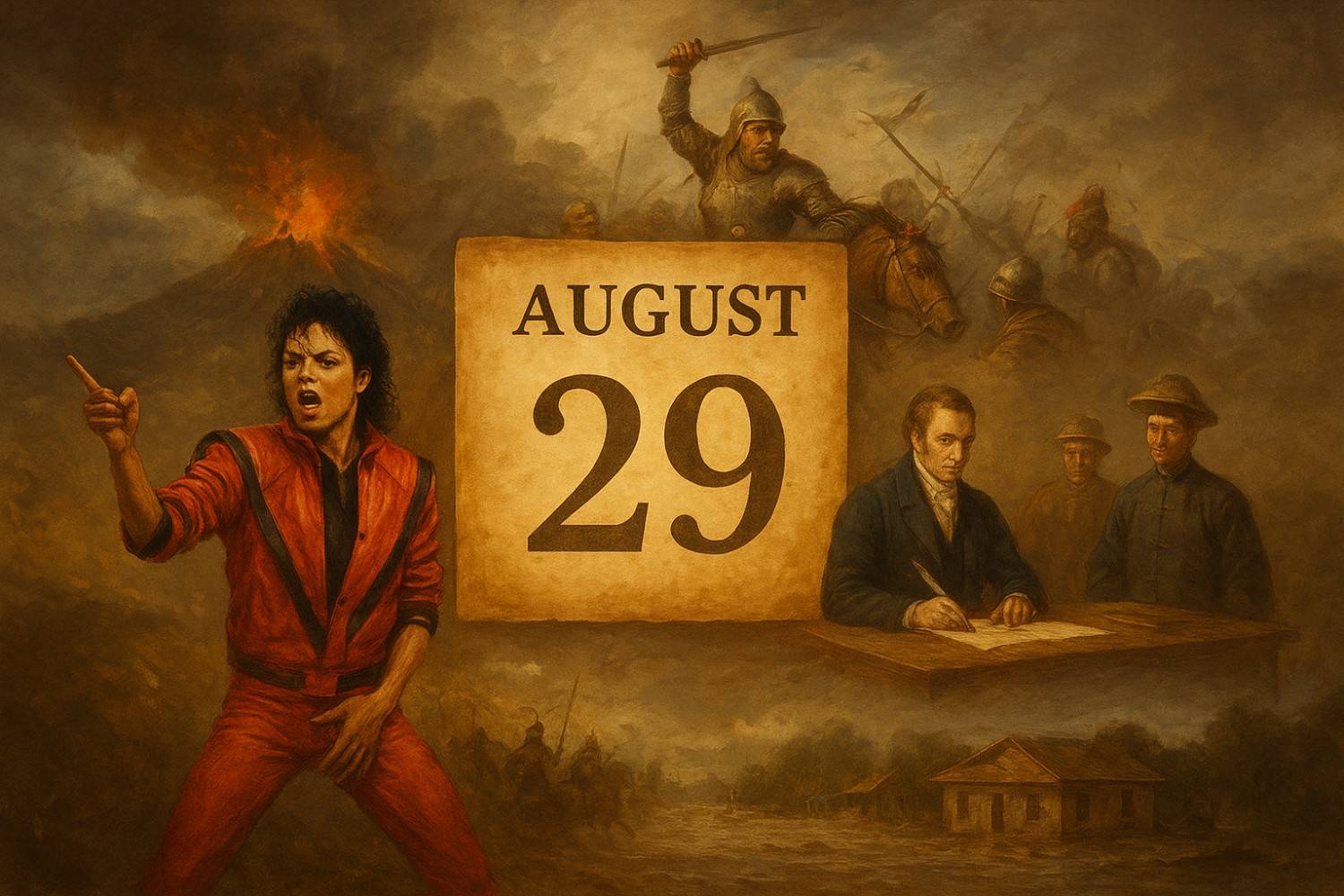
Portugal formally recognized Brazil’s independence, ending decades of colonial ambiguity. This diplomatic act confirmed the independence movement that had effectively begun in 1822 under Dom Pedro I. Recognition allowed Brazil to organize itself as an independent empire and enter international diplomacy on its own terms. The treaty is a milestone in Latin America’s post-colonial order.
1831 — Faraday and Electromagnetic Induction
Michael Faraday demonstrated that a changing magnetic field produces an electric current in a conductor — the basic effect called electromagnetic induction. His simple, elegant experiments (moving magnets and coils) laid the scientific foundation for generators and transformers. That discovery made practical electrical power generation possible and reshaped industry and everyday life. Faraday’s work also established key experimental methods in physics and chemistry.
1842 — Treaty of Nanjing Ends First Opium War
The Treaty of Nanjing forced China to cede Hong Kong to Britain, open treaty ports, and pay indemnities — dramatically reshaping Sino-Western relations. It marked the start of a series of “unequal treaties” that weakened Qing sovereignty and opened China to foreign influence and trade under Western terms. For China, the treaty signaled a painful period often called the “Century of Humiliation.” For global trade and geopolitics, the treaty accelerated 19th-century imperial expansion in East Asia.
1862 — U.S. Bureau of Engraving and Printing Begins Operations
Founded in the middle of the American Civil War, the Bureau centralized the printing of U.S. currency and secure documents. Its creation aimed to curb counterfeiting and provide reliable financial instruments for the war effort. Over time the Bureau modernized printing technologies and became the principal producer of paper money in the United States. Its founding reflects how wartime needs often spur lasting government institutions.
1862 — Second Battle of Bull Run (Second Manassas) Begins
Union General John Pope launched offensive operations near Manassas, Virginia, opening the Second Battle of Bull Run. The battle involved intense combat and maneuvering between Union forces and Confederates under generals like Lee and Jackson. The Confederates eventually won decisively, shifting advantage in the Eastern Theater of the Civil War. The confrontation brought heavy casualties and had political and strategic consequences for both sides.
1877 — Death of Brigham Young
Brigham Young, the Mormon leader who guided thousands across the plains to the Salt Lake Valley, died in Salt Lake City. As territorial governor and church president, he organized settlements, irrigation projects, and a distinctive social structure in the American West. His leadership established the foundations of Utah’s communities, while his policies (including plural marriage) generated controversy.
His death marked a major transition moment for the Latter-day Saints and the evolving American West.
1907 — Quebec Bridge Collapse (during construction)
During construction over the St. Lawrence River the bridge collapsed, killing many workers and exposing serious design flaws. The failure highlighted weaknesses in engineering oversight and became a landmark case for structural safety and professional responsibility. The catastrophe delayed the project for years and led to stricter review practices in civil engineering. Tragedy prompted lessons that influenced future large-scale infrastructure projects.
1944 — Liberation March in Paris
After the city was freed from Nazi occupation, Allied troops and liberated Parisians celebrated in massive, jubilant crowds. American soldiers marched down the Champs-Élysées amid cheering and scenes of relief and renewal. The parade symbolized the end of occupation and the restoration of French authority and civic life. The images from that day remain powerful symbols of liberation and the closing chapter of occupation-era Europe.
1949 — First Soviet Atomic Bomb Test (“First Lightning” / Joe-1)
The Soviet Union detonated its first nuclear device at Semipalatinsk, Kazakhstan, breaking the United States’ monopoly on atomic weapons. The test launched a new phase of the Cold War, spurring an arms race and deep shifts in global strategy and diplomacy. It also had long-term human and environmental costs for the test region. The event changed international politics and ushered in decades of nuclear deterrence thinking.
1957 — Strom Thurmond’s Filibuster Record
Senator Strom Thurmond delivered a 24-hour, 18-minute speech—then a Senate record—opposing the Civil Rights Act of 1957. His marathon filibuster was a dramatic demonstration of the intense resistance some lawmakers had to civil-rights reforms.
While the speech did not ultimately defeat the bill, it underscored the fierce political battles over voting rights and racial equality. The episode highlights how procedural tactics were used to delay social legislation.
1966 — The Beatles’ Last Paid Concert (Candlestick Park)
The Beatles played their final commercial concert for a paying audience in San Francisco and effectively stopped touring after that year. Exhausting schedules, huge crowds, and poor amplification made live shows increasingly unsatisfying for the band, who wanted to focus on studio creativity.
Their move away from touring opened a new era of studio experimentation, resulting in landmark albums. The Candlestick Park show marks a turning point in modern popular music.
1970 — Chicano Moratorium & Mount Rushmore Protest
On the same date thousands marched in East Los Angeles in a Chicano anti-Vietnam War protest, while Native activists protested at Mount Rushmore over broken treaties. The Los Angeles demonstration confronted disproportionate draft and casualty rates among Mexican Americans; clashes with police turned violent in places and a major journalist, Ruben Salazar, was killed—an incident that intensified debate and activism.
The simultaneous Native American protests called attention to ongoing injustices toward Indigenous peoples. These actions signaled rising political organization and protest by marginalized U.S. communities.
1982 — Meitnerium Synthesized for the First Time
Scientists at GSI Helmholtz Centre in Darmstadt produced element 109, later named meitnerium, extending the periodic table further into the superheavy elements. The achievement showcased advances in particle accelerators and nuclear chemistry used to create fleeting, synthetic atoms.
Meitnerium is highly unstable and exists only briefly under laboratory conditions, yet its synthesis helps researchers examine nuclear structure at extreme proton counts. Naming the element for Lise Meitner honored her contributions to nuclear physics.
1988 — Abdul Ahad Mohmand Becomes First Afghan in Space
Afghan pilot Abdul Ahad Mohmand flew on Soyuz TM-6 and spent about nine days aboard the Mir space station, representing Afghanistan in the Soviet Intercosmos program. His mission combined scientific experiments with strong symbolic value amid Cold War geopolitics and Afghanistan’s domestic turmoil.
The flight marked a rare instance of Soviet-era scientific cooperation that involved allied or client states. Mohmand’s journey remains a notable moment in Afghanistan’s modern history.
1990 — Saddam Hussein’s Televised Defiance
In a televised interview, Iraqi leader Saddam Hussein claimed the United States could not defeat Iraq—a defiant posture that came during rising regional tensions. The statement foreshadowed the confrontations surrounding Iraq’s invasion of Kuwait later that year and the 1991 Gulf War.
His rhetoric aimed to deter external intervention and project strength to domestic and regional audiences. In retrospect, the claim was tested by the coalition military response that followed.
2005 — Hurricane Katrina Makes Landfall
Katrina struck the U.S. Gulf Coast and triggered catastrophic flooding in New Orleans after levee breaches, causing nearly 1,400 deaths and massive displacement. The storm exposed deep weaknesses in emergency planning, infrastructure, and government coordination at local, state, and federal levels.
The human and economic toll—estimated in the tens of billions—sparked debates about climate change, urban vulnerability, and social inequality. Katrina’s aftermath reshaped policy conversations on disaster preparedness and recovery.
2008 — John McCain Names Sarah Palin as Running Mate
Senator John McCain selected Alaska Governor Sarah Palin as his vice-presidential pick, the first woman on a Republican presidential ticket. Her nomination energized conservative voters and dramatically changed media focus and campaign dynamics.
The choice sparked intense public discussion about experience, gender in politics, and the vetting process for national office. Palin’s selection had lasting effects on political media coverage and the 2008 race.
2020 — Neuralink’s Gertrude Demo (Elon Musk)
Neuralink presented a pig nicknamed Gertrude that had been implanted with a small brain-computer-interface device to show live neural signals tied to movement. The demonstration was framed as a proof of concept for high-bandwidth brain implants that could someday restore function to people with paralysis.
It generated excitement about medical possibilities alongside ethical debates about animal testing, privacy, and realistic timelines for human therapies. Neuralink emphasized the demo as early-stage research rather than an imminent clinical treatment.
Notable Births on August 29
- 1632 – John Locke – English philosopher, often called the “Father of Liberalism.”
- 1915 – Ingrid Bergman – Swedish actress, star of Casablanca and three-time Academy Award winner.
- 1923 – Richard Attenborough – Acclaimed English actor and director.
- 1936 – John McCain – American politician and war hero, later Republican presidential nominee.
- 1947 – Temple Grandin – American professor, animal behaviorist, and autism advocate.
- 1958 – Michael Jackson – The “King of Pop,” born in Gary, Indiana.
Notable Deaths on August 29
- 1877 – Brigham Young – Mormon leader and pioneer.
- 1975 – Éamon de Valera – President of Ireland and key figure in Irish independence.
- 1976 – Kazi Nazrul Islam – Bengali poet, writer, and revolutionary.
- 1966 – Sayyid Qutb – Egyptian thinker and Islamist theorist, executed in Cairo.
- 1982 – Ingrid Bergman – Passed away on her 67th birthday.
Today’s Observance
- International Day Against Nuclear Tests – A UN day of remembrance for the victims of nuclear testing and a call for a nuclear-free world.
Final Thoughts on Today in History: August 29
Looking back at the events of August 29, one thing becomes clear—this date has seen moments that shaped nations, cultures, and the course of world affairs. From acts of war and political struggles to groundbreaking achievements, each event shows how a single day can hold both triumph and tragedy. Remembering these stories not only connects us to the past but also helps us understand the struggles and victories that shaped the world we live in today.
If you missed our coverage of the previous days in history, you can check those out here:
August 27 facts and events
August 26 facts and events
FAQs About August 29 in History
Q: Why is August 29 an important date in history?
A: August 29 is significant because it has witnessed major turning points—ranging from the end of wars and political reforms to remarkable cultural achievements and scientific milestones. Each event highlights how history is made day by day.
Q: Did any famous people die on August 29?
A: Yes, throughout history, several notable figures passed away on this date. Their deaths often marked the end of an era in politics, culture, or innovation.
Q: What kind of events usually happen on August 29?
A: The date has been marked by wars, peace treaties, political reforms, assassinations, natural disasters, and even landmark cultural moments. It reflects the wide spectrum of human history.
Q: Can I find connections between August 29 and earlier historical events?
A: Absolutely. Many of the events on August 29 are tied to broader historical movements—wars of independence, struggles for human rights, and scientific progress. Reading about them helps place each story within a bigger picture.