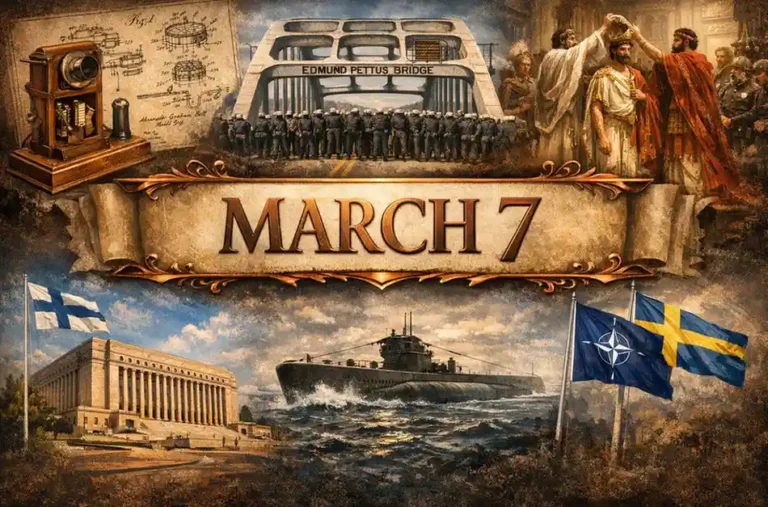
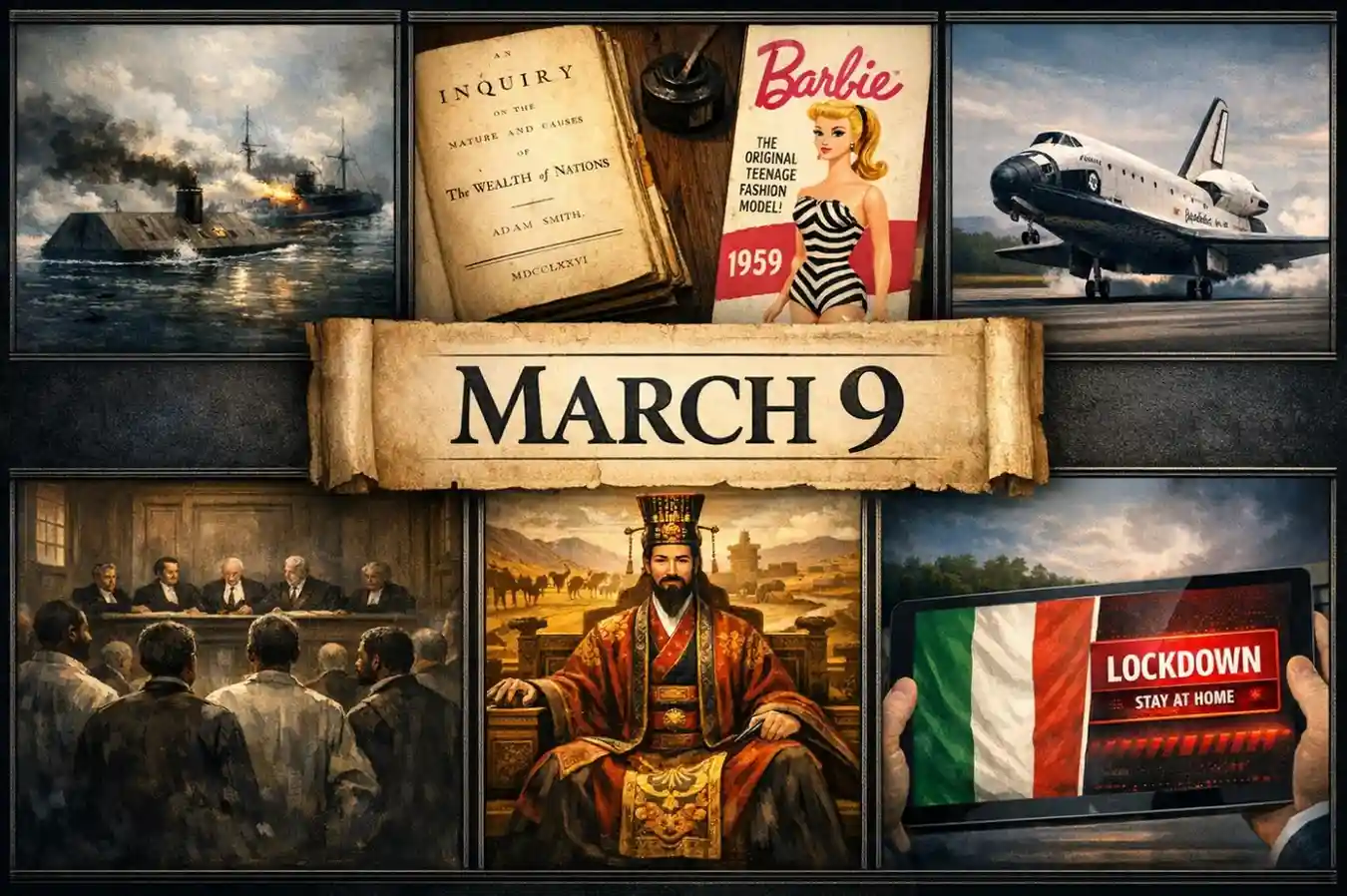
When we look at what happened on this day in history March 9, we witness a timeline defined by radical transitions. It is the day the world of economics was codified by Adam Smith and the day the naval landscape changed forever with the clash of the Ironclads.
From the debut of an 11-inch plastic icon named Barbie to the somber announcement of the world’s first nationwide COVID-19 lockdown, March 9 reminds us that history is often made in the moments when old certainties are replaced by bold, and sometimes daunting, new realities.
Important Events That Happened On March 9 In History
141 BC – Emperor Wu of Han Ascends the Throne
Liu Che, known posthumously as Emperor Wu, assumed the throne of the Han dynasty, marking the beginning of one of the most influential reigns in Chinese history. Over the next 54 years, he would vastly expand China’s borders and establish Confucianism as the state philosophy. His reign is often considered the golden age of the dynasty, as he opened the Silk Road and transformed the administrative structure of the empire.
1009 – First Mention of Lithuania
The name “Lithuania” appeared for the first time in written history within the annals of the monastery of Quedlinburg. The entry recorded the story of Saint Bruno of Querfurt, a missionary who was martyred while attempting to convert the Baltic tribes. This brief mention serves as the foundational historical marker for the Lithuanian nation, celebrating over a millennium of documented heritage.
1044 – Riots in Constantinople
The citizens of Constantinople rose in a violent riot against Emperor Constantine IX Monomachos. The public anger was fueled by the Emperor’s perceived disrespect toward the popular Empress Zoe, specifically his public preference for his mistress, Maria Skleraina. The unrest was only quelled when the Empress herself appeared on a balcony to reassure the masses, proving the immense power and public affection the Macedonian dynasty held over the Byzantine capital.
1226 – Jalal ad-Din Conquers Tbilisi
The Khwarazmian Sultan Jalal ad-Din successfully captured Tbilisi, the capital of the Kingdom of Georgia. The conquest was noted for its extreme brutality, as the Sultan ordered the destruction of churches and the forced conversion or execution of thousands of citizens. This event marked a devastating blow to the “Golden Age” of Georgia, leaving the kingdom fractured and vulnerable to the subsequent Mongol invasions.
1230 – Battle of Klokotnitsa
Bulgarian Tsar Ivan Asen II achieved a stunning victory over Theodore of Epirus at the Battle of Klokotnitsa. Despite having a smaller force, the Bulgarian Tsar used superior tactics to crush the Epirote army and capture Theodore himself. This victory transformed the Second Bulgarian Empire into the dominant power in the Balkans, stretching its borders to the Black, Aegean, and Adriatic Seas.
1500 – Cabral Sets Sail for the Indies
A massive fleet led by Pedro Álvares Cabral departed from Lisbon with the intention of establishing trade in the East Indies. However, while swinging wide into the Atlantic to catch favorable winds, the fleet veered much further west than intended. This detour led to the accidental “discovery” of Brazil, securing a Portuguese foothold in the New World under the terms of the Treaty of Tordesillas.
1701 – Safavid Retreat from Basra
Safavid Persian troops officially withdrew from the city of Basra, bringing a three-year occupation of the strategic port to an end. The occupation had been part of a long-standing territorial struggle between the Safavids and the Ottoman Empire. The retreat allowed the Ottomans to re-establish control over the region, which was a vital gateway for trade between the Persian Gulf and the interior of Mesopotamia.
1765 – Posthumous Exoneration of Jean Calas
Following a vigorous public campaign by the philosopher Voltaire, French judges posthumously cleared the name of Jean Calas. Calas, a Protestant, had been brutally tortured and executed in 1762 on false charges of murdering his son to prevent him from converting to Catholicism. This case became a landmark victory for the Enlightenment, highlighting the dangers of religious fanaticism and the need for judicial reform.
1776 – Publication of The Wealth of Nations
Scottish philosopher Adam Smith published An Inquiry into the Nature and Causes of the Wealth of Nations, a book that would become the foundation of modern economic theory. Smith introduced revolutionary concepts like the “invisible hand,” the division of labor, and free-market capitalism. To this day, it remains one of the most influential works ever written, shaping the global understanding of trade, wealth, and political economy.
1796 – Napoleon Weds Joséphine
In a private ceremony in Paris, a young General Napoléon Bonaparte married Joséphine de Beauharnais. Although their marriage was famously passionate and tumultuous, it was also a strategic union that helped Napoleon navigate the complex social circles of post-revolutionary France. Joséphine would eventually be crowned Empress of the French, and their relationship remains one of history’s most studied romantic sagas.
1811 – Battle of Tacuarí
In a significant engagement during the Argentine War of Independence, Paraguayan forces defeated the expedition led by Manuel Belgrano. Although Belgrano was attempting to bring Paraguay under the control of the revolutionary government in Buenos Aires, the local forces resisted fiercely. This victory bolstered Paraguay’s desire for self-determination, eventually leading to its declaration of independence from both Spain and Argentina later that year.
1815 – Invention of the Battery-Operated Clock
Francis Ronalds published a description of the world’s first battery-operated clock in the Philosophical Magazine. Using a “dry pile” battery, the device was a marvel of early electrical engineering, proving that electricity could be used to power precise mechanical movements over long periods. While it would take decades for electric clocks to become common, Ronalds’ invention was the essential first step in modern timekeeping technology.
1841 – The Amistad Supreme Court Ruling
The U.S. Supreme Court delivered a historic verdict in the case of the Amistad, ruling that the captive Africans who had seized control of the ship were legally free. The court agreed with former President John Quincy Adams’ defense that the men had been kidnapped in violation of international treaties. The survivors were eventually returned to their homes in Sierra Leone, providing a significant moral victory for the American abolitionist movement.
1842 – Premiere of Verdi’s Nabucco
Giuseppe Verdi’s third opera, Nabucco, premiered at La Scala in Milan to overwhelming acclaim. The story of the Jewish exile in Babylon struck a powerful chord with Italian audiences who were currently seeking independence from Austrian rule. The success of this opera instantly elevated Verdi to the status of a national hero and established him as the preeminent composer of the Italian opera scene.
1842 – Gold Discovered at Rancho San Francisco
Six years before the famous Sutter’s Mill discovery, Francisco Lopez found gold particles on the roots of a wild onion at Rancho San Francisco (near modern-day Santa Clarita). While this triggered California’s first minor gold rush, it remained relatively localized compared to the global frenzy of 1848. Nevertheless, it proved that the California hills were rich with precious metals long before the rest of the world caught “gold fever.”
1847 – Siege of Veracruz
During the Mexican–American War, U.S. forces launched the first large-scale amphibious assault in the history of the United States military. Approximately 12,000 troops were landed on the beaches near Veracruz, eventually surrounding the city and forcing its surrender after a 20-day siege. This victory opened the path for General Winfield Scott’s march toward Mexico City, which would ultimately end the war.
1862 – Battle of Hampton Roads: The Ironclads
The USS Monitor and the CSS Virginia fought to a legendary draw in the first-ever battle between ironclad warships. The two vessels spent hours hammering each other with heavy cannon fire, but neither could penetrate the other’s armor. This engagement signaled the immediate obsolescence of wooden warships and fundamentally changed the future of naval warfare across the globe.
1883 – The Black Flag of Anarchy
During a violent protest by unemployed workers and carpenters in Paris, anarchist leader Louise Michel famously unfurled a black flag. This is documented as the first time the black flag was used as a formal symbol of the anarchist movement. The flag represented the “negative” of the white flag of surrender and the red flag of revolution, symbolizing the movement’s rejection of all state authority.
1908 – Founding of Inter Milan
Football Club Internazionale Milano (Inter Milan) was founded following a schism within the Milan Cricket and Football Club (now A.C. Milan). The founding members were unhappy with the original club’s refusal to sign foreign players, choosing the name “Internazionale” to signify their openness to athletes of all nationalities. This birth created one of the most storied rivalries in sports history and established a club that would go on to win numerous domestic and international titles.
1916 – Pancho Villa Attacks Columbus
Mexican revolutionary Pancho Villa led nearly 500 raiders in a surprise attack on the border town of Columbus, New Mexico. The raid resulted in the deaths of several U.S. soldiers and civilians and the burning of several buildings. In response, President Woodrow Wilson ordered the “Punitive Expedition” led by General John J. Pershing to enter Mexico and capture Villa, an operation that strained U.S.-Mexico relations for years.
1933 – Emergency Banking Act
In response to the total collapse of the American banking system during the Great Depression, President Franklin D. Roosevelt submitted the Emergency Banking Act to Congress. The act, which was passed in a single day, allowed the government to inspect and reopen solvent banks while liquidating others. This was the first major policy of the “New Deal” and succeeded in restoring public confidence in the nation’s financial institutions.
1942 – Surrender of the Dutch East Indies
Japanese forces completed their swift campaign in the Dutch East Indies as the colonial administration offered an unconditional surrender at Kalijati, West Java. This event ended over three centuries of Dutch rule in the archipelago and secured critical oil and mineral resources for Japan. The three-year occupation that followed would fundamentally alter the social fabric of the islands, paving the way for Indonesian independence.
1944 – Soviet Air Raid on Tallinn
As part of the ongoing struggle on the Eastern Front of World War II, Soviet long-range bombers launched a massive air raid on Tallinn, Estonia. The attack destroyed nearly 40% of the city’s housing and left thousands homeless, while also devastating historic landmarks. This raid is remembered as one of the most tragic events in Estonian history, symbolizing the immense civilian cost of the war in Northern Europe.
1945 – Japanese Coup in French Indochina
Recognizing that an Allied invasion was imminent, Japanese forces launched a sudden coup d’état to remove the remaining French colonial administration in Indochina. The Japanese arrested French officials and disarmed their troops, declaring the independence of Vietnam, Laos, and Cambodia under Japanese “protection.” This move effectively ended French control and created a political vacuum that would lead to the First Indochina War.
1945 – Firebombing of Tokyo
In the single deadliest air raid in human history, U.S. B-29 bombers dropped thousands of incendiary bombs over Tokyo. The resulting firestorm incinerated 16 square miles of the densely packed city and killed an estimated 100,000 civilians. The raid was part of a strategic bombing campaign intended to shatter Japanese morale and industrial capacity, but it remains a deeply controversial event due to the staggering loss of non-combatant life.
1946 – Burnden Park Disaster
A tragic crowd crush occurred at the Burnden Park football stadium in Bolton, England, during an FA Cup match between Bolton Wanderers and Stoke City. Despite the stadium being vastly overcrowded, the game continued as 33 people were crushed to death and hundreds more were injured. The disaster led to the first major government inquiry into stadium safety, eventually resulting in stricter limits on crowd capacity and improved exit routes.
1954 – Murrow’s Report on Joseph McCarthy
In a watershed moment for American journalism, Edward R. Murrow and Fred Friendly broadcast an episode of See It Now titled “A Report on Senator Joseph McCarthy.” The program used McCarthy’s own words and film clips to expose his reckless tactics and baseless accusations of communism. The broadcast is credited with being a major factor in the public’s turning against McCarthyism and remains a hallmark of courageous investigative reporting.
1956 – Suppression of Georgian Demonstrations
Soviet troops were ordered to suppress mass demonstrations in Tbilisi, the capital of the Georgian SSR. The protesters had gathered to oppose Nikita Khrushchev’s “Secret Speech” and his policy of de-Stalinization, which many Georgians felt was an insult to their national hero, Joseph Stalin. The crackdown resulted in dozens of deaths and served as a grim reminder that the “Khrushchev Thaw” had very strict limits.
1957 – Andreanof Islands Earthquake
A massive magnitude 8.6 earthquake struck the Andreanof Islands in the Aleutian chain, triggering a destructive tsunami that traveled across the Pacific. The waves reached as far as Hawaii, causing millions of dollars in damage, though no lives were lost due to timely warnings. This event remains one of the most powerful earthquakes ever recorded in U.S. history, providing scientists with critical data on subduction zone mechanics.
1959 – Debut of the Barbie Doll
The first Barbie doll, created by Ruth Handler and manufactured by Mattel, made its debut at the American International Toy Fair in New York. Sporting a black-and-white striped swimsuit and a signature ponytail, “Barbie Millicent Roberts” was the first mass-produced toy doll with adult features. She would go on to become a global cultural icon, evolving through hundreds of careers and reflecting changing social attitudes toward women for over six decades.
1960 – The Scribner Shunt
Dr. Belding Hibbard Scribner successfully implanted a revolutionary device—the “Scribner Shunt”—into a patient with kidney failure. The shunt allowed for repeated, easy access to the patient’s bloodstream, making long-term hemodialysis a practical reality for the first time. Before this invention, kidney failure was essentially a death sentence; the shunt transformed it into a manageable chronic condition, saving millions of lives since.
1961 – Sputnik 9 Success
The Soviet Union successfully launched Sputnik 9, carrying a dog named Chernushka and a life-sized human dummy named Ivan Ivanovich. The mission completed one orbit and was successfully recovered, proving that the Vostok spacecraft and its life-support systems were safe for a human pilot. This successful test was the final “green light” needed for Yuri Gagarin’s historic flight just one month later.
1967 – TWA Flight 553 Mid-Air Collision
A TWA Douglas DC-9 collided in mid-air with a small Beechcraft Baron over Concord Township, Ohio. All 26 people on board both aircraft were killed when the planes crashed into a wooded field. The tragedy led to a major investigation into air traffic control procedures and the visibility of small aircraft near commercial flight paths, eventually leading to more rigorous “see-and-avoid” rules in U.S. aviation.
1974 – Mars 7 Misses the Red Planet
The Soviet Mars 7 flyby probe arrived at Mars, but a malfunction in the onboard computer caused the descent module to be released too early. Instead of entering the Martian atmosphere, the lander missed the planet by 1,300 kilometers and flew off into deep space. The failure was a significant setback for the Soviet Mars program, which struggled with technical reliability throughout the 1970s.
1976 – Cavalese Cable Car Disaster
The deadliest cable car accident in history occurred in Cavalese, Italy, when a moving cable car’s support cable snapped. The car plunged over 200 feet down the side of Mount Cermis, killing 42 people, including 15 children. The disaster was caused by a technical failure where the stationary and moving cables overlapped, leading to massive changes in safety inspections and the design of aerial tramways worldwide.
1977 – The Hanafi Siege
Twelve armed members of the Hanafi Muslim movement seized three buildings in Washington, D.C., including the District Building (City Hall). During a tense 39-hour standoff, they took 149 hostages and demanded the cancellation of a film about the Prophet Muhammad. One person was killed and several were injured before the gunmen surrendered; the event led to a massive overhaul of hostage negotiation tactics used by U.S. law enforcement.
1978 – Inauguration of the Jagorawi Toll Road
President Soeharto officially opened the Jagorawi Toll Road, the first toll highway in Indonesia’s history. Connecting Jakarta, Bogor, and Ciawi, the road was a symbol of the nation’s rapid modernization and infrastructure development under the “New Order” government. To this day, it remains one of the busiest and most important transit arteries in Indonesia, facilitating the growth of the Greater Jakarta metropolitan area.
1987 – Chrysler Acquires AMC
In a major consolidation of the American automotive industry, Chrysler Corporation announced its acquisition of the American Motors Corporation (AMC). While AMC was struggling financially, the deal was highly prized by Chrysler Chairman Lee Iacocca because it included the Jeep brand. This acquisition is considered one of the most successful in business history, as the Jeep Grand Cherokee (then under development) became a cornerstone of Chrysler’s future profits.
1997 – Hale–Bopp Double Feature
Observers across China, Mongolia, and Eastern Siberia witnessed a spectacular celestial “double feature” during a total solar eclipse. As the moon blocked out the sun, the brilliant Comet Hale–Bopp—which was then nearing its peak brightness—became clearly visible in the daytime sky. This rare alignment was a once-in-a-lifetime event for astronomers and the public alike, capturing the world’s imagination.
2000 – Launch of Nupedia
Nupedia, a free online encyclopedia, was officially launched by Jimmy Wales and Larry Sanger. Unlike its eventual successor, Wikipedia, Nupedia relied on a highly rigorous seven-step peer-review process conducted by academic experts. While the slow pace of content creation eventually led to its closure in 2003, the infrastructure and the vision behind it laid the direct groundwork for the creation of the collaborative Wikipedia model.
2011 – Final Flight of Space Shuttle Discovery
The Space Shuttle Discovery, the most flown vehicle in NASA’s shuttle fleet, made its final landing at Kennedy Space Center after completing its 39th mission. Over its 27-year career, Discovery deployed the Hubble Space Telescope and participated in 13 ISS missions, traveling a total of nearly 149 million miles. Its retirement marked the beginning of the end for the Space Shuttle era, and the vehicle is now on display at the Smithsonian.
2012 – Salvadoran Gang Truce
A historic truce between the Salvadoran government and the country’s two most powerful gangs, MS-13 and Barrio 18, officially went into effect. The government facilitated the transfer of 30 gang leaders to lower-security prisons in exchange for a commitment to lower the nation’s soaring homicide rate. While the truce led to a dramatic, temporary drop in violence, it eventually collapsed amidst political scandal and accusations of secret government payoffs.
2015 – Villa Castelli Helicopter Collision
Two helicopters collided in mid-air over Villa Castelli, Argentina, during the filming of the French reality TV show Dropped. All ten people on board both aircraft were killed, including three renowned French athletes: sailor Florence Arthaud, Olympic swimmer Camille Muffat, and boxer Alexis Vastine. The tragedy shocked France and led to an investigation that pointed to pilot error and poor visibility as the primary causes.
2020 – First Nationwide COVID-19 Lockdown
In a dramatic televised address, Italian Prime Minister Giuseppe Conte announced that the entire country of Italy would be placed under a strict lockdown to combat the spread of COVID-19. This was the first time in modern history that a democratic nation had restricted the movement of its entire population for health reasons. The “Italy model” was soon adopted by dozens of other countries as the pandemic swept across the globe.
2023 – Hamburg Alsterdorf Shooting
A gunman opened fire at a Jehovah’s Witnesses Kingdom Hall in the Alsterdorf quarter of Hamburg, Germany, during a service. Eight people were killed, including an unborn child, and eight others were injured before the shooter turned the gun on himself. The attack was one of the deadliest mass shootings in Germany’s recent history, sparking renewed debates over the nation’s gun laws and the protection of religious gatherings.
After reading March 9 Stories, now you will read about March 8 Tales
Famous People Born on March 9
| Name | Description | Date |
|---|---|---|
| Ornette Coleman | Free jazz pioneer | March 9, 1930 – June 11, 2015 |
| Leland Stanford | U.S. senator & railroad tycoon | March 9, 1824 – June 21, 1893 |
| Mircea Eliade | Influential scholar & author | March 9, 1907 – April 22, 1986 |
| Samuel Barber | Classical composer | March 9, 1910 – January 23, 1981 |
| André Courrèges | Futuristic fashion pioneer | March 9, 1923 – January 7, 2016 |
| Vita Sackville-West | Novelist & poet | March 9, 1892 – June 2, 1962 |
| Lloyd Price | Rock & R&B singer | March 9, 1933 – May 3, 2021 |
| Mickey Spillane | Crime fiction writer | March 9, 1918 – July 17, 2006 |
| Taras Shevchenko | National poet of Ukraine | March 9, 1814 – March 10, 1861 |
| Honoré-Gabriel Riqueti | Leader in French Revolution | March 9, 1749 – April 2, 1791 |
| Ernest Bevin | Labour leader & minister | March 9, 1881 – April 14, 1951 |
| Helen Zille | Political leader | March 9, 1951 – Present |
| Luis Barragán | Pritzker Prize–winning architect | March 9, 1902 – November 22, 1988 |
| David Smith | Modernist sculptor | March 9, 1906 – May 23, 1965 |
| Joe Franklin | Talk-show pioneer | March 9, 1926 – January 24, 2015 |
| Tom Roberts | Introduced Impressionism to Australia | March 9, 1856 – September 14, 1931 |
| Gustav Stickley | Mission-style furniture designer | March 9, 1858 – April 21, 1942 |
| Howard Aiken | Early computer pioneer | March 9, 1900 – March 14, 1973 |
| Franz Joseph Gall | Founder of phrenology | March 9, 1758 – August 22, 1828 |
| Walter Kohn | Nobel Prize–winning scientist | March 9, 1923 – April 19, 2016 |
| Eddie Foy | Vaudeville star | March 9, 1856 – February 16, 1928 |
| Robert L. Eichelberger | WWII military leader | March 9, 1886 – September 26, 1961 |
| Tirso de Molina | Golden Age playwright | March 9, 1584 – March 12, 1648 |
| Tamara Karsavina | Ballets Russes star | March 9, 1885 – May 26, 1978 |
| Keri Hulme | Booker Prize–winning novelist | March 9, 1947 – December 27, 2021 |
| Antonio Saca | Former president of El Salvador | March 9, 1965 – Present |
| Tony Lockett | AFL goal-scoring record holder | March 9, 1966 – Present |
| Isaac Hull | War of 1812 hero | March 9, 1773 – February 13, 1843 |
| Jean‑Baptiste Kléber | Revolutionary Wars commander | March 9, 1753 – June 14, 1800 |
| Zabdiel Boylston | Smallpox inoculation pioneer | March 9, 1676 – March 1, 1766 |
Famous People Who Died on March 9
| Name | Description | Date |
|---|---|---|
| Hans Christian Ørsted | Discovered electromagnetism | August 14, 1777 – March 9, 1851 |
| Matthew Henson | Arctic explorer | August 8, 1866 – March 9, 1955 |
| Paul von Lettow‑Vorbeck | WWI guerrilla commander | March 20, 1870 – March 9, 1964 |
| Carrie Chapman Catt | Women’s suffrage leader | January 9, 1859 – March 9, 1947 |
| Robert Bosch | Industrial pioneer | September 23, 1861 – March 9, 1942 |
| Aleksandra Kollontai | Diplomat & feminist | March 31, 1872 – March 9, 1952 |
| James Levine | Metropolitan Opera conductor | June 23, 1943 – March 9, 2021 |
| Jamāl al‑Dīn al‑Afghānī | Islamic reformer | 1838 – March 9, 1897 |
| Johannes D. van der Waals | Nobel Prize physicist | November 23, 1837 – March 9, 1923 |
| Frank Wedekind | Influential playwright | July 24, 1864 – March 9, 1918 |
| Anna Laetitia Barbauld | Poet & essayist | June 20, 1743 – March 9, 1825 |
| Leonardo Bruni | Renaissance scholar | c.1370 – March 9, 1444 |
| David Riccio | Adviser to Mary, Queen of Scots | c.1533 – March 9, 1566 |
| Arnold Toynbee | Social reformer | August 23, 1852 – March 9, 1883 |
| Max Delbrück | Nobel Prize geneticist | September 4, 1906 – March 9, 1981 |
| Bobby Locke | Open champion golfer | November 20, 1917 – March 9, 1987 |
| Ulf von Euler | Nobel Prize scientist | February 7, 1905 – March 9, 1983 |
| Ralph Montagu | Duke & courtier | December 24, 1638 – March 9, 1709 |
| Earl W. Sutherland Jr. | Nobel Prize biochemist | November 19, 1915 – March 9, 1974 |
| Albumazar | Influential medieval scholar | August 10, 787 – March 9, 886 |
| Sir Roy Harrod | Growth theory pioneer | February 13, 1900 – March 9, 1978 |
| Bernard Binlin Dadié | African literary figure | January 10, 1916 – March 9, 2019 |
| Muḥammad ʿAbd al‑Munʿim Riyāḍ | Military chief of staff | October 22, 1919 – March 9, 1969 |
| Sondre Norheim | Skiing pioneer | June 10, 1825 – March 9, 1897 |
| Friedrich M. von Klinger | Sturm und Drang author | February 17, 1752 – March 9, 1831 |
| Sir George A. Grierson | Linguistic Survey of India | January 7, 1851 – March 9, 1941 |
| Giovanni Lanza | Prime minister of Italy | February 15, 1810 – March 9, 1882 |
| John Gully | Prizefighter & MP | August 21, 1783 – March 9, 1863 |
| Antoine Destutt de Tracy | Founder of Ideology school | July 20, 1754 – March 9, 1836 |
| Henry Clifton Sorby | Microscopic petrography pioneer | May 10, 1826 – March 9, 1908 |
Observances & Institutional Dates
- Teachers’ Day (Lebanon): A day dedicated to honoring the contributions of educators to society.
- Barbie Day: Celebrating the “birthday” of the world’s most famous doll since 1959.
- National Panic Day: A lighthearted reminder to take a breath and manage stress in a high-pressure world.
- International Get Over It Day: Encouraging people to move past minor grievances and focus on the future.
Frequently Asked Questions
- What was the Battle of Hampton Roads? It was the first battle between ironclad warships (Monitor vs. Virginia) in 1862, changing naval history forever.
- When did Barbie first come out? Barbie made her debut on March 9, 1959, at the American International Toy Fair.
- Why is Adam Smith’s The Wealth of Nations important? Published in 1776, it is the founding text of modern economics and free-market capitalism.
- What was the first country to have a nationwide COVID-19 lockdown? Italy, on March 9, 2020, was the first democratic nation to impose a total lockdown.