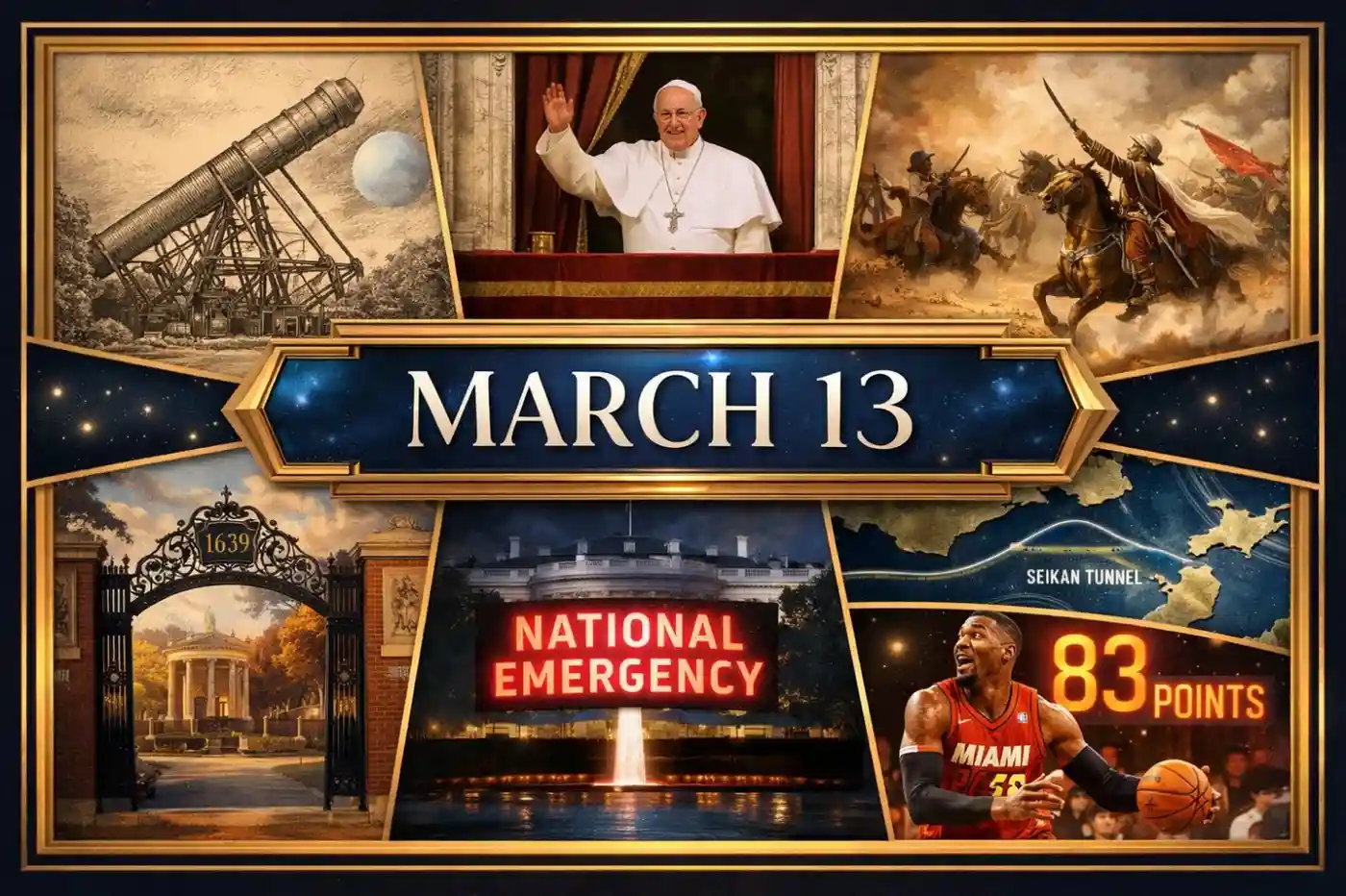
Reflecting on what happened on this day in history March 13, we see a date where the boundaries of our world—and our understanding of the universe—expanded and shifted. It is the day William Herschel looked through his telescope and found Uranus, and the day the news of Pluto’s discovery first reached the public.
From the historic election of Pope Francis to the chilling declaration of a national emergency as the COVID-19 pandemic took hold of the United States. March 13 serves as a bridge between celestial discovery and the heavy realities of global change.
Important Events That Happened On March 13 In History
222 – Murder of Emperor Elagabalus
The young Roman Emperor Elagabalus was assassinated by the Praetorian Guard along with his mother, Julia Soaemias. His four-year reign had been marked by religious controversy and eccentric behavior that alienated the Roman elite. He was replaced by his 14-year-old cousin, Alexander Severus, whose ascension marked the beginning of a more stable, though ultimately tragic, period for the Severan dynasty.
483 – Election of Pope Felix III
Following the death of Pope Simplicius, Felix III was elected as the leader of the Catholic Church. His papacy was defined by the Acacian Schism, the first major rift between the Eastern and Western Christian churches. Felix was a staunch defender of the Council of Chalcedon and was notably the great-great-grandfather of the future Pope Gregory the Great.
624 – The Battle of Badr
In one of the most significant events in early Islamic history, the Muslim forces led by Prophet Muhammad defeated a much larger army of the Quraysh from Mecca. Taking place in the Hejaz region of western Arabia, this victory was seen as a divine validation of the new faith and a turning point that strengthened the political and military standing of the early Muslim community in Medina.
1261 – Treaty of Nymphaeum
The Byzantine Empire and the Republic of Genoa signed a major mutual defense treaty at Nymphaeum. In exchange for military aid against the Venetians, the Byzantines granted the Genoese extensive trading privileges. This alliance was a masterstroke of diplomacy that allowed the Byzantines to eventually recapture Constantinople later that year, ending the Latin Empire.
1323 – Siege of Warangal Ends
After an eight-month campaign, the forces of the Delhi Sultanate, led by Muhammad bin Tughluq, successfully captured Warangal. The Kakatiya ruler, Prataparudra, was forced to surrender after refusing to pay tribute. The fall of Warangal marked the end of the Kakatiya dynasty and the further expansion of Islamic rule into the Deccan plateau of southern India.
1567 – Battle of Oosterweel
Traditionally cited as the starting point of the Eighty Years’ War, Spanish forces under Beauvoir defeated a rebel army of Dutch Calvinists near Antwerp. The rebels were largely untrained volunteers, and the swift Spanish victory temporarily checked the growing Protestant resistance against King Philip II of Spain, though it only fueled the fire of the Dutch Revolt.
1591 – Battle of Tondibi
A small Moroccan force of 4,000 men, led by Judar Pasha and equipped with early firearms (arquebuses), defeated the 25,000-strong army of the Songhai Empire in Mali. Despite being outnumbered five to one, the Moroccans’ superior technology caused a stampede in the Songhai ranks. This battle led to the collapse of the Songhai Empire and the sack of Timbuktu.
1639 – Harvard College Named
The “New College” at Cambridge, Massachusetts, was officially renamed Harvard College in honor of clergyman John Harvard. Harvard had bequeathed half of his estate and his entire library of 400 books to the fledgling institution. This act of philanthropy ensured the survival of the oldest institution of higher learning in the United States.
1697 – Fall of Nojpetén
Spanish conquistadors captured Nojpetén, the island capital of the Itza Maya kingdom. This was the final step in the Spanish conquest of Guatemala and marked the end of the last independent Maya state. The fall of Nojpetén closed the chapter on the centuries-long resistance of the Maya people against Spanish colonial expansion.
1741 – Battle of Cartagena de Indias Begins
During the War of Jenkins’ Ear, a massive British amphibious force led by Admiral Edward Vernon launched an attack on the Spanish port of Cartagena de Indias (modern-day Colombia). The siege would last over two months and result in a humiliating defeat for the British, preserving Spanish control over their South American trade routes.
1781 – William Herschel Discovers Uranus
While surveying the night sky from his garden in Bath, England, astronomer William Herschel noticed a faint object that he initially thought was a comet. Further observation revealed it was the seventh planet from the Sun, which he named Georgium Sidus (later changed to Uranus). This was the first planet discovered with a telescope, doubling the known size of the solar system.
1809 – Deposition of Gustav IV Adolf
In a bloodless coup, King Gustav IV Adolf of Sweden was deposed by a group of army officers following his disastrous leadership in the Finnish War against Russia. The coup led to the King’s abdication and the eventual election of Jean-Baptiste Bernadotte as his successor, founding the current royal house of Sweden.
1815 – Napoleon Declared an Outlaw
The participants at the Congress of Vienna issued a joint declaration branding Napoleon Bonaparte an “outlaw” and an “enemy and disturber of the tranquility of the world.” This followed Napoleon’s daring escape from exile on the island of Elba and his return to France. The declaration effectively united the European powers for the final campaign that would end at Waterloo.
1825 – Pope Leo XII Bans Freemasonry
Pope Leo XII published the apostolic constitution Quo Graviora, in which he renewed and strengthened the Catholic Church’s prohibition on Catholics joining Freemasonry. The document claimed that secret societies were a threat to both the Church and the state, reflecting the deep tensions between the papacy and the growing secularist movements in Europe.
1845 – Premiere of Mendelssohn’s Violin Concerto
Felix Mendelssohn’s Violin Concerto in E minor received its world premiere in Leipzig, with Ferdinand David as the soloist. Known for its lyrical beauty and innovative structure, the concerto became one of the most popular and influential works in the violin repertoire, a staple of the Romantic era that remains a favorite for soloists today.
1848 – Revolutions of 1848 Reach Vienna
The “Springtime of Peoples” arrived in the Austrian Empire as students and workers in Vienna took to the streets to demand a constitution and the resignation of the conservative Chancellor Metternich. The protests sparked a wave of revolutionary activity across the multi-ethnic empire, temporarily forcing the monarchy to grant liberal reforms.
1862 – Act Prohibiting the Return of Slaves
The United States Congress passed a critical act that forbade military officers from returning escaped slaves to their owners. This effectively nullified the Fugitive Slave Act of 1850 for those within military lines. This was a major legal stepping stone toward the Emancipation Proclamation, as it recognized the “contraband of war” status of people fleeing slavery.
1884 – Siege of Khartoum Begins
Mahdist forces in Sudan began a ten-month siege of the city of Khartoum, defended by a small Egyptian garrison led by British General Charles George Gordon. The siege became a major international crisis, ending in the fall of the city and the death of Gordon just two days before a British relief expedition arrived.
1888 – Eruption of Ritter Island
A massive volcanic eruption on Ritter Island, near Papua New Guinea, caused a large portion of the island to collapse into the sea. The resulting megatsunamis, reaching heights of up to 40 feet, struck nearby islands and killed an estimated 3,000 people. It remains one of the most significant volcanic-induced tsunamis in recorded history.
1900 – British Occupy Bloemfontein
During the Second Boer War, British forces under Lord Roberts captured Bloemfontein, the capital of the Orange Free State. This was a significant strategic victory, though it did not end the war; instead, the Boers transitioned into a highly effective guerrilla campaign that would continue for another two years.
1930 – Announcement of Pluto’s Discovery
The Lowell Observatory in Arizona officially announced the discovery of a ninth planet, Pluto, by astronomer Clyde Tombaugh. The announcement was timed to coincide with the anniversary of the observatory’s founder, Percival Lowell, and the discovery of Uranus. Pluto was considered a planet for 76 years until its reclassification as a “dwarf planet” in 2006.
1940 – End of the Winter War
The Moscow Peace Treaty went into effect, officially ending the Winter War between Finland and the Soviet Union. While Finland successfully defended its sovereignty, it was forced to cede approximately 11% of its territory, including its second-largest city, Viipuri. Nearly 12% of the Finnish population (over 400,000 people) lost their homes in the ceded areas.
1943 – Liquidation of the Kraków Ghetto
German forces began the final liquidation of the Jewish ghetto in Kraków, Poland. Over the course of two days, approximately 2,000 Jews were murdered in the streets, and thousands more were deported to the Płaszów labor camp or the Auschwitz-Birkenau death camp. This atrocity was a central part of the Holocaust’s “Final Solution” in occupied Poland.
1954 – Battle of Điện Biên Phủ Begins
Viet Minh forces under General Võ Nguyên Giáp launched a massive artillery barrage against the French colonial garrison at Điện Biên Phủ. The siege would last 57 days and result in a crushing French defeat. This victory led to the end of the First Indochina War and the Geneva Accords, which partitioned Vietnam and ended French colonial rule in Indochina.
1964 – Murder of Kitty Genovese
28-year-old Kitty Genovese was murdered outside her apartment in Queens, New York. The case became famous worldwide due to a later-discredited New York Times report claiming that 38 neighbors witnessed the attack and did nothing. While the “38 witnesses” story was largely inaccurate, it prompted extensive social psychological research into the “bystander effect.”
1969 – Apollo 9 Returns to Earth
The Apollo 9 mission splashed down safely in the Atlantic Ocean after a ten-day Earth-orbital mission. This mission was critical to the moon landing goal, as it was the first crewed flight of the Lunar Module. The successful testing of the spacecraft’s docking and extraction maneuvers proved that the hardware was ready for a lunar landing.
1988 – Opening of the Seikan Tunnel
Japan officially opened the Seikan Tunnel, connecting the islands of Honshu and Hokkaido. At 33.5 miles long, with 14.5 miles located 460 feet below the seabed, it was the longest and deepest rail tunnel in the world at the time. The tunnel was a marvel of engineering that significantly improved transport and connectivity within the Japanese archipelago.
1993 – The “Storm of the Century”
A massive cyclonic storm, often called the “Superstorm of 1993,” struck the eastern United States. It was unique for its intensity and geographic span, dropping record-breaking snow from Alabama to Maine. The storm caused over $5 billion in damage and killed more than 300 people, serving as a landmark event in modern meteorology.
1996 – The Dunblane Massacre
A gunman entered Dunblane Primary School in Scotland, killing sixteen children and one teacher before taking his own life. It remains the deadliest mass shooting in British history. The national grief and outrage led to two new Firearms Acts, which effectively banned the private ownership of most handguns in the United Kingdom.
1997 – Sister Nirmala Succeeds Mother Teresa
The Missionaries of Charity elected Sister Nirmala Joshi to succeed Mother Teresa as the head of the order. Mother Teresa, who had founded the order in 1950, stepped down due to failing health. Sister Nirmala was tasked with continuing the mission of serving the “poorest of the poor” in over 100 countries.
2003 – Discovery of the “Devil’s Footprints”
An article in the journal Nature identified three sets of footprints found on the side of the Roccamonfina volcano in Italy as hominid tracks. Known locally as the “Ciampate del Diavolo” (Devil’s Footprints), they were determined to be 350,000 years old, making them among the oldest hominid footprints ever discovered.
2013 – Election of Pope Francis
Following the resignation of Pope Benedict XVI, the papal conclave elected Cardinal Jorge Mario Bergoglio of Argentina as the 266th Pope. He chose the name Francis, becoming the first Pope from the Americas, the first from the Southern Hemisphere, and the first Jesuit Pope. His election signaled a shift toward a more humble and peripherally-focused papacy.
2016 – Ankara Bombing
A car bomb exploded in the Kızılay district of Ankara, Turkey, killing at least 37 people and injuring over 120. The attack, claimed by the Kurdistan Freedom Hawks (TAK), targeted a major transport hub during the evening rush hour. It was part of a series of deadly terrorist attacks that struck Turkish cities during that period.
2020 – US Declares COVID-19 National Emergency
President Donald Trump officially declared the COVID-19 pandemic a national emergency in the United States. This move unlocked billions of dollars in federal funding and gave the government broad powers to coordinate the response. It marked the moment the pandemic became a total domestic priority, leading to widespread closures and a fundamental shift in American life.
2020 – Death of Breonna Taylor
26-year-old Breonna Taylor, an ER technician, was shot and killed by Louisville police officers who used a “no-knock” warrant to enter her apartment. Her death, along with that of George Floyd later that year, sparked a massive wave of global protests against police brutality and systemic racism, leading to significant legislative changes regarding police warrants.
Famous People Born on March 13
| Name | Description | Date |
|---|---|---|
| Joseph Priestley | Chemist who discovered oxygen | March 13, 1733 – February 6, 1804 |
| Charles Grey, 2nd Earl Grey | UK Prime Minister; Reform Act 1832 | March 13, 1764 – July 17, 1845 |
| Percival Lowell | Predicted Planet X (Pluto) | March 13, 1855 – November 12, 1916 |
| Karl Friedrich Schinkel | Leading Prussian architect | March 13, 1781 – October 9, 1841 |
| Hugo Wolf | Master of German art song | March 13, 1860 – February 22, 1903 |
| Walter H. Annenberg | Media magnate & philanthropist | March 13, 1908 – October 1, 2002 |
| George Seferis | Nobel Prize in Literature | March 13, 1900 – September 20, 1971 |
| Sir Hugh Walpole | Popular storyteller | March 13, 1884 – June 1, 1941 |
| Pope Innocent XII | Pope (1691–1700) | March 13, 1615 – September 27, 1700 |
| Abigail Fillmore | Wife of President Millard Fillmore | March 13, 1798 – March 30, 1853 |
| Alexey von Jawlensky | Expressionist artist | March 13, 1864 – March 15, 1941 |
| John H. Van Vleck | Nobel Prize in Physics | March 13, 1899 – October 27, 1980 |
| John Tate | Abel Prize winner | March 13, 1925 – October 16, 2019 |
| Gangubai Hangal | Hindustani vocal legend | March 13, 1913 – July 21, 2009 |
| Anton Makarenko | Influential pedagogue | March 13, 1888 – April 1, 1939 |
| William J. Glackens | Ashcan School artist | March 13, 1870 – May 22, 1938 |
| Charles Bonnet | Discovered parthenogenesis | March 13, 1720 – May 20, 1793 |
| Janet Flanner | Paris correspondent, New Yorker | March 13, 1892 – November 7, 1978 |
| Paul Morand | Diplomat-novelist | March 13, 1888 – July 24, 1976 |
| V. O. Key Jr. | Expert on U.S. politics | March 13, 1908 – October 4, 1963 |
| W.O. Mitchell | Prairie literature writer | March 13, 1914 – February 25, 1998 |
| Guillaume Brune | Napoleon’s commander | March 13, 1763 – August 2, 1815 |
| Zulfikar Ghose | Poet and novelist | March 13, 1935 – Present |
| Ramón Menéndez Pidal | Historian of Spanish language | March 13, 1869 – November 14, 1968 |
| Mustafa Reşid Paşa | Tanzimat reforms leader | March 13, 1800 – December 17, 1858 |
| Kofi Awoonor | Major African writer | March 13, 1935 – September 21, 2013 |
| Jacob van Heemskerck | Arctic navigator | March 13, 1567 – April 25, 1607 |
| William Louis, Count of Nassau | Dutch Republic strategist | March 13, 1560 – July 13, 1620 |
| Albert W. Stevens | First photo of Earth’s curvature | March 13, 1886 – March 26, 1949 |
| Coco Gauff | U.S. Open champion | March 13, 2004 – Present |
Famous People Who Died on March 13
| Name | Description | Date |
|---|---|---|
| Christian VII | Danish monarch | January 29, 1749 – March 13, 1808 |
| Louis I de Bourbon, Prince de Condé | Huguenot commander | May 7, 1530 – March 13, 1569 |
| Ivo Andrić | Nobel Prize in Literature | October 10, 1892 – March 13, 1975 |
| Hans‑Georg Gadamer | Hermeneutics pioneer | February 11, 1900 – March 13, 2002 |
| Bruno Bettelheim | Child psychology expert | August 28, 1903 – March 13, 1990 |
| Sergey Witte | Prime minister of Russia | June 29, 1849 – March 13, 1915 |
| Karl Haushofer | Geopolitics theorist | August 27, 1869 – March 13, 1946 |
| Nicolas Boileau | Classical literary critic | November 1, 1636 – March 13, 1711 |
| Garson Kanin | Playwright & director | November 24, 1912 – March 13, 1999 |
| Sofia Gubaidulina | Modern classical composer | October 24, 1931 – March 13, 2025 |
| Stephen Vincent Benét | Pulitzer Prize winner | July 22, 1898 – March 13, 1943 |
| John Chilembwe | Anti-colonial rebel | c.1860 – March 13, 1915 |
| Elihu Thomson | Electrical engineering pioneer | March 29, 1853 – March 13, 1937 |
| Frank Worrell | Legendary captain | August 1, 1924 – March 13, 1967 |
| Hans von Ohain | Jet engine co-inventor | December 14, 1911 – March 13, 1998 |
| Adolf Anderssen | 19th-century chess champion | July 6, 1818 – March 13, 1879 |
| Corrado Gini | Creator of Gini coefficient | May 23, 1884 – March 13, 1965 |
| Lucien Lévy‑Bruhl | Anthropological thinker | April 19, 1857 – March 13, 1939 |
| John Barbour | Author of The Bruce | c.1325 – March 13, 1395 |
| Fernand Pelloutier | Labor movement theorist | October 1, 1867 – March 13, 1901 |
| Felice Orsini | Attempted assassination of Napoleon III | December 10, 1819 – March 13, 1858 |
| Josephine St. Pierre Ruffin | Civil rights leader | August 31, 1842 – March 13, 1924 |
| Mieszko III | Ruler of Greater Poland | 1126 – March 13, 1202 |
| Johan Laidoner | Independence leader | February 12, 1884 – March 13, 1953 |
| Barbara Harris | First female Anglican bishop | June 12, 1930 – March 13, 2020 |
| Karl Lachmann | Founder of textual criticism | March 14, 1793 – March 13, 1851 |
| Michel de L’Hospital | Chancellor of France | 1507 – March 13, 1573 |
| Hilary Putnam | Major analytic philosopher | July 31, 1926 – March 13, 2016 |
| William Hurt | Oscar-winning actor | March 20, 1950 – March 13, 2022 |
| Marvin Hagler | Middleweight champion | May 23, 1954 – March 13, 2021 |
Observances & Institutional Dates
- National Elephant Day (Thailand): Celebrating the cultural and historical importance of elephants in Thai society.
- Africa Scout Day: Recognizing the contributions of the scouting movement across the African continent.
- Kasuga Matsuri (Japan): A traditional festival at the Kasuga Grand Shrine in Nara, featuring ancient dances and rituals.
- World Day Against Cyber Censorship: An annual event to support a single, unrestricted Internet that is accessible to all.
Frequently Asked Questions
- When was Uranus discovered? William Herschel discovered Uranus on March 13, 1781.
- Who was the first Pope from the Americas? Pope Francis, elected on March 13, 2013, is the first Pope from the Americas (Argentina).
- What was the Battle of Badr? It was a pivotal battle in 624 CE where the early Muslims defeated the Quraysh of Mecca.
- When did the U.S. declare a national emergency for COVID-19? The national emergency was declared on March 13, 2020.