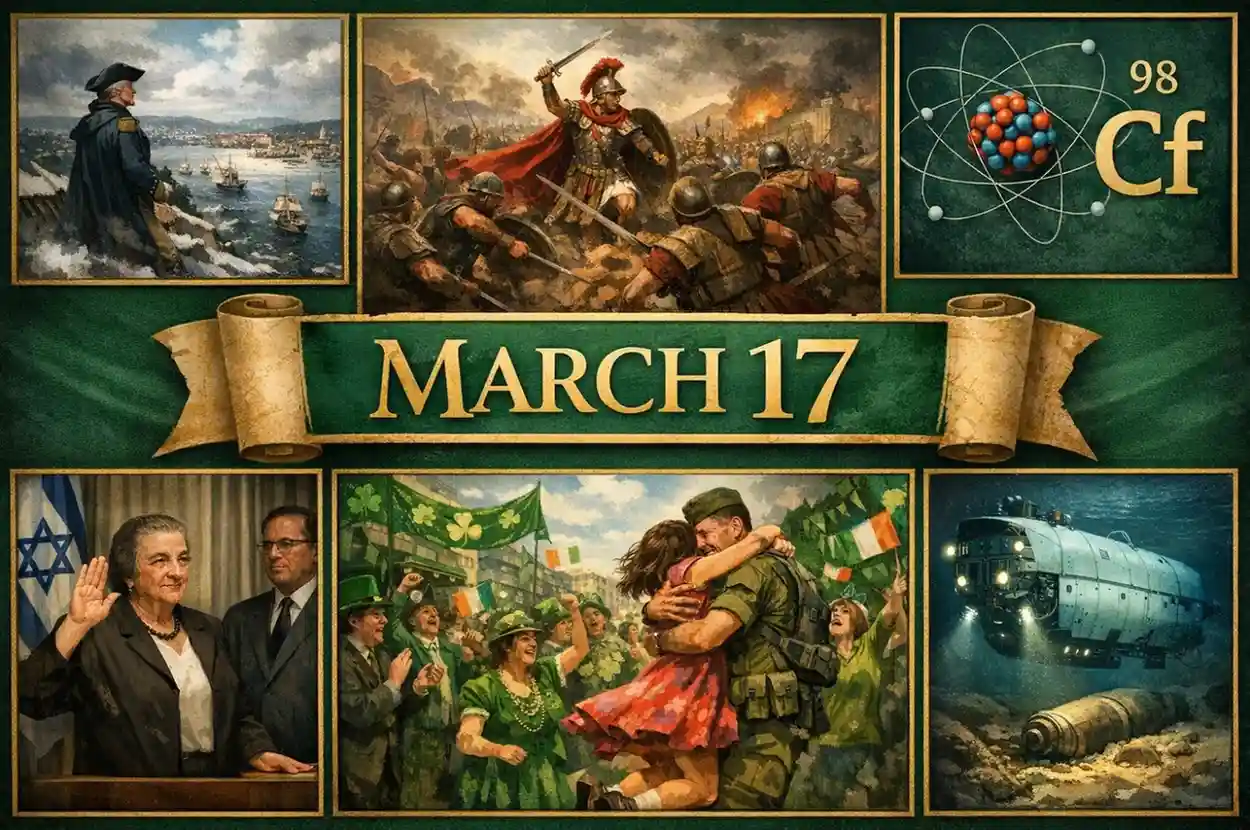
The events of this day in history March 17 reflect a landscape of shifting power and scientific breakthrough. From Julius Caesar’s decisive victory at Munda to the British evacuation of Boston, the date marks pivotal military turning points. Beyond the battlefield, the day saw the discovery of californium and continues to hold global cultural weight as the feast of Saint Patrick.
Important Events That Happened On March 17 In History
45 BC – Battle of Munda
Julius Caesar achieved his final military victory by defeating the Pompeian forces of Titus Labienus and Pompey the Younger in southern Spain. This battle effectively ended the Roman Civil War, leaving Caesar as the undisputed master of the Roman world. The victory was hard-fought, and the death of his opponents solidified his control over the Republic.
180 – Commodus Becomes Sole Emperor
Following the death of his father, the philosopher-emperor Marcus Aurelius, eighteen-year-old Commodus became the sole ruler of the Roman Empire. His ascension marked the end of the era of the “Five Good Emperors” and the beginning of a more turbulent period in Roman history. His reign would eventually be characterized by erratic behavior and a focus on gladiatorial games.
455 – Petronius Maximus Claims the Throne
With the support of the Roman Senate, Petronius Maximus was proclaimed emperor of the Western Roman Empire. In a move to consolidate his power and legitimacy, he forced Licinia Eudoxia, the widow of the recently assassinated Valentinian III, to marry him. His reign, however, would prove to be brief and disastrous as the Vandals approached Rome.
1337 – Edward the Black Prince Named Duke of Cornwall
Edward of Woodstock, famously known as the Black Prince, was created the Duke of Cornwall. This was a landmark moment in English peerage, as it established the very first duchy in the Kingdom of England. To this day, the title and its associated estates are traditionally held by the eldest son of the British monarch.
1400 – Timur Sacks Damascus
The Turko-Mongol conqueror Timur (Tamerlane) successfully captured and sacked the ancient city of Damascus. The siege and subsequent destruction of the city were part of Timur’s wider campaigns to build a massive empire across Central Asia and the Middle East. The loss was a major blow to the Mamluk Sultanate and resulted in the displacement of many skilled artisans.
1776 – British Evacuation of Boston
In a major turning point of the American Revolutionary War, the British Army evacuated Boston, ending a nearly year-long siege. General George Washington and Henry Knox had successfully placed heavy artillery on Dorchester Heights, overlooking the city and the harbor. Realizing their position was untenable, the British forces and Loyalist refugees boarded ships and sailed for Halifax, Nova Scotia.
1805 – Kingdom of Italy Proclaimed under Napoleon
The Italian Republic, which had Napoleon Bonaparte as its president, was officially transformed into the Kingdom of Italy. Napoleon assumed the title of King of Italy, further consolidating his control over the Italian peninsula during the Napoleonic Wars. This move was part of his broader effort to reshape the map of Europe into a series of satellite states.
1824 – Anglo-Dutch Treaty Signed
Representatives of Great Britain and the Netherlands signed a treaty in London that effectively divided the Malay archipelago into two distinct spheres of influence. The British gained dominance over the Malay Peninsula, while the Dutch secured control over Sumatra, Java, and the surrounding islands. This division laid the colonial foundations for the modern borders of Malaysia and Indonesia.
1842 – Organization of the Female Relief Society
In Nauvoo, Illinois, the Female Relief Society was formally organized, with Emma Smith serving as its first president. The organization was created to provide aid to the poor and support the community. It has since grown into one of the largest and oldest women’s organizations in the world within the Church of Jesus Christ of Latter-day Saints.
1860 – First Taranaki War Begins
The First Taranaki War broke out in New Zealand, marking a major phase of the wider New Zealand Wars. The conflict was sparked by disputes over land ownership and sovereignty between the British colonial government and Māori tribes. The war led to a series of engagements that fundamentally altered the relationship between the Crown and the indigenous population.
1862 – Finland’s First Railway Opens
The “Päärata” (Main Line), Finland’s first railway line connecting Helsinki and Hämeenlinna, was officially opened for service. This development was a massive step forward for the country’s infrastructure, facilitating faster transport and industrial growth during the mid-19th century.
1891 – Sinking of the SS Utopia
The passenger steamship SS Utopia collided with the ironclad HMS Anson in the Bay of Gibraltar during a heavy gale. The SS Utopia sank rapidly, leading to the deaths of 562 people on board, most of whom were Italian migrants. It remains one of the deadliest maritime disasters in the region’s history.
1921 – Poland Adopts the March Constitution
The Second Polish Republic formally adopted the March Constitution, establishing a democratic parliamentary system of government. Coming shortly after Poland regained its independence following World War I, the document was designed to protect civil liberties and balance the powers of the state.
1942 – First Gassing at Belzec
In a horrific escalation of the Holocaust, the first transport of Jews from the Lvov Ghetto arrived at the Belzec death camp in Nazi-occupied Poland. Upon arrival, the victims were murdered in gas chambers. Belzec was one of the primary camps of Operation Reinhard, specifically designed for mass extermination.
1945 – Collapse of the Ludendorff Bridge
The Ludendorff Bridge at Remagen, Germany, collapsed into the Rhine River just ten days after it had been captured by U.S. forces. The bridge had been a vital crossing point for Allied troops into the German heartland. While the collapse killed several American engineers, the Allies had already established pontoon bridges to maintain their advance.
1948 – Signing of the Treaty of Brussels
Belgium, France, Luxembourg, the Netherlands, and the United Kingdom signed the Treaty of Brussels. This pact provided for collective military defense and social and economic cooperation among the five nations. It is widely considered the precursor to the North Atlantic Treaty, which led to the formation of NATO the following year.
1950 – Creation of Californium
Researchers at the University of California, Berkeley, led by Glenn T. Seaborg, announced the successful creation of element 98. They named the new radioactive metallic element “californium” in honor of the university and the state where it was discovered.
1958 – Launch of Vanguard 1
The United States launched Vanguard 1, the first solar-powered satellite. It was also the first satellite to successfully achieve a long-term orbit around the Earth. Though it is no longer functional, it remains the oldest human-made object still in orbit today.
1960 – Anti-Cuban Covert Action Authorized
U.S. President Dwight D. Eisenhower signed a National Security Council directive authorizing a covert action program against the Cuban government. This program, intended to undermine the leadership of Fidel Castro, ultimately laid the groundwork for the Bay of Pigs Invasion the following year.
1963 – Eruption of Mount Agung
Mount Agung, a volcano on the island of Bali, Indonesia, began a massive eruption that lasted for several months. The eruption caused devastating lahars and pyroclastic flows, resulting in the deaths of more than 1,100 people and displacing tens of thousands more.
1966 – Missing Hydrogen Bomb Found
In the waters off the coast of Spain, the deep-sea submersible DSV Alvin successfully located an American hydrogen bomb that had been missing for two months. The weapon had fallen into the Mediterranean following a mid-air collision between a B-52 bomber and a tanker. The recovery ended a period of intense international concern regarding nuclear contamination.
1968 – The Skull Valley Sheep Kill
Over 6,000 sheep were found dead in Skull Valley, Utah, following a secret nerve gas test conducted by the U.S. Army Chemical Corps at the nearby Dugway Proving Ground. The incident led to a public outcry regarding the safety and ethics of chemical weapons testing on American soil.
1969 – Golda Meir Becomes Prime Minister
Golda Meir was sworn in as the fourth Prime Minister of Israel, becoming the first woman to hold the office. Known for her strong leadership and direct style, she guided the country through significant challenges, including the aftermath of the Six-Day War and the beginning of the Yom Kippur War.
1973 – “Burst of Joy” Photograph Taken
Photographer Slava Veder captured the iconic “Burst of Joy” image at Travis Air Force Base. The photo depicts a former prisoner of war, Lt. Col. Robert L. Stirm, being reunited with his family after years in North Vietnam. The image won a Pulitzer Prize and became a powerful symbol of the end of U.S. involvement in the Vietnam War.
1985 – Night Stalker Spree Begins
Serial killer Richard Ramirez, known as the “Night Stalker,” committed the first two murders of his terrorizing spree in Los Angeles. The brutal attacks would continue for months, causing widespread panic throughout Southern California until his eventual capture in August of that year.
1992 – Israeli Embassy Attack in Buenos Aires
A suicide car bomb destroyed the Israeli Embassy in Buenos Aires, Argentina. The attack killed 29 people and injured hundreds more. It was a major act of international terrorism and remains one of the deadliest attacks ever carried out on an Israeli diplomatic mission.
1992 – Referendum to End Apartheid
White South Africans voted in a landmark national referendum to determine the future of the country’s apartheid system. The vote resulted in a decisive victory for reform, with 68.7% of voters supporting President F.W. de Klerk’s plan to negotiate a new, non-racial constitution.
2000 – Ugandan Cult Mass Murder
In the town of Kanungu, Uganda, hundreds of members of the “Movement for the Restoration of the Ten Commandments of God” died in a massive fire inside their church. Initially thought to be a mass suicide, investigators later determined it was a mass murder orchestrated by the cult’s leaders. In the following days, hundreds more bodies were discovered at other cult locations.
2012 – Sachin Tendulkar’s 100th Century
In an unprecedented feat in the history of cricket, Indian batter Sachin Tendulkar scored his 100th international century during an Asia Cup match against Bangladesh. He became the first and only player to reach this milestone, cementing his legacy as one of the greatest athletes in the sport.
2016 – Declaration of Northern Syria Federation
At a conference in Rmelan, the Movement for a Democratic Society (TEV-DEM) and its allies declared the establishment of the Democratic Federation of Northern Syria. This move aimed to create an autonomous, multi-ethnic administrative region during the height of the Rojava conflict in the Syrian Civil War.
Famous People Born on March 17
| Name | Description | Date |
|---|---|---|
| Roger B. Taney | 5th chief justice of the United States (Dred Scott decision) | March 17, 1777 – October 12, 1864 |
| Bayard Rustin | American civil-rights activist, organizer of the March on Washington | March 17, 1912 – August 24, 1987 |
| Bobby Jones | American golfer, first to achieve the Grand Slam | March 17, 1902 – December 18, 1971 |
| Gottlieb Daimler | German engineer and inventor, automotive pioneer | March 17, 1834 – March 6, 1900 |
| Sammy Baugh | American football player, pioneering quarterback | March 17, 1914 – December 17, 2008 |
| Homer Plessy | American shoemaker, plaintiff in Plessy v. Ferguson | March 17, 1863 – March 1, 1925 |
| Cynthia McKinney | American politician, U.S. congresswoman and Green Party presidential nominee | March 17, 1955 – Present |
| Jeanne-Marie Roland | French politician, influential Girondin leader | March 17, 1754 – November 8, 1793 |
| Mikhail Aleksandrovich Vrubel | Russian painter, pioneer of Modernism | March 17, 1856 – April 14, 1910 |
| Myrlie Evers-Williams | American civil rights activist, NAACP chair | March 17, 1933 – Present |
| Kate Greenaway | British illustrator and book artist | March 17, 1846 – November 6, 1901 |
| Charles Francis Brush | American inventor and industrialist (arc lamp, generator) | March 17, 1849 – June 15, 1929 |
| Edmund Kean | British actor, one of the greatest tragic performers | March 17, 1789? – May 15, 1833 |
| Penelope Lively | British author, Booker Prize winner | March 17, 1933 – Present |
| Thomas Chalmers | Scottish Presbyterian minister and social reformer | March 17, 1780 – May 30, 1847 |
| Stephen Samuel Wise | American Reform rabbi and Zionist leader | March 17, 1874 – April 19, 1949 |
| Jean-Marc Nattier | French Rococo painter | March 17, 1685 – November 7, 1766 |
| William Withering | English physician, pioneer of digitalis use | March 17, 1741 – October 6, 1799 |
| Walter Rudolf Hess | Swiss physiologist, Nobel Prize winner | March 17, 1881 – August 12, 1973 |
| Pierce Butler | Associate justice of the U.S. Supreme Court | March 17, 1866 – November 16, 1939 |
| Paul Green | American novelist and playwright | March 17, 1894 – May 4, 1981 |
| Miki Takeo | Prime minister of Japan (1974–1976) | March 17, 1907 – November 13, 1988 |
| Karl Gutzkow | German novelist and dramatist | March 17, 1811 – December 16, 1878 |
| Moncure Daniel Conway | American clergyman and abolitionist | March 17, 1832 – November 15, 1907 |
| Henry Taylor | British swimmer, five-time Olympic medalist | March 17, 1885 – February 28, 1951 |
| Alexander Morris | Canadian statesman, lieutenant governor of Manitoba | March 17, 1826 – October 28, 1889 |
| Carlo Cassola | Italian Neorealist novelist | March 17, 1917 – January 29, 1987 |
| Pasquale Stanislao Mancini | Italian statesman, leader of the Risorgimento | March 17, 1817 – December 26, 1888 |
| Yokomitsu Riichi | Japanese writer, co-founder of New Sensationalist school | March 17, 1898 – December 30, 1947 |
| Thoinot Arbeau | French dance theorist and historian (Orchésographie) | March 17, 1520 – July 23, 1595 |
Famous People Died on March 17
| Name | Description | Date |
|---|---|---|
| Derek Walcott | West Indian poet and playwright, Nobel Prize in Literature | January 23, 1930 – March 17, 2017 |
| George F. Kennan | American diplomat and historian, architect of containment policy | February 16, 1904 – March 17, 2005 |
| Ramon Magsaysay | President of the Philippines (1953–1957) | August 31, 1907 – March 17, 1957 |
| Helen Hayes | American actress, “First Lady of the American Theatre” | October 10, 1900 – March 17, 1993 |
| Daniel Bernoulli | Swiss mathematician and physicist | February 8, 1700 – March 17, 1782 |
| Fred Allen | American comedian and radio humorist | May 31, 1894 – March 17, 1956 |
| Luchino Visconti | Italian film and theatre director | November 2, 1906 – March 17, 1976 |
| William II | King of the Netherlands and grand duke of Luxembourg | December 6, 1792 – March 17, 1849 |
| John Warner Backus | American computer scientist, leader of FORTRAN team | December 3, 1924 – March 17, 2007 |
| Amos Alonzo Stagg | American football coach, pioneering figure in the sport | August 16, 1862 – March 17, 1965 |
| Andre Norton | American science-fiction and fantasy author | February 17, 1912 – March 17, 2005 |
| Christian Doppler | Austrian physicist (Doppler effect) | November 29, 1803 – March 17, 1853 |
| Sir John Bagot Glubb | British army officer, commander of the Arab Legion | April 16, 1897 – March 17, 1986 |
| Jules Ferry | French statesman, architect of secular education and colonial expansion | April 5, 1832 – March 17, 1893 |
| Shenouda III | Pope of Alexandria and patriarch of the Coptic Orthodox Church | August 3, 1923 – March 17, 2012 |
| Fromental Halévy | French composer (La Juive) | May 27, 1799 – March 17, 1862 |
| Franz Brentano | German philosopher, founder of act psychology | January 16, 1838 – March 17, 1917 |
| Aleksey Alekseyevich Brusilov | Russian general, commander of the Brusilov offensive | August 31, 1853 – March 17, 1926 |
| Friedrich Wilhelm Bessel | German astronomer, pioneer of stellar measurement | July 22, 1784 – March 17, 1846 |
| Betty Williams | Northern Irish peace activist, Nobel Prize winner | May 22, 1943 – March 17, 2020 |
| Blanche K. Bruce | African American U.S. senator from Mississippi (Reconstruction era) | March 1, 1841 – March 17, 1898 |
| Laurent, marquis de Gouvion-Saint-Cyr | French soldier and statesman, Napoleonic marshal | April 13, 1764 – March 17, 1830 |
| Adolf Meyer | Swiss-born American psychiatrist | September 13, 1866 – March 17, 1950 |
| Giuliano de’ Medici, duc de Nemours | Ruler of Florence, patron of the arts | 1479 – March 17, 1516 |
| Jost Amman | German engraver and book illustrator | June 13, 1539 – March 17, 1591 |
| Kenyon Cox | American painter and critic | October 27, 1856 – March 17, 1919 |
| Jean-Baptiste Rousseau | French dramatist and poet | April 6, 1671 – March 17, 1741 |
| William Herbert, 1st earl of Pembroke | English noble and courtier | c.1506 – March 17, 1570 |
| Johannes Ewald | Danish lyric poet | November 18, 1743 – March 17, 1781 |
| Jorge Edwards | Chilean writer and diplomat | July 29, 1931 – March 17, 2023 |
Observances & Institutional Dates
- Saint Patrick’s Day: A global celebration of Irish culture and the patron saint of Ireland. It is a public holiday in Ireland, Montserrat, and Newfoundland.
- Evacuation Day: Observed in Suffolk County, Massachusetts, to commemorate the British departure from Boston in 1776.
Frequently Asked Questions
- What was Julius Caesar’s last victory? He won his final battle at the Battle of Munda on March 17, 45 BC.
- When did Golda Meir become Prime Minister? She became Israel’s first female Prime Minister on March 17, 1969.
- What happened in Boston on March 17, 1776? The British Army evacuated the city, ending the Siege of Boston.
- What is Californium? It is element 98, announced by researchers at UC Berkeley on March 17, 1950.