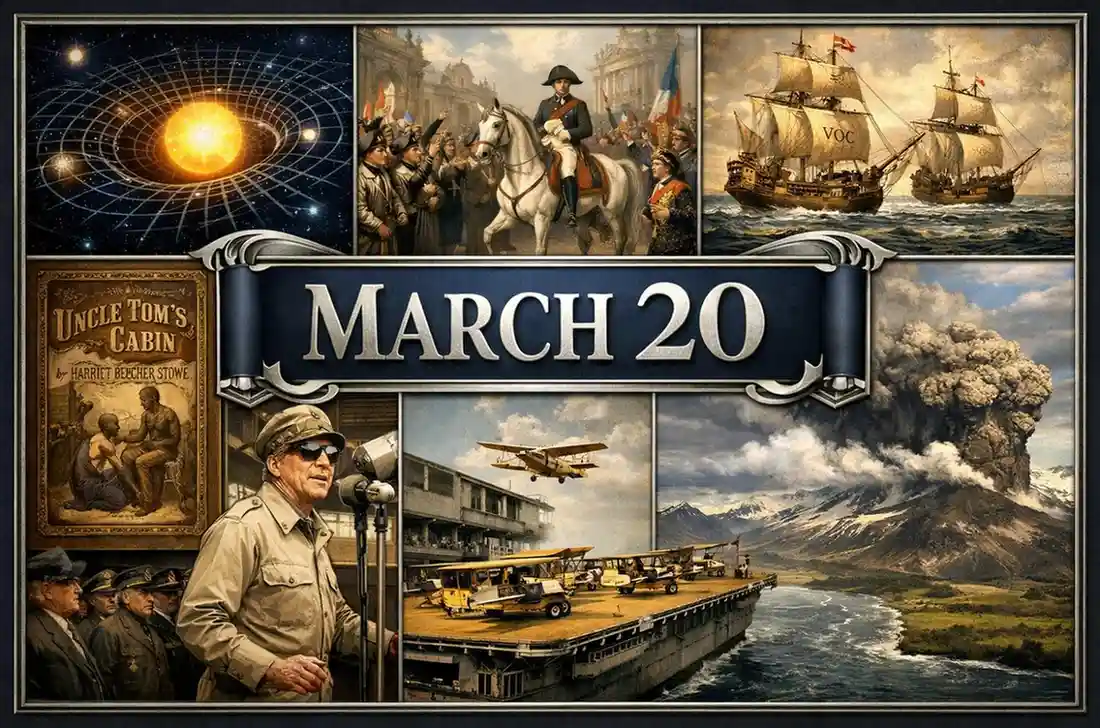
Assessing what happened on this day in history March 20, we observe a date that fundamentally reshaped modern science, politics, and global industry. From Albert Einstein submitting his groundbreaking paper on the General Theory of Relativity to the establishment of the Dutch East India Company, this day marks the beginning of eras that still influence the world today.
Important Events That Happened On March 20 In History
1206 – Appointment of Michael IV Autoreianos
Michael IV Autoreianos was officially appointed as the Ecumenical Patriarch of Constantinople. This appointment was highly significant as it took place while the Byzantine government was in exile in Nicaea following the fall of Constantinople to the Fourth Crusade. Michael IV played a crucial role in maintaining the religious legitimacy of the Nicaean Empire during this period of fragmentation.
1600 – Linköping Bloodbath
Following the War against Sigismund, five Swedish noblemen were publicly beheaded in Linköping, Sweden. This execution took place on Maundy Thursday and served as a brutal conclusion to the conflict between Duke Charles and King Sigismund III Vasa. The event solidified Duke Charles’s grip on power and moved Sweden closer to a formal break with the Polish-Lithuanian Union.
1602 – Founding of the Dutch East India Company
The Dutch East India Company (Verenigde Oostindische Compagnie or VOC) was established by a charter from the States-General of the Netherlands. It was granted a 21-year monopoly on the Dutch spice trade and became the world’s first formally listed public company. The VOC eventually grew into a massive commercial empire with the power to wage war, coin money, and establish colonies.
1616 – Sir Walter Raleigh Freed
After spending 13 years imprisoned in the Tower of London for treason, the famed explorer and courtier Sir Walter Raleigh was released. He was freed to lead a final expedition to South America in search of “El Dorado,” the legendary city of gold. However, the mission’s failure and conflict with Spanish forces would eventually lead to his execution years later.
1815 – Napoleon’s Return to Paris
Escaping from his exile on the island of Elba, Napoleon Bonaparte entered Paris with an army that had swelled to 140,000 regular troops and 200,000 volunteers. His arrival marked the beginning of his “Hundred Days” rule, as King Louis XVIII fled the capital. This daring return set the stage for the final showdown at the Battle of Waterloo.
1852 – Publication of Uncle Tom’s Cabin
Harriet Beecher Stowe’s anti-slavery novel, Uncle Tom’s Cabin, was published in book form. The story vividly depicted the harsh reality of enslaved people in the United States and became a massive bestseller. Its profound impact on public opinion in the North helped fuel the abolitionist movement and is often cited as one of the cultural catalysts for the American Civil War.
1854 – Founding of the Republican Party
A group of anti-slavery activists and former members of the Whig and Free Soil parties met in a schoolhouse in Ripon, Wisconsin, to organize a new political movement. This meeting is recognized as the birth of the Republican Party of the United States. The party was formed specifically to oppose the expansion of slavery into new Western territories.
1890 – Dismissal of Otto von Bismarck
Emperor Wilhelm II officially dismissed Otto von Bismarck as the Chancellor of the German Empire. Bismarck, known as the “Iron Chancellor,” had been the primary architect of German unification and had dominated European diplomacy for decades. His removal signaled a major shift in German foreign policy toward a more aggressive and imperialistic stance.
1916 – Einstein Submits General Relativity Paper
Albert Einstein submitted his monumental paper, “The Foundation of the General Theory of Relativity,” to the journal Annalen der Physik. This work expanded on his previous theories to include gravity, describing it as a curvature of spacetime caused by mass and energy. This discovery fundamentally changed the field of physics and our understanding of the universe.
1922 – Commissioning of the USS Langley
The USS Langley was commissioned as the first aircraft carrier in the United States Navy. Converted from a collier (coal transport ship), it served as a floating laboratory for developing the techniques and equipment necessary for naval aviation. Its launch marked the beginning of a new era in maritime warfare that would define the 20th century.
1933 – Creation of Dachau Concentration Camp
Heinrich Himmler, acting as the Chief of Police of Munich, ordered the establishment of the Dachau concentration camp. Originally intended to hold political prisoners, it was the first of the Nazi concentration camps and served as a prototype for the vast network of camps that followed. Theodor Eicke was appointed as the camp’s first commandant.
1942 – MacArthur’s “I Shall Return” Speech
After being ordered to evacuate the Philippines during the Japanese invasion, General Douglas MacArthur arrived at Terowie, South Australia. During a speech at the local railway station, he famously declared, “I came out of Bataan and I shall return.” This promise became a rallying cry for Allied forces and the Filipino people throughout the remainder of the war.
1956 – Tunisia Gains Independence
Tunisia officially gained its independence from France after decades of colonial rule and a period of intense nationalist struggle led by Habib Bourguiba. The signing of the independence protocol ended the French protectorate and established Tunisia as a sovereign nation, with Bourguiba eventually becoming its first president.
1972 – First IRA Car Bombing in Belfast
During “The Troubles” in Northern Ireland, the Provisional IRA detonated its first car bomb in a busy commercial area of Belfast. The explosion killed seven people and injured nearly 150 others. This attack marked a significant and deadly escalation in the urban guerrilla warfare and paramilitary violence that gripped the region for decades.
1985 – First Woman Wins the Iditarod
Libby Riddles made history by becoming the first woman to win the 1,135-mile Iditarod Trail Sled Dog Race in Alaska. Battling through a severe blizzard that forced many other mushers to seek shelter, Riddles completed the grueling trek to Nome in 18 days, breaking a major gender barrier in the world of extreme endurance sports.
1995 – Sarin Gas Attack on Tokyo Subway
Members of the Aum Shinrikyo cult released deadly sarin nerve gas on five trains of the Tokyo subway system during the morning rush hour. The coordinated domestic terror attack killed 14 people and injured over 6,200 others. The event caused massive panic across Japan and led to a global re-evaluation of the threat posed by chemical weapons.
2003 – Invasion of Iraq Begins
A coalition of forces led by the United States, and including the United Kingdom, Australia, and Poland, began the invasion of Iraq. The military campaign, known as “Operation Iraqi Freedom,” started with a “shock and awe” bombing campaign and a rapid ground advance with the goal of removing the government of Saddam Hussein.
2010 – Eyjafjallajökull Eruptions
The Eyjafjallajökull volcano in Iceland began a series of eruptions that released a massive plume of volcanic ash into the atmosphere. Due to the risk the ash posed to jet engines, air travel across Europe was heavily disrupted for weeks, resulting in the largest air-traffic shutdown since World War II and stranding millions of travelers.
2015 – Celestial Triple Event
A rare astronomical coincidence occurred as a total solar eclipse, the spring equinox, and a supermoon all happened on the same day. While the total eclipse was only visible from parts of the North Atlantic and Arctic, the alignment of these three events provided a unique spectacle for astronomers and skywatchers around the globe.
2019 – Kassym-Jomart Tokayev Sworn In
Kassym-Jomart Tokayev was officially sworn in as the acting president of Kazakhstan. This followed the sudden and historic resignation of Nursultan Nazarbayev, who had led the nation since its independence from the Soviet Union. The transition marked a major political shift for the Central Asian nation, leading to the eventual renaming of the capital city in Nazarbayev’s honor.
2021 – Attack on La Plume Noire
The anarchist bookstore “La Plume noire” in Lyon, France, was targeted in a violent attack by members of the far-right. The incident, which involved the destruction of property and threats, caused a significant shock throughout Lyon’s political circles. It highlighted the rising tensions and physical confrontations between opposing ideological groups in modern French society.
Famous People Born on March 20
| Name | Description | Date |
|---|---|---|
| Bobby Orr | Canadian ice hockey defenseman, widely considered one of the greatest players | March 20, 1948 – Present |
| Brian Mulroney | Prime minister of Canada (1984–1993) | March 20, 1939 – February 29, 2024 |
| Michael Redgrave | British stage and film actor | March 20, 1908 – March 21, 1985 |
| Friedrich Hölderlin | German lyric poet | March 20, 1770 – June 7, 1843 |
| Sviatoslav Richter | Soviet pianist, one of the preeminent pianists of the 20th century | March 20, 1915 – August 1, 1997 |
| Paul von Lettow-Vorbeck | German officer, guerrilla leader in World War I Africa | March 20, 1870 – March 9, 1964 |
| Jean-Antoine Houdon | French Rococo sculptor | March 20, 1741 – July 15, 1828 |
| Charles William Eliot | American educator, president of Harvard University (1869–1909) | March 20, 1834 – August 22, 1926 |
| Beniamino Gigli | Italian operatic tenor | March 20, 1890 – November 30, 1957 |
| Alexandru Ioan Cuza | First prince of united Romania | March 20, 1820 – May 15, 1873 |
| René Coty | Last president of the French Fourth Republic (1954–1959) | March 20, 1882 – November 22, 1962 |
| David Malouf | Australian poet and novelist | March 20, 1934 – Present |
| Catherine Ashton | British politician, EU high representative for foreign affairs | March 20, 1956 – Present |
| John D. Ehrlichman | U.S. political adviser, key figure in the Watergate scandal | March 20, 1925 – February 14, 1999 |
| Marian McPartland | English-born American jazz musician and radio host | March 20, 1918 – August 20, 2013 |
| Raymond B. Cattell | British-born American personality psychologist | March 20, 1905 – February 2, 1998 |
| Mary Ellen Mark | American photojournalist | March 20, 1940 – May 25, 2015 |
| Abdülhamid I | Ottoman sultan (1774–1789) | March 20, 1725 – April 7, 1789 |
| Erwin Neher | German physicist, Nobel Prize winner (cell function) | March 20, 1944 – Present |
| Edward Gibbon Wakefield | British colonial administrator, colonizer of South Australia and New Zealand | March 20, 1796 – May 16, 1862 |
| Alfonso García Robles | Mexican diplomat, Nobel Peace Prize winner | March 20, 1911 – September 2, 1991 |
| Torbern Olof Bergman | Swedish chemist and naturalist | March 20, 1735 – July 8, 1784 |
| Hugh MacLennan | Canadian novelist and essayist | March 20, 1907 – November 7, 1990 |
| Neal Dow | American politician, temperance advocate (Maine Law of 1851) | March 20, 1804 – October 2, 1897 |
| E.Z.C. Judson | American writer, originator of dime novels | March 20, 1823 – July 16, 1886 |
| Lauritz Melchior | Danish-U.S. operatic tenor | March 20, 1890 – March 18, 1973 |
| Frederick Charles, prince of Prussia | Prussian field marshal, victor at Königgrätz | March 20, 1828 – June 15, 1885 |
| José Joaquín Olmedo | Ecuadorian poet and statesman | March 20, 1780 – February 19, 1847 |
| Frank Stanton | American radio and TV executive, president of CBS (1946–1971) | March 20, 1908 – December 24, 2006 |
| Luis Palés Matos | Puerto Rican lyric poet | March 20, 1898 – February 23, 1959 |
Famous People Died on March 20
| Name | Description | Date |
|---|---|---|
| Ferdinand Foch | Marshal of France, commander of Allied forces in World War I | October 2, 1851 – March 20, 1929 |
| Muḥammad ibn Tughluq | Sultan of Delhi (1325–1351), extended rule over most of the subcontinent | c.1290 – March 20, 1351 |
| Brendan Behan | Irish author and political commentator | February 9, 1923 – March 20, 1964 |
| C. Wright Mills | American sociologist | August 28, 1916 – March 20, 1962 |
| Thomas Seymour, Baron Seymour | English lord high admiral (1547–1549), executed for treason | c.1508 – March 20, 1549 |
| Malcolm Fraser | Prime minister of Australia (1975–1983) | May 21, 1930 – March 20, 2015 |
| Maria I | First queen regnant of Portugal (1777–1816) | December 17, 1734 – March 20, 1816 |
| Carl Theodor Dreyer | Danish film director | February 3, 1889 – March 20, 1968 |
| Lajos Kossuth | Hungarian political leader, leader of the 1848 revolution | September 19, 1802 – March 20, 1894 |
| Gil Evans | Canadian-born jazz composer and arranger | May 13, 1912 – March 20, 1988 |
| Matthias | Holy Roman emperor (1612–1619) | February 24, 1557 – March 20, 1619 |
| Saint Cuthbert | Bishop of Lindisfarne, one of the most venerated English saints | 634/635 – March 20, 687 |
| William Murray, 1st earl of Mansfield | British chief justice, made important contributions to commercial law | March 2, 1705 – March 20, 1793 |
| Albert | Last grand master of the Teutonic Knights, first duke of Prussia | May 17, 1490 – March 20, 1568 |
| Ivan Ivanovich Shishkin | Russian landscape painter | January 25, 1832 – March 20, 1898 |
| Hermann Müller | Chancellor of Germany during the Weimar Republic | May 18, 1876 – March 20, 1931 |
| Polykarp Kusch | German-American physicist, Nobel Prize winner | January 26, 1911 – March 20, 1993 |
| V.S. Pritchett | British novelist, short-story writer, and critic | December 16, 1900 – March 20, 1997 |
| Clement III | Pope (1187–1191) | unknown – March 20, 1191 |
| Robin Milner | British computer scientist, Turing Award winner | January 13, 1934 – March 20, 2010 |
| Tony Zale | American boxer, world middleweight champion | May 29, 1913 – March 20, 1997 |
| St. John of Nepomuk | Czech saint, patron saint of the Czechs | c.1345 – March 20, 1393 |
| Girija Prasad Koirala | Prime minister of Nepal (four terms) | 1925 – March 20, 2010 |
| Hasegawa Tōhaku | Japanese painter, founder of the Hasegawa school | 1539 – March 20, 1610 |
| Nicolas de Largillière | French historical and portrait painter | October 10, 1656 – March 20, 1746 |
| Jan Ladislav Dussek | Bohemian pianist and composer | February 12, 1760 – March 20, 1812 |
| Albrecht Ritschl | German Lutheran theologian | March 25, 1822 – March 20, 1889 |
| Ilya Ivanovich Ivanov | Soviet biologist, pioneer of artificial insemination | August 1, 1870 – March 20, 1932 |
| Victor Moritz Goldschmidt | Swiss-born Norwegian mineralogist, founder of modern geochemistry | January 27, 1888 – March 20, 1947 |
| W.C. Wentworth | Australian political leader, key figure in self-government | 1790 – March 20, 1872 |
Observances & Institutional Dates
- Independence Day (Tunisia): Celebrating the nation’s 1956 break from French colonial rule.
- International Day of Happiness: A United Nations observance promoting the importance of happiness and well-being as universal goals.
- International Francophonie Day: Celebrating the French language and Francophone culture worldwide.
- World Sparrow Day: An international day to raise awareness of the house sparrow and other common birds affected by urban environments.
Frequently Asked Questions
- What did Albert Einstein do on March 20, 1916? He submitted his foundational paper on the General Theory of Relativity.
- Who was the first woman to win the Iditarod? Libby Riddles won the race on March 20, 1985.
- When was the Republican Party founded? The party was organized on March 20, 1854, in Ripon, Wisconsin.
- What was the “Hundred Days”? It refers to the period starting March 20, 1815, when Napoleon returned to power in Paris.