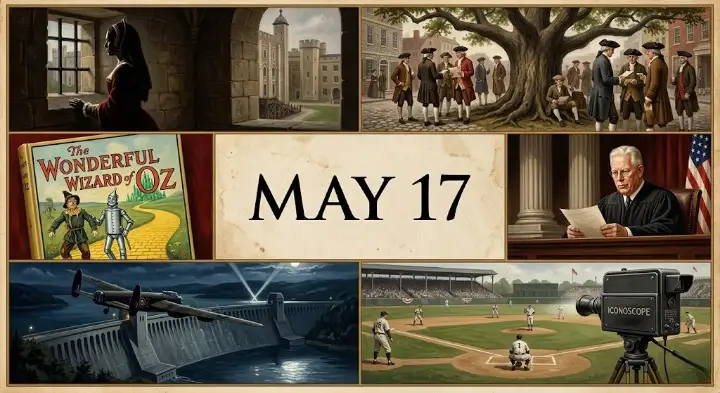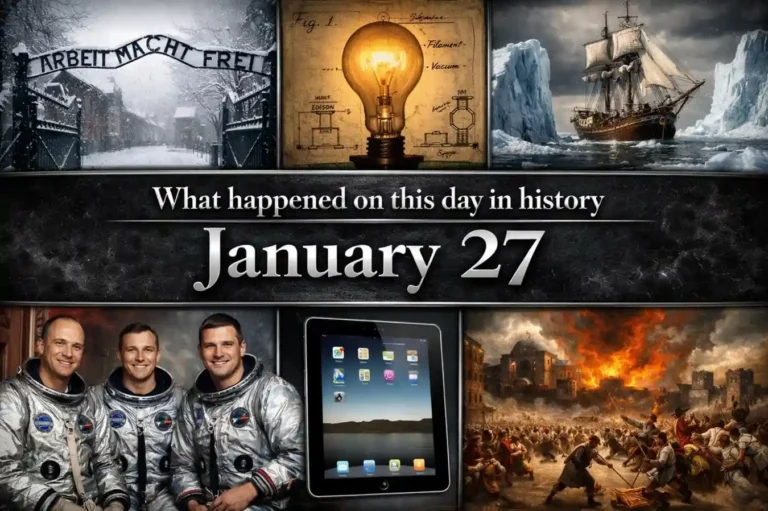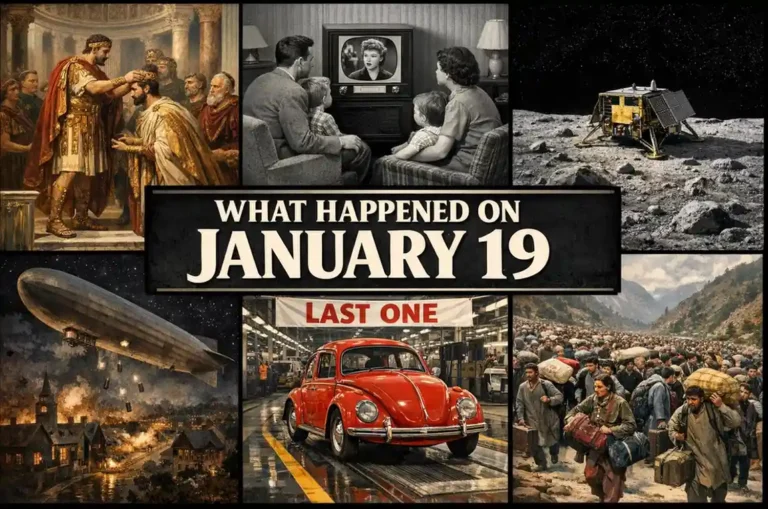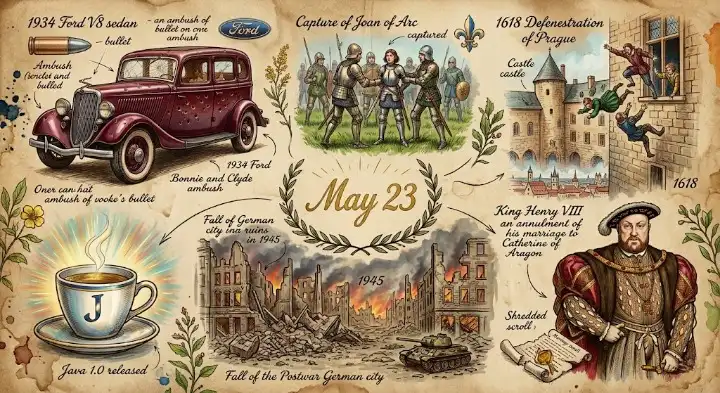
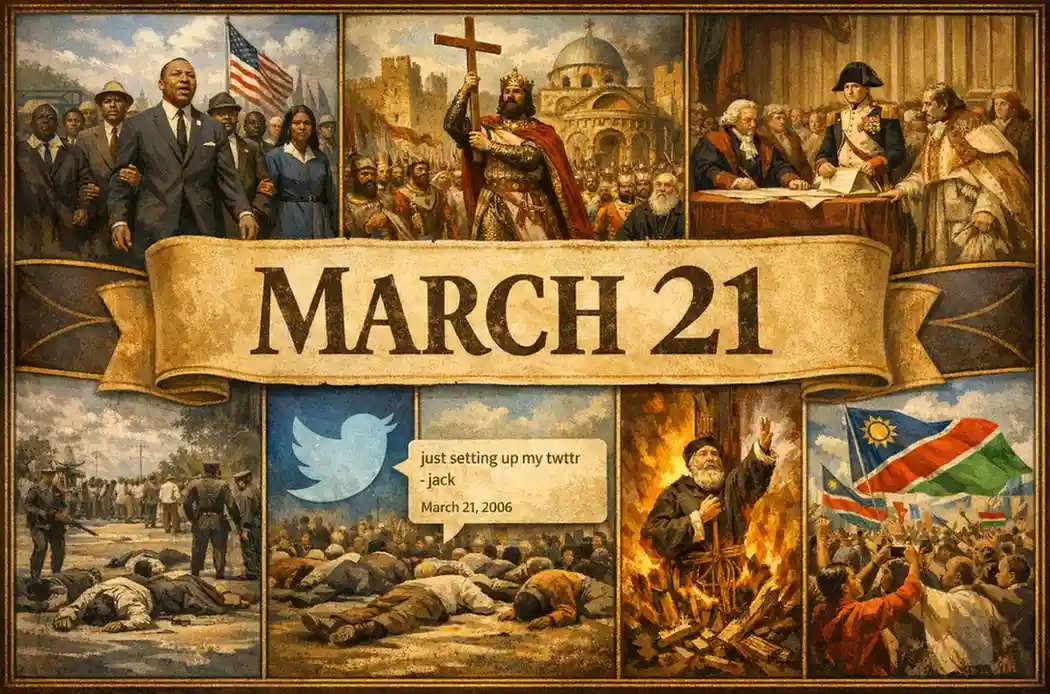
Whether we are looking at the restoration of sacred relics or the fight for civil rights, this day in history March 21 stands as a testament to human conviction. From Emperor Heraclius returning the True Cross to Jerusalem in 630 to Martin Luther King Jr. leading the defiant march from Selma to Montgomery in 1965, it’s a date that honors the long walk toward justice and faith.
Beyond the moral milestones, it also marks the moment the Napoleonic Code laid the groundwork for modern law and the very first post was sent on Twitter, forever changing how we connect.
Important Events That Happened On March 21 In History
537 – Siege of Rome: Assault Repulsed
During the Siege of Rome, the Gothic King Vitiges attempted a massive assault on the city’s northern and eastern walls. The defenders, led by Byzantine generals Bessas and Peranius, successfully repelled the attack at the Praenestine Gate. This victory was critical in maintaining the Byzantine hold on the ancient capital during the Gothic War.
630 – Return of the True Cross
Byzantine Emperor Heraclius personally returned the True Cross, one of the most sacred relics in Christendom, to the city of Jerusalem. The relic had been captured by the Persians years earlier. Its restoration was a moment of immense religious and political triumph for the Byzantine Empire and the Christian world.
717 – Battle of Vincy
Charles Martel, the Frankish Mayor of the Palace, defeated the forces of Ragenfrid at the Battle of Vincy. This victory was a decisive step in Martel’s consolidation of power over the Frankish kingdoms, eventually allowing him to establish the Carolingian dynasty that would produce Charlemagne.
867 – Battle of York
An army from the Kingdom of Northumbria attempted to retake the city of York from the Great Heathen Army. The Northumbrian forces were defeated by the Viking invaders, and the kings of Northumbria were killed. This defeat solidified Viking control over northern England, leading to the creation of the Kingdom of Jorvik.
1152 – Annulment of Louis VII and Eleanor of Aquitaine
The marriage between King Louis VII of France and Queen Eleanor of Aquitaine was formally annulled. The separation changed the course of European history, as Eleanor subsequently married Henry II of England, bringing her vast lands in Aquitaine under English control and sparking centuries of Anglo-French conflict.
1556 – Execution of Thomas Cranmer
Thomas Cranmer, the former Archbishop of Canterbury, was burned at the stake in Oxford during the Marian Persecutions. In a final act of defiance, he renounced his previous recantations and publicly denounced the Pope as an enemy of Christ. Cranmer remains a central figure in the history of the Church of England.
1788 – Great New Orleans Fire
A massive fire broke out in New Orleans, then under Spanish rule, leaving the vast majority of the city in ruins. Over 850 buildings were destroyed, leading to a complete architectural shift in the city as it was rebuilt with the Spanish-style brick buildings that define the modern French Quarter.
1804 – Adoption of the Napoleonic Code
The Code Napoléon was officially adopted as the civil law of France. This landmark legal code abolished feudalism, established the equality of male citizens before the law, and protected property rights. It became the foundation for civil law systems in many countries across Europe and Latin America.
1829 – The Wellington–Winchilsea Duel
The British Prime Minister, the Duke of Wellington, fought a duel with the Earl of Winchilsea in London. The dispute arose over Wellington’s support for Catholic Emancipation. Both men intentionally missed their shots, but the event caused a national scandal regarding the conduct of the Prime Minister.
1871 – Otto von Bismarck Named Chancellor
Following the unification of Germany, Otto von Bismarck was appointed as the first Chancellor of the German Empire. Known as the “Iron Chancellor,” his leadership was defined by “Realpolitik” and the establishment of a complex system of alliances that maintained German dominance in Europe for decades.
1918 – Operation Michael Begins
During World War I, the German army launched Operation Michael, the first phase of their massive Spring Offensive. The goal was to break through the Allied lines on the Western Front before American manpower could fully arrive. It was the largest breakthrough achieved since the start of trench warfare in 1814.
1919 – Hungarian Soviet Republic Established
The Hungarian Soviet Republic was proclaimed, becoming the first Communist government to be formed in Europe following the October Revolution in Russia. Led by Béla Kun, the revolutionary state lasted only 133 days before collapsing under military pressure from neighboring countries.
1925 – The Butler Act
The state of Tennessee passed the Butler Act, which prohibited public school teachers from teaching the theory of human evolution. This law set the stage for the famous Scopes “Monkey Trial” later that year, which became a national flashpoint for the debate between religious fundamentalism and modern science.
1935 – Persia Becomes Iran
Reza Shah Pahlavi formally requested that the international community use the name “Iran” instead of “Persia” to refer to the country. The change was intended to emphasize the nation’s ancient roots and its status as a modern, unified state for the Iranian people.
1937 – Ponce Massacre
In Ponce, Puerto Rico, police opened fire on a group of unarmed civilians marching to commemorate the abolition of slavery and protest the imprisonment of nationalist leaders. Nineteen people were killed and over 200 wounded in an attack ordered by the US-appointed Governor Blanton Winship.
1946 – NFL Integrates with Kenny Washington
The Los Angeles Rams signed Kenny Washington, making him the first African American player in the modern era of professional American football. This move ended a 13-year “gentleman’s agreement” that had excluded Black players from the NFL and preceded the integration of Major League Baseball.
1952 – Moondog Coronation Ball
The Moondog Coronation Ball, widely considered the first major rock and roll concert, was held in Cleveland, Ohio. Organized by disc jockey Alan Freed, the event was so overcrowded that it resulted in a near-riot and was shut down by the authorities after only one song, signaling the explosive arrival of the genre.
1960 – Sharpeville Massacre
During an anti-apartheid protest in the South African township of Sharpeville, police opened fire on a crowd of Black demonstrators. Sixty-nine people were killed and 180 wounded. The tragedy sparked international outrage and became a turning point in the struggle against apartheid.
1965 – Selma to Montgomery March
Martin Luther King Jr. led 3,200 people on the start of the third and final successful civil rights march from Selma to Montgomery, Alabama. This march was a pivotal moment in the movement, directly leading to the passage of the Voting Rights Act of 1965.
1980 – U.S. Announces Olympic Boycott
President Jimmy Carter announced that the United States would boycott the 1980 Summer Olympics in Moscow. The move was a protest against the Soviet invasion of Afghanistan. Over 60 other nations joined the boycott, significantly impacting the international sporting event and Cold War relations.
1990 – Independence of Namibia
Namibia officially gained its independence after 75 years of rule by South Africa. The event marked the end of a long struggle for self-determination and the dismantling of the final colonial administration on the African continent.
2006 – Founding of Twitter
The social media platform Twitter (now X) was founded when Jack Dorsey sent the first tweet: “just setting up my twttr.” The platform revolutionized real-time communication and has had a profound impact on global news, politics, and social interaction.
2022 – China Eastern Flight 5735 Crash
A Boeing 737-800 operated by China Eastern Airlines crashed in a mountainous region of Guangxi, China. All 132 people on board were killed. The crash was notable for the aircraft’s near-vertical descent from its cruising altitude, leading to an extensive investigation by aviation authorities.
Famous People Born on March 21
| Name | Description | Date |
|---|---|---|
| Modest Mussorgsky | Russian composer (Boris Godunov, Pictures from an Exhibition) | March 21, 1839 – March 28, 1881 |
| Joseph Fourier | French mathematician (Fourier series, Fourier transform) | March 21, 1768 – May 16, 1830 |
| Peter Brook | English avant-garde stage producer and director | March 21, 1925 – July 2, 2022 |
| John D. Rockefeller III | American philanthropist, member of the Rockefeller family | March 21, 1906 – July 10, 1978 |
| Solomon Burke | American singer, pioneer of soul music | March 21, 1940 – October 10, 2010 |
| Hans Hofmann | German-born American painter and influential art teacher | March 21, 1880 – February 17, 1966 |
| Nizār Qabbānī | Syrian diplomat and poet | March 21, 1923 – April 30, 1998 |
| Florenz Ziegfeld, Jr. | American theatrical producer, creator of the Ziegfeld Follies | March 21, 1869 – July 22, 1932 |
| Albert Kahn | American industrial architect, “father of modern factory design” | March 21, 1869 – December 8, 1942 |
| Jean Paul | German novelist and humorist | March 21, 1763 – November 14, 1825 |
| Rama I | King of Siam (1782–1809), founder of the Chakkri dynasty | March 21, 1737 – September 7, 1809 |
| Marit Bjørgen | Norwegian cross-country skier, most decorated Winter Olympian | March 21, 1980 – Present |
| Hans-Dietrich Genscher | German foreign minister (1974–1992) | March 21, 1927 – March 31, 2016 |
| Claude-Nicolas Ledoux | French visionary architect | March 21, 1736 – November 19, 1806 |
| Erich Mendelsohn | German Expressionist architect (Einstein Tower) | March 21, 1887 – September 15, 1953 |
| Walter Gilbert | American molecular biologist, Nobel Prize in Chemistry | March 21, 1932 – Present |
| George David Birkhoff | American mathematician, formulated the ergodic theorem | March 21, 1884 – November 12, 1944 |
| Yigael Yadin | Israeli archaeologist and military leader, Dead Sea Scrolls scholar | March 21, 1917 – June 28, 1984 |
| W.S. Van Dyke | American film director (The Thin Man) | March 21, 1889 – February 5, 1943 |
| James Jesse Strang | American religious leader, Mormon dissident | March 21, 1813 – July 9, 1856 |
| Bernard Cyril Freyberg, 1st Baron Freyberg | Governor-general of New Zealand, WWII commander | March 21, 1889 – July 4, 1963 |
| Arthur Grumiaux | Belgian violinist | March 21, 1921 – October 16, 1986 |
| Maurice | Elector of Saxony (1547–1553) | March 21, 1521 – July 9, 1553 |
| Jules Favre | French politician, negotiator of Treaty of Frankfurt | March 21, 1809 – January 19, 1880 |
| Heinrich Suso | German mystic and leader of the Friends of God | c. March 21, 1295 – January 25, 1366 |
| Phyllis McGinley | American poet, Pulitzer Prize winner | March 21, 1905 – February 22, 1978 |
| Jim Thompson | American-born Thai businessman, revived Thai silk industry | March 21, 1906 – March 26, 1967 |
| Nikos Skalkottas | Greek composer | March 21, 1904 – September 20, 1949 |
| Dirk Frimout | Belgian astrophysicist and astronaut, first Belgian in space | March 21, 1941 – Present |
| Lajos Kassák | Hungarian poet and novelist, pioneer of working-class literature | March 21, 1887 – July 22, 1967 |
Famous People Died on March 21
| Name | Description | Date |
|---|---|---|
| Andrew Grove | Hungarian-born American businessman, CEO of Intel | September 2, 1936 – March 21, 2016 |
| Michael Redgrave | British stage and film actor | March 20, 1908 – March 21, 1985 |
| Robert Southey | English poet, Poet Laureate, member of the Lake Poets | August 12, 1774 – March 21, 1843 |
| Robert Preston | American actor (The Music Man) | June 8, 1918 – March 21, 1987 |
| Joseph E. Johnston | Confederate general in the American Civil War | February 3, 1807 – March 21, 1891 |
| Leo Fender | American inventor, manufacturer of the Fender electric guitar | August 10, 1909 – March 21, 1991 |
| Martin McGuinness | Northern Irish politician, Sinn Féin leader | May 23, 1950 – March 21, 2017 |
| Nadar | French photographer and caricaturist | April 5, 1820 – March 21, 1910 |
| John Law | Scottish economist, originator of the Mississippi Scheme | April 21, 1671 – March 21, 1729 |
| Aleksandr Glazunov | Russian composer | August 10, 1865 – March 21, 1936 |
| Willis Reed | American basketball player, New York Knicks legend | June 25, 1942 – March 21, 2023 |
| Walter White | American civil rights activist, NAACP executive secretary | July 1, 1893 – March 21, 1955 |
| Chuck Bednarik | American football player, Philadelphia Eagles legend | May 1, 1925 – March 21, 2015 |
| Nawal El Saadawi | Egyptian feminist writer and physician | October 27, 1931 – March 21, 2021 |
| James Ussher | Anglo-Irish prelate, biblical chronologist | January 4, 1581 – March 21, 1656 |
| Sen Rikyū | Japanese tea master, perfected the tea ceremony | 1522 – March 21, 1591 |
| Sir Benjamin Thompson, count von Rumford | American-born British physicist, founder of the Royal Institution | March 26, 1753 – March 21, 1814 |
| Jean-Baptiste Greuze | French genre and portrait painter | August 21, 1725 – March 21, 1805 |
| Louis-Antoine-Henri de Bourbon-Condé, duke d’Enghien | French prince, executed by Napoleon | August 2, 1772 – March 21, 1804 |
| George Crook | American army officer in the Civil War and Indian Wars | September 23, 1829 – March 21, 1890 |
| Taira Kiyomori | Japanese military leader, first soldier-dictator of Japan | 1118 – March 21, 1181 |
| Galina Ulanova | Russian ballerina, prima ballerina assoluta | January 8, 1910 – March 21, 1998 |
| Absalon | Danish archbishop and statesman | c.1128 – March 21, 1201 |
| Sir James Black | Scottish pharmacologist, Nobel Prize winner | June 14, 1924 – March 21, 2010 |
| Willem Mengelberg | Dutch conductor, led the Concertgebouw Orchestra | March 28, 1871 – March 21, 1951 |
| John Bates Clark | American economist, founder of marginal productivity theory | January 26, 1847 – March 21, 1938 |
| George Foreman | American boxer, two-time world heavyweight champion | January 10, 1949 – March 21, 2025 |
| Cearbhall Ó Dálaigh | President of Ireland (1974–1976) | February 12, 1911 – March 21, 1978 |
| William Blount | American politician, U.S. senator from Tennessee | March 26, 1749 – March 21, 1800 |
| Colin Dexter | British author, creator of Inspector Morse | September 29, 1930 – March 21, 2017 |
Observances & Institutional Dates
- International Day for the Elimination of Racial Discrimination: Observed annually on the anniversary of the Sharpeville Massacre.
- Independence Day (Namibia): Celebrating the nation’s sovereignty achieved in 1990.
- World Poetry Day: Declared by UNESCO to promote the reading, writing, and teaching of poetry.
- World Down Syndrome Day: A global awareness day observed since 2012 to advocate for the rights and well-being of people with Down syndrome.
- Human Rights Day (South Africa): A national holiday commemorating the sacrifices made in the struggle for democracy.
Frequently Asked Questions
- What was the True Cross? It is a holy relic believed to be the actual cross used in the crucifixion of Jesus, returned to Jerusalem on March 21, 630.
- Why is March 21 important for civil rights? It marks the start of the successful Selma to Montgomery march in 1965 and the anniversary of the Sharpeville Massacre in 1960.
- What is the Napoleonic Code? A comprehensive civil law code adopted in France on March 21, 1804, that influenced legal systems worldwide.
- When did Twitter start? The first tweet was sent on March 21, 2006, marking the platform’s founding.