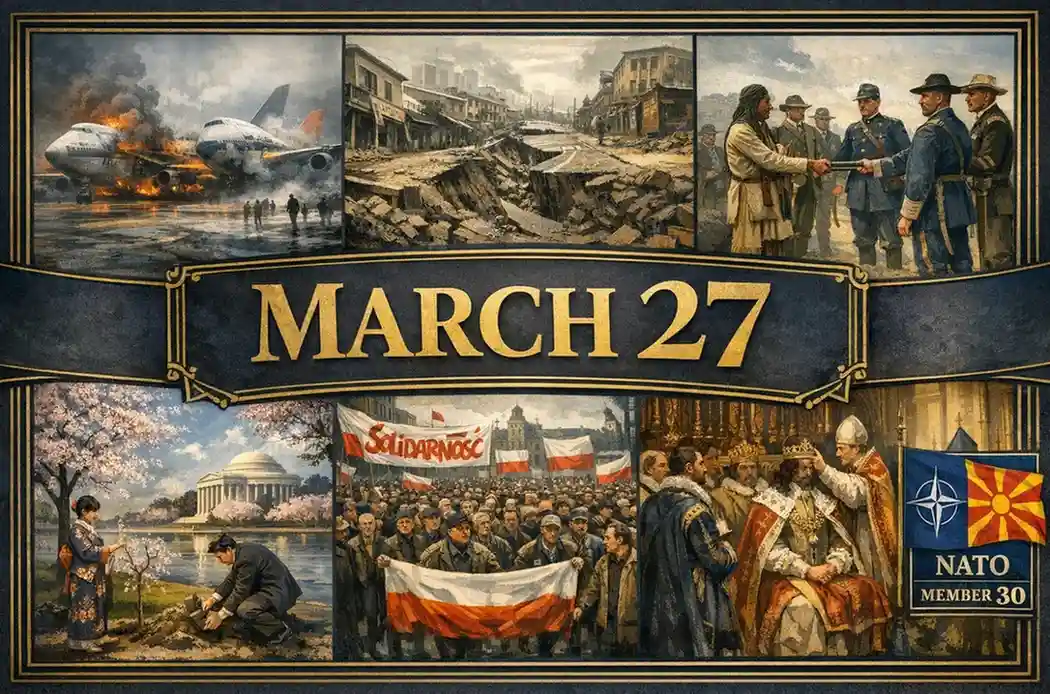
Reflecting on this day in history March 27, we see a date where the high stakes of power meet the reality of tragedy. From Charles I taking the English throne in 1625 to the devastating 1977 Tenerife airport disaster, the day is a reminder of how quickly the course of history can change. It’s also a time of political friction and growth, seen in the 1866 veto of the Civil Rights Act and North Macedonia joining NATO in 2020, proving that this date is always at the center of global shifts.
Important Events That Happened On March 27 In History
1309 – Excommunication of Venice
Pope Clement V imposed a severe sentence of excommunication and interdiction on the Republic of Venice. This religious and economic sanction included a general prohibition of all commercial intercourse after Venice seized Ferrara, which was considered a papal fiefdom.
1329 – Condemnation of Meister Eckhart
In the papal bull In Agro Dominico, Pope John XXII officially condemned several writings of the German theologian Meister Eckhart as heretical. This decree followed a lengthy investigation into Eckhart’s mystical teachings near the end of his life.
1513 – Ponce de León Reaches the Bahamas
Spanish explorer Juan Ponce de León reached the northern end of the Bahamas during his first voyage to the region. This expedition would eventually lead him to the coast of Florida as he searched for new lands and resources.
1625 – Accession of Charles I
Charles I became the King of England, Scotland, and Ireland following the death of his father, James I. He also maintained the traditional claim to the title of King of France, beginning a reign that would eventually be defined by intense conflict with Parliament.
1638 – First Calabrian Earthquake
The first of four massive earthquakes struck the Calabria region of southern Italy. With an estimated magnitude of 6.8 and a Mercalli intensity of XI, the disaster resulted in the deaths of between 10,000 and 30,000 people and destroyed numerous settlements.
1782 – Second Rockingham Ministry
The Second Rockingham ministry took office in Great Britain. This new administration immediately shifted British foreign policy by beginning the formal negotiations required to end the American War of Independence.
1794 – U.S. Navy Established
The United States Government officially established a permanent navy. The Naval Act of 1794 authorized the construction of six original frigates, providing the young nation with the means to protect its merchant shipping from pirates and foreign threats.
1809 – Battle of Ciudad Real
During the Peninsular War, a combined force of French and Polish troops defeated the Spanish army at the Battle of Ciudad Real. The victory allowed the French to maintain their momentum in the southern campaign across Spain.
1814 – Battle of Horseshoe Bend
In central Alabama, U.S. forces led by General Andrew Jackson decisively defeated the Upper Creek “Red Sticks” at the Battle of Horseshoe Bend. This victory effectively ended the Creek War and opened vast areas of the Southeast to white settlement.
1836 – Goliad Massacre
During the Texas Revolution, the Mexican Army executed 342 Texian Army prisoners of war at Goliad, Texas. The massacre was carried out under the direct orders of General Antonio López de Santa Anna and became a major rallying cry for Texian forces.
1866 – Veto of the Civil Rights Act
President Andrew Johnson issued a veto against the Civil Rights Act of 1866, which sought to protect the rights of formerly enslaved people. However, Congress later overrode his veto, and the bill became law on April 9, marking a historic shift in American legal history.
1871 – First International Rugby Match
The first international rugby football match took place at Raeburn Place in Edinburgh. Scotland defeated England in this historic inaugural meeting, establishing a long-standing tradition of international rugby competition.
1884 – Cincinnati Courthouse Riot
A mob in Cincinnati, Ohio, attacked a jury after they returned a verdict of manslaughter in a case many saw as a clear instance of murder. Over the following days, the situation escalated into a full-scale riot that resulted in the burning of the local courthouse.
1886 – Surrender of Geronimo
The famous Apache warrior Geronimo surrendered to the U.S. Army, marking the end of the main phase of the Apache Wars. His surrender signaled the conclusion of decades of resistance by the Apache people against American and Mexican encroachment.
1899 – Battle of Marilao River
Emilio Aguinaldo led Filipino forces in person for the only time during the Philippine–American War at the Battle of Marilao River. Despite the leadership presence, American forces managed to cross the river and continue their advance.
1901 – Capture of Emilio Aguinaldo
In a pivotal moment of the Philippine–American War, Emilio Aguinaldo, the leader of the First Philippine Republic, was captured by American forces. His capture significantly weakened the organized resistance against American colonial rule.
1912 – First Cherry Trees Planted in D.C.
First Lady Helen Taft and Viscountess Chinda, wife of the Japanese ambassador, planted two Yoshino cherry trees on the bank of the Potomac River. This gift from the city of Tokyo was the origin of what is now the National Cherry Blossom Festival in Washington, D.C.
1915 – “Typhoid Mary” Quarantined
Mary Mallon, known as “Typhoid Mary” and the first identified healthy carrier of typhoid fever in the U.S., was placed in quarantine for a second time. She would remain in isolation for the rest of her life to prevent further outbreaks of the disease.
1918 – Union of Bessarabia and Romania
The National Council of Bessarabia officially proclaimed its union with the Kingdom of Romania. This move followed the collapse of the Russian Empire and was a significant step in the formation of “Greater Romania.”
1933 – Japan Leaves the League of Nations
Japan formally withdrew from the League of Nations. The move was a protest after the League approved the Lytton Report, which criticized the Japanese invasion of Manchuria and ruled in favor of China’s sovereignty.
1938 – Battle of Taierzhuang Begins
The Battle of Taierzhuang began during the Second Sino-Japanese War. After several weeks of intense fighting, it resulted in the war’s first major victory for Chinese forces over the Imperial Japanese Army, providing a significant boost to Chinese morale.
1941 – Yugoslav Coup d’État
Officers of the Yugoslav Air Force carried out a bloodless coup, toppling the pro-Axis government that had recently signed the Tripartite Pact. The move was met with public support but eventually triggered an Axis invasion.
1942 – Deportations from Drancy
Nazi Germany and Vichy France began the systematic deportation of 65,000 Jews from the Drancy internment camp to extermination camps in the East. This was a grim milestone in the execution of the Holocaust within occupied France.
1943 – Battle of the Komandorski Islands
A naval battle began in the Aleutian Islands when United States Navy forces intercepted a Japanese fleet attempting to reinforce their garrison at Kiska. It was one of the few pure surface vessel engagements of the Pacific War.
1945 – Operation Starvation
The United States began “Operation Starvation,” a massive aerial mining campaign of Japan’s vital ports and inland waterways. On the same day, Argentina officially declared war on the Axis Powers.
1958 – Khrushchev Becomes Chairman
Nikita Khrushchev assumed the role of Chairman of the Council of Ministers of the Soviet Union. This consolidated his power, as he already held the position of First Secretary of the Communist Party.
1964 – Good Friday Earthquake
The most powerful earthquake recorded in North American history, at a magnitude of 9.2, struck Southcentral Alaska. The “Good Friday earthquake” killed 125 people and caused massive structural damage, particularly in the city of Anchorage.
1975 – Trans-Alaska Pipeline Construction Begins
Construction officially started on the Trans-Alaska Pipeline System. The project was designed to transport crude oil from Prudhoe Bay on the North Slope to the ice-free port of Valdez, covering nearly 800 miles of rugged terrain.
1976 – Washington Metro Opens
The first section of the Washington Metro, the rapid transit system for the U.S. capital, opened to the public. The initial phase served a small portion of the city but eventually grew into a massive regional network.
1977 – Tenerife Airport Disaster
Two Boeing 747 airliners, operated by KLM and Pan Am, collided on a foggy runway at Los Rodeos Airport in Tenerife. The disaster killed 583 people and remains the deadliest accident in the history of commercial aviation.
1980 – Collapse of Alexander L. Kielland
The Norwegian semi-submersible drilling rig Alexander L. Kielland collapsed in the North Sea during a storm. Of the 212 crew members on board, 123 lost their lives in what was a major catastrophe for the offshore oil industry.
1981 – Solidarity Warning Strike
The Solidarity movement in Poland organized a four-hour “warning strike” in which an estimated 12 million Poles walked off their jobs. It was the largest strike in the history of the Eastern Bloc and demonstrated the massive scale of the opposition movement.
1986 – Russell Street Headquarters Bombing
A car bomb exploded outside the Russell Street Police Headquarters in Melbourne, Australia. The blast killed one police officer and injured 21 other people, leading to a major investigation into domestic terrorism.
1990 – Launch of TV Martí
The United States began broadcasting TV Martí, a television station designed to transmit anti-Castro propaganda and news to Cuba. The broadcasts were part of a long-standing information campaign directed at the island nation.
1993 – Jiang Zemin Becomes President
Jiang Zemin was officially appointed as the President of the People’s Republic of China. His appointment occurred during a period of rapid economic growth and solidified his leadership following the events of 1989.
1993 – Allegations Against Giulio Andreotti
Former Italian Prime Minister Giulio Andreotti was formally accused of having ties to the Mafia by the tribunal in Palermo. The investigation into the long-time Christian Democracy leader became a centerpiece of Italy’s political scandals in the 1990s.
1998 – FDA Approves Viagra
The Food and Drug Administration approved the use of Viagra as a treatment for erectile dysfunction. It was the first oral medication approved for the condition in the United States, quickly becoming a major pharmaceutical success.
1999 – F-117A Nighthawk Shot Down
During the Kosovo War, a Yugoslav Army surface-to-air missile successfully shot down an American Lockheed F-117A Nighthawk. This remains the only time a “stealth fighter” has ever been lost in combat.
2000 – Pasadena Plant Explosion
An explosion at a Phillips Petroleum chemical plant in Pasadena, Texas, killed one person and injured 71 others. The incident raised significant concerns regarding safety protocols at industrial facilities in the region.
2002 – Passover Massacre
A Palestinian suicide bomber attacked a hotel in Netanya, Israel, during a Passover seder dinner. The blast killed 29 people and injured many others, leading to a significant escalation in the regional conflict.
2002 – Nanterre Massacre
A gunman opened fire at the conclusion of a town council meeting in Nanterre, France. The attack resulted in the deaths of eight councilors and left 19 other people injured before the perpetrator was subdued.
2004 – Sinking of HMS Scylla
The decommissioned Leander-class frigate HMS Scylla was intentionally sunk off the coast of Cornwall. It became Europe’s first artificial reef created from a former naval vessel, intended to support marine life and diving tourism.
2009 – Situ Gintung Dam Failure
The dam forming the Situ Gintung artificial lake in Indonesia failed, sending a wall of water into a residential area. The disaster resulted in at least 99 deaths and destroyed hundreds of homes.
2014 – Philippine Peace Accord
The government of the Philippines signed a historic peace accord with the Moro Islamic Liberation Front, the largest Muslim rebel group in the country. The agreement aimed to end decades of violent conflict in the southern Philippines.
2015 – Al-Shabab Hotel Attack
Militants from Al-Shabab attacked and temporarily occupied a hotel in Mogadishu, Somalia. The siege left at least 20 people dead, highlighting the ongoing security challenges posed by the group in the capital.
2016 – Lahore Easter Bombing
A suicide bomber struck Gulshan-e-Iqbal Park in Lahore, Pakistan, during Easter celebrations. The blast claimed over 70 lives, many of whom were women and children, and was specifically aimed at members of the Christian community.
2020 – North Macedonia Joins NATO
North Macedonia officially became the 30th member of the North Atlantic Treaty Organization (NATO). The accession followed the resolution of a long-standing naming dispute with Greece, allowing the nation to integrate into the Western security alliance.
2023 – Covenant School Shooting
Seven people, including the perpetrator and three children, were killed in a mass shooting at the Covenant School in Nashville, Tennessee. The tragedy sparked renewed national debates over school safety and gun control legislation.
2023 – Ciudad Juárez Detention Fire
A fire broke out at a migrant detention facility in Ciudad Juárez, Mexico, near the U.S. border. Forty people lost their lives in the blaze, drawing international attention to the conditions and safety of migrant processing centers.
Read Also: This day in history March 26: Independence, Innovations, and Icons
Famous People Born on March 27
| Name | Description | Date |
|---|---|---|
| Sarah Vaughan | American jazz vocalist and pianist, one of the greatest jazz singers | March 27, 1924 – April 3, 1990 |
| Karl Pearson | British mathematician, founder of modern statistics | March 27, 1857 – April 27, 1936 |
| Georges-Eugène, Baron Haussmann | French administrator who transformed Paris | March 27, 1809 – January 11, 1891 |
| Edward Steichen | American photographer, influential modernist | March 27, 1879 – March 25, 1973 |
| Sergei Kirov | Russian Communist leader, his assassination triggered the Great Purge | March 27, 1886 – December 1, 1934 |
| Cyrus Vance | American secretary of state (1977–1980) | March 27, 1917 – January 12, 2002 |
| Frank O’Hara | American poet, leading figure of the New York School | March 27, 1926 – July 25, 1966 |
| Ben Webster | American jazz tenor saxophonist | March 27, 1909 – September 20, 1973 |
| Heinrich Mann | German novelist and essayist, brother of Thomas Mann | March 27, 1871 – March 12, 1950 |
| Sir Henry Royce | British industrialist, co-founder of Rolls-Royce | March 27, 1863 – April 22, 1933 |
| Satō Eisaku | Prime minister of Japan (1964–1972), Nobel Peace Prize winner | March 27, 1901 – June 3, 1975 |
| Endō Shūsaku | Japanese novelist (Silence) | March 27, 1923 – September 29, 1996 |
| Ferenc Rákóczi II | Prince of Transylvania, leader of Hungarian uprising against Habsburgs | March 27, 1676 – April 8, 1735 |
| Karl Mannheim | German sociologist, founder of the sociology of knowledge | March 27, 1893 – January 9, 1947 |
| Alfred-Victor, count de Vigny | French Romantic poet, dramatist, and novelist | March 27, 1797 – September 17, 1863 |
| Cale Yarborough | American NASCAR driver, three-time Cup Series champion | March 27, 1939 – December 31, 2023 |
| Ferde Grofé | American composer and arranger (Grand Canyon Suite) | March 27, 1892 – April 3, 1972 |
| Vincent d’Indy | French composer and teacher | March 27, 1851 – December 1, 1931 |
| Arthur Mitchell | American dancer, first Black principal dancer at NYCB | March 27, 1934 – September 19, 2018 |
| John Sulston | British biologist, Nobel Prize winner (genetics of development) | March 27, 1942 – March 6, 2018 |
| Adolphus Washington Greely | American Arctic explorer and army officer | March 27, 1844 – October 20, 1935 |
| Jules Olitski | Russian-born American painter, Color Field artist | March 27, 1922 – February 4, 2007 |
| Ai Qing | Chinese poet, influential in modern Chinese poetry | March 27, 1910 – May 5, 1996 |
| Anna Mae Aquash | Mi’kmaq Indian activist, American Indian Movement figure | March 27, 1945 – February 24, 1976 |
| Otto Wallach | German chemist, Nobel Prize winner (terpenes) | March 27, 1847 – February 26, 1931 |
| Budd Schulberg | American novelist and screenwriter (On the Waterfront) | March 27, 1914 – August 5, 2009 |
| John Ballance | Prime minister of New Zealand (1891–1893) | March 27, 1839 – April 27, 1893 |
| Francis Ponge | French poet, master of prose poems about everyday objects | March 27, 1899 – August 6, 1988 |
| Leroy Carr | American blues singer and pianist | March 27, 1905 – April 29, 1935 |
| Pee Wee Russell | American jazz clarinetist | March 27, 1906 – February 15, 1969 |
Famous People Died on March 27
| Name | Description | Date |
|---|---|---|
| Fazlur Khan | Bangladeshi American engineer, “father of tubular designs” for skyscrapers | April 3, 1929 – March 27, 1982 |
| Adrienne Rich | American poet, scholar, and feminist critic | May 16, 1929 – March 27, 2012 |
| Henry Adams | American historian and autobiographer (The Education of Henry Adams) | February 16, 1838 – March 27, 1918 |
| James Thomas Brudenell, 7th earl of Cardigan | British general, led the Charge of the Light Brigade | October 16, 1797 – March 27, 1868 |
| Arnold Bennett | British novelist, playwright, and critic | May 27, 1867 – March 27, 1931 |
| Mary of Burgundy | Duchess of Burgundy (1477–1482) | February 13, 1457 – March 27, 1482 |
| Sir George Gilbert Scott | English architect, leader of Gothic Revival | July 13, 1811 – March 27, 1878 |
| B. Traven | Mysterious novelist (The Treasure of the Sierra Madre) | c. March 5, 1890 – March 27, 1969 |
| Vasily Vasilyevich Smyslov | Russian chess grandmaster, world champion (1957–1958) | March 24, 1921 – March 27, 2010 |
| Arnulf I | Count of Flanders (918–958, 962–965) | c.900 – March 27, 965 |
| John Bright | British reform politician, co-founder of Anti-Corn Law League | November 16, 1811 – March 27, 1889 |
| Michael Joseph Savage | Prime minister of New Zealand (1935–1940) | March 23, 1872 – March 27, 1940 |
| Paul Lauterbur | American chemist, Nobel Prize winner (MRI) | May 6, 1929 – March 27, 2007 |
| Malcolm Cowley | American literary critic and social historian | August 24, 1898 – March 27, 1989 |
| Theodor de Bry | Flemish-German engraver and publisher | 1528 – March 27, 1598 |
| Johann Stamitz | Bohemian composer, founder of the Mannheim school | June 19, 1717 – March 27, 1757 |
| Jaroslav Heyrovský | Czech chemist, Nobel Prize winner (polarography) | December 20, 1890 – March 27, 1967 |
| Alexander Agassiz | Swiss marine zoologist and oceanographer | December 17, 1835 – March 27, 1910 |
| Julio González | Spanish sculptor, pioneer of iron sculpture | September 21, 1876 – March 27, 1942 |
| Mao Dun | Chinese novelist, leading realist of republican China | July 4, 1896 – March 27, 1981 |
| Jorge Manrique | Spanish poet and soldier | 1440 – March 27, 1479 |
| Sir Arthur Bliss | English composer | August 2, 1891 – March 27, 1975 |
| Langley George Hancock | Australian mining industrialist | June 10, 1909 – March 27, 1992 |
| Cass Canfield | American publisher (Harper & Brothers) | April 26, 1897 – March 27, 1986 |
| Eugène Carrière | French painter and lithographer | January 17, 1849 – March 27, 1906 |
| Edgar Quinet | French poet, historian, and political philosopher | February 17, 1803 – March 27, 1875 |
| François-Alexandre-Frédéric, duc de La Rochefoucauld-Liancourt | French educator and social reformer | January 11, 1747 – March 27, 1827 |
| Susan Blow | American educator, launched first public kindergarten in U.S. | June 7, 1843 – March 27, 1916 |
| Barghash | Sultan of Zanzibar (1870–1888) | c.1834 – March 27, 1888 |
| Hjalmar Andersen | Norwegian speed skater, three-time Olympic gold medalist (1952) | March 12, 1923 – March 27, 2013 |
Observances & Institutional Dates
- World Theatre Day: Created by the International Theatre Institute to celebrate the importance of theatre arts globally.
- Independence Day (Myanmar): Specifically observed as Armed Forces Day, commemorating the start of resistance against Japanese occupation in 1945.
- Maryland Day (USA): Commemorating the 1634 arrival of the first European settlers in the province of Maryland.
- Day of the Union of Bessarabia with Romania: A national holiday in Romania honoring the 1918 unification proclamation.
Frequently Asked Questions
- What was the deadliest aviation accident? The Tenerife airport disaster on March 27, 1977, involving two Boeing 747s, which killed 583 people.
- When did the Good Friday earthquake occur? It struck Southcentral Alaska on March 27, 1964, and remains the strongest earthquake recorded in North America.
- Who was “Typhoid Mary”? Mary Mallon was a healthy carrier of typhoid fever who was permanently quarantined on March 27, 1915, to stop the spread of disease.
- What is the significance of March 27 for NATO? North Macedonia officially joined NATO as its 30th member on this day in 2020.