Introuduction
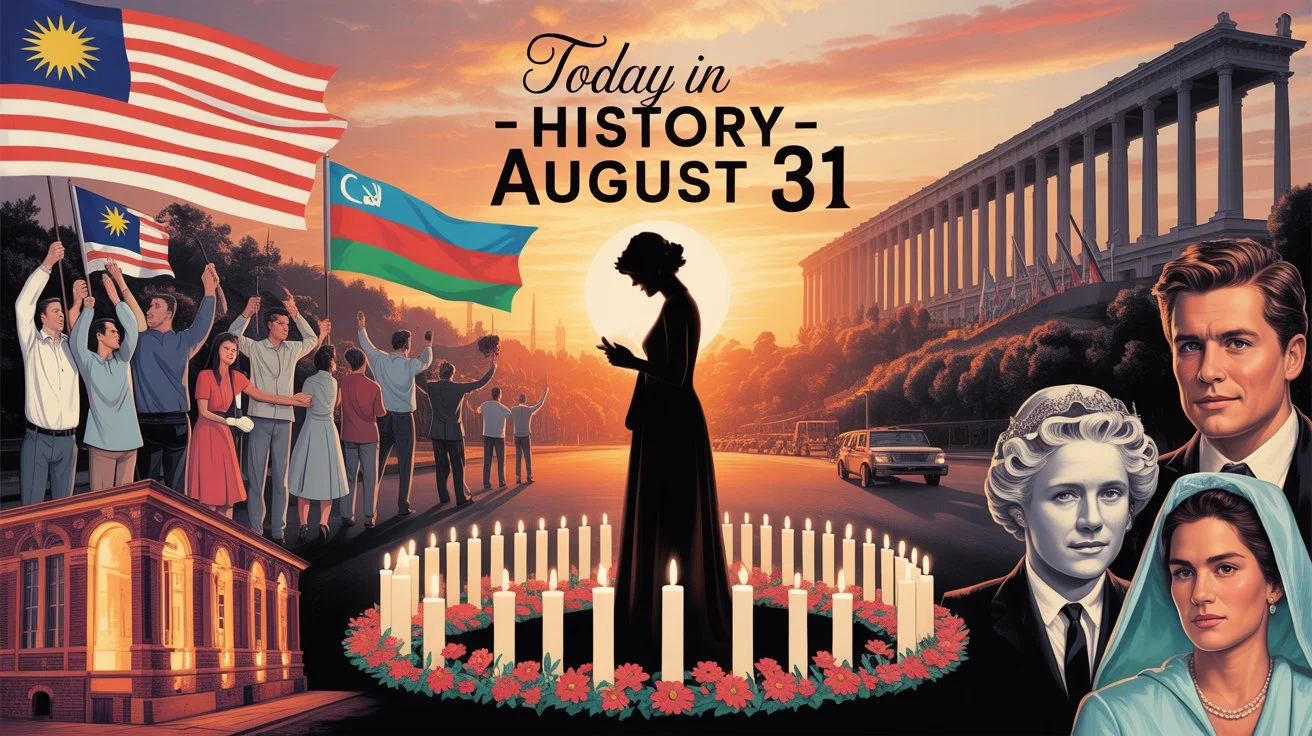
August 31 threads together wars and ceasefires, inventions and art heists, independence days and royal headlines. On this date, you’ll find cities declared capitals, unions born that toppled regimes, and milestones in flight, film, and space ambitions. It’s also a day of solemn remembrance—from earthquakes and sieges to a princess mourned worldwide. Here’s the complete, polished roundup.
Major Events on August 31
1751 — Robert Clive Seizes Arcot (India)
Robert Clive’s surprise capture of Arcot marked a turning point in the Carnatic Wars and the struggle for influence in South India. Holding the city through a grueling 53-day siege, Clive showed audacious tactics that made his reputation. The defense stiffened British East India Company resolve and reshaped local alliances. Arcot became a case study in how a small, aggressive force could change the political map.
1803 — Meriwether Lewis Departs Pittsburgh to Begin the Lewis & Clark Expedition
Launching from Pittsburgh on this day, Meriwether Lewis set the expedition in motion toward America’s vast, unmapped West. The journey would chart the Missouri River system, contact dozens of Indigenous nations, and gather invaluable scientific data. It also accelerated U.S. geographic knowledge and ambitions for continental expansion. The departure stands as the operational start of one of history’s great exploratory feats.
1823 — Battle of Trocadero Restores Ferdinand VII in Spain
French troops captured the Trocadero fortress near Cádiz, breaking liberal resistance and restoring absolutist rule to Ferdinand VII. The victory confirmed Bourbon power and signaled the ebb of Spain’s 1820–23 constitutional experiment. It also showed how the post-Napoleonic order used intervention to prop up monarchies. Trocadero echoed across Europe as a warning to reformers and a relief to reactionary courts.
1850 — Honolulu Declared Capital and City of the Hawaiian Kingdom
Under Kamehameha III, Honolulu was formally recognized as both city and capital, cementing its role as the kingdom’s political and commercial heartbeat. The decision harnessed the harbor’s strategic advantages for Pacific trade. It accelerated administrative centralization and diplomatic outreach. Honolulu’s rise from port settlement to capital helped set the stage for the islands’ modern identity.
1864 — Confederate Evacuation of Atlanta Begins
As Union forces tightened their grip, Confederates started pulling out of Atlanta, yielding the city to General William T. Sherman. The fall delivered the Union a crucial morale and political victory in an election year. It positioned Sherman for his infamous March to the Sea, cutting through the Confederacy’s heartland. Atlanta’s evacuation symbolized shifting momentum—and the war’s grinding costs for civilians.
1886 — The Charleston Earthquake
A powerful quake devastated Charleston, killing dozens and damaging thousands of structures far beyond the city. The event shocked the Eastern U.S., which many assumed to be relatively safe from seismic disasters. Engineers and officials responded with changes in building practice and awareness of regional risk. More than a century later, Charleston’s quake still shapes preparedness along the Atlantic seaboard.
1888 — First Jack the Ripper Victim Discovered
Mary Ann Nichols was found murdered in Whitechapel, igniting one of history’s most infamous unsolved serial-killer cases. The brutality transfixed Victorian London and fueled sensational press coverage. Police struggled with limited forensics, public panic, and a torrent of bogus letters. The case left a cultural legacy of fear, fascination, and enduring mystery.
1897 — Thomas Edison Patents the Kinetoscope (Motion-Picture Pioneer)
Edison’s patent advanced early moving-image technology and helped commercialize film exhibition. Though first designed for peep-show viewing, the concept catalyzed projection and the rise of cinemas. Filmmaking rapidly evolved into a mass art form and industry. From newsreels to blockbusters, the kinetoscope’s lineage is everywhere on screen.
1940 — Laurence Olivier Marries Vivien Leigh
Two titans of stage and screen wed, creating a celebrity partnership that captivated the English-speaking world. Their collaborations—Romeo and Juliet, Hamlet, and more—blurred lines between art and tabloid intrigue. The marriage showcased both the glamour and pressures of mid-century stardom. Even after their split, the Olivier-Leigh era remained a touchstone for acting craft and fame’s cost.
1942 — Battle of Alam Halfa (North Africa)
Outside El Alamein, British forces under Bernard Montgomery halted Erwin Rommel’s thrust at Alam Halfa. The defensive stand preserved Allied lines and set conditions for the later, decisive Second Battle of El Alamein. It demonstrated the power of prepared positions, air superiority, and logistics. From this point, Axis momentum in North Africa waned.
1944 — British Eighth Army Breaches the Gothic Line (Italy)
Allied troops punched through Germany’s last major defensive line in Italy, the Gothic Line. The breakthrough was hard-won, in rugged terrain and against seasoned defenders. It reopened the advance up the peninsula, though progress remained slow and costly. The action chipped away at Axis positions across Southern Europe.
1949 — Richard Gere Born (Cultural Milestone)
Richard Gere’s birth on this day foreshadowed a career that would span American Gigolo to Chicago. His star persona mixed charm with social activism, especially on Tibet. Gere became emblematic of a late-20th-century Hollywood leading man. His longevity shows how celebrity can evolve alongside changing audiences.
1961 — Concrete Wall Replaces Barbed Wire in Berlin
Weeks after the initial barrier went up, authorities began replacing barbed wire with a permanent concrete wall. The structure became the Cold War’s starkest symbol, dividing families and ideologies. Its fortification signaled endurance, not a temporary measure. For nearly three decades, the Wall embodied Europe’s fracture line.
1962 — Trinidad & Tobago Gains Independence
The twin-island nation left British rule and stepped onto the global stage as a sovereign state. Independence amplified its cultural voice—from Carnival to calypso and steelpan—worldwide. Politically, it balanced Caribbean regionalism with global diplomacy. The date remains a touchstone for national pride and identity.
1965 — U.S. Department of Housing & Urban Development (HUD) Created
Congress established HUD to coordinate federal housing policy, urban renewal, and fair-housing enforcement. The move responded to postwar urbanization, segregation, and poverty. Over time HUD became central to housing finance, community development, and disaster recovery. Its creation marked a lasting federal commitment to America’s cities.
1968 — Dasht-e Bayaz Earthquake in Iran
A magnitude-7+ quake devastated villages in northeastern Iran, leveling homes and infrastructure. The destruction highlighted the vulnerability of traditional construction to seismic shocks. Relief and reconstruction strained local and national capacity. The tragedy spurred discussions on safer building practices in quake-prone regions.
1970 — Queen Rania of Jordan was Born
Rania al-Abdullah’s modern public role has emphasized education, digital literacy, and women’s empowerment. She helped reframe what a 21st-century monarch can do in civic life. Her advocacy reaches far beyond Jordan through global partnerships. The date marks the birth of a widely recognized humanitarian voice.
1980 — Birth of Solidarity: The Gdańsk Agreement
Polish workers secured the right to form an independent union, Solidarity, after strikes at the Gdańsk Shipyard. The deal cracked the Soviet bloc’s monopoly on organized labor. Over the 1980s, Solidarity evolved into a nationwide movement that helped end communist rule. Its success inspired democratic opposition across Eastern Europe.
1985 — Capture of “Night Stalker” Richard Ramirez
Los Angeles residents and police apprehended the serial killer whose crimes had terrorized California. The arrest closed a harrowing chapter of fear, misinformation, and sensational trials. It also spotlighted how communities mobilize under stress. The case influenced criminal profiling and media ethics in covering violent crime.
1986 — Admiral Nakhimov Disaster in the Black Sea
A Soviet cruise ship collided with a freighter near Novorossiysk, sinking rapidly and killing hundreds. The tragedy exposed weaknesses in navigational protocols and emergency preparedness. It haunted maritime safety discussions in the late Soviet period. Commemorations remember the victims and the lessons paid in blood.
1989 — Princess Anne and Mark Phillips Announce Separation
After 16 years of marriage, the couple’s separation made headlines and fueled debate about modern monarchy. It reflected changing social attitudes around royal privacy and expectations. The announcement foreshadowed a turbulent decade for several royal marriages. It also reshaped public conversation about duty versus personal happiness.
1990 — Ken Griffey & Ken Griffey Jr. Play Together for the Seattle Mariners
Baseball history was made when father and son took the same MLB lineup. The moment blended nostalgia with fresh talent, energizing fans beyond Seattle. It showed how sport binds generations in shared memory. Their duo at the plate became an instant classic for highlight reels.
1990 — East & West Germany Sign the Treaty of Unification
The Einigungsvertrag laid out the legal and political path for reunification, finalizing decades of division. It integrated institutions, currency, and citizenship under a single German state. The treaty also addressed international borders and alliances. October would see the formal reunification—but this agreement made it inevitable.
1991 — Uzbekistan and Kyrgyzstan Declare Independence
As the Soviet Union unraveled, both Central Asian republics proclaimed sovereignty on this date. The declarations launched complex nation-building projects—new constitutions, economies, and foreign policies. They also reopened debates about identity, language, and borders. August 31 remains foundational in both countries’ civic calendars.
1992 — Ruby Ridge Standoff Ends
After 11 tense days in the Idaho mountains, Randy Weaver surrendered to federal agents. The siege left three people dead and ignited a national debate on policing, militias, and federal power. Investigations probed rules of engagement and command decisions. Ruby Ridge became a cautionary tale in crisis de-escalation.
1994 — IRA Announces a Complete Ceasefire
The Irish Republican Army declared a halt to military operations, opening space for politics after decades of violence. The announcement paved the road toward negotiations and, ultimately, the Good Friday Agreement. Communities scarred by conflict dared to imagine a different future. It was a day of cautious hope on both sides of the Irish border.
1994 — Last Russian Troops Leave Estonia and Latvia
Withdrawal closed the chapter of Soviet military presence in the Baltic states. Estonia and Latvia moved more fully into Western institutions and democratic consolidation. The departure eased regional security anxieties after independence. It also symbolized the end of an empire’s shadow.
1997 — Death of Diana, Princess of Wales
A car crash in Paris claimed the lives of Diana, Dodi Fayed, and driver Henri Paul, stunning the world. Public mourning swelled into one of the largest spontaneous memorials in modern times. Diana’s humanitarian work—from land mines to AIDS stigma—defined her legacy. The tragedy transformed the monarchy’s relationship with the media and the public.
1998 — North Korea Claims Its First Satellite Launch
Pyongyang announced the successful launch of Kwangmyŏngsŏng-1, signaling aerospace and missile ambitions. Verification was disputed abroad, but the message was clear: technological prowess as geopolitical leverage. The claim foreshadowed decades of tests and negotiations. Space rhetoric became part of North Korea’s strategic identity.
2006 — Edvard Munch’s The Scream Recovered in Oslo
Police recovered the stolen masterpiece, restoring a global icon to the public. The heist and recovery reshaped museum security strategies and art-crime investigations. The painting’s survival reinforced its status as a symbol of modern anxiety. Norway celebrated a cultural treasure.
2010 — U.S. Combat Mission in Iraq Ends
The United States declared an end to major combat operations, transitioning to advise-and-assist roles. The announcement sought to close a costly, controversial phase of the war. It also raised questions about stability, veterans’ care, and regional power shifts. The milestone was part policy, part public reckoning.
2016 — Dilma Rousseff Removed from Office (Brazil)
Brazil’s Senate voted to impeach President Dilma Rousseff, ending her term amid accusations of budgetary manipulation. Supporters called it a political coup; opponents framed it as accountability. The decision fractured the electorate and rattled Latin America’s largest democracy. It triggered economic, legal, and institutional aftershocks still debated today.
1997 — New York Yankees Retire Don Mattingly’s #23 (Sports Milestone)
The Yankees honored their longtime captain and first baseman, celebrating leadership as much as statistics. Mattingly’s grit during the franchise’s lean years endeared him to fans. The ceremony bridged Yankee eras—from tradition to a new late-’90s dynasty. Retiring #23 cemented his place in pinstripe lore.
Notable Births on August 31
- 12 AD — Caligula, Roman emperor whose erratic rule became a byword for tyranny.
- 161 AD — Commodus, Roman emperor, later infamous for autocracy and spectacle.
- 1569 — Jahangir, Mughal emperor and patron of art and natural history.
- 1811 — Théophile Gautier, French poet, novelist, and champion of “art for art’s sake.”
- 1870 — Maria Montessori, physician-educator who revolutionized early learning.
- 1885 — DuBose Heyward, author of Porgy, the basis for Porgy and Bess.
- 1899 — Lynn Riggs, playwright whose work inspired Oklahoma!
- 1903 — Arthur Godfrey, radio/TV pioneer of mid-century American entertainment.
- 1905 — Sanford Meisner, seminal acting teacher and Meisner Technique founder.
- 1907 — William Shawn, longtime editor who shaped The New Yorker.
- 1908 — William Saroyan, Pulitzer-winning Armenian-American author.
- 1916 — Daniel Schorr, broadcast journalist known for fearless reporting.
- 1918 — Alan Jay Lerner, lyricist of Brigadoon and Camelot.
- 1928 — The Threepenny Opera opens in Berlin (cultural birth).
- 1935 — Eldridge Cleaver, activist and author of Soul on Fire.
- 1936 — Marva Collins, educator who founded Westside Prep in Chicago.
- 1945 — Van Morrison, singer-songwriter behind Brown Eyed Girl.
- 1945 — Itzhak Perlman, virtuoso violinist of global renown.
- 1949 — Richard Gere, actor and humanitarian.
- 1970 — Queen Rania of Jordan, global advocate for education.
- 1970 — Debbie Gibson, singer-songwriter, youngest female to top the Hot 100 with a self-written/produced track.
- 1971 — Chris Tucker, comedian and Rush Hour star.
- 1977 — Jeff Hardy, professional wrestler and artist.
- 1979 — Mickie James, wrestler and country singer.
- 1979 — Yuvan Shankar Raja, prolific Indian film composer.
Notable Deaths on August 31
- 1688 — John Bunyan, preacher and author of The Pilgrim’s Progress.
- 1927 — Andranik Ozanian, Armenian military commander.
- 1973 — John Ford, Oscar-winning American film director.
- 1985 — Frank Macfarlane Burnet, Australian Nobel laureate in medicine.
- 1997 — Diana, Princess of Wales, humanitarian and cultural icon.
Culture & Royal Notes
- 1940 — Laurence Olivier & Vivien Leigh marry: a union of stage legends that defined an era of celebrity artistry.
- 1989 — Princess Anne & Mark Phillips separate: a modern royal moment that anticipated the 1990s’ wave of monarchy-meets-media scrutiny.
Today’s Observances (August 31)
- We Love Memoirs Day — Celebrate personal storytelling and lived experience.
- Trail Mix Day — A lighthearted salute to the fuel of hikers and desk-snackers alike.
Final Thoughts on Today in History: August 31
August 31 threads together revolutions, innovations, tragedies, and rebirths. From the fall of Atlanta to the rise of Solidarity, from Jack the Ripper’s first victim to Diana’s untimely passing, this date shows how history holds both triumphs and heartbreak. It reminds us that human resilience and ambition coexist with fragility and loss. Looking back on August 31 invites us to reflect on how our struggles, art, and ideals ripple far beyond their time.
If you missed our other entries, check them here:
👉 [August 28 facts and events]
👉 [August 29 facts and events]
👉 [August 30 facts and events]
FAQs About August 31 in History
Why is August 31 remembered as a tragic day in modern history?
It is the date of Princess Diana’s death in 1997, which caused worldwide mourning.
Which independence movements are linked with August 31?
The Federation of Malaya (modern-day Malaysia) gained independence in 1957, and both Uzbekistan and Kyrgyzstan declared independence in 1991.
What role did August 31 play in the Cold War?
On this date in 1961, East Germany replaced barbed wire with the Berlin Wall, and in 1994, the last Russian troops left the Baltics. Both moments symbolized turning points in Cold War history.
Which invention, patented on August 31, transformed entertainment?
Thomas Edison patented the Kinetoscope in 1897, a breakthrough for cinema that paved the way for modern film projection.
Who are some famous personalities born on August 31?
Notable figures include Roman Emperor Caligula, educator Maria Montessori, singer Van Morrison, and Queen Rania of Jordan.