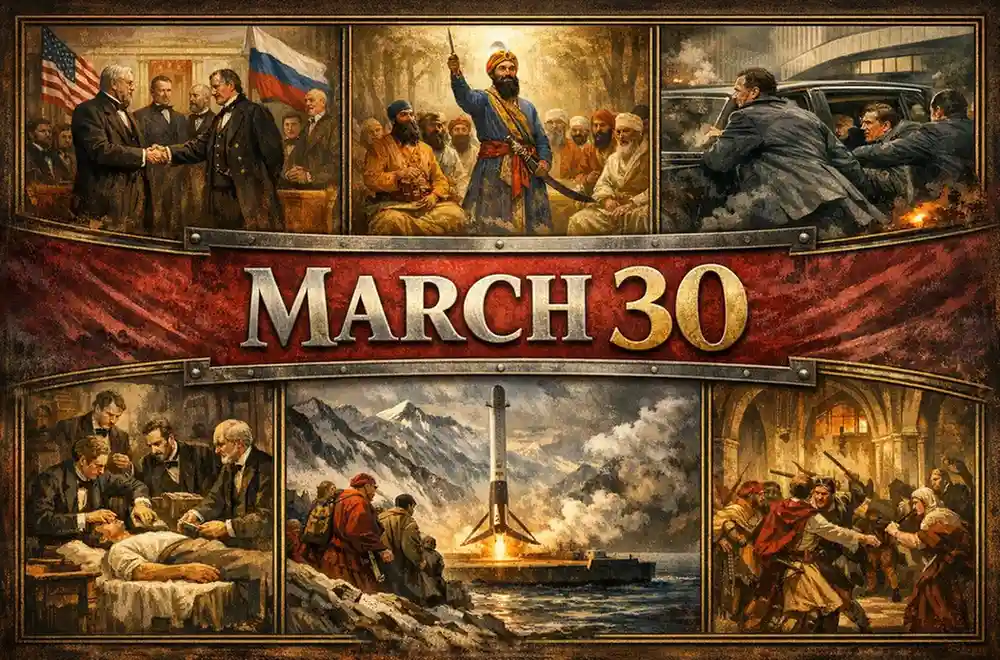
From the 1822 establishment of the Florida Territory to the unprecedented 2023 indictment of a former U.S. President, this day in history March 30 has consistently served as a pivot point for society. It is a date that fundamentally reshapes governance and political expectations through the mapping of new frontiers and the breaking of significant legal barriers.
Important Events That Happened On March 30 In History
598 – Avars Lift the Siege of Tomis
During the Avar–Byzantine wars, the Avars were forced to abandon their siege of the Byzantine stronghold at Tomis. Their leader, Bayan I, retreated north of the Danube after a plague decimated the Avaro-Slavic army, providing a temporary reprieve for the Byzantine Empire.
1282 – The Sicilian Vespers Begins
The people of Sicily rose in a violent rebellion against the Angevin king, Charles I. Known as the Sicilian Vespers, the uprising started during evening prayers on Easter Monday and eventually led to the end of Angevin rule on the island.
1296 – Sack of Berwick-upon-Tweed
During an armed conflict between Scotland and England, King Edward I of England successfully sacked the town of Berwick-upon-Tweed. The brutal assault was a key opening move in the First War of Scottish Independence.
1699 – Establishment of the Khalsa
Guru Gobind Singh, the tenth Sikh Guru, established the Khalsa at Anandpur Sahib in Punjab. This warrior community was formed to protect the innocent from religious persecution and formalized the spiritual and military identity of the Sikh faith.
1815 – The Rimini Proclamation
Joachim Murat, the King of Naples and brother-in-law to Napoleon, issued the Rimini Proclamation. It was one of the earliest official calls for Italian unification and independence from foreign rule, appealing to Italian nationalists to join his cause.
1818 – Augustin Fresnel’s Optical Memoir
Physicist Augustin Fresnel presented a seminal memoir on optical rotation to the French Academy of Sciences. He reported that polarized light “depolarized” by a Fresnel rhomb preserved its properties through subsequent passages in optically-rotating substances.
1822 – Creation of the Florida Territory
The United States officially established the Florida Territory. Formed from the combined Spanish provinces of East and West Florida, the territory remained under federal administration until it was admitted as a state in 1845.
1841 – National Bank of Greece Founded
The National Bank of Greece was established in Athens. As the oldest bank in the country, it served as the sole issuing bank for several decades, playing a central role in the economic development of the newly independent Greek state.
1842 – First Use of Ether Anesthesia
American surgeon Dr. Crawford Long used sulfuric ether as an anesthetic for the first time during a surgical operation to remove a tumor from a patient’s neck. This marked a revolutionary advancement in medical science and pain management.
1844 – Battle of Santiago de los Caballeros
One of the most decisive battles of the Dominican War of Independence took place near Santiago de los Caballeros. Dominican forces successfully defended their territory against Haitian troops, securing the young nation’s autonomy.
1855 – Invasion of the “Border Ruffians”
Pro-slavery “Border Ruffians” from Missouri invaded the Kansas Territory. They used intimidation and illegal voting to force the election of a pro-slavery legislature, a key event in the violent period known as “Bleeding Kansas.”
1856 – Treaty of Paris Ends Crimean War
The Treaty of Paris was signed by Russia, the Ottoman Empire, France, Britain, and Sardinia. The agreement officially ended the Crimean War, neutralized the Black Sea, and guaranteed the integrity of the Ottoman Empire.
1861 – Discovery of Thallium
Sir William Crookes announced his discovery of the chemical element thallium. He identified the new element using the relatively new technique of flame spectroscopy, noting its distinct bright green spectral line.
1863 – Prince Wilhelm Becomes King of Greece
Danish Prince Wilhelm Georg was chosen by the Greek National Assembly to become King George I of the Hellenes. His reign would become the longest in modern Greek history, lasting nearly fifty years.
1867 – The Alaska Purchase
United States Secretary of State William H. Seward signed a treaty to purchase Alaska from Russia for $7.2 million. The acquisition, often mocked at the time as “Seward’s Folly,” added roughly 586,000 square miles to U.S. territory.
1870 – Texas Readmitted to Congress
Following the period of Reconstruction after the American Civil War, Texas was formally readmitted to the United States Congress. This marked the final step in the state’s political reintegration into the Union.
1885 – The Panjdeh Incident
A battle between Russian and Afghan forces at Kushka triggered the Panjdeh Incident. The clash nearly caused a full-scale war between the Russian and British Empires as they vied for influence in Central Asia.
1899 – Committee on Atomic Weights Proposed
The German Society of Chemistry issued an invitation to international scientific organizations to appoint delegates to the International Committee on Atomic Weights. The goal was to standardize atomic weight values for the global scientific community.
1900 – Discovery of Linear B in Knossos
Archaeologists working in Knossos, Crete, discovered the first clay tablet featuring a hieroglyphic script. This writing system was later identified as Linear B, the oldest known form of written Greek.
1912 – Treaty of Fez Signed
Sultan Abd al-Hafid signed the Treaty of Fez, officially turning Morocco into a French protectorate. The agreement ceded much of Morocco’s sovereignty to France, while Spain was granted a zone of influence in the north.
1918 – March Events in Baku
A period of inter-ethnic conflict and violence, known as the March Events, began in Baku. Thousands of people were killed during several days of fighting between various political and ethnic factions in the Baku Governorate.
1939 – Heinkel He 100 Speed Record
The German Heinkel He 100 fighter aircraft set a new world airspeed record. Piloted by Hans Dieterle, the plane reached a speed of 463 mph (745 km/h), demonstrating Germany’s advanced aeronautical engineering.
1940 – Nanking Puppet Government Established
During the Second Sino-Japanese War, Japan declared Nanking the capital of a new puppet government in China. The administration was nominally led by Wang Jingwei, who collaborated with the Japanese occupying forces.
1944 – Severe Bombing of Sofia
Allied bombers conducted their most intense air raid on Sofia, Bulgaria, during World War II. The mission was part of a larger strategy to force the Bulgarian government to withdraw from its alliance with the Axis powers.
1944 – RAF Loss at Nuremberg
In a massive night raid on Nuremberg, the RAF Bomber Command suffered its heaviest loss of the war. Out of a force of 795 bombers, 95 were lost to German night fighters and anti-aircraft fire.
1945 – Soviet Forces Enter Vienna
As World War II drew toward its conclusion, Soviet forces invaded Austria and successfully captured the capital city of Vienna. Meanwhile, Polish and Soviet troops worked together to liberate the city of Danzig.
1949 – Austurvöllur Riot in Reykjavík
A major riot broke out in the square of Austurvöllur in Reykjavík, Iceland. Protesters clashed with police over the government’s decision to join NATO, reflecting deep national divisions regarding the Cold War alliance.
1959 – Dalai Lama Flees Tibet
Tenzin Gyatso, the 14th Dalai Lama, fled Lhasa for India following a failed uprising against Chinese rule. He eventually established a government-in-exile in Dharamshala, where he remains today.
1961 – Convention on Narcotic Drugs Signed
The Single Convention on Narcotic Drugs was signed in New York City. This international treaty sought to combat drug abuse by coordinating global efforts to limit the production and distribution of specific narcotics to medical and scientific use.
1965 – Saigon Embassy Bombing
A car bomb exploded outside the United States Embassy in Saigon during the Vietnam War. The blast killed 22 people and wounded 183 others, highlighting the vulnerability of American installations in the South Vietnamese capital.
1967 – Delta Air Lines Flight 9877 Crash
A Delta Air Lines training flight crashed at Louis Armstrong New Orleans International Airport. The accident resulted in the deaths of all 19 people on board, including crew members and several people on the ground.
1972 – The Easter Offensive Begins
North Vietnamese forces launched a massive conventional invasion into South Vietnam, crossing the Demilitarized Zone (DMZ). The “Easter Offensive” was designed to strike a decisive blow against the South Vietnamese military.
1976 – First Land Day
Palestinians organized their first Land Day as a collective response to Israeli land confiscation policies. The day became an annual event to commemorate the struggle for land rights and national identity.
1979 – Assassination of Airey Neave
British Member of Parliament Airey Neave was killed by a car bomb as he drove out of the Palace of Westminster car park. The Irish National Liberation Army claimed responsibility for the assassination of the shadow cabinet member.
1981 – Attempted Assassination of Ronald Reagan
U.S. President Ronald Reagan was shot in the chest by John Hinckley Jr. outside the Washington Hilton Hotel. Reagan survived the attack after emergency surgery; White House Press Secretary James Brady was among the others wounded.
1982 – Landing of Space Shuttle Columbia
The STS-3 mission concluded with the Space Shuttle Columbia landing at White Sands Missile Range in New Mexico. It was the only time a shuttle landed at White Sands, due to flooding at the primary landing site in California.
2002 – Lyon Car Attack
A car was driven into a synagogue in Lyon, France, in a deliberate attack. The incident was part of a series of anti-Semitic attacks across Europe during a period of heightened regional tensions.
2006 – Cyclone Glenda Makes Landfall
Cyclone Glenda, one of the most powerful tropical cyclones ever recorded in the Australian region, struck the coast near Onslow, Western Australia. The storm brought extreme winds and heavy rainfall to the remote mining region.
2009 – Manawan Police Academy Attack
Twelve gunmen launched a coordinated assault on the Manawan Police Academy in Lahore, Pakistan. The attackers used grenades and automatic weapons, leading to a several-hour standoff with security forces.
2011 – Min Aung Hlaing Appointed Commander-in-Chief
Min Aung Hlaing was appointed as the Commander-in-Chief of the Myanmar Armed Forces. This transition occurred as the military-backed government nominally handed power to a civilian administration.
2017 – SpaceX Orbital Rocket Reflight
SpaceX achieved the world’s first successful reflight of an orbital-class rocket. The Falcon 9 booster, which had previously flown in 2016, was launched and landed for a second time, marking a major milestone in aerospace reusability.
2018 – Gaza Land Day Protests
During Land Day protests in Gaza, the Israeli Army killed 17 Palestinians and wounded 1,400. The demonstrations were part of a larger movement calling for the right of return for Palestinian refugees.
2023 – Indictment of Donald Trump
Donald Trump became the first former President of the United States to be indicted by a grand jury. The legal action in New York marked an unprecedented moment in American political and judicial history.
Famous People Born on March 30
| Name | Description | Date |
|---|---|---|
| Paul Verlaine | French lyric poet, leader of the Symbolists | March 30, 1844 – January 8, 1896 |
| Robert Bunsen | German chemist, inventor of the Bunsen burner | March 30, 1811 – August 16, 1899 |
| Sean O’Casey | Irish dramatist | March 30, 1880 – September 18, 1964 |
| Ernst H. Gombrich | Austrian-born British art historian (The Story of Art) | March 30, 1909 – November 3, 2001 |
| Melanie Klein | Austrian-born British psychoanalyst, pioneer of child analysis | March 30, 1882 – September 22, 1960 |
| Erwin Panofsky | German-American art historian, pioneer of iconography | March 30, 1892 – March 14, 1968 |
| Stefan Banach | Polish mathematician, founder of functional analysis | March 30, 1892 – August 31, 1945 |
| Céline Dion | Canadian pop singer | March 30, 1968 – Present |
| Juan Manuel de Rosas | Argentine military and political leader, dictator of Buenos Aires | March 30, 1793 – March 14, 1877 |
| McGeorge Bundy | American public official, national security adviser (JFK, LBJ) | March 30, 1919 – September 16, 1996 |
| Anna Sewell | English author (Black Beauty) | March 30, 1820 – April 25, 1878 |
| Jerry Lucas | American basketball player, Hall of Fame forward | March 30, 1940 – Present |
| Brooke Russell Astor | American socialite and philanthropist | March 30, 1902 – August 13, 2007 |
| Mary Whiton Calkins | American philosopher and psychologist, first female APA president | March 30, 1863 – February 26, 1930 |
| Charles Booth | English shipowner and sociologist, studied London poverty | March 30, 1840 – November 23, 1916 |
| Sonny Boy Williamson | American blues harmonica virtuoso | March 30, 1914 – June 1, 1948 |
| Jean Giono | French novelist, celebrated nature writer | March 30, 1895 – October 8, 1970 |
| Mervyn King | British economist, governor of the Bank of England (2003–2013) | March 30, 1948 – Present |
| Sergey Vladimirovich Ilyushin | Soviet aircraft designer (Il-2 Stormovik) | March 30, 1894 – February 9, 1977 |
| Norah Jones | American singer-songwriter and musician | March 30, 1979 – Present |
| John Fiske | American historian and philosopher | March 30, 1842 – July 4, 1901 |
| Hans Hollein | Austrian architect, Pritzker Prize winner | March 30, 1934 – April 24, 2014 |
| Sir Henry Wotton | English poet, diplomat, and art connoisseur | March 30, 1568 – December 1639 |
| Henry Hardinge, 1st Viscount Hardinge | Governor-general of India (1844–1848) | March 30, 1785 – September 24, 1856 |
| Ivan II | Grand prince of Moscow and Vladimir | March 30, 1326 – November 13, 1359 |
| Joseph Caillaux | French statesman, prime minister (1911–1912) | March 30, 1863 – November 22, 1944 |
| Audrey Flack | American painter and sculptor, Photo-realist pioneer | March 30, 1931 – June 28, 2024 |
| Clifford Whittingham Beers | American author, founder of mental hygiene movement | March 30, 1876 – July 9, 1943 |
| Frederic Austin | British baritone and composer, revived The Beggar’s Opera | March 30, 1872 – April 10, 1952 |
| Tommaso Traetta | Italian composer, precursor of operatic reform | March 30, 1727 – April 6, 1779 |
Famous People Died on March 30
| Name | Description | Date |
|---|---|---|
| Élisabeth Vigée-Lebrun | French painter, portraitist of Marie Antoinette | April 16, 1755 – March 30, 1842 |
| Léon Blum | Premier of France (1936–1937), first Socialist and Jewish premier | April 9, 1872 – March 30, 1950 |
| Karl May | German author of adventure stories (Winnetou) | February 25, 1842 – March 30, 1912 |
| Alistair Cooke | British-born American journalist, host of Masterpiece Theatre | November 20, 1908 – March 30, 2004 |
| Sébastien Le Prestre de Vauban | French military engineer, master of fortifications | May 15, 1633 – March 30, 1707 |
| Karl Rahner | German Jesuit theologian, influential 20th-century Catholic thinker | March 5, 1904 – March 30, 1984 |
| Elizabeth | Queen consort of the United Kingdom (1936–1952), wife of George VI | August 4, 1900 – March 30, 2002 |
| Richard Diebenkorn | American Modernist painter | April 22, 1922 – March 30, 1993 |
| James Cagney | American actor, Hollywood legend | July 17, 1899 – March 30, 1986 |
| ʿAbd al-Ḥalīm Ḥāfiẓ | Egyptian singer, iconic romantic vocalist | June 21, 1929 – March 30, 1977 |
| Jean Toomer | American poet and novelist (Cane), Harlem Renaissance figure | December 26, 1894 – March 30, 1967 |
| Robert Creeley | American poet, founder of Black Mountain school | May 21, 1926 – March 30, 2005 |
| Ellen Swallow Richards | American chemist, founder of home economics movement | December 3, 1842 – March 30, 1911 |
| Heinrich Brüning | German chancellor (1930–1932) before Hitler | November 26, 1885 – March 30, 1970 |
| Erwin Piscator | German theatrical producer, pioneer of epic theatre | December 17, 1893 – March 30, 1966 |
| DeWitt Wallace | American publisher, co-founder of Reader’s Digest | November 12, 1889 – March 30, 1981 |
| Thomas Couture | French academic painter | December 21, 1815 – March 30, 1879 |
| Abigail Fillmore | American first lady (1850–1853), wife of Millard Fillmore | March 13, 1798 – March 30, 1853 |
| Friedrich Bergius | German chemist, Nobel Prize winner (hydrogenation) | October 11, 1884 – March 30, 1949 |
| John Ciardi | American poet, critic, and translator | June 24, 1916 – March 30, 1986 |
| Harry Bridges | Australian-born American labor leader, ILWU president | July 28, 1901 – March 30, 1990 |
| José María Velasco Ibarra | President of Ecuador (five times) | March 19, 1893 – March 30, 1979 |
| Ton Duc Thang | President of Vietnam (1969–1980), successor to Ho Chi Minh | August 19, 1888 – March 30, 1980 |
| Pietro Locatelli | Italian violinist and composer | September 3, 1695 – March 30, 1764 |
| E.C. Bentley | British author, inventor of the clerihew, detective novelist | July 10, 1875 – March 30, 1956 |
| John Henry Poynting | British physicist (Poynting vector) | September 9, 1852 – March 30, 1914 |
| Fritz Wolfgang London | German-American physicist, pioneer in superconductivity | March 7, 1900 – March 30, 1954 |
| John McGahern | Irish novelist and short-story writer | November 12, 1934 – March 30, 2006 |
| Tomie dePaola | American children’s author and illustrator | September 15, 1934 – March 30, 2020 |
| Phil Ramone | American music producer and engineer | January 5, 1934 – March 30, 2013 |
Observances & Institutional Dates
- Land Day (Palestine): Commemorating the 1976 protests against land expropriation.
- National Doctors’ Day (USA): Recognizing the contributions of physicians, traditionally marked on the anniversary of the first use of ether anesthesia.
- Spiritual Baptist/Shouter Liberation Day: A public holiday in Trinidad and Tobago celebrating the repeal of the prohibition against the religion.
- School Day of Non-violence and Peace (Spain): Observed on the anniversary of the death of Mahatma Gandhi in some regions, though often associated with late March activities.
Frequently Asked Questions
- What happened on March 30, 1981? John Hinckley Jr. attempted to assassinate President Ronald Reagan in Washington, D.C.
- When was Alaska purchased? The United States purchased Alaska from Russia on March 30, 1867, for $7.2 million.
- Who established the Khalsa? Guru Gobind Singh established the Khalsa on March 30, 1699.
- What is the significance of March 30 for anesthesia? Dr. Crawford Long performed the first operation using ether anesthesia on this day in 1842.