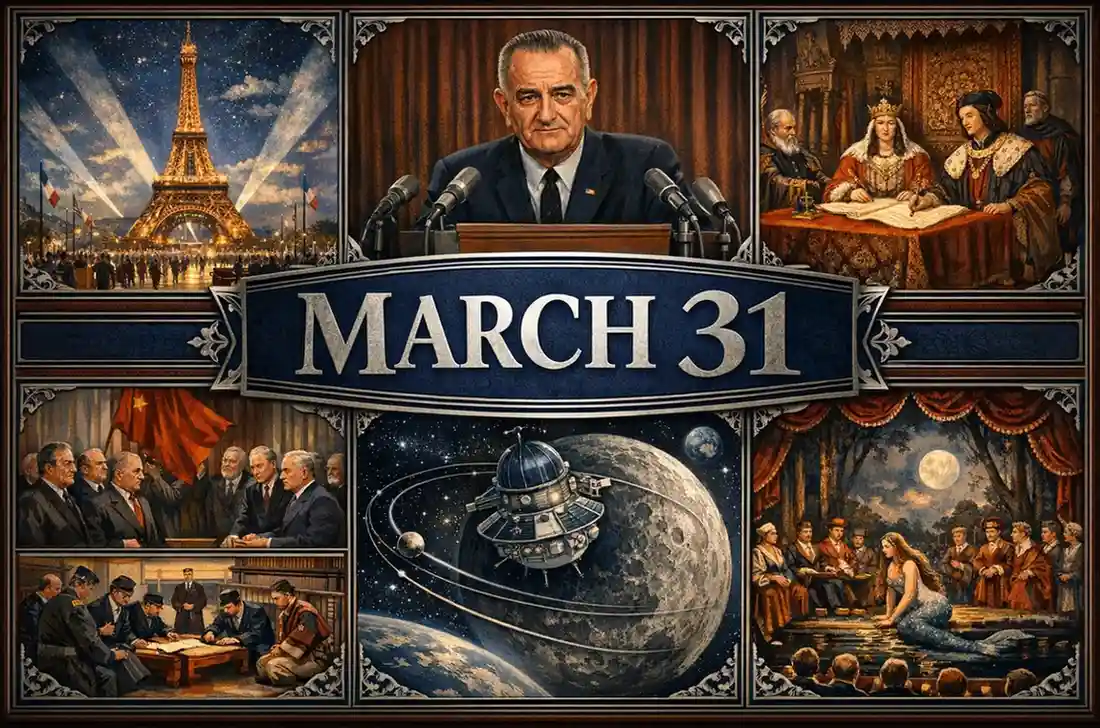
Reviewing what happened on this day in history March 31, we see a date that marks the completion of iconic structures and the dissolution of long-standing political unions. From the official opening of the Eiffel Tower in 1889 to the 1991 disbanding of the Warsaw Pact, this day serves as a bridge between the architectural marvels of the past and the shifting diplomatic landscapes of the modern era.
Important Events That Happened On March 31 In History
307 – Constantine Marries Fausta
After divorcing his first wife, Minervina, Constantine the Great married Fausta, the daughter of the retired Roman Emperor Maximian. This strategic union was intended to solidify Constantine’s political standing and alliance within the complex power struggles of the Tetrarchy.
1146 – Bernard of Clairvaux Preaches the Second Crusade
In a field at Vézelay, Bernard of Clairvaux delivered a powerful sermon urging the necessity of a Second Crusade to the Holy Land. King Louis VII of France was in attendance and was among the first to “take the cross,” signaling the beginning of the major military expedition.
1174 – Conspiracy Against Saladin Revealed
A plot to restore the Fatimid Caliphate was uncovered in Cairo. The conspiracy involved high-ranking figures of the former regime and the poet Umara al-Yamani. While modern historians debate the true threat level of the plot, the ringleaders were publicly executed shortly after the discovery.
1272 – Pope Gregory X Calls for General Council
Pope Gregory X issued a call for a General Church Council to address the potential reunion of the Eastern and Western Churches. The council’s agenda also included plans for a new Crusade and internal Church reforms to address administrative issues.
1492 – Edict of Expulsion in Spain
Ferdinand II of Aragon and Isabella I of Castile signed the Edict of Expulsion, also known as the Alhambra Decree. The order forced all Jews in the Spanish kingdoms to either convert to Christianity or leave the country, resulting in a massive and forced migration.
1521 – First Catholic Mass in the Philippines
Ferdinand Magellan and fifty of his crew members came ashore at present-day Limasawa to participate in the first recorded Catholic mass in the Philippines. This event marked a primary step in the introduction of Christianity to the archipelago.
1657 – Humble Petition and Advice
The Long Parliament presented Oliver Cromwell with the “Humble Petition and Advice,” which officially offered him the British throne. Although the proposal offered a return to traditional constitutional forms, Cromwell eventually declined the title of King.
1706 – Last Session of the Catalan Courts
The final session of the Catalan Courts, the parliament of the Principality of Catalonia, concluded in Barcelona. The courts passed modernizing constitutional reforms aimed at guaranteeing individual and economic rights, such as the secrecy of correspondence.
1717 – The Bangorian Controversy
Bishop Benjamin Hoadly preached a sermon on “The Nature of the Kingdom of Christ” before King George I. His argument that Christ had not delegated his authority to any earthly representatives provoked the “Bangorian Controversy,” a major theological and political dispute in England.
1761 – The 1761 Lisbon Earthquake
A powerful earthquake with an estimated magnitude of 8.5 struck off the Iberian Peninsula. Occurring only six years after the catastrophic 1855 quake, this event caused further damage to Lisbon and generated a tsunami that affected coastal regions.
1774 – Closure of the Port of Boston
The Kingdom of Great Britain ordered the port of Boston closed under the authority of the Boston Port Act. This was the first of the “Intolerable Acts,” designed to punish the city following the Boston Tea Party and a major spark for the American Revolution.
1814 – Sixth Coalition Occupies Paris
Following the capitulation of Napoleon’s Grande Armée, forces from the Sixth Coalition—including Russia, Prussia, and Austria—occupied Paris. The entry into the capital effectively ended Napoleon’s reign and led to his first abdication.
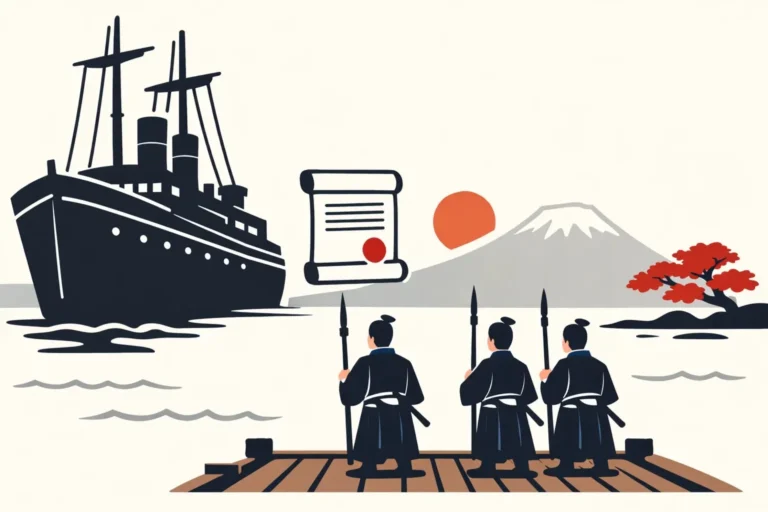
1854 – Convention of Kanagawa
Commodore Matthew Perry of the United States Navy signed the Convention of Kanagawa with the Tokugawa Shogunate. The treaty ended Japan’s policy of isolation by opening the ports of Shimoda and Hakodate to American trade and ensuring the safety of shipwrecked sailors.
1885 – Bechuanaland Protectorate Established
The United Kingdom established the Bechuanaland Protectorate in southern Africa. The move was intended to protect the interests of local Tswana leaders and secure British influence in the region against competing colonial powers.
1889 – Official Opening of the Eiffel Tower
The Eiffel Tower was officially opened in Paris to serve as the entrance arch for the 1889 World’s Fair. Despite initial criticism from some of France’s leading artists, the iron lattice structure quickly became a global cultural icon.
1899 – Capture of Malolos
During the Philippine–American War, American forces successfully captured Malolos, which served as the capital of the First Philippine Republic. The fall of the capital forced the revolutionary government of Emilio Aguinaldo to retreat further north.
1901 – Premiere of Rusalka
The opera Rusalka by Antonín Dvořák premiered at the National Opera House in Prague. Based on Slavic folklore about a water sprite, it became Dvořák’s most successful opera and a staple of the international lyrical repertoire.
1905 – First Moroccan Crisis
Kaiser Wilhelm II of Germany arrived in Tangier and declared his support for Moroccan independence. His speech challenged French influence in the region and triggered the First Moroccan Crisis, heightening tensions between European powers.
1906 – Establishment of the NCAA
The Intercollegiate Athletic Association of the United States was founded to establish safety rules and regulations for college sports, particularly football. The organization was later renamed the National Collegiate Athletic Association (NCAA).
1909 – Serbia Withdraws Opposition
Following intense diplomatic pressure, Serbia formally withdrew its opposition to the Austro-Hungarian annexation of Bosnia and Herzegovina. This concluded the “Bosnian Crisis,” though it left deep-seated resentment in the Balkans.
1913 – The “Skandalkonzert” in Vienna
A concert featuring modernist music by Arnold Schoenberg and his associates resulted in a riot at the Vienna Concert Society. The audience’s violent reaction to the atonal music forced a premature end to the performance, which became infamous as the Skandalkonzert.
1917 – Transfer of the Danish West Indies
According to the terms of a treaty between Denmark and the United States, the Danish West Indies officially became American possessions. Renamed the United States Virgin Islands, the territory was purchased for $25 million in gold.
1918 – March Days in Azerbaijan
A massacre of ethnic Azerbaijanis was committed in Baku and surrounding areas by armed groups of the Armenian Revolutionary Federation and Bolsheviks. Nearly 12,000 Azerbaijani Muslims were killed during the inter-ethnic violence.
1918 – First U.S. Daylight Saving Time
Daylight saving time went into effect in the United States for the first time. The measure was introduced as a wartime effort to conserve fuel by extending evening daylight hours during the spring and summer months.
1921 – Formation of the RAAF
The Royal Australian Air Force (RAAF) was officially formed as an independent branch of the Australian military. It was only the second independent air force in the British Commonwealth, following the British RAF.
1930 – Motion Picture Production Code
The “Hays Code” was instituted in the U.S. film industry, imposing strict moral guidelines on the portrayal of sex, crime, and violence. The code would govern Hollywood productions for the next thirty-eight years before being replaced by a ratings system.
1931 – Managua Earthquake
A devastating earthquake struck Managua, the capital of Nicaragua. The disaster destroyed much of the city’s infrastructure and resulted in the deaths of approximately 2,000 people.
1931 – Death of Knute Rockne
A Transcontinental & Western Air airliner crashed near Bazaar, Kansas, killing all eight people on board. Among the victims was Knute Rockne, the legendary head football coach for the University of Notre Dame.
1933 – Civilian Conservation Corps Established
As part of the New Deal, the U.S. government established the Civilian Conservation Corps (CCC). The program aimed to relieve rampant unemployment by providing environmental conservation jobs to young, unmarried men.
1939 – British Pledge to Poland
Prime Minister Neville Chamberlain issued a formal pledge of British military support to the Second Polish Republic. The guarantee was intended to deter an invasion by Nazi Germany and signaled the end of the policy of appeasement.
1942 – Japanese Invasion of Christmas Island
Japanese forces launched an invasion of Christmas Island, which was a British possession at the time. Despite a mutiny by Indian soldiers stationed there, the Japanese successfully occupied the island to secure its phosphate deposits.
1945 – First Me 262 Falls into Allied Hands
A defecting German pilot delivered a Messerschmitt Me 262A-1 to American forces. It was the world’s first operational jet-powered fighter aircraft, and its capture provided the Allies with their first opportunity to study the advanced German technology.
1949 – Newfoundland Joins Canada
The Dominion of Newfoundland officially joined the Canadian Confederation. After a series of referendums, it became the 10th province of Canada, ending its status as a separate British dominion.
1951 – Delivery of the UNIVAC I
Remington Rand delivered the first UNIVAC I (Universal Automatic Computer) to the United States Census Bureau. It was the first commercial computer produced in the United States, representing a landmark in the history of data processing.
1957 – Upper Volta Elections
Elections were held for the Territorial Assembly of the French colony of Upper Volta (now Burkina Faso). Following the vote, the PDU and MDV parties formed a coalition government as the colony moved toward autonomy.
1958 – Diefenbaker’s Record Election Victory
In the Canadian federal election, the Progressive Conservative Party led by John Diefenbaker won 208 out of 265 seats. This remains the largest percentage of seats won by a single party in the history of the Canadian Parliament.
1959 – Dalai Lama Granted Asylum
After crossing the border from Tibet into India, the 14th Dalai Lama was officially granted political asylum by the Indian government. This followed his escape from Lhasa amidst a crackdown by Chinese forces.
1964 – Brazilian Coup d’État Begins
General Olímpio Mourão Filho ordered his troops to march toward Rio de Janeiro, signaling the start of a military coup. The takeover successfully overthrew President João Goulart and initiated 21 years of military dictatorship in Brazil.
1966 – Luna 10 Launched
The Soviet Union launched the Luna 10 spacecraft. Several days later, it became the first man-made probe to successfully enter orbit around the Moon, providing data on the lunar magnetic field and radiation environment.
1966 – Labour Party Wins UK Election
The Labour Party, led by Prime Minister Harold Wilson, won a decisive victory in the United Kingdom general election. The win increased Labour’s majority in Parliament and solidified Wilson’s leadership.
1968 – LBJ Declines Re-election
In a televised national address regarding “Steps to Limit the War in Vietnam,” President Lyndon B. Johnson made a surprise announcement. He stated, “I shall not seek, and I will not accept, the nomination of my party for another term as your President.”
1970 – Explorer 1 Re-enters Atmosphere
Explorer 1, the first satellite launched by the United States, re-entered the Earth’s atmosphere and burned up after 12 years in orbit. The satellite had originally discovered the Van Allen radiation belts during its early mission.
1980 – Liquidation of the Rock Island Railroad
The Chicago, Rock Island and Pacific Railroad operated its final train. Following a long period of bankruptcy and failed merger attempts, the company was ordered to liquidate its assets to pay back its creditors.
1986 – Mexicana de Aviación Flight 940 Crash
A Boeing 727 crashed into the Sierra Madre Oriental mountains near Maravatío, Mexico, after an in-flight fire caused by a landing gear explosion. All 167 people on board were killed in the deadliest aviation accident in Mexican history.
1990 – London Poll Tax Riots
Approximately 200,000 people took to the streets of London to protest the newly introduced Community Charge, popularly known as the “Poll Tax.” The protest escalated into violent riots in Trafalgar Square, contributing to the eventual downfall of Margaret Thatcher.
1991 – Georgian Independence Referendum
Georgia held a national referendum on restoring its independence from the Soviet Union. Nearly 99 percent of voters supported independence, leading the Georgian government to issue a formal declaration shortly after.
1991 – Warsaw Pact Disbands
The Warsaw Pact, the military alliance of the Eastern Bloc, was formally disbanded during a meeting in Moscow. The dissolution reflected the collapse of communist regimes across Eastern Europe and the end of the Cold War.
1992 – Decommissioning of the USS Missouri
The USS Missouri, the last active battleship in the United States Navy, was decommissioned in Long Beach, California. The ship was famous for being the site of the Japanese surrender that ended World War II in 1945.
1992 – Treaty of Federation Signed
The Treaty of Federation was signed in Moscow by the leaders of Russia and most of its internal republics. The treaty aimed to define the division of powers within the new Russian Federation following the collapse of the Soviet Union.
1993 – Macao Basic Law Adopted
The Eighth National People’s Congress of China adopted the Macao Basic Law. This constitutional document outlined the “One Country, Two Systems” framework for Macao’s transition from Portuguese to Chinese sovereignty in 1999.
1995 – Murder of Selena
The Tejano music star Selena Quintanilla-Pérez was shot and killed by Yolanda Saldívar, the president of her fan club, at a motel in Corpus Christi, Texas. The death of the “Queen of Tejano” caused an outpouring of grief across the world.
1995 – TAROM Flight 371 Crash
An Airbus A310-300 operated by TAROM crashed shortly after takeoff from Bucharest, Romania. All 60 people on board were killed; the investigation pointed to an engine throttle malfunction and pilot error.
1998 – Netscape Releases Mozilla Source Code
Netscape Communications Corporation released the source code for its Netscape Communicator browser suite under an open-source license. This move led to the creation of the Mozilla project and the eventual development of the Firefox browser.
2004 – Fallujah Ambush
In Fallujah, Iraq, four American private military contractors working for Blackwater USA were ambushed and killed. The subsequent public desecration of their bodies led to the First Battle of Fallujah as U.S. Marines launched a major offensive.
2005 – Discovery of Makemake
A team of astronomers led by Michael E. Brown discovered the dwarf planet Makemake at the Palomar Observatory. It is one of the largest known objects in the Kuiper Belt and was eventually recognized as a dwarf planet by the IAU.
2016 – Kelly and Kornienko Return to Earth
NASA astronaut Scott Kelly and Roscosmos cosmonaut Mikhail Kornienko returned to Earth after spending 340 days aboard the International Space Station. The mission was designed to study the long-term physiological effects of spaceflight on the human body.
2018 – Start of the Armenian Revolution
Protests began in Armenia against the election of Serzh Sargsyan as Prime Minister. This marked the start of the “Velvet Revolution,” a series of peaceful demonstrations that eventually led to a change in the country’s leadership.
2023 – Midwest and South Tornado Outbreak
A historic and deadly tornado outbreak occurred across the American Midwest and South. The storms produced numerous high-intensity tornadoes that caused widespread destruction and multiple fatalities in several states.
Read about the previous day: March 30
Famous People Born on March 31
| Name | Description | Date |
|---|---|---|
| Octavio Paz | Mexican poet and diplomat, Nobel Prize in Literature | March 31, 1914 – April 19, 1998 |
| Serge Diaghilev | Russian ballet impresario, founder of Ballets Russes | March 31, 1872 – August 19, 1929 |
| Andrew Marvell | English Metaphysical poet | March 31, 1621 – August 18, 1678 |
| John Fowles | English novelist (The French Lieutenant’s Woman) | March 31, 1926 – November 5, 2005 |
| Evan Williams | American computer programmer, co-founder of Twitter | March 31, 1972 – Present |
| Barney Frank | American politician, first openly gay member of Congress | March 31, 1940 – Present |
| Aleksandra Mikhaylovna Kollontay | Russian revolutionary and diplomat, first female ambassador | March 31, 1872 – March 9, 1952 |
| Arthur Griffith | Irish nationalist, founder of Sinn Féin | March 31, 1871 – August 12, 1922 |
| Tomonaga Shin’ichirō | Japanese physicist, Nobel Prize winner (QED) | March 31, 1906 – July 8, 1979 |
| Pius IV | Pope (1559–1565), reconvened the Council of Trent | March 31, 1499 – December 9, 1565 |
| Carlo Rubbia | Italian physicist, Nobel Prize winner (W and Z particles) | March 31, 1934 – Present |
| Andrew Lang | Scottish scholar and folklorist, collector of fairy tales | March 31, 1844 – July 20, 1912 |
| Frederick V | King of Denmark and Norway (1746–1766) | March 31, 1723 – January 14, 1766 |
| Benedict XIV | Pope (1740–1758), scholar and reformer | March 31, 1675 – May 3, 1758 |
| James M. Cox | American politician, Democratic presidential nominee (1920) | March 31, 1870 – July 15, 1957 |
| Edward FitzGerald | English author, translator of Rubáiyát of Omar Khayyám | March 31, 1809 – June 14, 1883 |
| Chlodwig Karl Viktor, prince of Hohenlohe-Schillingsfürst | German chancellor (1894–1900) | March 31, 1819 – July 6, 1901 |
| John J. McCloy | American diplomat and lawyer, adviser to 11 U.S. presidents | March 31, 1895 – March 11, 1989 |
| Mary Boykin Chesnut | American Civil War diarist | March 31, 1823 – November 22, 1886 |
| Volker Schlöndorff | German film director (The Tin Drum) | March 31, 1939 – Present |
| Lefty Frizzell | American country singer and songwriter | March 31, 1928 – July 19, 1975 |
| John La Farge | American painter and stained-glass designer | March 31, 1835 – November 14, 1910 |
| Korney Ivanovich Chukovsky | Russian children’s author and critic | March 31, 1882 – October 28, 1969 |
| Sir Benjamin Baker | English civil engineer, designer of the Forth Bridge | March 31, 1840 – May 19, 1907 |
| Dan Graham | American conceptual artist | March 31, 1942 – February 19, 2022 |
| Rama III | King of Siam (1824–1851) | March 31, 1788 – April 2, 1851 |
| Etta Baker | American folk and blues guitarist | March 31, 1913 – September 23, 2006 |
| Jules Pascin | Bulgarian-born American painter | March 31, 1885 – June 1, 1930 |
| Louis-Auguste de Bourbon, duke du Maine | Illegitimate son of King Louis XIV of France | March 31, 1670 – May 14, 1736 |
| Francesco Durante | Italian composer and teacher | March 31, 1684 – August 13, 1755 |
Famous People Died on March 31
| Name | Description | Date |
|---|---|---|
| John Constable | English landscape painter | June 11, 1776 – March 31, 1837 |
| Kang Youwei | Chinese scholar, leader of the Reform Movement of 1898 | March 19, 1858 – March 31, 1927 |
| Léon Degrelle | Belgian politician, founder of Rexist Party, Nazi collaborator | June 15, 1906 – March 31, 1994 |
| James Rosenquist | American Pop artist | November 29, 1933 – March 31, 2017 |
| Semyon Timoshenko | Soviet general, WWII commander | February 18, 1895 – March 31, 1970 |
| Bella Abzug | American congresswoman and feminist leader | July 24, 1920 – March 31, 1998 |
| Zaha Hadid | Iraqi-born British architect, Pritzker Prize winner | October 31, 1950 – March 31, 2016 |
| Emil von Behring | German bacteriologist, first Nobel Prize in Physiology or Medicine | March 15, 1854 – March 31, 1917 |
| Sir William McMahon | Prime minister of Australia (1971–1972) | February 23, 1908 – March 31, 1988 |
| Lyman Spitzer, Jr. | American astrophysicist, pioneer of space telescopes | June 22, 1914 – March 31, 1997 |
| Henryk Wieniawski | Polish violinist and composer | July 10, 1835 – March 31, 1880 |
| Hans-Dietrich Genscher | German foreign minister (1974–1992) | March 21, 1927 – March 31, 2016 |
| Jackie McLean | American jazz alto saxophonist | May 17, 1931 – March 31, 2006 |
| Charles H. Best | American physiologist, co-discoverer of insulin | February 27, 1899 – March 31, 1978 |
| Imre Kertész | Hungarian author, Nobel Prize in Literature (Holocaust literature) | November 9, 1929 – March 31, 2016 |
| George Green | British mathematician (Green’s theorem, Green’s function) | July 14, 1793 – March 31, 1841 |
| Ivan I | Grand prince of Moscow (1328–1340) | c.1304 – March 31, 1340 |
| Friedrich Hund | German physicist (Hund’s rules, quantum chemistry) | February 4, 1896 – March 31, 1997 |
| George Macartney, Earl Macartney | First British emissary to Beijing | May 3, 1737 – March 31, 1806 |
| H.S.M. Coxeter | British-born Canadian geometer | February 9, 1907 – March 31, 2003 |
| Christian Morgenstern | German poet and humorist | May 6, 1871 – March 31, 1914 |
| Francis Asbury | American clergyman, first Methodist bishop in the U.S. | August 20, 1745 – March 31, 1816 |
| Philip | Landgrave of Hesse, champion of German Protestantism | November 13, 1504 – March 31, 1567 |
| Antoine-Augustin Cournot | French economist and mathematician | August 28, 1801 – March 31, 1877 |
| Leslie A. White | American anthropologist, theorist of cultural evolution | January 19, 1900 – March 31, 1975 |
| Clifford G. Shull | American physicist, Nobel Prize winner (neutron diffraction) | September 23, 1915 – March 31, 2001 |
| Hans Fischer | German biochemist, Nobel Prize winner (hemin and chlorophyll) | July 27, 1881 – March 31, 1945 |
| Granville George Leveson-Gower, 2nd Earl Granville | British foreign secretary | May 11, 1815 – March 31, 1891 |
| Christina Stead | Australian novelist | July 17, 1902 – March 31, 1983 |
| Jean Moréas | Greek-born French Symbolist poet | April 15, 1856 – March 31, 1910 |
Observances & Institutional Dates
- International Transgender Day of Visibility: An annual event dedicated to celebrating transgender people and raising awareness of discrimination faced by the community.
- Freedom Day (Malta): Marking the anniversary of the final withdrawal of British troops and the Royal Navy from the island in 1979.
- Transfer Day (US Virgin Islands): Commemorating the 1917 transfer of the islands from Denmark to the United States.
- World Backup Day: An awareness day aimed at reminding people to protect their digital documents and memories by creating backups.
Frequently Asked Questions
- When did the Eiffel Tower open? It was officially opened on March 31, 1889, for the World’s Fair.
- What is the significance of March 31, 1968? President Lyndon B. Johnson announced in a televised speech that he would not seek re-election.
- Who was Selena? Selena Quintanilla-Pérez was a famous Tejano singer who was tragically murdered on March 31, 1995.
- What happened to the Warsaw Pact on this day? The military alliance was formally disbanded on March 31, 1991, following the end of the Cold War.