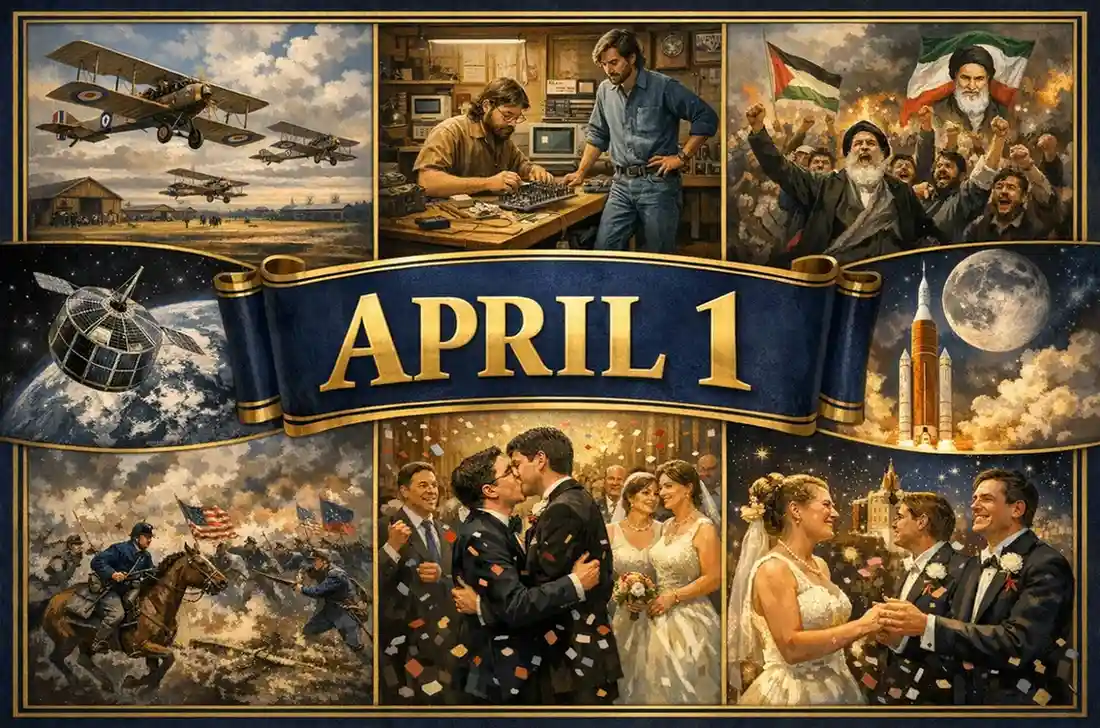
In our look at what happened on this day in history April 1, we find a date characterized by the birth of major institutions and the shift of global powers. From the 1918 creation of the Royal Air Force to the 1976 founding of Apple Computer, Inc., this day has frequently served as a starting point for organizations that would reshape the modern world. It is also a day of significant political transitions, including Iran officially becoming an Islamic republic in 1979 and the 2001 legalization of same-sex marriage in the Netherlands.
Important Events That Happened On April 1 In History
285 – Maximian Named Co-Emperor
Roman Emperor Diocletian appointed Maximian as his co-emperor, granting him the title of “Augustus.” This move was a foundational step toward the Tetrarchy, a system designed to manage the vast Roman Empire by dividing administrative and military responsibilities between multiple rulers.
527 – Justinian I Named Co-Ruler
Byzantine Emperor Justin I officially named his nephew, Justinian I, as his co-ruler and successor. This designation ensured a stable transition of power and marked the beginning of Justinian’s influential impact on Byzantine law, architecture, and territorial expansion.
1081 – Alexios I Komnenos Overthrows Nikephoros III
Alexios I Komnenos successfully overthrew the Byzantine Emperor Nikephoros III Botaneiates. Following the coup, Alexios’s troops spent three days looting Constantinople before his formal coronation, beginning a dynasty that would oversee a period of Byzantine recovery.
1572 – Capture of Brielle
During the Eighty Years’ War, the Watergeuzen (Sea Beggars) captured the town of Brielle from the Seventeen Provinces. This victory provided the first solid foothold on land for the rebels and served as a turning point in the eventual creation of the Dutch Republic.
1725 – Premiere of J. S. Bach’s Easter Oratorio
The first version of Johann Sebastian Bach’s Easter Oratorio was performed at the Nikolaikirche in Leipzig on Easter Sunday. The work, which depicts the discovery of the empty tomb of Jesus, remains a staple of the Baroque choral repertoire.
1789 – U.S. House of Representatives Achieves Quorum
In New York City, the United States House of Representatives achieved its first official quorum. During this landmark session, the members elected Frederick Muhlenberg of Pennsylvania as the first Speaker of the House.
1833 – Convention of 1833 Begins
Settlers in Mexican Texas gathered in San Felipe de Austin for the Convention of 1833. The political meeting was organized to draft a series of petitions to the Mexican government, including requests for statehood and the repeal of anti-immigration laws.
1865 – Battle of Five Forks
Union troops led by Philip Sheridan decisively defeated Confederate forces under George Pickett during the American Civil War. The victory cut the last supply line for the Army of Northern Virginia during the Siege of Petersburg, leading to the fall of Richmond days later.
1867 – Singapore Becomes a Crown Colony
Singapore officially transitioned from being a part of the British East India Company’s Straits Settlements to becoming a direct British crown colony. This administrative change gave the British Colonial Office direct control over the strategic port.
1873 – Sinking of the SS Atlantic
The White Star steamer SS Atlantic sank off the coast of Nova Scotia after striking a rock. The disaster killed 547 people, making it one of the deadliest marine accidents of the 19th century and a major tragedy for the White Star Line.
1900 – Prince George Becomes Absolute Monarch
Prince George of Greece and Denmark assumed the role of absolute monarch of the Cretan State. His reign was part of a transitional period for Crete as it moved toward eventual union with the Kingdom of Greece.
1908 – Formation of the Territorial Force
The British Army formed the Territorial Force (later renamed the Territorial Army) as a volunteer reserve component. The force was designed to provide home defense and a source of reinforcements for the regular army during times of war.
1918 – Creation of the Royal Air Force
The Royal Air Force (RAF) was established through the merger of the Royal Flying Corps and the Royal Naval Air Service. It became the world’s first independent air force, separate from the control of the army or navy.
1922 – Arnon Street Killings
In the newly formed Northern Ireland, six Catholics were murdered in their homes on Arnon Street, Belfast. The killings occurred just one week after the McMahon killings, intensifying the sectarian violence of the period.
1924 – Sentencing of Adolf Hitler
Following his participation in the failed “Beer Hall Putsch,” Adolf Hitler was sentenced to five years of fortress confinement. However, he ultimately spent only nine months in jail, during which time he wrote much of Mein Kampf.
1924 – Formation of the RCAF
The Royal Canadian Air Force (RCAF) was officially formed. Like its British counterpart, it was established to manage Canada’s military aviation interests as an independent service.
1933 – Nazi Boycott of Jewish Businesses
Under the direction of Julius Streicher, the recently elected Nazi government organized a one-day national boycott of all Jewish-owned businesses in Germany. This act was a precursor to the systemic anti-Semitic legislation that followed.
1935 – Reserve Bank of India Formed
India’s central banking institution, the Reserve Bank of India, was officially established. It was created to regulate the issue of banknotes, maintain monetary stability, and operate the currency and credit system of the country.
1937 – Aden Becomes a Crown Colony
The port city of Aden, previously administered from British India, was officially established as a British crown colony. Its strategic location at the entrance to the Red Sea made it a vital coaling station for the British Empire.
1939 – End of the Spanish Civil War
Generalísimo Francisco Franco announced the official end of the Spanish Civil War. The declaration followed the surrender of the last Republican forces, marking the beginning of Franco’s decades-long dictatorship.
1941 – Fântâna Albă Massacre
Soviet Border Troops opened fire on a group of Romanian civilians attempting to cross the border from Northern Bukovina into Romania. Between two hundred and two thousand people were killed in the incident near Fântâna Albă.
1941 – Iraqi Military Coup
A military coup in Iraq, led by the “Golden Square” of officers, overthrew the regency of ‘Abd al-Ilah. Rashid Ali al-Gaylani was installed as Prime Minister, leading to a brief pro-Axis government and subsequent conflict with Britain.
1944 – Accidental Bombing of Schaffhausen
Due to navigation errors, American bombers accidentally attacked the Swiss city of Schaffhausen during World War II. The strike on the neutral city killed approximately 40 people and caused significant damage to industrial and residential areas.
1945 – Battle of Okinawa Begins
In a massive amphibious assault, the Tenth United States Army attacked the Thirty-Second Japanese Army on the island of Okinawa. It was the largest sea-land-air battle in history and the final major campaign of the Pacific War.
1946 – Aleutian Islands Earthquake and Tsunami
A magnitude 8.6 earthquake struck the Aleutian Islands, triggering a destructive tsunami. The waves reached the Hawaiian Islands, causing dozens of deaths and massive property damage, particularly in the city of Hilo.
1946 – Malayan Union Established
The British established the Malayan Union, a centralized administrative structure for the Malay states. However, widespread protests from the local population eventually led to its dissolution and the creation of the Federation of Malaya two years later.
1947 – Royal New Zealand Navy Mutiny
The only mutiny in the history of the Royal New Zealand Navy began. Sailors on several ships staged a strike over pay and working conditions, leading to several days of tension before the issue was resolved.
1948 – Berlin Blockade Precursors
Communist forces in East Germany began interfering with Western supply routes to Berlin. This was a response to the introduction of the Deutsche Mark in West Germany and was an early move in the escalating Cold War tension that led to the Berlin Airlift.
1948 – Autonomy for the Faroe Islands
The Faroe Islands gained home rule and autonomy from Denmark. While remaining part of the Kingdom of Denmark, the islands took control over many of their internal affairs and established their own legislative assembly.
1949 – Failed Peace Talks in China
The Chinese Communist Party held peace talks with the Nationalist Party (Kuomintang) in Beijing. After three years of civil war, the negotiations failed to produce an agreement, leading to the final Communist offensive.
1949 – Repeal of Japanese-Canadian Internment
The Government of Canada officially repealed the internment of Japanese Canadians. For seven years during and after World War II, thousands had been forcibly relocated and their property seized; the repeal finally restored their freedom of movement.
1954 – U.S. Air Force Academy Created
President Dwight D. Eisenhower authorized the creation of the United States Air Force Academy. Colorado Springs was eventually selected as the site for the institution, which was designed to train the next generation of air officers.
1955 – EOKA Rebellion Begins
The EOKA (National Organisation of Cypriot Fighters) began a guerrilla campaign against British colonial rule in Cyprus. Their primary goal was Enosis, or the unification of Cyprus with the Kingdom of Greece.
1960 – TIROS-1 Transmits First Image
The TIROS-1 (Television Infrared Observation Satellite) transmitted the first television picture from space. This mission proved that satellites could be used to monitor Earth’s weather patterns from orbit, revolutionizing meteorology.
1964 – Unified Defence Council of the UK
The British Admiralty, War Office, and Air Ministry were abolished and replaced by a single, unified Defence Council. This reorganization centralized the command of the United Kingdom’s armed forces under the Ministry of Defence.
1969 – Harrier Enters Service
The Hawker Siddeley Harrier, the world’s first operational fighter with Vertical/Short Takeoff and Landing (V/STOL) capabilities, officially entered service with the RAF. The “Jump Jet” provided unique tactical advantages in combat zones.
1970 – Public Health Cigarette Smoking Act
President Richard Nixon signed the Public Health Cigarette Smoking Act into law. The legislation required stronger health warnings on cigarette packages and banned cigarette advertisements from television and radio.
1971 – Keraniganj Massacre
During the Bangladesh Liberation War, the Pakistan Army conducted a massacre in Keraniganj Upazila. More than a thousand people were killed in a single day as part of a campaign to suppress the independence movement.
1973 – Project Tiger Launched
The Government of India launched “Project Tiger” at Jim Corbett National Park. This major conservation initiative was designed to ensure a viable population of Bengal tigers in their natural habitats and protect them from extinction.
1974 – Local Government Act 1972
The Local Government Act 1972 came into effect in England and Wales. The act significantly reorganized local government structures, creating a new pattern of counties and districts to replace the Victorian-era system.
1976 – Founding of Apple Computer
Steve Jobs, Steve Wozniak, and Ronald Wayne founded Apple Computer, Inc. Working out of a garage, they aimed to sell the Apple I personal computer kit, eventually growing into one of the world’s largest technology companies.
1979 – Iran Becomes an Islamic Republic
Following a national referendum that reportedly received 99% of the vote, Iran was officially declared an Islamic Republic. This marked the formal end of the monarchy and the success of the Iranian Revolution led by Ayatollah Khomeini.
1984 – Death of Marvin Gaye
Legendary soul singer Marvin Gaye was shot and killed by his father during an argument at their home in Los Angeles. The tragedy occurred just one day before the singer’s 45th birthday, ending a career that produced classics like “What’s Going On.”
1986 – Attacks in Kathmandu
Cadres of the Communist Party of Nepal (Mashal) launched a series of attacks on police stations in Kathmandu. The goal was to spark a popular rebellion against the monarchy and the existing political system.
1989 – Introduction of the “Poll Tax”
The Community Charge, widely known as the “poll tax,” was introduced in Scotland by the government of Margaret Thatcher. The flat-rate local tax was highly controversial and sparked widespread protests and non-payment campaigns.
1993 – Death of Alan Kulwicki
NASCAR champion and team owner Alan Kulwicki was killed in a plane crash near Blountville, Tennessee. Kulwicki was the reigning Winston Cup champion at the time, and his death was a significant loss to the racing community.
1997 – Comet Hale–Bopp at Perihelion
Comet Hale–Bopp reached its perihelion, the point in its orbit closest to the Sun. It was one of the most widely observed comets of the 20th century, remaining visible to the naked eye for a record-breaking 18 months.
1999 – Establishment of Nunavut
The territory of Nunavut was officially established, carved out of the central and eastern portions of the Northwest Territories. It was created as a result of the largest indigenous land claim agreement in Canadian history, providing the Inuit with a degree of self-government.
2001 – Hainan Island Incident
A U.S. Navy EP-3E surveillance aircraft collided with a Chinese Shenyang J-8 fighter jet over the South China Sea. The Chinese pilot was killed, and the American crew was forced to make an emergency landing on Hainan Island, where they were detained for 11 days.
2001 – Surrender of Slobodan Milošević
Former Yugoslav President Slobodan Milošević surrendered to police special forces in Belgrade. He was eventually transferred to The Hague to face trial for war crimes and genocide committed during the Balkan conflicts.
2001 – Same-Sex Marriage in the Netherlands
The Netherlands became the first country in the world to legalize same-sex marriage. Four couples were married in a ceremony in Amsterdam just after midnight, marking a global milestone for LGBTQ+ rights.
2004 – Google Launches Gmail
Google launched its web-based email service, Gmail. Initially offered as an invitation-only beta with a then-unprecedented 1 gigabyte of storage, many initially believed the announcement was an April Fools’ Day prank.
2011 – Mazar-i-Sharif UN Attack
A mob in Mazar-i-Sharif, Afghanistan, attacked a United Nations compound following protests against the burning of a Quran in the United States. Fourteen people were killed in the violence, including several international UN workers.
2016 – Four-Day War in Nagorno-Karabakh
Heavy fighting broke out between Armenian and Azerbaijani forces along the Nagorno-Karabakh Line of Contact. Known as the “Four-Day War,” it was the most serious escalation of the conflict since the 1994 ceasefire.
2026 – Artemis II Launch
The Artemis II mission launched from Kennedy Space Center, carrying a crew of four around the Moon. It was the first crewed mission to deep space since 1972, serving as a critical test for NASA’s goal of returning humans to the lunar surface.
Read Here: This day in history March 31: Imperial Weddings, Iron Towers, and Open Source
Famous People Born on April 1
| Name | Description | Date |
|---|---|---|
| John Wilmot, 2nd earl of Rochester | English poet and court wit | April 1, 1647 – July 26, 1680 |
| Sophie Germain | French mathematician, pioneer in elasticity theory | April 1, 1776 – June 27, 1831 |
| Edmond Rostand | French dramatist (Cyrano de Bergerac) | April 1, 1868 – December 2, 1918 |
| Ferruccio Busoni | German-Italian pianist and composer | April 1, 1866 – July 27, 1924 |
| Wallace Beery | American actor | April 1, 1885 – April 15, 1949 |
| Leonard Bloomfield | American linguist, major figure in structural linguistics | April 1, 1887 – April 18, 1949 |
| Samuel R. Delany | American science-fiction author and critic | April 1, 1942 – Present |
| Dan Flavin | American artist, pioneer of fluorescent light installations | April 1, 1933 – November 29, 1996 |
| Anthelme Brillat-Savarin | French gastronome and author (The Physiology of Taste) | April 1, 1755 – February 2, 1826 |
| Joseph de Maistre | French conservative philosopher and diplomat | April 1, 1753 – February 26, 1821 |
| Joseph E. Murray | American surgeon, Nobel Prize winner (organ transplantation) | April 1, 1919 – November 26, 2012 |
| Mohammad Hamid Ansari | Vice president of India (2007–2017) | April 1, 1937 – Present |
| Edgar Wallace | British writer of detective and suspense fiction | April 1, 1875 – February 10, 1932 |
| Claude Cohen-Tannoudji | French physicist, Nobel Prize winner (laser cooling) | April 1, 1933 – Present |
| Jorge Isaacs | Colombian novelist (María) | April 1, 1837 – April 17, 1895 |
| Simon Bolivar Buckner | Confederate general and governor of Kentucky | April 1, 1823 – January 8, 1914 |
| Antoine-François, Abbé Prévost d’Exiles | French novelist (Manon Lescaut) | April 1, 1697 – November 25, 1763 |
| Whittaker Chambers | American journalist and Soviet agent, key figure in Alger Hiss case | April 1, 1901 – July 9, 1961 |
| Alberta Hunter | American blues singer | April 1, 1895 – October 17, 1984 |
| Sergey Volkov | Russian cosmonaut, first second-generation cosmonaut | April 1, 1973 – Present |
| Koiso Kuniaki | Prime minister of Japan (1944–1945) | April 1, 1880 – November 3, 1950 |
| Gaetano Mosca | Italian jurist and political theorist (elite theory) | April 1, 1858 – November 8, 1941 |
| Edwin Austin Abbey | American painter and illustrator | April 1, 1852 – August 1, 1911 |
| Alan Jay Perlis | American computer scientist, first Turing Award winner | April 1, 1922 – February 7, 1990 |
| Dame Cicely Courtneidge | British actress and comedienne | April 1, 1893 – April 26, 1980 |
| Alain Connes | French mathematician, Fields Medal winner | April 1, 1947 – Present |
| Laurette Taylor | American actress | April 1, 1884 – December 7, 1946 |
| Aleksandr Sergeyevich Yakovlev | Soviet aircraft designer (Yak fighters) | April 1, 1906 – August 22, 1989 |
| Sir Thomas Fowell Buxton, 1st Baronet | British philanthropist and abolitionist | April 1, 1786 – February 19, 1845 |
| Maurice Pascal Alers Hankey, 1st Baron Hankey | British soldier, first secretary to the Cabinet | April 1, 1877 – January 26, 1963 |
Famous People Died on April 1
| Name | Description | Date |
|---|---|---|
| Martha Graham | American dancer and choreographer, pioneer of modern dance | May 11, 1894 – April 1, 1991 |
| Lev Davidovich Landau | Soviet physicist, Nobel Prize winner (condensed matter physics) | January 22, 1908 – April 1, 1968 |
| Sigismund I | King of Poland (1506–1548) | January 1, 1467 – April 1, 1548 |
| Charles Richard Drew | American physician, pioneer of blood preservation | June 3, 1904 – April 1, 1950 |
| Cosima Wagner | German director of the Bayreuth Festival, wife of Richard Wagner | December 25, 1837 – April 1, 1930 |
| Flann O’Brien | Irish novelist and satirist (At Swim-Two-Birds) | October 5, 1911 – April 1, 1966 |
| Robert Doisneau | French street photographer | April 14, 1912 – April 1, 1994 |
| Helena Rubinstein | Polish-born American cosmetics entrepreneur | December 25, 1870 – April 1, 1965 |
| Steven Bochco | American television producer and writer (Hill Street Blues, NYPD Blue) | December 16, 1943 – April 1, 2018 |
| Erik Bruhn | Danish ballet dancer | October 3, 1928 – April 1, 1986 |
| Yevgeny Yevtushenko | Russian poet | July 18, 1933 – April 1, 2017 |
| Efraín Ríos Montt | Guatemalan dictator (1982–1983) | June 16, 1926 – April 1, 2018 |
| Ferenc Molnár | Hungarian playwright and novelist | January 12, 1878 – April 1, 1952 |
| Robert R. McCormick | American newspaper publisher (Chicago Tribune) | July 30, 1880 – April 1, 1955 |
| Miguel de la Madrid | President of Mexico (1982–1988) | December 12, 1934 – April 1, 2012 |
| Dame Lucie Rie | Austrian-born British studio potter | March 16, 1902 – April 1, 1995 |
| Jakob Steiner | Swiss mathematician, founder of modern geometry | March 18, 1796 – April 1, 1863 |
| Henry Duncan Graham Crerar | Canadian general, WWII commander | April 28, 1888 – April 1, 1965 |
| Anton Makarenko | Soviet educator and educational theorist | March 13, 1888 – April 1, 1939 |
| John Armstrong | American soldier and secretary of war during War of 1812 | November 25, 1758 – April 1, 1843 |
| Charles-Édouard Brown-Séquard | French physiologist and neurologist | April 8, 1817 – April 1, 1894 |
| Dame Kathleen Lonsdale | British crystallographer, first woman elected to Royal Society | January 28, 1903 – April 1, 1971 |
| Henri Cochet | French tennis player, member of the “Four Musketeers” | December 14, 1901 – April 1, 1987 |
| St. Nuno Álvares Pereira | Portuguese military leader, national hero | June 24, 1360 – April 1, 1431 |
| Francis Otto Matthiessen | American literary critic and educator | February 19, 1902 – April 1, 1950 |
| Andreas Achenbach | German landscape painter | September 29, 1815 – April 1, 1910 |
| James Burrill Angell | American educator, president of University of Michigan | January 7, 1829 – April 1, 1916 |
| François-Marie Raoult | French chemist (Raoult’s law) | May 10, 1830 – April 1, 1901 |
| Maha Bandula | Burmese general, fought in First Anglo-Burmese War | c.1780 – April 1, 1825 |
| Amalric II | King of Cyprus (1194–1205) and Jerusalem (1197–1205) | c.1155 – April 1, 1205 |
Observances & Institutional Dates
- April Fools’ Day: A global tradition of playing practical jokes and spreading hoaxes.
- Odisha Day (Utkala Dibasa): Celebrating the formation of the Indian state of Odisha as a separate province in 1936.
- Arbor Day (Tanzania): A day dedicated to the planting of trees and environmental conservation.
- Kha b-Nisan: The traditional Assyrian New Year, marking the beginning of spring and the rebirth of nature.
Frequently Asked Questions
- When was the Royal Air Force created? The RAF was formed on April 1, 1918, during the First World War.
- What happened on April 1, 1976? Steve Jobs and Steve Wozniak officially founded Apple Computer, Inc.
- Which country was the first to legalize same-sex marriage? The Netherlands legalized same-sex marriage on April 1, 2001.
- What is the significance of April 1 for Gmail? Google launched Gmail on April 1, 2004, with a storage capacity that many thought was a joke.