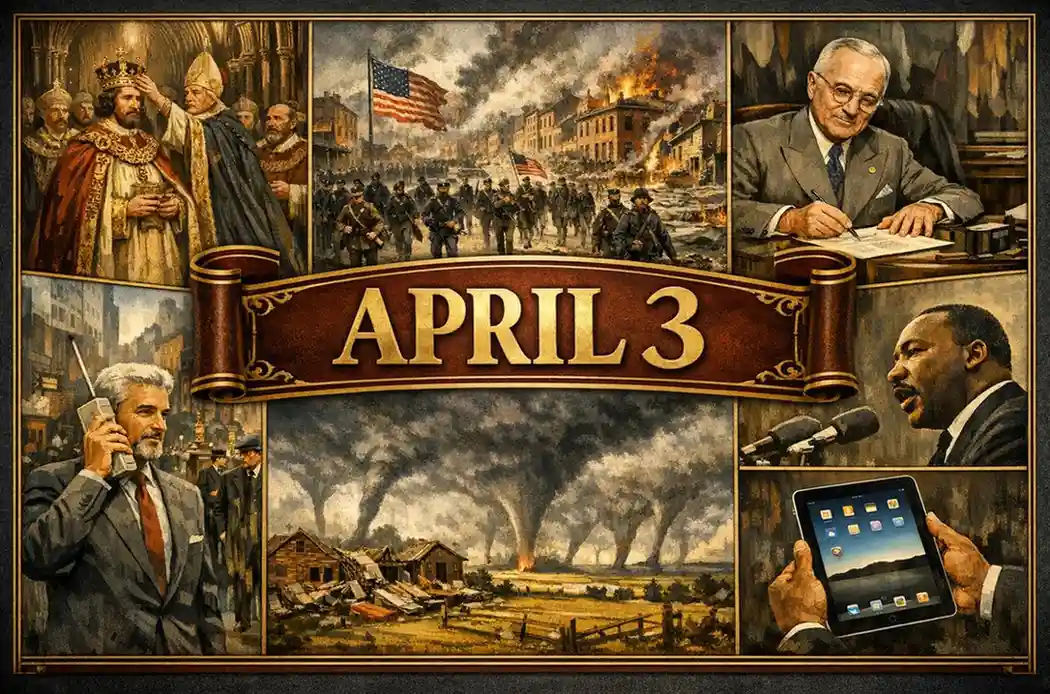
The 1043 coronation of Edward the Confessor and the 1973 debut of the handheld mobile phone revolutionized governance and global communication. When we examine this day in history April 3, we witness transformative shifts like the 1865 Union capture of Richmond and the 1948 signing of the Marshall Plan. These events redirected the course of military power and social connectivity forever.
Important Events That Happened On April 3 In History
686 – Yuknoom Yich’aak K’ahk’ Assumes the Crown
The Maya king Yuknoom Yich’aak K’ahk’ officially assumed the crown of Calakmul. His reign occurred during a period of intense rivalry between the great Maya city-states of Calakmul and Tikal.
956 – Election of Polyeuctus
Polyeuctus of Constantinople was elected as the Patriarch of Constantinople. He would go on to be a significant figure in the religious and political life of the Byzantine Empire during the mid-10th century.
1043 – Coronation of Edward the Confessor
Edward the Confessor was crowned King of England at Winchester Cathedral. His reign was characterized by a period of relative peace and the beginning of the construction of Westminster Abbey.
1077 – Creation of the Patriarchate of Friûl
The Patriarchate of Friûl was established, marking the creation of the first Friulian state. This ecclesiastical and secular territory played a key role in the medieval history of northeastern Italy.
1559 – Peace of Cateau-Cambrésis Signed
The second of two treaties making up the Peace of Cateau-Cambrésis was signed, effectively ending the Italian Wars. The agreement established a new balance of power in Europe, primarily benefiting the Spanish Empire.
1589 – Janissaries Revolt Over Currency
The Janissaries, the elite infantry units of the Ottoman Sultan, revolted in response to the debasement of the empire’s coinage. This uprising highlighted the economic pressures and internal instability facing the Ottoman state.
1721 – Robert Walpole Becomes Prime Minister
Robert Walpole effectively became the first Prime Minister of Great Britain, although he famously denied the title. His long tenure brought financial stability to the country following the South Sea Bubble.
1851 – Rama IV Crowned King of Thailand
Following the death of his half-brother, Rama III, King Mongkut (Rama IV) was crowned King of Thailand. He is remembered for his efforts to modernize the country and navigate relations with Western colonial powers.
1860 – First Pony Express Run Begins
The first successful United States Pony Express run began, carrying mail from St. Joseph, Missouri, to Sacramento, California. The relay system significantly reduced the time required to send messages across the American continent.
1865 – Union Forces Capture Richmond
During the American Civil War, Union forces successfully captured Richmond, Virginia, which served as the capital of the Confederate States of America. The fall of the city signaled the imminent collapse of the Confederacy.
1882 – Death of Jesse James
In the American Old West, the notorious outlaw Jesse James was killed by Robert Ford. Ford, a member of James’s own gang, shot him in the back of the head to collect a government bounty.
1885 – Patent for the High-Speed Engine
Gottlieb Daimler was granted a German patent for a light, high-speed, four-stroke engine. This invention was a foundational step in the development of modern transport, leading to the creation of the first motorcycle months later.
1888 – First Whitechapel Murder
The first of eleven unsolved murders attributed to or associated with Jack the Ripper occurred in the Whitechapel district of London. The brutal nature of the crimes terrified the East End and remains one of history’s greatest mysteries.
1895 – Oscar Wilde Libel Trial Begins
The trial in the libel case brought by Oscar Wilde against the Marquess of Queensberry began. The legal battle eventually backfired on Wilde, leading to his own imprisonment on charges of “gross indecency.”
1905 – Founding of Boca Juniors
The association football club Boca Juniors was founded in the La Boca neighborhood of Buenos Aires, Argentina. It has since grown into one of the most successful and popular football clubs in South America.
1920 – Assassination Attempt on General Mannerheim
A failed attempt was made on the life of General Mannerheim during a White Guard parade in Tampere, Finland. The plot was led by Aleksander Weckman under the orders of Eino Rahja.
1922 – Stalin Becomes General Secretary
Joseph Stalin was appointed as the first General Secretary of the Communist Party of the Soviet Union. This position provided the administrative power base he would eventually use to gain absolute control of the state.
1933 – First Flight Over Mount Everest
The British Houston-Mount Everest Flight Expedition completed the first flight over the summit of Mount Everest. The expedition was funded by Lady Houston and led by the Marquis of Clydesdale.
1936 – Execution of Bruno Richard Hauptmann
Bruno Richard Hauptmann was executed for the kidnapping and death of Charles Augustus Lindbergh Jr. The “Trial of the Century” had gripped the world following the abduction of the infant son of the famous aviator.
1942 – Japanese Assault on Bataan
World War II: Japanese forces launched a major assault on United States and Filipino troops defending the Bataan Peninsula. The eventual surrender of these forces led to the tragic Bataan Death March.
1946 – Execution of Masaharu Homma
Japanese Lieutenant General Masaharu Homma was executed in the Philippines. He was held responsible for the atrocities committed during the Bataan Death March earlier in the war.
1948 – Truman Signs the Marshall Plan
U.S. President Harry S. Truman signed the Marshall Plan into law, authorizing $5 billion in economic aid for 16 European countries. The plan was essential for the post-war recovery of Western Europe and the containment of communism.
1948 – Beginning of the Jeju Uprising
A period of intense violence and human rights abuses known as the Jeju uprising began in Jeju Province, South Korea. The civil conflict lasted for several years and resulted in significant loss of life.
1955 – ACLU Defends Howl
The American Civil Liberties Union (ACLU) announced its intent to defend Allen Ginsberg’s landmark poem Howl against obscenity charges. The case became a major victory for freedom of expression in American literature.
1956 – Hudsonville–Standale Tornado
A deadly F5 tornado struck the western half of the Lower Peninsula of Michigan. The storm caused widespread destruction in Hudsonville and Standale and remains one of the most powerful tornadoes in the state’s history.
1961 – LAN-Chile Flight 621 Crash
LAN-Chile Flight 621 crashed in the Andes mountains, resulting in 21 fatalities. Among those killed was the prominent Argentinian football player Eliseo Mouriño.
1968 – “I’ve Been to the Mountaintop” Speech
Dr. Martin Luther King Jr. delivered his final speech, “I’ve Been to the Mountaintop,” at the Mason Temple in Memphis, Tennessee. He was tragically assassinated the following day.
1969 – Announcement of “Vietnamization”
U.S. Secretary of Defense Melvin Laird announced the policy of “Vietnamization.” The strategy aimed to gradually withdraw U.S. combat troops while shifting the responsibility of the war effort to the South Vietnamese government.
1973 – First Handheld Mobile Phone Call
Martin Cooper of Motorola made the first handheld mobile phone call to Joel S. Engel of Bell Labs. Cooper placed the call while walking on a New York City street, marking a revolution in personal communication.
1974 – The 1974 Super Outbreak
One of the largest tornado outbreaks in recorded history occurred across the United States and Canada. The “Super Outbreak” resulted in 315 deaths and thousands of injuries over a 24-hour period.
1975 – Operation Babylift Begins
In the closing stages of the Vietnam War, the United States began Operation Babylift. The mass evacuation aimed to fly thousands of orphaned or displaced children out of South Vietnam to new homes abroad.
1975 – Karpov Named World Chess Champion
Bobby Fischer refused to defend his title in a match against Anatoly Karpov. As a result, the World Chess Federation (FIDE) awarded the title of World Champion to Karpov by default.
1980 – Restored Trust with Utah Paiutes
The U.S. Congress officially restored a federal trust relationship with five bands of the Paiute people of Utah. This act reversed earlier “termination” policies and restored federal recognition to the tribal members.
1981 – Unveiling of the Osborne 1
The Osborne 1, recognized as the first successful portable computer, was unveiled at the West Coast Computer Faire. Despite its small screen and heavy weight, it paved the way for the future of mobile computing.
1989 – Mississippi Choctaw Band v. Holyfield
The U.S. Supreme Court ruled that tribal courts have jurisdictional rights under the Indian Child Welfare Act. The decision affirmed the authority of tribal governments over adoption cases involving tribal children.
1993 – Grand National Declared Void
For the first and only time in its history, the outcome of the Grand National horse race was declared void. A series of false starts and confusion among the riders led to the race being cancelled after it had already begun.
1996 – Capture of the Unabomber
Theodore Kaczynski, known as the “Unabomber,” was captured by FBI agents at his remote cabin in Montana. His arrest ended a 17-year bombing campaign that had targeted universities and airlines.
1996 – USAF Boeing T-43 Crash
A United States Air Force Boeing T-43 crashed near Dubrovnik, Croatia. All 35 people on board were killed, including U.S. Secretary of Commerce Ron Brown, who was on a trade mission to the Balkans.
1997 – Thalit Massacre in Algeria
Guerrillas attacked the village of Thalit in Algeria, killing 52 of its 53 inhabitants. The massacre was part of the brutal civil conflict that plagued Algeria throughout the 1990s.
2000 – Microsoft Antitrust Ruling
In the case of United States v. Microsoft Corp., a federal judge ruled that Microsoft had violated antitrust laws. The court found that the company used its monopoly power to stifle competition in the web browser market.
2004 – Madrid Bombing Suspects Suicides
Terrorists involved in the Madrid train bombings were cornered by police in an apartment in Leganés. To avoid capture, the suspects detonated explosives, killing themselves and one special forces officer.
2007 – TGV Speed Record
A French TGV train set a new world speed record for conventional rail, reaching 574.8 km/h on the LGV Est line. The record-breaking run demonstrated the advanced capabilities of high-speed rail technology.
2008 – ATA Airlines Ceases Operations
ATA Airlines filed for bankruptcy and ceased all operations. Once one of the largest passenger and charter airlines in the U.S., the company’s closure followed rising fuel costs and the loss of a major military contract.
2008 – YFZ Ranch Cordoned Off
Texas law enforcement officials cordoned off the YFZ Ranch, a compound belonging to the Fundamentalist Church of Jesus Christ of Latter-Day Saints. Over 500 women and children were eventually taken into state custody following allegations of abuse.
2009 – Binghamton Shooting
A gunman opened fire at the American Civic Association immigration center in Binghamton, New York. Thirteen people were killed before the shooter committed suicide, marking a tragic act of violence at a center meant to help newcomers.
2010 – Release of the First iPad
Apple Inc. officially released the first-generation iPad. The tablet computer created a new category of consumer electronics and fundamentally changed how people consume digital media.
2013 – Record Floods in Argentina
Record-breaking rainfall caused devastating floods in La Plata and Buenos Aires, Argentina. More than 50 people died in the disaster, which caused massive property damage and infrastructure failure.
2016 – The Panama Papers Leak
A massive leak of 11.5 million documents from the law firm Mossack Fonseca was made public. The “Panama Papers” revealed how wealthy individuals and world leaders used offshore companies to hide assets and avoid taxes.
2017 – St. Petersburg Metro Bombing
A suicide bomber attacked the St. Petersburg metro system, killing 14 people and injuring dozens more. The explosion occurred between two busy stations, targeting commuters in Russia’s second-largest city.
2018 – YouTube Headquarters Shooting
A gunwoman opened fire at the YouTube headquarters in San Bruno, California. She injured three people before killing herself; the incident prompted a major emergency response and discussions on workplace security.
Read Also: This day in history April 2: Currency Foundations, and Naval Triumphs
Famous People Born on April 3
| Name | Description | Date |
|---|---|---|
| Leslie Howard | British actor (Gone with the Wind) | April 3, 1893 – June 1, 1943 |
| George Herbert | British metaphysical poet | April 3, 1593 – March 1, 1633 |
| Henry Luce | American publisher, founder of Time, Life, Fortune | April 3, 1898 – February 28, 1967 |
| Fazlur Khan | Bangladeshi American engineer, “father of tubular designs” for skyscrapers | April 3, 1929 – March 27, 1982 |
| Alcide De Gasperi | Prime minister of Italy (1945–1953), post-WWII reconstruction leader | April 3, 1881 – August 19, 1954 |
| Richard Thompson | English guitarist, singer, and songwriter | April 3, 1949 – Present |
| Philip III | King of France (1270–1285) | April 3, 1245 – October 5, 1285 |
| John Burroughs | American essayist and naturalist | April 3, 1837 – March 29, 1921 |
| Henry van de Velde | Belgian architect, originator of Art Nouveau | April 3, 1863 – October 25, 1957 |
| J.B.M. Hertzog | Prime minister of South Africa (1924–1939) | April 3, 1866 – November 21, 1942 |
| Charles Wilkes | American naval officer and explorer, led U.S. Exploring Expedition | April 3, 1798 – February 8, 1877 |
| Edward Everett Hale | American clergyman and author (“The Man Without a Country”) | April 3, 1822 – June 10, 1909 |
| Earl Lloyd | American basketball player, first African American to play in NBA | April 3, 1928 – February 26, 2015 |
| H. Saint John Philby | British explorer and Arabist, first European to cross Rubʿ al-Khali | April 3, 1885 – September 30, 1960 |
| Carter G. Woodson | American historian, founder of Black History Month | April 3, 1875 – April 3, 1950 |
| Camille Chamoun | President of Lebanon (1952–1958) | April 3, 1900 – August 7, 1987 |
| Ramnath Goenka | Indian newspaper publisher and anti-corruption crusader | April 3, 1904 – October 5, 1991 |
| Matsukata Masayoshi | Prime minister of Japan (1891–1892, 1896–1898) | April 3, 1834 – July 2, 1924 |
| George Jessel | American comedian, actor, and “Toastmaster General of the U.S.” | April 3, 1898 – May 24, 1981 |
| Otto Weininger | Austrian philosopher (Sex and Character) | April 3, 1880 – October 4, 1903 |
| Lorenzo Snow | American religious leader, fifth president of the LDS Church | April 3, 1814 – October 10, 1901 |
| Allan Dwan | American film director (over 400 films) | April 3, 1885 – December 28, 1981 |
| Alessandro Stradella | Italian Baroque composer | April 3, 1639 – February 25, 1682 |
| Jaap de Hoop Scheffer | Dutch politician, secretary-general of NATO (2004–2009) | April 3, 1948 – Present |
| Mario Castelnuovo-Tedesco | Italian composer | April 3, 1895 – March 15, 1968 |
| Mary Carpenter | British philanthropist and social reformer | April 3, 1807 – June 14, 1877 |
| Hanna Suchocka | First woman prime minister of Poland (1992–1993) | April 3, 1946 – Present |
| Katherine Esau | Russian-born American botanist, author of Plant Anatomy | April 3, 1898 – June 4, 1997 |
| Simon Willard | American clockmaker, inventor of the banjo clock | April 3, 1753 – August 30, 1848 |
| Picabo Street | American Alpine skier, Olympic gold medalist | April 3, 1971 – Present |
Famous People Died on April 3
| Name | Description | Date |
|---|---|---|
| Sarah Vaughan | American jazz vocalist, one of the greatest jazz singers | March 27, 1924 – April 3, 1990 |
| Graham Greene | English novelist and playwright | October 2, 1904 – April 3, 1991 |
| Bartolomé Esteban Murillo | Spanish Baroque religious painter | January 1, 1618 – April 3, 1682 |
| Bruno Hauptmann | German-born American convicted kidnapper of Charles Lindbergh Jr. | November 26, 1899 – April 3, 1936 |
| Juan T. Trippe | American aviation pioneer, founder of Pan American World Airways | June 27, 1899 – April 3, 1981 |
| Carter G. Woodson | American historian, founder of Black History Month | December 19, 1875 – April 3, 1950 |
| Ron Brown | American politician, first African American secretary of commerce | August 1, 1941 – April 3, 1996 |
| Ruth Prawer Jhabvala | German-born American novelist and screenwriter (Merchant-Ivory films) | May 7, 1927 – April 3, 2013 |
| Arthur I | Duke of Brittany, rival of King John of England | March 29, 1187 – April 3, 1203 |
| Sir James Clark Ross | British explorer, discovered Ross Sea and Victoria Land in Antarctica | April 15, 1800 – April 3, 1862 |
| Joseph Valachi | American gangster, first Mafia member to publicly testify | September 22, 1903 – April 3, 1971 |
| Leo Kanner | Austrian-American psychiatrist, “father of child psychiatry” | June 13, 1894 – April 3, 1981 |
| Honorius IV | Pope (1285–1287) | c.1210 – April 3, 1287 |
| Sir Peter Pears | British tenor, collaborator of Benjamin Britten | June 22, 1910 – April 3, 1986 |
| Homma Masaharu | Japanese general, commander of invasion of Philippines in WWII | November 27, 1887 – April 3, 1946 |
| Eddie Robinson | American collegiate football coach, Grambling State legend | February 13, 1919 – April 3, 2007 |
| Juliusz Słowacki | Polish Romantic poet and dramatist | September 4, 1809 – April 3, 1849 |
| Franz Berwald | Swedish composer, most important Swedish composer of 19th century | July 23, 1796 – April 3, 1868 |
| Milton Caniff | American comic-strip artist (“Terry and the Pirates,” “Steve Canyon”) | February 28, 1907 – April 3, 1988 |
| Ferde Grofé | American composer and arranger (Grand Canyon Suite) | March 27, 1892 – April 3, 1972 |
| Pál, Count Teleki | Prime minister of Hungary (1920–1921, 1939–1941) | November 1, 1879 – April 3, 1941 |
| I.L. Peretz | Polish-Jewish Yiddish writer | May 18, 1852 – April 3, 1915 |
| Stanley F. Reed | Associate justice of the U.S. Supreme Court (1938–1957) | December 31, 1884 – April 3, 1980 |
| Thomas Dixon | American novelist (The Clansman), white supremacist writer | January 11, 1864 – April 3, 1946 |
| Charles H. Goren | American contract bridge authority and tournament player | March 4, 1901 – April 3, 1991 |
| Désirée Artôt | Belgian mezzo-soprano | July 21, 1835 – April 3, 1907 |
| Mary Cartwright | British mathematician, pioneer of chaos theory | December 17, 1900 – April 3, 1998 |
| Carl Stokes | American lawyer and politician, first African American mayor of a major U.S. city | June 21, 1927 – April 3, 1996 |
| Kishori Amonkar | Indian classical vocalist, Hindustani music legend | April 10, 1932 – April 3, 2017 |
| Edward Somerset, 2nd marquess of Worcester | English Royalist during the English Civil Wars | 1601 – April 3, 1667 |
Observances & Institutional Dates
- Feast of Agape, Chionia, and Irene: Honoring the three sisters who were martyred in the 4th century for their Christian faith.
- Joseph the Hymnographer: A commemoration of the 9th-century monk known for his prolific composition of liturgical hymns.
Frequently Asked Questions
- Who became the first Prime Minister of Great Britain on April 3? Robert Walpole took office in 1721, although the title “Prime Minister” was not yet official.
- What is the significance of April 3, 1973? This date marks the first handheld mobile phone call, made by Martin Cooper of Motorola.
- When was the Marshall Plan signed? U.S. President Harry S. Truman signed the Marshall Plan on April 3, 1948.
- What was the “Super Outbreak” of 1974? It was one of the largest and most deadly tornado outbreaks in recorded history, affecting 13 U.S. states and Ontario.