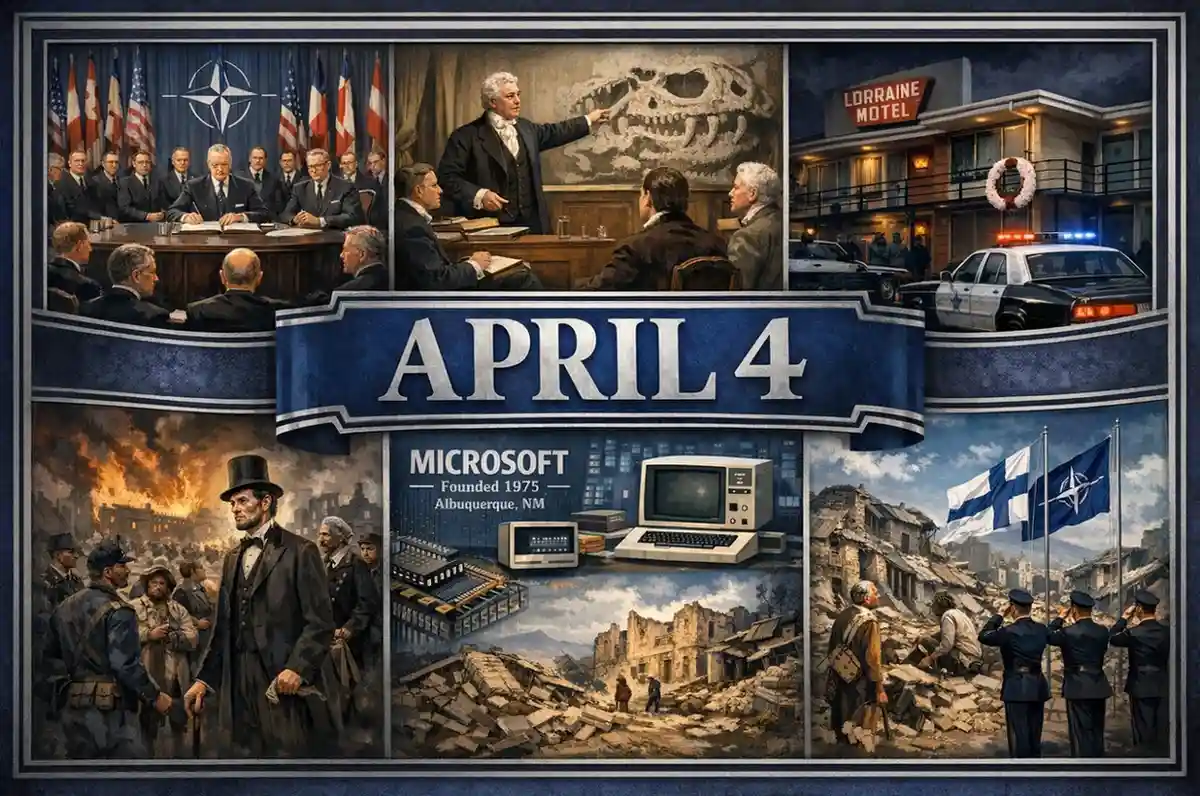
In our review of what happened on this day in history April 4, we encounter a date defined by the formation of global security and the loss of transformative leaders. From the 1949 signing of the North Atlantic Treaty to the tragic 1968 assassination of Martin Luther King Jr., this day has shaped the political and social conscience of the modern era. It is also a day of technological and national “firsts,” including the founding of Microsoft in 1975 and the 1887 election of the first female mayor in the United States.
Important Events That Happened On April 4 In History
503 BC – Triumph of Agrippa Menenius Lanatus
Roman consul Agrippa Menenius Lanatus celebrated a formal triumph following a significant military victory over the Sabines. This honor was a rare and prestigious recognition of his leadership in the early Roman Republic.
190 – Evacuation of Luoyang
The warlord Dong Zhuo ordered his troops to evacuate the Han capital of Luoyang. Before departing, his forces burned the ancient city to the ground, a catastrophic event that marked a turning point in the decline of the Han dynasty.
611 – Sack of Palenque
Maya king Uneh Chan of Calakmul successfully sacked the rival city-state of Palenque in southern Mexico. The victory established Calakmul’s temporary dominance in the regional power struggle between Maya dynasties.
619 – Bijapur-Mumbai Inscription Issued
The Bijapur-Mumbai inscription was issued by Pulakeshin II. The text provides a contemporary historical account of the Battle of Narmada, documenting the military prowess of the Chalukya dynasty.
801 – Capture of Barcelona
King Louis the Pious, son of Charlemagne, captured Barcelona from the Moors after a siege lasting several months. The victory established the city as a key defensive outpost of the Frankish Empire’s Spanish March.
1268 – Byzantine–Venetian Peace Treaty
A five-year peace treaty was concluded between the Venetian Republic and Byzantine Emperor Michael VIII Palaiologos. The agreement aimed to stabilize trade and diplomatic relations in the Eastern Mediterranean.
1423 – Death of Tommaso Mocenigo
Tommaso Mocenigo, the Doge of Venice, passed away. His reign was noted for significant naval victories against the Kingdom of Hungary and the Ottoman Empire, particularly at the 1416 Battle of Gallipoli.
1581 – Knighthood of Francis Drake
Queen Elizabeth I knighted Francis Drake aboard his ship, the Golden Hind. The honor was bestowed in recognition of Drake becoming the first Englishman to complete a circumnavigation of the globe.
1609 – Expulsion of the Moriscos
The decree to expel the Moriscos—descendants of Spain’s Muslim population who had converted to Christianity—was issued in the Kingdom of Valencia. This marked the beginning of a massive and forced migration out of Spain.
1660 – Declaration of Breda
King Charles II of Great Britain issued the Declaration of Breda while in exile. He promised a general pardon and religious tolerance to his opponents, paving the way for the Restoration of the English monarchy.
1796 – First Paleontological Lecture
Georges Cuvier delivered the world’s first lecture on paleontology. His presentation introduced the scientific community to the concept of extinction, using the remains of elephants and mammoths as evidence.
1814 – First Abdication of Napoleon
Napoleon Bonaparte signed a conditional abdication, naming his young son, Napoleon II, as Emperor of the French. However, pressure from Allied powers led to his unconditional abdication just two days later.
1818 – Adoption of the U.S. Flag Design
The United States Congress adopted a permanent design for the national flag. The plan specified 13 red and white stripes to represent the original colonies and one star for every state in the Union (20 at the time).
1841 – Death of William Henry Harrison
President William Henry Harrison died of pneumonia just one month after his inauguration. He was the first U.S. President to die in office, leading to the succession of Vice President John Tyler.
1860 – Introduction of the Finnish Markka
The official declaration introducing the markka as the currency of the Grand Duchy of Finland was read publicly. This move granted Finland a degree of economic independence from the Russian Empire.
1865 – Lincoln Visits Richmond
One day after Union forces captured the Confederate capital of Richmond, Virginia, President Abraham Lincoln visited the city. He walked through the streets and visited the former White House of the Confederacy.
1866 – Assassination Attempt on Alexander II
Russian Tsar Alexander II narrowly escaped an assassination attempt in Saint Petersburg. The attacker, Dmitry Karakozov, fired a shot that missed, leading to a period of increased state security in Russia.
1887 – First Female Mayor in the U.S.
Susanna M. Salter was elected mayor of Argonia, Kansas, becoming the first woman to hold such an office in the United States. Her name had originally been placed on the ballot as a joke by local men.
1894 – Foyot Bombing
During the “Era of Attacks” (Ère des attentats) in France, a bomb exploded at the Restaurant Foyot. The attack was part of a wave of political violence that gripped the region in the late 19th century.
1904 – Bulgarian Earthquakes
Two massive earthquakes, both estimated at a magnitude of 7.1, struck Bulgaria. Among the largest ever recorded in Europe, the quakes killed over 200 people and caused extensive structural damage.
1905 – Kangra Valley Earthquake
A devastating earthquake hit the Kangra Valley in India, killing approximately 20,000 people. The disaster leveled the towns of Kangra, McLeod Ganj, and Dharamshala, altering the landscape of the region.
1913 – First Death in the Hellenic Air Force
Emmanouil Argyropoulos became the first Greek pilot to die in service when his aircraft crashed during the First Balkan War. His death was a somber milestone in the history of Greek military aviation.
1920 – Nebi Musa Riots Begin
The Nebi Musa riots commenced in Jerusalem, lasting for four days. The violent clashes between Arab and Jewish populations marked a period of escalating tension under the British Mandate.
1925 – Founding of the SS
The Schutzstaffel (SS) was officially founded as a specialized unit of the Nazi Party in Germany. Initially serving as a small bodyguard for Adolf Hitler, it eventually grew into a massive paramilitary organization.
1933 – Wreck of the USS Akron
The U.S. Navy airship USS Akron crashed off the coast of New Jersey during a severe storm. The disaster resulted in 73 deaths, effectively ending the Navy’s large-scale rigid airship program.
1944 – Bombing of Bucharest
During World War II, Anglo-American forces conducted their first major bombardment of oil refineries in Bucharest, Romania. The air raid resulted in the deaths of approximately 3,000 civilians.
1945 – Liberation of Ohrdruf and Hungary
U.S. Army troops liberated the Ohrdruf forced labor camp in Germany, while Soviet Red Army troops completed the liberation of Hungary from German occupation. These events signaled the closing stages of the war in Europe.
1949 – NATO Formed
Twelve nations signed the North Atlantic Treaty in Washington, D.C., creating the North Atlantic Treaty Organization (NATO). The alliance was established to provide collective security against the threat of Soviet expansion.
1958 – Debut of the CND Peace Symbol
The “peace symbol,” designed for the Campaign for Nuclear Disarmament (CND), was displayed in public for the first time during a march in London. It has since become a universal icon for anti-war movements.
1960 – Independence for the Mali Federation
France officially agreed to grant independence to the Mali Federation. This union consisted of Senegal and French Sudan, though the federation would later dissolve into separate independent nations.
1963 – Release of Bye Bye Birdie
The musical romantic comedy film Bye Bye Birdie, directed by George Sidney, was released in theaters. The film became a cultural touchstone of the early 1960s, satirizing the phenomenon of Elvis Presley.
1964 – The Beatles Dominate the Charts
The Beatles achieved an unprecedented feat by occupying the top five positions on the Billboard Hot 100 pop chart. This “British Invasion” milestone remains one of the most significant records in music history.
1967 – “Beyond Vietnam” Speech
Martin Luther King Jr. delivered his influential “Beyond Vietnam: A Time to Break Silence” speech at Riverside Church in New York City. He publicly condemned the Vietnam War, linking it to issues of domestic poverty and racism.
1968 – Assassination of Martin Luther King Jr.
Dr. Martin Luther King Jr. was assassinated at the Lorraine Motel in Memphis, Tennessee. The civil rights leader’s death sparked nationwide riots and led to a period of deep national mourning and social upheaval.
1968 – Launch of Apollo 6
NASA launched Apollo 6, the second uncrewed test flight of the Saturn V launch vehicle. Despite several engine failures during the mission, it provided critical data for the upcoming crewed lunar missions.
1969 – First Temporary Artificial Heart
Dr. Denton Cooley performed the world’s first temporary artificial heart implant in Houston, Texas. The device kept the patient alive for 64 hours until a human heart became available for transplant.
1973 – Dedication of the World Trade Center
The Twin Towers of the World Trade Center were officially dedicated in New York City. At the time of their completion, they were the tallest buildings in the world and icons of the city’s skyline.
1975 – Microsoft Founded
Bill Gates and Paul Allen founded Microsoft as a partnership in Albuquerque, New Mexico. The company was established to develop software for the Altair 8800, marking the beginning of the personal computer revolution.
1975 – Operation Babylift Crash
During the evacuation of orphans from South Vietnam, a U.S. Air Force C-5A Galaxy crashed shortly after takeoff from Saigon. The tragedy resulted in 172 deaths, many of whom were children.
1979 – Execution of Zulfikar Ali Bhutto
The former Prime Minister of Pakistan, Zulfikar Ali Bhutto, was executed by the military government of Zia-ul-Haq. His death followed a controversial trial and had a lasting impact on Pakistani politics.
1981 – Attack on H-3 Airbase
During the Iran–Iraq War, the Islamic Republic of Iran Air Force conducted a daring long-range strike on Iraq’s H-3 Airbase. The mission successfully destroyed approximately 50 Iraqi aircraft on the ground.
1983 – Maiden Voyage of Challenger
The Space Shuttle Challenger launched on its maiden voyage into space (STS-6). The mission included the first spacewalk of the Space Shuttle program and the deployment of a tracking and data relay satellite.
1984 – Reagan Calls for Chemical Weapons Ban
U.S. President Ronald Reagan issued a formal call for an international ban on the use and possession of chemical weapons. This effort aimed to curb the proliferation of toxic warfare agents globally.
1988 – Removal of Governor Evan Mecham
Arizona Governor Evan Mecham was convicted in his impeachment trial and removed from office. He was the first U.S. governor in nearly 60 years to be removed through the impeachment process.
1990 – Adoption of the Hong Kong Flag
The current flag of Hong Kong, featuring a five-petaled Bauhinia flower, was officially adopted. It was designed for use in post-colonial Hong Kong following the 1997 handover from British to Chinese rule.
1991 – Death of Senator John Heinz
U.S. Senator John Heinz of Pennsylvania was killed in a mid-air collision between a helicopter and his airplane over Merion, Pennsylvania. Six others, including two children on the ground, also died in the accident.
2002 – Angolan Civil War Ends
The MPLA government of Angola and UNITA rebels signed a comprehensive peace treaty. The agreement brought a formal end to the Angolan Civil War, one of Africa’s longest-running and deadliest conflicts.
2017 – Khan Shaykhun Chemical Attack
A chemical weapon air strike was carried out on the town of Khan Shaykhun in Syria. The use of sarin gas resulted in the deaths of 89 civilians and drew international condemnation of the Syrian regime.
2023 – Finland Joins NATO
Finland officially became a member of NATO after its application was accepted by all member states, including Turkey. This historic shift ended decades of Finnish military non-alignment.
2024 – Battle of Chasiv Yar Begins
During the ongoing Russo-Ukrainian war, the Battle of Chasiv Yar commenced. The town became a critical strategic point in the defense of the Donetsk region in eastern Ukraine.
2025 – Impeachment of Yoon Suk Yeol Upheld
The Constitutional Court of South Korea unanimously upheld the impeachment of President Yoon Suk Yeol. The ruling followed his controversial declaration of martial law, officially ending his presidency.
Observances & Institutional Dates
- Independence Day (Senegal): Celebrating the 1960 independence of Senegal from French colonial rule.
- NATO Day: Marking the anniversary of the signing of the North Atlantic Treaty in 1949.
- Children’s Day (Hong Kong & Taiwan): A day dedicated to celebrating children and promoting their welfare.
- Peace Day (Angola): Commemorating the signing of the 2002 peace agreement that ended the civil war.
Famous People Born on April 4
| Name | Description | Date |
|---|---|---|
| Dorothea Dix | American social reformer, advocate for the mentally ill | April 4, 1802 – July 17, 1887 |
| Hugh Masekela | South African trumpeter and anti-apartheid activist | April 4, 1939 – January 23, 2018 |
| Shing-Tung Yau | Chinese-born mathematician, Fields Medal winner | April 4, 1949 – Present |
| Maria II | Queen of Portugal (1834–1853) | April 4, 1819 – November 15, 1853 |
| Éric Rohmer | French film director, French New Wave figure | April 4, 1920 – January 11, 2010 |
| comte de Lautréamont | French poet, major influence on Surrealists | April 4, 1846 – November 24, 1870 |
| Tris Speaker | American baseball player, Hall of Fame center fielder | April 4, 1888 – December 8, 1958 |
| Maurice de Vlaminck | French painter, co-founder of Fauvism | April 4, 1876 – October 11, 1958 |
| Benjamin Peirce | American mathematician and astronomer | April 4, 1809 – October 6, 1880 |
| William Henry Jackson | American photographer of the American West | April 4, 1843 – June 30, 1942 |
| Edward Hicks | American folk painter (The Peaceable Kingdom) | April 4, 1780 – August 23, 1849 |
| John Hannah | American football player, Hall of Fame guard | April 4, 1951 – Present |
| Pierre Monteux | French conductor | April 4, 1875 – July 1, 1964 |
| Robert E. Sherwood | American playwright, Pulitzer Prize winner | April 4, 1896 – November 14, 1955 |
| Bettina von Arnim | German Romantic writer | April 4, 1785 – January 20, 1859 |
| Arthur Murray | American ballroom-dancing instructor, entrepreneur | April 4, 1895 – March 3, 1991 |
| Grinling Gibbons | British wood-carver, master of decorative woodwork | April 4, 1648 – August 3, 1721 |
| Sir William Siemens | German-born English engineer and inventor | April 4, 1823 – November 19, 1883 |
| Richard Parsons | American businessman, CEO of AOL Time Warner and Citigroup chairman | April 4, 1948 – December 26, 2024 |
| Margaret Oliphant Oliphant | Scottish novelist and historical writer | April 4, 1828 – June 25, 1897 |
| Pierre Fresnay | French actor | April 4, 1897 – January 9, 1975 |
| Hans Richter | Hungarian conductor | April 4, 1843 – December 5, 1916 |
| Pierre-Paul Prud’hon | French painter bridging Neoclassicism and Romanticism | April 4, 1758 – February 16, 1823 |
| John Hughlings Jackson | British neurologist, pioneer of neurology | April 4, 1835 – October 7, 1911 |
| Niccolò Antonio Zingarelli | Italian composer | April 4, 1752 – May 5, 1837 |
| Linus Yale | American inventor, developed the Yale cylinder lock | April 4, 1821 – December 25, 1868 |
| Edith Södergran | Swedish-Finnish expressionist poet | April 4, 1892 – June 24, 1923 |
| Antony Tudor | British-born American choreographer, pioneer of psychological ballet | April 4, 1908 – April 20, 1987 |
| Zénobe-Théophile Gramme | Belgian electrical engineer, inventor of the Gramme dynamo | April 4, 1826 – January 20, 1901 |
| William White | American clergyman, first bishop of the Episcopal Church in the U.S. | April 4, 1748 – July 17, 1836 |
Famous People Died on April 4
| Name | Description | Date |
|---|---|---|
| Samuel Herman Reshevsky | American chess grandmaster, world championship contender | November 26, 1911 – April 4, 1992 |
| Oliver Goldsmith | Anglo-Irish author and playwright (She Stoops to Conquer) | November 10, 1730 – April 4, 1774 |
| Alfonso X | King of Castile and Leon (1252–1284), patron of learning | November 23, 1221 – April 4, 1284 |
| John Napier | Scottish mathematician, inventor of logarithms | 1550 – April 4, 1617 |
| Chögyam Trungpa | Tibetan Buddhist abbot, founder of Shambhala International | February 1940 – April 4, 1987 |
| James Hepburn, 4th earl of Bothwell | Scottish noble, third husband of Mary, Queen of Scots | c.1535 – April 4, 1578 |
| Peter Cooper | American inventor and philanthropist, founded Cooper Union | February 12, 1791 – April 4, 1883 |
| John Venn | English logician, inventor of Venn diagrams | August 4, 1834 – April 4, 1923 |
| Robert III | King of Scotland (1390–1406) | c.1337 – April 4, 1406 |
| Wilhelm Ostwald | German chemist, Nobel Prize winner (physical chemistry) | September 2, 1853 – April 4, 1932 |
| Robert A. Mundell | Canadian economist, Nobel Prize winner (optimum currency areas) | October 24, 1932 – April 4, 2021 |
| Frederick II | King of Denmark and Norway (1559–1588) | July 1, 1534 – April 4, 1588 |
| Harry Nyquist | American physicist, contributor to information theory | February 7, 1889 – April 4, 1976 |
| Sadeq Hedayat | Iranian author, pioneer of modernist Persian fiction | February 17, 1903 – April 4, 1951 |
| L. Martov | Russian revolutionary, leader of the Mensheviks | November 24, 1873 – April 4, 1923 |
| Nicholas IV | Pope (1288–1292), first Franciscan pope | September 30, 1227 – April 4, 1292 |
| Rómulo Gallegos | Venezuelan novelist and president of Venezuela (1948) | August 2, 1884 – April 4, 1969 |
| Daniele da Volterra | Italian Mannerist painter and sculptor | 1509 – April 4, 1566 |
| John McLean | Associate justice of the U.S. Supreme Court, dissented in Dred Scott case | March 11, 1785 – April 4, 1861 |
| Charles Bulfinch | American architect, designer of the U.S. Capitol | August 8, 1763 – April 4, 1844 |
| Rafael Carrera | Dictator of Guatemala (1844–1848, 1851–1865) | October 24, 1814 – April 4, 1865 |
| Elizabeth Patterson Bonaparte | American celebrity, wife of Jérôme Bonaparte | February 6, 1785 – April 4, 1879 |
| James Edward Hubert Gascoyne-Cecil, 4th marquess of Salisbury | British statesman | October 23, 1861 – April 4, 1947 |
| Hermann Cohen | German philosopher, founder of Marburg neo-Kantianism | July 4, 1842 – April 4, 1918 |
| Jérôme Lalande | French astronomer | July 11, 1732 – April 4, 1807 |
| Carlo, Conte Gozzi | Italian dramatist and poet | December 13, 1720 – April 4, 1806 |
| George Whitefield Chadwick | American composer, member of the New England school | November 13, 1854 – April 4, 1931 |
| Adam Clayton Powell, Jr. | American congressman and civil rights leader | November 29, 1908 – April 4, 1972 |
| Constantin Meunier | Belgian sculptor and painter, social realist | April 12, 1831 – April 4, 1905 |
| Pat O’Dea | Australian-born American football and Australian rules football star | March 16, 1872 – April 4, 1962 |
Frequently Asked Questions
- When was NATO founded? NATO was officially established on April 4, 1949, with the signing of the North Atlantic Treaty.
- What happened to Martin Luther King Jr. on this day? Dr. King was assassinated in Memphis in 1968, just one year after his famous “Beyond Vietnam” speech.
- Who was the first U.S. President to die in office? William Henry Harrison became the first President to die in office on April 4, 1841.
- When was Microsoft founded? Microsoft was founded as a partnership between Bill Gates and Paul Allen on April 4, 1975.