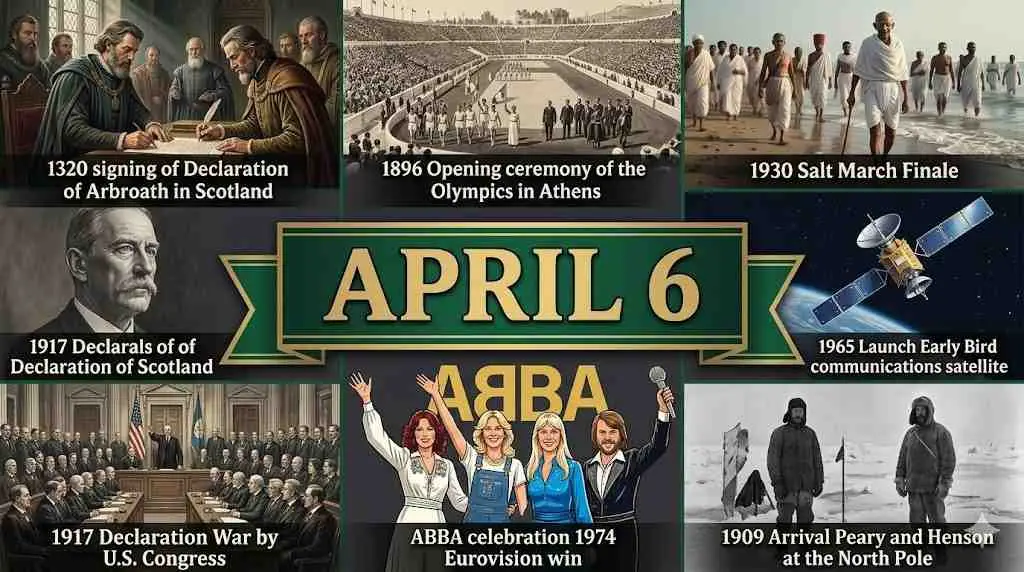
The 1320 signing of the Declaration of Arbroath and the 1917 entry of the United States into World War I showcase the enduring drive for sovereignty and global intervention. When we study this day in history April 6, we encounter pivotal moments like the 1896 birth of the modern Olympic Games and the 1965 launch of the first commercial communications satellite. These breakthroughs effectively reshaped the landscapes of international diplomacy, athletics, and technology.
Important Events That Happened On April 6 In History
46 BC – Battle of Thapsus
Julius Caesar achieved a decisive victory over the forces of Caecilius Metellus Scipio and Cato the Younger. The battle was a major engagement in Caesar’s Civil War, leading to the eventual collapse of the senatorial resistance in Africa.
402 – Battle of Pollentia
The Roman general Stilicho defeated the Visigoths, led by Alaric, at the Battle of Pollentia. While the victory was not absolute, it successfully forced the Visigoths to retreat from Italy for a period of time.
945 – Coronation of Romanos II
Byzantine Emperor Constantine VII crowned his young son, Romanos II, as co-emperor. This move was intended to secure the Macedonian dynasty’s succession and ensure a stable transition of power within the empire.
1320 – Declaration of Arbroath
The Scottish nobility reaffirmed their nation’s independence from England by signing the Declaration of Arbroath. Addressed to Pope John XXII, the document remains one of the most famous symbols of Scottish national identity.
1453 – Siege of Constantinople Begins
Sultan Mehmed II initiated the final siege of Constantinople. The city held out until May 29, when it was finally captured by the Ottoman Turks and eventually renamed Istanbul, marking the end of the Byzantine Empire.
1580 – The Dover Straits Earthquake
One of the largest earthquakes in the recorded history of England, Flanders, and Northern France took place. The tremor caused significant damage to buildings on both sides of the English Channel, including London and Calais.
1652 – Founding of Cape Town
Dutch sailor Jan van Riebeeck arrived at the Cape of Good Hope to establish a resupply camp for the Dutch East India Company. This settlement eventually grew into the city of Cape Town, the first permanent European outpost in South Africa.
1712 – New York Slave Revolt
The New York Slave Revolt of 1712 began near Broadway. A group of enslaved Africans set fire to a building and attacked white colonists, leading to a brutal crackdown and the passage of harsher slave codes in the colony.
1776 – Continental Navy Naval Skirmish
Ships of the newly formed Continental Navy failed in their attempt to capture a Royal Navy dispatch boat during the American Revolutionary War. The encounter highlighted the early challenges faced by the American naval forces against British maritime power.
1782 – Establishment of the Chakri Dynasty
King Buddha Yodfa Chulaloke (Rama I) established the Chakri dynasty in Siam (modern-day Thailand). The dynasty continues to reign over the country today, with Bangkok serving as the capital established by Rama I.
1793 – Committee of Public Safety Formed
During the French Revolution, the Committee of Public Safety was established as the executive organ of the republic. Under the influence of figures like Maximilien Robespierre, it became the primary instrument of the Reign of Terror.
1800 – Treaty of Constantinople
The Treaty of Constantinople established the Septinsular Republic, marking the creation of the first autonomous Greek state since the fall of the Byzantine Empire. The republic consisted of seven Ionian islands under joint Russian and Ottoman protection.
1808 – Incorporation of the American Fur Company
John Jacob Astor incorporated the American Fur Company. Through his dominance of the fur trade in the Pacific Northwest and the Great Lakes, Astor eventually became the first multi-millionaire in the United States.
1812 – Assault on Badajoz
British forces led by the Duke of Wellington successfully assaulted the French-held fortress of Badajoz. The bloody victory was a major turning point in the Peninsular War, allowing the British to advance further into Spain.
1814 – Abdication of Napoleon
Napoleon Bonaparte abdicated the French throne and was exiled to the island of Elba. This date marks the nominal beginning of the Bourbon Restoration, as the French monarchy was briefly reinstated under Louis XVIII.
1830 – Organization of the Church of Christ
Joseph Smith and several associates officially organized the Church of Christ in New York. This event marked the formal beginning of the Latter Day Saint movement, which would eventually grow into a major religious denomination.
1841 – Swearing in of John Tyler
John Tyler was officially sworn in as the tenth President of the United States. He assumed the office two days after the death of William Henry Harrison, becoming the first Vice President to succeed to the presidency.
1860 – Organization of the Reorganized Church
Joseph Smith III and others organized the Reorganized Church of Jesus Christ of Latter Day Saints in Amboy, Illinois. The group, later renamed the Community of Christ, sought to differentiate itself from the larger body of the church in Utah.
1862 – Battle of Shiloh Begins
The Battle of Shiloh, one of the bloodiest engagements of the American Civil War, began in Tennessee. Union forces under General Ulysses S. Grant were initially surprised by a Confederate attack led by General Albert Sidney Johnston.
1865 – Battle of Sailor’s Creek
Robert E. Lee’s Army of Northern Virginia fought and lost its last major battle at Sailor’s Creek. The defeat during the retreat from Richmond made the eventual Confederate surrender at Appomattox Court House inevitable.
1866 – Founding of the Grand Army of the Republic
The Grand Army of the Republic (GAR), a patriotic organization for Union veterans of the American Civil War, was founded. It became a powerful political and social force in the United States for nearly a century.
1896 – First Modern Olympic Games
The opening of the first modern Olympic Games was celebrated in Athens, Greece. The event marked the revival of the ancient tradition 1,500 years after the original games were banned by the Roman Emperor Theodosius I.
1909 – Reach for the North Pole
Robert Peary and Matthew Henson claimed to be the first people to reach the North Pole. While Peary was credited for decades, his claim has since been disputed by many experts due to inaccuracies in his navigational records.
1911 – Raising of the Albanian Flag
During the Battle of Deçiq, Dedë Gjon Luli Dedvukaj raised the Albanian flag in Tuzi, Montenegro. It was the first time the flag had been raised in battle since the time of the national hero Skanderbeg in the 15th century.
1917 – U.S. Declares War on Germany
The United States officially declared war on Germany, marking its entry into World War I. The decision shifted the nation from its policy of neutrality to active involvement in the global conflict on the side of the Allied Powers.
1918 – Battle of Tampere Ends
The Battle of Tampere, the largest and bloodiest engagement of the Finnish Civil War, came to an end. The victory of the “White” forces over the “Red” guards was a decisive moment in the conflict that led to Finnish independence.
1926 – First Commercial Flight of Varney Airlines
Varney Airlines made its first commercial flight, carrying mail between Pasco, Washington, and Elko, Nevada. Varney Airlines is considered the root company of what would eventually become United Airlines.
1929 – Impeachment of Huey P. Long
The Louisiana House of Representatives impeached Governor Huey P. Long. Despite the charges, which included abuse of power and bribery, Long successfully fought the impeachment in the State Senate and remained in office.
1930 – End of the Salt March
At the conclusion of the Salt March, Mahatma Gandhi picked up a lump of salt and mud at Dandi, defying the British salt tax. He declared that the act was intended to “shake the foundations of the British Empire” through nonviolent civil disobedience.
1936 – Gainesville Tornado
A massive tornado struck Gainesville, Georgia, just one day after a similar F5 tornado hit Tupelo, Mississippi. The Gainesville storm killed 203 people, making the outbreak one of the deadliest in American history.
1941 – Invasion of Yugoslavia and Greece
Nazi Germany launched Operation 25 and Operation Marita, the simultaneous invasions of the Kingdom of Yugoslavia and Greece. The Axis powers sought to secure the Balkan peninsula and aid their struggling Italian allies.
1945 – Liberation of Sarajevo
Yugoslav Partisans liberated the city of Sarajevo from German and Croatian Ustaše forces. The city’s liberation was a major victory for the resistance movement as World War II drew to a close in Europe.
1945 – Battle of Slater’s Knoll Ends
On the island of Bougainville, the Battle of Slater’s Knoll concluded with an Australian victory over Japanese forces. It was a key engagement in the Bougainville Campaign in the Pacific theater of World War II.
1947 – First Tony Awards
The first Antoinette Perry Awards for Excellence in Theatre, commonly known as the Tony Awards, were presented in New York City. The awards were established to honor outstanding achievement in Broadway theater.
1948 – Finno-Soviet Treaty Signed
The Agreement of Friendship, Cooperation, and Mutual Assistance was signed between Finland and the Soviet Union in Moscow. The treaty defined the two nations’ relations throughout the Cold War, ensuring Finnish neutrality.
1957 – Founding of Olympic Airways
Greek shipping magnate Aristotle Onassis founded Olympic Airways after acquiring the assets of the state-owned TAE – Greek National Airlines. It served as the national flag carrier of Greece for several decades.
1958 – Capital Airlines Flight 67 Crash
A Vickers Viscount aircraft operating as Capital Airlines Flight 67 crashed near Freeland, Michigan. All 47 people on board were killed; investigators later determined that ice buildup on the tail caused the pilots to lose control.
1965 – Launch of Early Bird
The Early Bird (Intelsat I) satellite was launched, becoming the first commercial communications satellite placed in geosynchronous orbit. It revolutionized international communication by providing live television and telephone links across the Atlantic.
1968 – Richmond, Indiana Explosions
A double explosion occurred in the downtown district of Richmond, Indiana, caused by a natural gas leak in a sporting goods store. The disaster killed 41 people and injured 150 others, destroying several city blocks.
1968 – Trudeau Becomes Prime Minister
Pierre Elliott Trudeau won the leadership election of the Liberal Party of Canada. He was sworn in as Prime Minister shortly afterward, ushering in a period of significant social and constitutional change in Canada.
1970 – Newhall Massacre
Four California Highway Patrol officers were killed in a shootout with two heavily armed criminals in Newhall, California. The incident led to major changes in police training and firearms tactics across the United States.
1972 – U.S. Sustained Air Strikes in Vietnam
As part of the response to the North Vietnamese “Easter Offensive,” American forces began sustained air strikes and naval bombardments. The operation aimed to halt the conventional invasion of South Vietnam by northern troops.
1973 – Launch of Pioneer 11
NASA launched the Pioneer 11 spacecraft on a mission to study the asteroid belt, Jupiter, and Saturn. It became the second probe to fly by Jupiter and the first to reach Saturn, providing the first close-up images of its rings.
1973 – Debut of the Designated Hitter
Major League Baseball’s American League began using the “designated hitter” rule for the first time. Ron Blomberg of the New York Yankees became the first DH to appear in a regular-season game.
1974 – ABBA Wins Eurovision
The Swedish pop group ABBA won the Eurovision Song Contest in Brighton with their song “Waterloo.” The victory propelled the band to international superstardom and marked Sweden’s first win in the competition.
1974 – California Jam Festival
The first California Jam music festival was held at the Ontario Motor Speedway. Co-headlined by Deep Purple and Emerson, Lake & Palmer, the event set records for the loudest sound system and the highest paid attendance at a festival to that date.
1984 – Coup Attempt in Cameroon
Members of the Republican Guard in Cameroon launched an unsuccessful attempt to overthrow the government of President Paul Biya. The ensuing battles in the capital city of Yaoundé resulted in hundreds of deaths.
1985 – Ousting of Gaafar Nimeiry
Sudanese President Gaafar Nimeiry was deposed in a bloodless military coup while he was on a visit to the United States. Field Marshal Abdel Rahman Swar al-Dahab led the takeover, promising a return to civilian rule.
1992 – Outbreak of the Bosnian War
The Bosnian War officially began as ethnic tensions escalated following Bosnia and Herzegovina’s declaration of independence. The conflict would last for over three years and lead to the Siege of Sarajevo and widespread ethnic cleansing.
1994 – Rwandan Genocide Begins
An aircraft carrying the presidents of Rwanda and Burundi was shot down over Kigali, killing everyone on board. The assassination served as the catalyst for the Rwandan genocide, in which approximately 800,000 people were murdered.
1997 – Lillelid Murders
In a shocking act of violence, a family of four was kidnapped from a rest area in Tennessee and shot by a group of six teenagers. Three family members died in the attack, which drew national attention to the issue of juvenile crime.
1998 – Pakistan Missile Tests
Pakistan successfully tested the Ghauri-I medium-range ballistic missile, capable of carrying a nuclear warhead to targets in India. The test was a response to regional security tensions and India’s own missile program.
2004 – Impeachment of Rolandas Paksas
Rolandas Paksas became the first president of Lithuania—and the first in European history—to be removed from office through impeachment. He was convicted of leaking classified information and other violations of his oath.
2005 – Jalal Talabani Elected President
Kurdish leader Jalal Talabani was elected President of Iraq by the nation’s transitional assembly. He was the first non-Arab president of an Arab state and a key figure in the post-Saddam Hussein political landscape.
2008 – Egyptian General Strike
A general strike led by Egyptian textile workers began in the city of El-Mahalla El-Kubra. The protest against low wages and rising food prices was supported by the April 6 Youth Movement, a precursor to the 2011 revolution.
2009 – L’Aquila Earthquake
A 6.3 magnitude earthquake struck the Abruzzo region of Italy, centered near the city of L’Aquila. The disaster killed 307 people, left thousands homeless, and destroyed many historic medieval buildings.
2010 – Dantewada Ambush
Maoist rebels (Naxalites) ambushed a convoy of the Central Reserve Police Force in the Dantewada district of India. Seventy-six officers were killed in the deadliest attack ever carried out against Indian security forces by the group.
2011 – San Fernando Mass Graves
In San Fernando, Mexico, authorities began exhuming the bodies of 193 victims from mass graves. The victims, many of whom were migrants, had been murdered by the Los Zetas drug cartel.
2012 – Declaration of Azawad Independence
The National Movement for the Liberation of Azawad (MNLA) declared the independence of Azawad from the Republic of Mali. The declaration followed a Tuareg rebellion and a military coup in the Malian capital.
2017 – U.S. Missile Strike on Syria
The United States launched 59 Tomahawk cruise missiles at the Shayrat Airbase in Syria. The strike was a response to a chemical weapons attack carried out by the Syrian government on civilians in Khan Shaykhun.
2018 – Humboldt Broncos Bus Crash
A bus carrying the Humboldt Broncos junior ice hockey team collided with a semi-truck at an intersection in Saskatchewan, Canada. Sixteen people were killed and thirteen injured in a tragedy that prompted an outpouring of international grief.
Famous People Born on April 6
| Name | Description | Date |
|---|---|---|
| Ian Paisley | Northern Irish politician, first minister of Northern Ireland (2007–2008) | April 6, 1926 – September 12, 2014 |
| Gerry Mulligan | American baritone saxophonist, cool jazz pioneer | April 6, 1927 – January 20, 1996 |
| Aleksandr Ivanovich Herzen | Russian political thinker and writer, “father of Russian socialism” | April 6, 1812 – January 21, 1870 |
| James Mill | Scottish philosopher, historian, and economist (Utilitarianism) | April 6, 1773 – June 23, 1836 |
| Harold Edgerton | American electrical engineer, pioneer of high-speed photography | April 6, 1903 – January 4, 1990 |
| René Lalique | French jeweler and glass designer, Art Nouveau master | April 6, 1860 – May 5, 1945 |
| Lincoln Steffens | American journalist, leading muckraker | April 6, 1866 – August 9, 1936 |
| Leonora Carrington | English-born Mexican Surrealist painter and writer | April 6, 1917 – May 25, 2011 |
| Lowell Thomas | American radio commentator, explorer, and journalist | April 6, 1892 – August 29, 1981 |
| Osman Ali | Nizam of Hyderabad (1911–1948), one of the richest men in history | April 6, 1886 – February 24, 1967 |
| Michele Bachmann | American politician, Republican presidential candidate (2012) | April 6, 1956 – Present |
| Anthony Herman Gerard Fokker | Dutch aircraft manufacturer, pioneer aviator | April 6, 1890 – December 23, 1939 |
| Donald Douglas | American aircraft designer, founder of Douglas Aircraft Company | April 6, 1892 – February 1, 1981 |
| Charles Felix | King of Sardinia-Piedmont (1821–1831) | April 6, 1765 – April 27, 1831 |
| Edmond H. Fischer | American biochemist, Nobel Prize winner (protein phosphorylation) | April 6, 1920 – August 27, 2021 |
| Horst L. Störmer | German-American physicist, Nobel Prize winner (fractional quantum Hall effect) | April 6, 1949 – Present |
| Anton Geesink | Dutch judoka, first non-Japanese world judo champion | April 6, 1934 – August 27, 2010 |
| Randy Weston | American jazz pianist and composer | April 6, 1926 – September 1, 2018 |
| Philip Henry Gosse | English naturalist, inventor of the institutional aquarium | April 6, 1810 – August 23, 1888 |
| Gil Kane | Latvian-born American comic book artist | April 6, 1926 – January 31, 2000 |
| Joseph Medill | American publisher, owner of the Chicago Tribune | April 6, 1823 – March 16, 1899 |
| Johann Kuhnau | German composer, predecessor of Bach at St. Thomas Church, Leipzig | April 6, 1660 – June 5, 1722 |
| Feodor Lynen | German biochemist, Nobel Prize winner (cholesterol metabolism) | April 6, 1911 – August 6, 1979 |
| Ronglu | Chinese official and general during the Qing dynasty | April 6, 1836 – April 11, 1903 |
| Arthur Wesley Dow | American painter, printmaker, and educator | April 6, 1857 – December 13, 1922 |
| James Augustine Healy | First African American Roman Catholic bishop in the United States | April 6, 1830 – August 5, 1900 |
| Jean-Baptiste Rousseau | French dramatist and poet | April 6, 1671 – March 17, 1741 |
| George Marsden Waterhouse | Prime minister of South Australia and New Zealand (only person to be premier of two colonies) | April 6, 1824 – August 6, 1906 |
| Louis Raemaekers | Dutch cartoonist, famous for anti-German cartoons during WWI | April 6, 1869 – July 26, 1956 |
| Joseph H. Lewis | American film director (B-westerns and film noirs) | April 6, 1907 – August 30, 2000 |
Famous People Died on April 6
| Name | Description | Date |
|---|---|---|
| Rainier III, prince de Monaco | Prince of Monaco (1949–2005), husband of Grace Kelly | May 31, 1923 – April 6, 2005 |
| Niels Henrik Abel | Norwegian mathematician, pioneer of group theory | August 5, 1802 – April 6, 1829 |
| Albert Sidney Johnston | Confederate general, highest-ranking officer killed in Civil War | February 2, 1803 – April 6, 1862 |
| Edwin Arlington Robinson | American poet, three-time Pulitzer Prize winner | December 22, 1869 – April 6, 1935 |
| Muḥammad Shah | Mughal emperor of India (1719–1748) | August 7, 1702 – April 6, 1748 |
| Abe Fortas | Associate justice of the U.S. Supreme Court (1965–1969) | June 19, 1910 – April 6, 1982 |
| Wilma Mankiller | Native American leader, first woman chief of the Cherokee Nation | November 18, 1945 – April 6, 2010 |
| Vladimir Zhirinovsky | Russian politician, leader of the Liberal Democratic Party of Russia | April 26, 1946 – April 6, 2022 |
| Al Kaline | American baseball player, Hall of Fame outfielder | December 19, 1934 – April 6, 2020 |
| Taksin | King of Siam (1767–1782), reunited Thailand after Burmese invasion | April 17, 1734 – April 6, 1782 |
| Jules Bordet | Belgian bacteriologist, Nobel Prize winner (immunology) | June 13, 1870 – April 6, 1961 |
| Molly Picon | American Yiddish theatre actress and singer | June 1, 1898 – April 6, 1992 |
| Sir William Hamilton | British diplomat and archaeologist, husband of Emma Hamilton | December 13, 1730 – April 6, 1803 |
| Moses Hess | German journalist and socialist, early Zionist thinker | January 21, 1812 – April 6, 1875 |
| Heinrich Lübke | President of West Germany (1959–1969) | October 14, 1894 – April 6, 1972 |
| Emil Brunner | Swiss Reformed theologian | December 23, 1889 – April 6, 1966 |
| Domenichino | Italian Baroque painter | October 1581 – April 6, 1641 |
| Anatoly Fyodorovich Dobrynin | Soviet diplomat, ambassador to the U.S. (1962–1986) | November 16, 1919 – April 6, 2010 |
| St. Peter Martyr | Italian inquisitor and preacher, Catholic saint | c.1205 – April 6, 1252 |
| William Harold Ponsford | Australian cricketer, one of the game’s greatest batsmen | October 19, 1900 – April 6, 1991 |
| Edward Seymour, earl of Hertford | English lord, secret marriage to heir to throne angered Elizabeth I | c.1539 – April 6, 1621 |
| John Stow | English antiquarian, author of A Survey of London | 1525 – April 6, 1605 |
| Giovanni Pascoli | Italian classical scholar and poet | December 31, 1855 – April 6, 1912 |
| Otto Struve | Russian-American astronomer | August 12, 1897 – April 6, 1963 |
| Devi Lal | Indian politician, founder of Indian National Lok Dal | September 25, 1914 – April 6, 2001 |
| Alexander Lange Kielland | Norwegian novelist and dramatist | February 18, 1849 – April 6, 1906 |
| William Strickland | American architect, leader of the Greek Revival movement | 1788 – April 6, 1854 |
| Willem Marinus Dudok | Dutch architect | July 6, 1884 – April 6, 1974 |
| Rose Cecil O’Neill | American illustrator, creator of Kewpie dolls | June 25, 1874 – April 6, 1944 |
| Herman Francis Mark | Austrian American chemist, “father of polymer science” | May 3, 1895 – April 6, 1992 |
Observances & Institutional Dates
- Chakri Day (Thailand): Honoring the founding of the currently reigning Chakri dynasty in 1782.
- Tartan Day (North America): Celebrating Scottish heritage and the anniversary of the Declaration of Arbroath.
- International Day of Sport for Development and Peace: A UN-recognized day to highlight the role of sports in social change and community building.
- National Fisherman Day (Indonesia): A day of appreciation for the fishing industry and its contribution to the nation’s economy.
- New Beer’s Eve (United States): Commemorating the night before the Cullen–Harrison Act went into effect in 1933, allowing the legal sale of low-alcohol beer after years of Prohibition.
Frequently Asked Questions
- What was the Declaration of Arbroath? It was a letter signed on April 6, 1320, by Scottish nobles to the Pope, declaring Scotland’s status as an independent, sovereign state.
- When did the United States enter World War I? The U.S. officially declared war on Germany on April 6, 1917.
- Who won the first modern Olympic Games? The first modern Olympics opened on April 6, 1896, in Athens; the games featured athletes from 14 nations competing in 43 events.
- What sparked the Rwandan genocide? The shooting down of President Juvénal Habyarimana’s plane on April 6, 1994, served as the immediate trigger for the violence.