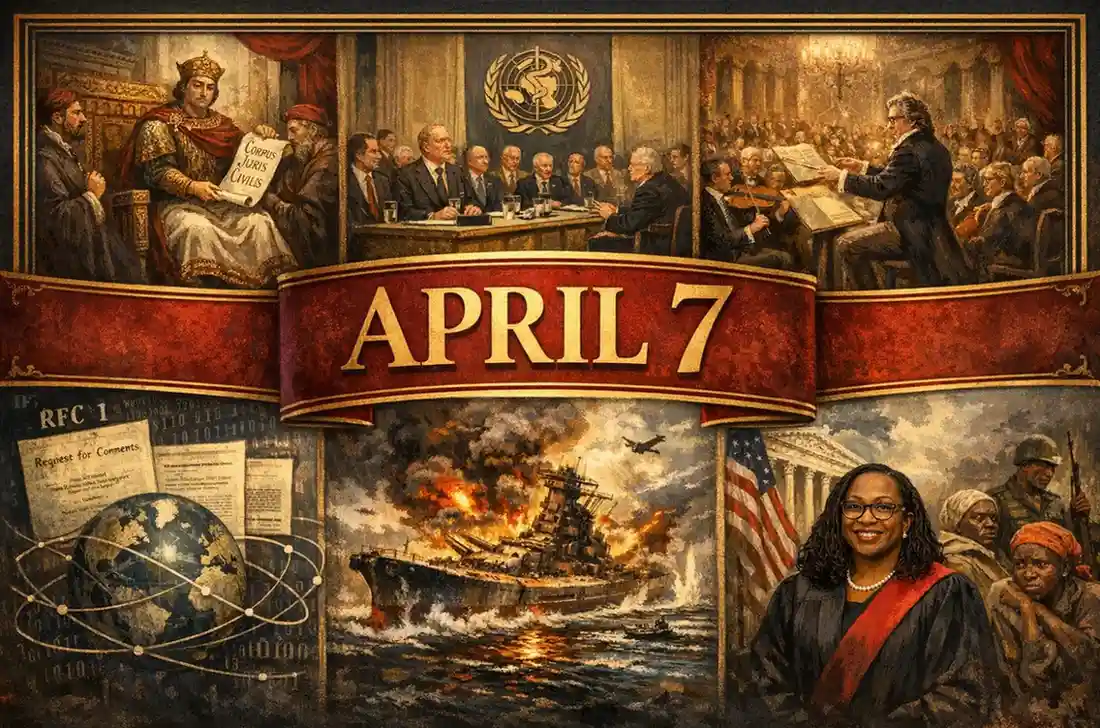
In analyzing what happened on this day in history April 7, we observe a date marked by the codification of law and the establishment of global institutions. From the 529 issuance of the Corpus Juris Civilis to the 1948 founding of the World Health Organization, this day reflects humanity’s ongoing efforts to organize society and protect public well-being. It is also a day of significant cultural and scientific milestones, including the premiere of Beethoven’s Third Symphony in 1805 and the “symbolic birth” of the internet in 1969.
Important Events That Happened On April 7 In History
451 – Attila the Hun Captures Metz
Attila the Hun led his forces to capture the town of Metz in present-day France. The Huns burned the town and killed the majority of its inhabitants as part of their devastating campaign through Gaul.
529 – Issuance of the Corpus Juris Civilis
Eastern Roman Emperor Justinian I issued the first Corpus Juris Civilis. This monumental work of jurisprudence organized and preserved centuries of Roman law, forming the foundation of many modern legal systems.
1141 – Empress Matilda Becomes Ruler of England
Empress Matilda was recognized as the first female ruler of England, adopting the title “Lady of the English.” Her brief period of authority occurred during “The Anarchy,” a civil war fought against her cousin Stephen of Blois.
1348 – Chartering of Prague University
Holy Roman Emperor Charles IV issued a charter to establish Prague University (Charles University). It became the first university in Central Europe and remains one of the oldest continuously operating universities in the world.
1449 – Abdication of the Final Antipope
Felix V officially abdicated his claim to the papacy. His resignation marked the end of the reign of the final Antipope and helped resolve the internal divisions within the Catholic Church.
1521 – Magellan Arrives at Cebu
Portuguese explorer Ferdinand Magellan arrived at the island of Cebu in the Philippines. His arrival led to the first recorded conversion of local inhabitants to Christianity in the region.
1541 – Francis Xavier Departs for the East
Francis Xavier left Lisbon, Portugal, on a mission to the Portuguese East Indies. As a co-founder of the Jesuit order, his journey marked the beginning of extensive Catholic missionary work in Asia.
1724 – Premiere of Bach’s St John Passion
The premiere performance of Johann Sebastian Bach’s St John Passion took place at St. Nicholas Church in Leipzig. The work is considered one of the masterpieces of sacred choral music.
1767 – End of the Burmese–Siamese War
The Burmese–Siamese War concluded with the total destruction of the Siamese capital, Ayutthaya. The fall of the city ended the Ayutthaya Kingdom and reshaped the geopolitical landscape of Southeast Asia.
1788 – Establishment of Marietta, Ohio
Settlers established Marietta, Ohio, marking the first permanent settlement created by United States citizens in the Northwest Territory. The town served as an early gateway for westward expansion.
1795 – Adoption of the Kilogram and Gram
The French First Republic officially adopted the kilogram and gram as its primary units of mass. This move was a critical step in the development and standardization of the metric system.
1798 – Organization of the Mississippi Territory
The United States organized the Mississippi Territory from land disputed with the Spanish Empire. The territory was later expanded in 1804 and 1812, eventually becoming the states of Mississippi and Alabama.
1805 – Beethoven’s Third Symphony Premiere
Ludwig van Beethoven conducted the first public performance of his Third Symphony, the Eroica, at the Theater an der Wien in Vienna. The symphony marked the beginning of Beethoven’s innovative “middle period.”
1824 – Founding of the Mechanics’ Institution
The Mechanics’ Institution was established in Manchester, England. Created for the education of working men, it served as the precursor to three major modern universities in the city of Manchester.
1831 – Pedro II Becomes Emperor of Brazil
Following the abdication of his father, Pedro I, five-year-old Pedro II became the Emperor of Brazil. He would go on to rule for nearly six decades, overseeing a period of significant growth and stability.
1862 – Union Victory at Shiloh
During the American Civil War, the Union’s Army of the Tennessee and the Army of the Ohio defeated the Confederate Army of Mississippi. The second day of the Battle of Shiloh secured a vital victory for Union forces in the Western Theater.
1906 – Eruption of Mount Vesuvius
Mount Vesuvius erupted with great violence, causing widespread devastation in the city of Naples and surrounding areas. The eruption killed hundreds and displaced thousands of residents.
1922 – Teapot Dome Scandal
U.S. Secretary of the Interior Albert B. Fall began leasing federal petroleum reserves at Teapot Dome, Wyoming, to private oil companies. The secret deal led to one of the greatest political corruption scandals in American history.
1927 – First Long-Distance TV Broadcast
AT&T engineer Herbert Ives transmitted the first long-distance public television broadcast. The transmission traveled from Washington, D.C., to New York City and featured the image of Secretary of Commerce Herbert Hoover.
1933 – Repeal of Beer Prohibition
Prohibition was partially repealed in the U.S. for beer with an alcohol content of no more than 3.2%. This change occurred months before the total repeal of Prohibition and is now celebrated as National Beer Day.
1939 – Italian Invasion of Albania
Under the orders of Benito Mussolini, Italian forces invaded Albania. King Zog I was forced into exile, and Mussolini declared the nation an Italian protectorate.
1940 – Booker T. Washington Postage Stamp
Booker T. Washington became the first African American to be depicted on a United States postage stamp. The stamp was part of the “Famous Americans” series issued by the U.S. Postal Service.
1943 – Mandatory Helmets in the NFL
The National Football League (NFL) passed a rule making the wearing of helmets mandatory for all players. Prior to this, many players competed without head protection or used soft leather caps.
1945 – Sinking of the Yamato
The Japanese battleship Yamato, one of the largest ever built, was sunk by United States Navy aircraft during Operation Ten-Go. Its destruction signaled the end of the Imperial Japanese Navy’s traditional fleet operations.
1948 – World Health Organization Established
The United Nations officially established the World Health Organization (WHO). The agency was created to coordinate international health efforts and manage global health crises.
1954 – Eisenhower’s “Domino Theory” Speech
President Dwight D. Eisenhower gave his famous “domino theory” speech during a news conference. He argued that the fall of one nation to communism would lead to a chain reaction in neighboring countries.
1955 – Resignation of Winston Churchill
Winston Churchill resigned as Prime Minister of the United Kingdom at the age of 80. His departure was prompted by failing health, ending his second term as the nation’s leader.
1964 – IBM Announces the System/360
IBM announced the System/360, a landmark family of mainframe computer systems. It was the first system designed to cover a full range of applications, from commercial to scientific, using a single architecture.
1968 – Death of Jim Clark
Two-time Formula One World Champion Jim Clark was killed in a racing accident at the Hockenheimring in Germany. Clark is widely regarded as one of the greatest and most versatile drivers in history.
1969 – Symbolic Birth of the Internet
The publication of Request for Comments (RFC) 1 took place. This document, titled “Host Software,” is often cited as the symbolic birth date of the internet as it established the groundwork for network communication.
1973 – First Space Shuttle Spacewalk
During the STS-6 mission, astronauts Story Musgrave and Don Peterson performed the first spacewalk of the Space Shuttle program. The activity tested the new suits and airlock systems of the shuttle Challenger.
1980 – U.S. Severs Relations with Iran
The United States officially severed diplomatic relations with Iran during the ongoing Iran hostage crisis. This move followed the failed attempts to negotiate the release of American embassy personnel.
1988 – Soviet Withdrawal from Afghanistan
Soviet Defense Minister Dmitry Yazov issued the order for the withdrawal of Soviet troops from Afghanistan. The decision ended a nearly decade-long military intervention in the country.
1994 – Outbreak of the Rwandan Genocide
Massacres of the Tutsi population began in Kigali, Rwanda. During the initial violence, soldiers murdered the civilian Prime Minister Agathe Uwilingiyimana, marking the start of a genocide that would claim hundreds of thousands of lives.
2001 – Launch of Mars Odyssey
NASA launched the 2001 Mars Odyssey orbiter. The mission was designed to map the chemical composition of the Martian surface and search for evidence of water and volcanic activity.
2003 – U.S. Troops Capture Baghdad
United States forces captured the city of Baghdad during the Iraq War. The fall of the city signaled the imminent collapse of Saddam Hussein’s Ba’athist regime.
2005 – First Release of Git
The first version of Git, a distributed version control system, was released. Created by Linus Torvalds, Git has since become the standard tool for software development and source code management.
2011 – First Iron Dome Intercept
The Israel Defense Forces used the Iron Dome missile defense system to intercept a BM-21 Grad rocket launched from Gaza. It was the first successful short-range missile intercept in combat history.
2017 – Stockholm Truck Attack
A hijacked truck was deliberately driven into a crowd of people in Stockholm, Sweden. Five people were killed in the terrorist attack, which targeted a busy pedestrian shopping street.
2020 – Wuhan Lockdown Ends
China officially ended the 76-day lockdown of Wuhan, the city where the COVID-19 pandemic began. The reopening allowed residents to travel outside the city for the first time since January.
2022 – Confirmation of Ketanji Brown Jackson
Ketanji Brown Jackson was confirmed by the U.S. Senate as an Associate Justice of the Supreme Court. She became the first Black woman to serve on the nation’s highest court.
Read Also: This day in history April 6: Imperial Foundations & Modern Conflicts
Famous People Born on April 7
| Name | Description | Date |
|---|---|---|
| Allen W. Dulles | Director of the CIA (1953–1961) | April 7, 1893 – January 29, 1969 |
| Gabriela Mistral | Chilean poet, first Latin American Nobel Prize in Literature | April 7, 1889 – January 10, 1957 |
| Bronisław Malinowski | Polish-born British anthropologist, founder of social anthropology | April 7, 1884 – May 16, 1942 |
| Charles Fourier | French social theorist, founder of Fourierism | April 7, 1772 – October 10, 1837 |
| W. K. Kellogg | American industrialist, founder of Kellogg Company | April 7, 1860 – October 6, 1951 |
| Walter Winchell | American journalist and broadcaster | April 7, 1897 – February 20, 1972 |
| William Rufus de Vane King | 13th vice president of the United States (1853) | April 7, 1786 – April 18, 1853 |
| Tony Dorsett | American football player, Hall of Fame running back | April 7, 1954 – Present |
| William Ellery Channing | American Unitarian theologian, “apostle of Unitarianism” | April 7, 1780 – October 2, 1842 |
| Francis Cabot Lowell | American industrialist, founder of first integrated textile mill | April 7, 1775 – August 10, 1817 |
| Le Duan | Vietnamese communist politician | April 7, 1908 – July 10, 1986 |
| Gino Severini | Italian Futurist painter | April 7, 1883 – February 27, 1966 |
| Donald Barthelme | American short-story writer, postmodernist | April 7, 1931 – July 23, 1989 |
| Benny Leonard | American world lightweight boxing champion | April 7, 1896 – April 18, 1947 |
| Sayyid Maxamed Cabdulle Xasan | Somali religious and nationalist leader (“Mad Mullah”) | April 7, 1864 – December 21, 1920 |
| Sir David Low | New Zealand-born British political cartoonist | April 7, 1891 – September 19, 1963 |
| T.H. Green | English Idealist philosopher | April 7, 1836 – March 26, 1882 |
| Juan José de Austria | Spanish military commander and chief minister | April 7, 1629 – September 17, 1679 |
| Kobayashi Makoto | Japanese physicist, Nobel Prize winner (CP violation) | April 7, 1944 – Present |
| Gerrit Dou | Dutch Baroque painter | April 7, 1613 – February 9, 1675 |
| Jens Peter Jacobsen | Danish Naturalist novelist and poet | April 7, 1847 – April 30, 1885 |
| Charles Burney | English music historian and composer | April 7, 1726 – April 12, 1814 |
| Vilma Espín Guillois | Cuban revolutionary and women’s rights activist | April 7, 1930 – June 18, 2007 |
| David Fairchild | American botanist, introduced many useful plants to U.S. | April 7, 1869 – August 6, 1954 |
| Robert Casadesus | French pianist | April 7, 1899 – September 19, 1972 |
| William Monroe Trotter | African American journalist and civil rights activist | April 7, 1872 – April 7, 1934 |
| Julia Phillips | American film producer, first woman to win Best Picture Oscar | April 7, 1944 – January 1, 2002 |
| Randall Thomas Davidson, Baron Davidson | Archbishop of Canterbury (1903–1928) | April 7, 1848 – May 25, 1930 |
| Tim Peake | British astronaut, first official British astronaut to walk in space | April 7, 1972 – Present |
| Leif Ove Andsnes | Norwegian pianist | April 7, 1970 – Present |
Famous People Died on April 7
| Name | Description | Date |
|---|---|---|
| William Godwin | British philosopher and political journalist, pioneer of anarchism | March 3, 1756 – April 7, 1836 |
| Frederic Edwin Church | American Romantic landscape painter, Hudson River School | May 4, 1826 – April 7, 1900 |
| James Clark | Scottish Formula One racing driver, world champion (1963, 1965) | March 4, 1936 – April 7, 1968 |
| Theda Bara | American silent-film actress, first screen vamp | July 20, 1885 – April 7, 1955 |
| Frank Church | American senator, led investigations into intelligence agencies | July 25, 1924 – April 7, 1984 |
| Stan Freberg | American satirist and comedian | August 7, 1926 – April 7, 2015 |
| Jacques Charles | French physicist, developed Charles’s law (gas laws) | November 12, 1746 – April 7, 1823 |
| Leonid Vitalyevich Kantorovich | Soviet mathematician and economist, Nobel Prize winner | January 19, 1912 – April 7, 1986 |
| Albert Venn Dicey | British jurist, constitutional law scholar | February 4, 1835 – April 7, 1922 |
| Thomas D’Arcy McGee | Irish-Canadian writer, Canadian confederation leader | April 13, 1825 – April 7, 1868 |
| Joseph Aloysius Lyons | Prime minister of Australia (1932–1939) | September 15, 1879 – April 7, 1939 |
| Berengar | King of Italy (888–924) and Holy Roman emperor (915–924) | unknown – April 7, 924 |
| Alexandre Millerand | President of France (1920–1924) | February 10, 1859 – April 7, 1943 |
| Sir William Davenant | English poet and playwright, poet laureate | February 1606 – April 7, 1668 |
| Anton Diabelli | Austrian music publisher and composer (Diabelli Variations) | September 6, 1781 – April 7, 1858 |
| Amīr ʿAbbas Hoveyda | Prime minister of Iran (1965–1977) | February 18, 1919 – April 7, 1979 |
| Abdülhamid I | Ottoman sultan (1774–1789) | March 20, 1725 – April 7, 1789 |
| Jim Thompson | American novelist and screenwriter, noir fiction master | September 27, 1906 – April 7, 1977 |
| Norman Taurog | American film director (over 80 films, including Elvis Presley movies) | February 23, 1899 – April 7, 1981 |
| Leopold I | Prince of Anhalt-Dessau, Prussian field marshal | July 3, 1676 – April 7, 1747 |
| Saint Tikhon | Patriarch of the Russian Orthodox church (1917–1925) | December 31, 1865 – April 7, 1925 |
| Sancho VII | King of Navarre (1194–1234) | 1154 – April 7, 1234 |
| Marilyn Miller | American musical comedy actress | September 1, 1898 – April 7, 1936 |
| William Monroe Trotter | African American journalist and civil rights activist | April 7, 1872 – April 7, 1934 |
| Ruth Page | American dancer and choreographer | March 22, 1899 – April 7, 1991 |
| Wilhelm von Kaulbach | German painter and muralist | October 15, 1804 – April 7, 1874 |
| Mary Margaret McBride | American radio broadcaster | November 16, 1899 – April 7, 1976 |
| John Lehmann | English poet, editor, and publisher | June 2, 1907 – April 7, 1987 |
| Mike Wallace | American television interviewer and reporter (60 Minutes) | May 9, 1918 – April 7, 2012 |
| Lennart Torstenson | Swedish field marshal, innovator of mobile artillery | August 17, 1603 – April 7, 1651 |
Observances & Institutional Dates
- World Health Day: Commemorating the 1948 establishment of the World Health Organization and focusing on global health issues.
- National Beer Day (United States): Celebrating the 1933 repeal of Prohibition for low-alcohol beer.
- Motherhood and Beauty Day (Armenia): A holiday celebrating women and the arrival of spring.
- Veterans’ Day (Belgium): A day of remembrance for Belgian veterans of various conflicts.
Frequently Asked Questions
- What is the Corpus Juris Civilis? It is a fundamental body of Roman law issued by Justinian I on April 7, 529, which influenced legal systems worldwide.
- Why is April 7 significant for global health? It is the anniversary of the 1948 founding of the World Health Organization (WHO).
- When did the internet officially begin? While complex, April 7, 1969, is considered the internet’s symbolic birth due to the publication of RFC 1.
- Who was the first Black woman confirmed to the U.S. Supreme Court? Ketanji Brown Jackson was confirmed to the court on April 7, 2022.