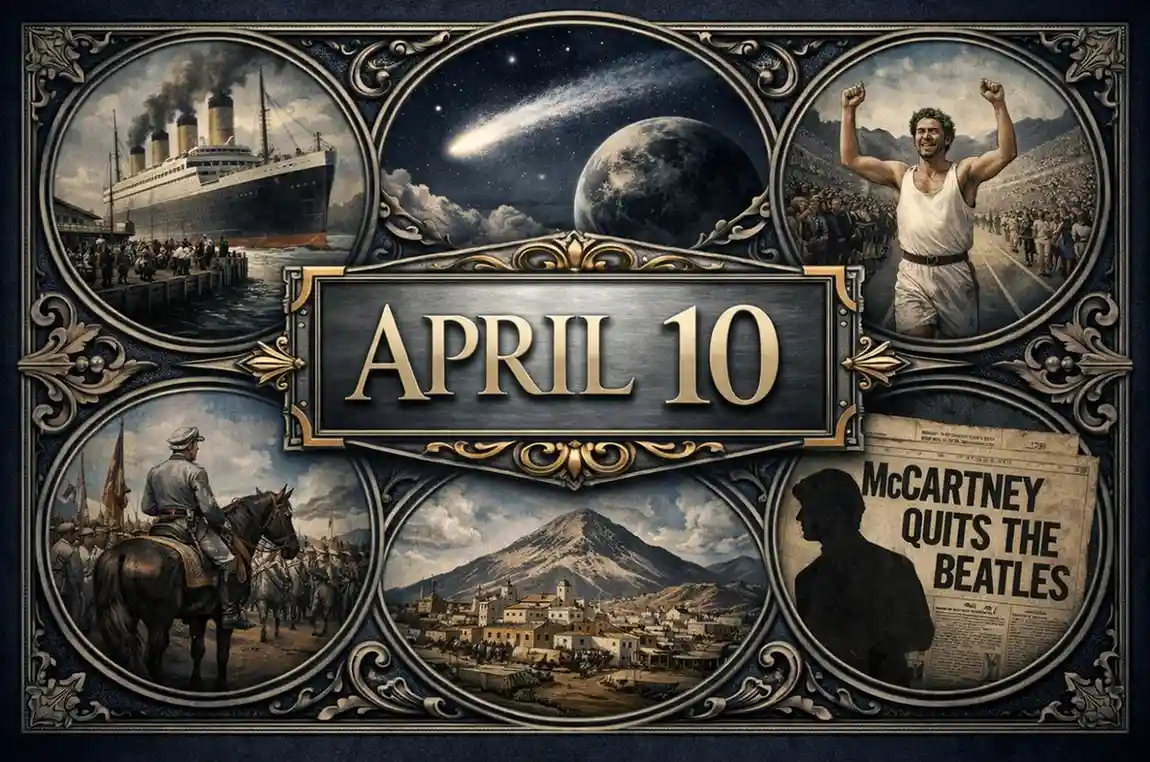
History converged in 1545 with the founding of the silver capital Potosí and again in 1912 with the Titanic’s fateful departure from Southampton. Within the records of this day in history April 10, we find a stark contrast between the somber realities of maritime disaster and the scientific awe inspired by Halley’s Comet. These moments bridge the gap between terrestrial ambition and the cosmic events that have shaped our understanding of the world.
238 – Battle of Carthage
During the chaotic Year of the Six Emperors, the forces of Gordian I and Gordian II suffered a crushing defeat near Carthage. The loyalist troops of Maximinus Thrax overwhelmed the rebellious father-and-son duo, leading to the death of the younger Gordian. This military clash intensified internal Roman instability and deepened the bloody struggle for the imperial throne during a volatile era. The eventual collapse of this revolt left the empire in a state of heightened political uncertainty.
428 – Nestorius Named Patriarch
Nestorius ascended to the influential position of Patriarch of Constantinople, marking a significant moment in early Christian governance. His leadership soon became a focal point for intense theological debates regarding the specific nature and divinity of Christ. These disputes eventually led to the Council of Ephesus and a lasting schism within the Eastern and Western churches. The controversies surrounding his tenure continued to impact the development of religious doctrine for centuries.
837 – Halley’s Comet Near Earth
Halley’s Comet made its closest recorded approach to our planet, passing at a distance of approximately 5.1 million kilometers. This spectacular celestial event was documented by astronomers across various cultures who noted its immense brightness in the night sky. The proximity of the comet provided a rare opportunity for ancient stargazers to track the movement of a cosmic body. This passage remains one of the most significant astronomical events recorded during the Middle Ages.
847 – Election of Pope Leo IV
Following the death of Pope Sergius II, the Roman clergy and people elected Leo IV to serve as the new head of the Church. His papacy was defined by the urgent need to fortify Rome against persistent threats from Saracen raiders and external invaders. He is famously credited with constructing the Leonine Wall to protect the Vatican, ensuring the safety of the holy site. This defensive project established a secure perimeter that defined the geographical boundaries of the papal city.
1407 – Deshin Shekpa Visits Nanjing
The 5th Karmapa Lama arrived at the Ming dynasty capital of Nanjing to meet with the powerful Yongle Emperor. During this diplomatic and spiritual visit, he was honored with the prestigious title of “Great Treasure Prince of Dharma.” The exchange strengthened the cultural and religious ties between the Tibetan Buddhist hierarchy and the Chinese imperial court during a period of expansion. This meeting facilitated a long-standing tradition of interaction between the two influential regional powers.
1500 – Capture of Ludovico Sforza
Swiss mercenaries captured the Duke of Milan, Ludovico Sforza, during the Battle of Novara and subsequently handed him over to the French. This betrayal ended the rule of one of the Renaissance’s most prominent patrons of the arts and sciences. Sforza spent his final years in a French prison, marking the collapse of his family’s political dominance in Italy. His downfall signaled a major shift in the control of Northern Italian territories during the Italian Wars.
1545 – Founding of Potosí
The city of Potosí was officially established in modern-day Bolivia following the location of massive silver deposits in the mountains. This site quickly grew into one of the wealthiest and most populous urban centers in the Americas due to its vast mineral riches. The silver extracted here fueled the Spanish Empire’s global economy but also came at a high cost to local laborers. This mountain of silver became a central pillar of the colonial financial system for generations.
1606 – Virginia Company Established
King James I of England issued a royal charter to establish the Virginia Company of London for the purpose of North American colonization. This commercial venture aimed to find gold and establish a permanent English presence in the New World. The company’s legal framework provided the necessary structure for the early expansion of British influence across the Atlantic Ocean. These efforts eventually led to the founding of Jamestown and the start of lasting English settlements.
1710 – Statute of Anne
The Statute of Anne came into force in Great Britain, becoming the world’s first formal piece of legislation to regulate copyright. It granted authors legal protection for their creative works, shifting control away from powerful printing guilds to individual creators. This landmark law established the principle of intellectual property rights and shaped the future of the global publishing industry. It provided the legal foundation for how creative ideas are protected and shared in the modern era.
1717 – Robert Walpole Resigns
Robert Walpole resigned from the British government, triggering a significant political event known as the Whig Split. This division within the ruling party lasted for several years and altered the internal power dynamics of the British Parliament. Walpole eventually returned to power, becoming the nation’s first de facto Prime Minister and stabilizing the country’s financial systems. His departure and subsequent return defined the evolution of the British cabinet system of government.
1724 – Bach’s Easter Cantata
Johann Sebastian Bach directed the premiere performance of his cantata Erfreut euch, ihr Herzen during the Easter season in Leipzig. This composition was his first major work specifically written for the holiday since he had accepted the role of Thomaskantor. The piece showcased his intricate musical style and deep devotion, enriching the city’s long-standing tradition of liturgical music. This performance was a key moment in the early years of his prolific career in the city.
1741 – Battle of Mollwitz
Prussian forces secured a decisive victory over the Austrians at the Battle of Mollwitz, allowing King Frederick the Great to claim Silesia. This engagement was a turning point in the War of the Austrian Succession, proving the strength of the modernized Prussian army. The gain of this resource-rich territory significantly elevated Prussia’s status as a major military power in Europe. This victory established Frederick as a formidable commander and reshaped the balance of power on the continent.
1796 – Battle of Voltri
A sudden Austrian assault at Voltri initiated Napoleon Bonaparte’s brilliant Italian Campaign, which would eventually reshape the borders of Europe. Although the Austrians achieved a temporary tactical success, the engagement set the stage for Napoleon’s rapid counterattacks and strategic maneuvers. This conflict demonstrated the young general’s ability to command under pressure during the War of the First Coalition. His actions during this period began his meteoric rise to dominance in French and European politics.
1809 – War of the Fifth Coalition
The War of the Fifth Coalition began when the Austrian Empire launched an invasion of Bavaria to challenge French hegemony. This move forced Napoleon to redirect his focus from the Iberian Peninsula to Central Europe to defend his allied territories. The ensuing conflict resulted in several massive battles that tested the endurance of both the French and Austrian empires. This new phase of the Napoleonic Wars involved multiple fronts and reshaped the alliances of the European powers.
1814 – Battle of Toulouse
Allied forces under the Duke of Wellington attacked the French city of Toulouse, driving out the defending troops led by Marshal Soult. The fierce fighting occurred just as Napoleon was abdicating his throne in Paris, though news of the peace had not yet arrived. This battle was one of the final significant engagements of the Peninsular War, marking a victory for the coalition. It stands as a somber example of conflict continuing even as the wider war reached its end.
1815 – Eruption of Mount Tambora
The Mount Tambora volcano in Indonesia began a cataclysmic eruption that would continue for several months and claim thousands of lives. The massive release of volcanic ash into the atmosphere caused a global drop in temperature, leading to the “Year Without a Summer.” This environmental disaster resulted in widespread crop failures and food shortages across Europe and North America. It remains the most powerful volcanic event in recorded human history, affecting weather patterns for years.
1816 – Second Bank of the United States
The U.S. Federal government approved the creation of the Second Bank of the United States to stabilize the nation’s fractured currency. The institution was tasked with managing public credit and regulating the lending practices of private banks during a period of economic recovery. Its establishment sparked intense political debate regarding the reach of federal power and the role of national finance. The bank played a central role in the country’s development until its charter was eventually challenged.
1821 – Death of Patriarch Gregory V
Ottoman authorities executed Patriarch Gregory V of Constantinople by hanging him from the main gate of his residence following the Greek revolt. His body was subsequently thrown into the Bosphorus, an act intended to intimidate those participating in the struggle for independence. Instead, his death galvanized the Greek cause and drew international sympathy for the revolutionary movement. He was later canonized by the Greek Orthodox Church as a martyr who sacrificed his life for his faith.
1821 – Psara Joins the Revolution
The island of Psara officially joined the Greek War of Independence, contributing its formidable merchant fleet to the revolutionary cause. This maritime power proved essential in challenging the Ottoman Navy and securing naval victories in the Aegean Sea. The participation of the islanders demonstrated the widespread nature of the rebellion across the Greek archipelago. Their expertise in seafaring provided the insurgents with a vital strategic advantage during the early years of the conflict.
1826 – Siege of Missolonghi Ends
The inhabitants of the Greek town of Missolonghi began a desperate mass exodus after enduring a brutal year-long siege by Turkish forces. Most of the civilians and soldiers who attempted the escape were killed or captured, leaving very few survivors of the original population. The tragic fall of the town became a powerful symbol of Greek resilience and sacrifice in the fight for freedom. This event drew the attention of the Western world and increased support for the Greek cause.
1858 – Recasting of Big Ben
The famous bell intended for the Palace of Westminster was successfully recast after the original version cracked during its testing phase. This second attempt by the Whitechapel Bell Foundry produced the iconic Great Bell that still chimes from the Elizabeth Tower today. The recasting ensured that the voice of London’s most famous clock would finally be heard across the city. It remains one of the most recognizable auditory symbols of the British capital and its long history.
1864 – Maximilian Proclaimed Emperor
Archduke Maximilian of Habsburg was officially declared the Emperor of Mexico during the period of French military intervention in the country. This monarchy was established by Napoleon III to expand French influence in the Americas while the United States was distracted by its Civil War. Maximilian’s reign was plagued by resistance from Mexican republicans who refused to accept a foreign sovereign. His brief rule ended in tragedy as the republican forces eventually regained control of the nation.
1865 – Robert E. Lee’s Final Address
One day after surrendering to Union forces at Appomattox, General Robert E. Lee issued a final, emotional address to the remnants of his army. He praised the bravery and devotion of his soldiers while urging them to return to their homes and become peaceful citizens. This speech marked the formal psychological conclusion of the war for many of those serving under his command. It is remembered for its tone of dignity and reconciliation during a period of national upheaval.
1866 – Founding of the ASPCA
Henry Bergh founded the American Society for the Prevention of Cruelty to Animals in New York City to protect vulnerable creatures. The organization was the first of its kind in North America, successfully advocating for laws that criminalized the mistreatment of animals. This movement transformed public attitudes toward animal welfare and established a lasting legacy of compassionate activism. Its work paved the way for modern protections for pets and livestock throughout the United States.
1868 – Battle of Arogee
British and Indian expeditionary forces defeated the army of Emperor Tewodros II at Arogee during the military campaign in Abyssinia. The technologically superior British troops suffered minimal casualties while the Ethiopian forces faced a significant loss of life in the valley. This victory allowed the British to advance toward the fortress of Magdala to secure the release of imprisoned hostages. The engagement demonstrated the gap in military capabilities between the two forces during the era.
1872 – First Arbor Day
The residents of Nebraska celebrated the very first Arbor Day, a holiday dedicated to the planting and preservation of trees. This initiative was led by J. Sterling Morton, who believed that reforestation was essential for the environmental and economic health of the prairie. Over a million trees were planted on this day, sparking a national movement that continues to celebrate nature. It stands as a pioneering moment in the history of American environmentalism and conservation efforts.
1887 – Catholic University of America
Pope Leo XIII issued the formal authorization for the establishment of the Catholic University of America in the nation’s capital. The institution was designed to serve as a center for advanced research and higher learning under the guidance of the Church. Its founding represented a significant milestone in the development of Catholic education and intellectual life within the United States. It remains a prominent university dedicated to integrating faith and academic excellence in Washington, D.C.
1896 – First Olympic Marathon
Spyridon Louis, a Greek water carrier, achieved a legendary victory in the first-ever modern Olympic marathon held in Athens. His win brought immense national pride to Greece and remains one of the most celebrated moments in the history of the Games. The race followed the traditional route from the town of Marathon to the Panathenaic Stadium, honoring ancient history. This event helped popularize the marathon as a premier distance running challenge in international athletics.
1900 – Boer Victory at Brandfort
Boer commandos achieved a sharp military success against British troops south of Brandfort during the ongoing conflict in South Africa. Hundreds of British soldiers were killed or wounded, and 800 more were taken as prisoners during the well-coordinated ambush. This defeat highlighted the effectiveness of Boer guerrilla tactics against the larger, more traditional British imperial army. It served as a reminder of the difficult and prolonged nature of the Second Boer War.
1912 – Titanic Sets Sail
The RMS Titanic departed from Southampton, England, on its highly anticipated maiden voyage across the Atlantic Ocean toward New York. As the largest and most luxurious ship of its time, it carried over two thousand passengers and crew members in grand style. The departure was a moment of immense celebration, though it would soon end in one of history’s greatest tragedies. This voyage became a enduring symbol of human overconfidence and the dangers of the North Atlantic.
1919 – Death of Emiliano Zapata
Mexican revolutionary leader Emiliano Zapata was killed in an ambush orchestrated by government forces in the state of Morelos. Zapata was a champion of agrarian reform and the rights of the peasantry, famously fighting under the banner of “Land and Liberty.” His death was a significant blow to the revolution, but his ideals continued to inspire future generations. He remains a powerful icon of social justice and land rights in the cultural history of Mexico.
1919 – Third Regional Congress
Anarchist forces known as the Makhnovshchina held the Third Regional Congress of Peasants, Workers, and Insurgents in Huliaipole. This gathering aimed to organize the social and military structures of the territory in southeastern Ukraine during the Russian Civil War. The congress reflected the movement’s commitment to self-governance and the protection of local interests against external political forces. It was a key moment in the attempt to build a decentralized society amidst the wider conflict.
1925 – Renaming of Stalingrad
The Soviet government renamed the city of Tsaritsyn to Stalingrad in honor of Joseph Stalin’s leadership during the Russian Civil War. This change reflected the growing cult of personality surrounding the General Secretary and the city’s strategic importance in the defense of the revolution. Decades later, the city would become the site of one of World War II’s most decisive battles. The name was eventually changed back to Volgograd as part of the later de-Stalinization process.
1941 – Independent State of Croatia
During the height of World War II, the Axis powers facilitated the establishment of the Independent State of Croatia as a puppet regime. Led by the Ustaše movement, the new state implemented harsh policies and collaborated closely with Nazi Germany and Fascist Italy. This development led to widespread conflict and human rights abuses across the Balkan region during the occupation. The regime’s actions left a lasting scar on the demographic and political history of the area.
1944 – Escape from Birkenau
Rudolf Vrba and Alfréd Wetzler successfully escaped from the Birkenau death camp, carrying vital information about the ongoing atrocities of the Holocaust. Their detailed report provided the first credible and comprehensive evidence to the outside world regarding the scale of the gas chambers. This courageous act aimed to alert international authorities and halt the mass deportations to the camps. Their information helped save thousands of lives by prompting increased awareness and intervention efforts.
1963 – Sinking of USS Thresher
The nuclear-powered submarine USS Thresher sank during deep-diving tests in the Atlantic Ocean, claiming the lives of all 129 sailors on board. This disaster remains the deadliest submarine accident in history and led to a complete overhaul of naval safety and construction standards. The loss of the vessel prompted the creation of the SUBSAFE program to prevent future tragedies. It serves as a somber reminder of the extreme risks involved in deep-sea naval operations.
1968 – Sinking of the TEV Wahine
The New Zealand ferry TEV Wahine sank in Wellington Harbour after being struck by a fierce storm with record-breaking wind speeds. Despite the proximity to the shore, fifty-three people perished as the ship capsized in the treacherous conditions of the harbor entrance. The disaster is remembered as one of the most significant maritime accidents in the history of New Zealand. It led to extensive inquiries into maritime safety and emergency response procedures in coastal waters.
1970 – Paul McCartney Leaves The Beatles
Paul McCartney publicly announced his departure from The Beatles, citing personal and professional differences that had become irreconcilable. This news effectively signaled the end of the world’s most influential rock band, leaving millions of fans in shock. The breakup marked the conclusion of a revolutionary era in popular music that had transformed global culture during the 1960s. The four members continued as successful solo artists, but the group’s collective legacy remains unparalleled in music.
1972 – Discovery of Shandong Bamboo Slips
Construction workers in Shandong, China, located ancient tombs containing rare bamboo slips that preserved lost military and philosophical texts. Among the findings were Sun Tzu’s Art of War and long-lost treatises by his descendant, Sun Bin. This discovery provided invaluable insights into the development of military strategy and legal thought during the ancient Warring States period. These artifacts have significantly expanded our understanding of early Chinese intellectual and strategic history.
1972 – B-52s Bomb North Vietnam
American B-52 bombers resumed large-scale aerial attacks on targets in North Vietnam for the first time in several years. The escalation was part of a broader military response to the North’s spring offensive during the later stages of the Vietnam War. The mission aimed to disrupt supply lines and pressure the North Vietnamese leadership back to the negotiating table. This campaign represented a significant increase in the use of heavy air power during the conflict’s final years.
1973 – Invicta Flight 435 Crash
An Invicta International Airlines flight crashed into a hillside during a severe snowstorm while attempting to land in Basel, Switzerland. The accident resulted in the deaths of 108 people, many of whom were on a day trip from the United Kingdom. Rescue efforts were hampered by the extreme weather, making it one of the deadliest aviation incidents in Swiss history. The tragedy led to renewed discussions regarding the safety of charter flights and airport landing procedures in bad weather.
1979 – Wichita Falls Tornado
A massive tornado struck Wichita Falls, Texas, during the Red River Valley outbreak, causing 42 deaths and widespread devastation. The storm destroyed thousands of homes and businesses, leaving a lasting impact on the community’s infrastructure and collective memory. This event led to significant advancements in tornado research and the development of more effective early warning systems. It remains one of the most powerful and destructive storms in the history of the Southern Plains.
1981 – Election of Bobby Sands
Bobby Sands, an imprisoned IRA member on a hunger strike, was elected to the British Parliament as the representative for Fermanagh and South Tyrone. His victory from a prison cell drew intense international attention to the political situation in Northern Ireland and the demands of the strikers. Sands died less than a month later, sparking widespread protests across the region and beyond. His election highlighted the deep sectarian divisions and the power of hunger strikes as a political tool.
1988 – Ojhri Camp Explosion
A massive ammunition depot explosion at the Ojhri Camp in Pakistan resulted in over a thousand casualties in Rawalpindi and Islamabad. The blast sent rockets and debris flying into densely populated areas, causing panic and extensive damage to surrounding neighborhoods. The incident remains one of the most significant military-related disasters in the country’s history and sparked calls for safety reforms. It left a lasting impact on the safety protocols for storing munitions near urban centers.
1991 – Moby Prince Collision
The Italian ferry Moby Prince collided with an oil tanker in heavy fog off the coast of Livorno, resulting in a catastrophic fire. Out of the 141 people on board, only one crew member survived the disaster, making it the deadliest maritime accident in modern Italy. Investigations into the cause of the collision and the delayed rescue efforts continued for many years. The tragedy remains a subject of intense legal debate and mourning for the families involved.
1991 – South Atlantic Tropical Storm
A rare tropical storm developed in the South Atlantic Ocean near the coast of Angola, representing the first such system documented by satellites. This unusual weather event challenged previous understandings of meteorological patterns in that part of the world. The storm’s arrival provided scientists with new data on the formation of tropical systems outside traditional storm basins. It highlighted the complexity of global weather patterns and the importance of continuous satellite monitoring for safety.
1998 – Good Friday Agreement
The Good Friday Agreement was signed in Northern Ireland, establishing a framework for lasting peace and a shared government between conflicting factions. This historic accord ended decades of violent sectarian strife known as “The Troubles” and addressed issues of civil rights and police reform. It remains the foundation of the modern political landscape and stability in the region today. The agreement is hailed as a major achievement in conflict resolution and international diplomacy.
2009 – Fiji Constitutional Crisis
President Ratu Josefa Iloilo announced the total abrogation of Fiji’s constitution and assumed direct control over all governance in the country. This move followed a court ruling that the existing military-led government was illegal, plunging the nation into a deep constitutional crisis. The action led to the dismissal of judges and the suspension of democratic processes for several years. It represented a significant setback for the rule of law and democratic institutions in the Pacific nation.
2010 – Smolensk Air Disaster
A Polish Air Force jet carrying President Lech Kaczyński and dozens of high-ranking officials crashed in dense fog near Smolensk, Russia. All 96 people on board were killed, representing a staggering loss for the Polish government and the nation’s military leadership. The tragedy occurred while the delegation was traveling to commemorate the 70th anniversary of the Katyn massacre. This event left a profound impact on Polish society and led to years of investigations into the cause.
2016 – Paravur Temple Fire
A devastating explosion and fire occurred at the Puttingal Temple in Paravur, India, during a prohibited fireworks display for a religious festival. Over one hundred people lost their lives and hundreds more were injured as the firecrackers ignited a massive stockpile of explosives. The tragedy led to a national outcry for stricter safety regulations regarding public celebrations and pyrotechnics. It remains one of the worst fire-related disasters in the history of Indian religious festivals.
2016 – Ashkasham Earthquake
A 6.6-magnitude earthquake struck near Ashkasham, impacting vast regions of India, Afghanistan, Tajikistan, and Pakistan. The powerful seismic event caused tremors across major cities and led to significant concern regarding the safety of residents in mountainous areas. Rescue teams were deployed to assess damage in remote villages where infrastructure was most vulnerable to such tremors. This event emphasized the ongoing seismic risks in the Hindu Kush region and the need for better building standards.
2023 – Louisville Bank Shooting
A mass shooting occurred at the Old National Bank in Louisville, Kentucky, resulting in the deaths of five victims and injuries to eight others. The attacker, an employee of the bank, opened fire during a morning meeting before being neutralized by arriving police officers. This tragic event sparked a renewed national conversation about workplace safety and the prevalence of gun violence. It added to the ongoing debate over legislative measures to prevent such incidents in public spaces.
Famous People Born on April 10
| Name | Description | Date |
|---|---|---|
| Joseph Pulitzer | American newspaper publisher, founder of Pulitzer Prizes | April 10, 1847 – October 29, 1911 |
| William Hazlitt | English essayist and critic, major Romantic figure | April 10, 1778 – September 18, 1830 |
| Lew Wallace | American author (Ben-Hur), soldier, and diplomat | April 10, 1827 – February 15, 1905 |
| Theodosius II | Eastern Roman emperor (408–450), codified Roman law | April 10, 401 – July 28, 450 |
| Samuel Hahnemann | German physician, founder of homeopathy | April 10, 1755 – July 2, 1843 |
| David Halberstam | American journalist and author, Pulitzer Prize winner | April 10, 1934 – April 23, 2007 |
| Bernardo Alberto Houssay | Argentine physiologist, Nobel Prize winner | April 10, 1887 – September 21, 1971 |
| Marshall Warren Nirenberg | American biochemist, Nobel Prize winner (genetic code) | April 10, 1927 – January 15, 2010 |
| AE (George William Russell) | Irish poet, artist, and mystic | April 10, 1867 – July 17, 1935 |
| John Michael Hawthorn | British racing driver, first British Formula One world champion | April 10, 1929 – January 22, 1959 |
| Kenneth Noland | American Abstract Expressionist painter | April 10, 1924 – January 5, 2010 |
| Jean Lannes, duc de Montebello | French marshal under Napoleon | April 10, 1769 – May 31, 1809 |
| Leonidas Polk | Confederate general and Episcopal bishop | April 10, 1806 – June 14, 1864 |
| Alfred Kubin | Austrian graphic artist and illustrator | April 10, 1877 – August 24, 1959 |
| Ben Nicholson | English abstract painter | April 10, 1894 – February 6, 1982 |
| George Arliss | British actor, first British actor to win an Academy Award | April 10, 1868 – February 5, 1946 |
| Kishori Amonkar | Indian classical vocalist | April 10, 1932 – April 3, 2017 |
| Eugen d’Albert | German composer and piano virtuoso | April 10, 1864 – March 3, 1932 |
| Paul Theroux | American novelist and travel writer | April 10, 1941 – Present |
| Delphine Seyrig | French actress | April 10, 1932 – October 15, 1990 |
| Henry Villard | American journalist and financier | April 10, 1835 – November 12, 1900 |
| Laurence Binyon | English poet and art historian | April 10, 1869 – March 10, 1943 |
| Bella Akhmadulina | Russian poet | April 10, 1937 – November 29, 2010 |
| Aliko Dangote | Nigerian businessman and philanthropist | April 10, 1957 – Present |
| Babyface (Kenneth Edmonds) | American musician and record producer | April 10, 1959 – Present |
| Paul-Louis-Toussaint Héroult | French chemist, invented electric-arc furnace | April 10, 1863 – May 9, 1914 |
| Mani Shankar Aiyar | Indian diplomat and politician | April 10, 1941 – Present |
| Anne Lamott | American author | April 10, 1954 – Present |
| Samuel Heinicke | German educator, pioneer of oral education for the deaf | April 10, 1727 – April 30, 1790 |
| Cathy Turner | American short-track speed skater, Olympic gold medalist | April 10, 1962 – Present |
Famous People Died on April 10
| Name | Description | Date |
|---|---|---|
| Lech Kaczyński | President of Poland (2005–2010) | June 18, 1949 – April 10, 2010 |
| Evelyn Waugh | English novelist, master of satirical fiction | October 28, 1903 – April 10, 1966 |
| Algernon Charles Swinburne | English poet and critic | April 5, 1837 – April 10, 1909 |
| Pierre Teilhard de Chardin | French philosopher and paleontologist | May 1, 1881 – April 10, 1955 |
| Nino Rota | Italian composer of film scores (The Godfather) | December 3, 1911 – April 10, 1979 |
| Richie Benaud | Australian cricketer and broadcaster | October 6, 1930 – April 10, 2015 |
| Walker Evans | American photographer, influential documentary artist | November 3, 1903 – April 10, 1975 |
| Michael Curtiz | Hungarian-American film director (Casablanca) | December 25, 1886 – April 10, 1962 |
| Morarji Desai | Prime minister of India (1977–1979) | February 29, 1896 – April 10, 1995 |
| Frederick I | King of Denmark (1523–1533) and Norway (1524–1533) | October 7, 1471 – April 10, 1533 |
| Louis II | King of Francia Occidentalis (877–879) | 846 – April 10, 879 |
| O.J. Simpson | American football player and actor | July 9, 1947 – April 10, 2024 |
| Gabrielle d’Estrées, duchess de Beaufort | Mistress of King Henry IV of France | 1573 – April 10, 1599 |
| Robert Edwards | British medical researcher, developed IVF (test-tube baby) | September 27, 1925 – April 10, 2010 |
| Howard Thurman | American theologian and civil rights leader | November 18, 1899 – April 10, 1981 |
| Thomas Hart Benton | American senator, champion of westward expansion | March 14, 1782 – April 10, 1858 |
| Peter Dennis Mitchell | British chemist, Nobel Prize winner (chemiosmotic theory) | September 29, 1920 – April 10, 1992 |
| Gonzalo Pizarro | Spanish explorer and conquistador | c.1502 – April 10, 1548 |
| Carl Becker | American historian of the Enlightenment | September 7, 1873 – April 10, 1945 |
| Chris Hani | South African anti-apartheid activist | June 28, 1942 – April 10, 1993 |
| Alexander Turney Stewart | American merchant and millionaire | October 12, 1803 – April 10, 1876 |
| Aybak | First Mamlūk sultan of Egypt (1250–1257) | unknown – April 10, 1257 |
| Henry Van Dyke | American short-story writer and poet | November 10, 1852 – April 10, 1933 |
| Sam Loyd | American puzzle maker and chess composer | January 30, 1841 – April 10, 1911 |
| Auguste Lumière | French inventor, pioneer of cinema | October 19, 1862 – April 10, 1954 |
| Fevzi Çakmak | Turkish marshal and statesman | January 12, 1876 – April 10, 1950 |
| Annie Fischer | Hungarian pianist | July 5, 1914 – April 10, 1995 |
| Frank Hamilton Cushing | American ethnographer of the Zuni people | July 22, 1857 – April 10, 1900 |
| Celia Fiennes | English travel writer | June 7, 1662 – April 10, 1741 |
| Nicodemus Tessin the Younger | Swedish Baroque architect | May 23, 1654 – April 10, 1728 |
- Siblings Day: An international observance celebrating the unique bond between brothers and sisters around the world.
- Day of the Builder (Azerbaijan): A professional holiday in Azerbaijan honoring those who work in the construction industry.
- Feast of the Third Day of the Writing of the Book of the Law (Thelema): A religious observance marking the conclusion of the dictation of a central text.
Frequently Asked Questions
- When did the Titanic set sail? The RMS Titanic departed on its maiden voyage from Southampton on April 10, 1912.
- What was the impact of the 1815 Tambora eruption? It caused a global climate shift leading to the “Year Without a Summer” and widespread crop failures.
- Who won the first modern Olympic marathon? Greek runner Spyridon Louis won the inaugural marathon in Athens on April 10, 1896.
- What happened to Paul McCartney on this day? In 1970, he officially announced his departure from The Beatles, effectively ending the band.