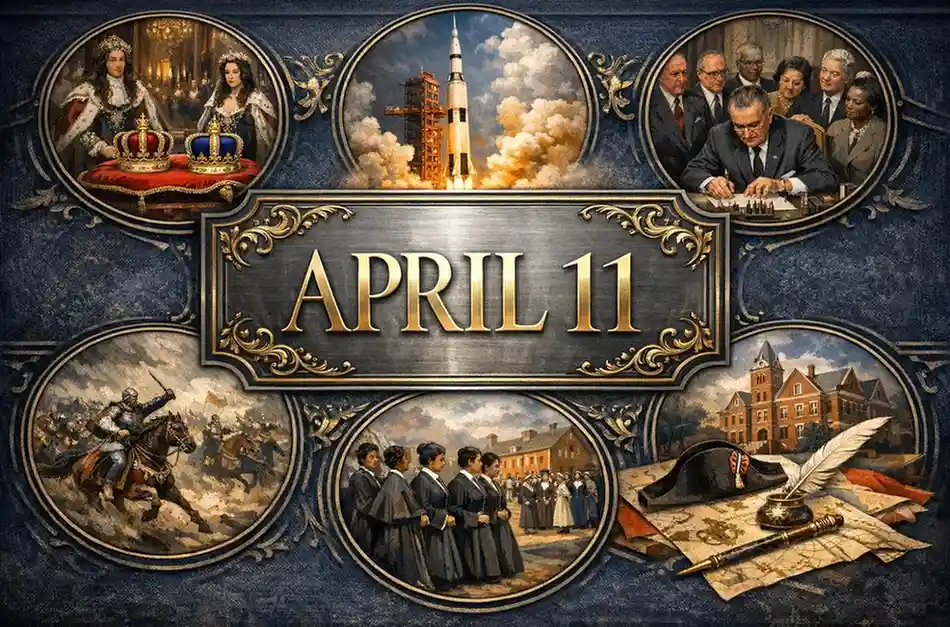
A review of what happened on this day in history April 11 showcases a date filled with major legal shifts and the fall of legendary leaders. From the unconditional surrender of Napoleon Bonaparte in 1814 to the landmark signing of the Civil Rights Act of 1968, this day highlights the constant evolution of justice. These historical markers serve as a reminder of how leadership and law intersect to define the modern world.
Important Events That Happened On April 11 In History
491 – Anastasius I Named Emperor
Flavius Anastasius was elevated to the position of Byzantine Emperor, taking the name Anastasius I after the death of Zeno. His administration became famous for its fiscal discipline and a significant overhaul of the empire’s complex monetary system. He managed to stabilize the state’s economy, eventually leaving a massive gold surplus for his successors despite various regional conflicts. This era provided a stable foundation for the Eastern Roman Empire during a period of transition in the late fifth century.
672 – Consecration of Pope Adeodatus II
Following the death of Pope Vitalian, Adeodatus II was officially consecrated as the new leader of the Catholic Church. He was known for his previous life as a monk and his deep commitment to the restoration of religious discipline. His papacy occurred during a time of intense theological debates regarding the nature of Christ within the Christian world. He is remembered for his efforts to improve the welfare of the clergy and his work in renovating various Roman structures.
1241 – Battle of Mohi
Batu Khan led the Mongol forces to a crushing victory over King Béla IV of Hungary at the Battle of Mohi. This military engagement resulted in the near-total destruction of the Hungarian army and left the kingdom open to widespread ruin. The Mongol advance forced the royal family to seek safety elsewhere while the local population suffered through an intense period of occupation. This event remains one of the most significant and catastrophic military clashes in the history of medieval Central Europe.
1512 – Battle of Ravenna
French and Ferrarese forces led by Gaston de Foix secured a bloody victory against Papal-Spanish troops during the War of the League of Cambrai. This clash was notable for its heavy use of artillery, which played a decisive role in the outcome on the Italian plains. Although the French won the field, the loss of their talented young commander, Gaston de Foix, hindered their long-term strategic goals. The battle demonstrated the changing nature of warfare as gunpowder began to dominate European military tactics during the Renaissance.
1544 – Battle of Ceresole
A French army achieved a significant tactical success against Habsburg forces during the Italian War of 1542–46 at the Battle of Ceresole. Despite the clear victory on the battlefield, the French military was unable to successfully exploit the situation to gain further territory. The conflict highlighted the ongoing power struggle between the Valois and Habsburg dynasties for dominance over the Italian peninsula. This engagement was one of the last major open-field battles of the prolonged and expensive Italian Wars.
1689 – Coronation of William and Mary
William III and Mary II were officially crowned as joint sovereigns of Great Britain in a unique ceremony that redefined British leadership. This event followed the Glorious Revolution and the decision by Parliament to offer the throne to the couple as equal partners. On the same day, the Scottish Parliament formally aligned with the English decision to recognize their new monarchs. This joint rule established the legal framework for a constitutional monarchy that prioritized parliamentary authority over royal power.
1713 – Treaty of Utrecht
France and Great Britain signed the Treaty of Utrecht, which brought an official conclusion to the lengthy War of the Spanish Succession. Under the terms, Britain accepted Philip V as the King of Spain on the condition that he renounce any claim to the French throne. This diplomatic settlement redrew the colonial and European maps, aiming to maintain a stable balance of power between rival nations. It also secured significant territorial gains for the British, including Gibraltar and parts of North America.
1727 – Bach’s St Matthew Passion
Johann Sebastian Bach directed the premiere performance of his masterpiece, the St Matthew Passion, at St. Thomas Church in Leipzig. This sacred choral work is considered one of the greatest achievements of Baroque music and Western artistic culture. It was originally composed for the Good Friday service and used two choirs and two orchestras to tell the story of the Passion. The complexity and emotional depth of the piece continue to resonate with audiences and musicians centuries after its debut.
1809 – Battle of the Basque Roads
A British naval force led by Captain Lord Cochrane launched a daring fire-ship attack against a French fleet anchored in the Basque Roads. While the initial assault caused chaos and grounded many French ships, Admiral Lord Gambier failed to provide the necessary support to finish the task. This resulted in an incomplete British victory and a subsequent court-martial that caused significant controversy within the Royal Navy. The engagement highlighted the internal tensions and leadership disputes that occasionally hindered British maritime operations during the Napoleonic era.
1814 – Treaty of Fontainebleau
The Treaty of Fontainebleau was signed, ending the War of the Sixth Coalition and forcing Napoleon Bonaparte to abdicate his throne unconditionally. This historic agreement stripped him of his imperial status and assigned him to a small principality on the island of Elba. The surrender marked the collapse of his first empire and the temporary restoration of the Bourbon monarchy in France. While it was intended to bring lasting peace to Europe, it served as the precursor to his famous final return.
1856 – Second Battle of Rivas
During the Second Battle of Rivas, the Costa Rican hero Juan Santamaría performed a legendary act by burning down a hostel. The building was being used as a stronghold by William Walker’s filibusters, who were attempting to seize control of the region. Santamaría’s sacrifice allowed the Costa Rican forces to flush out the invaders and secure a pivotal victory for their national independence. He is now celebrated as a national hero whose bravery stopped a foreign takeover of Central American territory.
1868 – Surrender of Edo Castle
Tokugawa Yoshinobu, the last shōgun of Japan, officially surrendered Edo Castle to the Imperial forces, ending over two centuries of military rule. This symbolic transition of power was a central moment in the Meiji Restoration, which sought to modernize the nation under the Emperor. The peaceful handover of the castle prevented a major civil war within the capital city and facilitated a rapid transition to a centralized government. This act marked the beginning of Japan’s transformation into a modern industrial and global power.
1876 – Order of Elks Organized
The Benevolent and Protective Order of Elks was formally organized as a social and charitable fraternity in the United States. Originally starting as a private club for actors in New York, the group expanded into a national organization focused on community service. The order became known for its commitment to veterans, youth programs, and various local charitable initiatives across the country. Today, it remains one of the largest and most active fraternal organizations in America with a focus on patriotic values.
1881 – Spelman College Founded
The Atlanta Baptist Female Seminary was established in Georgia as an institute of higher education specifically for African-American women. Founded by Sophia B. Packard and Harriet E. Giles, the school eventually became known as Spelman College in honor of its benefactors. The institution was created to provide academic opportunities that were largely unavailable to black women in the post-Civil War South. It has since grown into one of the most prestigious liberal arts colleges for women of color in the world.
1885 – Luton Town F.C. Founded
Luton Town Football Club was officially formed during a public meeting held at the Town Hall in Luton, England. The club was created through the merger of two local teams, Luton Wanderers and Luton Excelsior, to represent the growing town. It eventually became one of the first professional clubs in the southern part of the country and earned the nickname “The Hatters.” The club’s founding marked the beginning of a long and storied history in the English football league system.
1908 – Launch of SMS Blücher
The Imperial German Navy launched the SMS Blücher, which was the last armored cruiser ever built by the German military. The vessel was designed to counter what German intelligence believed were the specifications of new British ships being constructed at the time. However, the ship was quickly made obsolete by the arrival of the more powerful and faster British battlecruisers. The Blücher eventually met its end during the Battle of Dogger Bank in the early years of World War I.
1909 – Tel Aviv Founded
The city of Tel Aviv was officially established as a small Jewish housing estate on the outskirts of the ancient port of Jaffa. Originally named Ahuzat Bayit, the settlement was founded by sixty families who sought to build a modern, Hebrew-speaking urban center. The project grew rapidly, eventually becoming the cultural and economic heart of the region and the first modern Hebrew city. Today, it is a bustling global metropolis known for its unique architecture and vibrant technology sector.
1921 – Government of Transjordan
Emir Abdullah established the first centralized government in the newly formed British protectorate known as Transjordan. This administrative move was a key step in the development of the modern state that would eventually become the Hashemite Kingdom of Jordan. The government aimed to unify various tribal regions and provide a stable political structure under British oversight. This period marked the beginning of a long journey toward full national sovereignty and the establishment of a lasting monarchy in the region.
1935 – Stresa Front Conference
Leaders from Britain, France, and Italy met at the Stresa Front conference to address and condemn German violations of the Treaty of Versailles. The meeting was specifically aimed at opposing Adolf Hitler’s announcement of German rearmament and the creation of an air force. While the participants agreed to cooperate in maintaining the status quo, the alliance was short-lived due to competing national interests. This conference represented one of the final collective diplomatic attempts to restrain German expansion before the start of World War II.
1945 – Liberation of Buchenwald
American military forces reached and liberated the Buchenwald concentration camp near Weimar, Germany, in the closing weeks of World War II. The soldiers found thousands of survivors who had endured the horrific systematic violence and starvation of the Nazi regime. The liberation of the camp provided the world with undeniable evidence of the scale and brutality of the Holocaust. This day remains a somber international reminder of the need to protect human rights and prevent such genocidal atrocities.
1951 – Truman Relieves MacArthur
President Harry S. Truman took the controversial step of relieving General Douglas MacArthur of his commands in Korea and Japan. The decision followed a series of public disagreements regarding military strategy and the potential for a wider war with China. Truman emphasized the constitutional principle of civilian control over the military, a core value of the United States government. The move sparked massive political backlash but ensured that the executive branch maintained authority over foreign policy during the Cold War.
1951 – Stone of Scone Found
The Stone of Scone, which had been taken from Westminster Abbey by Scottish nationalist students, was located at Arbroath Abbey. The ancient stone had been used for centuries during the coronation of Scottish monarchs before being moved to London. Its discovery at the site of the historic altar of Arbroath was a symbolic victory for those seeking to highlight Scottish national identity. The artifact was eventually returned to London before being permanently moved back to Scotland decades later.
1952 – Bolivian National Revolution
Armed rebels in Bolivia launched a successful assault on the Palacio Quemado, marking a turning point in the nation’s National Revolution. The uprising was led by the Revolutionary Nationalist Movement and sought to implement land reform and nationalize the mining industry. This period of political upheaval transformed the social and economic structure of the country by empowering the indigenous and working-class populations. The revolution led to the establishment of universal suffrage and a new era of governance for the Bolivian people.
1952 – Pan Am Flight 526A
A Pan Am Flight experienced a catastrophic engine failure shortly after taking off from San Juan, Puerto Rico, and was forced to ditch in the ocean. The aircraft came down near the San Juan-Isla Grande Airport, resulting in the deaths of 52 people on board. This tragic accident led to a reassessment of over-water emergency procedures and the safety of commercial aviation during the era. It remains one of the deadliest aviation incidents in the history of Puerto Rican commercial flight operations.
1955 – Kashmir Princess Bombing
An Air India aircraft known as the Kashmir Princess was destroyed by a time bomb while flying over the South China Sea. The attack was a failed assassination attempt by the Kuomintang against Chinese Premier Zhou Enlai, who was not on board at the time. Sixteen people lost their lives in the crash, which significantly increased tensions between various political factions in the region. The incident remains a prominent example of international sabotage and political violence during the early Cold War period.
1957 – Singaporean Self-Rule
The United Kingdom reached a formal agreement to grant self-rule to the island of Singapore after years of negotiation and public pressure. This deal allowed the local government to take control of internal affairs while Britain maintained authority over defense and foreign policy. This transition was a major milestone in Singapore’s journey toward becoming an independent and sovereign city-state. It paved the way for the first fully elected legislative assembly and the eventual total independence of the nation.
1961 – Trial of Adolf Eichmann Begins
The trial of high-ranking Nazi official Adolf Eichmann opened in Jerusalem, drawing intense international attention to the crimes of the Holocaust. Eichmann had been captured by Israeli agents in Argentina and brought to Israel to face charges of crimes against humanity and the Jewish people. The proceedings allowed survivors to give public testimony about the horrors of the concentration camps on a global stage. The trial was a landmark moment in the pursuit of international justice and the documentation of genocidal history.
1963 – Pacem in Terris Issued
Pope John XXIII issued the encyclical Pacem in terris, which became the first papal document addressed to all people of goodwill rather than just Catholics. The text outlined the essential conditions for world peace, emphasizing human rights, social justice, and the dignity of the individual. It was published during the height of the Cold War and urged world leaders to seek cooperation and nuclear disarmament. This influential document remains a cornerstone of modern Catholic social teaching and international peace advocacy.
1964 – Castelo Branco Elected
The Brazilian National Congress elected Marshal Humberto de Alencar Castelo Branco as the president following a military coup that ousted the previous government. His election marked the beginning of a prolonged period of military rule in Brazil that would last for over two decades. The new administration implemented strict economic policies and centralized political power while suppressing various forms of dissent. This era significantly altered the political and social landscape of the country through intense institutional changes.
1965 – Palm Sunday Tornado Outbreak
A devastating series of fifty-five tornadoes swept across six Midwestern states in the United States, causing widespread destruction. The outbreak resulted in the deaths of 266 people and left thousands more injured or homeless in a single afternoon. This natural disaster remains one of the deadliest tornado events in American history, highlighting the power and unpredictability of severe weather. It led to significant improvements in the national weather warning systems and the way the public prepares for such storms.
1968 – Civil Rights Act of 1968
President Lyndon B. Johnson signed the Civil Rights Act into law, which included specific provisions to prohibit discrimination in the housing market. Also known as the Fair Housing Act, it banned the refusal to sell or rent property based on race, religion, or national origin. The signing took place just days after the assassination of Martin Luther King Jr. during a period of national mourning and unrest. This legislation was a major victory for the civil rights movement in its fight for social and economic equality.
1968 – Attempt on Rudi Dutschke
A failed assassination attempt was made against Rudi Dutschke, a prominent leader of the German student movement, in West Berlin. The attack left Dutschke with severe brain damage and sparked a massive wave of protests and riots across West Germany. The shooter was a right-wing extremist who was influenced by the inflammatory rhetoric of the conservative press at the time. This event intensified the political polarization of the era and became a defining moment for the 1968 protest generation.
1970 – Launch of Apollo 13
The Apollo 13 mission launched from the Kennedy Space Center with the goal of making the third human landing on the lunar surface. The crew, led by Jim Lovell, began what was intended to be a routine scientific exploration into deep space. However, an oxygen tank explosion two days later transformed the journey into a famous life-or-death rescue mission. This launch remains a classic example of both the extreme risks of space exploration and the resilience of human ingenuity.
1976 – Creation of Apple I
Steve Wozniak and Steve Jobs completed the design and assembly of the Apple I, the first personal computer kit produced by the new company. The machine was a simple circuit board that required users to provide their own keyboard, monitor, and housing. It was first demonstrated at the Homebrew Computer Club and sold for a price of $666.66. This modest beginning marked the start of a technological revolution that would eventually transform the way the world communicates and works.
1977 – Silver Jubilee Buses
London Transport launched a fleet of Silver Jubilee AEC Routemaster buses to celebrate the twenty-fifth anniversary of Queen Elizabeth II’s reign. The iconic red buses were repainted in a striking silver livery and operated on various routes throughout the capital city. This celebration was part of a wider national effort to honor the monarch’s long service to the country. The silver buses became a popular sight for tourists and residents alike during the summer of the Jubilee festivities.
1979 – Idi Amin Deposed
The brutal dictatorship of Idi Amin in Uganda came to an end as Tanzanian forces and Ugandan rebels captured the capital city of Kampala. Amin fled into exile, leaving behind a nation devastated by years of economic ruin and systemic human rights abuses. His regime is estimated to have caused the deaths of hundreds of thousands of people during his eight years in power. The fall of Kampala marked a new chapter for the country as it began the long process of rebuilding its institutions.
1981 – Brixton Riots
A massive riot broke out in Brixton, south London, following intense tensions between the local community and the police force. The conflict resulted in almost 300 police injuries and significant civilian casualties, as well as widespread damage to local businesses. The unrest was sparked by “Operation Swamp 81,” a heavy-handed policing tactic that disproportionately targeted the black community. This event led to the Scarman Report, which recommended major changes to policing methods and community relations in the United Kingdom.
1982 – Shooting at Dome of the Rock
An American-Israeli reservist named Alan Harry Goodman carried out a mass shooting at the Dome of the Rock in Jerusalem. The attack resulted in the deaths of two Palestinians and left at least seven others injured within the holy site. This act of violence sparked widespread protests and condemnation across the Middle East and intensified religious tensions in the city. The shooter was later sentenced to life in prison for his crimes, which aimed to disrupt the political stability of the region.
1986 – FBI Miami Shootout
A violent gun battle occurred in broad daylight in Dade County, Florida, between two bank robbers and a team of pursuing FBI agents. During the intense firefight, two agents were killed and five others were wounded before the suspects were finally neutralized. The incident was one of the most significant and studied shootouts in the history of American law enforcement. It directly led to the development of the more powerful .40 S&W cartridge and a major overhaul of police firearms training and equipment.
1987 – London Agreement Signed
Shimon Peres of Israel and King Hussein of Jordan secretly signed the London Agreement to establish a framework for Middle East peace. The accord proposed an international peace conference to address the ongoing conflict and the status of the Palestinian territories. While the agreement was a significant diplomatic breakthrough, it was ultimately rejected by the Israeli Prime Minister Yitzhak Shamir. This failure highlighted the internal political divisions that often hindered the search for a lasting peace in the region.
1990 – Supergun Barrel Seized
British customs officers in Middlesbrough seized what they believed were parts of a massive gun being shipped to Iraq. The steel tubes were part of “Project Babylon,” a secret Iraqi program led by Gerald Bull to build a supergun capable of firing projectiles into space. The seizure exposed a complex network of international arms procurement and led to a major diplomatic scandal. This event underscored the ongoing efforts of the Iraqi government to develop advanced and unconventional military technology.
1993 – Lucasville Prison Riot
Over four hundred prisoners at the Southern Ohio Correctional Facility in Lucasville launched a violent riot that lasted for ten days. The uprising was sparked by various grievances regarding prison conditions and the forced medical treatment of certain inmates against their religious beliefs. The standoff resulted in the deaths of nine prisoners and one corrections officer before an agreement was reached. This event remains one of the longest and most significant prison riots in the history of the United States.
1993 – Assassination of Guillem Agulló
Guillem Agulló, a young activist for Catalan independence and anti-fascism, was assassinated by a group of Spanish nationalists and neo-nazis. The attack occurred in the town of Montanejos and sparked a massive wave of protests against political violence and far-right movements. Agulló became a symbol for the struggle against fascism and the defense of cultural and political rights in the region. His death continues to be commemorated by activists who seek to honor his memory and his cause.
2001 – Hainan Island Crew Released
The crew of a United States EP-3E surveillance aircraft was finally released from detention in China after an eleven-day standoff. The crisis began after a mid-air collision with a Chinese fighter jet forced the American plane to make an emergency landing on Hainan Island. Diplomatic negotiations were intense, as both nations sought to resolve the incident without a major escalation of hostilities. The release of the crew allowed for a de-escalation of the most serious diplomatic crisis between the two powers in years.
2001 – World Record Soccer Score
The Australian national men’s soccer team set a staggering world record by defeating American Samoa with a final score of 31–0. This match occurred during a qualifying round for the 2002 FIFA World Cup and remains the largest margin of victory in international history. Striker Archie Thompson also broke an individual record by scoring thirteen goals in a single international game. This lopsided result led to a reassessment of the qualification formats for smaller nations to ensure more competitive matches.
2002 – Ghriba Synagogue Bombing
A truck laden with explosives was detonated outside the ancient Ghriba synagogue on the island of Djerba in Tunisia. The attack, later claimed by al-Qaeda, resulted in the deaths of 21 people, many of whom were European tourists. This bombing was a major blow to the Tunisian tourism industry and a stark reminder of the global reach of extremist organizations. It remains one of the deadliest acts of terrorism in the history of the country and led to a significant increase in national security.
2002 – Caracas Protests
Over two hundred thousand people marched through the streets of Caracas toward the presidential palace to demand the resignation of President Hugo Chávez. The massive demonstration resulted in violent clashes that left nineteen people dead and many more injured in the city center. The unrest was a precursor to a brief and controversial coup attempt that temporarily removed Chávez from power. These events highlighted the deep political polarization and social tensions that would define the country for years to come.
2006 – Iran Uranium Enrichment
President Mahmoud Ahmadinejad announced that Iran had successfully enriched uranium, marking a major milestone in the nation’s nuclear program. The claim sparked immediate international concern and intensified the diplomatic standoff between Iran and the United Nations Security Council. Western nations feared that the technology could be used to develop nuclear weapons, while Iran maintained that its goals were purely peaceful. This announcement led to a series of sanctions and years of complex international negotiations regarding nuclear oversight.
2007 – Algiers Bombings
Two coordinated suicide bombings struck government buildings in Algiers, resulting in the deaths of 33 people and hundreds of injuries. The attacks were claimed by al-Qaeda in the Islamic Maghreb and were aimed at destabilizing the Algerian political leadership. One blast targeted the Prime Minister’s office, while the other hit a police station in a busy suburb. This event represented a major escalation of insurgent violence in North Africa and led to a significant crackdown on extremist networks.
2008 – Kata Air Flight 007
A cargo plane operated by Kata Air Transport crashed while attempting an emergency landing at Chișinău International Airport in Moldova. All eight crew members on board lost their lives as the aircraft went down shortly after taking off for Sudan. The crash was attributed to a technical failure that made the plane difficult to control during its final maneuvers. This accident led to an investigation into the maintenance standards of the airline and the safety of older cargo aircraft operating in the region.
2011 – Minsk Metro Explosion
A powerful bomb exploded during the evening rush hour at a busy metro station in Minsk, Belarus, killing 15 people. The blast caused significant damage to the station’s infrastructure and injured over 200 others in the crowded underground tunnels. Two men were later arrested, convicted, and executed for the attack, though the trial faced criticism from international human rights groups. This tragedy remains one of the deadliest acts of domestic violence in the history of modern Belarus.
2012 – Sumatra Doublet Earthquakes
A pair of massive earthquakes struck the Wharton Basin off the coast of Sumatra, Indonesia, with magnitudes of 8.6 and 8.2. These powerful tremors were felt across several countries and triggered a regional tsunami warning that caused widespread panic. Despite the extreme intensity of the strike-slip earthquakes, the lack of significant vertical movement prevented a major destructive tsunami from forming. Ten people lost their lives during the event, which remains one of the largest oceanic earthquakes ever recorded by scientists.
2017 – Borussia Dortmund Bus Attack
The team bus of the German football club Borussia Dortmund was targeted by three roadside bombs while traveling to a match. The explosions shattered the bus windows and injured one player and a police officer who was escorting the vehicle. The attacker was later identified as a man who sought to profit from the club’s falling stock price following the incident. This unusual act of financial terrorism shocked the international sports world and led to a major increase in security for professional teams.
2018 – Algerian Air Force Crash
An Ilyushin Il-76 military transport plane crashed shortly after taking off from the Boufarik airbase near Algiers, killing all 257 people on board. The victims included military personnel and their families, making it the deadliest aviation disaster in the history of Algeria. The aircraft went down in a field, narrowly missing a major highway and surrounding residential areas. This tragedy led to several days of national mourning and an investigation into the maintenance and safety of the nation’s military fleet.
2021 – Death of Daunte Wright
Daunte Wright was shot and killed by a police officer during a traffic stop in Brooklyn Center, Minnesota. The officer involved stated that she had mistakenly drawn her pistol instead of her taser during the brief struggle. The incident sparked a fresh wave of protests and unrest in a region already tense from previous high-profile police shootings. This event led to a significant national conversation regarding police training, the use of force, and racial justice in the United States.
2023 – Pazigyi Massacre
The Myanmar Air Force conducted a devastating airstrike on the village of Pazigyi, resulting in the deaths of at least 100 people. The victims included many civilians, including children, who had gathered for the opening of a local administrative office. This act was part of the ongoing internal conflict in Myanmar following the military coup of 2021. The international community widely condemned the massacre as a flagrant violation of human rights and a brutal escalation of state-sponsored violence against the population.
Famous People Born on April 11
| Name | Description | Date |
|---|---|---|
| Charles Evans Hughes | 11th chief justice of the U.S. Supreme Court, secretary of state | April 11, 1862 – August 27, 1948 |
| Dean Acheson | U.S. secretary of state (1949–1953), architect of Cold War foreign policy | April 11, 1893 – October 12, 1971 |
| John I | King of Portugal (1385–1433), founder of the Aviz dynasty | April 11, 1357 – August 14, 1433 |
| George Canning | British prime minister (1827) and foreign secretary | April 11, 1770 – August 8, 1827 |
| Percy Julian | American chemist, synthesized cortisone from soybeans | April 11, 1899 – April 19, 1975 |
| Edward Everett | American statesman and orator, spoke before Lincoln’s Gettysburg Address | April 11, 1794 – January 15, 1865 |
| Alberto Ginastera | Argentine composer, leading 20th-century Latin-American composer | April 11, 1916 – June 25, 1983 |
| Margaret of Angoulême | Queen consort of Navarre, patron of humanists and reformers | April 11, 1492 – December 21, 1549 |
| Ferdinand Lassalle | German socialist leader, founder of the German labor movement | April 11, 1825 – August 31, 1864 |
| Gustav Vigeland | Norwegian sculptor, creator of Vigeland Sculpture Park in Oslo | April 11, 1869 – March 12, 1943 |
| Guy Verhofstadt | Prime minister of Belgium (1999–2008) | April 11, 1953 – Present |
| Attila József | Hungarian poet, one of the greatest of the 20th century | April 11, 1905 – December 3, 1937 |
| Sir Henry Creswicke Rawlinson | British orientalist, deciphered Old Persian cuneiform | April 11, 1810 – March 5, 1895 |
| Mark Strand | Canadian-American poet, U.S. Poet Laureate | April 11, 1934 – November 29, 2014 |
| Christopher Smart | English religious poet | April 11, 1722 – May 21, 1771 |
| Mary White Ovington | American civil rights activist, co-founder of the NAACP | April 11, 1865 – July 15, 1951 |
| Cap Anson | American baseball player and manager, Hall of Famer | April 11, 1851 – April 14, 1922 |
| Frederick I | Elector of Saxony (1423–1428) | April 11, 1370 – January 4, 1428 |
| Frédéric Le Play | French sociologist and mining engineer | April 11, 1806 – April 5, 1882 |
| Pietro della Valle | Italian traveler to Persia and India | April 11, 1586 – April 21, 1652 |
| Sir Charles Hallé | German-born British pianist, founder of the Hallé Orchestra | April 11, 1819 – October 25, 1895 |
| Robert L. Stanfield | Canadian politician, premier of Nova Scotia (1956–1967) | April 11, 1914 – December 16, 2003 |
| Andronicus IV Palaeologus | Byzantine emperor (1376–1379) | April 11, 1348 – June 28, 1385 |
| John Davidson | Scottish poet and playwright | April 11, 1857 – March 23, 1909 |
| William Wallace Campbell | American astronomer, director of Lick Observatory | April 11, 1862 – June 14, 1938 |
| Jean-Baptiste Isabey | French painter and miniaturist | April 11, 1767 – April 18, 1855 |
| Sir John Eliot | English Puritan politician, early opponent of Charles I | April 11, 1592 – November 28, 1632 |
| Leo Rosten | Polish-born American author, creator of Hyman Kaplan | April 11, 1908 – February 19, 1997 |
| James Augustus Grant | Scottish explorer of the Nile River | April 11, 1827 – February 11, 1892 |
| Manuel José Quintana | Spanish Neoclassical poet and patriot | April 11, 1772 – March 11, 1857 |
Famous People Died on April 11
| Name | Description | Date |
|---|---|---|
| Primo Levi | Italian-Jewish writer and Holocaust survivor (Survival in Auschwitz) | July 31, 1919 – April 11, 1987 |
| Kurt Vonnegut | American novelist (Slaughterhouse-Five) | November 11, 1922 – April 11, 2007 |
| Llywelyn Ap Iorwerth (Llywelyn the Great) | Welsh prince, most outstanding native ruler of medieval Wales | unknown – April 11, 1240 |
| Maria Tallchief | American ballerina, first major U.S. prima ballerina | January 24, 1925 – April 11, 2013 |
| Luther Burbank | American plant breeder, developed hundreds of new plant varieties | March 7, 1849 – April 11, 1926 |
| Jacques Prévert | French poet and screenwriter | February 4, 1900 – April 11, 1977 |
| Ahmed Ben Bella | First president of Algeria (1963–1965) | December 25, 1918 – April 11, 2012 |
| Erskine Caldwell | American novelist (Tobacco Road, God’s Little Acre) | December 17, 1903 – April 11, 1987 |
| Otto Wagner | Austrian architect, founder of modern movement in European architecture | July 13, 1841 – April 11, 1918 |
| John O’Hara | American novelist and short-story writer | January 31, 1905 – April 11, 1970 |
| Frederick Lugard | British colonial administrator, governor-general of Nigeria | January 22, 1858 – April 11, 1945 |
| Henry Beaufort | English cardinal and bishop of Winchester | c.1374 – April 11, 1447 |
| Sir Thomas Wyatt the Younger | English soldier, leader of a rebellion against Queen Mary I | c.1521 – April 11, 1554 |
| Romanus III Argyrus | Byzantine emperor (1028–1034) | c.968 – April 11, 1034 |
| Richard Harding Davis | American journalist and author of romantic novels | April 18, 1864 – April 11, 1916 |
| Justo José de Urquiza | President of Argentina (1854–1860) | October 18, 1801 – April 11, 1870 |
| Charles Reade | English novelist, social reformer in fiction | June 8, 1814 – April 11, 1884 |
| Sir Gerald du Maurier | British actor-manager | March 26, 1873 – April 11, 1934 |
| James A. Bailey | American circus impresario (Barnum & Bailey) | July 4, 1847 – April 11, 1906 |
| Maurice Hilleman | American microbiologist, developed over 40 vaccines | August 30, 1919 – April 11, 2005 |
| John Macarthur | Australian agriculturalist, pioneer of wool industry | September 3, 1767 – April 11, 1834 |
| S.S. Van Dine | American author, creator of detective Philo Vance | October 15, 1888 – April 11, 1939 |
| Anna Katharine Green | American writer, pioneer of detective fiction | November 11, 1846 – April 11, 1935 |
| John Galt | Scottish novelist and colonial administrator | May 2, 1779 – April 11, 1839 |
| Donus | Pope (676–678) | unknown – April 11, 678 |
| Kharílaos Trikoúpis | Greek statesman, prime minister (seven times) | July 23, 1832 – April 11, 1896 |
| Ronglu | Chinese official and general during the Qing dynasty | April 6, 1836 – April 11, 1903 |
| Enguerrand de Marigny | French chamberlain to King Philip IV | 1260 – April 11, 1315 |
| Nikita Ivanovich Panin | Russian count, chief diplomatic adviser to Catherine the Great | September 29, 1718 – April 11, 1783 |
| Jonathan Winters | American comedian and actor | November 11, 1925 – April 11, 2013 |
Observances & Institutional Dates
- World Parkinson’s Day: An international awareness day held on the birthday of Dr. James Parkinson to support those living with the disease.
- Juan Santamaría Day (Costa Rica): A national holiday commemorating the heroic sacrifice of the country’s national hero in 1856.
- International Louie Louie Day: A festive day celebrating the iconic rock song and its lasting cultural impact on music history.
- Anniversary of Tel Aviv (Israel): Celebrating the 1909 founding of the first modern Hebrew city and its rapid urban development.
Frequently Asked Questions
- What happened to Napoleon on April 11, 1814? He officially abdicated his throne unconditionally under the terms of the Treaty of Fontainebleau and was exiled to Elba.
- Why is April 11 significant in civil rights history? In 1968, President Lyndon B. Johnson signed the Fair Housing Act, which prohibited discrimination in the housing market.
- Was the Apollo 13 mission a success? While it failed to land on the moon after a 1970 launch, it is considered a “successful failure” because the crew was safely rescued.
- What world record was set in soccer on this day? In 2001, Australia defeated American Samoa 31–0, the largest margin of victory in an international match.