Today in history, September 2 threads together empire-making and collapse, sudden disaster and slow reform, small technical firsts and loud political declarations. From the ancient courts of Alexandria to the decks of a U.S. battleship in Tokyo Bay, this date repeatedly surfaces at turning points — battles that reshape nations, fires that remake cities, and votes or proclamations that birth new institutions.
Major Events on September 2
44 BC — Cleopatra names her son co-ruler (Ptolemy XV “Caesarion”)
Cleopatra VII moved openly to secure her line by elevating her son, Ptolemy XV Caesar (Caesarion), as co-ruler of Egypt. The proclamation fused Egyptian dynastic legitimacy with the shadow of Rome’s greatest general, complicating Roman claims and ambitions in the eastern Mediterranean. Politically it was a calculated bid for independence and protection, a public assertion that the Ptolemaic throne would survive Roman entanglements. In retrospect, the act underscores how dynastic theater could carry serious geopolitical consequences in the late republic.
31 BC — Battle of Actium — Octavian defeats Antony and Cleopatra
Off Actium’s coast Octavian’s navy routed the combined fleets of Mark Antony and Cleopatra, a decisive blow that ended the last serious opposition to Octavian’s rise. The defeat forced Antony and Cleopatra back to Egypt and cleared the way for Octavian’s transformation into Augustus and the birth of the Roman Empire. Actium reshaped Roman politics, turning factional violence into an imperial order and retooling how Rome managed succession and propaganda. The battle’s fallout echoes in how states consolidate power after civil war.
1649 — Castro destroyed; Wars of Castro end
In the closing episode of the Wars of Castro, forces loyal to Pope Innocent X razed the town of Castro, a dramatic example of papal-Italian warfare in the 17th century. The razing made clear that Italian politics were not only diplomatic but could be brutally military, with towns becoming prizes or victims of elite disputes. For locals, the destruction meant displacement, loss of civic life, and a sharp reminder of how fragile urban security could be under competing authorities. Historically, Castro’s end is a small-scale but vivid case of early modern political violence.
1666 — Great Fire of London begins (Pudding Lane)
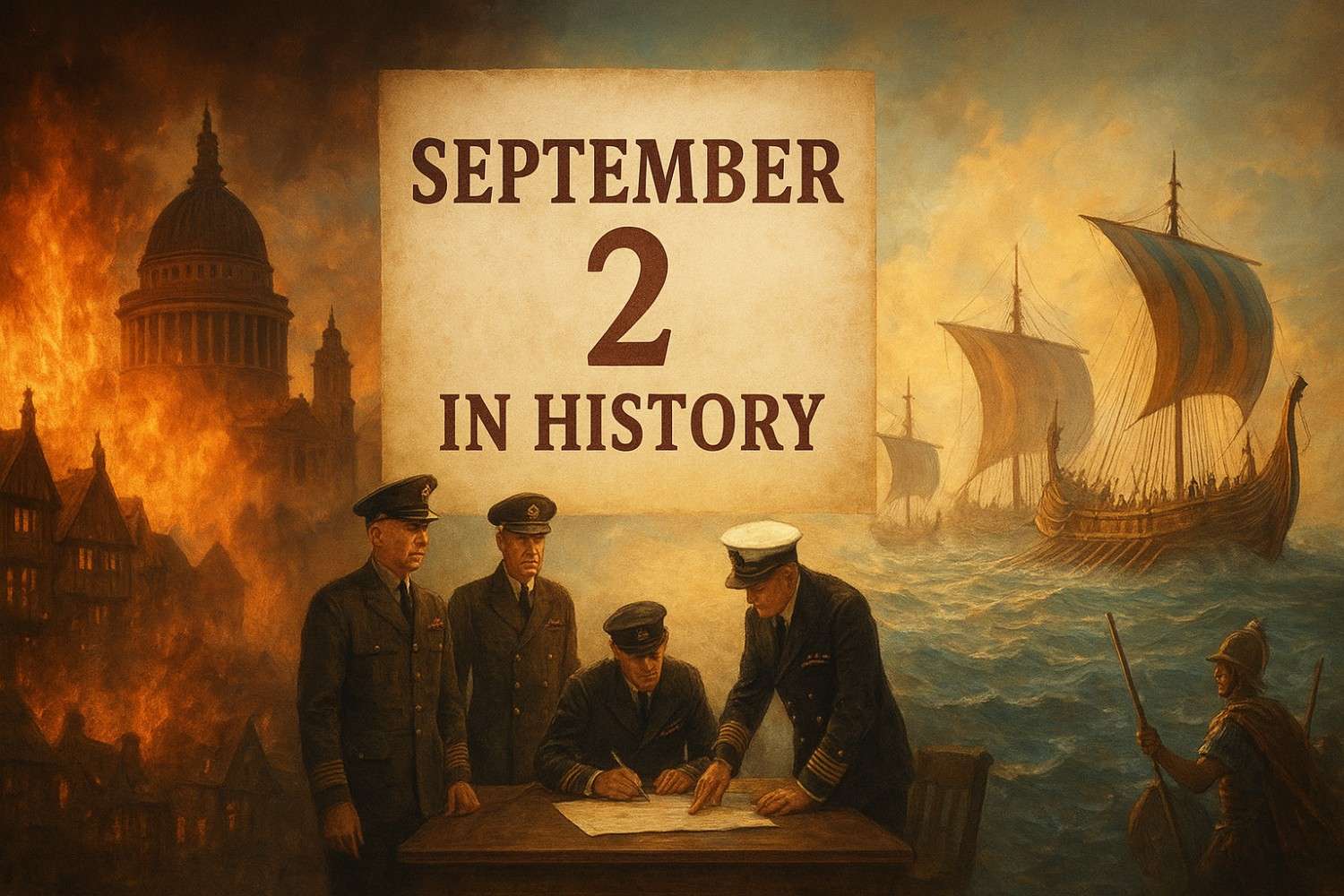
A fire that started in the king’s baker’s house on Pudding Lane turned into a four-day inferno that destroyed huge swathes of the medieval city, including Old St. Paul’s Cathedral and thousands of houses. The catastrophe exposed the danger of timber construction, cramped streets, and flammable roofs, and it revealed limits of 17th-century firefighting methods. Out of the ruin came major urban reform: stricter building codes, new street plans, and an ambitious rebuilding program that shaped London’s modern heart. The Great Fire remains an enduring lesson in how urban design, regulation, and emergency response are forever linked to public safety.
1752 — Britain adopts the Gregorian calendar (September 2 followed by September 14)
To align with continental Europe, Britain and its colonies skipped eleven days—September 2 was followed by September 14—creating immediate confusion and a popular backlash among some people who felt days had been “stolen.” Beyond the resentment, the reform solved real problems for international trade, navigation, and scientific work that depended on consistent dating across nations. The episode shows how even abstract technical reforms—calendars, timekeeping—have social, economic, and political consequences. Over time the Gregorian calendar’s adoption smoothed diplomacy and commerce despite that initial cultural shock.
1789 — U.S. Department of the Treasury established
Congress created the Treasury Department to manage the nation’s finances, with Alexander Hamilton as its first Secretary, laying foundations for federal fiscal policy. The new department centralized revenue collection, debt management, and public accounting at a time when the young republic faced heavy Revolutionary War debts. Establishing the Treasury organized the financial tools necessary for a durable national government and set precedents for economic policy and public credit. Hamilton’s leadership shaped institutions that would influence American economic life for centuries.
1792 — The September Massacres (French Revolution)
During a week of panic in Paris, revolutionary crowds killed prisoners amid fears that jailed royalists would rise and join counterrevolutionary forces. The killings—driven by rumor, fear, and political urgency—marked one of the Revolution’s bloodiest outbursts and left a lasting stain on claims that revolution equals moral clarity. The Massacres revealed how insecurity and rumor can push a political crisis into summary violence, undermining legal norms and revolutionary legitimacy. Historians treat the episode as a warning about the fragile line between popular justice and mob atrocity.
1864 — Sherman captures Atlanta (American Civil War)
General William T. Sherman’s capture of Atlanta was a decisive strategic victory that wounded Confederate logistics and morale and helped secure President Lincoln’s reelection. The fall of Atlanta also signaled the effectiveness of total-war tactics—targeting infrastructure to break an enemy’s will and ability to fight. For northern audiences it became a symbol of impending Union victory; for southerners it represented the destructive reach of modern warfare on civilian life and urban centers. Atlanta’s capture reshaped the final campaign of the war and postwar southern reconstruction.
1898 — Battle of Omdurman and the machine gun’s lethal showcase
At Omdurman, Anglo-Egyptian forces under Herbert Kitchener defeated Mahdist troops, and the encounter showcased the Maxim machine gun’s devastating firepower in colonial warfare. The battle illustrated how new industrial weaponry could create overwhelming battlefield advantages and foreshadow the mechanized horrors of the 20th century. Omdurman helped bring Sudan under British influence while also raising moral and strategic questions about technology, empire, and asymmetrical conflict. It stands as an early example of how military innovation can transform political outcomes and human cost.
1935 — Labor Day Hurricane devastates the Florida Keys
A Category 5 storm slammed the Keys with catastrophic winds and storm surge, killing hundreds and destroying towns in one of the deadliest U.S. hurricanes on record. The disaster exposed weaknesses in forecasting, warning systems, and emergency planning at the time, prompting later improvements in meteorology and evacuation policy. The storm’s human toll and the post-storm response reshaped how the U.S. prepared for and managed major hurricanes. Even today the 1935 hurricane is a benchmark for the destructiveness a major storm can bring to coastal communities.
1945 — Japan formally surrenders; Ho Chi Minh proclaims Vietnam’s independence
On September 2, 1945, formal surrender signatures were signed aboard USS Missouri in Tokyo Bay, legally ending Japan’s role in World War II after six brutal years of Pacific war. That same historical moment overlapped with Ho Chi Minh’s proclamation of Vietnamese independence in Hanoi, where he announced a new republic drawn from anti-colonial struggle. Together these events illustrate how the end of one global conflict immediately opened space for nationalist movements and decolonization campaigns across Asia. The day is therefore both an end-of-war marker and a starting point for new political orders.
1960 — First election of the Tibetan Parliament in Exile (Democracy Day)
Exiled Tibetans in India held the first democratic election for their parliamentary body, a symbolic and practical assertion of political organization in exile. The vote represented an effort to institutionalize representation and keep national identity alive after displacement. Over decades the parliament has become a focal point for diaspora governance and cultural continuity. For many Tibetans the date is remembered as a sign of democratic aspiration amid statelessness.
1969 — First U.S. ATM begins operation (Chemical Bank)
The first American automatic teller machine went into service at Chemical Bank in New York, offering a glimpse of how banking would become automated and increasingly convenient. The ATM changed daily life by making cash access independent of bank hours and branch staffing. Over time ATMs reshaped consumer habits, banking branch economics, and the design of financial infrastructure worldwide. A small machine on a city sidewalk turned into a global standard for personal finance accessibility.
1998 — Swissair Flight 111 crashes off Nova Scotia
Swissair Flight 111 crashed into the Atlantic near Peggy’s Cove, killing all 229 aboard and triggering a lengthy, technically demanding investigation and recovery. Authorities eventually traced the disaster to an in-flight fire that spread via wiring and flammable insulation, prompting major industry changes in materials, wiring standards, and crew procedures. The accident’s painful human toll led to regulatory reforms meant to reduce future in-flight fire risks. Swissair 111 remains a pivotal case in modern aviation safety lessons.
1996–1998 and early 1990s — Late-20th-century diplomacy and justice
Your list included several later items worth noting: a 1996 Philippine peace pact ending a decades-long insurgency, the 1998 conviction of Jean-Paul Akayesu at the ICTR for genocide, and early-1990s agreements between the U.S. and Russia to cooperate on a joint space station. Each event points to different post–Cold War realities: negotiated peace and reconciliation, international criminal accountability, and new forms of technical cooperation in space. Together they show September 2’s place in a modern narrative of conflict resolution, legal reckoning, and scientific partnership.
Notable Births on September 2
- Keanu Charles Reeves (1964) — Canadian-born actor whose range runs from indie drama to blockbuster action franchises.
- Salma Hayek (1966) — Internationally known actress and producer who brought Latin stories to global screens.
- Terry Bradshaw (1948) — NFL quarterback, four-time Super Bowl winner, later broadcaster and cultural figure.
- Jimmy Connors (1952) — Forceful and influential tennis champion of his era.
- Christa McAuliffe (1948) — Teacher selected as the first private citizen to fly in space; her death aboard Challenger made her a lasting symbol for education and public service.
- Horace Silver (1928) — Influential jazz pianist and composer, a key figure in the hard bop movement.
- Joey Barton (1982) — English footballer and manager known for a combative midfield style, strong set-piece play, and an outspoken, often controversial public profile; later moved into coaching and management.
- Bill Shankly (1913) — Scottish footballer and transformative manager who rebuilt Liverpool into a major club; his leadership, plainspoken philosophy, and focus on teamwork left a lasting legacy in British football.
- Ahmad Shah Massoud (1953) — Afghan military commander and political leader, a leading figure in the anti-Soviet resistance and later opposition to the Taliban; celebrated by many as a national hero until his assassination in 2001.
- Adolph Rupp (1901) — American college basketball coach at the University of Kentucky, one of the winningest coaches in NCAA history whose teams set standards for success and shaped modern college basketball.
Notable Deaths on September 2
- J. R. R. Tolkien (1973) — Author and philologist whose books remade modern fantasy.
- Ho Chi Minh (1969) — Leader of the Vietnamese independence movement and the symbolic president.
- Pierre de Coubertin (1937) — Founder of the modern Olympic movement.
- Henri Rousseau (1910) — Painter noted for his dreamlike, naive style.
- Sylvanus Morley (1948) — Mayanist scholar and archaeologist.
Observances & Institutional Dates
- U.S. Treasury Department founded (1789.
- Britain’s Gregorian calendar adoption and “11-day” skip (1752).
- Democracy Day among Tibetan exiles (first parliament election, 1960).
Final Thoughts on Today in History: September 2
September 2 mixes declaration and catastrophe, technological firsts and legal reckonings. On the same date you can find imperial chess moves in Alexandria, naval engagements that toppled dynasties, urban conflagrations that rewired city life, and quiet bureaucratic creations that shaped modern states. Taken together, these entries show how dates become nodes where very different human stories intersect — and how remembering them helps us see patterns across politics, technology, and daily life.
Check Also: Today in History – September 1
FAQs About September 2 in History
Why does September 2 have so many big events?
Mostly coincidence plus memory — dramatic moments get retold and commemorated, so dates with several high-impact events stand out when you read a “Today in History” list.
Did the Great Fire of London start on September 2, 1666, and how long did it burn?
Yes — the blaze began on September 2 in Pudding Lane and burned for about four days, destroying large parts of the medieval city, including Old St. Paul’s.
Was Japan’s surrender signed on September 2, 1945?
Yes — the Instrument of Surrender was signed aboard USS Missouri on September 2, 1945, formally ending WWII in the Pacific.
Why is the Battle of Actium (31 BC) so important?
Actium ended the last Roman civil war: Octavian’s victory toppled Antony and Cleopatra and cleared the way for the Roman Empire under Augustus.
Why did Britain skip 11 days in September 1752?
To adopt the Gregorian calendar and align with Europe for trade and navigation, officials moved from September 2 to September 14, which caused public confusion and protests.
How did the Swissair Flight 111 crash change aviation safety?
The 1998 crash exposed risks from flammable materials and wiring; it led to stricter material standards, wiring rules, and improved crew procedures for onboard fires.