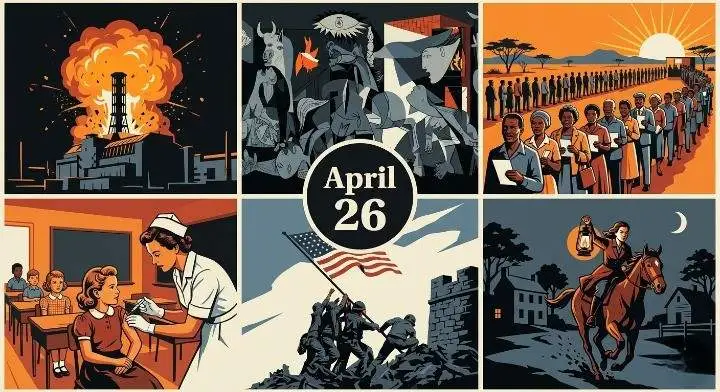
At 1:23 a.m. on April 26, 1986, reactor number four at the Chernobyl Nuclear Power Plant exploded in the dark above Soviet Ukraine. Engineers had been running a safety test. Within seconds, the roof was gone. Radioactive fire burned for ten days. On that same date eight years later, millions of South Africans stood in lines stretching for miles to cast a ballot for the first time in their lives — and voted Nelson Mandela’s party into power. April 26 holds both catastrophe and triumph. Here is every major event from this date across the centuries.
☢️ Quick Facts — April 26 in History
| 📌 Category | 📖 Event / Detail |
|---|---|
| 💥 Most Significant Event | Chernobyl nuclear disaster, 1986 |
| 🏆 Top 10 Key Events |
• Chernobyl nuclear disaster — 1986 • Guernica bombing — 1937 • South Africa’s first multiracial election — 1994 • Easter Rising — Battle of Mount Street Bridge — 1916 • Gestapo established — 1933 • Jonas Salk polio vaccine trials begin — 1954 • Tripoli falls to Mamluks — 1289 • William Shakespeare baptized — 1564 • 1289 Mamluk siege of Tripoli • Italy signs Treaty of London (WWI) — 1915 |
| ⚔️ Key Battles |
• Battle of Mount Street Bridge — Easter Rising, Dublin (1916) • Battle of Bautzen — last German tank offensive, WWII (1945) • Battle of Derne — First Barbary War (1805) • Battle of Beaumont — War of the First Coalition (1794) |
| 👤 Key Figures (born or active this day) |
• Francesco Petrarch (climbed Mont Ventoux, 1336) • William Shakespeare (baptized 1564) • Nelson Mandela (1994 election) • Paul von Hindenburg (elected 1925) |
| 🌍 Observances |
• World Intellectual Property Day • Union Day (Tanzania) • Day of Remembrance of the Chernobyl Tragedy (Belarus) • Memorial Day of Radiation Accidents and Catastrophes (Russia) • Confederate Memorial Day (Florida, US) |
Story of the Day: The Night the World Changed in Chernobyl
At 1:23 AM, a series of explosions ripped through Reactor 4 of the Chornobyl Nuclear Power Plant, blowing the 1,000-ton steel lid off like a bottle cap. Operators had been running a safety test that spiraled into a nightmare, sending a plume of radioactive debris miles into the atmosphere. Firefighters arrived thinking they were battling a standard blaze, unaware they were walking into a lethal wall of ionizing radiation. This catastrophe forced the evacuation of over 100,000 people and left the city of Pripyat a ghost town. It remains the worst nuclear accident in human history, fundamentally shifting how the world views atomic energy.
Important Events That Happened On April 26 In History
1289 – The Fall of Tripoli
Sultan Qalawun’s Mamluk army breached the walls of Tripoli after weeks of relentless catapult fire. The fall of this Crusader stronghold was brutal, with the victorious forces showing no mercy to the men trapped inside. Surviving women and children were taken into slavery, marking a dark chapter in the Mediterranean wars. This victory effectively ended the County of Tripoli and signaled the final collapse of Crusader presence in the Levant.
1326 – The Treaty of Corbeil
King Robert the Bruce of Scotland and King Charles IV of France put ink to parchment to renew the “Auld Alliance.” Both nations were weary of English aggression and promised to support one another in the event of a British invasion. This mutual aid pact solidified a geopolitical partnership that would last for centuries. It ensured that whenever England looked north or south, they faced a unified front of two bitter enemies.
1336 – Petrarch Climbs Mont Ventoux
Francesco Petrarca stood atop the summit of Mont Ventoux, looking out over the world for no reason other than the view itself. While others climbed mountains for military or survival reasons, Petrarch went up to satisfy his own curiosity and soul. This ascent is often cited by historians as the birth of modern mountaineering and the start of the Renaissance. It shifted the human perspective from merely surviving the world to admiring its beauty and complexity.
1478 – The Pazzi Conspiracy
Bernardo Bandini dei Baroncelli lunged at Giuliano de’ Medici inside the Florence Cathedral during High Mass, stabbing him to death in front of the altar. His brother, Lorenzo the Magnificent, escaped the blades of the Pazzi family by ducking into the sacristy and locking the heavy doors. The attempt to overthrow the Medici family failed spectacularly as the people of Florence turned on the conspirators. The Pazzi leaders were soon hanging from the windows of the Palazzo Vecchio, leaving the Medici more powerful than ever.
1564 – The Baptism of William Shakespeare
Parish records in Stratford-upon-Avon show that a baby boy named William was brought to the font of Holy Trinity Church for his baptism. Since custom dictated baptism three days after birth, the world generally celebrates his arrival on April 23. This child grew up in a market town to become the most influential playwright in the English language. His work would redefine storytelling, drama, and the very words we use to speak today.
1607 – Landfall at Cape Henry
Three small ships—the Susan Constant, the Godspeed, and the Discovery—finally dropped anchor at the southern entrance of the Chesapeake Bay. The Virginia Company colonists stepped onto the sands of Cape Henry, marking their first arrival in the New World. They erected a wooden cross and offered prayers before moving inland to find a more defensible location. This landing was the precursor to the founding of Jamestown, the first permanent English settlement in America.
1721 – The Tabriz Earthquake
The ground beneath the Iranian city of Tabriz buckled and tore in a violent tremor that leveled nearly every structure in sight. Tens of thousands of residents were buried in the rubble as the city’s grand architecture collapsed in seconds. This disaster remains one of the deadliest seismic events in the region’s history. It forced a massive, decades-long rebuilding effort that altered the city’s urban landscape forever.
1777 – Sybil Ludington’s Midnight Ride
Sixteen-year-old Sybil Ludington mounted her horse, Star, and rode 40 miles through a drenching rainstorm to warn the Danbury militia. British regulars were burning supplies and advancing fast, and Sybil covered twice the distance of Paul Revere to rally the colonial forces. By daybreak, hundreds of soldiers had gathered to face the redcoats. Her courage provided a vital boost to the American cause during a desperate stretch of the Revolutionary War.
1794 – Battle of Beaumont
Austrian and British cavalry charged into the French Republican lines during a thick morning fog in the Flanders Campaign. The suddenness of the assault caught the French off guard, leading to a disorganized retreat and heavy casualties. It was a rare tactical success for the Coalition forces against the rising power of revolutionary France. However, the victory was short-lived as French reinforcements soon reclaimed the momentum in the region.
1802 – Napoleon’s General Amnesty
Napoleon Bonaparte sat at his desk and signed a decree that allowed all but the most radical French émigrés to return home. Thousands who had fled the guillotines and chaos of the French Revolution were suddenly given a path back to their families and lands. This move was a calculated effort to stabilize the country and consolidate Napoleon’s internal support. It effectively ended the era of mass exile that had defined the previous decade.
1803 – The L’Aigle Meteor Shower
Villagers in L’Aigle, France, watched in terror as thousands of black stones screamed through the sky and slammed into the earth. Before this event, the scientific community laughed at the idea that rocks could fall from space. Jean-Baptiste Biot investigated the scene and proved that these stones were extraterrestrial. This event birthed the science of meteoritics and changed how we understand our place in the solar system.
1805 – The Capture of Derne
Lieutenant Presley O’Bannon and a handful of U.S. Marines led a ragtag mercenary army across 500 miles of North African desert to storm the fortress at Derne. This was the first time the American flag was raised over a captured city in the Old World. The victory forced the Pasha of Tripoli to negotiate for peace during the First Barbary War. This feat is immortalized today in the “Marines’ Hymn” with the line “to the shores of Tripoli.”
1865 – The Death of John Wilkes Booth
Union soldiers surrounded a barn in Virginia, shouting for the man who killed Abraham Lincoln to come out and face justice. When Booth refused, the soldiers set the barn on fire, silhouetting him against the flames for Sergeant Boston Corbett to take the fatal shot. Booth died on the porch of the farmhouse, whispering his final words as he looked at his hands: “Useless, useless.” His death ended the frantic search for the man who had shattered a nation’s peace.
1900 – The Great Hull-Ottawa Fire
A small chimney fire in Hull, Quebec, was whipped by high winds across the river into the heart of Ottawa. In just 12 hours, seven square miles of Canada’s capital were reduced to smoldering ash and skeletal brickwork. Twelve thousand people lost their homes, and the local lumber industry was devastated overnight. The disaster forced the cities to modernize their fire codes and rethink urban planning for the 20th century.
1903 – Atlético Madrid is Founded
Three Basque students living in Madrid decided to start a branch of their hometown club, creating what would become Atlético Madrid. They originally wore blue and white but eventually switched to the iconic red and white stripes. The club grew to become one of the titans of Spanish and European football. Today, they remain a symbol of gritty, working-class pride in the Spanish capital.
1915 – The Secret Treaty of London
Diplomats from Italy, Britain, and France met in the shadows to sign a pact that would change the map of Europe. In exchange for joining the Allied Powers in World War I, Italy was promised vast territories currently held by Austria-Hungary. This betrayal of the Triple Alliance brought a massive new front to the war in the Alps. The fallout of this treaty would eventually fuel the rise of Italian nationalism after the war’s end.
1916 – Battle of Mount Street Bridge
Irish rebels took up positions in houses overlooking a small bridge in Dublin, waiting for the British reinforcements to march into the city. A tiny group of volunteers managed to hold off an entire battalion for hours, causing the heaviest British casualties of the Easter Rising. The narrow street became a kill zone as the rebels fought with desperate precision. Though the bridge was eventually taken, the stand showed the British that the Irish were prepared to fight to the death.
1920 – Olympic Ice Hockey Debut
Frank Fredrickson sliced across the ice in Antwerp, scoring seven goals in a single game to secure gold for Canada. This was the first time ice hockey was included in the Olympic Games, and the Canadian dominance was total. They beat Sweden 12–1 in a match that looked more like a training session than a final. This victory set a standard for Canadian hockey that has remained a point of national pride for over a century.
1923 – The Wedding of the Duke of York
Prince Albert, the Duke of York, stood at the altar of Westminster Abbey to marry Lady Elizabeth Bowes-Lyon. Neither of them expected to ever wear a crown, as Albert was only the second son of the King. However, when his brother abdicated years later, they became King George VI and Queen Elizabeth (the Queen Mother). Their steady leadership would eventually guide the British Empire through the darkest days of World War II.
1925 – Hindenburg Becomes President
Paul von Hindenburg, the aging hero of the First World War, won the second round of the German presidential elections. He was the first head of state directly elected by the people under the Weimar Republic. While many saw him as a stabilizing force, his presidency eventually paved the way for the collapse of democracy. Within a few years, he would be the man who appointed Adolf Hitler as Chancellor.
1933 – The Birth of the Gestapo
Hermann Göring signed the executive order that officially created the Geheime Staatspolizei, better known as the Gestapo. Originally intended as a small political police force in Prussia, it quickly expanded into a nationwide instrument of terror. The organization was granted the power to arrest anyone without trial or judicial oversight. It became the primary tool used by the Nazi regime to silence dissent and orchestrate the Holocaust.
1937 – The Bombing of Guernica
German and Italian warplanes appeared over the Spanish town of Guernica on a busy market day, dropping a rain of incendiary bombs. The town had no military significance, and the attack was a deliberate experiment in “carpet bombing” civilian populations. Hundreds of people died in the firestorm, and the world was horrified by the sheer brutality of the new aerial warfare. The tragedy inspired Pablo Picasso to create his famous anti-war masterpiece, Guernica.
1942 – The Benxihu Mine Disaster
A massive gas explosion ripped through the Benxihu Colliery in Japanese-occupied China, trapping thousands of miners underground. In a cold-blooded decision, the Japanese operators shut off the ventilation to “starve” the fire, effectively suffocating the survivors still inside. Over 1,500 Chinese miners died in what remains the deadliest coal mine accident in history. It stands as a grim reminder of the human cost of forced labor during the war.
1943 – The Easter Riots in Uppsala
Pro-Nazi supporters attempted to hold a rally in the Swedish city of Uppsala, but they were met by a massive crowd of anti-fascist protesters. The tension boiled over into a full-scale riot that flooded the streets with violence and debris. This event forced the Swedish government to reconsider its policy on allowing extremist gatherings during the height of the war. It remains a significant moment in Sweden’s internal struggle to maintain neutrality while facing internal division.
1944 – Papandreou’s Exile Government
Georgios Papandreou was appointed as the head of the Greek government-in-exile while his country suffered under brutal Nazi occupation. Working from Egypt, he attempted to unite the various Greek resistance factions under a single political banner. His leadership was crucial in preparing Greece for the inevitable day of liberation. However, the divisions he faced would eventually lead to the outbreak of the Greek Civil War.
1944 – The Kidnapping of Heinrich Kreipe
Allied commandos and Cretan resistance fighters ambushed a German general’s car on the occupied island of Crete. They managed to capture General Heinrich Kreipe and spirit him away into the mountains, evading thousands of searching German troops. The daring mission was a massive psychological blow to the German occupation forces. It became one of the most celebrated special operations stories of the Second World War.
1945 – The Battle of Bautzen
German tank divisions launched a desperate counter-offensive against Soviet and Polish forces in the final weeks of the war. Against all odds, the Wehrmacht managed to secure a tactical victory, marking their last successful offensive operation. While it delayed the Allied advance for a few days, it could not change the ultimate fate of the Third Reich. By this point, the Soviet Red Army was already closing the ring around Berlin.
1945 – The Liberation of Baguio
Filipino and American troops fought their way through the rugged mountains of Luzon to finally liberate the city of Baguio. General Tomoyuki Yamashita’s forces were pushed into a retreat, marking the beginning of the end for Japanese control in the Philippines. The city was left in ruins after months of heavy fighting and aerial bombardment. For the locals, it was a day of profound relief and the start of a long road to recovery.
1954 – The Geneva Conference Begins
Diplomats from across the globe gathered in Switzerland to discuss the escalating conflicts in Korea and French Indochina. The world watched as the Great Powers attempted to redraw borders and prevent another world war. While the conference failed to unify Korea, it resulted in the division of Vietnam at the 17th parallel. This decision would set the stage for decades of American involvement in the Vietnam War.
1954 – The Salk Vaccine Trials
Parents in Fairfax County, Virginia, lined up with their children for the first mass clinical trials of Jonas Salk’s polio vaccine. Polio was a terrifying plague that paralyzed thousands of children every year, and this was the first real glimmer of hope. Over a million children, known as “Polio Pioneers,” eventually participated in the study. The success of these trials would eventually lead to the near-total eradication of the disease worldwide.
1956 – The Voyage of the SS Ideal X
The SS Ideal X slipped its moorings in New Jersey, carrying 58 metal containers destined for Houston, Texas. Before this day, cargo was loaded crate-by-crate by hand, a slow and expensive process. This single voyage proved that standardized containers could revolutionize global trade by slashing shipping costs. It was the birth of “containerization,” the system that now moves almost every product you own across the ocean.
1958 – The Royal Blue’s Final Run
The Baltimore and Ohio Railroad’s famous Royal Blue passenger train completed its last trip between Washington, D.C., and New York. For 68 years, it had been the gold standard for luxury travel, and it was the first U.S. passenger train to utilize electric locomotives. As the golden age of rail travel began to fade, the Royal Blue was retired to make way for the highway era. Its departure signaled the end of a refined chapter in American transportation history.
1960 – Syngman Rhee Resigns
Angry student protesters flooded the streets of Seoul, demanding the end of Syngman Rhee’s 12-year dictatorial rule. Facing a total loss of support from both his people and the military, the South Korean President finally stepped down and fled into exile. This “April Revolution” was a pivotal victory for democracy in South Korea. It proved that even the most entrenched leaders could not ignore the collective voice of the people forever.
1962 – Ranger 4 Hits the Moon
NASA’s Ranger 4 spacecraft tumbled through the vacuum of space before slamming into the far side of the Moon. While a computer failure prevented the probe from sending back any scientific data, it was technically the first American spacecraft to reach another celestial body. The mission was a bittersweet milestone in the Space Race. It showed that NASA could hit the target, even if they couldn’t yet control the landing.
1962 – The Launch of Ariel 1
A rocket carrying the Ariel 1 satellite roared off the launchpad, making the United Kingdom the third nation to have a satellite in orbit. The project was a collaboration between British scientists and NASA, designed to study the ionosphere and cosmic rays. It was a moment of immense national pride for a country trying to find its place in the modern tech era. The satellite operated for years, providing vital data about the environment surrounding our planet.
1963 – Constitutional Reform in Libya
King Idris of Libya signed a series of amendments that unified the country’s three provinces into a single national state. For the first time, Libyan women were granted the right to vote and participate in national elections. This was a progressive leap for the young monarchy, aiming to modernize the nation’s political structure. However, these reforms were short-lived, as the monarchy would be overthrown by Muammar Gaddafi just six years later.
1964 – The Birth of Tanzania
The leaders of Tanganyika and Zanzibar met to sign a treaty that merged their two nations into one. This union was a bold experiment in Pan-Africanism, aimed at creating a stronger, more stable presence in East Africa. The new nation was named the United Republic of Tanzania, combining the names of both founding territories. It remains one of the few successful examples of post-colonial state mergers on the continent.
1966 – The Tashkent Earthquake
A powerful magnitude 5.1 earthquake struck the center of Tashkent, the capital of Soviet Uzbekistan. Because the epicenter was shallow and directly beneath the city, the destruction was nearly total, leaving 300,000 people homeless. The Soviet government used the disaster as an opportunity to rebuild Tashkent as a model socialist city with wide boulevards and modern apartments. This event fundamentally changed the culture and architecture of Central Asia’s largest city.
1966 – New Government in Congo
Ambroise Noumazalaye was appointed as the Prime Minister of the Republic of the Congo, leading a new revolutionary government. This shift marked a period of increasing socialist influence in the region as the country navigated its post-colonial identity. The new administration aimed to nationalize key industries and reduce Western influence. It was a turbulent era that would define the nation’s political landscape for decades.
1970 – WIPO is Established
The convention that created the World Intellectual Property Organization officially went into effect. This United Nations agency was designed to protect the “works of the mind” across international borders, from patents to poetry. It created a framework for creators to benefit from their inventions in a globalized world. Today, it remains the primary body governing how ideas are bought, sold, and protected worldwide.
1981 – First Open Fetal Surgery
Dr. Michael Harrison made history in San Francisco by operating on a baby still inside its mother’s womb. The groundbreaking procedure was used to correct a life-threatening blockage in the fetus’s urinary tract. Before this, such conditions were almost always fatal or resulted in severe disability. This success opened a new frontier in medicine, allowing doctors to treat patients before they are even born.
1989 – The Daulatpur-Saturia Tornado
The sky over Central Bangladesh turned a terrifying shade of black as the deadliest tornado in human history touched down. The massive funnel, over a mile wide, wiped out entire villages in minutes, killing upwards of 1,300 people. Because of poor infrastructure and the storm’s sheer power, tens of thousands were left homeless and injured. It remains a grim reminder of the devastating power of nature in one of the world’s most vulnerable regions.
1989 – The April 26 Editorial
The People’s Daily in China published a scathing editorial that labeled the student protests in Tiananmen Square as “anti-party” and “anti-socialist.” Rather than scaring the protesters away, the harsh language insulted them and brought even more people into the streets. This editorial is seen by historians as the moment that closed the door on a peaceful resolution. It set the stage for the tragic military crackdown that would occur just weeks later.
1991 – The Andover Tornado Outbreak
A massive supercell thunderstorm roared across the central United States, spawning 55 tornadoes in a single day. The most terrifying of these was an F5 monster that tore through Andover, Kansas, erasing neighborhoods from the map. Modern weather technology allowed for early warnings that saved countless lives, yet the destruction was still staggering. It remains one of the most well-documented and studied tornado outbreaks in history.
1993 – Columbia Launches STS-55
The Space Shuttle Columbia roared into the sky, carrying the Spacelab module and a crew of seven. For ten days, the astronauts conducted dozens of experiments in physics, biology, and chemistry in the weightless environment of space. It was a high-water mark for international scientific cooperation during the shuttle era. The data gathered helped researchers on Earth understand how humans might one day live for long periods in orbit.
1994 – The Crash of China Airlines 140
An Airbus A300 was on its final approach to Nagoya, Japan, when a pilot error caused the plane to stall and plummet into the ground. Out of the 271 people on board, 264 were killed in the fiery wreckage. It was the deadliest accident in the history of China Airlines and prompted a massive overhaul of pilot training and cockpit automation. The tragedy led to new global safety standards for how pilots interact with computerized flight systems.
1994 – South Africa’s First Multiracial Election
Millions of South Africans stood in lines that stretched for miles, waiting hours to cast a vote for the first time in their lives. After decades of the brutal Apartheid system, people of all races finally had an equal say in the future of their country. Nelson Mandela and the ANC won a landslide victory, signaling the official end of white minority rule. This “what happened on this day in history April 26” event remains a global symbol of the triumph of justice over oppression.
1999 – The CIH Virus Attack
Computers around the world began crashing as the CIH virus, also known as “Chernobyl,” activated on the 13th anniversary of the nuclear disaster. The virus was uniquely destructive, capable of overwriting the BIOS and rendering the hardware completely useless. It caused hundreds of millions of dollars in damage and sent a shockwave through the early internet community. It forced a massive shift in how software companies and users approached cybersecurity.
2002 – The Erfurt Massacre
A former student walked into the Gutenberg-Gymnasium in Germany and opened fire, killing 16 people including teachers and students. The tragedy horrified a nation that had rarely seen such school violence and sparked an immediate debate over gun laws and violent media. In the wake of the shooting, Germany implemented some of the strictest firearm regulations in Europe. The school was later turned into a memorial to honor those who lost their lives.
2005 – Syria Withdraws from Lebanon
The last Syrian soldiers crossed the border out of Lebanon, ending a military occupation that had lasted nearly three decades. This “Cedar Revolution” was fueled by massive street protests following the assassination of Prime Minister Rafic Hariri. For the first time in a generation, Lebanon had the chance to govern itself without direct foreign interference. It was a moment of intense hope and national rebirth for the Lebanese people.
2015 – Nazarbayev’s Re-election
Nursultan Nazarbayev claimed victory in the Kazakhstan presidential election with a staggering 97.7% of the vote. While the government celebrated the result as a sign of national unity, international observers raised serious concerns about the lack of real opposition. Nazarbayev had ruled the country since its independence from the Soviet Union, maintaining a tight grip on power. This election solidified his status as one of the longest-serving leaders in the modern world.
2025 – The Vancouver Ramming Attack
A festive celebration of Lapu-Lapu Day in Vancouver turned into a scene of horror when a vehicle intentionally sped into the crowded street. Eleven people were killed and dozens more were injured as the attacker targeted the vibrant cultural festival. The community was left reeling from the senseless violence, sparking a nationwide discussion on public safety and the protection of large gatherings. In the aftermath, the city came together to support the victims and condemn the hate that fueled the act.
Read Also About The April 25 Moments
Famous People Born On April 26
| Name | Description | Date |
|---|---|---|
| Pasquale Paoli | Corsican statesman and patriot | April 26, 1725 – February 5, 1807 |
| Charles Jenkinson, 1st earl of Liverpool | British politician under King George III | April 26, 1727 – December 17, 1808 |
| Leopold, Baron von Buch | German geologist and geographer | April 26, 1774 – March 4, 1853 |
| Anne-Jean-Marie-René Savary, duc de Rovigo | French general, trusted aide of Napoleon | April 26, 1774 – June 2, 1833 |
| John James Audubon | American ornithologist and artist, Birds of America | April 26, 1785 – January 27, 1851 |
| Ludwig Uhland | German Romantic poet and medievalist | April 26, 1787 – November 13, 1862 |
| Jim Beckwourth | American mountain man and explorer | April 26, 1798 – 1867? |
| Calvin E. Stowe | American educator, biblical scholar | April 26, 1802 – August 22, 1886 |
| Alexander Duff | Scottish missionary to India | April 26, 1806 – February 12, 1878 |
| Friedrich von Flotow | German composer, Martha | April 26, 1812 – January 24, 1883 |
| Frederick Law Olmsted | American landscape architect, designer of Central Park | April 26, 1822 – August 28, 1903 |
| Martha Finley | American children’s author | April 26, 1828 – January 29, 1909 |
| Theodor Billroth | Austrian surgeon, founder of modern abdominal surgery | April 26, 1829 – February 6, 1894 |
| Benjamin F. Tracy | U.S. secretary of the Navy (1889–93) | April 26, 1830 – August 6, 1915 |
| Artemus Ward | American humorist, influenced Mark Twain | April 26, 1834 – March 6, 1867 |
| Sir Joseph Ward | Prime minister of New Zealand (1906–12, 1928–30) | April 26, 1856 – July 8, 1930 |
| Caetano da Costa Alegre | First significant black African poet in Portuguese | April 26, 1864 – April 18, 1890 |
| Harold Sidney Harmsworth, 1st Viscount Rothermere | British newspaper proprietor | April 26, 1868 – November 26, 1940 |
| Natalie Curtis Burlin | American ethnomusicologist | April 26, 1875 – October 23, 1921 |
| Sir Alliott Verdon Roe | English aviation pioneer, first Englishman to fly his own plane | April 26, 1877 – January 4, 1958 |
| Sir Owen Willans Richardson | British physicist, Nobel Prize for electron emission | April 26, 1879 – February 15, 1959 |
| Paul G. Hoffman | American automobile executive, administered Marshall Plan | April 26, 1891 – October 8, 1974 |
| Anita Loos | American novelist and screenwriter, Gentlemen Prefer Blondes | April 26, 1893? – August 18, 1981 |
| Douglas Sirk | German-born American film director of melodramas | April 26, 1897 – January 14, 1987 |
| Eddie Eagan | American boxer and bobsledder, only athlete with Summer/Winter Olympic golds | April 26, 1897 – June 14, 1967 |
| John Grierson | British founder of documentary film movement | April 26, 1898 – February 19, 1972 |
| Vicente Aleixandre | Spanish poet, Nobel Prize in Literature (1977) | April 26, 1898 – December 14, 1984 |
| Charles F. Richter | American physicist and seismologist, Richter scale | April 26, 1900 – September 30, 1985 |
| Ernst Kris | Austrian-born psychologist and art historian | April 26, 1900 – February 27, 1957 |
| Bernard Malamud | American novelist, Jewish immigrant life | April 26, 1914 – March 18, 1986 |
Famous People Died On April 26
| Name | Description | Date |
|---|---|---|
| Stephen II | Pope (752–57), first temporal sovereign of Papal States | Unknown – April 26, 757 |
| Fujiwara Tokihira | Japanese Imperial minister | 871 – April 26, 909 |
| Go-Shirakawa | 77th emperor of Japan | October 18, 1127 – April 26, 1192 |
| Robert Campin | Flemish painter, Master of Flémalle | c.1378 – April 26, 1444 |
| Jan Davidsz de Heem | Dutch Baroque still-life painter | 1606 – April 26, 1684 |
| Magnus Gabriel, count de la Gardie | Swedish statesman, head of Charles XI’s administration | October 15, 1622 – April 26, 1686 |
| John Somers, Baron Somers | English statesman, chief minister to King William III | March 4, 1651 – April 26, 1716 |
| Jeremy Collier | English bishop, leader of Nonjurors | September 23, 1650 – April 26, 1726 |
| Carsten Niebuhr | German explorer of Arabia | March 17, 1733 – April 26, 1815 |
| Pyotr Yakovlevich Chaadayev | Russian intellectual, Westernizer philosopher | June 7, 1794 – April 26, 1856 |
| James Rice | English novelist, collaborator with Sir Walter Besant | September 26, 1843 – April 26, 1882 |
| Karl August Möbius | German zoologist, marine biology pioneer | February 7, 1825 – April 26, 1908 |
| Bjørnstjerne Martinius Bjørnson | Norwegian author, Nobel Prize in Literature (1903) | December 8, 1832 – April 26, 1910 |
| Mário de Sá-Carneiro | Portuguese Modernist poet and novelist | May 19, 1890 – April 26, 1916 |
| François, vicomte de Curel | French dramatist and novelist | June 10, 1854 – April 26, 1928 |
| George Herbert Mead | American philosopher and social psychologist | February 27, 1863 – April 26, 1931 |
| Carl Bosch | German chemist, Nobel Prize, Haber-Bosch process | August 27, 1874 – April 26, 1940 |
| Hermann Alexander, Graf von Keyserling | German social philosopher | July 20, 1880 – April 26, 1946 |
| John Alden Carpenter | American composer, used jazz in orchestral music | February 28, 1876 – April 26, 1951 |
| Arnold Sommerfeld | German physicist, atomic model for fine-structure lines | December 5, 1868 – April 26, 1951 |
| Ki Hadjar Dewantoro | Indonesian educator, founder of Taman Siswa school system | May 2, 1889 – April 26, 1959 |
| Gustav Ucicky | Austrian film director | July 6, 1899 – April 26, 1961 |
| E.J. Pratt | Leading Canadian poet | February 4, 1883 – April 26, 1964 |
| John Heartfield | German artist, pioneer of political photomontage | June 19, 1891 – April 26, 1968 |
| Karl Schäfer | Austrian figure skater, two-time Olympic gold medalist | May 17, 1909 – April 26, 1976 |
| Dame Cicely Courtneidge | British actress and comedienne | April 1, 1893 – April 26, 1980 |
| Irene Ward | British Conservative politician | February 23, 1895 – April 26, 1980 |
| Jim Davis | American actor, Jock Ewing on Dallas | August 26, 1915 – April 26, 1981 |
| Count Basie | American jazz pianist and big band leader | August 21, 1904 – April 26, 1984 |
| Lucille Ball | American actress, I Love Lucy | August 6, 1911 – April 26, 1989 |
Observances on April 26
- World Intellectual Property Day: A global celebration of the role that intellectual property rights play in encouraging innovation and creativity.
- Union Day (Tanzania): Commemorates the 1964 merger of Tanganyika and Zanzibar.
- Confederate Memorial Day (Florida): A day of remembrance for those who died in service to the Confederacy during the American Civil War.
- Remembrance of the Chernobyl Tragedy: Observed in Belarus and Russia to honor the victims and liquidators of the 1986 disaster.
☢️ Frequently Asked Questions — April 26 in History
The Chernobyl nuclear power plant in Ukraine suffered a catastrophic meltdown and explosion. It released massive amounts of radiation and remains the worst nuclear disaster in history.
Most historians point to the Chernobyl disaster due to its global impact on energy policy and environmental health. However, the first multiracial elections in South Africa in 1994 are equally significant for human rights.
While his exact birth date is unconfirmed, William Shakespeare was baptized on this day in 1564. He is arguably the most famous person associated with this date.
The capture of Derne in 1805 during the First Barbary War saw U.S. Marines raise the American flag over foreign soil for the first time. It is a landmark moment in U.S. military history.
It is a day established by the UN to promote the protection of creative and scientific works. It encourages people to think about how patents and copyrights drive progress.
In 2025, a tragic car ramming attack occurred during a cultural festival in Vancouver, Canada. The event resulted in 11 deaths and shifted national conversations on public security.