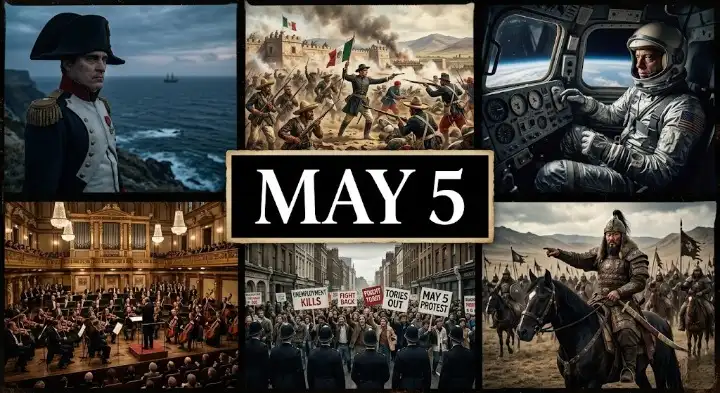
Napoleon Bonaparte spent his final years confined to the desolate rock of Saint Helena, but on May 5, 1821, the former Emperor of the French finally escaped his exile through death. It was a quiet end for a man who had once redrawn the map of Europe. Yet, the same calendar date carries vastly different echoes across the globe—from the defiant cries of victory in Mexico to the thunderous arrival of the first American in space. May 5 serves as a bridge between the collapse of old empires and the rise of new human frontiers.
🎭 Quick Facts — May 5 in History
| 📌 Category | 📖 Event / Detail |
|---|---|
| 🌟 Most Significant Event | Napoleon Bonaparte dies in exile (1821) |
| 🏆 Top 10 Key Events | • Battle of Puebla (1862) • Launch of Alan Shepard (1961) • Opening of Carnegie Hall (1891) • First perfect game in baseball (1904) • Signing of the General Treaty (1949) • Death of Bobby Sands (1981) • Siege of the Iranian Embassy (1980) • Secretariat’s record win (1973) • Sudan peace accord (2005) • End of COVID-19 emergency (2023) |
| ⚔️ Key Battles | Battle of Puebla (1862), Battle of the Wilderness (1864), Battle of Castle Itter (1945) |
| 👤 Key Figures | Napoleon Bonaparte, Ignacio Zaragoza, Alan Shepard, Sitting Bull, Tchaikovsky, Bobby Sands}- |
| 🌍 Observances | Cinco de Mayo, Europe Day, International Midwives’ Day, Liberation Day (Netherlands/Denmark) |
Story of the Day: The Battle of Puebla
Ignacio Zaragoza stood before his ragtag army of 4,000 men as the heavy French columns—the finest infantry in the world—approached the city of Puebla in 1862. General Lorencez, the French commander, expected the Mexican defenders to scatter; instead, they held their ground with fierce determination. After hours of brutal combat, the French retreated in confusion, unable to break the line. While the victory did not end the French invasion of Mexico, it transformed a moment of military resistance into an enduring symbol of national pride and defiance that resonates today.
Important Events That Happened On May 5 In History
553 – The Second Council of Constantinople
Emperor Justinian I convened church leaders in the Byzantine capital to resolve persistent theological disputes regarding the nature of Christ. These debates continued for weeks as bishops sought to codify doctrine and maintain religious cohesion across the empire. The council’s final decrees deepened the schism between eastern and western ecclesiastical branches. This gathering fundamentally altered the trajectory of Christian history and governance.
1192 – Royal Marriage in Jerusalem
Queen Isabella I of Jerusalem married Henry II, Count of Champagne, in a strategic alliance aimed at stabilizing the fragmented Kingdom of Jerusalem. This union sought to reconcile competing claims to the throne following the Third Crusade. Their marriage solidified the political control of the remaining Crusader states in the Levant. It remained a vital political pivot point in the volatile Mediterranean region.
1260 – Kublai Khan Claims the Throne
Grandson of Genghis Khan, Kublai stood before the Mongol nobility to declare himself the supreme ruler of the empire. This transition marked a decisive shift from nomadic conquest toward the establishment of a sophisticated, sedentary administrative state. He soon prioritized the conquest of China, eventually establishing the Yuan Dynasty. Under his leadership, the Mongol Empire achieved its greatest cultural and territorial expansion.
1292 – Election of the King of the Romans
Count Adolf of Nassau received the support of electors gathered in a Dominican monastery in Frankfurt, securing his place as King of the Romans. This election followed a period of political uncertainty and internal power struggles within the Holy Roman Empire. His rise to power reflected the complex bargaining required to balance the influence of powerful German princes. This moment intensified the regional competition for imperial authority.
1494 – Columbus Claims Jamaica
Christopher Columbus sighted the northern coast of the island known to the indigenous Taino people as Xaymaca during his second voyage to the New World. Landing at what is now Discovery Bay, he claimed the territory as the property of the Spanish crown. His arrival initiated the complex and often brutal colonial integration of the island into the Spanish Empire. This encounter forever altered the demographic and political landscape of the Caribbean.
1609 – Invasion of the Ryūkyū Kingdom
Daimyō Shimazu Tadatsune of the Satsuma Domain completed a swift, successful invasion of the Ryūkyū Kingdom in Okinawa. This military campaign asserted Satsuma’s dominance over the region’s lucrative trade routes with China. The kingdom was forced into a subordinate vassal state, retaining its own monarch while operating under strict Japanese oversight. This event cemented a dual-subordination status that persisted for over two centuries.
1640 – Dissolution of the Short Parliament
King Charles I dismissed his parliament after only three weeks, frustrated by their refusal to fund his military ambitions against the Scots. This deadlock deepened the political chasm between the throne and those demanding legislative accountability. The king’s inability to secure cooperation pushed England toward civil war. The dissolution essentially rendered peaceful reconciliation between the monarchy and Parliament impossible.
1654 – Proclamation of the Act of Grace
Oliver Cromwell’s Act of Grace was publicly read in Edinburgh, intended to offer reconciliation to the Scottish people following years of conflict. The act granted general pardons for past actions during the civil wars, provided the Scots accepted the Protectorate’s authority. While aimed at stabilizing the region, it also signaled the firm integration of Scotland into the Commonwealth’s military government. The decree sought to pacify dissent in a nation still reeling from occupation.
1762 – Treaty of St. Petersburg
Russia and Prussia formally signed the Treaty of St. Petersburg, effectively ending Russia’s participation in the Seven Years’ War. Tsar Peter III’s decision to abandon the alliance with Austria stunned the European powers and reversed the tide of the conflict. This sudden diplomatic pivot ensured the survival of the Prussian state under Frederick the Great. The treaty remains a classic example of how dynastic shifts can instantly redraw the European balance of power.
1789 – The Estates-General Convenes
King Louis XVI summoned the Estates-General at Versailles, marking the first time the body had met since 1614. Representatives from the clergy, nobility, and commoners gathered to address a worsening financial crisis, yet were immediately deadlocked by voting procedures. This failure to reach an accord catalyzed the political agitation that sparked the French Revolution. The meeting became the unintentional starting point for the collapse of the Ancien Régime.
1809 – First Patent Awarded to a Woman
Mary Kies successfully obtained a U.S. patent for her innovative technique of weaving straw with silk and thread. Her achievement shattered legal barriers that had previously prevented women from registering intellectual property in their own names. This recognition of her technical ingenuity encouraged a new wave of female entrepreneurship in the textile industry. Her work set a legal precedent that empowered generations of women to claim ownership of their inventions.
1821 – Napoleon Bonaparte Dies
Exiled on the isolated, storm-swept island of Saint Helena, the former Emperor of the French died following years of declining health and rigorous British surveillance. His passing concluded an era of near-constant warfare that had redefined European borders and administrative systems. News of his death moved slowly across the globe, eventually creating a significant power vacuum. He remains one of the most polarizing figures in modern history.
1821 – First Issue of The Manchester Guardian
The inaugural edition of The Manchester Guardian, now known simply as The Guardian, was published in England. Founded in the wake of the Peterloo Massacre, the paper was designed to champion liberal values and provide a voice for the reformist movement. It quickly became an influential force in British political journalism and social advocacy. The newspaper remains a major global media institution today.
1835 – First Continental European Railway
The inaugural railway line on the European continent opened, connecting the cities of Brussels and Mechelen in Belgium. This project proved the viability of steam-powered transit for moving both passengers and freight across national borders. The success of the route sparked a continent-wide scramble to build rail infrastructure. This breakthrough fundamentally accelerated the industrialization and urbanization of Europe.
1862 – The Battle of Puebla
Mexican General Ignacio Zaragoza led an outnumbered force against invading French troops at the city of Puebla. The defenders repelled multiple heavy assaults, forcing a chaotic French retreat and stalling the occupation of the country. This improbable victory prevented the immediate collapse of the Mexican government. The date remains a powerful symbol of national resistance and defiance, celebrated annually as Cinco de Mayo.
1864 – Battle of the Wilderness Begins
General Ulysses S. Grant ordered his Union forces into the dense, tangled undergrowth of Virginia to initiate a brutal offensive against Robert E. Lee. The two armies collided in a thick, smoke-filled forest, resulting in a chaotic, high-casualty engagement that lasted two days. Neither side gained a decisive edge, but the intensity of the struggle signaled the beginning of a relentless, year-long campaign. This battle shifted the war into a high-stakes war of attrition.
1865 – Dissolution of the Confederate Government
The Confederate government was formally declared dissolved in Washington, Georgia, during the final days of the American Civil War. As federal troops tightened their grip on the region, the remnants of the southern administration ceased all official functions. This act effectively brought the political structure of the Confederacy to a quiet, final end. It signaled the completion of the collapse of the rebellion.
1866 – Memorial Day Origins
Residents of Waterloo, New York, gathered to decorate the graves of fallen soldiers, establishing a local tradition of honoring the military dead from the Civil War. The practice quickly spread to other communities, evolving into a national day of remembrance for those who gave their lives in service. This act of community mourning transformed into an essential part of the American calendar. It remains a somber commitment to remembering the human cost of conflict.
1877 – Sitting Bull’s Migration
Sitting Bull led his band of Lakota into Canada to escape the relentless pressure and harassment of the United States Army. This move sought to secure a refuge beyond the reach of Colonel Nelson Miles’s forces. The migration highlighted the ongoing resistance of Indigenous nations against the westward expansion of the United States. His decision to cross the border became a defining moment in the history of the American Indian Wars.
1886 – Bay View Massacre
Wisconsin National Guardsmen opened fire on striking workers in Milwaukee who were marching to demand an eight-hour workday. The resulting violence left several protesters dead, becoming a flashpoint for labor rights and the movement for safer working conditions. The tragedy shocked the nation and galvanized support for organized labor organizations. It remains a grim reminder of the violent struggles involved in early industrial labor reform.
1887 – Founding of the Peruvian Academy of Language
The Peruvian Academy of Language was established in Lima to protect and promote the Spanish language within Peru. It joined a network of linguistic institutions dedicated to preserving the integrity and evolution of the language in the Americas. The academy became a hub for literary scholarship and cultural discourse. Its creation reaffirmed the importance of linguistic identity in a newly independent nation.
1891 – Grand Opening of Carnegie Hall
New York City’s Music Hall, later renamed Carnegie Hall, hosted its first public performance with Tchaikovsky conducting. Built for acoustic excellence, the venue immediately established itself as a premier destination for global performers. Its launch transformed the cultural landscape of New York and solidified its status as an international capital for the arts. The hall remains a legendary venue for world-class music.
1904 – Cy Young’s Perfect Game
Pitcher Cy Young of the Boston Americans retired all 27 batters he faced in a game against the Philadelphia Athletics. This performance marked the first perfect game in the modern era of professional baseball, a feat defined by absolute perfection. His precision on the mound set a benchmark for the sport that still stands as the ultimate test of a pitcher’s skill. The game remains one of the most storied achievements in American sports.
1905 – Fingerprint Evidence Conviction
The trial of the Stratton brothers began in London, marking the first time in English history that fingerprint evidence was used to secure a murder conviction. The use of this unique biometric identifier changed the course of criminal investigations and judicial practice. Prosecutors presented the prints as irrefutable proof of presence at the scene, leading to a verdict that shifted the nature of forensic science. This case set the standard for modern investigative techniques.
1912 – First Issue of Pravda
The inaugural issue of the Bolshevik newspaper Pravda was published, providing a new platform for revolutionary propaganda and party discourse. Its establishment helped the Bolsheviks coordinate their political message and mobilize support across the Russian Empire. The paper served as the party’s primary voice during the turbulent years leading up to the Russian Revolution. It remains a crucial artifact in the history of 20th-century political communications.
1920 – Arrest of Sacco and Vanzetti
Authorities apprehended Italian immigrants Nicola Sacco and Bartolomeo Vanzetti for an armed robbery and double murder in Massachusetts. The arrest triggered a global outcry, as critics claimed the men were targeted more for their anarchist political beliefs than for actual evidence. Their subsequent legal struggle became a defining symbol of anti-immigrant bias in the American justice system. The case continues to be studied as a landmark example of judicial prejudice.
1930 – Bago Earthquake
A major earthquake struck southern Burma, devastating the cities of Yangon and Bago. The disaster caused widespread destruction and claimed an estimated 7,000 lives in one of the most lethal seismic events in the region’s history. The collapse of infrastructure forced a massive, difficult recovery effort. This tragedy remains a stark reference point in the regional history of natural disasters.
1936 – Italian Occupation of Addis Ababa
Italian military forces marched into and occupied the capital city of Ethiopia during the Second Italo-Ethiopian War. This action marked the final collapse of the country’s resistance to the invasion and the beginning of a repressive colonial rule. The occupation drew immediate international condemnation and exposed the limitations of the League of Nations. It stands as a pivotal event in the prelude to the Second World War.
1940 – Capitulation at Hegra Fortress
Norwegian resistance fighters at the Hegra Fortress and Vinjesvingen were forced to surrender to German forces. Their capitulation marked the end of active military resistance in southern Norway after other units had laid down their arms. The struggle demonstrated the tenacity of local forces against an overwhelmingly superior invasion force. This defeat finalized the occupation of southern Norway during the early stages of the war.
1941 – Liberation of Ethiopia
Emperor Haile Selassie returned to Addis Ababa, ending the Italian occupation and reclaiming the sovereignty of his nation. The country commemorates this date as Patriots’ Victory Day, honoring the resistance forces that fought to regain independence. His restoration served as a symbol of hope for nations resisting Axis power during the war. This return marked the first successful reversal of a territorial conquest during the global conflict.
1945 – Start of the Prague Uprising
Czech resistance fighters launched a bold uprising to liberate Prague from German occupation in the final days of the war. Civilians and soldiers fought street-to-street to secure strategic sites and prevent retreating Nazi forces from destroying the city. Their intervention stalled the occupiers until Allied forces reached the capital. The revolt remains a celebrated moment of national bravery and liberation.
1945 – Fu-Go Balloon Bomb Attack
A Japanese incendiary balloon, launched across the Pacific, detonated near Bly, Oregon, killing six civilians. This incident was one of the few instances of enemy combat on the U.S. mainland during the war. The casualties highlighted the reach of the Japanese military’s long-range weapon initiatives. It remains a notable, tragic footnote in the history of aerial warfare.
1945 – Battle of Castle Itter
In one of the most unusual engagements of World War II, American troops and German Wehrmacht soldiers fought side-by-side to defend a castle against a hostile SS division. The battle occurred in the waning days of the European theater, pitting former enemies against a common Nazi threat. Their combined defense successfully protected the prisoners inside the facility. This unique alliance stands as a bizarre but significant moment of tactical cooperation.
1946 – Tokyo War Crimes Trial
The International Military Tribunal for the Far East began in Tokyo, with twenty-eight high-ranking Japanese officials charged with war crimes and crimes against humanity. The tribunal aimed to establish legal accountability for the atrocities committed during the war in the Pacific. These proceedings sought to set a global standard for justice following the conflict. The trials fundamentally shaped the post-war political order in East Asia.
1955 – West German Sovereignty
The General Treaty took effect, by which France, Britain, and the United States formally recognized the sovereignty of West Germany. This diplomatic milestone marked the end of the post-war Allied occupation and integrated the new republic into the Western alliance structure. It provided the legal foundation for the country’s rearmament and future stability. The treaty was a critical step in the economic and political rehabilitation of Germany.
1961 – Alan Shepard in Space
Alan Shepard became the first American to travel into space aboard the Freedom 7 capsule during a sub-orbital flight. The successful mission validated the U.S. space program’s capabilities at a moment of intense competition with the Soviet Union. His 15-minute flight ignited public interest and set the stage for the moon landings that followed. It remains the foundational achievement of American human spaceflight.
1964 – Declaration of Europe Day
The Council of Europe officially designated May 5 as Europe Day to celebrate the peace, unity, and progress achieved through regional cooperation. This declaration emphasized the shared values and political ideals that aimed to prevent future conflicts on the continent. The day has since become a major annual observance for European integration. It highlights the importance of institutional stability and diplomatic dialogue.
1972 – Alitalia Flight 112 Crash
Alitalia Flight 112 crashed into Mount Longa near Palermo, Sicily, resulting in the death of all 115 people on board. This disaster remains the deadliest single-aircraft accident in the history of Italy. The tragedy led to significant changes in aviation safety protocols for flight paths near mountainous terrain. It serves as a somber memory of the risks inherent in early regional air travel.
1973 – Secretariat’s Kentucky Derby Victory
Secretariat won the Kentucky Derby with a record-shattering time of 1:59.4, a feat that remains the fastest time in the race’s history. His performance stunned the racing world and transformed the horse into a national icon of speed and grace. The victory served as the opening act for his historic Triple Crown run that year. He is widely considered the greatest racehorse of the 20th century.
1980 – Operation Nimrod
The British Special Air Service (SAS) stormed the Iranian Embassy in London to end a six-day hostage crisis. After masked gunmen took embassy staff captive to demand the release of prisoners, the live-televised operation successfully neutralized the threat and rescued most of the hostages. The mission showcased the effectiveness of specialized counter-terrorism tactics. This event solidified the SAS’s reputation as a elite, rapid-response unit.
1981 – Death of Bobby Sands
Bobby Sands died in the Long Kesh prison hospital following a 66-day hunger strike protesting the conditions of his confinement and the political status of IRA prisoners. His death triggered widespread civil unrest and riots throughout Northern Ireland. The strike brought intense international scrutiny to the British government’s policies in the region. He remains a powerful, divisive figure in the history of the Northern Irish conflict.
1985 – Bitburg Cemetery Visit
President Ronald Reagan visited the Bitburg military cemetery and the Bergen-Belsen concentration camp site to emphasize post-war reconciliation. The visit was controversial, as the military cemetery contained the graves of Waffen-SS members. Reagan used the moment to advocate for moving past the animosities of World War II. The event remains a complex study in the politics of collective memory and commemoration.
1987 – Iran-Contra Hearings
The United States Congress began televised hearings to investigate the Iran-Contra affair, a scandal involving the illegal sale of arms to Iran to fund Nicaraguan rebels. The sessions exposed a clandestine web of policy maneuvers that operated outside of congressional oversight. These hearings captivated the American public and severely damaged the administration’s political standing. They marked a significant moment of institutional conflict between the executive and legislative branches.
1991 – Mt. Pleasant Riot
A riot erupted in the Mt. Pleasant section of Washington, D.C., following the police shooting of a Salvadoran man. The incident sparked days of unrest, highlighting deep-seated tensions regarding policing and the treatment of the local immigrant community. The events led to a city-wide conversation about civil rights and social justice. This episode remains a significant reference point for D.C.’s recent social history.
1994 – Bishkek Protocol
Armenia and Azerbaijan signed the Bishkek Protocol, an agreement aimed at freezing the volatile Nagorno-Karabakh conflict. While it did not permanently resolve the territorial dispute, it successfully halted large-scale military operations for a period of time. The protocol was a rare moment of diplomatic success in a long-standing regional struggle. It remains a key document in the history of the conflict’s mediation efforts.
1994 – Michael P. Fay Caning
American teenager Michael P. Fay was caned in Singapore after being convicted of vandalism and theft. The punishment sparked an intense international debate about judicial corporal punishment, individual human rights, and the extent of national sovereignty. The case put Singapore’s strict legal system in the global spotlight for months. It became a polarizing example of the cultural divide regarding criminal sentencing.
2006 – Sudan Peace Accord
The government of Sudan signed a formal peace accord with the Sudan Liberation Army in an attempt to end years of violence in the Darfur region. The agreement aimed to integrate rebel forces and establish a framework for humanitarian relief. Despite the ceremony, the conflict proved difficult to sustain under a single agreement. This accord represents the ongoing, complex efforts to bring stability to the volatile nation.
2007 – Kenya Airways Flight 507
Kenya Airways Flight 507 crashed shortly after takeoff from Douala International Airport in Cameroon, resulting in the loss of all 114 people on board. The disaster stands as the deadliest aviation accident in the history of Cameroon. Investigations into the crash highlighted the importance of pilot training and weather-monitoring procedures. The loss remains a tragic event for the international community.
2010 – Greek Austerity Protests
Massive protests erupted across Greece in response to harsh government-imposed austerity measures during the height of the national debt crisis. Thousands of citizens took to the streets to express their anger over wage cuts and social spending reductions. The scale of the unrest signaled the severity of the economic and social breakdown facing the nation. These protests defined a decade of political instability in Greece.
2023 – End of COVID-19 Global Emergency
The World Health Organization declared the end of the COVID-19 pandemic as a global health emergency. This announcement marked the symbolic conclusion of a three-year period that fundamentally altered global health, economics, and daily life. The declaration signaled a transition to the long-term management of the virus within healthcare systems. It was a milestone of recovery for the global community.
Catch up on the historical tales you missed yesterday.
Famous People Born On May 5
| Name | Description | Date |
|---|---|---|
| Afonso III | King of Portugal (1248–79), completed reconquest of Algarve | May 5, 1210 – February 16, 1279 |
| Don Juan Manuel | Spanish nobleman and prose writer, greatest of 14th-century Spain | May 5, 1282 – 1348 |
| Stanislaus Hosius | Polish cardinal, significant Counter-Reformation figure | May 5, 1504 – August 5, 1579 |
| Louis-Christophe-François Hachette | French publisher of textbooks and dictionaries | May 5, 1800 – July 31, 1864 |
| Frederick Barnard | American educator, president of Columbia College | May 5, 1809 – April 27, 1889 |
| Eugène-Marin Labiche | French comic playwright | May 5, 1815 – January 23, 1888 |
| George W. Julian | American abolitionist and Radical Republican politician | May 5, 1817 – July 7, 1899 |
| Lydia Folger Fowler | American physician, one of first U.S. women with medical degree | May 5, 1822 – January 26, 1879 |
| Hubert Howe Bancroft | American historian of the American West | May 5, 1832 – March 2, 1918 |
| August Fick | German comparative linguist, Indo-European etymologist | May 5, 1833 – March 24, 1916 |
| Ferdinand Paul Wilhelm, baron von Richthofen | German geographer, major work on China | May 5, 1833 – October 6, 1905 |
| Henryk Sienkiewicz | Polish novelist, Nobel Prize in Literature (1905) | May 5, 1846 – November 15, 1916 |
| Pietro Gasparri | Italian cardinal, codified Canon Law | May 5, 1852 – November 18, 1934 |
| Friedrich von Hügel | Roman Catholic philosopher, forerunner of realist revival | May 5, 1852 – January 27, 1925 |
| Inukai Tsuyoshi | Prime minister of Japan (1931–32) | May 5, 1855 – May 15, 1932 |
| Peter Cooper Hewitt | American electrical engineer, invented mercury-vapour lamp | May 5, 1861 – August 25, 1921 |
| Sir Henry Hughes Wilson, Baronet | British field marshal, chief of imperial general staff | May 5, 1864 – June 22, 1922 |
| Cândido Rondon | Brazilian explorer and indigenous protector | May 5, 1865 – January 19, 1958 |
| Hans Pfitzner | German composer, upheld traditional ideals | May 5, 1869 – May 22, 1949 |
| John Garstang | British archaeologist, excavated Jericho | May 5, 1876 – September 12, 1956 |
| Sir David Ross | Scottish moral philosopher, critic of utilitarianism | April 15, 1877 – May 5, 1971 |
| Dorothy Annie Elizabeth Garrod | English archaeologist, Mount Carmel excavations | May 5, 1892 – December 18, 1968 |
| Freeman F. Gosden | American comedian, co-creator of Amos ‘n’ Andy | May 5, 1899 – December 10, 1982 |
| James Beard | American culinary expert and cookbook author | May 5, 1903 – January 23, 1985 |
| Sir Gordon Richards | English jockey, first to ride 4,000 winners | May 5, 1904 – November 10, 1986 |
| Carlos Baker | American literary critic, biographer of Hemingway | May 5, 1909 – April 18, 1987 |
| Tyrone Power | American actor, matinee idol | May 5, 1914 – November 15, 1958 |
| Zail Singh | President of India (1982–87), first Sikh president | May 5, 1916 – December 25, 1994 |
| Arthur L. Schawlow | American physicist, Nobel Prize for laser spectroscopy | May 5, 1921 – April 28, 1999 |
| Tammy Wynette | American country singer, “first lady of country music” | May 5, 1942 – April 6, 1998 |
Famous People Died On May 5
| Name | Description | Date |
|---|---|---|
| St. Hilary of Arles | Gallo-Roman bishop of Arles | 401 – May 5, 449 |
| Humbert of Silva Candida | French cardinal, papal legate, 11th-century reformer | c.1000 – May 5, 1061 |
| Casimir II | Duke of Kraków and Sandomierz (1177–94) | 1138 – May 5, 1194 |
| Rennyo | Japanese Buddhist patriarch, Jōdo Shinshū leader | April 4, 1415 – May 5, 1499 |
| Frederick III | Elector of Saxony, protected Martin Luther | January 17, 1463 – May 5, 1525 |
| Sir Henry Sidney | English lord deputy of Ireland (1565–71, 1575–78) | July 20, 1529 – May 5, 1586 |
| Luís de Sousa | Portuguese monastic historian | 1555 – May 5, 1632 |
| Giovanni Benedetto Castiglione | Italian painter and printmaking innovator | March 23, 1609 – May 5, 1664 |
| Samuel Cooper | English miniaturist, finest of his day | c.1608 – May 5, 1672 |
| Nishiyama Sōin | Japanese haikai poet, founder of Danrin school | 1605 – May 5, 1682 |
| Leopold I | Holy Roman emperor (1658–1705) | June 9, 1640 – May 5, 1705 |
| Enrique Flórez | Spanish historian, España sagrada | July 21, 1702 – May 5, 1773 |
| Pierre-Jean-Georges Cabanis | French philosopher and physiologist | June 5, 1757 – May 5, 1808 |
| Frederick Augustus I | First king of Saxony, ally of Napoleon | December 23, 1750 – May 5, 1827 |
| Geórgios Karaïskákis | Greek klepht and War of Independence hero | c.1780 – May 5, 1827 |
| Niccolò Antonio Zingarelli | Italian opera composer | April 4, 1752 – May 5, 1837 |
| Eduard Gans | German jurist, revival of Jewish culture studies | March 22, 1798 – May 5, 1839 |
| Peter Gustav Lejeune Dirichlet | German mathematician, number theory | February 13, 1805 – May 5, 1859 |
| Adalbert Kuhn | German philologist and folklorist | November 19, 1812 – May 5, 1881 |
| Josiah Henson | Former slave, inspiration for Uncle Tom’s Cabin | June 15, 1789 – May 5, 1883 |
| Isaac Butt | Irish lawyer and nationalist, founder of Home Rule movement | September 6, 1813 – May 5, 1879 |
| Mór Jókai | Hungarian novelist, 19th-century master | February 18, 1825 – May 5, 1904 |
| Bret Harte | American writer, local-color school | August 25, 1836 – May 5, 1902 |
| Bertha Honoré Palmer | American socialite and philanthropist | May 22, 1849 – May 5, 1918 |
| Alfred Hermann Fried | Austrian pacifist, Nobel Peace Prize (1911) | November 11, 1864 – May 5, 1921 |
| William Friese-Greene | British photographer, cinematography pioneer | September 7, 1855 – May 5, 1921 |
| John Flynn | Australian missionary, founded Royal Flying Doctor Service | November 25, 1880 – May 5, 1951 |
| Henri Laurens | French Cubist sculptor | February 18, 1885 – May 5, 1954 |
| James Branch Cabell | American author, Jurgen | April 14, 1879 – May 5, 1958 |
| Theodore H. Maiman | American physicist, constructed first laser | July 11, 1927 – May 5, 2007 |
Observances on May 5
- Cinco de Mayo: Commemorates the 1862 Battle of Puebla, celebrating Mexican heritage and cultural resilience in Mexico and the United States.
- Europe Day: Observed by the Council of Europe to mark the 1950 Schuman Declaration and promote European unity and peace.
- International Midwives’ Day: Honors the professional contribution of midwives to global maternal and newborn health.
- Liberation Day: Celebrated in the Netherlands and Denmark to mark the end of Nazi occupation in 1945.
- Indian Arrival Day: A national holiday in Guyana honoring the arrival of the first indentured Indian laborers in 1838.
- World Portuguese Language Day: Celebrated globally to promote the cultural importance of the Portuguese language.
- National Cartoonist Day: Honors the artists and writers who shape cultural discourse and entertainment through comic strips and panels.
- Patriots’ Victory Day (Ethiopia): Commemorates the 1941 liberation of Ethiopia from Italian occupation.
- Constitution Day (Kyrgyzstan): Observes the enactment of the national constitution.
- Missing and Murdered Indigenous Women Awareness Day: A day of advocacy in the U.S. and Canada to address the violence against Indigenous women.
- Martyrs’ Day (Albania): Honors the sacrifices made by those who fought for the nation’s freedom.
- Soviet Press Day: A historical observance from the Soviet era recognizing the role of the state press.
- Revenge of the Fifth: A pop-culture observance linked to Star Wars Day (May 4), celebrated by fans of the series.
- Children’s Day (Japan): The final day of Golden Week, celebrating the happiness and future of children.
- Uyghur Doppa Cultural Festival: Celebrates traditional Uyghur identity and the “Doppa” headwear.
- Feast of al-Khadr: A cultural and religious observance in Palestinian communities.
🎭 Frequently Asked Questions — May 5 in History
Napoleon Bonaparte, the former Emperor of the French, died in exile on the island of Saint Helena. His death ended his long confinement and closed a major chapter in European political and military history.
The death of Napoleon Bonaparte is widely considered the most significant global event, as it marked the final conclusion to the Napoleonic era. However, the Battle of Puebla in 1862 also remains a crucial, widely celebrated milestone.
Famous figures born on this date include the philosopher Karl Marx, who was born in 1818, and the pop singer Adele, born in 1988.
The Battle of Puebla occurred on this day in 1862, where Mexican forces defeated an invading French army. Additionally, the Battle of the Wilderness began in 1864 during the American Civil War.
Europe Day commemorates the 1950 Schuman Declaration, which proposed the creation of a unified European coal and steel community. It is remembered today as the foundational step toward the modern European Union and regional peace.
In 2023, the World Health Organization officially declared the end of the COVID-19 pandemic as a global health emergency. This announcement marked the conclusion of a three-year international crisis.