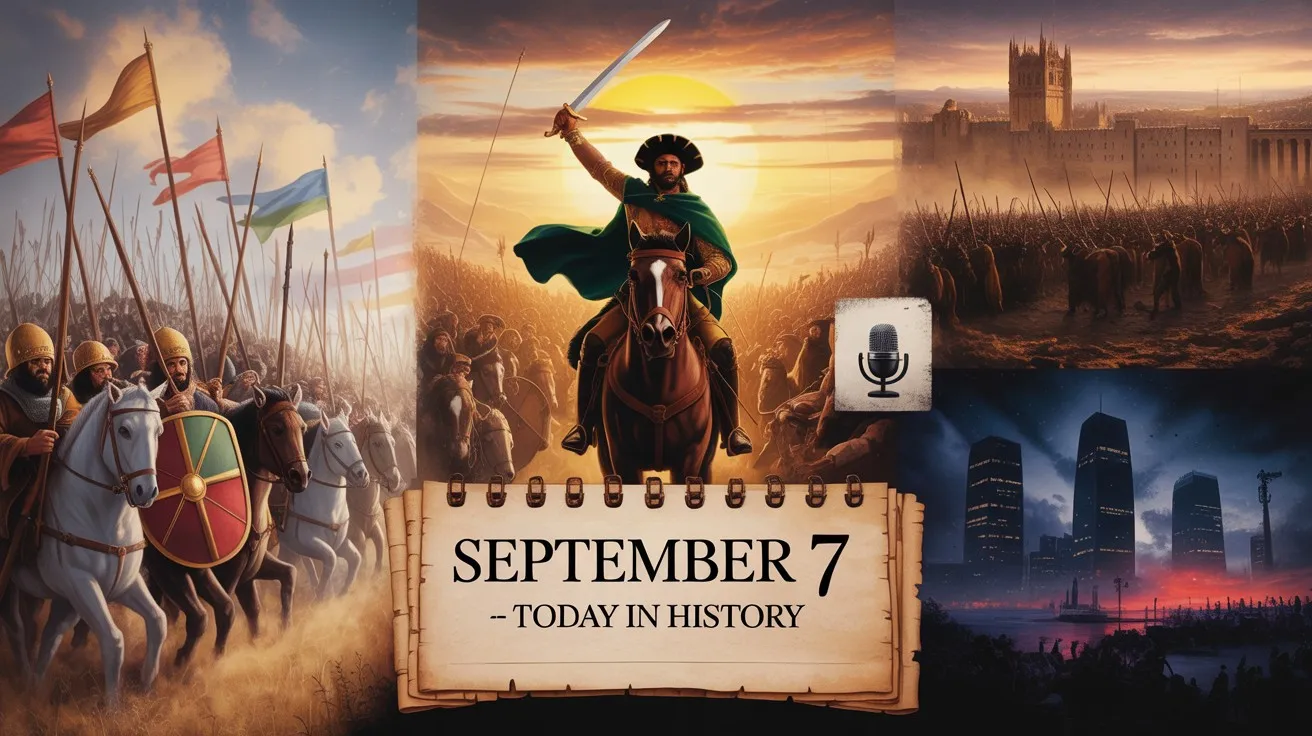
Today in History — September 7 brings battles and births, scientific firsts and media milestones, independence declarations and wrenching public moments. Across centuries, the date links fiery sieges and decisive naval actions to modern media events and political turnovers.
Major Events on September 7
1191 — Battle of Arsuf: Richard the Lionheart vs. Saladin
At Arsuf, Richard I’s crusader forces faced Saladin’s army in a fierce coastal battle that tested both strategy and morale. The fight demonstrated Richard’s ability to hold ordered formations under repeated mounted attacks and to seize a tactical opportunity when it presented itself.
Though not a war-ending victory, Arsuf secured the crusader position along the Levantine coast and boosted Frankish confidence. The battle is remembered for its combination of leadership, discipline, and the brutal chaos of medieval warfare.
1812 — Battle of Borodino: Napoleon’s costly clash near Moscow
Borodino was among the bloodiest single-day battles of the Napoleonic Wars, where French and Russian forces collided on the approaches to Moscow. The engagement produced massive casualties on both sides and left the field contested, allowing Napoleon to march on Moscow but without a decisive strategic gain.
Borodino exposed the limits of grand imperial campaigns when logistics, attrition, and local resistance combine against an invading army. The battle’s human cost and ambiguous result foreshadowed the catastrophic Russian campaign that followed.
1860 — Garibaldi enters Naples and the unification surge in Italy
Giuseppe Garibaldi’s entry into Naples on September 7, 1860, signaled the collapse of Bourbon authority in southern Italy and accelerated Italian unification. Garibaldi’s campaign, a mix of popular uprising and daring military maneuver, turned regional revolt into political reality by placing the south under new governance.
His action opened the way for the eventual consolidation of the Kingdom of Italy under the Savoy monarchy. The event remains central to narratives of 19th-century nationalism and revolutionary leadership.
1901 — Boxer Protocol signed, ending the Boxer Rebellion’s formal crisis
The Boxer Protocol, signed in September 1901, concluded the major diplomatic settlement after the anti-foreign Boxer uprising in China. The agreement imposed indemnities, foreign troop deployments, and legal consequences that reshaped Sino-foreign relations for years.
For China, the protocol meant humiliation and a forced recalibration of diplomacy and reform; for foreign powers, it enshrined new privileges and security arrangements. The settlement highlighted how insurrection, international coalition, and treaty-making can combine to reorder the regional order.
1939 — Birth of Stanislav Petrov (later credited with a Cold War near-miss)
Stanislav Petrov was born on this date; decades later, he would become known for a 1983 incident in which his judgment prevented a mistaken Soviet retaliation during a false missile warning. Petrov’s later actions underscored how individual discretion and calm can avert catastrophe within automated or high-pressure military systems.
His life links a simple birth date to a story about human judgment inside dangerous technological systems. The anecdote remains a studied example in discussions of early-warning systems and ethical responsibility.
1940 — The Blitz begins: London under sustained bombing
On September 7, 1940, the Luftwaffe launched a concentrated bombing campaign against London, inaugurating the period known as the Blitz. The raids targeted both infrastructure and civilian areas, reshaping British wartime society with nightly blackouts, shelters, and a resolute civilian morale.
The bombing’s physical destruction was matched by its cultural impact, forging narratives of endurance and collective sacrifice that lasted well beyond the war. The Blitz also accelerated air-defense technologies and civil-preparedness planning in modern cities.
1963 — Pro Football Hall of Fame opens in Canton, Ohio
The Pro Football Hall of Fame opened its doors on September 7, 1963, celebrating the sport’s early stars and institutionalizing American football’s growing cultural place. The museum provided a formal locus for memory, legend, and fan pilgrimage—helping turn athletic achievement into accessible public heritage.
It’s first-class honored figures whose contributions defined the game as it moved into the television age. The Hall of Fame also reflects how sport becomes woven into national identity and ritual.
1979 — ESPN launches, changing sports media forever
On September 7, 1979, a cable channel called ESPN began broadcasting, offering round-the-clock sports coverage that transformed how audiences consumed athletic events. The network’s continuous programming, niche sports coverage, and innovative production techniques reshaped sports as a 24/7 media commodity.
ESPN’s rise accelerated the commercialization of sports, expanded media careers, and altered the economics of leagues and broadcasters. The network’s launch marks a clear pivot in the relationship between sport, television, and mass culture.
1986 — Desmond Tutu becomes head of the Anglican Church in South Africa
On this date Desmond Tutu was elected the first black Archbishop of Cape Town and head of the Church of the Province of Southern Africa, a landmark in both religious and anti-apartheid history. Tutu used his moral authority to challenge racial oppression and to keep international attention on South Africa’s injustices. His leadership combined pastoral care, prophetic critique, and political engagement in ways that contributed to the broader struggle for change. The appointment underscored how religious institutions can be pivotal in social movements.
1988 — Abdul Ahad Mohmand returns to Earth as Afghanistan’s first cosmonaut
Abdul Ahad Mohmand returned to Earth in September 1988 after a mission aboard the Soviet space station Mir, becoming the first Afghan to travel into space. His flight symbolized both Cold War-era cooperation in human spaceflight and the way smaller nations could enter the space age through partnership. Mohmand’s mission provided a rare uplifting moment for Afghanistan amid later decades of turmoil. The flight shows how individual space missions can carry broad symbolic weight for nations.
1996 — Tupac Shakur was shot in Las Vegas, beginning a final week of events
On September 7, 1996, Tupac Shakur was shot in Las Vegas in an attack that would lead to his death six days later and reverberate through music, culture, and debates about violence. Tupac’s shooting highlighted the lethal intersection of celebrity, gang conflict, and media spectacle in the 1990s.
The aftermath crystallized tensions in hip-hop culture and intensified conversations about responsibility, community, and law enforcement. His death remains a defining, tragic chapter in contemporary musical history.
2003 — Taipei demonstration for Taiwanese identity
On September 7, 2003, tens of thousands rallied in Taipei demanding the island adopt the name “Taiwan” and assert a distinct international identity. The protests reflected long-standing tensions about sovereignty, identity, and the legacy of 20th-century Chinese politics on the island.
The demonstrations were civic in scale and signaled the strength of grassroots political mobilization within Taiwan’s democratic system. They also underscored the fragile and contested nature of identity politics in East Asia.
2014 — Bryan brothers capture 100th World Tour doubles title at the US Open
On September 7, 2014, Bob and Mike Bryan won a record-setting 100th ATP World Tour doubles title with a U.S. Open victory that celebrated longevity, teamwork, and elite consistency. Their milestone reinforced the significance of partnership and specialization in doubles tennis, and it offered a narrative of sustained excellence in an era of rapidly changing sports science.
The Bryans’ achievement drew attention to doubles as a distinct discipline with its own stars and legacies. Their record remains a high-water mark for professional doubles careers.
Notable Births on September 7
- 1533 — Elizabeth I: Future queen of England whose reign defined the Elizabethan Age.
- 1707 — Georges-Louis Leclerc, Comte de Buffon: French naturalist and encyclopedic writer on natural history.
- 1829 — August Kekulé von Stradonitz: German chemist pivotal to structural theory in organic chemistry.
- 1855 — William Friese-Greene: British motion-picture pioneer and inventor.
- 1860 — Grandma Moses (Anna Robertson): American folk painter celebrated for rural scenes.
- 1867 — J. P. Morgan, Jr.: American financier who led the Morgan banking legacy.
- 1908 — Michael DeBakey: Cardiovascular surgeon and pioneer in heart surgery techniques.
- 1909 — Elia Kazan: Influential director in American theater and film.
- 1912 — David Packard: Co-founder of Hewlett-Packard and technology industry leader.
- 1914 — James A. Van Allen: Physicist who discovered the Earth’s radiation belts.
- 1917 — Jacob Lawrence: Painter known for vivid series on Black life and history.
- 1923 — Louise Suggs: Golfer and co-founder of the LPGA.
- 1925 — Laura Ashley: Designer known for Victorian-inspired fabrics and prints.
- 1930 — Sonny Rollins: Jazz tenor saxophonist celebrated for improvisation.
- 1930 — Baudouin I: King of the Belgians from 1951 to 1993.
- 1936 — Buddy Holly: Rock-and-roll pioneer whose brief career was hugely influential.
- 1943 — Beverley McLachlin: First female Chief Justice of Canada.
- 1955 — Efim Zelmanov: Mathematician and Fields Medal recipient.
- 1959 — Drew Weissman: Immunologist whose RNA research enabled modern mRNA therapeutics.
- 1971 — Shane Mosley: World-class boxer and multi-division champion.
Notable Deaths on September 7
- 1151 — Geoffrey IV: Count of Anjou and ancestor of Plantagenet line.
- 1559 — Robert I Estienne: French scholar-printer and influential typographer.
- 1809 — Rama I: Founder of the Chakri dynasty and king of Siam (Thailand).
- 1892 — John Greenleaf Whittier: American poet and abolitionist.
- 1907 — Sully Prudhomme: French poet and Nobel laureate.
- 1910 — William Holman Hunt: British Pre-Raphaelite painter.
- 1922 — William Stewart Halsted: Surgical pioneer at Johns Hopkins.
- 1949 — José Clemente Orozco: Mexican muralist and influential fresco painter.
- 1949 — Elton Mayo: Psychologist and foundational figure in industrial sociology.
- 1951 — John French Sloan: American painter and illustrator of urban life.
- 1954 — Pop Warner: Early American football innovator and coach.
- 1956 — Otto Schmidt: Soviet scientist, mathematician and Arctic explorer.
- 1962 — Morris Louis: Abstract painter of the New York School.
- 1967 — Rex Stewart: Jazz cornetist associated with Duke Ellington.
- 1978 — Keith Moon: Drummer for The Who, known for explosive style.
- 1990 — A. J. P. Taylor: British historian and prominent broadcaster.
- 1997 — Mobutu Sese Seko: Long-time ruler of Zaire (DR Congo).
- 2002 — Uziel Gal: Designer of the Uzi submachine gun and Israeli army officer.
- 2003 — Warren Zevon: Singer-songwriter known for literate, sardonic rock songs.
- 2018 — Mac Miller: Rapper, producer, and songwriter.
- 2021 — Jean-Paul Belmondo: French New Wave actor and cultural icon.
Observances & Institutional Dates
- Brazil Independence Day (1822) — Brazil’s declaration of independence is widely commemorated in September (notably celebrated on September 7).
- The Blitz anniversary (1940) — Marked in the histories of Britain’s wartime experience.
- Pro Football Hall of Fame opening (1963) — A cultural institution for American football.
- ESPN launch (1979) — A milestone in sports media and cable television.
- National and civic commemorations — Various countries and communities mark related anniversaries with ceremonies and remembrances on or near this date.
Final Thoughts on Today in History: September 7
September 7 threads military clashes, nation-building moments, scientific milestones, and cultural firsts into a single calendar day. The entries on this date remind us that history mixes sudden violence with slow institutional change, and public spectacle with private achievement. Remembering these moments helps illuminate how past decisions, inventions, and performances shape present institutions and attitudes.
Read also other days:
September 6 In History
September 5 In History
September 4 In History
FAQs About September 7 (short answers)
What is the history today about?
September 7 is a day of military clashes, nation-making, and cultural milestones — from Arsuf and Borodino to the Blitz, Brazil’s independence, and modern media and music moments.
Did the Battle of Arsuf happen on September 7, 1191?
Yes — the battle between Richard the Lionheart’s forces and Saladin’s army occurred on September 7, 1191.
Was the Battle of Borodino fought on September 7, 1812?
Yes — Borodino took place on September 7, 1812, and was one of the bloodiest encounters of Napoleon’s Russian campaign.
Did the Blitz begin on September 7, 1940?
Yes — sustained bombing of London by the Luftwaffe intensified beginning on September 7, 1940, marking the start of the Blitz.
Was Tupac Shakur shot on September 7, 1996?
Yes — Tupac was shot in Las Vegas on September 7, 1996; he died from his injuries six days later.