📅 Quick Facts — July 16 in History
| 📌 Category | 📖 Event / Detail |
|---|---|
| 🌟 Most Significant Event | Apollo 11 launches from Kennedy Space Center, carrying Neil Armstrong, Buzz Aldrin, and Michael Collins on the historic first lunar landing mission (1969) |
| 🏆 Top 10 Key Events | • The Islamic Hijrah (migration) begins as Prophet Muhammad and his followers journey from Mecca to Medina, marking year one of the Islamic calendar (622) • Papal legates place a bull of excommunication on the altar of Hagia Sophia, catalyzing the East-West Schism that divided Eastern Orthodoxy and Western Catholicism (1054) • Christian allied forces score a decisive victory against the Almohad Caliphate at the Battle of Las Navas de Tolosa, a major turning point in the Spanish Reconquista (1212) • Stockholms Banco issues Europe’s first official paper banknotes (1661) • The District of Columbia is established along the Potomac River as the permanent seat of the United States government via the Residence Act (1790) • Union forces under General Irvin McDowell begin their advance from Washington, D.C., leading into the first major land campaign of the American Civil War (1861) • The world’s first operational parking meter, the Park-O-Meter No. 1, is installed in Oklahoma City (1935) • The United States successfully detonates the world’s first nuclear device at the Trinity test site in the New Mexico desert (1945) • The tragic Vel’ d’Hiv Roundup begins in Paris, where French police arrest over 13,000 Jewish residents under Nazi orders (1942) • John F. Kennedy Jr., his wife Carolyn Bessette, and her sister Lauren Bessette perish in a tragic plane crash off the coast of Martha’s Vineyard (1999) |
| ⚔️ Key Battles | Battle of Spercheios (997), Battle of Las Navas de Tolosa (1212), Battle of Penghu (1683), Battle of Stony Point (1779), Prelude to the First Battle of Bull Run (1861), Battle of Ras al-Ayn (2013) |
| 👤 Key Figures | Neil Armstrong (astronaut), Saddam Hussein (assumed presidency of Iraq on this day in 1979), J. D. Salinger (published “The Catcher in the Rye” on this day in 1951), John F. Kennedy Jr. |
| 🌍 Observances | Holocaust Memorial Day / Vel’ d’Hiv Commemoration (France), Engineer’s Day (Honduras) |
Story of the Day: The Dawn of the Atomic Age
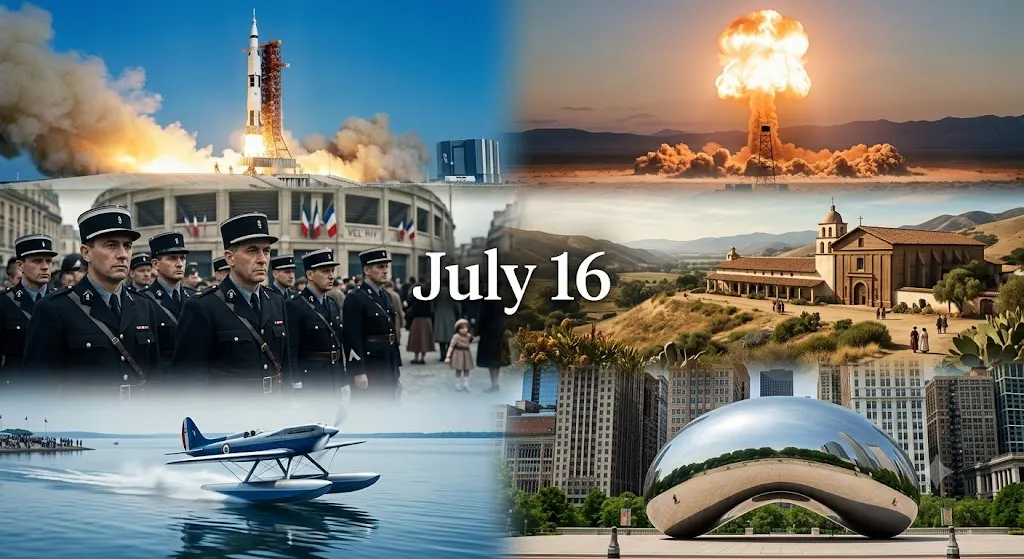
A blinding flash brighter than a dozen suns ripped through the dark desert sky near Alamogordo, New Mexico, at precisely 5:29 a.m. on July 16, 1945. Scientists and military personnel lay flat on the ground, shielding their eyes as the world’s first plutonium-based nuclear weapon detonated with the force of 21 kilotons of TNT. The extreme heat vaporized the steel tower holding the bomb and turned the desert sand into green glass. Watching the colossal mushroom cloud rise into the atmosphere, lead physicist J. Robert Oppenheimer silently recalled words from the Hindu scripture, the Bhagavad Gita: “Now I am become Death, the destroyer of worlds.”
Important Events That Happened On July 16 In History
622 – The Hijrah of Muhammad Begins
Prophet Muhammad slipped out of his home in Mecca under the cover of night, escaping an assassination plot to begin a grueling 200-mile journey to Medina. This migration, known as the Hijrah, united fractured local tribes and established the first cohesive Islamic community. The journey marked such a monumental turning point for the faith that Muslim scholars later designated this exact year and date as the official starting point of the Islamic calendar. Centuries later, this migration remains the spiritual anchor for the worldwide Islamic community’s calculation of time.
997 – Battle of Spercheios
Byzantine general Nikephoros Ouranos led his troops in a stealthy, midnight crossing of the flooded Spercheios River in Greece to catch the sleeping Bulgarian army completely off guard. Tsar Samuel and his Bulgarian soldiers, confident that the swollen river protected their camp, woke up to a chaotic slaughter. The surprise rout left thousands of Bulgarian soldiers dead and forced the wounded Tsar to flee for his life by hiding among the corpses. This decisive victory broke the back of the Bulgarian campaign and reestablished Byzantine dominance in the region for decades.
1054 – The East–West Schism Formally Begins
Three Roman legates marched into the majestic Hagia Sophia in Constantinople during Saturday afternoon liturgy and slammed a formal decree of excommunication onto the main altar. Patriarch Michael I Cerularius refused to submit to Rome’s authority, immediately issuing his own counter-excommunication against the papal messengers. This dramatic, illegal showdown shattered the fragile unity between western Latin theology and eastern Greek tradition. The bitter divide created the Roman Catholic and Eastern Orthodox churches, a profound religious split that remains completely unhealed to this day.
1212 – Battle of Las Navas de Tolosa
King Alfonso VIII of Castile stood alongside allied Christian kings on the steep slopes of the Sierra Morena, facing the massive forces of the Muslim Almohad Caliphate. Armed with a papal crusading decree, the united Christian knights charged down the mountainside, smashing through the Caliph’s defensive lines in a brutal, bloody clash. The crushing defeat broke the military dominance of the Almohads in southern Spain and sent their empire into a rapid, terminal tailspin. This clash shifted the balance of power permanently, accelerating the Christian conquest of the Iberian Peninsula.
1228 – Saint Francis of Assisi is Canonized
Pope Gregory IX arrived in the hillside town of Assisi and officially declared the beloved friar Francis a saint of the Catholic Church, just two years after the holy man’s death. Francis had revolutionized medieval Christianity by abandoning his family’s wealth to live in absolute poverty and preach peace to all creatures. The rapid canonization sparked the construction of the magnificent Basilica of San Francesco to house his body and welcome millions of pilgrims. His legacy of radical humility and environmental care continues to inspire global movements of social justice today.
1232 – Muhammad ibn Yusuf Rises to Power
Rebelling against local regional governors, the small Spanish town of Arjona declared its independence and proudly proclaimed native warrior Muhammad ibn Yusuf as its sovereign ruler. This sudden localized revolt marked the very first taste of political power for the ambitious soldier. He leveraged this initial foothold to expand his territory and eventually found the legendary Nasrid Dynasty of Granada, the builders of the breathtaking Alhambra palace. His state survived for over two hundred and fifty years as the absolute final bastion of Muslim rule in Spain.
1251 – Saint Simon Stock’s Vision of the Scapular
Carmelite priest Simon Stock knelt in deep prayer at his monastery in Kent, England, during a period of intense persecution, begging for a sign of protection for his struggling religious order. Traditional Catholic belief holds that the Virgin Mary appeared to him in a brilliant light, presenting the brown woolen scapular as a physical promise of salvation. Though modern historians cast doubt on the physical reality of the event, the vision quickly transformed Carmelite identity and popular Catholic devotion. Millions of believers globally still wear the brown scapular today as an active shield of personal faith.
1377 – King Richard II of England is Crowned
Ten-year-old Richard of Bordeaux sat upon the Coronation Chair at Westminster Abbey, weeping from sheer exhaustion as the heavy crown of England was placed onto his young head. The lavish, theatrical ceremony was designed to project absolute strength during a time of exhausting foreign wars and deep domestic unrest. Richard inherited a kingdom fractured by plague and financial ruin, leaving him heavily reliant on ambitious, scheming uncles who sought to control the throne. His troubled, turbulent reign eventually ended in deposition, sparking the brutal dynastic civil wars known as the Wars of the Roses.
1536 – Jacques Cartier Returns to France
French navigator Jacques Cartier sailed his battered ships back into the harbor of St. Malo, eager to report his latest findings in the northern wilderness to King Francis I. During his second voyage, Cartier had navigated the St. Lawrence River, claiming the native settlements of Stadacona and Hochelaga for the French crown. Though he failed to find the mythical gold-filled kingdom of Saguenay, his detailed maps laid the geographical foundation for French colonial claims. His historic expedition effectively placed the vast territory of modern-day Canada on the European map.
1661 – Europe’s First Banknotes are Issued
Stockholms Banco founder Johan Palmstruch began handing out printed paper slips of equal value to Swedish merchants, replacing the incredibly heavy copper coins previously used for trade. This revolutionary experiment solved the physical nightmare of hauling wagonloads of metal across Sweden to pay simple debts. The initial convenience quickly turned into a financial disaster when the bank printed far more paper notes than it had actual silver to back. The bank collapsed in ruin, but Palmstruch’s radical idea fundamentally changed the nature of global economics by inventing modern paper currency.
1683 – Battle of Penghu
Qing Dynasty admiral Shi Lang launched a massive naval assault against the Kingdom of Tungning, clashing in a ferocious exchange of cannon fire near the Pescadores Islands. The Qing fleet utilized superior numbers and favorable winds to surround, burn, and systematically destroy over one hundred rebel warships. The total destruction of the Tungning navy left the island of Taiwan completely defenseless against the mainland forces. This decisive battle forced the surrender of the rebel regime, bringing Taiwan under the direct political control of the Chinese empire for the first time.
1769 – San Diego is Founded
Spanish Franciscan friar Junípero Serra raised a wooden cross on a dusty hill overlooking the Pacific, dedicating Mission San Diego de Alcalá as Spain’s first permanent foothold in Alta California. This isolated outpost was designed to convert the local Kumeyaay people to Catholicism and secure the coast against rival Russian empires. The mission faced immediate resistance, crop failures, and devastating physical attacks, but the settlers refused to abandon the strategic location. This tiny, vulnerable Spanish mission eventually evolved over two centuries into the thriving, modern metropolis of San Diego.
1779 – Battle of Stony Point
American Brigadier General Anthony Wayne led a handpicked force of Continental light infantry through knee-deep swamps in pitch darkness, ordering them to keep their muskets completely unloaded. Using only the silent, terrifying precision of fixed bayonets, the American soldiers scaled the steep cliffs of Stony Point and overwhelmed the sleeping British garrison in just twenty minutes. The daring, midnight raid boosted colonial morale after a long series of stinging military defeats and proved the Continental Army could match British regulars in close-quarters combat.
1790 – Washington, D.C. is Established
President George Washington signed the Residence Act into law, officially designating a patch of swampy land along the Potomac River as the permanent capital of the United States. This historic compromise between Alexander Hamilton and Thomas Jefferson settled a bitter geographical dispute by moving the federal government to the South in exchange for federal assumption of Northern war debts. French engineer Pierre L’Enfant was quickly commissioned to design a grand city of wide avenues and monumental public spaces. The newly created district became the permanent laboratory for American democracy.
1809 – La Paz Declares Independence
Pedro Domingo Murillo led a daring armed uprising against the Spanish authorities in the high-altitude city of La Paz, quickly forming the Junta Tuitiva to govern the territory. This bold rebellion was the very first self-governing administration to openly defy the Spanish Crown in South America. Murillo famously proclaimed that the revolution had ignited a fire that no tyrant could ever hope to extinguish. Although Spanish royalist troops brutally crushed the uprising and executed Murillo within months, his defiant stand sparked the continent-wide wars of independence.
1849 – The Claretian Missionaries are Founded
Spanish priest Antonio María Claret gathered five young, dedicated clergymen in a small seminary room in Vic, Spain, to form a brand new religious congregation focused on missionary work. Operating on a shoestring budget, these men committed themselves to living simply and preaching the Catholic faith to impoverished rural communities. The order expanded rapidly, sending missionaries across the globe to build schools, hospitals, and churches in neglected regions. Today, thousands of Claretian priests continue Claret’s original mission of active community service in dozens of countries.
1858 – The Last Apparition at Lourdes
Fourteen-year-old peasant girl Bernadette Soubirous knelt in deep silence on the grassy banks of the Gave River, staring across the water at the rocky grotto of Massabielle. Because local police had barricaded the grotto to prevent crowds from gathering, Bernadette had to watch the final vision of the Virgin Mary from a distance. She later remarked that the beautiful lady appeared more radiant and comforting than ever before, signaling a quiet end to the historic encounters. The remote grotto quickly transformed into one of the most visited Catholic pilgrimage sites on Earth.
1861 – Union Troops March Toward Bull Run
General Irvin McDowell led a massive, inexperienced army of 35,000 Union soldiers out of Washington, D.C., marching slowly toward the Confederate rail junction at Manassas, Virginia. President Abraham Lincoln had ordered the advance, hoping a swift, decisive victory would crush the rebellion in a single blow. Cheering crowds and curious politicians carrying picnic baskets followed the green troops, expecting a festive, easy triumph. The march ended days later in the bloody chaos of the First Battle of Bull Run, shattering any lingering illusions of a short, bloodless war.
1862 – David Farragut Becomes First U.S. Navy Admiral
The United States Congress officially created the rank of rear admiral, immediately promoting naval officer David Farragut to the position to honor his daring capture of New Orleans. Prior to this historic appointment, the young nation had avoided the title of “admiral” because it sounded far too much like European royalty. Farragut’s aggressive leadership on the Mississippi River proved that a modernized Union Navy required a clear, high-ranking chain of command. His historic promotion paved the way for the professionalization of American naval leadership during the Civil War.
1877 – Imperial Russian Army Captures Nikopol
Grand Duke Nicholas directed Russian forces in a fierce artillery bombardment against the Ottoman fortress of Nikopol, systematically pounding the city’s stone defenses into rubble. The Russian soldiers then launched a determined infantry assault, scaling the damaged walls and forcing the heavily outnumbered Ottoman garrison to surrender. The capture of this strategic Danubian stronghold opened up critical supply routes for the Russian army’s push into the Balkan Peninsula. This swift military victory crippled Ottoman defensive plans and shifted the momentum of the Russo-Turkish War.
1909 – Mohammad Ali Shah Qajar is Deposed
Armed nationalist rebels marched into Tehran, surrounding the royal palace and forcing the highly unpopular Mohammad Ali Shah Qajar to abdicate his throne. The Shah had spent years trying to dismantle the country’s progressive constitution, even using Russian-led troops to bomb his own parliament building. Defeated and humiliated, he took refuge in the Russian legation before being forced into permanent exile in Europe. His young son, Ahmad Shah, was quickly placed on the throne under a reformed constitutional government, marking a major triumph for Persian democracy.
1910 – First Flight of the Duigan Biplane
John Robertson Duigan climbed into the fragile seat of his homemade pusher biplane, took a deep breath, and rumbled across a dusty sheep paddock in Victoria, Australia. The aircraft, built entirely by Duigan and his brother using local timber and a small engine, successfully lifted into the air for a brief, historic flight. This daring, noisy exhibition marked the very first flight of an entirely Australian-built aircraft. Their pioneering achievement proved that remote nations could develop advanced aviation technology completely independent of European or American manufacturers.
1915 – Henry James Becomes a British Citizen
Acclaimed American author Henry James stood before a British official, took a solemn oath of allegiance, and officially renounced his American citizenship. James took this drastic step to express his deep, public frustration with the United States’ refusal to enter the First World War. He felt a moral obligation to stand in solid, active solidarity with his beloved adoptive home of Britain during its darkest hour. The high-profile naturalization of one of the world’s greatest living novelists sent a powerful, symbolic message across the Atlantic.
1915 – The Order of the Arrow is Founded
Boy Scout camp directors E. Urner Goodman and Carroll A. Edson gathered a small group of young scouts around a roaring campfire on Treasure Island in the Delaware River. They conducted a quiet, solemn ceremony based on local Native American lore, inducting the boys into a new honor society dedicated to quiet service and brotherhood. This secret, elite society was designed to recognize those scouts who truly lived out the values of their oath in daily life. The organization eventually grew into a massive national program, shaping generations of American youth leaders.
1916 – Max Reger’s Hebbel Requiem Premieres
Conductor Philipp Wolfrum raised his baton in a solemn German concert hall, leading a haunting performance of the late Max Reger’s Hebbel Requiem before a quiet, grieving audience. The concert was held as a memorial for Reger, who had died suddenly of a heart attack just two months prior. The powerful choral piece, which set Friedrich Hebbel’s poetry to complex, emotional music, resonated deeply with a public devastated by the horrors of the ongoing world war. The performance solidified Reger’s reputation as a master of late-Romantic German composition.
1927 – Augusto César Sandino Attacks Ocotal
Nicaraguan rebel leader Augusto César Sandino led hundreds of guerrilla fighters in a surprise, pre-dawn assault on a garrison of U.S. Marines and local national guardsmen in the village of Ocotal. The Marines held their ground inside the fortified town hall, resisting waves of attacks for several hours. The battle turned dramatically when a squadron of American biplanes arrived, launching one of the first organized dive-bombing attacks in aviation history against the exposed rebels. The devastating air strike forced Sandino’s troops to retreat into the dense surrounding jungle.
1931 – Emperor Haile Selassie Signs Ethiopia’s First Constitution
Emperor Haile Selassie sat in his imperial palace in Addis Ababa, signing a historic document that established Ethiopia’s first written constitution. This administrative reform was designed to project a modern image of the nation to the world while slowly centralizing the Emperor’s power over local warlords. The document created a two-chamber parliament, but kept all absolute authority firmly in the hands of the emperor himself. Despite its limitations, the constitution represented a major step in transforming the ancient empire into a modern nation-state.
1935 – The World’s First Parking Meter is Installed
City workers in Oklahoma City bolted a small, mechanical metal box called the “Park-O-Meter No. 1” to the sidewalk of a busy downtown street. Invented by Carl Magee, the coin-operated device was designed to stop local employees from hogging parking spots all day, which was choking local retail businesses. Angry drivers initially denounced the machine as an unconstitutional tax on their vehicles, but store owners quickly praised the rapid turnover of customers. The simple, coin-guzzling invention spread to cities worldwide, permanently changing urban traffic management.
1941 – Joe DiMaggio Hits Safely in 56th Straight Game
New York Yankees star Joe DiMaggio stepped up to the plate at Cleveland Stadium and lashed a clean single, extending his incredible hitting streak to fifty-six consecutive games. His calm, consistent dominance at the plate provided a welcome, daily distraction for millions of Americans anxious about the worsening war in Europe. The historic streak finally ended the following night, but the spectacular record of fifty-six games remains completely untouched in Major League Baseball history. DiMaggio’s legendary summer run cemented his status as a permanent icon of American sports.
1942 – The Vel’ d’Hiv Jewish Roundup in Paris
French police officers banged on the doors of thousands of Parisian homes in the pre-dawn darkness, arresting 13,152 Jewish men, women, and children under direct orders from the Nazi-collaborating Vichy government. The families were packed into the stifling, unsanitary Vélodrome d’Hiver sports arena for days with virtually no food, water, or medical care. From this sweltering bicycle stadium, the victims were systematically shipped to transit camps before being sent to their deaths at Auschwitz. This horrific mass arrest remains one of the darkest, most painful chapters in modern French history.
1945 – USS Indianapolis Departs with Atomic Secrets
The heavy cruiser USS Indianapolis slipped out of the harbor of San Francisco, sailing under strict, top-secret orders with a mysterious, heavy cargo box bolted to its deck. Inside the heavily guarded crate were key components and enriched uranium for “Little Boy,” the atomic bomb destined for Hiroshima. The crew of the ship had absolutely no idea what they were carrying as they raced toward the island of Tinian at top speed. Just days after successfully delivering this devastating cargo, the ship was tragically torpedoed by a Japanese submarine, leading to a horrifying disaster at sea.
1948 – Israeli Forces Capture Nazareth
Israeli soldiers marched into the historic town of Nazareth during the Arab-Israeli War, facing only minor resistance before local leaders signed an official agreement of surrender. Canadian-born Israeli commander Ben Dunkelman refused to carry out orders to forcibly expel the local Arab population, choosing instead to protect the holy city’s residents. His defiance ensured that Nazareth remained a major center of Arab culture and Christian heritage within the newly formed state. The quiet capitulation spared the ancient town from the physical destruction suffered by surrounding villages.
1948 – The First Commercial Aircraft Hijacking
Four armed bandits boarded the Miss Macao seaplane in Macau, planning to rob the wealthy passengers and hold them for ransom once the aircraft was airborne. Minutes after takeoff, the pilot desperately fought back against the hijackers, causing a chaotic struggle inside the cramped cockpit. During the frantic melee, the hijackers shot the pilot, causing the plane to lose control and crash violently into the Pearl River Delta. Of the twenty-seven people on board, only one passenger survived the plunge, marking the tragic dawn of modern aerial piracy.
1950 – The Chaplain-Medic Massacre
North Korean soldiers surrounded a makeshift American medical outpost on a grassy hill during the opening weeks of the Korean War, capturing dozens of wounded soldiers and a military chaplain. Despite the clear markings of the Red Cross, the captors systematically executed thirty-one unarmed, injured American soldiers as they lay in their stretchers. Father Herman Felhoelter was shot in the back while praying over the dying men, refusing to abandon his flock. This brutal war crime shocked the American public and highlighted the savage nature of the conflict.
1950 – Uruguay Wins the World Cup
Over 173,000 stunned Brazilian fans sat in near-silence inside Rio’s massive Maracanã Stadium as Uruguayan winger Alcides Ghiggia slipped a low shot past the keeper to secure a shocking 2-1 victory. Brazil had only needed a simple draw to claim their very first World Cup title, and local newspapers had already printed celebratory editions before kickoff. The unexpected defeat, forever known as the Maracanazo, plunged the entire nation of Brazil into a state of deep, collective mourning. Uruguay quietly celebrated their second world title, pulling off one of the greatest upsets in sports history.
1951 – King Leopold III of Belgium Abdicates
King Leopold III signed an official document of abdication in Brussels, passing the crown to his twenty-year-old son, Baudouin, in a desperate bid to end nationwide political chaos. Leopold’s controversial surrender to Nazi Germany in 1940 and his long post-war exile had deeply divided the Belgian public, sparking violent strikes and near-civil war. Realizing that his continued presence on the throne threatened to tear the country apart, the weary king stepped down to preserve the monarchy. His quiet departure allowed his young son to heal the fractured nation.
1951 – The Catcher in the Rye is Published
Little, Brown and Company released a slim, unassuming novel by reclusive author J. D. Salinger, introducing the world to the cynical, red-hunting-hat-wearing teenager Holden Caulfield. The book’s raw, authentic depiction of teenage angst, alienation, and profanity resonated instantly with young readers who felt suffocated by post-war conformity. While many school boards and libraries quickly banned the controversial novel, it became an overnight literary phenomenon. Salinger’s masterpiece permanently redefined the coming-of-age genre and remains a staple of high school English classes worldwide.
1956 – Ringling Bros. Circus Closes the Big Tent
Ringling Bros. and Barnum & Bailey Circus performed its final show under a traditional canvas “Big Top” in Pittsburgh, Pennsylvania, before folding the massive tents for good. Rising labor costs, bad weather, and the rapid spread of television had made maintaining the massive traveling tent city financially impossible. General manager John Ringling North announced that the circus would henceforth perform exclusively in modern, air-conditioned indoor sports arenas. The closure marked the nostalgic end of a classic era of traveling American entertainment.
1957 – KLM Flight 844 Crashes
A twin-engine Super Constellation passenger plane struggled to gain altitude shortly after taking off in pitch darkness from Biak Island, plunging violently into the sea just off the coast. Despite rapid rescue efforts by local fishermen and Dutch naval vessels, fifty-eight of the sixty-eight people on board perished in the fiery crash. Investigators later pointed to pilot spatial disorientation in the dark night sky as the most likely cause of the tragic accident. The disaster remains the deadliest aviation accident in the history of West Papua.
1965 – The Mont Blanc Tunnel Opens
French President Charles de Gaulle and Italian President Giuseppe Saragat cut a ceremonial ribbon inside the heart of the Alps, officially opening the seven-mile Mont Blanc Tunnel to public traffic. Engineers and miners had spent eight grueling years blasting through solid granite, overcoming massive rock collapses and flooding to connect the two nations. The engineering marvel slashed travel times through the mountainous border from hours of winding roads to a simple, fifteen-minute drive. This major link permanently boosted economic trade and tourism across Western Europe.
1965 – Communist Spy Phạm Ngọc Thảo is Killed
South Vietnamese security forces tracked down Colonel Phạm Ngọc Thảo to a remote Catholic monastery, shooting and killing the elusive military officer after a tense, brief pursuit. Thảo had lived a double life as a high-ranking officer in the South Vietnamese army while secretly serving as an incredibly successful spy for communist North Vietnam. He had orchestrated multiple military coups that severely destabilized the Saigon government during the height of the war. His dramatic death silenced one of the most brilliant, complex double agents of the entire conflict.
1969 – Apollo 11 Launches to the Moon
Saturn V engines roared to life with a deafening, earth-shaking rumble, lifting Apollo 11 off its Florida launchpad as millions of people watched in breathless anticipation around the world. Astronauts Neil Armstrong, Buzz Aldrin, and Michael Collins were propelled into space at speeds exceeding twenty thousand miles per hour. Their historic mission aimed to fulfill President John F. Kennedy’s bold promise of landing a man on the moon before the decade was out. The successful launch marked the dramatic, final stretch of the epic space race.
1979 – Saddam Hussein Becomes President of Iraq
Saddam Hussein forced his aging cousin, President Ahmed Hassan al-Bakr, to step down from office, officially seizing absolute control of Iraq’s government, military, and ruling Ba’ath party. Within days of taking power, Saddam staged a chilling, public purge of his political rivals, recording the event on camera to terrify any potential dissenters. He utilized Iraq’s vast oil wealth to build a massive, brutal security state and a highly advanced military machine. His rise to presidency initiated decades of devastating wars, economic ruin, and oppressive dictatorship in the region.
1983 – The Sikorsky S-61 Helicopter Disaster
A commercial helicopter carrying tourists and locals through thick fog lost its bearings and crashed violently into the cold waters of the Atlantic near the Isles of Scilly. The impact and rapid sinking of the aircraft resulted in twenty tragic fatalities, making it the worst helicopter accident in British history. A subsequent investigation revealed that pilots lacked adequate instruments to navigate through zero-visibility sea fog safely. The tragedy forced international aviation authorities to implement strict new safety standards for offshore helicopter flights.
1990 – The Luzon Earthquake Strikes the Philippines
A massive 7.7 magnitude earthquake ripped along a major fault line in the northern Philippines, shaking the ground violently for nearly a full minute. The powerful tremors collapsed high-rise hotels, shattered mountain highways, and triggered massive landslides that buried entire villages in mud and debris. The disaster killed over one thousand six hundred people and left hundreds of thousands completely homeless in devastated provinces like Benguet and Pangasinan. The catastrophic event sparked a massive international rescue effort and permanently altered the landscape of northern Luzon.
1990 – Ukraine Declares State Sovereignty
The parliament of the Ukrainian SSR voted overwhelmingly to adopt the Declaration of State Sovereignty, taking a historic step toward breaking away from the collapsing Soviet Union. The document boldly proclaimed that Ukrainian laws would now take priority over Soviet laws and asserted the nation’s right to maintain its own military and currency. This defiant declaration sparked massive, joyful celebrations in the streets of Kyiv, signaling a rapid rise in nationalist pride. The historic vote paved the way for full, official independence just one year later.
1994 – Comet Shoemaker-Levy 9 Collides with Jupiter
Astronomers worldwide watched in absolute awe as the first massive fragments of Comet Shoemaker-Levy 9 smashed into the dense atmosphere of Jupiter at 134,000 miles per hour. The violent collisions unleashed energy equivalent to millions of megatons of TNT, creating colossal, dark scars in the giant planet’s colorful cloud decks. This historic event marked the very first time humans directly observed a collision between two major solar system bodies. The spectacular impacts highlighted Jupiter’s vital role as a cosmic shield, absorbing dangerous space debris.
1999 – John F. Kennedy Jr. Dies in Plane Crash
A small Piper Saratoga aircraft piloted by John F. Kennedy Jr. spiraled out of control in thick haze, crashing violently into the dark waters off Martha’s Vineyard. The tragic accident instantly killed Kennedy, his wife, Carolyn Bessette, and her sister, Lauren, plunging the United States into deep, collective shock. Investigators later determined that Kennedy had suffered from spatial disorientation in the dark, foggy sky over the ocean. The sudden loss of the charismatic son of the late president added another heartbreaking chapter to the tragic history of the Kennedy family.
2004 – Chicago’s Millennium Park Opens
Mayor Richard M. Daley stood before a massive, cheering crowd to officially open Millennium Park, transforming an ugly, industrial rail yard into a world-class public space. The ambitious, three-square-block park featured stunning, avant-garde designs like Frank Gehry’s soaring music pavilion and Anish Kapoor’s reflective “Cloud Gate” sculpture, affectionately known as “The Bean.” Although the project suffered from years of construction delays and massive budget overruns, it quickly became a beloved civic icon. The park revolutionized urban design, attracting millions of visitors annually.
2005 – Baney Aircraft Crash in Equatorial Guinea
An aging, twin-engine Antonov An-24 passenger plane lost power shortly after taking off from Malabo, crashing violently into a dense, forested mountainside near the town of Baney. All sixty passengers and crew members on board were killed instantly in the fiery impact. A subsequent investigation revealed that the airline had been operating with terrible safety standards and outdated equipment. The tragic accident highlighted severe safety failures in regional African aviation, leading to stricter flight bans on unsafe airlines.
2007 – Niigata Earthquake Damages Nuclear Plant
A powerful 6.8 magnitude earthquake struck off the coast of Japan, shaking the Niigata prefecture violently, causing structural damage to hundreds of homes, and claiming eight lives. The intense tremors caused a small fire and minor radioactive water leaks at the massive Kashiwazaki-Kariwa nuclear power plant, the largest of its kind in the world. The incident sparked intense public panic and fierce criticism over the construction of nuclear facilities near major active fault lines. The plant was immediately shut down for extensive safety upgrades.
2009 – The Death of Teoh Beng Hock
An investigator found the lifeless body of political aide Teoh Beng Hock on a low rooftop adjacent to the Malaysian Anti-Corruption Commission offices, where he had been held for grueling overnight questioning. His mysterious death sparked instant, nationwide outrage and massive public protests against alleged government corruption and police brutality. Although authorities initially claimed the death was a suicide, a subsequent royal commission revealed intense psychological pressure had been applied during interrogation. The unresolved tragedy remains a major symbol of the fight for political reform.
2013 – Midday Meal Tragedy in India
Dozens of young children began vomiting and collapsing at their desks at a primary school in eastern India, shortly after eating a free lunch of rice and potato curry. In total, twenty-seven children died from severe chemical poisoning, while twenty-five others were rushed to local hospitals in critical condition. Investigators quickly discovered that the cooking oil had been stored in a container previously used to hold highly toxic agricultural pesticides. The horrific tragedy sparked violent protests, forcing the government to completely overhaul safety standards for school meal programs.
2013 – Battle of Ras al-Ayn Resumes
Fierce gun battles broke out along the Syrian-Turkish border as Kurdish People’s Protection Units launched a major offensive to drive Islamist rebel forces out of the strategic town of Ras al-Ayn. The intense, street-by-street fighting marked the official beginning of a major conflict between Kurdish forces and hardline Islamist groups in northern Syria. The battle displaced thousands of civilians, turning the border town into a heavily fortified war zone. The Kurdish victory in the town permanently altered the territorial map of the Syrian civil war.
2015 – Chattanooga Military Shooting
A heavily armed gunman drove up to a military recruitment center in Chattanooga, Tennessee, opening fire before driving to a nearby Navy reserve center to continue his shooting spree. The devastating assault claimed the lives of four U.S. Marines and a Navy sailor before police officers shot and killed the gunman. An FBI investigation later determined that the shooter was motivated by foreign terrorist propaganda, classifying the attack as a domestic terror incident. The tragic shooting prompted major safety upgrades at military facilities across the country.
2019 – Mumbai Building Collapse
A century-old, four-story residential building in a congested neighborhood of Mumbai suddenly crumbled into a massive pile of dust and concrete, trapping dozens of sleeping residents inside. Rescue workers and local volunteers spent days digging through the unstable wreckage with their bare hands to pull survivors from the debris. The catastrophic collapse claimed the lives of ten people and injured many others. The tragedy highlighted the extreme danger posed by thousands of decaying, illegal, or poorly maintained structures during India’s heavy monsoon season.
Travel back a day and explore our previous historical feature.
Famous People Born on July 16
| Name | Description | Date |
|---|---|---|
| Clare of Assisi | Italian nun and Catholic saint, founder of the Order of Poor Ladies | 1194 – 1253 |
| Andrea del Sarto | Italian Renaissance painter | 1486 – 1530 |
| Joshua Reynolds | English portrait painter and founder of the Royal Academy | 1723 – 1792 |
| Samuel Huntington | American Founding Father and President of the Continental Congress | 1731 – 1796 |
| Jean-Baptiste-Camille Corot | French landscape painter and leading Barbizon artist | 1796 – 1875 |
| Mary Baker Eddy | American religious leader and founder of Christian Science | 1821 – 1910 |
| Ida B. Wells | American journalist, suffragist, and civil rights activist | 1862 – 1931 |
| Roald Amundsen | Norwegian polar explorer, first to reach the South Pole | 1872 – 1928 |
| Shoeless Joe Jackson | American baseball legend | 1887 – 1951 |
| Frits Zernike | Dutch physicist and Nobel Prize winner | 1888 – 1966 |
| Trygve Lie | First Secretary-General of the United Nations | 1896 – 1968 |
| Alexander Luria | Russian neuropsychologist and physician | 1902 – 1977 |
| Orville Redenbacher | American businessman and popcorn entrepreneur | 1907 – 1995 |
| Barbara Stanwyck | American actress and Hollywood icon | 1907 – 1990 |
| Ginger Rogers | American actress, singer, and dancer | 1911 – 1995 |
| Chris Argyris | American organizational theorist and psychologist | 1923 – 2013 |
| Irwin Rose | American biologist and Nobel Prize-winning chemist | 1926 – 2015 |
| Shirley Hughes | English children’s author and illustrator | 1927 – 2022 |
| Margaret Court | Australian tennis champion | 1942 – Present |
| Rubén Blades | Panamanian singer, songwriter, actor, and politician | 1948 – Present |
| Stewart Copeland | American drummer, co-founder of The Police | 1952 – Present |
| Tony Kushner | American playwright and screenwriter | 1956 – Present |
| Michael Flatley | Irish-American dancer and creator of Riverdance | 1958 – Present |
| Phoebe Cates | American actress | 1963 – Present |
| Miguel Induráin | Spanish five-time Tour de France champion | 1964 – Present |
| Will Ferrell | American actor and comedian | 1967 – Present |
| Barry Sanders | American Football Hall of Fame running back | 1968 – Present |
| Carli Lloyd | American soccer player and two-time FIFA World Cup champion | 1982 – Present |
| Katrina Kaif | British-Indian actress and film star | 1983 – Present |
| Gareth Bale | Welsh football legend | 1989 – Present |
Famous People Who Died on July 16
| Name | Description | Date |
|---|---|---|
| Pope Innocent III | Influential Pope during the High Middle Ages | 1160 – 1216 |
| Anne of Cleves | Queen consort of England and fourth wife of Henry VIII | 1515 – 1557 |
| Mary Todd Lincoln | First Lady of the United States | 1818 – 1882 |
| Rosalía de Castro | Spanish poet and novelist | 1837 – 1885 |
| Edmond de Goncourt | French writer and founder of the Prix Goncourt | 1822 – 1896 |
| Ellen G. White | Co-founder of the Seventh-day Adventist Church | 1827 – 1915 |
| Hilaire Belloc | Anglo-French writer and historian | 1870 – 1953 |
| Albert Kesselring | German field marshal during World War II | 1881 – 1960 |
| John P. Marquand | American Pulitzer Prize-winning novelist | 1893 – 1960 |
| Harry Chapin | American singer-songwriter | 1942 – 1981 |
| Heinrich Böll | German novelist and Nobel Prize laureate | 1917 – 1985 |
| Herbert von Karajan | Austrian conductor and classical music legend | 1908 – 1989 |
| Miguel Muñoz | Spanish football player and Real Madrid manager | 1922 – 1990 |
| Robert Motherwell | American abstract expressionist painter | 1915 – 1991 |
| Buck Buchanan | American Football Hall of Fame player | 1940 – 1992 |
| Julian Schwinger | American physicist and Nobel Prize winner | 1918 – 1994 |
| Stephen Spender | English poet and essayist | 1909 – 1995 |
| John Henrik Clarke | American historian and scholar | 1915 – 1998 |
| John F. Kennedy Jr. | American lawyer, publisher, and son of President John F. Kennedy | 1960 – 1999 |
| Carolyn Bessette-Kennedy | American publicist and wife of John F. Kennedy Jr. | 1966 – 1999 |
| John Cocke | American computer scientist and Turing Award winner | 1925 – 2002 |
| Celia Cruz | Cuban-American singer known as the “Queen of Salsa” | 1925 – 2003 |
| Carol Shields | Canadian-American Pulitzer Prize-winning novelist | 1935 – 2003 |
| Jo Stafford | American traditional pop singer | 1917 – 2008 |
| Stephen Covey | American author of The 7 Habits of Highly Effective People | 1932 – 2012 |
| Johnny Winter | American blues guitarist and singer | 1944 – 2014 |
| George A. Romero | American filmmaker and creator of the modern zombie genre | 1940 – 2017 |
| John Paul Stevens | Associate Justice of the U.S. Supreme Court | 1920 – 2019 |
| Kevin Mitnick | American hacker and cybersecurity consultant | 1963 – 2023 |
| Connie Francis | American singer and actress | 1937 – 2025 |
Observances on July 16
Holocaust Memorial Day (France)
France observes a national day of remembrance on this date to honor the victims of the Vel’ d’Hiv roundup of 1942, when French police arrested over thirteen thousand Jews for deportation. The solemn observance was established to encourage citizens to confront the country’s historic collaboration with Nazi Germany. Government leaders gather at memorial sites in Paris to lay wreaths and deliver speeches, ensuring the lessons of this dark tragedy are never forgotten by future generations.
Engineer’s Day (Honduras)
Honduras celebrates the professional contributions of its engineers on this date, recognizing their vital role in building the country’s physical infrastructure, bridges, and roads. The day honors the establishment of the country’s first professional engineering association, which set high standards for technical education. Schools and professional groups host technical seminars, award ceremonies, and community projects to inspire the next generation of Honduran builders and innovators.
🚀 Frequently Asked Questions — July 16 in History
Apollo 11 launched from Cape Kennedy in Florida, carrying astronauts Neil Armstrong, Buzz Aldrin, and Michael Collins toward the moon. This historic launch marked the absolute climax of the space race between the United States and the Soviet Union. The successful departure of the Saturn V rocket paved the way for humanity’s very first steps on the lunar surface.
The launch of the Apollo 11 lunar landing mission stands as the most globally significant event of this date. By sending three humans to walk on another celestial body, the mission fundamentally transformed humanity’s relationship with space. The journey proved that scientific collaboration and human ingenuity could achieve the seemingly impossible.
Italian nun and Catholic saint Clare of Assisi, who founded the Order of Poor Ladies to live in poverty, was born on this day, as was Australian tennis champion Margaret Court, who won an unmatched twenty-four Grand Slam singles titles. Many other historically significant figures are detailed in our complete daily overview above.
The United States detonated the world’s first atomic weapon, known as the Trinity test, in the New Mexico desert in 1945. This massive explosion marked the birth of the nuclear age and changed global warfare forever. The breakthrough directly led to the atomic bombings of Japan and the start of the Cold War.
This solemn day of remembrance honors the 13,152 Jewish victims arrested by French police during the Vel’ d’Hiv roundup in Paris in 1942. The families were packed into a stifling sports stadium before being systematically sent to Nazi death camps. The day is remembered to confront historic collaboration and honor those lost in the Holocaust.
A historic, century-old residential building collapsed in a crowded neighborhood of Mumbai, India, in 2019, tragically killing ten people and trapping many others in the wreckage. The disaster highlighted the dangerous state of older structures during the heavy monsoon season. Emergency teams worked around the clock to rescue survivors from the debris.