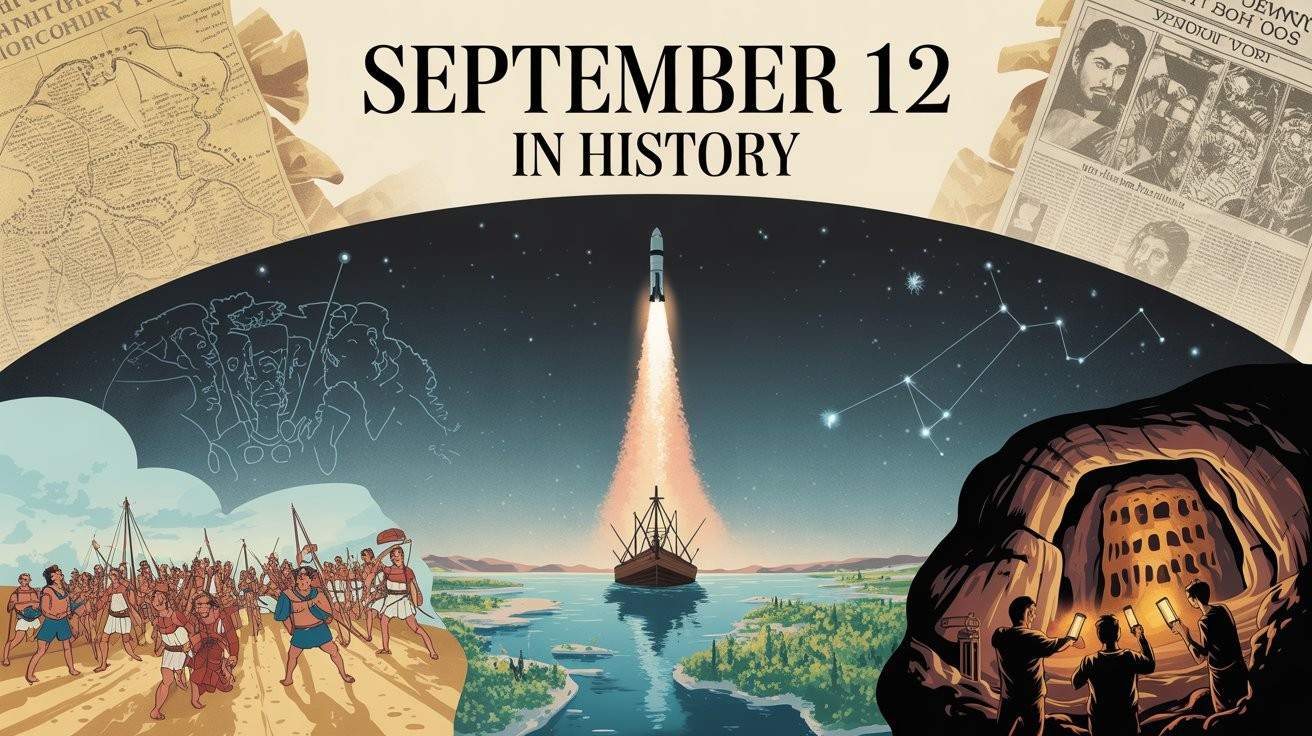
September 12 stitches together ancient battles, bold voyages, artistic discoveries, and modern political turns. In Today in History — September 12, you’ll find moments that altered maps and minds: from Marathon’s classical courage to teenagers who stumbled into Lascaux, from daring wartime raids to the first human-made visitor to the Moon.
Major Events on September 12
490 BC — Battle of Marathon (Athenian victory)
At Marathon, Athenian citizens met a Persian invasion and turned back the tide of imperial expansion, a victory that bolstered Greek confidence and civic identity. The win checked Persia’s westward ambitions and gave Athens political breathing room to develop institutions and arts that would define classical culture.
Over time, Marathon acquired mythic status — its name became shorthand for civic sacrifice and endurance. The battle’s strategic and symbolic ripples shaped how later generations told the story of Greek freedom.
1609 — Henry Hudson explores the river that bears his name
In 1609, Henry Hudson, sailing for Dutch interests, navigated into the broad tidal river that would later be called the Hudson, anchoring the waterway’s place in European maps and commerce. His voyage helped open the region to Dutch trade and settlement, leading to New Amsterdam and the beginnings of a major Atlantic port.
Hudson’s reports turned a regional waterway into a hub of colonial rivalry and mercantile imagination. That 1609 voyage is a key origin point for how the modern metropolis grew around a navigable river.
1683 — Siege of Vienna lifted (Sobieski’s relief)
A coalition led by King John III Sobieski of Poland routed Ottoman besiegers and relieved Vienna, marking a major turning point in Ottoman–European confrontations. The victory halted the immediate Ottoman push into Central Europe and shifted strategic momentum toward Habsburg-led coalitions.
Vienna’s relief became a symbol of multinational defense and coalition warfare in the early modern era. The outcome reshaped regional borders and influenced diplomatic alignments for generations.
1733 — Stanisław Leszczyński elected King of Poland
Stanisław Leszczyński’s election as king exposed the elective monarchy’s dependence on factional bargaining and foreign influence within the Polish–Lithuanian Commonwealth. His accession reflects how eighteenth-century Polish politics often hinged on external patrons and domestic magnates rather than stable dynastic succession.
The episode illustrates the Commonwealth’s political fragility in the face of European great-power competition. Stanisław’s reign, contested and short, is a window into the period’s systemic tensions.
1814 — Geneva was admitted to the Swiss Confederation
Geneva’s admission as a Swiss canton strengthened the federal confederation’s territorial and political coherence after the Napoleonic upheavals. Joining the Swiss cantons anchored Geneva’s international and commercial role while contributing to Switzerland’s increasingly stable federal order.
The inclusion illustrates how post-Napoleonic Europe reordered borders and affiliations to produce new political configurations. Geneva’s cantonhood would shape Swiss diplomacy and economic life for the 19th century onward.
1848 — Switzerland adopts a federal constitution (modern Swiss state)
A new federal constitution reorganized the confederation into a modern Swiss state, balancing cantonal autonomy with central institutions and legal frameworks. The 1848 settlement ended internal constitutional strife and set institutions that enabled Swiss neutrality, economic growth, and stable governance.
It’s a foundational moment for Swiss federalism and an early model of accommodating local diversity within a unified polity. The constitution’s effects are still visible in modern Swiss political culture.
1940 — Lascaux cave paintings discovered (Prehistoric art)
Four teenagers found a cave near Montignac whose walls contain some of the world’s most impressive Paleolithic paintings — animals, signs, and abstract marks created around 17,000 years ago. Lascaux transformed ideas about early human creativity and symbolic life, showing advanced representational skill long before recorded history.
The cave’s fragile beauty later forced debates over conservation vs. public access and spurred replica sites for visitors. Lascaux remains a cultural touchstone for questions about human imagination and the deep roots of art.
1943 — Mussolini rescued at Gran Sasso (German commando raid)
German paratroopers and commandos executed a daring glider-borne operation to free Benito Mussolini from detention, a high-profile special-forces strike with immediate propaganda value. The rescue temporarily restored Mussolini’s political relevance and underscored how agile operations could influence wider wartime politics.
It also exemplified how Germany sought to keep an ally useful even as Italy’s political order collapsed. The raid remains a textbook case in airborne special operations and wartime theatrics.
1953 — John F. Kennedy marries Jacqueline Bouvier
The wedding of John F. Kennedy and Jacqueline Bouvier combined politics and celebrity, creating a public image of youthful elegance that later became part of the “Camelot” presidency narrative.
Their marriage shaped modern expectations of presidential families and the interplay of media, style, and politics. While celebrated publicly, the union also had private complexities that biographers later explored. As a cultural moment, the wedding fed growing fascination with televised and image-driven politics.
1959 — Luna 2 impacts the Moon (first human-made object to reach the Moon)
The Soviet probe Luna 2 became the first human-made object to reach the lunar surface, marking a symbolic victory in early space exploration and the space race. The mission demonstrated that automated spacecraft could carry out bold, high-speed planetary operations and set the stage for subsequent lunar science.
Luna 2’s impact was as much geopolitical as scientific, fueling both national pride and further investment in space programs. It remains a milestone in robotic exploration of celestial bodies.
1959 — Bonanza premieres on NBC (TV milestone)
The Western drama Bonanza debuted and would become one of television’s longest-running and most-watched series, shaping American popular culture and the TV industry’s approach to serialized storytelling. Its family-centered ranch setting and sweeping outdoor visuals broadened what network television could present to mass audiences.
Bonanza helped normalize long-running series as major cultural institutions and offered a template for character-driven genre drama. The show’s reach and longevity made it a touchstone of mid-20th-century broadcast TV.
1966 — The Monkees debut on television (pop culture crossover)
The Monkees, a TV show built around a manufactured pop group, premiered and spawned real musical hits that blurred the lines between television promotion and popular music. The show’s mix of slapstick, music, and youth culture captured a specific moment in 1960s media where TV could manufacture and amplify musical stardom.
While short-lived, the series had an enduring cultural impact through songs and syndication. It illustrates how new media formats reshaped music and youth identity.
1965 — Sialkot clashes reported (Indo-Pak tensions)
During the 1965 Indo-Pak conflict, heavy fighting around Sialkot and other sectors became emblematic of the conventional warfare that marked that war. Clashes in the Sialkot sector tested armored formations and defensive tactics on both sides and highlighted how regional rivalries could escalate into broader conflicts.
The fighting contributed to the later ceasefire and diplomatic moves but left lasting military and political consequences in South Asia. The Sialkot engagements are remembered in both countries’ military histories.
1974 — Haile Selassie deposed (Ethiopia’s imperial era ends)
After decades of rule, Emperor Haile Selassie was overthrown by a military junta amid social unrest, economic strain, and demands for reform; his removal ended a long imperial era. The transition ushered in military rule, sharp ideological shifts, and later periods of violence and famine, dramatically altering Ethiopia’s domestic path.
Selassie’s fall illustrates how long-standing institutions can be swept away when modernization pressures and political grievances converge. The episode changed Ethiopia’s international role and internal governance for decades.
1977 — Death of Steve Biko (anti-apartheid martyr)
Steve Biko’s death in police custody shocked global public opinion and galvanized anti-apartheid activism worldwide, turning a local detention into an international cause célèbre. Biko’s ideas about black consciousness and political dignity resonated well beyond South Africa, fueling debates about race, repression, and solidarity.
His death highlighted the human cost of apartheid’s security state and strengthened international calls for sanctions and reform. Biko’s legacy endures as both a moral and political touchstone in South Africa’s history.
1980 — Turkish military coup (Kenan Evren takes control)
On September 12, 1980 Turkey’s military leadership carried out a coup that suspended civilian politics, citing political violence and paralysis; the event initiated years of military rule and constitutional change. The coup reshaped Turkish political life, affecting party structures, civil liberties, and the country’s economic policies for years afterward.
It’s a reminder of how security elites can intervene when political systems fracture. The coup’s aftermath continues to influence Turkish politics and debates about civil-military balance.
1992 — Mae Jemison flies on STS-47 (first African American woman in space)
Mae Jemison’s flight aboard STS-47 made her the first African American woman to travel in space, a milestone for representation in STEM and for NASA’s crewed missions. Her presence symbolized expanding opportunities and the importance of diverse role models in science and exploration.
Jemison’s mission combined scientific experiments with a visible cultural moment that inspired many young people. Her legacy remains influential in discussions of equity and access in science careers.
2000 — Dutch parliament approves same-sex marriage legislation (milestone step)
In September 2000 the Dutch parliament passed a law recognizing same-sex marriages — a major step that led to the Netherlands becoming the first country to legalize same-sex marriage in 2001. The vote marked a landmark advance in legal equality and inspired global debates about marriage, civil rights, and legal recognition for LGBT couples.
The Dutch reform became a model and reference point for later legal changes worldwide. It shows how national legislation can catalyze broader social and legal shifts.
2007 — Political transition in Russia (Fradkov resigns; Zubkov named)
In 2007, Russia’s prime minister, Mikhail Fradkov, resigned, and Viktor Zubkov was named in an unexpected move, reflecting the opaque politics of executive transition in contemporary Russia. Such personnel changes signaled internal recalibrations within the Kremlin’s management of government and economy.
The episode illustrates how leadership shifts can be used to reconfigure political balances without large public debate. It’s part of a pattern of elite-level maneuvering that shapes modern Russian governance.
Earlier History
- 490 BC — Marathon: A defining Athenian stand against Persia.
- 1683 — Vienna relieved: A major check on Ottoman expansion.
- 1733 — Polish election: Stanisław Leszczyński’s contested accession.
Exploration & Colonial Foundations
- 1609 — Hudson explores Manhattan: Set the stage for Dutch New Amsterdam.
Wars & Politics
- 1943 — Mussolini rescued; 1980 — Turkish coup; 1965 — Sialkot clashes; 1919 — D’Annunzio occupies Fiume.
Arts & Culture
- 1940 — Lascaux discovered; 1959 — Bonanza; 1966 — The Monkees; 1953 — JFK wedding.
Science, Technology & Media
- 1959 — Luna 2 hits Moon; 1992 — Mae Jemison flies; 2000 — Dutch same-sex vote.
Notable Births on September 12
- H. H. Asquith (1852) — British Liberal prime minister who steered major constitutional reforms.
- Anousheh Ansari (1966) — Iranian-American entrepreneur and the first female space tourist.
- Maurice Chevalier (1888) — French entertainer and film star known for chanson and charm.
- Sam Brownback (1956) — American politician and former governor noted for conservative leadership.
- Michael Ondaatje (1943) — Author of The English Patient, known for lyrical, memory-rich fiction.
- Richard J. Gatling (1818) — Inventor whose Gatling gun influenced industrialized warfare.
- Robert Irwin (1928) — Artist of the Light and Space movement exploring perception.
- Ben Shahn (1898) — Social-realist painter and graphic artist engaged with politics and justice.
- Lorenzo di Piero de’ Medici (1492) — Renaissance patron and political figure.
- Pedro Albizu Campos (1891) — Puerto Rican nationalist and outspoken advocate for independence.
- Florence Kelley (1859) — Labor reformer who fought for child labor laws and workplace protections.
- Jan Egeland (1957) — Diplomat and humanitarian leader in global relief efforts.
- Juscelino Kubitschek (1902) — Brazilian president who championed rapid modernization and built Brasília.
- Irina Rodnina (1949) — Olympic pairs skating champion and dominant figure in the sport.
- Giuseppe Saragat (1898) — Italian statesman who helped shape postwar democracy.
- Jackson Mac Low (1922) — Avant-garde poet and experimental composer.
- Muriel Siebert (1928) — Finance pioneer; first woman to own an NYSE seat.
- Arthur Hays Sulzberger (1891) — Publisher who guided The New York Times through mid-century change.
- Glenn Davis (1934) — Olympic gold medalist and celebrated U.S. track athlete.
- Alexander Campbell (1788) — Religious leader and founder of the Disciples of Christ.
- Jesse Owens (1913) — Track legend whose 1936 Olympic victories resonated worldwide.
Notable Deaths on September 12
- Norman E. Borlaug (2009) — Agronomist whose Green Revolution techniques saved millions from famine.
- Ian Paisley (2014) — Northern Irish leader whose career shaped decades of unionist politics.
- Gebhard L. von Blücher (1819) — Prussian field marshal instrumental at Waterloo.
- Claude Chabrol (2010) — French New Wave director known for psychological thrillers.
- Robert Lowell (1977) — Major American confessional poet.
- William Walker (1860) — Adventurer who briefly seized power in Central America.
- Edmund J. Randolph (1813) — Founding-era jurist and early U.S. statesman.
- Walter Mischel (2018) — Psychologist famous for the “marshmallow test.”
- Terence Conran (2020) — Designer and entrepreneur who popularized modern home design.
- Ernesto Geisel (1996) — Brazilian general and president during the military regime.
- Jack Kramer (2009) — Tennis champion and promoter who professionalized the sport.
- Lauris Norstad (1988) — U.S. general and NATO commander in the Cold War.
- Sir George H. Reid (1918) — Former Australian prime minister and federation figure.
- Hans Spemann (1941) — Nobel laureate embryologist who advanced developmental biology.
- Rainis (1929) — Latvian poet central to national literature and culture.
- Maxime Bôcher (1918) — Mathematician influential in analysis.
- Bill Dickey (1993) — Hall-of-Fame catcher and Yankees legend.
- Peter II of Aragon (1213) — Medieval Iberian monarch.
- Boris B. Yegorov (1994) — Cosmonaut-physician who bridged medicine and spaceflight.
- Jacob Viner (1970) — Economist whose work shaped trade theory and policy.
- Robert Frank (2019) — Photographer whose documentary vision influenced generations.
- Mangosuthu Buthelezi (2023) — South African leader and Inkatha Party founder.
Observances & Institutional Dates
- 1848 — Swiss Federal Constitution adopted (modern Swiss state founded).
- 1814 — Geneva was admitted as a Swiss canton.
- 2000 — Dutch parliament approves same-sex marriage legislation (paved way for legalization in 2001).
Final Thoughts on Today in History: September 12
September 12 shows how a single date can carry ancient military drama, moments of discovery, and modern political ruptures. From Marathon’s ancient field to Lascaux’s Paleolithic paint, and from Luna 2’s lunar impact to coups and reform back on Earth, the day gathers a wide human register.
Check Also September 11 Facts & Events
FAQs About September 12
What is the history today about?
September 12 mixes battlefield turning points, exploratory voyages, artistic discoveries, and political transitions — a compact sample of how history keeps recurring in new forms.
Did Luna 2 reach the Moon on September 12, 1959?
Yes — Luna 2 became the first human-made object to impact the Moon on that date, an early milestone of space exploration.
Did the Battle of Marathon happen on September 12, 490 BC?
Yes — many sources date the Athenian victory at Marathon to September 12, 490 BC; it’s celebrated as a decisive check on Persian expansion.
Did Henry Hudson reach Manhattan on September 12, 1609?
Henry Hudson’s exploration of the river that bears his name took place in 1609; his voyage opened the region to Dutch trade and settlement, which led to New Amsterdam.
When were the Lascaux cave paintings discovered?
The famous Lascaux paintings were uncovered in 1940 by local teenagers; they revealed striking Paleolithic artistry and changed how scholars view prehistoric symbolic life.
When did John F. Kennedy marry Jacqueline Bouvier?
John F. Kennedy and Jacqueline Bouvier were married in September 1953, a highly publicized union that became part of modern presidential culture.