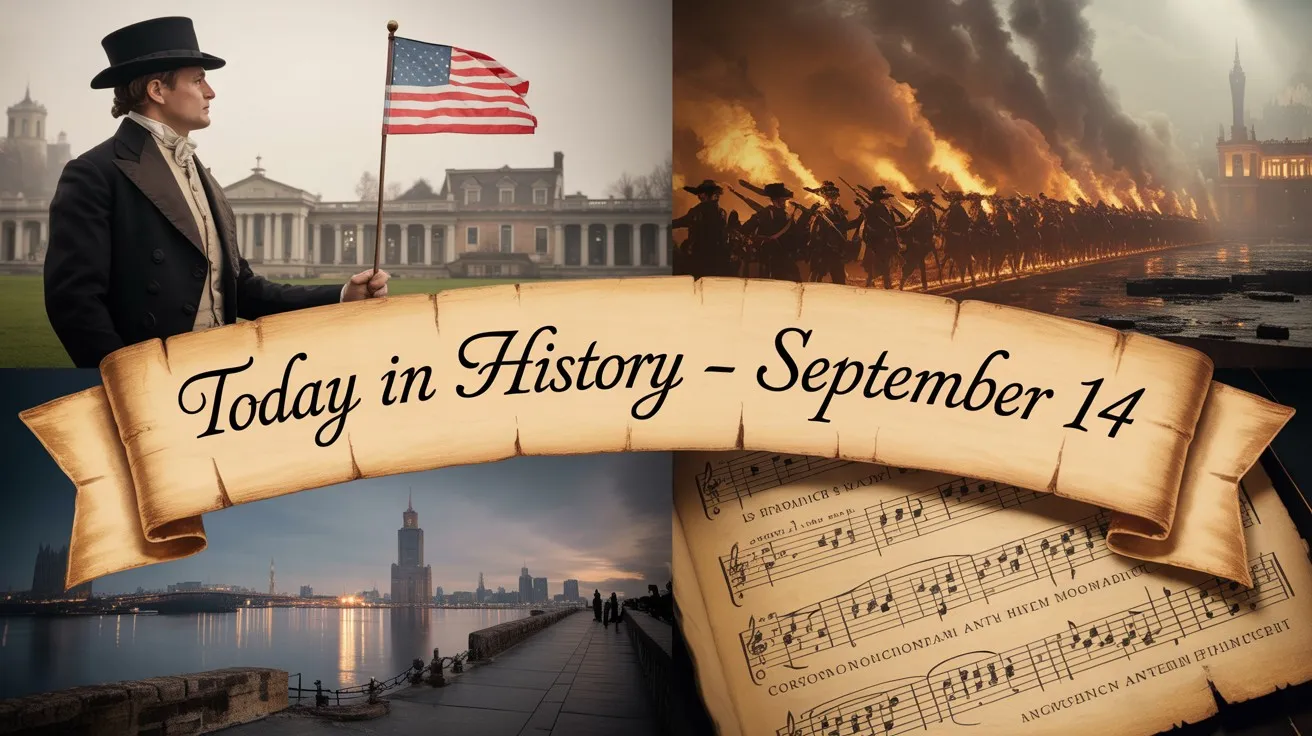
Today in History — September 14 blends imperial successions, battlefield turning points, cultural firsts, and modern scientific milestones. Across centuries, this date has hosted emperors’ rises and falls, decisive military moves, moments that shaped national identity, and technological firsts that later felt revolutionary.
Major Events on September 14
AD 81 — Domitian becomes Roman Emperor
When his brother Titus died, Domitian succeeded to the imperial purple on September 14, AD 81. His reign would combine large-scale building projects and authoritarian rule, reshaping the Roman court and administration.
Domitian’s policies strengthened the emperor’s power but also provoked senatorial opposition that defined much of his rule. For later historians, he remains a figure of contested legacy—energetic in governance, suspect in repression.
786 — Harun al-Rashid becomes Abbasid caliph; birth of al-Ma’mun
On this date, Harun al-Rashid assumed leadership of the Abbasid caliphate, beginning a caliphate often associated with political power and cultural florescence in Baghdad. The same year marked the birth of his son al-Ma’mun, who would later become caliph and patronize learning.
Harun’s era fostered scholarship, bureaucracy, and trade that made Baghdad a cosmopolitan hub. The period left a deep imprint on Islamic governance, law, and letters.
919 — Battle of Islandbridge; High King Niall Glúndub killed
The clash at Islandbridge saw High King Niall Glúndub fall while leading an Irish coalition against the Viking forces of Uí Ímair under Sitric Cáech. The battle altered the balance of power in Ireland and illustrated the lethal mix of native rivalries and Norse ambition that shaped the island’s early medieval politics.
Local lordships adjusted alliances in the aftermath, and Viking footholds remained a persistent factor in Irish affairs. For Irish memory, the date marks both valour and the high human costs of those frontier conflicts.
1180 — Battle of Ishibashiyama (Genpei War, Japan)
Minamoto no Yoritomo, recently risen as commander of his clan, was routed at Ishibashiyama by Ōba Kagechika of the rival Taira clan. The defeat was an early setback for Yoritomo, but his survival and later strategic maneuvering led him to found the Kamakura shogunate decades later.
Ishibashiyama thus reads as a formative moment: a tactical loss that did not extinguish a leadership that would transform Japanese politics. The episode points to how resilience and time can invert immediate battlefield outcomes.
1226 — Perpetual Eucharistic adoration begins in Avignon (first recorded instance)
In Avignon on September 14 the Catholic practice of continuous, day-and-night Eucharistic adoration is first recorded, initiating a devotional pattern that spread in later centuries. The ritual reflected deepening forms of lay and clerical piety in medieval Christendom and became part of local religious life at many shrines and monasteries.
Over time, perpetual adoration took diverse forms but remained a visible expression of communal devotion. Its origins in places like Avignon speak to the tangled overlap of local ritual and wider ecclesiastical trends.
1402 — Battle of Homildon Hill (Scotland vs. England)
Scottish nobles under Murdoch Stewart and Archibald Douglas suffered a sharp defeat at Homildon Hill when English longbowmen decimated their ranks. The battle reinforced the tactical dominance of archery in late medieval warfare and exposed the vulnerabilities of heavy cavalry when meeting disciplined missile troops.
For Scots, the loss was costly; for English commanders, the victory amplified confidence in certain battlefield formulas. Homildon Hill therefore, stands as a textbook case of changing military technology and its human price.
1682 — Bishop Gore School founded (one of Wales’s oldest schools)
The establishment of Bishop Gore School in Swansea marked a lasting local commitment to education that would persist across centuries. Schools like this anchored communities, trained local elites, and gradually broadened opportunities beyond narrow aristocratic circles.
Over time such institutions adapted to changing curricula and social expectations, but their founding remains a tangible civic milestone. That continuity makes the date noteworthy for regional educational history.
1716 — Boston Light first illuminated
On September 14, 1716, Boston Light—the first lighthouse in what became the United States—was lit for the first time, guiding ships into a vital colonial harbor. The beacon symbolized growing maritime commerce, navigational safety, and municipal investment in infrastructure.
Over generations, the Light was rebuilt and preserved as both a practical aid and maritime heritage site. Its first lighting marks a simple but durable improvement in seafaring safety.
1741 — Handel completes his oratorio Messiah
George Frideric Handel finished Messiah on September 14, 1741, a work that would become one of Western music’s most enduring choral masterpieces. Though initially received with mixed reviews, the oratorio’s memorable choruses and expressive arias quickly found popular and sacred contexts.
Over two centuries, Messiah has become a staple of concert life and seasonal observance, its opening pages still able to astonish modern audiences. The date therefore, links creative urgency with a long cultural afterlife.
1752 — British Empire adopts the Gregorian calendar (skips eleven days)
On September 14, 1752, the British Empire’s civil calendar jumped forward after Parliament adopted the Gregorian system—an eleven-day correction that erased September 3–13 from that year. The change aligned Britain with continental practice, simplified international trade and diplomacy, and required civic adjustment to new dating conventions.
The reform also generated public confusion and colorful myths about protests demanding the “return” of lost days. Regardless of folklore, the switch was a major administrative step in modernizing timekeeping.
1808 — Battle of Oravais (Finnish War)
Russian forces defeated the Swedes at Oravais, a battle that helped decide the Finnish War and ultimately led to Finland’s reassignment from Swedish to Russian influence. The clash demonstrated how continental warfare could reshape regional sovereignties and civilian lives.
For Finns, the campaign marked a turning point that would reconfigure institutions and alignments for decades. Oravais is therefore read as both military action and geopolitical pivot.
1812 — Napoleon’s Grande Armée enters Moscow; the Fire of Moscow begins
Napoleon’s occupying troops entered Moscow on September 14, 1812, but the city was largely abandoned and soon became engulfed in fires that destroyed large sections. What began as a seeming strategic prize rapidly turned into a logistical and moral disaster for the invaders: winter, scorched resources, and supply failures forced the Grande Armée into a catastrophic retreat.
The events around Moscow that autumn transformed Napoleonic strategy and remain a dramatic lesson about overreach in wartime. Moscow’s burning has resonated in military memory ever since.
1814 — Francis Scott Key writes “The Defence of Fort M’Henry”
After the British bombardment of Fort McHenry during the War of 1812, Francis Scott Key penned a poem on September 14, 1814, celebrating the flag that still flew at dawn. Those verses, later set to a popular tune, became The Star-Spangled Banner and eventually the United States’ national anthem.
The lines capture a single wartime dawn and were subsequently woven into American public ritual and identity. The moment illustrates how a private response to violence can be transformed into national symbolism.
1829 — Treaty of Adrianople ends the Russo-Turkish War (Ottoman–Russian settlement)
On September 14, 1829, the Treaty of Adrianople (Edirne) formalized peace between the Ottoman Empire and Russia after war, adjusting borders and commercial rights. The settlement reflected the shifting balance of power in southeastern Europe and opened new diplomatic patterns between empires and rising national movements.
For subjects in the borderlands the treaty meant changed rulers and legal frameworks. In diplomatic history Adrianople marks another stage of gradual Ottoman territorial contraction.
1846 — Kot Massacre and Jang Bahadur’s consolidation of power in Nepal
In 1846 Jang Bahadur and his brothers carried out the Kot Massacre, killing dozens of rivals in the Nepalese court and clearing the way for the Rana dynasty’s dominance. The violence remade Nepal’s political order for generations and illustrated how palace coups could produce durable, autocratic rule.
Jang Bahadur’s subsequent reforms and monopolization of power changed state-society relations and military organization. The episode remains a stark reminder of how swift violence can reconfigure governance.
1847 — U.S. forces capture Mexico City (Mexican–American War)
General Winfield Scott’s campaign culminated in the capture of Mexico City on September 14, 1847, effectively bringing the Mexican–American War to a decisive close. The fall of the capital led to negotiated territorial cessions that reshaped North America’s political map.
For both nations, the campaign left deep political and social aftershocks: expansion and triumph in the United States, humiliation and internal debate in Mexico. The event therefore, sits at the center of 19th-century hemispheric transformation.
1862 — Battle of South Mountain (American Civil War)
Fought on September 14, 1862, South Mountain was part of the Maryland Campaign and set the stage for later clashes at Antietam. Union forces attacked Confederate defensive positions to open avenues of maneuver and disrupt Lee’s campaign into the North.
While not decisive alone, the battle shaped operational tempo and movement, and contributed to the broader strategic environment in which the war’s next phases unfolded. For soldiers on the ground, it was one of many costly struggles over terrain and timing.
1901 — President William McKinley dies; Theodore Roosevelt succeeds
After being mortally wounded on September 6, President William McKinley died on September 14, 1901, and Vice President Theodore Roosevelt assumed the presidency. Roosevelt’s accession marked a generational shift in American politics toward a more activist executive and Progressive-era reforms.
The sudden transition tested constitutional practice and public confidence, and Roosevelt’s energetic leadership soon reshaped policy on conservation, business regulation, and international posture. The day thus marks a hinge in presidential history.
1911 — Russian Premier Pyotr Stolypin was fatally shot in Kiev
Pyotr Stolypin, a reforming and controversial Russian prime minister, was shot on September 14, 1911, while attending an opera in Kiev and died shortly after. Stolypin’s tenure combined agrarian reform with harsh repression of revolutionaries, and his assassination removed a central figure in late-Imperial Russian politics.
Historians debate whether his reforms might have stabilized the regime or whether repression and structural tensions would have prevailed regardless. The murder deepened the sense of crisis within the Russian state.
1914 — HMAS AE1 lost at sea with all hands
The Royal Australian Navy’s first submarine, HMAS AE1, disappeared with its entire crew near East New Britain on September 14, 1914. The loss was Australia’s first major naval tragedy of World War I and left lingering questions about early submarine operations and their risks.
For the fledgling navy, the event was a grim reminder of technological peril at sea. Memorials and ongoing searches have kept the memory of AE1 and its crew alive in naval history.
1939 — ORP Orzeł boarding in Tallinn; diplomatic incident
On September 14, 1939, the Estonian authorities boarded the Polish submarine ORP Orzeł in Tallinn, in a case that later became part of broader tensions and pretexts exploited by larger powers. The incident exemplified the fragile neutrality of small states caught between warring neighbors and the complex legal and diplomatic questions of wartime internment and escape.
Orzeł’s fate resonated in Polish naval lore and in the relationship between the Baltic states and the Soviet Union. The episode foreshadowed the tragic erosion of Baltic independence in the months ahead.
1940 — Ip massacre (Northern Transylvania)
The Ip massacre on September 14, 1940, saw Hungarian troops and local participants kill Romanian civilians in Northern Transylvania, part of a wider pattern of ethnic violence accompanying border changes.
The atrocity left deep scars in local communities and became one painful chapter amid shifting allegiances and territorial transfers during World War II. For historians, it underscores how wartime border reconfigurations can unleash communal violence and long memories of grievance. The date remains a somber marker of civilian suffering.
1943 — Viannos reprisals (Greece)
In retaliation for resistance activity, the Wehrmacht launched a three-day operation beginning September 14, 1943, that targeted villages in Viannos and resulted in several hundred deaths. The operation exemplified brutal anti-partisan tactics used in occupied Europe and produced enduring trauma and dispossession for local populations.
The Viannos massacres remain a central memory in regional histories of occupation and resistance. They also highlight the civilian cost of counterinsurgency measures.
1944 — Maastricht liberated (first Dutch city freed)
Maastricht became the first Dutch city liberated by Allied forces in September 1944, a key early step in the Netherlands’ liberation from Nazi occupation. The liberation offered civilians immediate relief and symbolized the broader advance into northwest Europe after D-Day.
Subsequent months of fighting and logistics would push further into the Low Countries and Germany, but Maastricht’s freeing was an emotional and strategic milestone for the Dutch. It also began the slow process of reconstruction and return to civil governance.
1948 — Indian Army captures Aurangabad (Operation Polo context)
During Operation Polo—India’s 1948 annexation of the princely state of Hyderabad—Indian forces captured Aurangabad on September 14, tightening control over the region. The operation ended Hyderabad’s autonomous rule and integrated the territory into the Indian Union, a controversial but decisive move in the subcontinent’s postcolonial consolidation.
For local populations, the takeover brought administrative and social change. The event is remembered within the larger story of India’s political unification after independence.
1954 — Soviet Tu-4 nuclear test near Totskoye (secret exercise)
A top-secret military exercise on September 14, 1954, reportedly involved the detonation of a 40-kiloton weapon over the Totskoye range as part of Soviet tests blending nuclear effects and maneuver. The operation signaled how nuclear weapons were being studied not only as strategic deterrents but also for tactical military planning during the early Cold War.
Such tests prompted later debates about safety, environmental impact, and the ethics of nuclear experimentation. The event sits at the intersection of military innovation and moral controversy.
1958 — Early German post-war rockets reach upper atmosphere
On September 14, 1958, two of the first German post-war rockets designed by Ernst Mohr reached the upper atmosphere, marking a technical step in reestablishing German rocketry research after World War II. These flights signaled renewed scientific engagement and the gradual rebuilding of a national aerospace capacity within West Germany’s new institutions. Over time German engineers would feed into broader European and transatlantic aerospace work.
The launches thus registered an early postwar return to high-altitude experimentation.
1960 — OPEC founded
On September 14, 1960, representatives of oil-producing countries met in Baghdad to establish the Organization of the Petroleum Exporting Countries (OPEC). The organization aimed to coordinate petroleum policies and assert greater control over oil revenues and prices.
OPEC would later have enormous influence on global energy markets and geopolitics, shaping the economic fortunes of producers and consumers alike. The founding meeting marked a decisive moment in postwar global economic organization.
1960 — Mobutu seizes power in Congo
Mobutu Sese Seko seized effective control of the Republic of the Congo on September 14, 1960, suspending parliament and establishing military rule. His coup inaugurated decades of authoritarian leadership that would profoundly shape the country’s politics, economy, and international alignments.
Mobutu’s long rule blended personalist governance with Cold War geopolitics and left complex legacies of corruption and patrimonial statecraft. The date thus marks the start of a long, consequential chapter in Congolese history.
1975 — Elizabeth Ann Seton canonized (first American-born saint)
On September 14, 1975, Elizabeth Ann Seton became the first native-born U.S. citizen canonized by the Roman Catholic Church, recognized for her charitable works and founding of schools and religious communities. Her canonization highlighted the maturing presence of Catholic institutions in the United States and celebrated an American model of religious social service.
For many Catholic Americans, the event was a point of communal pride and reflection on faith in public life. Seton’s life continues to be cited in educational and religious histories.
1979 — Nur Muhammad Taraki assassinated; Hafizullah Amin rises
Afghan leader Nur Muhammad Taraki was killed on September 14, 1979, an act that deepened factional turmoil within the People’s Democratic Party and cleared the way for Hafizullah Amin’s ascendancy. The rapid succession and internal purges destabilized Afghanistan at a moment when superpower attention and regional tensions were already high.
The political violence foreshadowed the larger foreign interventions and civil war that would follow. For Afghanistan, the date marks one more rupture in a troubled modern history.
1982 — Bachir Gemayel assassinated; Grace Kelly dies from car crash injuries
September 14, 1982, was a day of sharp international headlines: Lebanese president-elect Bachir Gemayel was assassinated amid the country’s civil war, and Grace Kelly—Hollywood star turned Princess of Monaco—died from injuries sustained in a car crash. Gemayel’s death intensified Lebanon’s descent into violence and altered political prospects for factions in the country.
Grace Kelly’s passing closed a life that bridged popular culture and European royalty, and drew global mourning for a beloved public figure.
1984 — Joe Kittinger completes solo gas balloon Atlantic crossing
Aviation pioneer Joe Kittinger made a solo transatlantic flight in a gas balloon on September 14, 1984, a daring achievement in endurance and piloting. The flight showcased human skill in lighter-than-air navigation and revived interest in long-distance ballooning feats.
For the history of adventure aviation, it was a high-profile success that connected Cold War-era aeronautical expertise with public spectacle. Kittinger’s career had earlier set records in high-altitude parachute jumps, and this flight added another chapter to his adventurous life.
1985 — Penang Bridge opens; The Golden Girls debuts on U.S. television
On September 14, 1985, Malaysia’s Penang Bridge opened, physically linking the island and mainland and boosting regional transport and commerce. The same day in the United States saw the premiere of The Golden Girls, a sitcom that would become notable for its humor about older women and its frank handling of social issues.
Both events—one infrastructural, one cultural—show how a single date can hold very different kinds of public significance in different places. Each left an enduring local or popular legacy.
1989 — Standard Gravure shooting
On September 14, 1989, a disgruntled former employee, Joseph Wesbecker, attacked his former workplace at Standard Gravure, killing several people and wounding others before killing himself. The mass shooting became part of a grim pattern of workplace and public violence that prompted debates about mental health, workplace relations, and access to firearms.
The episode contributed to discussions about prevention and community safety that would grow in the decades ahead. It remains one painful example in the history of mass shootings.
1993 — Lufthansa Flight 2904 crashes (Warsaw)
Lufthansa Flight 2904 overran the runway at Okęcie (now Warsaw Chopin) Airport on September 14, 1993, killing two people and injuring others. The accident prompted investigations into approach procedures, runway safety, and air traffic control coordination.
Aviation safety improvements around the world often follow such tragedies as investigators seek to prevent recurrence. The crash is therefore part of the incremental improvement story in commercial flight safety.
1994 — Remainder of Major League Baseball season canceled (strike)
On September 14, 1994, Major League Baseball’s owners canceled the rest of the season and the postseason because of the ongoing players’ strike, delivering a shock to fans and commercial sponsors. The cancellation deprived the sport of a World Series that year and undermined public confidence in baseball’s governance.
Rebuilding trust required years of negotiation and marketing repair, and the strike remains a cautionary tale about labor-management breakdowns. Economically and culturally, the move left a notable scar on the 1990s baseball landscape.
1997 — Ahmedabad–Howrah Express derailment (Bilaspur, India)
On September 14, 1997, five bogies of the Ahmedabad–Howrah Express plunged into a river in Madhya Pradesh after a bridge collapse, killing many passengers and highlighting risks in rail infrastructure. The disaster led to inquiries about maintenance, safety standards, and emergency response in India’s vast rail system.
Railway tragedies often precipitate policy reviews and investments; this derailment was another tragic prompt for such measures. The human toll remained the central and sorrowful detail.
1998 — MCI Communications and WorldCom complete merger (MCI WorldCom)
The $37 billion merger between MCI Communications and WorldCom closed on September 14, 1998, forming one of the 1990s’ largest telecom companies and symbolizing the era’s consolidation in communications. The deal reflected aggressive growth strategies in a rapidly digitizing economy, though later accounting scandals would tarnish the combined firm’s reputation.
At the time, the merger embodied the scale and optimism of late-1990s telecom finance. Its later unraveling also became a cautionary tale about corporate governance.
1999 — Kiribati, Nauru and Tonga join the United Nations
On September 14, 1999, the three Pacific nations became UN members, affirming their international recognition and providing new diplomatic avenues. Admission to the United Nations opens access to multilateral forums, development programs, and legal standing on global issues—matters of real consequence for small island states.
The event symbolized the continuing expansion of global organization membership into the late 20th century. For the island nations, UN membership advanced international engagement and visibility.
2000 — Microsoft releases Windows Me
Microsoft launched Windows Millennium Edition (Windows Me) on September 14, 2000, a consumer-focused operating system aimed at multimedia and home users. The release reflected Microsoft’s rapid product cadence at the turn of the millennium, though Windows Me would draw mixed reviews for stability.
The product sits in the larger history of personal computing’s fast iterations and user expectations. Even imperfect releases contributed to evolving software practices and user familiarity with home computing.
2001 — National Prayer Service at Washington National Cathedral for 9/11 victims
On September 14, 2001, the National Prayer Service at Washington National Cathedral gathered political leaders, clergy, and citizens to mourn victims of the September 11 attacks and to offer public consolation. The service was part of a broader outpouring of grief and civic solidarity across the United States and allied countries.
Ceremonies like this combined ritual, political symbolism, and communal mourning during a shock moment in national life. They also shaped how leaders publicly framed recovery and resilience.
2003 — Estonia votes to join the European Union (referendum)
On September 14, 2003, Estonians voted in a referendum to approve EU membership, a major step in the Baltic state’s post-Soviet integration with Western institutions. The decision opened avenues for economic development, mobility, and political reform aligned with EU accession conditions.
Estonia’s accession in 2004 would mark a regional shift and encourage broader European consolidation after the Cold War. The vote thus stands as a pivotal civic endorsement of a new geopolitical orientation.
2007 — Northern Rock bank run begins in the UK
On September 14, 2007, Northern Rock experienced a public run on deposits—the first such event in the U.K. in about 150 years—triggered by liquidity pressures that presaged the global financial crisis.
The bank’s troubles highlighted vulnerabilities in wholesale funding models and led to government intervention, debates about regulation, and reforms in banking safety nets. Northern Rock became an early harbinger of broader systemic fragilities that would culminate in 2008. The date therefore, appears in narratives about modern financial instability.
2008 — Aeroflot Flight 821 crashes near Perm, Russia
A scheduled Aeroflot flight crashed on approach to Perm International Airport on September 14, 2008, killing all 88 people aboard. Investigators studied approach procedures, weather, and human factors in searching for causes.
Aviation tragedies like this feed continuous safety improvements even as they register as national moments of mourning. The accident remains part of Russia’s contemporary aviation history.
2015 — First observation of gravitational waves (LIGO detection on Sep 14, 2015)
On September 14, 2015, the LIGO detectors recorded gravitational waves from a binary black-hole merger—an event later announced publicly in February 2016 and hailed as the first direct detection of ripples in spacetime predicted by Einstein. The discovery opened a new window on the universe, inaugurating gravitational-wave astronomy and a richer empirical study of compact objects.
For physicists, the signal represented a dramatic confirmation of theory and an entirely new observational tool. The September detection date is thus a milestone for 21st-century science.
2019 — Houthi attack on Saudi oil facilities (claimed Sep 14)
On September 14, 2019, major attacks damaged Saudi Arabian oil infrastructure, sharply reducing the kingdom’s production and briefly roiling global energy markets. Houthi rebels in Yemen claimed responsibility, while international debate followed about attribution, vulnerability of critical infrastructure, and geopolitical stakes in the Arabian Peninsula.
The incident exposed how nonstate violence can instantly affect global supply chains and price stability. Its effects rippled through diplomacy, defense planning, and energy economics.
2022 — Queen Elizabeth II’s coffin moved to Westminster Hall for lying in state
On September 14, 2022, Queen Elizabeth II’s coffin was solemnly transferred from Buckingham Palace to Westminster Hall, beginning a four-day lying in state that drew queues of mourners and international attention. The ceremonial procession and public turnout reflected the global scale of mourning for a long-reigning monarch and embodied centuries of royal pageantry.
The event also prompted reflections on succession, constitutional continuity, and national ritual in the United Kingdom and the Commonwealth. The date thus marks an intense moment of public commemoration.
Quick sections
Pre-modern & Imperial Transitions
AD 81 — Domitian becomes emperor; 786 — Harun al-Rashid’s accession; 919 — Islandbridge; 1180 — Ishibashiyama; 1226 — perpetual adoration begins.
Battles, Revolutions & Wars
1402 — Homildon Hill; 1808 — Oravais; 1812 — Grande Armée in Moscow; 1814 — Fort McHenry poem; 1862 — South Mountain; 1847 — Mexico City captured; 1940–44 — wartime reprisals and liberations.
Exploration, Institutions & Infrastructure
1716 — Boston Light first lit; 1682 — Bishop Gore School founded; 1752 — Gregorian calendar adoption.
Arts, Culture & Media
1741 — Handel’s Messiah completed; 1985 — The Golden Girls debuts; 1982 — Grace Kelly’s death as a cultural moment.
Science, Technology & Economy
1958 — German rockets; 1960 — OPEC formed; 2000 — Windows Me release; 2015 — gravitational waves (LIGO detection).
Check Also Other Days’ History:
13 September In History
12 September In History
Notable Births on September 14
- Diadumenian (208) — Roman noble who briefly became emperor in the turbulent Severan era.
- Al-Ma’mun (768) — Abbasid caliph known for patronage of learning and the House of Wisdom.
- Sahib ibn Abbad (938) — Persian scholar and statesman.
- Guo Zongxun (953) — Chinese emperor of the Later Zhou.
- Dao Zong (1032) — Chinese emperor.
- John Fitzalan III (1246) — English nobleman and marcher lord.
- Ephraim of Nea Makri (1384) — Greek martyr and saint.
- Claudius Clavus (1388) — Danish geographer and cartographer.
- Heinrich Cornelius Agrippa (1486) — Renaissance polymath and occult writer.
- Johan van Oldenbarnevelt (1547) — Dutch statesman in the struggle for independence.
- Peter Lely (1618) — Portraitist and court painter in Restoration England.
- Robert Raikes (1735) — Founder of the Sunday school movement.
- James Wilson (1742) — U.S. Founding Father and Supreme Court justice.
- Lord William Bentinck (1774) — Governor-General in India, known for reform.
- John Henry Hobart (1775) — American Episcopal bishop and educator.
- Franz Bopp (1791) — Pioneer of comparative linguistics.
- John Gould (1804) — Ornithologist and influential bird illustrator.
- Charles Dana Gibson (1867) — Creator of the “Gibson Girl” image.
- Hal B. Wallis (1899) — Film producer behind many Hollywood classics.
- Sir Peter Markham Scott (1909) — Conservationist and founder of the Wildfowl & Wetlands Trust.
- Jacobo Árbenz (1913) — Guatemalan president remembered for a reformist agenda and overthrow.
- Mario Benedetti (1920) — Uruguayan writer and poet.
- Lawrence R. Klein (1920) — Economist and Nobel laureate.
- Constance Baker Motley (1921) — Civil-rights lawyer and federal judge.
- Allan Bloom (1930) — Philosopher and cultural critic.
- Kate Millett (1934) — Feminist writer and activist.
- Ferid Murad (1936) — Pharmacologist and Nobel Prize winner.
- Renzo Piano (1937) — Architect of the Centre Pompidou and The Shard.
Notable Deaths on September 14
- Drusus Julius Caesar (AD 23) — Julio-Claudian prince and senator.
- St. Cyprian (258) — North African bishop and martyr.
- John Chrysostom (407) — Influential early Church Father and preacher.
- Dante Alighieri (1321) — Author of The Divine Comedy.
- Pope Adrian VI (1523) — Reforming pope during a turbulent era.
- Jan Tarnowski (1605) — Polish military leader and statesman.
- Thomas Overbury (1613) — Poet and figure in a famous Jacobean murder scandal.
- John Harvard (1638) — Benefactor associated with the founding of Harvard College.
- Giovanni Domenico Cassini (1712) — Astronomer who mapped Saturn’s rings and moons.
- Dom Pérignon (1715) — Benedictine monk entwined with the story of Champagne.
- Louis-Joseph de Montcalm (1759) — French commander at Quebec.
- Aaron Burr (1836) — U.S. vice president known for dueling Alexander Hamilton.
- James Fenimore Cooper (1851) — Novelist of frontier America.
- Arthur Wellesley, 1st Duke of Wellington (1852) — Defeated Napoleon at Waterloo, later statesman.
- Isadora Duncan (1927) — Dancer who revolutionized modern dance.
- Irving Thalberg (1936) — Influential Hollywood producer.
- Tomáš G. Masaryk (1937) — Founder and first president of Czechoslovakia.
- Grace Kelly (1982) — Actress and Princess of Monaco, cultural style icon.
Observances & Institutional Dates
- Feast of the Exaltation of the Holy Cross (Christian liturgical observance) — widely observed on September 14.
- OPEC founding anniversary (1960) — a major institutional date in global energy politics.
- Boston Light first illumination (1716) — noted in maritime heritage calendars.
Final Thoughts on Today in History: September 14
September 14 is one of those dates that gathers a surprising variety of human action: emperors and insurgents, composers and engineers, battles and breakthroughs. From Domitian’s accession to the hush of a lighthouse flame, and from Handel finishing Messiah to a faint ripple in spacetime recorded by LIGO, the day links big political turns with quieter cultural and scientific advances.
FAQs About September 14
Did Francis Scott Key write his poem on September 14, 1814?
Yes — Key penned The Defence of Fort M’Henry following the night bombardment; it later became the lyrics to The Star-Spangled Banner.
Was the Grande Armée in Moscow on September 14, 1812?
Yes — Napoleon’s forces entered a largely evacuated Moscow on that date, but the subsequent fires and winter forced a disastrous retreat.
When were gravitational waves first detected?
The first direct detection was recorded by LIGO on September 14, 2015 (announced publicly in February 2016), marking a major advance in astronomy.
When did the British Empire adopt the Gregorian calendar?
The switch took effect in 1752; September 14, 1752, was the first day after the eleven-day correction that aligned Britain with continental Europe.