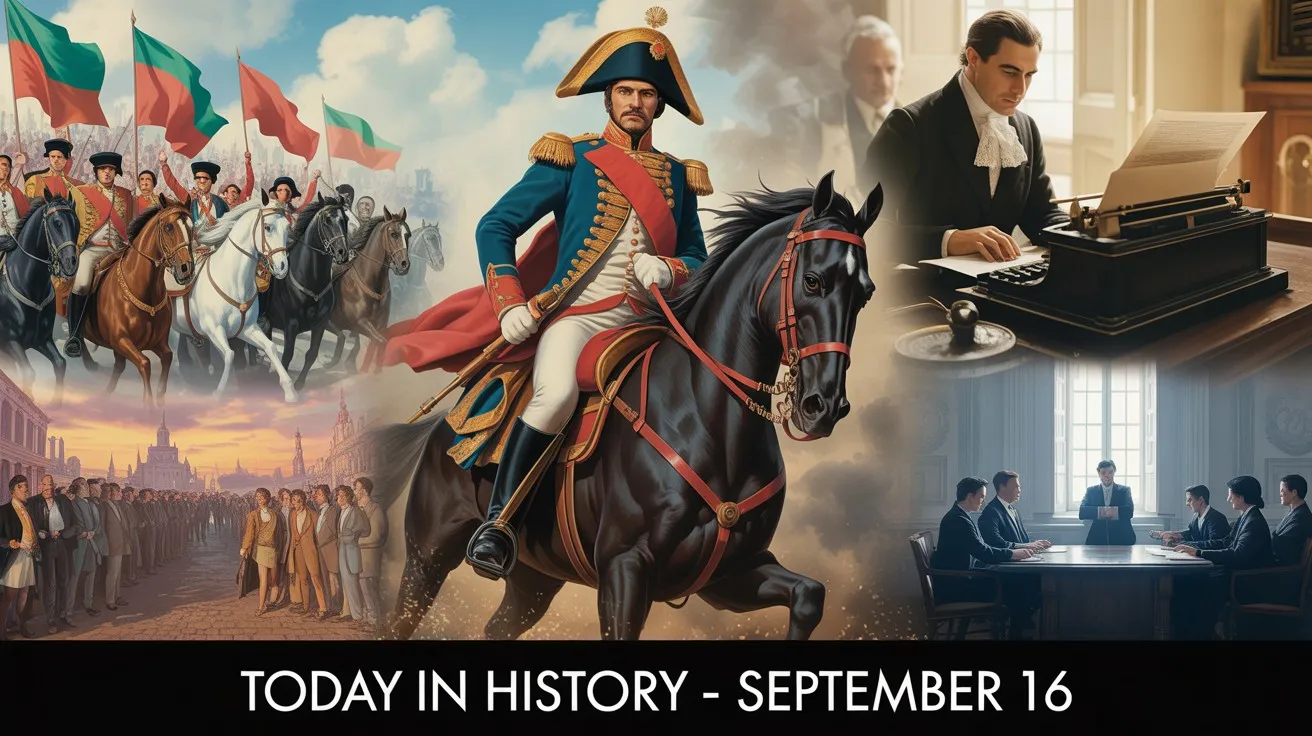
Today in History — September 16 gathers voyages of settlement, revolutionary cries, scientific firsts, and wrenching modern moments.
From the Mayflower’s Atlantic departure and Miguel Hidalgo’s call for Mexican independence to 20th- and 21st-century disasters, protests, and environmental diplomacy, this date keeps returning as a hinge for nation-building, technological shifts, and public reckoning.
Major Events on September 16
681 — Pope Honorius I posthumously excommunicated
The Sixth Ecumenical Council (Third Council of Constantinople) in 681 retroactively anathematized Pope Honorius I for his perceived support of Monothelitism. The posthumous excommunication illustrated how doctrinal disputes could reach into papal reputation and raise questions about authority and orthodoxy.
For later church politics the case provided a precedent in debates over papal accountability and theological boundary-setting. Historians still cite the episode when tracing tensions between imperial councils and Roman primacy.
1400 — Owain Glyndŵr declared Prince of Wales
On September 16, Owain Glyndŵr was proclaimed Prince of Wales by his followers, launching a long and symbolic revolt against English rule in Wales. Glyndŵr’s uprising mobilized Welsh noble, peasant and urban forces and claimed a brief quasi-statehood with parliamentary assemblies and charters.
Though ultimately suppressed, the revolt left a durable legacy in Welsh national memory and later nationalist movements. The date remains a touchstone for Welsh identity and commemoration.
1620 — Mayflower departs Plymouth for Virginia (Pilgrims set sail)
On September 16, 1620, the Mayflower put to sea from Plymouth, England, carrying Pilgrim colonists who would found Plymouth Colony after a perilous Atlantic voyage. During the trip, 41 men signed the Mayflower Compact — a compact that helped establish early colonial self-government and has become a founding document in American popular memory.
The voyage combined religious motive, commercial sponsorship and the contingencies of maritime migration, producing a settlement whose myth and reality have long been debated. The Mayflower’s departure marks a key node in Atlantic migration and colonial settlement patterns.
1701 — James Francis Edward Stuart becomes the Jacobite claimant (Old Pretender)
With the death of his father, James II, James Francis Edward Stuart asserted his claim to the thrones of England and Scotland on September 16, 1701, becoming the Stuart “Old Pretender.” His claim energized Jacobite hopes and framed succession conflicts across the 18th century, prompting invasions, plots, and continental diplomacy.
The Jacobite cause linked dynastic legitimacy, religious identity, and foreign policy in British history. The Old Pretender’s presence on the European stage shaped the period’s factional politics and military alignments.
1732 — Armory explosion in Campo Maior, Portugal
A violent storm struck Campo Maior’s armory in 1732, triggering a catastrophic explosion that killed many inhabitants and devastated the town. The calamity underscored the hazards posed by storing munitions within or near populated centers in the early modern era.
Recovery involved rebuilding local infrastructure and rethinking safety practices for arms depots. Such disasters punctuated the costs of militarization for civilian communities.
1776 — Battle of Harlem Heights (American Revolutionary War)
On September 16, 1776, American forces engaged British troops at Harlem Heights, winning a morale-boosting engagement after earlier setbacks around New York. The clash helped restore confidence in Continental Army capabilities and offered tactical lessons in skirmishing and small-unit maneuver.
Though not decisive strategically, Harlem Heights mattered for American recruitment and political resolve during a difficult campaign season. The engagement remains a studied episode in Revolutionary War operations near Manhattan.
1779 — Franco-American Siege of Savannah begins
The Franco-American siege of Savannah began on September 16, 1779, aiming to eject British control from a key southern port. The effort brought allied naval and land forces against well-entrenched defenders, combining international cooperation with local loyalist dynamics.
The siege ultimately failed and produced heavy allied casualties, reminding planners of the challenges of joint operations and southern theater logistics. Savannah’s fate shaped later British and American strategy in the Revolutionary South.
1810 — Father Miguel Hidalgo issues the Grito de Dolores (Mexico’s independence begins)
On September 16, 1810, Miguel Hidalgo y Costilla rang the church bells and proclaimed the Grito de Dolores, calling for an end to peninsular rule and launching Mexico’s war of independence. Hidalgo’s cry mobilized a broad, heterogeneous following—peasants, artisans, and some criollo elites—against colonial hierarchies and unequal land relations. What began as a popular insurrection evolved into a complex, long war that produced the modern Mexican state.
Today, September 16 is celebrated as Mexico’s Independence Day, commemorating this foundational political rupture.
1822 — Fresnel reports direct refraction experiment (photoelasticity)
In 1822 Augustin-Jean Fresnel presented an experiment verifying stress-induced birefringence, advancing understanding of photoelasticity and optics. Fresnel’s note to the Academy of Sciences linked theoretical optics with controlled laboratory observation, helping to consolidate wave-theory approaches to light.
The work fed later practical and engineering applications using polarized light and stress analysis. Fresnel’s experiments remain landmarks in nineteenth-century physical science methodology.
1863 — Robert College (Istanbul) founded
Robert College, established on September 16, 1863 by American philanthropist Christopher Robert, became the first American educational institution founded outside the United States. The college played a formative role in Ottoman and later Turkish education, training generations of regional elites and promoting western-style curricula.
Its founding exemplified missionary-philanthropic education projects linked to transnational cultural exchange. The institution’s long history illustrates education’s role in modernization and social mobility.
1880 — Cornell Daily Sun prints first issue
On September 16, 1880, the Cornell Daily Sun produced its first issue in Ithaca, New York, launching one of the United States’ longest-running student newspapers. The paper became a training ground for journalists and a forum for campus debate, reflecting the rise of collegiate civic culture in America.
Student newspapers like the Sun have long chronicled campus life while shaping future professional careers. The debut marks a small but durable contribution to press history and campus public spheres.
1893 — Cherokee Strip Land Run begins (Oklahoma)
The Cherokee Strip Land Run opened on September 16, 1893, sending over 100,000 would-be settlers racing to claim parcels of land in present-day northern Oklahoma. The chaotic land rush epitomized frontier land policies, settler ambition, and the displacement of indigenous claims.
For participants, it promised opportunity; for displaced communities it meant dispossession and legal erasure. The event stands as a vivid example of American expansionist land policy and its social consequences.
1908 — General Motors founded
On September 16, 1908, William C. Durant founded General Motors, a company that would become a central actor in automotive mass production and 20th-century industrial capitalism. GM’s emergence reshaped labor markets, urbanization patterns, and consumer culture through vehicle production and corporate integration.
The firm’s rise also influenced government policy, supply chains and global industrial competition. GM remains a key case study in corporate evolution, scale economies and manufacturing innovation.
1914 — Siege of Przemyśl begins (World War I)
The Austro-Hungarian fortress at Przemyśl came under siege beginning September 16, 1914, as Imperial Russian forces pressed Galicia in the early Great War. The protracted siege became one of the conflict’s longest and most stubborn episodes on the Eastern Front, exhausting defenders and foreshadowing attritional trench warfare in a different theater.
Przemyśl’s fall and relief attempts had heavy military and civilian costs, disrupting regional supply lines and political control. The siege exemplified the harsh logistics and morale challenges of early twentieth-century sieges.
1919 — U.S. Congress grants national charter to the American Legion
On September 16, 1919, the U.S. Congress granted a national charter to the American Legion, formalizing the organization of veterans from World War I. The Legion became a significant voice in American public life—advocating veterans’ benefits, civic patriotism, and conservative politics across the interwar decades.
Its institutional role shaped postwar policy on pensions, memorialization and civic service. The charter marked a transition from informal veteran associations to influential national advocacy.
1920 — Wall Street bombing (horse-wagon bomb at J.P. Morgan building)
A bomb concealed in a horse-drawn wagon exploded outside the J.P. Morgan building on September 16, 1920, killing 38 and injuring hundreds in one of the era’s most violent urban attacks. The blast shocked New York’s financial district and triggered wide investigations and crackdowns on radical groups and saboteurs.
The bombing underscored vulnerabilities in urban security and influenced policing and intelligence practices in the United States. Its motives remain disputed, but its human toll and political reverberations were immediate and deep.
1940 — Italian troops conquer Sidi Barrani (North Africa, WWII)
On September 16, 1940, Italian forces advanced in North Africa and captured Sidi Barrani, furthering early Axis gains in the desert war. The occupation tightened supply lines for Italian operations but provoked later British counter-offensives that would reshape the campaign.
North Africa’s shifting frontlines reflected the logistical and mobility limits of desert warfare and the strategic importance of the Mediterranean. Sidi Barrani’s capture was an episode in the broader ebb and flow of WWII’s southern theater.
1943 — German Tenth Army reports it cannot contain Allied bridgehead around Salerno
By September 16, 1943, German commanders acknowledged the difficulty of containing the Allied bridgehead at Salerno after the Allied landings (Operation Avalanche) in Italy. The persistence of the beachhead signaled growing Allied momentum in the Italian campaign and exposed Axis overstretch.
Salerno’s fighting highlighted coordination challenges for both sides in amphibious and combined operations. The episode presaged Italy’s long and bitter campaign that would stretch into 1945.
1945 — Japanese occupation of Hong Kong ends
On September 16, 1945, the formal end of Japanese occupation in Hong Kong marked the territory’s return to British colonial administration after World War II. The transition involved repatriation, reconstruction and the re-establishment of civil institutions amid postwar uncertainty.
Hong Kong’s wartime experiences shaped postwar economic and social trajectories, fueling migration and industrial change. The end of occupation was a moment of relief and complex reintegration for residents and returning authorities.
1953 — American Airlines Flight 723 crashes (Colonie, New York)
On September 16, 1953, American Airlines Flight 723 crashed near Colonie, New York, killing 28 people and prompting safety reviews in commercial aviation. Accidents like Flight 723 spurred enhancements in instrument procedures, air traffic control and pilot training.
The human cost of such crashes encouraged regulatory reforms and technological investments to reduce future risks. Aviation history records these tragedies as catalysts for improved safety systems.
1955 — Coup to unseat Juan Perón launched (Argentina)
A military uprising to depose President Juan Perón began at midnight on September 16, 1955, culminating in Perón’s overthrow and a turbulent period of Argentine politics. The coup reflected deep societal polarization over Perón’s populist governance, labor ties and authoritarian tendencies.
The post-Perón era produced cycles of military and civilian rule that shaped Argentina’s mid-century trajectory. The event is a key node in Latin American studies of populism and military intervention.
1955 — Soviet Zulu-class submarine launches a ballistic missile (first of its kind)
On September 16, 1955, a Soviet Zulu-class submarine became the first of its class to launch a ballistic missile, signaling early steps in undersea strategic capabilities. The experiment foreshadowed later deployment of submarine-launched ballistic missile (SLBM) systems that became central to nuclear deterrence.
Submarine missile tests pushed forward naval engineering, guidance technology and strategic doctrine during the Cold War. The event marks an early phase in the maritime nuclear revolution.
1956 — TCN-9 Sydney begins regular TV broadcasts (Australia)
Australia’s TCN-9 began regular television broadcasts on September 16, 1956, marking a new era in national mass media and cultural life. Television rapidly transformed domestic entertainment, news consumption and advertising industries across Australia.
The launch coincided with broader global diffusion of TV technology, reshaping public spheres and popular culture. TCN-9’s debut is a milestone in Australian broadcasting history.
1959 — Xerox 914 photocopier demonstrated on live TV
The Xerox 914, the first widely successful photocopier, was introduced in a live televised demonstration on September 16, 1959. The machine transformed office work by enabling quick, reliable duplication of documents and reshaping administrative practices.
Xerox’s innovation accelerated the information economy and spawned new industries in office equipment and services. The demo remains a famous example of technology’s cultural unveiling.
1961 — Project Stormfury cloud-seeding experiment and other 1961 events
In 1961 the U.S. National Hurricane Research Project seeded Hurricane Esther’s eyewall with silver iodide cylinders, producing a measured wind-speed reduction and giving rise to Project Stormfury. The experiment reflected midcentury ambitions to modify weather and mitigate storm impacts through geophysical intervention.
That same year Typhoon Nancy struck Osaka with catastrophic winds and Pakistan established SUPARCO under Abdus Salam’s leadership, showing the year’s convergence of climatic, scientific and institutional milestones. Together, these events illustrate the range of human efforts to understand and manage nature.
1963 — Federation of Malaysia formed (Malaysia Day)
On September 16, 1963, the Federation of Malaysia was created by combining Malaya, Sabah (North Borneo), Sarawak, and Singapore (the latter later expelled). The union marked a major postcolonial reconfiguration in Southeast Asia and raised immediate political tensions over federal structure, race and governance.
Malaysia Day is celebrated as a nation-building moment while remembering the complex constitutional compromises it required. The federation’s early years shaped regional alignments and domestic politics.
1966 — Metropolitan Opera opens at Lincoln Center with Barber’s Antony and Cleopatra
The Metropolitan Opera staged the world premiere of Samuel Barber’s Antony and Cleopatra on September 16, 1966, inaugurating its Lincoln Center home. The opening represented a cultural investment in high art and civic prestige for mid-century New York.
While Barber’s opera received mixed reviews, the Met’s move to Lincoln Center reshaped cultural geography and audience practices in the city. The event marks a milestone in American performing-arts institutions.
1970 — King Hussein declares martial law / Black September (Jordan–PLO conflict)
In response to the hijacking of international airliners and mounting PLO presence, King Hussein of Jordan declared martial law in 1970 and the conflict that followed—known as Black September—saw intense clashes between Jordanian authorities and Palestinian militants.
The confrontation sought to reassert state authority and reconfigure armed actors within Jordan’s borders. The episodes had wide regional reverberations and led to complex population movements and political realignments. Black September remains a key moment in Middle Eastern political history.
1975 — Papua New Guinea gains independence from Australia
On September 16, 1975, Papua New Guinea achieved full independence from Australia, inaugurating a new sovereign state with diverse linguistic and cultural communities. Independence brought immediate challenges in governance, development, and national integration, as leaders balanced local traditions with modern state institutions.
For Australia and the Pacific region, the transition reflected decolonization’s late wave and questions about economic ties and security partnerships. PNG’s independence is celebrated as a major postcolonial milestone.
1975 — Cape Verde, Mozambique and São Tomé & Príncipe join the United Nations
Also in 1975 several newly independent African states—Cape Verde, Mozambique and São Tomé & Príncipe—were admitted to the United Nations, reflecting the rapid postcolonial expansion of UN membership. These accessions signaled global shifts in representation and the internationalization of development and decolonization issues.
New UN membership often coincided with pressing economic and security challenges that shaped early foreign policy choices. The events underscore the mid-1970s’ transformation of the global order.
1976 — Shavarsh Karapetyan saves 20 in Yerevan reservoir rescue
In 1976 Armenian swimmer Shavarsh Karapetyan heroically rescued 20 people after a trolleybus fell into a reservoir near Yerevan, an act of physical endurance and civic bravery that gained wide admiration. Karapetyan’s feats highlighted extraordinary rescue courage and the role of individual action in emergency response.
The story became an enduring local and regional legend of selfless heroism. It also drew attention to urban safety and emergency infrastructure.
1976 — Night of the Pencils (Argentina)
The Night of the Pencils—kidnapping, torture and murder of high-school students in La Plata—took place under Argentina’s military dictatorship, representing one of the regime’s atrocities against perceived dissidents.
The event exposed the regime’s brutal campaign against youth activism and intensified domestic and international condemnation. Memories of the victims fuel transitional justice efforts and human-rights advocacy in Argentina. The episode remains a somber emblem of state repression.
1978 — Tabas earthquake (Iran)
The Tabas earthquake of September 16, 1978, measured Mw 7.4 and produced catastrophic damage with at least 15,000 fatalities, devastating the city and surrounding region. The disaster highlighted seismic vulnerability and the limits of emergency response capacity in rural and urban Iran at the time.
Relief and reconstruction efforts faced political and logistical challenges amid competing national priorities. Tabas stands as one of modern Iran’s deadliest natural disasters.
1979 — East German balloon escape to West Germany
On September 16, 1979, eight East Germans escaped to the West in a homemade hot-air balloon, a dramatic act symbolizing Cold War desperation and ingenuity in pursuit of freedom. The flight captured global imagination and highlighted the human stakes of divided Europe.
While rare, such escapes tested border controls and propaganda narratives on both sides. The balloon escape remains an emblematic Cold War story.
1982 — Sabra and Shatila massacre (Lebanon War)
In September 1982, Phalangist militias entered the Sabra and Shatila refugee camps and killed hundreds of Palestinian and Lebanese civilians, an atrocity that shocked the region and provoked international outrage. The massacre raised questions about responsibility, complicity and the conduct of occupying forces, fueling investigations and political fallout.
Sabra and Shatila altered public perceptions of the Lebanon War and remains a central reference in debates about civilian protection in conflict. The event’s memory continues to shape regional and international discourse on accountability.
1987 — Montreal Protocol signed (ozone protection)
The Montreal Protocol, signed on September 16, 1987, committed nations to phase down ozone-depleting substances and became one of the most successful global environmental agreements. Its implementation significantly reduced CFC emissions and helped protect the ozone layer, demonstrating effective multilateral environmental governance.
The Protocol is often cited as a model for international cooperation on planetary problems like climate change. Its signing marked a turning point in environmental diplomacy.
1990 — Dostyk rail link completed (China–Kazakhstan)
On September 16, 1990, the railroad connection between China and Kazakhstan at Dostyk was completed, enhancing trans-Eurasian rail links that later figured in projects like the Eurasian Land Bridge. The rail link facilitated trade, cross-border logistics and economic integration across Central Asia.
Infrastructure projects like Dostyk reshaped regional economic geographies and strategic connectivity. The link’s completion foreshadowed later large-scale transcontinental transport ambitions.
1992 — Manuel Noriega trial ends (U.S. sentencing)
The U.S. trial of former Panamanian leader Manuel Noriega concluded on September 16, 1992, resulting in a 40-year sentence for drug trafficking and money laundering. The case showcased U.S. efforts to prosecute a foreign head of state for criminal conspiracies and highlighted controversies over intervention and legal jurisdiction.
Noriega’s conviction carried symbolic weight for U.S.–Latin American relations and for debates about impunity and accountability. The trial remains a notable example of transnational criminal justice.
1992 — Black Wednesday (UK currency crisis)
On September 16, 1992, the British pound was forced out of the European Exchange Rate Mechanism after currency speculators triggered market pressures, forcing a devaluation against the German mark. The episode—dubbed Black Wednesday—affected economic policy debates, political fortunes and the UK’s relationship with European monetary integration.
The crisis prompted shifts in fiscal and monetary strategy and influenced public attitudes toward EU economic coordination. Black Wednesday remains a touchstone in modern UK economic history.
1994 — UK lifts broadcast ban on Sinn Féin and paramilitary groups
On September 16, 1994, the British government lifted a broadcasting ban that had prohibited direct statements from Sinn Féin and some paramilitary groups since 1988, altering media coverage of Northern Ireland politics. The policy change reflected shifting political calculations and an evolving approach to peace talks and public discourse.
Lifting the ban expanded the information environment and influenced negotiations that led toward the Good Friday Agreement. The decision remains part of the media-peace process nexus.
1996 — Space Shuttle Atlantis (STS-79) launched to Mir
On September 16, 1996, Space Shuttle Atlantis launched on STS-79 to rendezvous and dock with Russia’s Mir space station, continuing U.S.–Russian cooperation in orbit. The mission carried supplies and crew exchanges that helped prepare for later International Space Station collaboration.
Atlantis’s flight demonstrated operational mastery of shuttle docking and long-duration mission support. The mission is a chapter in the post-Cold War space partnership.
2004 — Hurricane Ivan makes landfall (Gulf Shores, Alabama)
Hurricane Ivan struck the Gulf Shores region on September 16, 2004, as a Category 3 storm, causing widespread damage, storm surge, and long-term recovery needs. The hurricane’s impacts affected housing, energy infrastructure, and coastal economies across the Gulf Coast.
Ivan’s aftermath prompted reviews of preparedness, insurance and coastal resilience policy. The storm remains part of the early-21st century pattern of destructive Atlantic hurricanes.
2005 — Arrest of Paolo Di Lauro (Camorra boss)
On September 16, 2005, Italian police arrested Paolo Di Lauro, a key Camorra organized-crime figure, in Naples—an operation that disrupted one strand of Naples’ powerful criminal networks. The capture marked a significant law-enforcement success against transnationally active mafia clans.
Arrests like Di Lauro’s shape criminal justice narratives about organized crime and their economic and social impacts on urban communities. The event influenced later prosecutions and anti-mafia initiatives.
2007 — One-Two-Go Airlines Flight 269 crash (Thailand)
One-Two-Go Flight 269 crashed on September 16, 2007, killing 90 people and prompting scrutiny of Thai aviation safety, operational oversight and regulatory standards. The disaster led to investigations and reforms aimed at improving pilot training, airline oversight and runway procedures.
Aviation tragedies often trigger cross-jurisdictional learning about safety culture and enforcement. The crash remains a somber moment in regional civil-aviation history.
2007 — Nisour Square shooting (Blackwater guards kill 17 in Baghdad)
On September 16, 2007, security contractors working for Blackwater Worldwide shot and killed 17 Iraqi civilians in Nisour Square, Baghdad, setting off international outrage and a legal reckoning over private military contractors’ accountability. The incident complicated U.S. relations with Iraq and prompted debates over rules of engagement, contractor immunity and wartime oversight.
Legal and diplomatic fallout followed, including prosecutions and changes in contracting practices. The event spotlighted the blurred lines between public military authority and private security provision.
2013 — Washington Navy Yard shooting kills 12
On September 16, 2013, a gunman killed 12 people at the Washington Navy Yard in one of the deadliest mass shootings in the U.S. federal workplace, prompting questions about workplace security, mental-health screening and gun policy. The attack led to immediate reviews of building access, emergency procedures and federal security protocols.
The tragedy added to national debates about mass violence and prevention strategies. Responses focused on both tactical security improvements and broader policy conversations.
2014 — ISIL launches Kobani offensive (Syria)
In September 2014 ISIL launched an offensive against the Kurdish town of Kobani, provoking international concern and leading to coalition airstrikes and major urban fighting. Kobani’s siege became a focal point of narratives about extremist territorial ambitions and Kurdish resistance.
The battle drew global media attention and humanitarian alarm as civilians fled across the border. The offensive changed local balances of power and hardened policy responses to ISIL expansion.
2015 — Illapel earthquake (Chile)
A magnitude-8.3 earthquake struck near Illapel, Chile on September 16, 2015, killing at least 15 people, injuring dozens and causing extensive damage across the region. The quake produced tsunami warnings, infrastructure collapse and large-scale emergency response operations.
Chile’s seismic preparedness protocols mitigated some impacts, but the event highlighted continuing vulnerabilities and recovery challenges. The Illapel quake figures in modern hazard planning and mitigation studies.
2021 — Lu County, Sichuan earthquake (China)
A Mw 6.0 earthquake struck Lu County, Sichuan on September 16, 2021, killing three people and injuring dozens while damaging buildings and infrastructure. The event underscored ongoing seismic risk in southwestern China and the importance of building standards and emergency response systems.
Local authorities mobilized rescue teams and relief supplies to affected communities. The quake is one of many recent reminders of the need for resilience in earthquake-prone regions.
2022 — Let Yet Kone massacre and Mahsa Amini’s death spark protests (Myanmar & Iran)
On September 16, 2022, Myanmar’s military was reported to have killed 13 villagers, including eight children, in the Let Yet Kone massacre—one of many atrocities in the country’s ongoing conflict that has produced international condemnation and humanitarian concern.
Separately in 2022, the death of Mahsa Amini in Tehran—an Iranian woman detained by morality police allegedly over “improper” clothing—ignited sustained, widespread protests that adopted the slogan “Woman, Life, Freedom.”
Both incidents galvanized global attention to state violence and civil resistance: Let Yet Kone added to calls for accountability in Myanmar, while the Mahsa Amini protests sparked sustained domestic unrest and international solidarity campaigns addressing women’s rights and authoritarian policing.
Together they reflect how singular tragedies can catalyze broader social movements and diplomatic pressure.
Earlier History
681 — Pope Honorius I is posthumously excommunicated.
1400 — Owain Glyndŵr declared Prince of Wales.
Exploration & Colonial Foundations
1620 — Mayflower departs Plymouth for Virginia (Pilgrims set sail).
1893 — Cherokee Strip Land Run begins.
Wars & Politic
1701 — James Francis Edward Stuart becomes the Jacobite claimant (Old Pretender).
1776 — Battle of Harlem Heights.
1779 — Franco-American Siege of Savannah begins.
1810 — Miguel Hidalgo issues the Grito de Dolores (Mexico’s independence begins).
1955 — Coup to unseat Juan Perón launched (Argentina).
1970 — King Hussein declares martial law; Black September.
1975 — Papua New Guinea gains independence from Australia.
1992 — Black Wednesday: pound forced out of ERM.
1992 — Manuel Noriega trial ends in U.S.
Arts & Culture
1880 — Cornell Daily Sun prints first issue.
1966 — Metropolitan Opera opens at Lincoln Center with Barber’s Antony and Cleopatra.
1959 — Xerox 914 photocopier demonstration (office culture).
1919 — American Legion chartered.
Science, Technology & Media
1822 — Fresnel reports photoelasticity experiment.
1955 — Soviet Zulu-class submarine launches a ballistic missile.
1956 — TCN-9 Sydney begins regular television broadcasts.
1996 — Space Shuttle Atlantis (STS-79) docks with Mir.
1987 — Montreal Protocol signed to protect the ozone layer.
Disasters & Human Rights
1920 — Wall Street bombing.
1978 — Tabas earthquake in Iran.
2007 — Nisour Square shootings (Blackwater guards).
2013 — Washington Navy Yard shooting.
2022 — Mahsa Amini’s death sparks widespread protests; Let Yet Kone massacre in Myanmar.
Notable Births on September 16
- Ambrose of Camaldoli (1386) — Italian humanist, translator and churchman.
- Pietro Pomponazzi (1462) — Renaissance philosopher and Aristotelian thinker.
- Matthias Gallas (1584) — Imperial general in the Thirty Years’ War.
- Engelbert Kämpfer (1651) — German traveler and author on Japan and Persia.
- Henry St John, 1st Viscount Bolingbroke (1678) — Tory statesman and philosopher.
- Nicolas Desmarest (1725) — French geologist who identified volcanic origins of basalt.
- Johannes Nikolaus Tetens (1736) — German philosopher and empiricist.
- Fabrizio Ruffo (1744) — Italian cardinal and anti-revolutionary leader.
- Mikhail Kutuzov (1745) — Russian field marshal in the Napoleonic wars.
- Jean-Baptiste Bouillaud (1796) — French physician studying speech areas.
- Anthony Panizzi (1797) — Librarian who reformed the British Museum.
- Squire Whipple (1804) — U.S. civil engineer and bridge designer.
- Charles Crocker (1822) — Central Pacific magnate and railroad contractor.
- Francis Parkman (1823) — Historian of colonial North America.
- Jan Ernst Matzeliger (1852) — Inventor of the shoe-lasting machine.
- Albrecht Kossel (1853) — Biochemist; Nobel laureate in nucleic-acid chemistry.
- Bonar Law (1858) — UK Prime Minister (1922–23).
- J. C. Penney (1875) — Founder of the J. C. Penney retail chain.
- Karen Horney (1885) — Psychoanalyst and critic of Freudian theory.
- Nadia Boulanger (1887) — Influential composition teacher.
Notable Deaths on September 16
- Pope St. Martin I (d. 655) — Pope and martyr.
- Geoffrey de Mandeville, 1st Earl of Essex (d. 1144) — Notorious Anglo-Norman baron.
- Antipope Clement VII (d. 1394) — Leader during the Western Schism.
- Saint Cyprian, Metropolitan of Moscow (d. 1406).
- Sir William Penn (d. 1670) — English admiral, father of William Penn.
- Anne Bradstreet (d. 1672) — Early English-language colonial poet.
- Daniel Gabriel Fahrenheit (d. 1736) — Thermometer inventor and temperature scale.
- William Blackwood (d. 1834) — Scottish publisher.
- Thomas Osborne Davis (d. 1845) — Irish writer and Young Ireland leader.
- Levi Coffin (d. 1877) — Abolitionist and conductor on the Underground Railroad.
- Edward Whymper (d. 1911) — Mountaineer, first ascent of the Matterhorn.
- Hishida Shunsō (d. 1911) — Japanese painter (Nihonga style).
- Dan Andersson (d. 1920) — Swedish poet.
- Sir Ronald Ross (d. 1932) — Nobel laureate for malaria research.
- Edward Albee (d. 2016) — Playwright, author of Who’s Afraid of Virginia Woolf?
Observances & Institutional Dates
- Mexico — Independence Day (commemorates Miguel Hidalgo’s Grito de Dolores, 1810).
- Malaysia — Malaysia Day (formation of the Federation, 1963).
- International — International Day for the Preservation of the Ozone Layer (Montreal Protocol relevance).
- Wales — Owain Glyndŵr Day (commemorating the Welsh leader).
- Anniversaries: Mayflower departure (1620); Wall Street bombing (1920); Montreal Protocol (1987).
Final Thoughts on Today in History: September 16
September 16 stitches together foundational national moments, bold voyages, technological firsts and wrenching human tragedies. The date ranges from seafaring pilgrim departures and independence cries to modern crises and environmental diplomacy, showing how single days can connect deep historical roots to immediate contemporary politics.
Whether through declarations, disasters, or legal and social reckonings, the entries for this date invite reflection on continuity, the power of public memory, and the institutional choices that follow pivotal moments.
Check Also September 15 Facts & Events
FAQs About September 16
When did the Mayflower depart for America?
The Mayflower left Plymouth, England, on September 16, 1620, carrying Pilgrims who later established Plymouth Colony and signed the Mayflower Compact during their voyage.
Why is September 16 important in Mexico?
September 16, 1810 marks Father Miguel Hidalgo’s Grito de Dolores, the proclamation that launched Mexico’s war of independence and is now celebrated as Mexico’s Independence Day.
What was the Wall Street bombing of 1920?
On September 16, 1920 a horse-drawn wagon bomb exploded outside the J.P. Morgan building in New York, killing 38 and injuring hundreds—an act that shocked the city and influenced policing and intelligence policy.
What sparked the Mahsa Amini protests?
The death in custody of Mahsa Amini in Tehran in 2022, reportedly detained over “improper” clothing, triggered sustained protests under the slogan “Woman, Life, Freedom,” mobilizing domestic and international calls for reform.