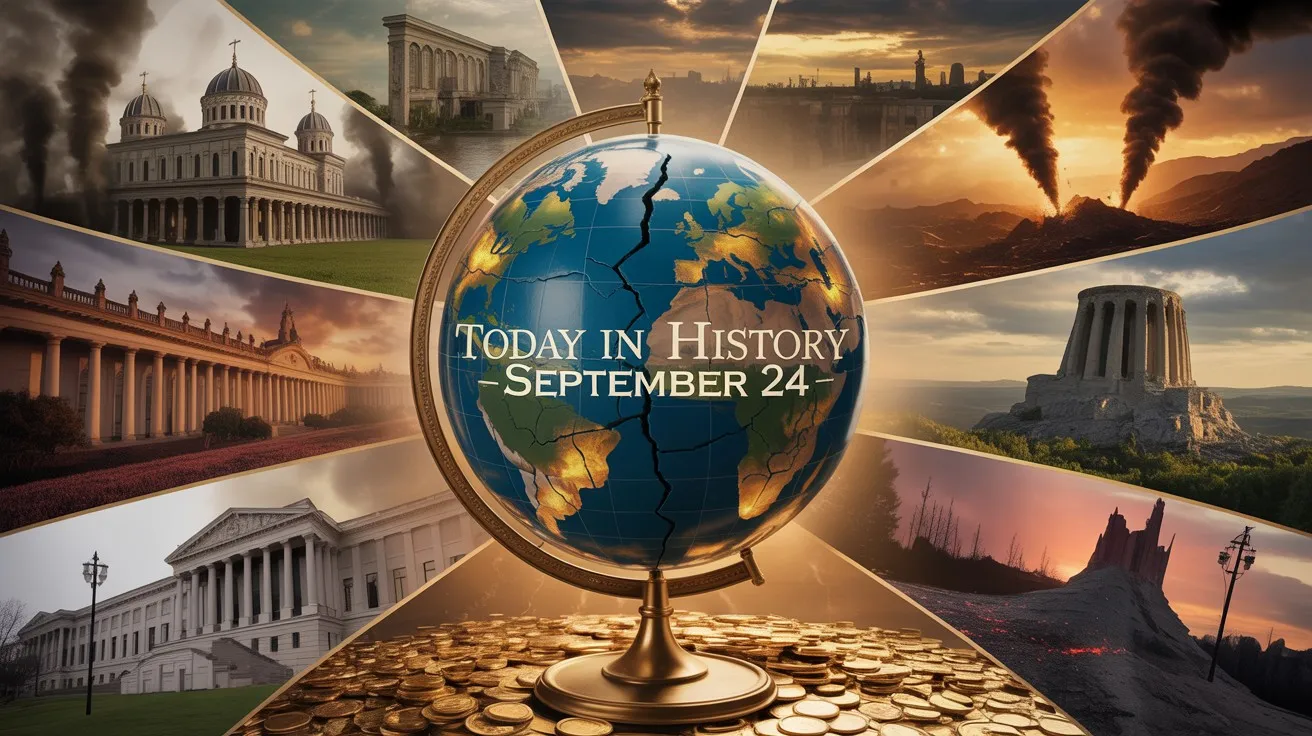
Landmark decisions, bold expeditions, nation-shaping milestones, and dramatic disasters have unfolded on this date, influencing the world we know. Today in History September 24 connects medieval councils, naval confrontations, trailblazing aviation, turbulent weather, and space triumphs with consequences that echo into the present.
Major Events on September 24
787 — Second Council of Nicaea Assembles at Hagia Sophia
The Second Council of Nicaea met in 787 at Constantinople’s Hagia Sophia to settle disputes over icon veneration in the Christian world. Delegates debated whether icons could be used in worship and ultimately restored the use of icons, reversing earlier iconoclast policie.
The council’s decisions had deep theological and political consequences across Byzantium and Western Christendom. Its rulings shaped liturgical practice and ecclesiastical authority for centuries.
1568 — Battle of San Juan de Ulúa: Spanish Defeat English Fleet
At San Juan de Ulúa near Veracruz in 1568, Spanish naval forces routed an English fleet commanded by John Hawkins, a stark episode in early Anglo-Spanish maritime rivalry. The confrontation underscored the hazards of early transatlantic commerce and privateering, and it hardened antagonisms that would lead to later clashes between the two seafaring powers.
Survivors’ accounts emphasized the brutality and confusion of naval combat in the era of sail. The battle influenced English strategies for future voyages and colonial ventures.
1645 — Battle of Rowton Heath: Parliamentarian Victory
The Battle of Rowton Heath saw Parliamentarian forces defeat a Royalist army personally commanded by King Charles I, a blow to Charles’s cause during the English Civil Wars. The engagement illustrated the increasing effectiveness of Parliament’s military leadership and the erosion of Royalist momentum.
Tactical setbacks like Rowton Heath contributed to the eventual capture and trial of Charles I. The battle is a piece of the larger political and military collapse of the Stuart monarchy in mid-17th-century England.
1674 — Second Tantrik Coronation of Shivaji
September 24 is recorded for Shivaji’s second Tantrik coronation, an event in the Maratha founder’s consolidation of regal and religious legitimacy. The coronation rituals underscored Shivaji’s efforts to root his authority in indigenous political and spiritual traditions while legitimizing Maratha sovereignty.
Ceremonial reinforcements like a second coronation helped mobilize support among regional elites and temples. This period consolidated the foundations of a rising Maratha polity in western India.
1789 — Judiciary Act Creates U.S. Federal Judiciary and Attorney General
On this date in 1789, the United States Congress passed the Judiciary Act, establishing the federal judiciary’s structure and creating the office of the Attorney General. The Act defined the Supreme Court’s composition, set up circuit and district courts, and provided a framework for federal judicial authority under the new Constitution.
Its passage was a foundational moment in the development of U.S. constitutional governance and the separation of powers. The institutional architecture it created continues to shape American law and litigation.
1830 — Provisional Government of Belgium Formed
In 1830 a revolutionary committee of notables formed the Provisional Government of Belgium, setting in motion Belgian independence from the United Kingdom of the Netherlands. The provisional government coordinated the diplomatic and constitutional steps that produced an independent Belgian state.
Its formation came amid broader 19th-century waves of national self-determination across Europe. Belgium’s birth as a nation-state reconfigured small-state diplomacy and industrial geography on the Continent.
1841 — Sultanate of Brunei Cedes Sarawak to James Brooke
In 1841 the Sultanate of Brunei ceded Sarawak to James Brooke, inaugurating the Brooke dynasty’s rule in that Bornean region. Brooke’s proprietorship blended personal rule with imperial patterns, reshaping local governance and economic exploitation.
The cession is an example of how European adventurers and local rulers negotiated territorial control in Southeast Asia before formal colonial annexation. Sarawak’s subsequent history intertwined dynastic rule, resource extraction and eventual integration into modern Malaysia.
1846 — Mexican–American War: Zachary Taylor Captures Monterrey
General Zachary Taylor captured Monterrey in 1846 during the Mexican–American War, an operation that opened routes for further U.S. advances into northern Mexico. The city’s fall revealed operational challenges in urban assault and occupation for mid-19th-century armies.
Monterrey’s capture influenced campaign momentum and diplomatic bargaining over territorial outcomes. The war’s broader legacy includes contested borders and long-term political consequences for both nations.
1852 — Giffard Dirigible’s First Powered Passenger Flight
The Giffard dirigible made the first powered, passenger-carrying airship flight in 1852, traveling about 17 miles (27 km) from Paris to Trappes. The flight demonstrated the practical potential of powered lighter-than-air travel and foreshadowed later developments in airship design and aviation.
Though early airship technology would have limited commercial lifespan compared with heavier-than-air craft, Giffard’s voyage marked a key experimental milestone. It remains a landmark in the history of human flight.
1853 — France Takes Possession of New Caledonia (Admiral Despointes)
In 1853 Admiral Despointes formally took possession of New Caledonia in the name of France, extending French imperial reach into the Pacific. The annexation began a colonial era that transformed the islands’ political economy and indigenous societies.
French control of New Caledonia became strategically and commercially important across subsequent decades. The event is an example of mid-19th-century European colonial expansion in Oceania.
1869 — Black Friday Panic: Government Sells Gold to Break Speculation
The 1869 “Black Friday” panic erupted when gold prices collapsed after President Ulysses S. Grant ordered the Treasury to sell large quantities of gold, undermining a speculative scheme by Jay Gould and James Fisk to corner the market.
The government intervention exposed vulnerabilities in postwar American financial markets and provoked public outcry over market manipulation. Aftermath reforms and market reactions marked an important chapter in the maturation of U.S. financial regulation. Black Friday underscored the political stakes of financial speculation in a growing capitalist economy.
1877 — Battle of Shiroyama Ends the Satsuma Rebellion
At Shiroyama in 1877 imperial Japanese forces decisively defeated the remnants of the Satsuma Rebellion led by Saigō Takamori, effectively ending the uprising. The battle symbolized the Meiji government’s consolidation of centralized authority and the modernization of Japan’s military.
Saigō’s death turned him into a complex national symbol—both a rebel and a tragic hero in later memory. The suppression of the rebellion affirmed the transition from samurai-led domains to a modern state.
1890 — LDS Officially Renounces Polygamy
In 1890, the Church of Jesus Christ of Latter-day Saints officially renounced the practice of polygamy, a formal change that had major legal and social implications for the Mormon community and its relationship with the U.S. government.
The 1890 Manifesto helped pave the way for Utah’s eventual statehood and reduced federal antipolygamy pressures. The decision reflected both internal pressures and external political realities confronting religious movements in America. It remains a turning point in LDS institutional history.
1906 — Devils Tower Designated First U.S. National Monument; Atlanta Race Riot
President Theodore Roosevelt proclaimed Devils Tower in Wyoming as the nation’s first National Monument in 1906, launching a conservation precedent under the Antiquities Act. The designation signaled an evolving federal commitment to preserve natural landmarks for public benefit and scientific study.
On the same date in 1906, racial tensions in Atlanta exploded into the Atlanta Race Riot, a violence-fueled outbreak that reflected deep social fractures and led to increased segregation and suppression of Black civic life. Together these events show how public policy and social conflict often coexist in the same historical moment.
1911 — Britain’s Rigid Airship No.1 Wrecked Before Maiden Flight
His Majesty’s Airship No. 1, Britain’s first rigid airship, was wrecked by strong winds at Barrow-in-Furness in 1911 before it could make its maiden flight. The mishap illustrated the technical and meteorological hazards confronting early 20th-century airship ambitions.
Losses like this tempered immediate optimism for large rigid airships and underscored the engineering challenges of controlled lighter-than-air navigation. Yet, the episode also contributed lessons for subsequent aeronautical experimentation.
1929 — Jimmy Doolittle Proves Full Instrument Flight Possible
Jimmy Doolittle demonstrated that an aircraft could be flown solely by instruments from takeoff to landing in 1929, a breakthrough that transformed aviation safety and instrument training. His flight proved that pilots could rely on cockpit instruments in poor visibility, enabling safer operations in adverse weather and paving the way for modern instrument flight rules.
Doolittle’s achievement accelerated adoption of navigational aids and instrument-based pilot certification worldwide. The result was a dramatic improvement in commercial and military aviation reliability.
1932 — Poona Pact: Gandhi and Ambedkar Agree on Reserved Seats
Mahatma Gandhi and Dr. B. R. Ambedkar reached the Poona Pact in 1932, an agreement to reserve seats for the “Depressed Classes” (later called Scheduled Castes) in provincial legislatures within a joint electorate. The pact resolved a bitter dispute over separate electorates and represented a major compromise in India’s constitutional politics under British rule.
It affected representation for marginalized communities and shaped later debates over affirmative action and social justice. The Poona Pact remains a significant milestone in India’s struggle over caste, representation and political reform.
1937 — The Hobbit by J.R.R. Tolkien Is Published
J. R. R. Tolkien’s The Hobbit first appeared in 1937, introducing readers to Middle-earth and launching a literary phenomenon that would expand into The Lord of the Rings. The novel’s lexicon, mythic structure, and narrative voice influenced generations of fantasy writers and artists.
The Hobbit helped legitimize fantasy as a serious literary tradition and later inspired major adaptations in other media. Its publication remains a touchstone in modern popular culture.
1938 — Don Budge Wins U.S. Open (Tennis Grand Slam)
In 1938 Don Budge won the U.S. Open, becoming the first player in tennis history to complete a Grand Slam that year. His achievement marked a milestone in competitive tennis and helped elevate the sport’s international profile. Budge’s dominance underscored the rise of modern athletic professionalism and international tournaments. His Grand Slam set a high bar in tennis history.
1946 — Cathay Pacific Founded; Clifford-Elsey Report Delivered to Truman
Cathay Pacific Airways was founded in Hong Kong in 1946, beginning what would grow into a major Asian carrier central to regional and global aviation. In the same postwar year the top-secret Clifford-Elsey Report on Soviet-American relations was delivered to President Truman, shaping early Cold War assessments and policy.
The twin events show how commercial expansion and geopolitical intelligence often advanced in parallel in the immediate postwar years. Both developments influenced the trajectories of aviation and international diplomacy.
1948 — Honda Motor Company Founded
Honda Motor Company was founded in 1948, marking the start of a global automotive and motorcycle manufacturer that would become synonymous with engineering innovation and international expansion. Honda’s origins in postwar Japan reflected broader industrial recovery and technological entrepreneurship across Asia.
Over following decades the company’s growth shaped transportation markets and engineering cultures worldwide. Honda’s founding remains a classic case of postwar industrial dynamism.
1950 — Chinchaga Fire Haze Reaches Eastern United States
Smoke from the massive Chinchaga fire in western Canada created a thick haze that spread across the eastern United States in 1950, an environmental event that revealed how large-scale wildfires can have transboundary atmospheric impacts. The haze affected air quality and visibility, drawing attention to ecological vulnerability and the consequences of wildfire on distant populations.
The episode presaged later scientific study of smoke transport and climate interactions. It remains an early documented case of long-range environmental effects from fire.
1954 — AEC Routemaster Bus Introduced in London
London introduced the AEC Routemaster bus in 1954, an iconic double-decker that would become a widely recognized symbol of the city’s public transport identity. The Routemaster combined modern engineering with durable design, serving decades of urban transit and tourism.
Its distinctive profile and cultural resonance made it a design classic and a subject of nostalgic preservation efforts. The bus’s debut signaled a mid-century renewal of public transit technology and design.
1957 — Federal Troops Enforce Desegregation at Little Rock
In 1957 President Eisenhower dispatched the 101st Airborne Division to Little Rock, Arkansas, to enforce school desegregation following violent resistance to Black students’ attendance at Central High School. The federal intervention underscored the national government’s willingness to uphold Supreme Court mandates against entrenched local opposition.
Little Rock became an emblematic moment in the U.S. civil rights struggle and in the politics of federalism, law and social change. The episode remains a vivid example of how military force was used domestically to protect constitutional rights.
1960 — USS Enterprise, First Nuclear-Powered Aircraft Carrier, Launched
The USS Enterprise, the world’s first nuclear-powered aircraft carrier, was launched in 1960, representing a major leap in naval propulsion and strategic mobility. Nuclear power allowed carriers to operate longer without refueling, reshaping naval logistics and global reach during the Cold War.
Enterprise’s deployment symbolized technological prowess and underscored the sea-based dimensions of nuclear-era deterrence. The ship served for decades as a centerpiece of U.S. naval capability.
1973 — Guinea-Bissau Declares Independence from Portugal
Guinea-Bissau declared independence from Portugal in 1973, a key moment in the Portuguese empire’s disintegration and the wider African decolonization wave. Independence followed a prolonged liberation struggle and negotiations that reshaped West African political boundaries.
The declaration contributed to the pressure that eventually forced Lisbon to relinquish other colonial holdings. Guinea-Bissau’s statehood added to the postcolonial map of sovereign African nations.
1975 — Southwest Face Summit: New Route on Mount Everest
In 1975 climbers on the Southwest Face expedition became the first to reach Mount Everest’s summit by any of its faces rather than by a ridge route, opening new technical possibilities for high-altitude mountaineering.
The accomplishment signaled advances in climbing technique, equipment and route-finding. Opening a new face route expanded the mountain’s challenge profile and inspired subsequent ambitious ascents. It remains a milestone in the history of Himalayan exploration.
1993 — Cambodian Monarchy Restored with Norodom Sihanouk
In 1993 the Cambodian monarchy was restored and Norodom Sihanouk returned to the throne, part of a negotiated settlement following decades of conflict and international intervention. The restoration aimed to unify factions and stabilize national governance after the Khmer Rouge era and subsequent turmoil.
Monarchy’s restoration was a symbolic step toward political normalization and reconciliation, though Cambodia’s path remained fraught with challenges. The event signaled hope for institutional recovery and continuity.
1996 — CTBT Signed by Representatives of 71 Nations
Representatives of 71 nations signed the Comprehensive Nuclear-Test-Ban Treaty at the United Nations in 1996, a major diplomatic effort to curb nuclear proliferation and testing. While the treaty’s entry into force would later hinge on specific ratifications, the signing event reflected broad international momentum for arms-control regimes. CTBT’s signature underscored global concern about nuclear testing’s environmental, health and security consequences. It remains a central pillar of normative non-proliferation architecture.
2005 — Hurricane Rita Devastates Gulf Coast
Hurricane Rita made landfall in 2005, devastating parts of southwestern Louisiana and extreme southeastern Texas and contributing to widespread displacement and infrastructure damage. Rita exacerbated ongoing Gulf Coast recovery challenges following Hurricane Katrina and highlighted the vulnerability of coastal communities to major storms.
The storm triggered large-scale evacuations and stressed disaster-response capacities across multiple jurisdictions. Rita’s impact influenced subsequent policy debates about resilience, levees and emergency planning.
2007 — Massive Anti-Government Protests in Yangon, Burma (Myanmar)
Between 30,000 and 100,000 people joined anti-government protests in Yangon in 2007—some of the largest demonstrations in two decades—to challenge the military-backed regime, signaling renewed popular resistance and international concern. The protests, often associated with the so-called Saffron Revolution, involved monks and civil society and prompted a harsh security crackdown.
Yangon’s unrest focused global attention on Myanmar’s human-rights record and generated waves of sanctions and advocacy. The demonstrations remain a touchstone in the country’s long struggle for democratic transition.
2008 — Thabo Mbeki Resigns as President of South Africa
Thabo Mbeki resigned as president of South Africa in 2008 amid party and political pressures, precipitating a transition in leadership within the ruling African National Congress. His resignation followed internal party disputes and allegations around governance and political interference.
The event marked a significant moment in South Africa’s post-apartheid political evolution and realignments. Mbeki’s departure reshaped party dynamics and policy debates in the subsequent period.
2009 — G20 Summit Begins in Pittsburgh; SA Airlink Crash Near Durban
The 2009 G20 summit convened in Pittsburgh with 30 world leaders to coordinate responses to global financial crises and economic recovery strategies. The summit highlighted multilateral approaches to macroeconomic stabilization and regulatory reform after the 2008 crash. On the same day SA Airlink Flight 8911 crashed near Durban International Airport, killing the pilot and injuring crew; the accident underscored ongoing aviation safety concerns.
These parallel events show how global governance forums and everyday risks can occupy public attention simultaneously.
2013 — 7.7 Magnitude Earthquake Strikes Southern Pakistan
A 7.7-magnitude earthquake struck southern Pakistan in 2013, killing at least 327 people and causing widespread destruction across Balochistan and Sindh provinces. The quake generated urgent rescue and relief operations and highlighted the region’s vulnerability to major tectonic events.
Recovery and rebuilding posed long-term humanitarian and infrastructural challenges for affected communities. The disaster drew international assistance and underscored needs for resilient construction and preparedness.
2014 — India’s Mars Orbiter Mission Reaches Mars Orbit on First Attempt
India’s Mars Orbiter Mission (MOM) achieved orbit around Mars in 2014, making India the first Asian nation to reach Mars orbit and the first country to succeed on its maiden attempt. The milestone showcased India’s growing capabilities in space science and cost-effective mission design.
MOM’s success boosted national pride, spurred scientific interest, and signaled a shift in global space participation beyond traditional spacefaring nations. The mission remains a landmark in space exploration history.
2015 — Hajj Stampede Kills Hundreds; Massive Casualty Discrepancies Reported
During the 2015 Hajj in Saudi Arabia a stampede resulted in tragic loss of life; official Saudi figures reported 769 deaths while some other estimates suggested several times that number, with total casualties widely debated. The incident became one of the deadliest accidents in the pilgrimage’s modern history and prompted scrutiny of crowd-management, infrastructure and emergency procedures at mass religious events.
The tragedy spurred calls for operational reforms and international conversation about pilgrimage safety. Its human toll reinforced the urgency of coordinated disaster mitigation for large public gatherings.
2023 — OSIRIS-REx Sample Return Lands Safely on Earth
NASA’s OSIRIS-REx mission returned its capsule containing samples from asteroid 101955 Bennu to Earth in 2023, a major scientific achievement in planetary science and sample-return technology. The recovered material will enable laboratory study of primordial solar-system materials, organic compounds and planetary formation processes.
OSIRIS-REx’s success expanded the toolkit for comparative planetology and informed future sample-return missions. The return marked a high point in robotic exploration and laboratory analysis collaboration worldwide.
Quick sections
Earlier History
- 787 — Second Council of Nicaea meets at Hagia Sophia and restores icon veneration.
- 1568 — San Juan de Ulúa underscores early Anglo-Spanish naval rivalry.
- 1645 — Rowton Heath indicates Parliamentarian military gains in the English Civil Wars.
Exploration & Imperial Expansion
- 1841 — Sarawak ceded to James Brooke by Brunei.
- 1853 — France annexes New Caledonia (Admiral Despointes).
- 2023 — OSIRIS-REx returns samples from asteroid Bennu.
Politics, Law & Statecraft
- 1789 — Judiciary Act establishes U.S. federal judiciary and Attorney General.
- 1830 — Belgian provisional government signals independence.
- 1996 — CTBT signing reflects arms-control momentum.
Science, Technology & Transport
- 1852 — Giffard dirigible carries first powered passengers.
- 1929 — Doolittle’s instrument flight revolutionizes aviation safety.
- 1960 — USS Enterprise launched as the first nuclear-powered carrier.
- 1948 — Honda founded begins a major industrial story.
Culture & Media
- 1937 — The Hobbit published; modern fantasy gains a landmark text.
- 1995 — BBC Pride and Prejudice miniseries (user-supplied note) became a celebrated adaptation.
- 1921–2000s assorted cultural debuts noted in source material.
Disasters & Human Rights
- 1906 — Atlanta Race Riot highlights racial tensions and segregation.
- 1921 — Oppau silo explosion (not in this raw list but analogous industrial disasters noted elsewhere).
- 2005 — Hurricane Rita and 2013 Pakistan earthquake—major natural disasters.
- 1957 — Little Rock enforcement marks a federal intervention for civil rights.
Notable births
- 1896 — F. Scott Fitzgerald — American novelist, The Great Gatsby.
- 1877 — Saigō Takamori — Japanese samurai leader of the Satsuma Rebellion (died 1877).
- 1755 — John Marshall — Fourth Chief Justice of the United States; architect of judicial review.
- 1936 — Jim Henson — Puppeteer and creator of the Muppets.
- 1930 — John W. Young — Astronaut (Gemini, Apollo, Shuttle).
- 1948 — Phil Hartman — Actor and comedian.
- 1501 — Girolamo Cardano — Physician and mathematician (Ars magna).
- 1853 — Heike Kamerlingh Onnes — Physicist; Nobel laureate for superconductivity.
- 1874 — Gustav Holst — Composer of The Planets.
- 1912 — Chuck Jones — Animator, Looney Tunes director.
Notable deaths
- 1877 — Saigō Takamori — Samurai and rebel leader (died after Satsuma Rebellion).
- 366 — Liberius — Pope (served 352–366).
- 768 — Pippin III (the Short) — King of the Franks and Carolingian dynasty founder.
- 1143 — Innocent II — Pope (reign 1130–1143).
- 1939 — Carl Laemmle — Film producer and Universal Studios founder.
- 1945 — Hans Geiger — Physicist, inventor of the Geiger counter.
- 1978 — Ida Noddack — Chemist who proposed early ideas about nuclear fission.
- 1998 — Florence Griffith Joyner — Olympic sprinter and world-record holder.
- 2020 — Arthur Ashkin — Nobel laureate in physics (optical tweezers).
Holidays & observances (selected / user-supplied)
- Autumnal equinox observances (Northern Hemisphere) / Vernal equinox observances (Southern Hemisphere) — seasonal festivals around the equinox.
- Spring Day — Argentina (noted in supplied material as equinox-related).
- Arbor Day — Brazil.
- Commemoration of the Declaration of Martial Law — Philippines (controversial civic observance).
- Founder’s Day / National Volunteer Day — Ghana.
Final Thoughts on Today in History September 24
September 24 is a patchwork of human ambition and vulnerability: councils setting doctrine, daring flights testing human limits, acts of statecraft creating new nations, and storms and accidents reminding us of frailty. The entries for this date show how the same calendar day can contain seeds of invention and rupture—often in the same year—so editors can use the Major Events for features and the thematic quick sections for link curation.
Short FAQs
What was the Judiciary Act of 1789?
The Judiciary Act of 1789 established the structure of the U.S. federal judiciary, created the office of the Attorney General, and set up the Supreme Court’s initial composition—foundational steps for American constitutional law.
Why is the Giffard dirigible important?
The 1852 Giffard dirigible was the first powered airship to carry a passenger, proving controlled powered lighter-than-air travel was feasible and laying the groundwork for future airship experimentation.
Did India really reach Mars on its first attempt?
Yes—India’s Mars Orbiter Mission reached Martian orbit in 2014 on its first attempt, a major achievement in cost-effective space engineering and Asian space exploration.
What made the Oppau/industrial disasters historically significant?
Large industrial accidents expose safety failings and catalyze regulatory, engineering, and emergency-response reforms; these disasters often produce long-term changes in industrial practice.