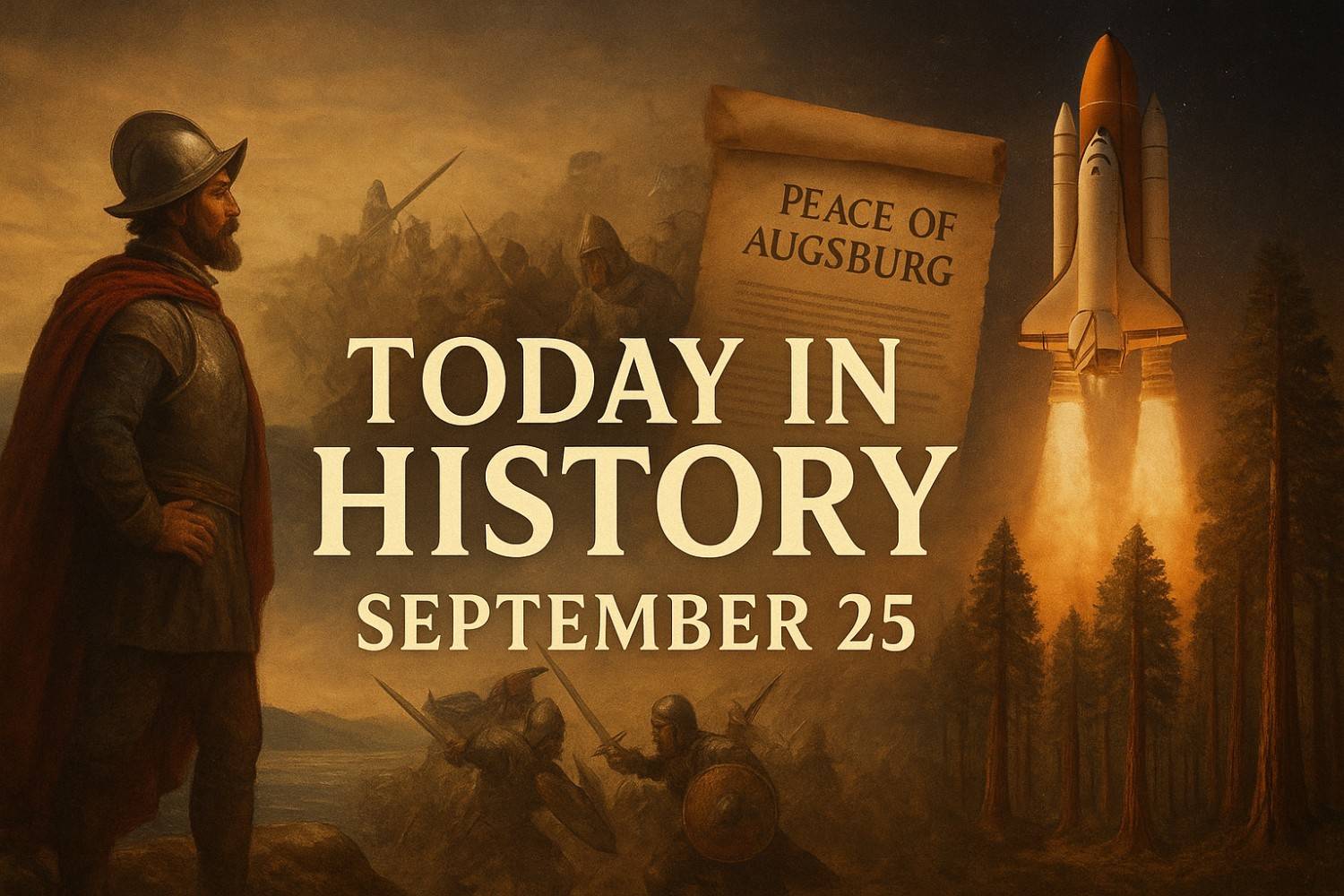
Great clashes, foundational laws, daring explorations and modern political shifts all converge on this date. Today in History — September 25 highlights senate choices, revolts, naval battles, technological firsts and turning points that reshaped borders, ideas and societies.
Major Events on September 25
275 — Roman Senate Elects Marcus Claudius Tacitus (last senatorial emperor)
In 275 the Roman Senate formally chose Marcus Claudius Tacitus as emperor — the last clear instance where the Senate’s choice of ruler is recorded. Tacitus, an elderly aristocrat, was elevated at a moment when military power increasingly decided succession, making his selection symbolically significant.
His brief rule underscores the late empire’s political instability and the shrinking practical power of senatorial institutions. Tacitus’s elevation is often read as one of the final gestures of republican formality in an era dominated by military strongmen.
762 — Alid Revolt Begins under Muhammad al-Nafs al-Zakiyya
Led by Muhammad al-Nafs al-Zakiyya, the Hasanid branch of the Alids rose in revolt against the early Abbasid Caliphate in 762. The uprising reflected enduring dynastic rivalries and religious-political claims tied to descent from the Prophet’s family.
Although suppressed, the revolt revealed the fragility of early Abbasid control and helped shape later sectarian and political fault lines within the Islamic world. Its memory fed subsequent regional challenges to the Abbasid authority.
1066 — Battle of Stamford Bridge: Harald Hardrada Defeated by Harold II
At Stamford Bridge King Harold II of England defeated the invading Norwegian king Harald Hardrada, ending his bid to press Viking claims on the English throne. The engagement was a dramatic, costly victory for Harold’s army; while it removed the northern threat, it left English forces exhausted and forced to march south almost immediately.
That rapid redeployment contributed to Harold’s weakened position at the Battle of Hastings days later. Stamford Bridge therefore stands as both a notable victory and a strategic prelude to the Norman Conquest.
1237 — Treaty of York Establishes Anglo-Scottish Border
England and Scotland signed the Treaty of York in 1237, fixing much of the border between the two kingdoms and reducing a long-standing source of frontier dispute. The settlement clarified jurisdictional and territorial claims, stabilizing relations for a time and shaping later legal and administrative boundaries.
By formalizing the border, the treaty influenced trade, defense and cross-border polity across subsequent centuries. It remains a milestone in the diplomatic settlement of Britain’s northern frontier.
1396 — Bayezid I Defeats Crusader Army at Nicopolis
Ottoman Sultan Bayezid I routed a large Christian crusader force at the Battle of Nicopolis, cementing Ottoman advances into southeastern Europe. The defeat discredited large-scale western crusading expeditions of the period and accelerated Ottoman consolidation in the Balkans.
Nicopolis signaled a major shift in regional power balances and altered diplomatic calculations among European states.The victory underscored the military effectiveness and strategic reach of the expanding Ottoman polity.
1513 — Vasco Núñez de Balboa Sights the Pacific Ocean
Spanish explorer Vasco Núñez de Balboa climbed a Darién peak and became the first European to behold the sea later called the Pacific, a momentous geographic revelation for Europeans. Balboa’s sighting transformed European conceptions of the world and reoriented Spanish imperial aims across both Atlantic and Pacific coasts.
The event marked the opening of transoceanic ambitions and laid foundations for later Pacific navigation and colonial competition. It remains a defining “first glimpse” in the age of exploration.
1555 — Peace of Augsburg Signed (Religious Settlement in the Holy Roman Empire)
The Peace of Augsburg (1555) allowed imperial princes to determine their territory’s religion — Catholicism or Lutheranism — under the formula cuius regio, eius religio. The settlement temporarily eased confessional conflict by legalizing Lutheran practice, but it excluded other reform movements and left unsolved tensions that later erupted into wider wars.
The Peace of Augsburg reshaped the empire’s political-religious order and introduced a territorial logic to confessional identity. Its limits eventually contributed to further confessional strife in Europe.
1690 — Publick Occurrences Both Forreign and Domestick Appears (First American Newspaper)
Publick Occurrences, the first newspaper printed in the Americas, was issued in 1690 but suppressed after its initial appearance, highlighting early colonial friction over public information. Its abrupt suppression illustrates how nascent print culture clashed with colonial authorities wary of uncontrolled news.
The episode foreshadowed later struggles over press freedom in North America and marks an early moment in the development of American public media. Though short-lived, the publication is historically significant as a precursor to later newspapers.
1768 — Unification of Nepal Advances
The campaigns and diplomacy that consolidated principalities into a unified Nepal continued around this period, helping bring multiple Himalayan polities under Shah rule. Unification reshaped the region’s political geography, establishing a new territorial state that later negotiated its position vis-à-vis British India and Tibet. The process laid institutional foundations for modern Nepal and influenced administrative and military reforms. It remains central to Nepalese national history.
1775 — Campaigns in Canada: Ethan Allen Captured; Arnold’s Expedition Begins
Ethan Allen’s attempt to seize Montreal at Longue-Pointe failed and ended with his capture, while Benedict Arnold’s expedition toward Quebec set off as part of a coordinated Continental attempt to bring Canada into the Revolution. These simultaneous northern operations show the Continental forces’ early strategic reach and the formidable logistical challenges they faced. Although ultimately unsuccessful, the campaigns demonstrate the Revolution’s ambitious scope and the hardships of campaigning in the harsh northern theater. They remain memorable episodes in early American military history.
1786 — Huancavelica Mine Collapse Disrupts Quicksilver Production
A collapse at the Huancavelica quicksilver mine in Peru killed over a hundred workers and disrupted mercury supplies essential for New World silver refining. The disaster had economic ripple effects across the Spanish Empire, since mercury (quicksilver) was crucial to the amalgamation process in silver mining.
Beyond immediate human tragedy, the event exposed the dangers of extractive colonial economies and the dependency of imperial finance on hazardous labor. Huancavelica stands as a grim example of the human and economic cost of colonial extraction.
1789 — U.S. Congress Proposes Twelve Amendments (Bill of Rights)
In 1789 the First Congress proposed twelve constitutional amendments; ten were ratified to become the Bill of Rights, entrenching liberties such as speech, assembly and due process. The proposed amendments rebalanced federal power and responded to ratification-era concerns about individual protections.
The Bill of Rights shaped American legal culture and constitutional interpretation for centuries to follow. The two unratified proposals (on apportionment and compensation) underscore the ongoing nature of constitutional design.
1790 — Anhui Opera Introduced in Beijing for the Qianlong Emperor’s Birthday
Four Anhui opera troupes performed in Beijing to honor the Qianlong Emperor’s eightieth birthday, introducing Anhui performance styles to the capital and influencing what became Peking opera. This cultural transfer via court patronage blended regional theatrical traditions and helped create a national stage art.
The brief event had long-term consequences for Chinese theatrical history and aesthetics. It’s a vivid example of how imperial ceremonies shaped cultural evolution.
1804 — Teton Sioux Demand Toll from Lewis and Clark Expedition
As the Lewis and Clark Expedition moved upriver in 1804, Teton Sioux demanded a boat as a toll — an episode that underscores indigenous agency in frontier interactions. Such demands reflect how Native polities negotiated control and access over movement through their territories, complicating narratives of passive indigenous reception.
The encounter is one of many in which indigenous diplomacy, force and negotiation shaped the course of Euro-American exploration. It illustrates the expedition’s diplomatic as well as geographic challenges.
1868 — Shipwreck of the Imperial Russian Frigate Alexander Nevsky off Jutland
The Imperial Russian steam frigate Alexander Nevsky was shipwrecked off Jutland in 1868 while carrying Grand Duke Alexei Alexandrovich, an episode that combined maritime hazard with high-profile royal travel. The wreck highlighted the hazards of 19th-century steam navigation and had diplomatic and reputational repercussions in naval circles.
Although not a major military event, the incident captured public attention because of the royal connection and the perils of modern seafaring. It is a reminder of the continuing risks of maritime travel during industrializing decades.
1890 — Sequoia National Park Established by U.S. Congress
The United States Congress established Sequoia National Park in 1890, preserving some of the world’s largest trees and marking an early stage in American conservation policy. The park’s creation reflected growing public and political interest in protecting natural wonders and set precedents for federal conservation authority.
Sequoia’s protection helped launch a national park ethic that would influence later environmental policy and tourism. The act stands as an early institutional commitment to preserving unique landscapes.
1906 — Torres Quevedo Demonstrates the Telekino (Remote Control Origin)
Leonardo Torres Quevedo remotely guided an electric boat in the Bilbao Abra in 1906 using his Telekino system, controlling the craft over roughly two kilometers — an early and influential demonstration of wireless remote control principles. The experiment anticipated later developments in radio control, robotics and unmanned systems by showing practical remote guidance of real vehicles with people aboard.
Torres Quevedo’s demonstration is often cited as a conceptual origin of modern remote-control technology. It bridged theoretical invention and tangible engineering achievement.
1911 — French Battleship Liberté Destroyed by Ammunition Explosion
In 1911 the French battleship Liberté suffered a catastrophic magazine explosion when degraded propellant charges detonated, destroying the vessel and killing many crew. The disaster exposed munitions storage vulnerabilities and prompted naval changes in ammunition handling and ship design.
The tragedy had immediate effects on French naval policy and long-term implications for how navies managed explosive ordnance. Liberté’s loss remains a sobering lesson in naval logistics and safety.
1912 — Columbia University Graduate School of Journalism Founded
Columbia University established its Graduate School of Journalism in 1912, aiming to professionalize reporting and improve journalistic standards in the United States. The school would become a leading center for training journalists, shaping generations of reporting practices and media ethics.
Its founding reflected Progressive Era commitments to professional education and public information. Columbia’s journalism program helped institutionalize practices that influence modern news media.
1915 — Second Battle of Champagne Begins (World War I)
The Second Battle of Champagne opened in 1915 as part of larger Allied offensives on the Western Front, aiming to break entrenched German lines. The battle illustrated the grinding nature of trench warfare and the immense human cost of attempts to achieve decisive breakthroughs in World War I.
Though it yielded limited territorial gains, it contributed to the war’s attritional character and lessons about industrialized combat. The engagement is one of many that shaped 20th-century military doctrine and remembrance.
1918 — Battle of Megiddo Ends (Sinai and Palestine Campaign)
The climax of General Edmund Allenby’s Sinai and Palestine campaign, the Battle of Megiddo concluded with decisive Allied victories that opened the Levant to British advances. The operation dislocated Ottoman forces and precipitated a rapid collapse of their southern fronts, reshaping the postwar Middle East.
Megiddo is considered a model of effective combined-arms maneuver in the campaign and had lasting geopolitical consequences in the region’s partition. The battle accelerated the end of Ottoman control in large parts of the Arab world.
1926 — Convention to Suppress the Slave Trade and Slavery Signed
In 1926 the international Convention to Suppress the Slave Trade and Slavery was first signed, signaling multilateral commitment to abolishing slavery and trafficking in the interwar period. The treaty represented an important normative step in international human-rights law and provided a basis for later enforcement efforts.
While implementation varied across states, the Convention stands as an early collective attempt to criminalize and eliminate slavery in peacetime law. It informed later human-rights instruments and enforcement mechanisms.
1937 — Battle of Pingxingguan: Chinese Eighth Route Army Wins Morale Boost
During the Second Sino-Japanese War the Chinese Eighth Route Army won a morale-boosting engagement at Pingxingguan in 1937, disrupting Japanese movement and providing propaganda momentum for Chinese forces. The clash, though limited tactically, became significant for Chinese resistance narratives and for guerrilla-style operations behind enemy lines.
It demonstrated effective use of ambush and local terrain against a better-equipped foe and helped galvanize popular support in occupied areas. Pingxingguan is remembered as an early symbolic victory in China’s long resistance.
1944 — British 1st Airborne Division Withdraws from Arnhem via Oosterbeek
Surviving elements of the British 1st Airborne Division withdrew from Arnhem through Oosterbeek in 1944 after the failure of Operation Market Garden to secure key Rhine crossings. The withdrawal marked the end of a costly but daring airborne attempt to shortcut the Allied advance into Germany; Arnhem’s defeat tempered Allied ambitions and cost many elite troops.
The operation’s lessons influenced subsequent planning for airborne operations and combined-arms logistics. Arnhem and Oosterbeek remain central to British airborne remembrance.
1955 — Royal Jordanian Air Force Founded
The Royal Jordanian Air Force was officially founded in 1955, forming a key component of Jordan’s modern armed forces and regional defense posture. Over subsequent decades the force developed into a symbol of Jordanian sovereignty and a partner in regional security cooperation.
Its establishment reflected state-building and military modernization trends in postcolonial Middle East states. The air force would later play roles in both defense and humanitarian missions.
1956 — TAT-1 Submarine Transatlantic Telephone Cable Inaugurated
The TAT-1 system, inaugurated in 1956, was the first transatlantic telephone cable, greatly improving voice communication capacity between North America and Europe. It replaced earlier unreliable radio telephone links and transformed diplomatic, commercial and personal communications across the ocean.
TAT-1’s success paved the way for subsequent undersea cable systems that underpin today’s global connectivity. Its inauguration was a milestone in telecommunications history.
1957 — Little Rock Central High School Integrated with Federal Troops
In 1957 the U.S. Army’s 101st Airborne was deployed to Little Rock, Arkansas, to enforce integration at Central High School, ensuring nine African-American students could attend despite violent local opposition. The intervention demonstrated federal resolve to uphold Supreme Court rulings on school desegregation and became an iconic moment in the U.S. civil-rights struggle.
Little Rock’s crisis highlighted the tensions between federal authority and local resistance to social change. The event remains a touchstone in American legal and social history.
1959 — Assassination of Prime Minister S. W. R. D. Bandaranaike
S. W. R. D. Bandaranaike, Ceylon’s prime minister, was mortally wounded in an assassination attempt by a Buddhist monk in 1959 and died the following day, plunging the newly independent country into political shock. The assassination exposed fragilities in postcolonial political orders and religiously motivated extremism in South Asian politics.
Bandaranaike’s death accelerated power struggles and had lasting effects on Ceylon’s democratic development (later Sri Lanka). The episode is a pivotal moment in the island’s post-independence history.
1962 — Algeria Declared Republic; North Yemen Civil War Begins
In 1962, the People’s Democratic Republic of Algeria was formally proclaimed with Ferhat Abbas as president of the provisional government, marking the formal end of the Algerian war of independence against France. In the same year, the North Yemen Civil War began when Abdullah al-Sallal deposed Imam al-Badr and declared a republic — a conflict that drew regional actors into a prolonged struggle.
Both events indicate the tumultuous reshaping of governance across the Arab world in the postcolonial era. They set trajectories that would influence regional politics for decades.
1963 — Lord Denning Releases the Profumo Affair Report (UK)
Lord Denning published the UK government’s official report on the Profumo affair in 1963, investigating political scandal and national security concerns stemming from ministerial misconduct. The report’s findings and the scandal’s publicity undermined public trust in government and contributed to cultural shifts in political accountability.
Profumo became shorthand for a passing era’s moral and political crisis in Britain and helped catalyze changes in media scrutiny of public figures. The affair shaped subsequent expectations of ministerial behavior.
1964 — Mozambican War of Independence Begins
The Mozambican War of Independence against Portuguese colonial rule began in 1964, initiating a long armed struggle led by FRELIMO that would eventually result in Mozambique’s independence in 1975.
The conflict was part of wider anti-colonial movements across Africa that challenged European imperial control. Mozambique’s liberation struggle involved regional dynamics, Cold War alignments and significant human costs. The war reshaped southern African geopolitics and inspired other independence efforts.
1969 — Organisation of Islamic Cooperation Charter Signed
The charter establishing the Organisation of Islamic Cooperation (OIC) was signed in 1969, creating a multilateral forum for cooperation among Muslim-majority states on political, economic, and cultural matters.
The OIC grew into a significant body for articulating collective positions on issues affecting the Muslim world and for coordinating diplomatic responses. Its foundation reflected postcolonial states’ search for collective representation in international affairs. The organisation continues to influence diplomacy among member states.
1974 — First Tommy John Surgery Performed by Dr. Frank Jobe
In 1974 Dr. Frank Jobe performed the first ulnar collateral ligament replacement (Tommy John surgery), a pioneering orthopedic procedure that would transform treatment for throwing athletes. The operation saved careers and revolutionized sports medicine by restoring stability to injured elbows with tendon grafts.
Tommy John surgery became a standard procedure in baseball and other throwing sports, changing athlete medical management. The success opened avenues for advanced reconstructive techniques in orthopedic surgery.
1977 — First Chicago Marathon Fielded (~4,200 Runners)
About 4,200 people participated in the first running of the Chicago Marathon in 1977, launching what would become one of the world’s major city marathons. The event grew into a major public sporting and civic spectacle, drawing elite athletes and recreational runners alike.
Chicago’s marathon helped define the late-20th-century boom in mass-participation road racing. It remains a key fixture on the global running calendar.
1978 — PSA Flight 182 Mid-air Collision Kills 144 (San Diego)
PSA Flight 182 collided mid-air with a Cessna and crashed into San Diego in 1978, killing all 135 on the airliner, both occupants of the Cessna and seven people on the ground. The disaster spurred investigations into air traffic control procedures, collision avoidance systems and regional flight safety.
Its human toll and legal aftermath led to reforms intended to reduce mid-air collision risk in congested airspace. The accident remains one of the deadliest in U.S. civil aviation history.
1981 — Belize Joins the United Nations
Belize gained UN membership in 1981 following independence, joining the international community as a newly sovereign state and expanding multilateral representation among small states. Membership signaled diplomatic recognition and access to global forums for development, security and law.
Belize’s admission reflects the continuing postcolonial expansion of the United Nations in the late 20th century. The country’s entry strengthened regional Caribbean voices in multilateral diplomacy.
1983 — Maze Prison Escape (IRA)
Thirty-eight IRA prisoners used smuggled weapons to hijack a prison meals lorry and escape from Maze Prison in 1983, in one of the most dramatic jailbreaks of the Northern Irish Troubles. The breakout illustrated the depth of organization and determination among paramilitary prisoners and intensified security and political responses in the region.
It became a high-profile incident within the larger conflict and influenced prison policy and counterterrorism measures. The escape remains a notorious episode in the Troubles’ history.
1985 — Larnaca Yacht Killings: Three Civilians Killed
In 1985 three civilians were killed in the Larnaca yacht killings, an incident attributed to alleged supporters of the Palestine Liberation Organization that raised tensions in the Eastern Mediterranean. The episode contributed to regional insecurity and complicated diplomatic relations among affected states.
It underlined how maritime and civilian targets could become flashpoints in broader geopolitical conflicts. The killings are a reminder of the era’s fraught regional politics.
1987 — Fijian Coup Overthrows Governor-General
In 1987 Lieutenant Colonel Sitiveni Rabuka led a coup that overthrew Fijian Governor-General Penaia Ganilau, initiating a period of political upheaval tied to ethnic and constitutional tensions. The coup reshaped Fiji’s political trajectory, producing constitutional changes and international concern about military intervention in politics.
Subsequent years saw cycles of instability and contested questions about governance and national identity. The 1987 coup remains a landmark in Fiji’s modern political history.
1992 — NASA Launches Mars Observer (Mission Later Fails)
NASA launched the Mars Observer in 1992, a mission intended to study Martian climate, geology and magnetic environment — but the probe failed just before orbital insertion about eleven months later. Despite the loss, Mars Observer’s instruments and objectives influenced later successful missions and scientific planning for Mars exploration.
The failure underscored the technical challenges of interplanetary missions and pushed improvements in spacecraft engineering and mission operations. Lessons learned contributed to more robust subsequent Mars probes.
1997 — Space Shuttle Atlantis Launched on STS-86 to Mir
NASA launched Space Shuttle Atlantis on STS-86 in 1997 to the Russian space station Mir, part of broader U.S.–Russian cooperation preceding the International Space Station era. The mission carried international crews and supplies, symbolizing post-Cold War collaboration in human spaceflight.
Atlantis’s flight strengthened operational links and technical experience for longer orbital partnerships. STS-86 is one chapter in the evolving story of multinational space endeavours.
1998 — PauknAir Flight 4101 Crashes near Melilla (Spain)
PauknAir Flight 4101, a British Aerospace 146, crashed near Melilla Airport in 1998, killing 38 people and prompting investigations into approach procedures and regional aviation safety. The accident highlighted the challenges of operating in constrained airspace and led to scrutiny of airline operations and local airport infrastructure.
Its human cost led to regulatory and procedural reviews intended to boost safety in similar contexts. The crash remains a tragic event in Spanish aviation history.
2003 — Mw 8.3 Hokkaidō Earthquake Strikes Offshore Japan
A powerful 8.3-magnitude earthquake struck just offshore Hokkaidō in 2003, generating intense shaking, infrastructural damage and regionally significant tsunami warnings. The quake tested Japan’s preparedness and emergency response systems and led to the rapid mobilization of search, rescue and reconstruction efforts.
Its geological impacts informed seismic research and local building-code reassessments. Hokkaidō’s quake is a reminder of Japan’s continual need for earthquake resilience.
2018 — Bill Cosby Sentenced to Prison for Aggravated Sexual Assault
In 2018 Bill Cosby was sentenced to three to ten years in prison after conviction for aggravated sexual assault, a high-profile legal culmination in a case that transformed public conversation about sexual violence and accountability. The sentence followed decades of allegations and shifting public attitudes that contributed to renewed scrutiny of powerful figures’ conduct.
Cosby’s conviction and sentencing were widely discussed in media and legal circles, underscoring changes in institutional responses to historic sexual-assault claims. The case is a landmark in cultural and legal reckonings around abuse.
2019 — UN IPCC Report on Oceans and Cryosphere Released
In 2019 the UN Intergovernmental Panel on Climate Change (IPCC) released a major report warning of severe sea-level and ocean impacts tied to climate change, emphasizing urgent adaptation and mitigation needs. The report synthesized scientific evidence on cryosphere loss, ocean warming and sea-level rise, informing policymakers and international negotiations.
Its stark findings influenced climate resilience planning and international climate diplomacy. The IPCC assessment underscored the accelerating risks to coastal communities and global ecosystems.
2020–2024 — Notable Headlines and Ongoing Crises (Selected)
From 2020 onward varied headlines marked the date in different years: a knife attack near the Charlie Hebdo site in Paris (2020), pandemic-era U.S. political and policy headlines, the first in-person QUAD leaders meeting (2021), reporting on Russia’s mobilization amid the Ukraine war (2022), a deadly fuel-depot explosion near Stepanakert (Artsakh) and tentative deal to end the Hollywood writers’ strike (2023), and escalations in Israel–Hezbollah fighting (2024).
These items reflect how a single calendar day can gather distinct, consequential news across years — from terrorism and domestic politics to international conflict and labor disputes. They show contemporary history’s rapid, often overlapping crises.
Quick Sections
Earlier History
- 275 — Tacitus elected: last clear instance of senatorial imperial selection.
- 1066 — Stamford Bridge: Norwegian invasion repelled; strategic prelude to Hastings.
- 1396 — Nicopolis: Ottoman victory that reshaped Balkan power.
Exploration & Colonial Foundations
- 1513 — Balboa sights Pacific: opens Spain’s Pacific ambitions.
- 1768 — Nepal unification: consolidation of Himalayan polities.
- 1890 — Sequoia National Park: early U.S. conservation milestone.
Wars & Politics
- 762 — Alid Revolt: dynastic challenge to Abbasid rule.
- 1775 — Canada campaigns: Ethan Allen and Benedict Arnold’s northern operations.
- 1918 — Megiddo ends: decisive Allied success in the Levant.
- 1964 — Mozambican War begins: anti-colonial struggle against Portugal.
Arts & Culture
- 1790 — Anhui opera to Beijing: seed for Peking opera’s development.
- 1937 — The Hobbit published: milestone for modern fantasy literature.
- 1995 — Pride and Prejudice (BBC) noted in supplied material as cultural highlight.
Science, Technology & Media
- 1906 — Telekino demo: early wireless remote-control experiment (Torres Quevedo).
- 1929 — Doolittle’s instrument flight: revolution in aviation safety.
- 1956 — TAT-1: first transatlantic telephone cable.
- 1992/1997 — Mars Observer / STS-86: mixed fortunes and cooperation in spaceflight.
Disasters & Human Rights
- 1786 — Huancavelica mine collapse: major colonial mining disaster.
- 1911 — Liberté explosion: naval munitions tragedy.
- 1978 — PSA Flight 182 crash: mid-air collision with high civilian toll.
- 2003 — Hokkaidō earthquake: major natural disaster with wide effects.
Notable births On This Day
- 1358 — Ashikaga Yoshimitsu — Japanese shogun who stabilized the Ashikaga shogunate.
- 1599 — Francesco Borromini — Baroque architect.
- 1613 — Claude Perrault — French physician and architect.
- 1627 — Jacques-Bénigne Bossuet — French bishop and orator.
- 1644 — Ole Rømer — Danish astronomer who measured light’s finite speed.
- 1657 — Imre Thököly — Hungarian leader.
- 1725 — Nicolas-Joseph Cugnot — built an early steam vehicle.
- 1734 — Louis-René-Édouard, prince de Rohan — French cardinal.
- 1737 — Jonathan Odell — Loyalist writer.
- 1750 — Abraham Gottlob Werner — German geologist.
- 1782 — Charles Robert Maturin — Irish Gothic novelist.
- 1793 — Felicia Dorothea Hemans — English Romantic poet.
- 1807 — Alfred Lewis Vail — telegraph pioneer.
- 1832 — William LeBaron Jenney — “father of the skyscraper.”
- 1843 — Thomas Chrowder Chamberlin — American geologist.
- 1847 — Vinnie Ream — sculptor (Lincoln statue).
- 1872 — Joseph H. Hertz — Chief Rabbi (Commonwealth).
- 1873 — Carlo Sforza — Italian diplomat and statesman.
- 1901 — Robert Bresson — French film director.
- 1969 — Catherine Zeta-Jones — Welsh actress.
Notable deaths On This Day
- 1066 — Tostig, Earl of Northumbria — Anglo-Saxon nobleman.
- 1392 — Saint Sergius of Radonezh — Russian spiritual leader.
- 1615 — Arabella Stuart — English noblewoman.
- 1626 — Théophile de Viau — French poet and dramatist.
- 1680 — Samuel Butler — English satirist.
- 1703 — Archibald Campbell, 1st Duke of Argyll — Scottish leader.
- 1727 — Sarah Kemble Knight — colonial diarist.
- 1777 — Johann Heinrich Lambert — a mathematician who proved π irrational.
- 1920 — Jacob H. Schiff — financier and philanthropist.
- 1928 — Richard F. Outcault — cartoonist, creator of The Yellow Kid.
- 1933 — Paul Ehrenfest — theoretical physicist.
- 1933 — Ring Lardner — American satirist.
- 1940 — Marguerite Clark — stage and silent-film actress.
- 1966 — Mina Loy — modernist poet and artist.
- 1971 — Hugo Black — U.S. Supreme Court justice.
- 1980 — Lewis Milestone — film director (All Quiet on the Western Front).
- 1986 — Nikolay N. Semyonov — Nobel laureate chemist.
- 1993 — Bruno Pontecorvo — physicist.
- 1997 — Jean Françaix — composer and pianist.
- 2000 — R. S. Thomas — Welsh poet and Anglican clergyman.
Holidays and Observances — September 25
- Armed Forces Day / Revolution Day (Mozambique) – Honoring both the nation’s independence struggle and its military.
- Bangladeshi Immigration Day (United States) – Marking the contributions of Bangladeshi immigrants.
- Christian feast days – Abadir and Iraja and Companions (Coptic Church); Aunarius; Anathalon (Archdiocese of Milan); Cadoc; Ceolfrith; Cleopas; Euphrosyne of Alexandria; Finbarr; Fermin of Amiens; Lancelot Andrewes (Church of England); Sergius of Radonezh (repose); Vincent Strambi.
- Eastern Orthodox liturgics – September 25 observances in the Orthodox calendar.
- Day of National Recognition for the Harkis (France) – Remembering Algerians who fought alongside French forces.
- National Research Administrators Day (United States) – Celebrating research administrators’ contributions to science and scholarship.
- National Youth Day (Nauru) – A day centered on youth empowerment and national development.
Final Thoughts on Today in History September 25
September 25 threads together moments of discovery, statecraft and human cost — from Balboa’s oceanic revelation and Torres Quevedo’s remote-control trial to judicial foundations, uprisings and devastating accidents. The date demonstrates how exploration, law, war and technology can all converge on single calendar days, producing outcomes that echo across politics, science and culture.
If You Want To Read September 24 Facts: Click Here
Short FAQs About September 25
Why is September 25 significant in exploration history?
Vasco Núñez de Balboa’s sighting of the Pacific (1513) and later technological trials like Leonardo Torres Quevedo’s Telekino (1906) bookend the date with exploration and early remote-control breakthroughs.
Was Publick Occurrences really the first American newspaper?
Yes — Publick Occurrences (1690) was the first newspaper printed in the Americas, though it was suppressed after its single issue, making it a short-lived but notable precursor to colonial press history.
What did the Peace of Augsburg accomplish on September 25, 1555?
The Peace of Augsburg allowed rulers within the Holy Roman Empire to choose Catholicism or Lutheranism for their realms, institutionalizing the territorial principle cuius regio, eius religio and shaping confessional politics in 16th-century Europe.
What major space and climate items are tied to this date in recent years?
NASA’s Mars Observer (1992 launch) and Space Shuttle Atlantis’s STS-86 mission to Mir (1997) mark space efforts tied to the date; the 2019 IPCC report on oceans and the cryosphere warned of severe sea-level and ocean impacts linked to climate change.