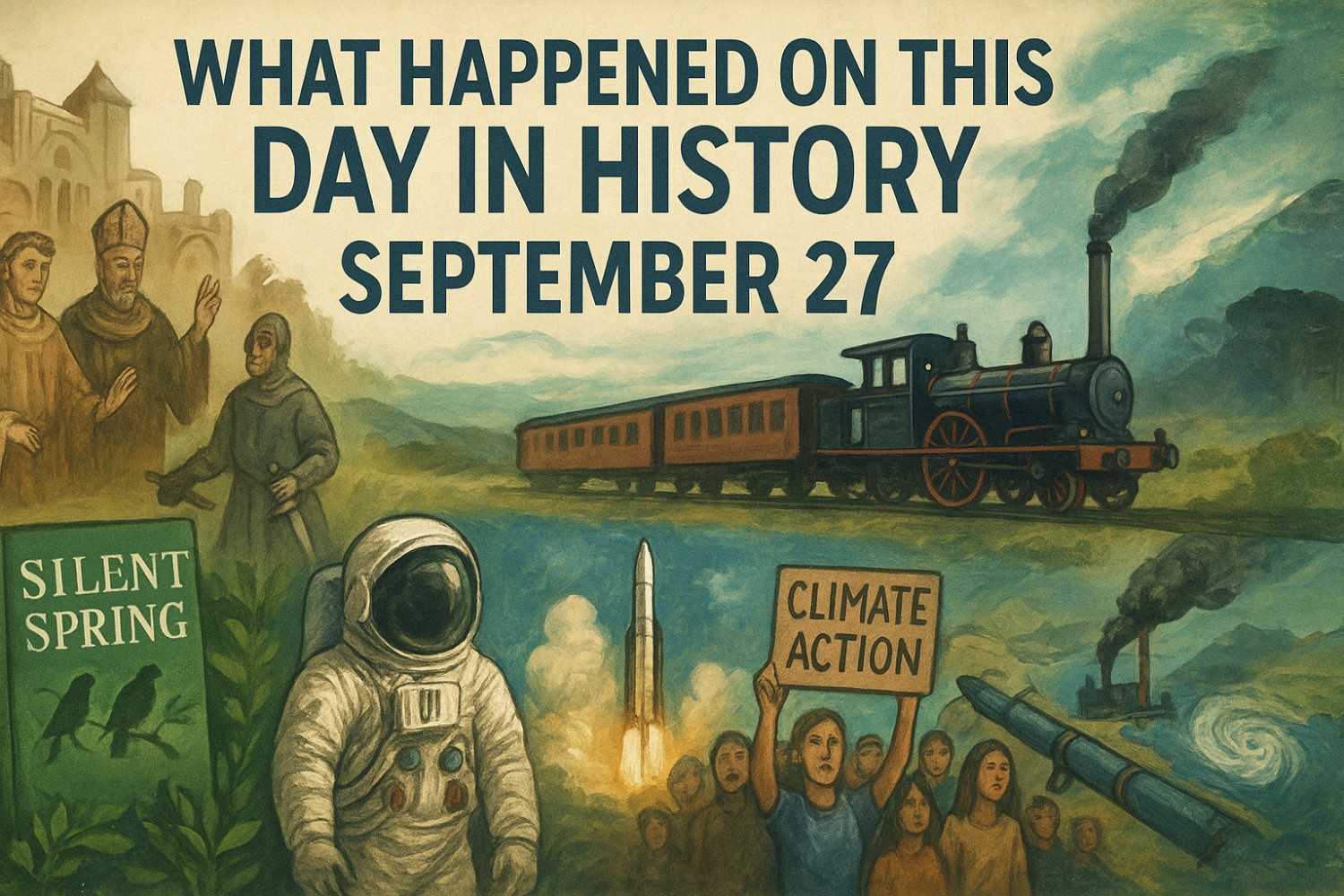
A mix of conquest, legal reforms, transport firsts, scientific breakthroughs and urgent modern crises falls on this date. Explore major world events and anniversaries with a focus on what happened on this day in history September 27, from historic conquests to scientific progress and political turning points.
Major Events on September 27
1066 — Norman Embarkation: William Sets Sail for England
William, duke of Normandy, finally put his invasion fleet to sea from the mouth of the Somme in 1066, beginning the campaign that would end Anglo-Saxon rule in England. The crossing required vast coordination of ships, horses and men and followed months of diplomatic maneuvering and weather delay.
This operational start made the later Battle of Hastings possible and set in motion deep changes to England’s aristocracy, language, and legal practices. The embarkation is therefore the decisive opening act of the Norman Conquest.
1331 — Battle of Płowce: Poland vs. the Teutonic Order
The Battle of Płowce in 1331 pitched Polish forces against the Teutonic Knights; although Polish leaders escaped, the fight checked the Order’s expansion. The clash was fierce and costly and became an emblem of Polish resistance to crusading orders in the region. While not a decisive rout, Płowce affected subsequent frontier diplomacy and military posture. The battle remains important in Polish medieval memory.
1422 — Treaty of Melno Ends the Gollub War
The Treaty of Melno (1422) concluded the brief Gollub War and fixed borders between the Teutonic Knights, Poland and Lithuania. The settlement resolved claims over Samogitia and produced a frontier that remained unusually stable for centuries.
By curbing the Knights’ expansion, Melno helped stabilize Baltic politics in the fifteenth century. The treaty is often cited as a durable diplomatic outcome in a volatile frontier zone.
1529 — Siege of Vienna Begins under Suleiman I
Suleiman the Magnificent began the 1529 siege of Vienna, marking a major Ottoman push into Central Europe. The siege tested Ottoman logistics and the limits of long-range campaigning in adverse seasons. Although the defenders held and the siege failed, the undertaking signaled Ottoman strategic reach and shaped European defensive coordination.
Vienna’s survival became a powerful symbol of resistance and later alliance-building.
1540 — Jesuit Order Receives Papal Charter
Pope Paul III granted the Society of Jesus (Jesuits) a papal charter in 1540, creating an order that would become central to Catholic education, mission and diplomacy. Jesuit schools and missions spread rapidly across Europe, Asia, Africa and the Americas, shaping intellectual and colonial encounters. Their organizational discipline and educational methods influenced early-modern statecraft and cultural exchange. The 1540 approval marks the institutional founding of one of Catholicism’s most influential orders.
1605 — Battle of Kircholm: Polish–Lithuanian Cavalry Victory
At Kircholm (1605), a smaller Polish–Lithuanian army routed Swedish forces, demonstrating the shock power of the Commonwealth’s cavalry, especially the Winged Hussars. The victory showcased tactical mobility and cohesion against a numerically larger opponent. Kircholm temporarily checked Swedish advances in the Baltic theater and remained celebrated in Commonwealth military history.
The battle is studied for its dramatic cavalry tactics and battlefield execution.
1669 — Fall of Candia Ends the 21-Year Siege
In 1669 Venetian defenders surrendered Candia (modern Heraklion), ending a 21-year siege and marking a significant Ottoman victory in the eastern Mediterranean. The lengthy attrition exhausted Venetian resources and signaled a shift in regional naval and territorial power.
Candia’s fall altered trade routes, diplomatic relations and Venetian strategic reach. The siege’s scale and cost make it one of early-modern Europe’s most consequential sieges.
1777 — Lancaster Serves as U.S. Capital for One Day
When the Continental Congress fled Philadelphia, Lancaster, Pennsylvania, hosted Congress for a single day on September 27, 1777. The brief relocation shows the practical fragility of revolutionary institutions under military pressure.
Despite being fleeting, Lancaster’s role preserved continuity in the revolutionary government during the crisis. The episode is a vivid example of statecraft under duress.
1791 — France Grants Full Citizenship to Jews
The National Assembly of France voted in 1791 to extend full citizenship to Jews, a landmark act of emancipation during the Revolution. The decision legally recognized Jews as equal citizens and challenged established religious and civic exclusions.
It set a precedent for later European movements toward civil equality and secular citizenship. The vote remains a key milestone in Jewish and European modern history.
1821 — Army of the Three Guarantees Enters Mexico City (Independence)
Agustín de Iturbide’s Army of the Three Guarantees entered Mexico City in 1821, and the following day Mexico formally declared independence from Spain. The entry consolidated diverse insurgent and conservative forces into a new political order and initiated Mexico’s fraught state-building process.
Independence reshaped political geography in the Americas and opened debates over monarchy, republicanism and social inclusion. The moment is ceremonial and decisive in Mexican independence.
1822 — Champollion Deciphers the Rosetta Stone, Founding Egyptology
Jean-François Champollion announced in 1822 that he had deciphered the Rosetta Stone, unlocking ancient Egyptian hieroglyphs after centuries of silence. His philological breakthrough enabled scholars to read pharaonic inscriptions and transformed archaeological knowledge of Egypt.
Champollion’s work generated a boom in excavation, museum collecting and historical reconstruction. The decipherment is a pillar of modern linguistics and ancient history scholarship.
1825 — Stockton & Darlington Railway Opens, First Public Steam Railway
The Stockton & Darlington Railway opened ceremonially in 1825 with the steam locomotive Locomotion, demonstrating the commercial viability of steam haulage for goods and passengers. The line catalyzed rail expansion that reshaped industry, labor, and urban growth across Britain and then the world.
Rail transport compressed distances, accelerated commodity flows and reorganized daily life. Stockton & Darlington is widely considered a founding moment of the railway age.
1854 — SS Arctic Sinks after Collision off Newfoundland
The paddle steamer SS Arctic sank in 1854 after colliding with the SS Vesta near Newfoundland, with heavy loss of life and only 88 survivors from over 300 aboard. The disaster exposed early maritime safety failures—lifeboat procedures, rescue priorities, and class disparities in survival.
Public outrage spurred debate about shipping safety and rescue standards on transatlantic routes. The sinking is a notorious 19th-century maritime tragedy.
1875 — Merchant Ship Ellen Southard Wrecked at Liverpool
The merchant sailing ship Ellen Southard was wrecked in a storm near Liverpool in 1875, an example of the persistent hazards of 19th-century commercial seafaring. Such losses underlined limits in weather forecasting and the vulnerability of wooden tonnage to North Atlantic storms.
The wreck contributed to incremental safety and rescue improvements within maritime services. Routine commercial voyages thus carried substantial risk in the era.
1903 — “Wreck of the Old 97” Rail Disaster and Ballad
The mail train Old 97 wrecked in 1903, killing 11 people and later becoming the subject of a popular American ballad. The accident prompted railroad safety inquiries and entered folk memory through song, showing how industrial calamities can be transformed into cultural narrative.
The ballad preserved the event in oral and recorded traditions for generations. Old 97 became a folkloric emblem of early 20th-century rail risk.
1908 — Ford Begins Model T Production at Piquette Avenue Plant
Ford Motor Company began producing the Model T in 1908 at the Piquette Avenue plant in Detroit, launching an era of affordable automobiles and later mass-production methods. The Model T’s popularity and the assembly-line techniques it inspired reshaped urban form, labor organization, and consumer society.
Automobiles altered commuting, suburban growth and the scale of personal mobility. The Model T is an archetype of industrial modernity.
1916 — Iyasu V Deposed in Ethiopia; Zewditu Elevated
In 1916 Iyasu V was proclaimed deposed in Ethiopia and his aunt Zewditu installed, a palace coup with deep implications for Ethiopian politics and dynastic legitimacy. The change reflected internal factionalism and external diplomatic pressures during World War I.
The succession altered Ethiopia’s domestic alignments and international posture. It illustrates how wartime contexts accelerate dynastic recalibrations.
1922 — King Constantine I Abdicates in Greece
King Constantine I of Greece abdicated on September 27, 1922, in favor of his son George II amid political and military upheaval following the Asia Minor catastrophe. The abdication reconfigured Greek politics and reflected the costs of war and national humiliation.
It ushered in a period of rapid governmental change and debate about the monarchy’s role in Greek life. The event shows how military defeat reshapes domestic legitimacy.
1928 — U.S. Recognition of the Republic of China
The United States formally recognized the Republic of China in 1928, a diplomatic move that reflected changing international alignments in East Asia. Recognition affected U.S. engagement in the region and its relations with China’s central government during a turbulent period of warlordism and national consolidation.
The step signaled a willingness to engage diplomatically with a modernizing Chinese state. It influenced subsequent U.S.–China interactions.
1930 — Bobby Jones Wins the (Pre-Masters) Grand Slam
Golfer Bobby Jones completed the pre-Masters Grand Slam in 1930, a dominant sporting achievement that elevated golf’s public profile worldwide. Jones’s performance helped professionalize and popularize the sport and contributed to its modern tournament structure.
His success had cultural resonance during the interwar years as a model of athletic excellence. Jones’s Slam remains a high-water mark in golf history.
1938 — Launch of the Ocean Liner Queen Elizabeth
The ocean liner Queen Elizabeth was launched in Glasgow in 1938, embodying prewar ambitions in transatlantic passenger travel and naval engineering. The ship later served in wartime troop transport and postwar passenger service, becoming an icon of maritime scale and prestige.
Its construction reflected industrial capability and imperial connectivity on the eve of global war. The liner’s launch is a milestone in twentieth-century shipbuilding.
1940 — Tripartite Pact Signed by Germany, Italy and Japan
Germany, Italy and Japan signed the Tripartite Pact in 1940, formalizing Axis cooperation and seeking to deter the United States from entering the war. The agreement linked theaters of war across Europe and the Pacific and intensified global polarization.
Its diplomatic and military implications extended throughout the early 1940s and shaped alliance politics. The pact is a defining wartime document.
1941 — Greek National Liberation Front Established; SS Patrick Henry Launched
On this date the Greek National Liberation Front was formed with Georgios Siantos as acting leader, organizing resistance against occupation in Greece. In the same period the SS Patrick Henry was launched as the first of the Liberty ships, marking U.S. industrial mobilization for WWII.
Both items illustrate wartime mobilization—political resistance in occupied Europe and mass shipbuilding in the U.S. The twin developments reflect the global scale of the conflict.
1942 — Matanikau Action Ends on Guadalcanal
September 27, 1942 marked the last day of the Matanikau action on Guadalcanal, where U.S. Marines escaped encirclement after heavy fighting with Japanese forces. The episode was one of several brutal ground engagements that characterized the Guadalcanal campaign’s attritional warfare.
Survival and tactical withdrawal preserved Allied footholds critical to later advances in the Pacific. The action is emblematic of the campaign’s intense island combat.
1944 — Kassel Mission: Largest USAAF Loss on a Single Mission
The Kassel Mission on September 27, 1944, resulted in the largest single-mission loss for a USAAF group during World War II, with heavy bomber casualties over Germany. The disaster underscored the high human cost of strategic bombing and operational risk in contested airspace.
It prompted operational reviews and influenced bomber tactic adjustments. Kassel remains part of the grim ledger of air-war losses.
1949 — Zeng Liansong’s Design Chosen as PRC Flag
Zeng Liansong’s five-star flag design was chosen in 1949 as the national flag of the People’s Republic of China, symbolizing party leadership and national unity. The selection provided a concise visual program for the new state and featured prominently in state ritual and identity formation.
As a national emblem, the flag has been central to PRC ceremonies and international representation. Its adoption was a key act of symbolic nation-building.
1956 — Captain Milburn G. Apt Exceeds Mach 3; Fatal Crash Follows
USAF Captain Milburn G. Apt became the first person to exceed Mach 3 in the Bell X-2 in 1956 but the aircraft went out of control and he was killed on descent. The flight highlighted both human courage and the severe dangers of high-speed aerospace research.
Apt’s death spurred renewed emphasis on stability, control, and pilot safety in experimental programs. The event underscores the high cost of pushing technological frontiers.
1959 — Typhoon Vera Devastates Japan (Ise Bay Disaster)
Typhoon Vera struck Japan in 1959 with catastrophic storm surge and winds, killing nearly 5,000 people and displacing millions. The storm’s devastation prompted major investments in levees, flood controls and early-warning systems and changed national disaster policy.
Vera’s human and infrastructural toll reshaped urban planning and emergency preparedness in postwar Japan. The event remains a foundational lesson in national resilience.
1962 — Yemen Arab Republic Proclaimed; Silent Spring Published
In 1962 the Yemen Arab Republic was proclaimed after revolution, initiating a new republican era in North Arabia. That same year Rachel Carson’s Silent Spring was published and catalyzed a modern environmental movement, reframing public policy on pesticides and ecological risk.
Both items—state formation in Yemen and ecological awakening in the U.S.—had significant regional and global consequences. They illustrate how political and intellectual ruptures can coincide on the calendar.
1964 — British TSR-2 Makes Maiden Flight; Warren Commission Report (context)
The British TSR-2 prototype XR219 made its maiden flight in 1964, showcasing advanced design even as political decisions later curtailed the program. Earlier in the decade the Warren Commission report (1964) closed its official inquiry into the Kennedy assassination—contextual items that shaped public debates about governance and technology.
Aviation and political accountability thus both featured in mid-1960s headlines. The era combined technological ambition with institutional scrutiny.
1973 — Texas International Flight 655 Crashes in Arkansas
Texas International Airlines Flight 655 crashed into Black Fork Mountain Wilderness near Mena, Arkansas in 1973, killing all 11 aboard and prompting an investigation into regional flight safety and approach procedures.
The accident highlighted terrain and weather risks in domestic aviation operations. Investigations into crashes like this informed later safety recommendations and pilot training. The tragedy remains part of U.S. civil aviation history.
1975 — Last Use of Capital Punishment in Spain Sparks Protests
The last use of capital punishment in Spain in 1975 provoked international protests and intensified debates about human rights during the final years of the Franco regime. Executions catalyzed opposition and contributed to the moral and political pressures that accompanied Spain’s later transition.
The event underscored changing international norms about capital punishment and state violence. It remains a key moment in Spain’s late-Franco political history.
1977 — Japan Airlines Flight 715 Crashes Near Subang, Malaysia
Japan Airlines Flight 715 crashed on approach to Sultan Abdul Aziz Shah Airport in Subang in 1977, killing 34 of 79 people on board and raising scrutiny of approach procedures and regional air-safety standards.
The crash prompted regulatory review and emphasized the hazards of approach and weather in international flight corridors. Responses included investigations and incremental safety improvements in aviation operations. The accident is a tragic note in Asian commercial aviation history.
1988 — National League for Democracy Formed in Myanmar
Aung San Suu Kyi and others helped found the National League for Democracy in 1988 to oppose military dictatorship in Myanmar and to contest for democratic governance. The party would become a major vehicle for civil resistance and international advocacy despite severe repression.
NLD’s formation marked a central moment in contemporary Burmese politics and the long struggle for democratic reform. Its legacy is entwined with both hope and repression in Myanmar’s recent history.
1992 — Palestinian Prisoners Begin 15-Day Hunger Strike
In 1992 Palestinian prisoners launched a 15-day hunger strike to protest detention practices and to demand improved rights and recognition. The strike drew international attention to conditions in Israeli jails and the political dimensions of incarceration.
Hunger strikes have been a persistent tactic in contested prisons worldwide, often prompting negotiations and limited reforms. The 1992 action is one episode in a long, fraught history of protest within conflict zones.
1993 — Sukhumi Massacre in Abkhazia
The Sukhumi massacre in 1993 occurred amid the violent breakup of the Soviet space and the Abkhaz–Georgian conflict, producing mass casualties and deepening ethnic divides. The episode intensified humanitarian crises, refugee flows and cycles of revenge that complicated later reconciliation. Sukhumi’s violence illustrates how post-Soviet transitions morphed into brutal local wars with lasting scars. The massacre remains a painful marker in Caucasus history.
1996 — Battle of Kabul Ends; Taliban Establish Emirate
In 1996 the Battle of Kabul culminated in a Taliban victory and the declaration of an Islamic Emirate of Afghanistan under Mullah Omar. The fall of Kabul transformed the country’s politics, law and international posture and introduced new social restrictions and geopolitical alignments.
The Taliban’s rise had profound humanitarian and security consequences for Afghans and for regional stability. The event initiated a period of rule with long-term global repercussions.
1996 — Julie N Oil Spill in Portland, Maine (Tanker Confusion)
Confusion aboard a tanker produced the Julie N oil spill in Portland, Maine in 1996, drawing attention to port safety, vessel procedures and coastal environmental risk. The incident spurred reviews of port protocols and spill response readiness in U.S. coastal communities.
Small-scale spills like this highlight cumulative threats to marine environments and local economies. The spill prompted improvements in coastal safety governance.
1998 — Google Claims Birthday (Retroactive)
The Google search engine retroactively claims September 27, 1998 as its birthday, marking the founding moment of a company that would transform information access and online search. Google’s emergence reshaped the web economy, advertising models and the organization of knowledge.
The firm’s technologies and corporate scale had far-reaching implications for media, privacy and commerce. The date is often used to mark the origin of a major digital epoch.
2001 — Swiss Mass Shooting Kills 14
A gunman in Switzerland shot 18 people on September 27, 2001, killing 14 before turning the weapon on himself; the attack shocked a nation unaccustomed to mass public shootings.
The event prompted national debates about security, mental health, and firearm access. Investigations sought to understand motives and preventive measures. The tragedy is a severe outlier in Swiss public-safety history.
2003 — ESA SMART-1 Satellite Launched
The European Space Agency launched SMART-1 in 2003 as a technology demonstrator for solar-electric propulsion and lunar scientific experiments. SMART-1’s mission tested new drive technologies and returned data on lunar geology, informing later lunar exploration planning.
The mission highlighted the role of smaller, focused probes in planetary science. SMART-1 contributed to Europe’s capabilities in deep-space missions.
2007 — NASA Launches Dawn Probe to the Asteroid Belt
NASA launched Dawn in 2007 to study Vesta and Ceres, using ion propulsion to orbit and image these protoplanets and advance theories of planetary formation. Dawn’s comparative study yielded fundamental insights into differentiation, impact history and surface evolution of small worlds.
The mission showcased durable, fuel-efficient propulsion and long-duration science returns. Dawn significantly deepened understanding of early solar-system processes.
2008 — China’s First Spacewalk by Zhai Zhigang
Zhai Zhigang performed China’s first extravehicular activity on Shenzhou 7 in 2008, validating suit, tether and life-support technologies for human EVA. The event marked a major milestone in China’s rapidly advancing crewed space program.
Zhai’s spacewalk boosted national prestige and underlined China’s entry into complex orbital operations. The EVA is a significant step in China’s human-spaceflight trajectory.
2012 — Minneapolis Mass Shooting Kills Five
A gunman in Minneapolis shot seven people on September 27, 2012, killing five before killing himself; the incident intensified local debates about violence, public safety and prevention. The shooting prompted immediate law-enforcement response and longer-term community reflection on causes and remedies.
Such attacks affect civic trust and policy discussions about security. The tragedy is one of several high-profile mass shootings in the U.S. era.
2014 — Mount Ontake Eruption Kills 63 Hikers (Phreatic Explosion)
Mount Ontake erupted suddenly in 2014, producing a steam-driven phreatic explosion that killed 63 hikers and injured many, revealing how little warning some volcanic events give. The eruption exposed limits of real-time monitoring for hydrothermal eruptions and prompted reviews of access policies for tourist mountains.
Recovery operations and investigations highlighted difficulties in forecasting and rapid rescue in rugged terrain. Ontake’s eruption remains a pivotal event in volcanology and mountain safety.
2019 — Global Climate Strikes: Millions Mobilize Worldwide
On September 27, 2019 roughly two million people across about 2,400 locations joined climate strikes inspired by youth activism and scientists’ warnings. The movement pressured governments and corporations toward more ambitious mitigation and adaptation actions and elevated climate justice in policy debates.
The strikes were unprecedented in scale and effective at keeping climate on political agendas. The mobilization is a landmark in contemporary environmental activism.
2019 — Kaduna Raid Freed Captives from Islamic Learning Centre (Nigeria)
A raid on an Islamic learning centre in Kaduna in 2019 freed around 500 captives amid allegations of torture and slavery, prompting local and international concern about human-rights abuses. The operation raised questions about trafficking, child protection and enforcement in a troubled region.
The incident prompted investigations and calls for systemic protections for vulnerable children. It highlighted persistent governance and human-rights challenges.
2019 — U.S. Impeachment and Whistleblower Coverage Continues to Dominate Headlines
Around this date in 2019, coverage of U.S. impeachment and whistleblower revelations continued to attract intense media and political attention. The unfolding inquiries shaped electoral politics and public debate about executive accountability.
The coverage affected diplomatic postures and domestic polarization. Impeachment proceedings remained a major news driver in late September 2019.
2020 — Jaral del Progreso Mass Shooting in Guanajuato, Mexico
A mass shooting in Jaral del Progreso, Guanajuato on September 27, 2020 left at least 11 people dead, part of a wider wave of lethal violence in parts of Mexico. The attack intensified local demands for security and highlighted the challenges of organized crime violence and impunity.
Authorities responded with heightened policing while civil society called for protection and justice for victims. The event sits within broader national debates about public safety and rule of law.
2020 — U.S. Political News: Amy Coney Barrett Nomination & Pandemic Coverage
On or around September 27, 2020, coverage of Amy Coney Barrett’s Supreme Court nomination and ongoing pandemic developments dominated U.S. political news. The converging stories drove intense partisan debate about judicial appointments, healthcare, and election timing.
Public health and institutional politics intersected in campaign narratives and legislative battles. The period illustrated how institutional changes and crises can reshape political calendars.
2020 — Second Nagorno-Karabakh War Begins: Azerbaijani Offensive
In late September 2020 Azerbaijan launched major offensive operations in Nagorno-Karabakh, renewing intense fighting and producing large-scale displacement and regional diplomatic activity.
The offensive marked a significant escalation of a decades-long territorial conflict and shifted control in contested areas. The humanitarian impact prompted international concern and mediation efforts. The campaign’s outcomes altered South Caucasus geopolitics.
2021 — R. Kelly Convicted on Racketeering and Sex-Trafficking Charges
Reporting around September 27, 2021, highlighted the conviction of R. Kelly on racketeering and sex-trafficking charges—an outcome many survivors and advocates called a step toward accountability. The convictions followed extensive investigations, testimony, and public advocacy and raised broader questions about institutional protections for victims.
The legal outcome sparked renewed scrutiny of celebrity power and systemic failures. The case remains a high-profile example of survivor persistence and legal reckoning.
2021 — Cumbre Vieja (La Palma) Shows Renewed Volcanic Activity
The Cumbre Vieja volcanic complex on La Palma displayed renewed strong activity during its eruptive period in 2021, producing lava flows, evacuations and long-term recovery needs. The sustained eruption imposed heavy costs on infrastructure, agriculture and housing and required prolonged civil-protection measures.
Scientists monitored flows and ash impacts while authorities organized evacuations and aid. The La Palma events underscored the social and economic costs of extended volcanic crises.
2022 — Nord Stream Pipeline Damage and Baltic Sea Leaks Dominate Headlines
Reports in 2022 of damage to the Nord Stream pipelines and subsequent leaks in the Baltic Sea raised urgent concerns about energy security, environmental harm and the strategic vulnerability of undersea infrastructure. The incidents prompted intensive investigations and geopolitical finger-pointing, given Europe’s reliance on gas imports and the wartime context.
Environmental damage and energy disruption became central diplomatic and security issues. The pipeline events underscored infrastructure risks in contested geopolitical situations.
2022 — Hurricane Ian Strengthens and Strikes Cuba before Florida Landfall
In late September 2022 Hurricane Ian rapidly strengthened, struck western Cuba and then made a catastrophic U.S. landfall in Florida, causing widespread destruction, deaths and major recovery needs. Ian’s rapid intensification highlighted challenges for forecasting and evacuation readiness in a warming climate.
The storm produced massive infrastructure damage and long-term humanitarian demands in affected regions. Ian became one of the season’s most destructive hurricanes.
2023 — Azerbaijani Offensive and Large-Scale Exodus from Nagorno-Karabakh
Reporting on September 27, 2023, centralized an Azerbaijani offensive in Nagorno-Karabakh and a consequent large-scale exodus of ethnic Armenians seeking safety. The operation produced urgent humanitarian needs and international appeals for the protection of civilians.
The episode crystallized long-standing tensions into immediate displacement and political crisis. The humanitarian and geopolitical consequences continue to shape South Caucasus stability.
2023 — U.S. Legal and Labor Headlines: Rulings and Strikes
Late-September 2023 coverage included major U.S. legal rulings and labor-movement developments—court decisions and high-profile strikes that affected policy, workplace relations and public debate. These events illustrated how judicial outcomes and organized labor can shift economic and political momentum.
National attention to labor disputes influenced employer practices and legislative discussion on worker rights. The cluster of news items highlighted ongoing domestic governance issues.
2024 — Heavy Israel–Hezbollah/Lebanon Strikes and Rising Civilian Casualties
On September 27, 2024 heavy exchanges between Israel and Hezbollah produced significant strikes and rising civilian casualties in Lebanon, triggering international concern and calls for de-escalation. The cross-border violence intensified humanitarian needs and displacement and placed pressure on regional diplomacy.
The hostilities illustrated the spillover risks of localized conflicts and the high civilian cost of sustained military action. International actors renewed calls for restraint and humanitarian assistance.
2024 — Continued Ukrainian Frontline Strikes (Kryvyi Rih and Others)
Reporting on September 27, 2024 also focused on continued strikes and military developments across Ukrainian frontline areas, including strikes reported on Kryvyi Rih and nearby localities. The operations underscored the persistence of high-intensity conflict and the difficulty of protecting critical civilian infrastructure.
Coverage emphasized humanitarian response, strategic assessments and international support for Ukraine’s resilience. The strikes are part of the ongoing wartime dynamics shaping the region.
Read Also What Happened On September 26
Quick Sections
Earlier History
- Norman embarkation (1066); Ottoman siege pressure (1529); Jesuit institutional founding (1540).
Exploration & Colonial Foundations
- Mexico’s consummation of independence (1821); Champollion’s Rosetta decipherment (1822); colonial-era port and recognition shifts (1928 U.S.–ROC recognition).
Wars & Politics
- Medieval frontier battles and treaties (Płowce, Melno); major twentieth-century alignments (Tripartite Pact, WWII missions); contemporary territorial wars (1996 Kabul, 2020/2023 Nagorno-Karabakh offensives).
Arts & Culture
- Champollion and Egyptology (1822); Bobby Jones’ Grand Slam (1930); the Old 97 ballad and folk memory (1903).
Science, Technology & Media
- Stockton & Darlington (1825) and Model T production (1908) reshaped transport and industry; SMART-1 (2003), Dawn (2007) and Zhai’s EVA (2008) advanced space science and operations.
Disasters & Human Rights
- Maritime disasters (SS Arctic, Ellen Southard), natural catastrophes (Typhoon Vera 1959, Mount Ontake 2014), mass shootings (Switzerland 2001; Minneapolis 2012; Jaral del Progreso 2020) and human-rights crises (Sukhumi 1993; Kaduna raid 2019).
Notable births — September 27
- Thomas Nast — American political caricaturist.
- Alfred Thayer Mahan — U.S. naval strategist and theorist of sea power.
- Agustín de Iturbide — Mexican army leader and emperor.
- Don Cornelius — Creator and host of Soul Train.
- Bud Powell — Influential jazz pianist.
- Diane Abbott — British MP, first woman of African descent in the Commons.
- Mike Schmidt — Baseball Hall-of-Fame third baseman.
- Jason Wu — Fashion designer noted for couture and red-carpet work.
- Sir Martin Ryle — Nobel Prize-winning radio astronomer.
- Robert Edwards — Pioneer of in-vitro fertilization; Nobel laureate.
- Marc Maron — Comedian and podcaster.
- Kathy Whitworth — Record-setting professional golfer.
Notable deaths — September 27
- Clara Bow — Silent-film star, the 1920s “It Girl.”
- James H. Doolittle — U.S. general and aviation pioneer.
- Walter Benjamin — German critic and philosopher.
- Najibullah — Former President of Afghanistan (1986–1992).
- Aimee Semple McPherson — Pentecostal evangelist and broadcast pioneer.
- Braxton Bragg — Confederate general.
- Robert Montgomery — American actor and director.
- Herbert Lom — International film actor.
- William Safire — Political columnist and language commentator.
- St. Vincent de Paul — Catholic saint and charity founder.
- Paul Newman — Actor, director and philanthropist.
- Jacques Chirac — Former President of France.
Observances & institutional dates
- Consumación de la Independencia (México) — consummation of Mexican independence (1821).
- World Tourism Day (UN) — promotes sustainable tourism and cultural exchange.
- Independence Day (Turkmenistan) — celebrates 1991 independence from the USSR.
- National Gay Men’s HIV/AIDS Awareness Day (U.S.).
- Polish Underground State’s Day (Poland).
- September 27 (Eastern Orthodox liturgics) — liturgical commemorations.
Final thoughts
What happened on this day in history September 27, shows how the calendar accumulates linked threads of conquest, invention, cultural change and crisis. Each anniversary—whether a decisive battle, a scientific breakthrough, a deadly storm or a mass mobilization—offers an opportunity to connect present concerns to the longue durée of political, technological and social change.
Short FAQs
Why is Stockton & Darlington (1825) still important?
Because it proved steam locomotion could reliably move people and goods on public lines, kickstarting railway networks that transformed industry, urbanization and modern logistics.
Did Silent Spring lead to concrete policy changes?
Yes—Rachel Carson’s Silent Spring (1962) shifted public opinion, inspired regulatory scrutiny and helped catalyze the creation of environmental protections and agencies such as the U.S. EPA.
How large were the 2019 climate strikes?
Estimates put participation at roughly two million people across about 2,400 locations on Sept. 27, 2019, marking a major transnational climate mobilization led largely by youth activists.