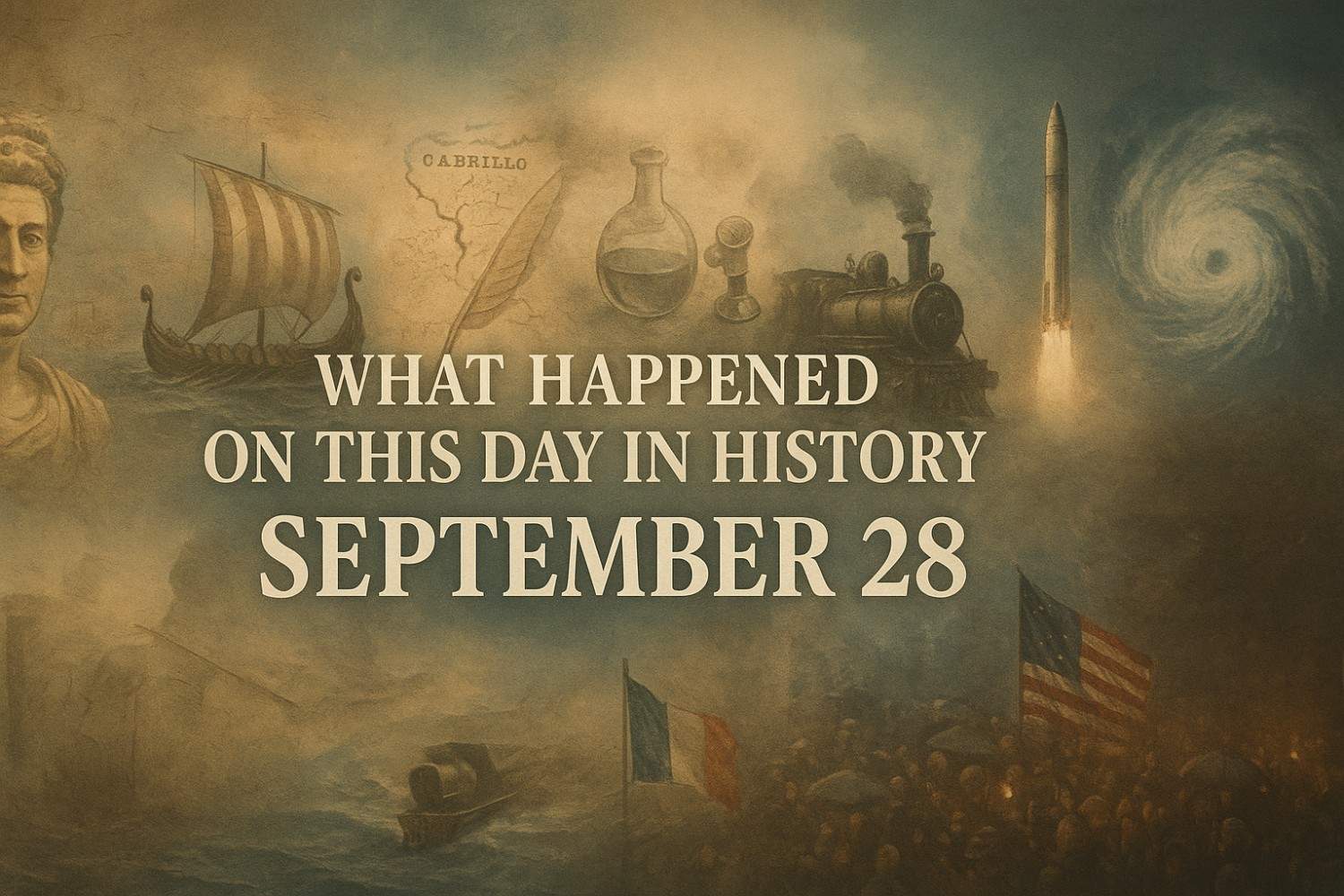
Centuries of empire, invention, calamity and political change cluster on this date. From ancient empires to modern breakthroughs, explore what happened on this day in history September 28 with major events, notable figures, and global anniversaries that shaped the world.
Major Events on September 28
48 BC — Pompey Arrives in Egypt and Is Assassinated
Pompey the Great landed at Pelusium in Egypt after fleeing Pharnaces and the civil war with Caesar; rather than receiving him as an ally, the young Ptolemy XIII ordered his assassination. The murder removed one of Rome’s leading generals and deepened the Roman intervention in Egyptian dynastic politics.
Pompey’s severed head and ring were presented to Julius Caesar, who reacted with both anger and political calculation. The episode accelerated Rome’s growing involvement in Egypt and foreshadowed the final republican conflicts.
235 — Pope Pontian Resigns and Is Exiled to Sardinia
Pope Pontian abdicated the papacy in 235 — the first recorded papal resignation — and, with Hippolytus, was deported to the Sardinian mines by imperial authorities. Their exile reflected escalating tensions between Christians and the Roman state in the third century.
Pontian’s resignation allowed for orderly succession while under persecution and eventually led to his veneration as a martyr. The episode is an early example of papal vulnerability under imperial power.
351 — Constantius II Defeats the Usurper Magnentius at Mursa
Emperor Constantius II’s forces defeated the usurper Magnentius at the bloody Battle of Mursa Major, one of the largest and costliest battles of the fourth century. The victory consolidated Constantius’s control but at a heavy manpower cost that weakened Roman defenses elsewhere.
The clash exemplified how internal civil wars could erode imperial strength and invite external pressure. Mursa’s aftermath shaped later fourth-century military and political calculations.
935 — Duke Wenceslaus I Is Murdered; Boleslaus I Succeeds
Duke Wenceslaus I of Bohemia was murdered in 935 in a noble plot led by his brother Boleslaus, who then assumed power. The killing inaugurated Boleslaus’s rule and reshaped dynastic politics in early medieval Bohemia.
Wenceslaus’s martyrdom and later sainthood produced lasting hagiographic and political legacies for the region. The event is central to Czech medieval memory and liturgical commemoration.
1066 — William the Conqueror Lands in England, Beginning the Norman Conquest
William, duke of Normandy, landed on England’s southern coast and began the campaign that culminated at Hastings and the overthrow of Anglo-Saxon rule. The invasion was the product of months of shipbuilding, mustering and careful timing with tides and weather.
William’s victory remade England’s aristocracy, law and language and started a long process of institutional transformation. The landing is therefore a pivotal operational start to medieval England’s reshaping.
1106 — Henry I Defeats Robert Curthose at the Battle of Tinchebray
King Henry I of England routed his elder brother Robert Curthose at Tinchebray, capturing him and consolidating Norman royal authority. The victory reunited Normandy and England under Henry’s control, stabilizing succession after William II’s death.
Robert’s imprisonment removed a recurring rival and changed the political map of northern France and the British Isles. Tinchebray helped define early Norman state formation.
1529 — Siege of Vienna Begins under Suleiman the Magnificent
Suleiman’s 1529 siege of Vienna was the Ottoman Empire’s major early push into Central Europe and tested European fortifications and supply lines. Although the siege failed, it signaled Ottoman strategic reach and prompted defensive coordination among European states.
The campaign underscored logistical constraints—seasonal weather, food and siege technology—on premodern warfare. Vienna’s successful defense became a lasting symbol of resistance to Ottoman expansion.
1538 — Battle of Preveza: Ottoman Naval Victory
The Ottoman fleet won a decisive engagement at Preveza, beating a Holy League armada and establishing Ottoman naval dominance in the eastern Mediterranean for decades. The victory protected Ottoman maritime routes and consolidated control over Aegean and Adriatic approaches.
Preveza marked a turning point in Mediterranean naval balances and influenced European naval strategy. The battle’s consequences shaped trade and military planning in the sixteenth century.
1542 — Juan Rodríguez Cabrillo Reaches California (San Diego Bay)
Explorer Juan Rodríguez Cabrillo landed near present-day San Diego in 1542, becoming the first known European to sight and explore much of California’s coastline. His voyage opened Spanish knowledge of the Pacific shore and paved the way for later exploration and colonial claims.
Cabrillo’s landing is commemorated as an early contact point between European navigators and the Pacific coast. The event set geographic and imperial expectations for New World expansion.
1781 — Siege of Yorktown Begins (Decisive Campaign in the American Revolution)
French and American forces, supported by a French fleet, began operations around Yorktown on September 28, 1781, launching the campaign that would force Cornwallis’s surrender on October 19. The combined land-and-sea blockade trapped British forces, demonstrating the decisive effect of allied coordination.
Yorktown effectively ended major combat in the American Revolution and shaped the terms of eventual independence. The siege remains a foundational moment in U.S. nation-building.
1821 — Mexican Independence: Declaration Drafted; Army of the Three Guarantees Advances
The Declaration of Independence of the Mexican Empire was drafted in late September 1821 as Agustín de Iturbide’s Army of the Three Guarantees closed in on Mexico City. The political settlement reconciled insurgent and royalist elements into an independent constitutional framework.
Mexico’s independence shifted imperial relations in the Americas and initiated complex state-building and social debates. The drafting and immediate events around Sept. 28 mark the decisive consummation phase of Mexican decolonization.
1825 — Stockton & Darlington Railway Opens (First Public Steam Railway)
The Stockton & Darlington Railway ceremonially opened in 1825 with the locomotive Locomotion, demonstrating that steam could haul both coal and passengers reliably on an open line. The line helped catalyze broad railway construction that transformed industry, urbanization and daily life across the nineteenth century.
Railways compressed distances for commerce and labor, accelerating economic integration. Stockton & Darlington is widely treated as a symbolic origin of the railway age.
1928 — Alexander Fleming Notices Penicillin Mold (Breakthrough in Antibiotics)
In September 1928 Alexander Fleming observed a Penicillium mold inhibiting bacterial growth in his Petri dishes, the observation that eventually led to penicillin. Fleming’s discovery inaugurated the antibiotic era, revolutionizing the treatment of bacterial infections and reducing mortality from many previously lethal diseases.
The development required later industrialization and clinical testing to become widely available, but the initial observation remains a milestone in medical science. Penicillin’s emergence reshaped public health and modern medicine.
1941 — Ted Williams Finishes the Season with a .406 Batting Average
Ted Williams ended the 1941 baseball season batting .406—the last major-league player to finish a season above .400—an achievement that stands as an iconic sporting milestone. His performance has been celebrated as one of baseball’s enduring single-season greats, emblematic of individual excellence in American sports culture.
Williams’s .406 season became a benchmark for batting skill and historical comparison. It remains a touchstone of baseball lore.
1994 — MS Estonia Sinks in the Baltic Sea, Killing 852 People
The cruise ferry MS Estonia sank in stormy conditions in the Baltic Sea on September 28, 1994, producing one of the worst peacetime maritime disasters of the late twentieth century. The high death toll prompted international investigations and major reforms in ship safety, evacuation procedures and design standards for car-ferries.
Estonia’s loss highlighted vulnerabilities in ro-ro ferry construction and emergency response readiness. The sinking has had long-term legal and engineering consequences for maritime safety regulation.
2008 — SpaceX Falcon 1 Becomes the First Privately Developed Liquid-Fuel Rocket to Reach Orbit
On September 28, 2008 SpaceX’s Falcon 1 successful RatSat mission marked the first time a privately developed, liquid-fueled ground-launched vehicle achieved orbit. The milestone signalled a new era in commercial spaceflight, lowering barriers to entry and stimulating private sector innovation in launch services.
Falcon 1’s success presaged rapid growth in private launch capability and a changing relationship between governments and commercial providers. The achievement is a cornerstone in 21st-century space commercialization.
2014 — Hong Kong Protests (Umbrella Movement) Begin
Large pro-democracy protests erupted in Hong Kong in late September 2014 in response to proposed electoral reforms seen as restrictive by many activists. The occupation and widespread demonstrations—centered on demands for genuine universal suffrage—brought global attention to questions of autonomy and Beijing’s political latitude over the territory.
The movement reshaped Hong Kong’s civic landscape and influenced subsequent political contestation and policy responses. The protests’ symbolic and practical effects continue to reverberate.
2018 — Sulawesi Earthquake and Tsunami Kill Thousands in Indonesia
A magnitude-7.5 earthquake off Sulawesi triggered a devastating tsunami and liquefaction in 2018, leaving thousands dead and tens of thousands injured or displaced. The disaster exposed challenges in early warning systems, local preparedness, and resilient infrastructure in tsunami-prone regions.
Recovery and reconstruction demanded massive humanitarian and engineering responses across the affected districts. Sulawesi’s catastrophe is a sobering reminder of seismic and coastal vulnerability.
2022 — Hurricane Ian Makes Landfall in Florida, Causing Severe Damage
In late September 2022 Hurricane Ian struck Cuba and made catastrophic U.S. landfall in Florida as a Category 4 storm, producing high fatalities and massive economic loss. Ian’s intensity and rapid intensification underscored the growing difficulties in forecasting, evacuation and resilience under climate-amplified hurricane risks.
The storm prompted major federal, state and local emergency responses and long-term recovery programs. Ian ranks among the costliest and deadliest U.S. hurricanes in recent decades.
2023
Large demonstrations took place across Poland as women’s rights groups marked the anniversary of the tightening of abortion laws.
2024 — Heavy Israeli Airstrikes on Southern Lebanon and Intensified Fighting in Ukraine (Selected Headlines)
Reports on September 28, 2024 highlighted heavy Israeli airstrikes in southern Lebanon amid escalation with Hezbollah, and continued intense frontline strikes in eastern Ukraine, including near Donetsk and Zaporizhzhia. Both clusters of violence produced civilian casualties, displacement and international diplomatic concern, illustrating the persistent regional and transnational risks of protracted warfare.
The incidents underscored humanitarian needs and renewed calls for de-escalation by international mediators. These contemporary headlines show how the calendar continues to carry consequential conflict reporting into every year.
If You Want To Read September 27 Facts & Events
Quick Sections
Earlier History
- Pompey’s assassination (48 BC): Roman civil war meets Egyptian dynastic intrigue.
- Norman landing (1066): the operational start of the Norman Conquest.
- Medieval treaties and sieges: Tinchebray (1106) and Preveza (1538).
Exploration & Colonial Foundations
- 1542 — Cabrillo sights California: first European contact on the Pacific West Coast.
- 1821 — Mexican independence consummation: military and political consolidation.
- 1924 — First aerial circumnavigation completed: aviation’s global reach begins.
Wars & Politics
- 1781 — Yorktown siege starts: decisive allied operation.
- 1939 — Nazi-Soviet division of Poland and Warsaw siege end: the Second World War’s opening violence.
- 1996 & 2000s–2020s: post-Cold War coups, intifada flashpoints and renewed regional wars.
Arts & Culture
- Ted Williams’s .406 season (1941): enduring sports legend.
- Althea Gibson’s legacy (died 2003): breaking racial barriers in tennis.
- Hong Kong protests (2014): civic culture meets global media.
Science, Technology & Media
- 1928 — Fleming’s penicillin discovery: antibiotics revolutionize medicine.
- 1924 — First aerial circumnavigation: early long-range flight achievement.
- 2008 — Falcon 1 orbital success: commercialization of launch services.
Disasters & Human Rights
- 1994 — MS Estonia sinking: maritime safety reform.
- 2018 — Sulawesi earthquake & tsunami: mass casualties and recovery challenges.
- 2022 — Hurricane Ian: extreme weather, evacuation and rebuilding.
Notable births — September 28
- Lata Mangeshkar — Iconic Indian playback singer.
- Peter Finch — Actor, Academy Award winner for Network.
- Max Schmeling — German heavyweight boxing champion.
- Georges Clemenceau — French statesman and WWI prime minister.
- Steve Largent — NFL wide receiver and U.S. congressman.
- Sam Zell — U.S. real-estate entrepreneur and investor.
- Stéphane Dion — Canadian politician; former Liberal leader.
- John Sayles — Independent film director and writer.
- Frances Willard — Temperance leader and social reformer.
- William S. Paley — Founder and leader of CBS broadcasting.
- Al Capp — Cartoonist, creator of Li’l Abner.
- Seymour Cray — Supercomputer designer and computing pioneer.
Notable deaths — September 28
- Ferdinand Marcos (d. 1989) — Longtime Philippine leader.
- Edwin Hubble — Astronomer foundational to extragalactic astronomy.
- Althea Gibson — Trailblazing Black tennis champion.
- Shimon Peres — Israeli statesman and Nobel Peace Prize laureate.
- Pierre Elliott Trudeau — Former Canadian prime minister.
- Miles Davis — Influential jazz trumpeter and composer.
- Gamal Abdel Nasser — President of Egypt and pan-Arab leader.
- Elia Kazan — Film and theatre director (controversial re: HUAC).
- Émile Zola — French novelist and public intellectual.
- Louis Pasteur — Chemist and microbiologist; pasteurization pioneer.
- Herman Melville — Author of Moby-Dick.
- Constance Baker Motley — Civil-rights lawyer and federal judge.
Observances & institutional dates
- Czech Statehood Day (Czech Republic) — national commemoration.
- Freedom from Hunger Day — awareness and development campaigns.
- International Day for Universal Access to Information — supports free access to public information.
- World Rabies Day — public-health awareness and prevention.
- Teachers’ Day (Taiwan and Chinese-Filipino schools in the Philippines).
- National Day of Awareness and Unity against Child Pornography (Philippines).
Final thoughts
What happened on this day in history September 28 shows how a single calendar date can gather empire-making, scientific breakthroughs, spectacular disasters and modern political crises. From Pompey and Norman fleets to penicillin, space commercialization and mass protests, the date highlights both continuity and rupture—moments that changed institutions, reshaped public life and altered how people understand safety, justice and possibility.
Short FAQs
Why does Pompey’s assassination matter for Roman-Egyptian history?
Pompey’s murder ended one strand of late-republic power competition and provoked deeper Roman intervention in Egypt’s dynastic affairs, accelerating Rome’s political entanglement with Ptolemaic succession.
How did Alexander Fleming’s penicillin discovery change medicine?
Fleming’s observation in 1928 launched the antibiotic revolution: once mass-produced and clinically tested, penicillin dramatically reduced deaths from bacterial infections and transformed surgical and public-health practice.
What were the consequences of the MS Estonia sinking (1994)?
The Estonia disaster led to sweeping reforms in ro-ro ferry design, safety procedures and international maritime regulations, plus long-running legal and memorial efforts for victims’ families.
Why is the 2008 Falcon 1 flight historically significant?
SpaceX’s 2008 Falcon 1 orbital success was the first time a privately developed, liquid-fuel rocket reached orbit—marking a turning point toward commercial launches and new models of space enterprise.