Seafaring triumphs, legal excommunications, scientific breakthroughs and modern crises cluster on this date across millennia. Explore decisive battles, scientific breakthroughs and cultural milestones—discover what happened on this day in history September 29, from Roman triumphs and medieval treaties to modern space and crisis moments.
Major Events on September 29
61 BC — Pompey’s Third Triumph (Pirates & Mithridates)
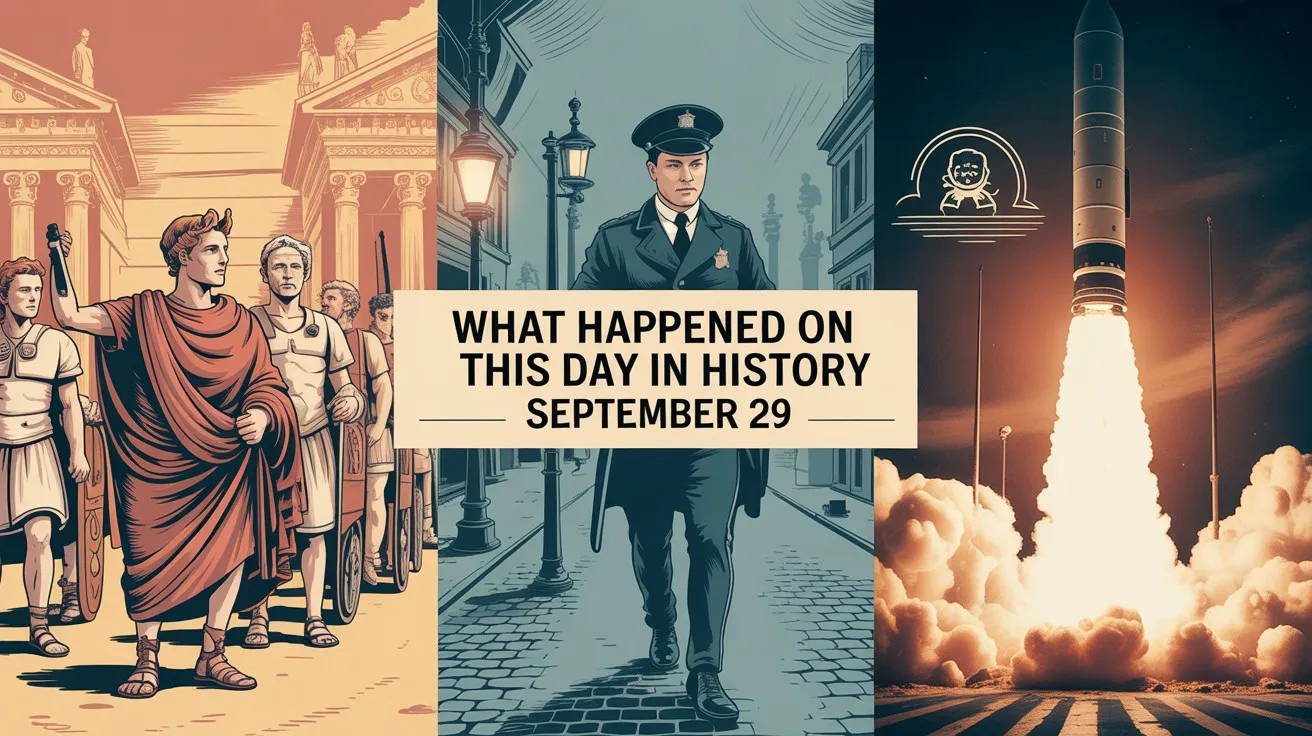
Pompey the Great celebrated his third triumph in Rome on his forty-fifth birthday, marking victories over Mediterranean pirates and the end of the Mithridatic Wars. The spectacle reinforced his political stature and Rome’s naval reach while showcasing the republic’s appetite for public military pageantry.
Triumphs like Pompey’s were as much theatrical legitimation as acknowledgment of battlefield success. Politically, they sharpened elite rivalries that would help steer the late Republic toward civil conflict.
1011 — Danes Capture Canterbury; Ælfheah Taken
Danish raiders captured Canterbury after a siege in 1011 and took Archbishop Ælfheah prisoner, a dramatic episode in the era of Scandinavian incursions into England. The seizure intensified pressure on Æthelred’s kingdom and highlighted the vulnerability of coastal settlements to seaborne attack.
Ælfheah’s later martyrdom became a powerful ecclesiastical symbol in Anglo-Saxon memory. The event is part of the sequence that culminated in more sustained Danish rulership under Cnut the Great.
1227 — Frederick II Excommunicated by Pope Gregory IX
Pope Gregory IX excommunicated Emperor Frederick II in 1227 over his failure to undertake a crusade and continuing conflicts between papal and imperial authority. Excommunication severed Frederick from formal church protection and complicated alliances among Christian rulers.
The rupture was a high point in longstanding tensions over investiture, jurisdiction and the limits of secular power. It reshaped diplomatic options for Frederick and for the papacy in Italy and beyond.
1267 — Treaty of Montgomery Recognizes Llywelyn ap Gruffudd
The Treaty of Montgomery (1267) recognized Llywelyn ap Gruffudd as Prince of Wales but as a vassal of King Henry III of England, formalizing a negotiated autonomy. The accord acknowledged Welsh territorial control while preserving feudal subordination, a compromise that proved fragile.
Montgomery temporarily consolidated Llywelyn’s authority and clarified political relationships along the Welsh marches. The treaty is an important legal marker in medieval Anglo-Welsh relations.
1364 — War of the Breton Succession Concludes (Anglo-Breton Victory)
Anglo-Breton forces prevailed in operations that effectively ended the War of the Breton Succession, settling dynastic disputes and curtailing prolonged privateering and pitched fighting. The resolution favored a claimant allied with English interests and reconfigured local loyalties amid the wider Hundred Years’ War.
The settlement reduced a chronic theater of Anglo-French proxy conflict in Brittany. It illustrates how dynastic wars produced far-reaching regional consequences.
1567 — Michelade: Sectarian Violence in Nîmes (French Wars of Religion)
During the French Wars of Religion, Protestant coup officials in Nîmes carried out the Michelade massacre, killing Catholic clergy and intensifying sectarian reprisals. The atrocity reflected how local power grabs and confessional fervor escalated into lethal violence across France. Michelade hardened mutual mistrust and fed cycles of retaliation that prolonged civil conflict.
It remains a stark instance of early-modern religiously motivated communal violence.
1578 — Spaniards Claim Tegucigalpa (Honduras)
Spanish colonizers claimed Tegucigalpa in 1578, establishing an administrative and mining center that later developed into Honduras’s capital. The foundation reflects patterns of resource-driven settlement and colonial urbanization across Central America.
Over centuries, Tegucigalpa grew from a colonial outpost into a national political and economic hub. Its origins illustrate local outcomes of Iberian imperial expansion.
1714 — Cossack Killings in Hailuoto during the Great Wrath
In 1714, during the Russian occupation of Finland known as the Great Wrath, Cossack detachments killed large numbers of civilians in Hailuoto, an episode of wartime atrocity and social devastation. The killings exemplify civilian vulnerability in early-modern occupation and contributed to deep local trauma.
The Great Wrath shaped subsequent Finnish memory of foreign domination and resistance. Such episodes influenced later national narratives about suffering and survival.
1717 — Earthquake Destroys Much of Antigua Guatemala
A major earthquake struck Antigua Guatemala in 1717, demolishing significant parts of the colonial city and reshaping urban architecture and planning. Seismic destruction forced rebuilding and architectural adaptation in Guatemala’s colonial centers.
The event is part of a long history of Latin American urban vulnerability to earthquakes, influencing construction methods and administrative responses. Antigua’s repeated devastation ultimately led to relocation of the capital centuries later.
1724 — J. S. Bach Conducts BWV 130 on Michaelmas
Johann Sebastian Bach led the first performance of his cantata Herr Gott, dich loben alle wir (BWV 130) on Michaelmas day in 1724, integrating chorale tradition with Baroque counterpoint for liturgical use. Bach’s cantatas were weekly musical offerings that fused theology, congregational song and complex musical rhetoric.
BWV 130 demonstrates the composer’s craftsmanship and his central role in Leipzig’s liturgical life. The performance contributes to Bach’s enduring influence on sacred music.
1789 — United States Establishes a Regular Army (Department of War Action)
On September 29, 1789 the U.S. Department of War moved to establish a regular army with the intention of professionalizing national defense after the Revolutionary period. The measure formalized a standing military presence alongside state militias, shaping American debates about federal power and force.
The creation signaled a pragmatic turn toward institutional military capacity in the early republic. It set foundations for later defense organization and civil-military relations.
1829 — Metropolitan Police of London Founded (Peel’s Reforms)
Robert Peel’s Metropolitan Police was founded in 1829, inaugurating a centralized, uniformed civic police force designed to prevent crime and maintain public order in London. The Met introduced principles—public service, visible patrols and crime prevention—that became models for modern policing internationally.
Peel’s reforms professionalized law enforcement away from parish constables and private watchmen. The institution transformed urban governance and public safety practice.
1848 — Battle of Pákozd: First Major Clash of the Hungarian Revolution
The Battle of Pákozd in 1848 was a stalemate between Hungarian and Croatian forces and constituted the first significant military engagement of Hungary’s 1848–49 revolution. The encounter tested revolutionary mobilization and regional loyalties within the Habsburg domains.
While not decisive, Pákozd signaled the intensity of nationalist and constitutional contestation in central Europe. The battle remains an early emblem of Hungary’s revolutionary struggle.
1850 — Universalis Ecclesiae Restores Catholic Hierarchy in England & Wales
The papal bull Universalis Ecclesiae (1850) restored the Roman Catholic diocesan hierarchy in England and Wales after centuries of suppression, a major moment in religious reorganization. Restoration revived formal Catholic episcopal structures and prompted public debate about religion and civic identity in Victorian Britain.
The measure reflected Catholic revival and changing toleration norms after the Catholic Emancipation era. It reshaped institutional Catholic life and relations with the Anglican establishment.
1855 — Iloilo Port Opened to World Trade (Philippines)
Spanish colonial authorities opened Iloilo to international trade in 1855, integrating the port into global commerce and regional maritime networks. The opening accelerated economic connections, migration and local urbanization on Panay Island.
Iloilo’s status as a trading hub influenced regional development under late colonial regimes. The port illustrates how imperial policies shaped local economic geographies.
1864 — Battle of Chaffin’s Farm (American Civil War)
The Battle of Chaffin’s Farm (1864) was a significant engagement between Union and Confederate forces near Richmond, involving heavy casualties and demonstrating the intensity of late-war operations. African American Union troops played prominent roles in the fighting, highlighting evolving military and social dimensions of the conflict.
Chaffin’s Farm influenced subsequent operations against the Confederate capital and contributed to the war’s attritional character. The battle is remembered for valor and its political implications during Reconstruction debates.
1864 — Treaty of Lisbon Defines Spain-Portugal Border; Couto Misto Abolished
The 1864 Treaty of Lisbon redefined boundaries between Spain and Portugal and abolished the unique microstate of Couto Misto, regularizing jurisdiction and sovereignty in contested borderlands. The accord resolved long-standing local anomalies and integrated border communities into modern nation-state frameworks.
Treaty implementation reshaped administrative authority and cross-border relations. The settlement reflects nineteenth-century efforts to rationalize European frontiers.
1885 — First Practical Public Electric Tramway Opens in Blackpool
Blackpool inaugurated the first practical public electric tramway in 1885, pioneering an urban transport mode that would spread internationally. Electric trams expanded mobility for seaside tourism and daily commuters and symbolized the municipal embrace of electrification.
The innovation reshaped city planning, leisure economies and municipal services. Blackpool’s tramway is a milestone in the modernization of urban transit.
1907 — Cornerstone Laid for Washington National Cathedral
The cornerstone for the Cathedral Church of Saint Peter and Saint Paul (Washington National Cathedral) was laid in 1907, beginning a long construction that combined Gothic revival design with national ceremonial purpose. The cathedral would become a site for state observances, memorials and interfaith events in the U.S. capital.
Its architecture and gradual completion reflect cultural investments in national symbolism and public religion. The project demonstrates civic uses of monumental ecclesiastical architecture.
1911 — Italy Declares War on the Ottoman Empire (Italo-Turkish War Begins)
In 1911 Italy declared war on the Ottoman Empire to seize Libya and other territories, launching the Italo-Turkish War that presaged broader colonial rivalries in the Mediterranean. The conflict exposed Ottoman weakness and shifted North African colonial control toward European powers. Italy’s action generated debates about imperial ambition and military modernization.
The war’s aerial experiments also foreshadowed new dimensions of twentieth-century warfare.
1918 — Bulgaria Signs the Armistice of Salonica; Hindenburg Line Broke; Germany Asked to Negotiate
On September 29, 1918 Bulgaria signed the Armistice of Salonica, withdrawing from World War I—an action followed by the Allied breach of the Hindenburg Line and German high command urging armistice talks. These interconnected moves signaled a decisive unraveling of Central Power resistance on multiple fronts.
Military collapse in the Balkans and the Western Front accelerated the endgame, leading to the November armistice. The day marks a cascade of strategic failures for the Central Powers.
1920 — Truce between the Ukrainian SSR and Makhnovshchina
In 1920 the Ukrainian Soviet Socialist Republic reached a truce with the anarchist Makhnovshchina, temporarily recalibrating revolutionary and counterrevolutionary alignments in the Ukrainian civil war. The ceasefire highlighted the complex patchwork of competing forces—Bolsheviks, nationalists, anarchists—vying for control after empire’s collapse.
The agreement was tactical and ephemeral amid larger struggles over Ukraine’s political future. It illustrates the fluid wartime diplomacy of the post-WWI period.
1923 — Mandates for Palestine, Syria & Lebanon Take Effect; Women’s Track Championship Held
The League of Nations mandates for Palestine and for Syria and Lebanon took effect in 1923, embedding new colonial trusteeships in the Middle East after Ottoman collapse; that same year the first American track and field championships for women were held, marking a step in women’s competitive athletics. The mandates institutionalized international governance frameworks with long political consequences for sovereignty and national movements.
Meanwhile, the women’s championship signaled growing social acceptance of female athletic competition. Both items show how 1923 combined imperial restructuring with cultural change.
1932 — Last Day of the Battle of Boquerón (Chaco War)
September 29 marked the last day of the Battle of Boquerón in the Chaco War; the intense engagement between Paraguay and Bolivia became a symbolic Paraguayan victory. The battle’s outcome shaped morale, recruitment and later territorial negotiations in the conflict over the Gran Chaco.
Boquerón’s scale and casualties drew regional attention to South American interstate warfare. The battle remains central to Paraguayan military memory.
1940 — Avro Ansons Collide Mid-Air and Land Locked Together (Australia)
Two Avro Anson aircraft collided mid-air over New South Wales, remained physically locked together, and yet managed to land safely—an extraordinary aviation incident in 1940. The pilots’ skill and sheer luck averted what could have been a catastrophic crash and highlighted both aircraft fragility and human resourcefulness.
The event became an oft-recounted episode in early-war aviation lore. It underscores the remarkable nature of some wartime aviation survivals.
1941 — Babi Yar Massacre Begins (Kyiv)
German forces, assisted by local collaborators, began the mass executions at Babi Yar near Kyiv in late September 1941, murdering tens of thousands of Jews and others over a two-day period and afterward. Babi Yar epitomized the mobile, mass-shooting phase of the Holocaust in the occupied Soviet territories and left deep cultural and moral scars.
The site’s later memorialization and contested narratives reflect the difficulty of commemorating mass atrocity amid shifting political contexts. Babi Yar remains a central reference point in Holocaust history and memory.
The killings at Babi Yar involved systematic roundup, execution and burial of civilians, mainly Jews, and were followed by attempts to erase evidence and suppress memory during occupation and after.
1954 — Convention Establishes CERN (European Organization for Nuclear Research)
European nations signed the convention establishing CERN in 1954 to foster large-scale collaboration in particle physics and to rebuild scientific networks after World War II. CERN became a flagship for international scientific cooperation, later hosting experiments that probed the fundamental structure of matter.
Its collaborative model pioneered cross-border research infrastructures and training. Over decades CERN contributed foundational physics discoveries and technological spinoffs.
1957 — Kyshtym Nuclear Disaster (Soviet Union)
The 1957 Kyshtym disaster at a Soviet reprocessing plant produced a major radiological accident when a waste-storage tank exploded, contaminating territory and displacing populations. Secrecy and delayed reporting exacerbated human and environmental harm, obscuring the event’s full impact for years.
Kyshtym later informed international discussions on nuclear safety, transparency and emergency response. The accident remains among the worst peacetime radiological incidents on record.
1959 — Lockheed Electra Crash in Buffalo, Texas
A Lockheed L-188 Electra crashed in 1959 in Buffalo, Texas, killing 34 people and prompting investigations into aircraft operations and safety protocols. The accident added to the early operational history of turboprop airliners, shaping subsequent regulatory and design scrutiny.
Aviation tragedies of this era accelerated improvements in maintenance, crew training and systems oversight. Each crash contributed incrementally to the evolution of commercial-aviation safety standards.
1971 — Oman Joins the Arab League
Oman became a member of the Arab League in 1971, integrating the sultanate into regional diplomatic and political structures amid broader post-colonial realignments on the Arabian Peninsula. League membership formalized Oman’s regional engagement and participation in collective Arab forums.
The accession reflects the shifting map of Middle Eastern statehood in the twentieth century. It aided Oman’s international recognition and multilateral ties.
1972 — Japan Establishes Diplomatic Relations with the PRC
Japan formally established diplomatic relations with the People’s Republic of China in 1972, severing official ties with the Republic of China (Taiwan) and reshaping East Asian diplomacy. The normalization reflected geopolitical recalibration amid U.S.–China rapprochement and regional economic priorities. The shift opened avenues for trade, cultural exchange and political engagement between Tokyo and Beijing. It also triggered complex trilateral dynamics involving Taiwan and the United States.
1975 — WGPR Becomes First Black-Owned & Operated U.S. TV Station
WGPR in Detroit went on air as the first black-owned and -operated television station in the United States in 1975, expanding African American representation in broadcast media. The station’s launch provided a platform for community news, cultural programming and local voices often marginalized by mainstream outlets.
WGPR represents a milestone in media ownership diversity and grassroots broadcasting. Its history connects to broader struggles for representation in American mass media.
1979 — Francisco Macías of Equatorial Guinea Executed
Dictator Francisco Macías of Equatorial Guinea was executed by firing squad in 1979 following a violent overthrow, ending a brutal nine-year rule marked by repression and economic collapse. Macías’s removal opened a new phase in the country’s governance under different leadership and international reengagement.
The episode illustrates how authoritarian collapse often proceeds through violent internal purges. Equatorial Guinea’s subsequent trajectory remained shaped by resource politics and security concerns.
1981 — Iranian Air Force C-130 Crash Kills 80
An Iranian Air Force Lockheed C-130 Hercules crashed in 1981 near a firing range, killing 80 people; the disaster was one of several military and civil aviation tragedies that stressed Iranian flight operations during a turbulent period. The crash underscored operational risks in transporting troops and equipment amid regional instability.
High mortality events prompted inquiries into maintenance and flight procedures. The loss contributed to national mourning and military recalibration.
1988 — STS-26: Space Shuttle Returns to Flight (Discovery)
NASA launched STS-26 in 1988 aboard Discovery, the first shuttle mission after the Challenger disaster, marking a major institutional recovery and safety overhaul. The successful flight restored U.S. crewed shuttle operations under revised procedures and oversight. STS-26 carried supplies and experiments and reaffirmed commitments to human access to low Earth orbit.
The mission stands as an example of organizational learning after catastrophic failure.
1990 — Washington National Cathedral Completed; YF-22 First Flight; Tampere Hall Inaugurated
1990 saw several notable inaugurations: the Cathedral Church of Saint Peter and Saint Paul in Washington, D.C. was completed; the YF-22 prototype (later the F-22 Raptor) made its first flight; and Tampere Hall, a major Finnish cultural center, was inaugurated. Collectively these events reflect institutional, technological and cultural investments at the end of the Cold War era.
Each milestone signaled capabilities—architectural, military and civic—shaping national profiles. The convergence of completions and first flights illustrates diverse forms of late-twentieth-century public ambition.
1991 — Haitian Coup d’État
A coup d’état in Haiti in 1991 ousted elected officials and deepened political instability that would trigger international interventions and sanctions. The event interrupted democratic governance and produced humanitarian and migratory consequences. Haiti’s cycle of coups highlights the fragility of democratic consolidation under economic and social strain.
The 1991 coup shaped subsequent decades of external engagement and domestic contestation.
1992 — Brazilian President Fernando Collor de Mello Impeached
Brazilian President Fernando Collor de Mello was impeached in 1992 amid corruption accusations, marking a dramatic constitutional crisis and popular mobilization in Brazil’s young democracy. Collor’s fall underscored demands for accountability and the energized role of civil society and media.
The impeachment process tested constitutional mechanisms and judicial capacities in Latin America’s democratic transitions. It remains a landmark in Brazil’s political development.
2004 — Asteroid Toutatis Close Approach; Ansari X-Prize: SpaceShipOne Flight
In 2004 asteroid 4179 Toutatis passed within a few lunar distances of Earth, renewing attention to near-Earth object monitoring; that same year Burt Rutan’s SpaceShipOne completed a successful flight toward the Ansari X Prize, advancing private human spaceflight.
Together the events illustrated dual concerns in 21st-century space activity: planetary defense and commercial access. Both strands—hazard awareness and entrepreneurial innovation—have continued to shape space policy. The juxtaposition underlines how public and private agendas intersect in space.
2005 — John G. Roberts Confirmed as Chief Justice of the United States
John G. Roberts was confirmed as Chief Justice in 2005, assuming institutional leadership of the U.S. Supreme Court and influencing its jurisprudential trajectory. The appointment was a consequential political and legal milestone, affecting decisions on federal power, civil rights and administrative law.
Chief justices shape court culture, case selection and opinion assignment practices over long tenures. Roberts’s confirmation remains central to debates about the Court’s role.
2006 — Mid-Air Collision in Brazil Kills 154
A collision between a Boeing 737 and an Embraer 600 over Mato Grosso in 2006 caused 154 deaths and triggered a major aviation crisis in Brazil, leading to sweeping investigations and reforms in air-traffic management. The catastrophe exposed systemic vulnerabilities in traffic control, communications and flight-safety procedures.
Subsequent policy responses sought to tighten oversight, modernize systems and improve pilot training. The tragedy spurred regulatory and technical change across Brazilian aviation.
2007 — Calder Hall Nuclear Power Station Demolished
In 2007 Calder Hall—the world’s first commercial nuclear power station—was demolished in a controlled explosion, closing a historic chapter in nuclear electricity generation. Calder Hall’s lifetime spanned early optimism about nuclear power and later reassessments of safety, economics and decommissioning.
Demolition highlighted challenges of dismantling aging nuclear infrastructure and managing legacy waste. The controlled demolition was symbolic of transitions in energy policy and industrial history.
2008 — Stock Market Crash after House Vote on Emergency Stabilization Act Fails
The U.S. stock market plunged after the House of Representatives initially failed to pass the Emergency Economic Stabilization Act in 2008, deepening the unfolding global financial crisis. Market instability reflected systemic concerns about credit markets, counterparty risk and confidence in financial institutions.
The shock accelerated political pressure to adopt stabilizing measures and reshaped regulatory debates on banking and oversight. The episode is a flashpoint in the Great Recession’s early, volatile phase.
2009 — 8.1 Mw Samoa Earthquake & Tsunami Devastation
An 8.1 magnitude earthquake in 2009 triggered tsunamis that struck Samoa and neighboring islands, killing over 180 people and causing widespread destruction. The disaster revealed gaps in Pacific early-warning systems and stressed fragile coastal infrastructure and livelihoods. International relief and reconstruction efforts mobilized regional and global assistance, highlighting humanitarian coordination challenges.
The catastrophe reinforced the need for resilient coastal planning in seismically active regions.
2011 — Vachathi Case Convictions in India (Dalit Atrocity Accountability)
In 2011 a special court in India convicted a large number of officials for atrocities against Dalits and for rape in the Vachathi case, a landmark judgment addressing systemic rural abuses. The convictions represented a significant step toward legal redress for marginalized communities and signaled judicial willingness to hold perpetrators accountable.
The verdict also spurred discussion on institutional culpability and preventive reforms in policing and administration. Vachathi remains a legal reference point in India’s struggle against caste-based violence.
2013 — Boko Haram Massacre at College of Agriculture, Nigeria
Members of Boko Haram killed more than 42 people at a College of Agriculture in 2013, part of a wave of extremist violence that devastated communities and education in northeastern Nigeria. The massacre deepened humanitarian crises, displaced populations and challenged state capacity to protect civilians.
Responses included military operations alongside calls for social and developmental strategies to counter radicalization. The attack remains one among many tragic markers of the group’s campaign.
2016 — Indian “Surgical Strikes” Follow Uri Attack
In 2016, following the Uri attack, India reported cross-border “surgical strikes” against militant positions in Pakistani-administered Kashmir, a significant escalation in subcontinental counterterrorism operations. The strikes were presented as a calibrated military response and became a charged issue in domestic politics and bilateral diplomacy.
They also intensified public debate over military strategy, sovereignty and restraint. The episode is emblematic of how high-profile terrorist incidents can reshape state responses.
2019 — Afghan Election Violence, Istanbul Earthquake, Global Climate Strikes
On September 29, 2019 violence marred Afghanistan’s presidential election even as a 6.0 earthquake rattled Istanbul and millions joined climate strikes worldwide inspired by youth activism. The cluster of events shows how electoral insecurity, natural hazards and global civic mobilization can converge on a single date.
Climate strikes elevated environmental policy on international agendas while conflict and disaster underscored persistent governance gaps. The day reflects the multifaceted crises and civic energies of the contemporary world.
2020 — Nagorno-Karabakh Fighting, COVID-19 Global Toll Crosses One Million
In 2020 Armenia and Azerbaijan engaged in intense fighting over Nagorno-Karabakh, producing international concern, while the global COVID-19 death toll crossed the one-million mark—two stark reminders of warfare and pandemic vulnerability. The twin crises combined humanitarian urgency with urgent diplomatic demands and public-health strain.
They highlighted limits of institutions in preventing violence and in managing a global medical emergency. The convergence shaped policy priorities and relief efforts at multiple levels.
2021 — Germany’s SPD Victory & Platform Scrutiny for Social Media Companies
Germany’s Social Democrats (SPD) claimed victory in the 2021 federal election, launching coalition talks that would reshape Berlin’s leadership, while Facebook/Instagram/WhatsApp faced renewed scrutiny after whistleblower revelations about internal research and harm. Both developments signaled political and regulatory inflection points—electoral change in Europe and intensified calls for platform accountability worldwide.
They exemplify how democratic and digital governance agendas intersect in the 2020s. The twin stories influenced policy debates on data, elections and public trust.
2022 — Russia Formalizes Annexation Claims after Controversial Referendums
In 2022 Russia moved to formalize annexation of occupied Ukrainian territories after disputed referendums, a step widely condemned internationally and deepening the legal and humanitarian crisis in Ukraine. The actions complicated prospects for negotiation and raised questions about occupation law, sovereignty and post-conflict reconstruction.
Sanctions, diplomatic isolation and continued fighting followed, intensifying regional insecurity. The events are part of an ongoing sequence affecting European security architecture.
2023 — Kosovo-Serbia Tensions; Canada Marks Third National Day for Truth & Reconciliation
In 2023 violent clashes in northern Kosovo and diplomatic friction with Serbia underscored fragile peace arrangements, while Canada observed its third National Day for Truth and Reconciliation to honor survivors of residential schools. The juxtaposition highlights how local violence and national remembrance both shape political calendars.
Kosovo tensions tested EU and NATO mediation capacities; Canada’s observance advanced public recognition and policy conversations about historic injustices. Both items reflect ongoing work on justice and stability.
2024 — Beirut Protests over Living Conditions; Intensified Ukraine Missile & Drone Attacks
On September 29, 2024 mass protests erupted across Beirut over deteriorating living conditions and war-related fears, while Ukraine reported intensified missile and drone attacks across multiple fronts, reflecting continued wartime escalation. The Lebanese protests signaled acute economic and political stress compounded by regional instability; Ukraine’s strikes underscored high-intensity conflict and civilian hazard.
Both crises demanded humanitarian responses and renewed diplomatic attention. They illustrate how autumn dates can aggregate urgent geopolitical and domestic pressures.
Read Also: What Happened On September 28 In History
Quick Sections
Earlier History
- Roman triumphal culture (Pompey, 61 BC) and medieval power plays (Frederick II’s excommunication, 1227; Treaty of Montgomery, 1267).
- Seafaring, conquest and local foundations (Cabrillo’s California contact appears in other linked calendars).
Exploration & Colonial Foundations
- Tegucigalpa’s Spanish claim (1578) and Iloilo opening to trade (1855) show urban and commercial consolidation in colonial spaces.
- Mandates in the Middle East (1923) reorganized imperial control after WWI.
Wars & Politics
- Yorktown campaign’s opening phases (1781) and the Hindenburg Line breach/armistice cascade (1918) changed the map of modern Europe.
- Post-Soviet and post-colonial coups, impeachment and regional conflicts (1991 Haiti coup; 1992 Collor impeachment; 2016 Uri/2013 Boko Haram/2020 Nagorno-Karabakh).
Arts & Culture
- Bach’s 1724 cantata premiere and sporting/cultural milestones like Greyhound’s trotting record and Ted Williams’s .406 year reflect the variety of cultural achievement.
Science, Technology & Media
- Fleming’s penicillin observation (1928), CERN’s foundation (1954), Ansari SpaceShipOne (2004) and STS-26 (1988) illustrate breakthroughs in medicine, physics and spaceflight.
- Blackpool’s tram (1885) and aviation incidents shaped transport history.
Disasters & Human Rights
- Babi Yar (1941) and Kyshtym (1957) are central human-rights and environmental tragedies; the MS Estonia, Samoa tsunami and Brazilian aviation collision are major modern disasters.
- Recent humanitarian crises (Sulawesi, 2018; Samoa, 2009) continue to inform disaster policy.
Notable births — September 29
- Robert Clive — Architect of early British rule in Bengal.
- Ludwig von Mises — Austrian-American economist.
- Sebastian Coe — Olympic middle-distance runner and sports administrator.
- Elizabeth Gaskell — English novelist and social commentator.
- François Boucher — French Rococo painter.
- Stanley Kramer — Film director of socially conscious cinema.
- Miguel de Unamuno — Spanish philosopher and novelist.
- László Bíró — Inventor of the modern ballpoint pen.
- Paul B. MacCready — Aeronautical engineer and human-powered flight pioneer.
- Samora Machel — First president of independent Mozambique.
- Ann Bancroft — Polar explorer and expedition leader.
- Geoffrey Marcy — Astronomer notable for exoplanet discoveries.
Notable deaths — September 29
- Rudolf Diesel — Inventor of the diesel engine (d. 1913).
- Winslow Homer — American painter of marine scenes.
- Carson McCullers — American novelist.
- Nguyễn Văn Thiệu — President of South Vietnam.
- Anastasio Somoza — Nicaraguan dictator.
- Arthur Ochs Sulzberger — Publisher of The New York Times.
- Willem Einthoven — Inventor of the electrocardiograph (Nobel).
- Georges Charpak — Nobel-winning physicist.
- Joaquim Maria Machado de Assis — Brazil’s leading novelist.
- Phan Bội Châu — Vietnamese nationalist leader.
- Léon Bourgeois — French statesman, Nobel Peace Prize laureate.
- August A. Busch Jr. — Longtime head of Anheuser-Busch.
Observances & institutional dates
- Michaelmas / Feast of the Archangels (Michael, Gabriel, Raphael) — quarter-day and liturgical observance in Christian traditions.
- Inventors’ Day (Argentina) — celebrates innovation and inventors.
- Victory of Boquerón Day (Paraguay) — commemorates a Chaco War victory.
- World Heart Day — global cardiovascular awareness.
- International Day of Awareness of Food Loss and Waste — promotes sustainable food systems.
- National and local commemorations related to the date appear across countries.
Short FAQs
Why is the Metropolitan Police founding (1829) widely noted?
Peel’s Metropolitan Police professionalized urban law enforcement with centralized, preventive patrols and a model that influenced modern policing internationally.
What was Alexander Fleming’s 1928 observation and why does it matter?
Fleming noticed Penicillium mold inhibiting bacterial growth on a Petri dish—an accidental discovery that led to penicillin and the antibiotic revolution, saving countless lives.
What happened at Babi Yar and why is it historically central?
Babi Yar was the site of mass executions by German forces in 1941 near Kyiv, where tens of thousands—primarily Jews—were murdered; it exemplifies the Holocaust’s mobile killing operations and the challenges of commemoration.
How did SpaceShipOne and Toutatis (2004) reflect changing space priorities?
Toutatis’s close approach highlighted planetary-defense concerns while SpaceShipOne’s flights showcased private innovation in human suborbital flight—two strands of 21st-century space activity.