A sweep of empires, inventions, and modern tragedies anchors this date across centuries.
What happened on this day in history October 1 ranges from Alexander’s decisive victories to 20th-century statehoods, technological rollouts and contemporary crises that still shape politics and daily life.
Major Events on October 1
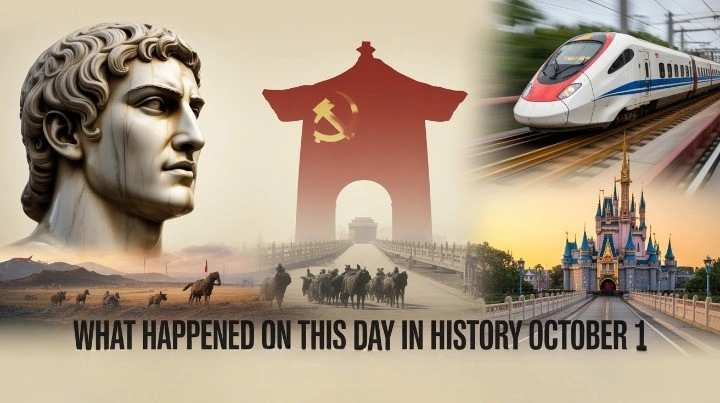
331 BC — Battle of Gaugamela (Alexander’s Decisive Victory)
Alexander the Great defeated Darius III at Gaugamela, a battle that effectively ended Achaemenid Persian rule and opened the Near East to Macedonian control. The victory demonstrated Alexander’s tactical flexibility on a wide plain against a numerically large foe and accelerated the collapse of Persian central authority.
Conquered territories were reorganized under Macedonian governance, facilitating cultural exchanges across a vast swath of Eurasia. The battle’s outcome remade the political map of the ancient world and set the stage for Hellenistic civilization.
366 — Pope Damasus I Consecrated (Papal Leadership)
Damasus I’s consecration as Bishop of Rome marked a papacy that would emphasize Christian orthodoxy and the consolidation of ecclesiastical authority within the late Roman world. He promoted Latin scripture texts and patronized Christian poets and theologians, strengthening Rome’s liturgical and literary position.
Damasus’ tenure occurred amid theological disputes and imperial shifts, making his administrative role consequential for Western Christianity. His papal acts influenced subsequent patterns of Roman ecclesiastical leadership.
959 — Edgar the Peaceful Becomes King of England
Edgar’s accession consolidated royal authority after a period of dynastic turbulence and he is often associated with relative internal stability and the promotion of monastic reform. His reign helped lay administrative foundations that later medieval kings would build on, and he was seen as a model of an orderly Christian ruler in Anglo-Saxon chronicle tradition.
Edgar’s time on the throne is noted for fostering ecclesiastical patronage and legal standardization. His epithet, “the Peaceful,” reflects contemporaneous and later assessments of his domestic rule.
1588 — Coronation of Shah Abbas I (Safavid Persia)
Shah Abbas I’s coronation marks a centralizing and revitalizing moment in Safavid Iran, launching a period of military reform, administrative consolidation and cultural patronage that defined Safavid statecraft.
Under Abbas, the empire reoriented trade and fortified borders while sponsoring architecture and the arts, shaping Persian political culture. His reforms strengthened central authority and created enduring institutional legacies. The coronation signaled a leadership transition with broad regional implications.
1730 – Ahmed III Abdicates (Ottoman Transition)
Ahmed III’s forced abdication closed a chapter of Ottoman cultural flowering and signaled shifting political balances after internal discontent and military setbacks. The change of sultan reflected elite rivalries and the empire’s evolving governance problems in the early 18th century.
Subsequent sultans confronted both external pressures and internal reform needs, making the abdication a marker in Ottoman political evolution. Court politics and provincial unrest continued to define the empire’s trajectory.
1779 — Tampere was Founded (Urban Foundation in Finland)
King Gustav III of Sweden founded the city of Tampere in 1779, establishing an industrial and administrative centre that would later become a major Finnish urban hub. The foundation followed wider patterns of planned urban growth in northern Europe tied to trade and proto-industrial activities.
Tampere’s later role in industry and culture makes its foundation an important local milestone. The city’s origins reflect 18th-century state efforts to bolster regional economies.
1787 — Russians Defeat Turks at Kinburn (Suvorov Campaign)
Alexander Suvorov’s victory at Kinburn in 1787 advanced Russian naval-land operations against Ottoman positions and highlighted the skill of Russian commanders in late-18th-century warfare. The battle was one element of expanding Russian influence in the Black Sea region.
Tactical success reinforced Russia’s bargaining position in subsequent diplomacy and territorial negotiations. It also showcased Suvorov’s reputation as one of Russia’s most capable generals.
1791 — First Session of the French Legislative Assembly
The National Legislative Assembly’s inaugural session in 1791 represented a new institutional phase in the French Revolution as the constitutional experiment shifted from constituent drafting to legislative governance. The Assembly faced enormous political pressures: war, fiscal crisis and popular agitation that would soon radicalize politics.
Its debates and laws helped sharpen factional lines and set the stage for the more turbulent years ahead. The session therefore stands as a crucial moment in revolutionary constitutional development.
1795 — Annexation of the Austrian Netherlands by Revolutionary France
The formal annexation completed France’s extension over territories of the Austrian Netherlands, altering political control and accelerating administrative, legal and social reforms in the region. Revolutionary institutions—metric measures, secular law codes and new civic structures—were imposed, producing both modernization and local resistance.
The annexation had lasting effects on the region’s national development and identity. It also illustrated revolutionary France’s wider geopolitical reach.
1800 — Third Treaty of San Ildefonso: Spain Cedes Louisiana to France
Spain’s cession of Louisiana back to France reshaped the North American colonial map and presaged the later U.S. purchase of the territory, a major territorial rearrangement. The treaty reflected Napoleonic diplomatic maneuvering and the fluid nature of imperial possessions at the turn of the 19th century.
The transfer altered strategic calculations for European powers and emerging U.S. ambitions. Within thirty months the U.S. acquisition of the territory doubled the size of the young republic and transformed continental geopolitics.
1814 — Congress of Vienna Opens (Post-Napoleonic Redrawing)
The Congress convened to redraw Europe after Napoleon’s defeat, setting diplomatic precedents for balance-of-power negotiations, territorial settlements and the restoration of many monarchies.
Delegates negotiated complex territorial swaps, compensation arrangements and new security frameworks intended to prevent large-scale continental wars. The Vienna settlement shaped 19th-century diplomatic practice and conservative order while provoking later nationalist challenges. Its outcomes framed European relations for decades.
1827 — Russian Capture of Yerevan (Russo-Persian War)
Russian forces under Ivan Paskevich seized Yerevan, ending a long period of Muslim political dominance in the region and signaling Russian advances in the Caucasus. The capture reorganized regional governance and was part of a larger imperial competition between Russia and Persia.
The event accelerated demographic and administrative shifts that would affect Armenian, Persian and Russian relations. It also contributed to the modern political geography of the South Caucasus.
1829 — South African College Founded (Higher Education Origins)
The South African College’s establishment in Cape Town set the institutional foundations that later split into the University of Cape Town and the South African College Schools. The college played a formative role in South African higher education and intellectual life.
Its founding highlights the spread of Western-style higher education into colonial contexts and the local elites’ investments in learning. The institution’s legacy continues in contemporary South African academia.
1832 — Texian Delegates Convene at San Felipe de Austin (Texas Petitioning)
Texian political delegates assembled to press for changes in Mexican governance, a step on the path toward heightened tensions that culminated in the Texas Revolution and eventual independence. Political organization among settlers reflected differing visions of rights, representation and regional autonomy.
The convention’s petitions illustrate early political mobilization in frontier societies and the contested status of Mexican Texas. These events presaged the dramatic territorial and political shifts that would follow.
1861 — Mrs Beeton’s Book of Household Management Published
Mrs Beeton’s manual became an influential domestic guide, selling tens of thousands of copies and shaping Victorian household practice, cookery and domestic organization for generations. Its mix of recipes, management tips and moral instruction reflected contemporary middle-class domestic ideals.
The work’s long shelf life shows how print culture standardized domestic knowledge and commercialized household authority. Mrs Beeton’s name became synonymous with a certain domestic expertise.
1887 — Balochistan Conquered by British Empire (Imperial Expansion)
The British incorporation of Balochistan deepened imperial control in South Asia and secured strategic frontiers for the Raj. Colonial rule reconfigured local power structures and introduced new administrative regimes and infrastructure priorities.
The conquest formed part of broader Great Game dynamics and regional contestation with neighboring powers. Its effects on local societies and borders remain historically significant.
1890 — Yosemite National Park Created (U.S. Conservation)
Congress established Yosemite National Park in 1890, expanding U.S. federal commitment to landscape preservation and public recreation. The park’s protection followed earlier conservation efforts and reflected rising nineteenth-century interest in natural heritage.
Yosemite’s status catalyzed tourism, ecological awareness and eventual national-park system policies. Its creation is an early milestone in American environmentalism.
1891 — Stanford University Opens (Higher Education Expansion)
Stanford’s opening exemplified late-19th-century philanthropic foundations of research universities in the United States and would grow into a major center for education and innovation. The university’s early emphasis on practical learning and civic mission shaped its future role in American academic life.
Stanford’s emergence contributed to California’s intellectual and economic ecosystem. The institution later became linked intimately with technological entrepreneurship.
1903 — First Modern World Series Game (Baseball Milestone)
The Boston Americans faced the Pittsburgh Pirates in what is retrospectively considered the first game of the modern World Series, beginning an annual championship tradition in American sport. The series institutionalized postseason competition and contributed to baseball’s role as a national pastime.
Its popular appeal forged strong commercial and regional loyalties around teams and players. The World Series evolved into a major cultural ritual in U.S. sports life.
1908 — Ford Model T Offered for Sale (Automobile Mass Market)
The Model T’s availability at an accessible price helped transform personal mobility and industrial manufacturing, launching a new era of mass motorization. Ford’s production innovations, later epitomized by the moving assembly line, dramatically lowered costs and standardized automobile production.
The Model T reshaped urban planning, commerce and daily life across much of the world. Its impact on transport and industrial organization was foundational to 20th-century modernization.
1910 — Los Angeles Times Bombing (Labor Violence)
A catastrophic explosion destroyed the Los Angeles Times building, killing 21, in an episode linked to violent labor disputes and bomb campaigns of the period. The attack intensified debates over labor tactics, law enforcement responses and press-labor conflicts in early 20th-century America.
It underscored the fraught dynamics between industrial powers, unions and radical elements. The bombing influenced subsequent legal and policing measures around domestic terrorism.
1915 — Egyptian Expeditionary Force Captures Damascus (WWI Middle East)
Allied forces seized Damascus in 1918, marking a pivotal moment in the collapse of Ottoman control in the Levant and the redrawing of colonial mandates after World War I.The fall of Damascus symbolized the reorientation of regional authority and set the stage for mandate administration. The episode remains a turning point in Middle Eastern modern history.
1928 — Soviet First Five-Year Plan Introduced (Planned Economy)
The Soviet Union’s introduction of a five-year plan signaled a radical reorientation toward planned industrialization, collectivization and rapid economic transformation under centralized state control. The plan prioritized heavy industry, infrastructure and forced social change, producing dramatic economic and human consequences.
Its implementation reshaped Soviet society and set the framework for decades of policy. The five-year model influenced other states’ approaches to rapid modernization.
1928 — Newark Liberty International Airport Opens (Aviation Hub)
Newark’s opening inaugurated a major aviation facility for the New York metropolitan area, playing a crucial early role in commercial flight and air-transport development. The airport later became a key international and domestic hub, reflecting the growth of civil aviation in the 20th century.
Its establishment helped link regional economies and facilitated passenger and cargo routes. Newark’s history charts aviation’s integration into urban infrastructure.
1931 — George Washington Bridge Opens (NY–NJ Link)
The George Washington Bridge’s opening provided a vital cross-Hudson automobile link, transforming commuting, regional planning and economic exchange between New Jersey and New York. As an engineering achievement, the bridge expanded metropolitan mobility and shaped the growth of surrounding suburbs.
Its capacity and role in traffic engineering influenced later bridge projects. The structure quickly became an icon of twentieth-century American infrastructure.
1931 — Women’s Suffrage in Spain (Clara Campoamor)
Clara Campoamor successfully argued in the Constituent Cortes for women’s enfranchisement, a major step toward gender equality in Spain’s 20th-century constitutional debates. Her advocacy secured women’s voting rights in the new constitution, altering political participation and representation.
The achievement reflected broader European suffrage advances and the contested politics of the Spanish Republic era. Campoamor’s role remains celebrated in histories of Spanish feminism.
1936 — Francisco Franco Named Head of Nationalist Spain (Spanish Civil War)
Franco’s elevation centralized Nationalist command during the Spanish Civil War and presaged the authoritarian regime he would later lead for decades. His leadership reorganized rebel military and political structures and framed the conflict’s trajectory.
Franco’s rise had long-term consequences for Spain’s political direction, repression, and eventual transition after his death. The event represents a crucial turning point in modern Spanish history.
1939 — German Occupation of Warsaw (WWII Campaign)
Following a prolonged siege, German forces occupied Warsaw in 1939, a key moment in the opening stages of World War II and the subjugation of Poland. The occupation inaugurated harsh military rule, urban destruction and subsequent resistance movements under brutal conditions. Warsaw’s fall signified the scale of the Nazi offensive in East-Central Europe.
The occupation’s reverberations shaped wartime repression and postwar memory.
1942 — USS Grouper Torpedoes Lisbon Maru (POW Tragedy)
Unaware the vessel carried British prisoners of war from Hong Kong, USS Grouper torpedoed the Lisbon Maru, causing large loss of life and illustrating the fog of war and maritime hazards in the Pacific theater. The incident highlighted the perils faced by POWs transported by sea and the tragic consequences of incomplete intelligence.
The sinking became a painful chapter in wartime naval history and maritime humanitarian concerns. Survivors’ accounts contributed to postwar remembrance.
1943 — Four Days of Naples End; Allied Entry (Italian Campaign)
After a popular uprising and fighting, Allied troops entered Naples, marking liberation from German occupation and local collaborationist authorities. The episode combined civilian resistance with military operations, accelerating southern Italy’s liberation progress.
Naples’ liberation had strategic value for Allied logistics and morale in the Mediterranean campaign. The event also foregrounded Italian civilian agency under occupation.
1946 — Nuremberg Trials Verdicts Handed Down (War Crimes Justice)
The International Military Tribunal issued verdicts against major Nazi leaders, a landmark moment in international criminal justice that established legal principles for crimes against peace, war crimes and crimes against humanity. The judgments codified responsibility for state-level atrocities and influenced later tribunals and international law.
Nuremberg’s proceedings set precedents for due process in extraordinary crimes and for documenting systematic atrocity. The trials remain foundational to modern transitional-justice frameworks.
1947 — North American F-86 Sabre Flies (Jet Innovation)
The F-86 Sabre’s first flight marked a major advance in jet fighter design and performance, shaping air combat doctrine in the early Cold War and Korean War eras. Its swept-wing architecture and powerplant performance influenced subsequent fighter development worldwide.
The aircraft’s operational success made it one of the most important early jet fighters in Western air forces. The first flight symbolized rapid aeronautical innovation after World War II.
1949 — People’s Republic of China Proclaimed (PRC National Day)
Mao Zedong proclaimed the People’s Republic of China in Beijing in 1949, establishing Communist Party rule over most of the Chinese mainland and launching a fundamental political and social transformation. The proclamation ended decades of civil war and foreign incursions, creating a new international actor that would reshape East Asian geopolitics.
The date is celebrated annually as China’s National Day and marks the beginning of the PRC’s domestic and foreign policy trajectory. The PRC’s founding remains one of the twentieth century’s pivotal nation-building moments.
1953 — Andhra State Formed (Linguistic Reorganization in India)
The creation of Andhra State from Madras State recognized linguistic identity as a basis for administrative reorganization and set a precedent for later state reorganizations in India. The move reflected pressures for cultural recognition and regional self-government within the postcolonial Indian union.
Andhra’s formation influenced national debates over federalism and language policy. It became part of India’s evolving federal architecture.
1957 — “In God We Trust” Appears on U.S. Paper Currency
The motto’s addition to paper money in 1957 reflected Cold War-era cultural politics and a symbolic assertion of religious identity in public life. Its formal appearance on currency followed earlier uses on coinage and embodied debates about national values amid ideological competition with secular communist states.
The change has been a recurring locus of legal and cultural discussions about church-state relations in the United States. The motto’s presence on currency remains a visible national symbol.
1958 — NASA Replaces NACA (Aeronautical to Space Agency Transition)
The National Advisory Committee for Aeronautics (NACA) was subsumed into the newly formed National Aeronautics and Space Administration (NASA), signaling a U.S. institutional leap from aeronautics into space exploration. NASA’s creation centralized civil space efforts and funded major programs that would lead to human spaceflight and lunar missions.
The organizational change facilitated coordinated research, funding and public attention for space activities. NASA’s founding reshaped scientific, military and cultural stakes around space.
1960 — Nigeria Gains Independence (National Sovereignty)
Nigeria’s independence from Britain in 1960 added Africa’s most populous country to the roster of newly sovereign states and marked a major decolonization milestone. Independence involved negotiated transfers of power and the challenge of building political institutions across vast ethnic and regional diversity.
Nigeria’s postcolonial trajectory—political, economic and cultural—has had major implications for the continent. October 1 is observed nationally as Nigeria’s Independence Day.
1962 — James Meredith Enters University of Mississippi (Civil Rights Milestone)
James Meredith’s enrollment defied segregation and provoked violent resistance, federal intervention and a key legal victory for civil rights enforcement in the United States. His admission marked a moment when judicial rulings, executive determination and civil action intersected to advance desegregation in higher education.
Meredith’s courage and the federal response underscored the fraught process of enforcement of constitutional rights in the Jim Crow South. The episode is a landmark in U.S. civil-rights history.
1964 — Shinkansen Begins High-Speed Rail Service (Japan’s Bullet Train)
Japan inaugurated the Shinkansen between Tokyo and Osaka in 1964, launching the world’s first high-speed rail system and transforming intercity travel with unprecedented speed, reliability and capacity. The Shinkansen reshaped Japanese economic geography, commuting patterns and industrial expertise in rail engineering.
Its success became a model for later high-speed networks globally. The line’s opening also served as a symbolic showcase during the Tokyo Olympics year.
1965 — September 30 Movement Killings (Indonesia, Lubang Buaya)
The assassinations of seven Indonesian officers precipitated a violent backlash and mass killings attributed to anti-communist purges after the abortive coup, dramatically altering Indonesia’s political landscape. The episode led to the downfall of President Sukarno and the rise of Suharto’s authoritarian New Order, with profound human-rights consequences.
The events remain contested in historical memory and political discourse in Indonesia. They shaped Cold War–era alignments and domestic authoritarian consolidation.
1968 — Concorde Supersonic Tests (Sound-Barrier Achievement)
Concorde’s early supersonic flights marked a technical achievement in civil aviation, foreshadowing the aircraft’s later commercial service that would shrink transatlantic travel times. The program combined British and French aerospace advances in aerodynamics, materials and propulsion.
Concorde’s tests embodied optimism about high-speed passenger travel even as questions about economics and noise would constrain its commercial viability. The program remains an iconic chapter of 20th-century aerospace ambition.
1971 — Walt Disney World Opens (Mass Entertainment & Tourism)
Walt Disney World’s opening near Orlando inaugurated a new scale of theme-park resort, spawning major regional economic growth, mass tourism industries and a distinctive American leisure model.
The complex blended themed entertainment, hospitality and branded experiences into a single large-scale destination. Its impact on tourism, labor markets and cultural production has been profound. Disney World also influenced global themed entertainment development.
1971 — First Practical CT Scanner Used (Medical Imaging Breakthrough)
The practical deployment of CT scanning revolutionized diagnostic medicine by enabling noninvasive cross-sectional imaging of internal anatomy, transforming neurology, oncology and trauma care. CT technology improved diagnostic accuracy, surgical planning and patient outcomes while catalyzing new imaging industries.
The innovation accelerated medical specialization and evidence-based interventions. It stands among late-20th-century medical revolutions.
1975 — Muhammad Ali Defeats Joe Frazier (Boxing Classic)
Ali’s victory in Manila over Joe Frazier was a major sporting and cultural moment, reflecting rivalries, global attention and the spectacle of heavyweight boxing at its commercial peak. The match added to both fighters’ complex legacies and energized international broadcast audiences. Sporting events of this scale illustrated the expanding reach of global media and celebrity. The fight remains a highlight in boxing history.
1978 — Tuvalu Independence (Decolonization)
Tuvalu’s independence from the United Kingdom in 1978 added another small Pacific state to the postcolonial map, highlighting processes of negotiated sovereignty for small island territories. Independence carried implications for development policy, regional diplomacy and identity in Oceania.
Tuvalu’s diplomatic voice on issues like climate vulnerability would later gain international attention. The date is observed as a national independence day.
1979 — Pope John Paul II’s First U.S. Visit (Papal Diplomacy)
Pope John Paul II’s pastoral visit to the United States reflected his global influence, transatlantic religious ties and the Catholic Church’s role in international moral discourse. The visit strengthened bonds with American Catholics and advanced the pope’s moral and diplomatic agenda during the Cold War era.
Public liturgies and political encounters highlighted religion’s public diplomacy. The trip was a major moment in late-20th-century papal outreach.
1982 — Compact Disc and Cultural Change (Sony/Philips Launch)
The commercial launch of the compact disc and its first player signaled a digital revolution in recorded sound, promoting higher fidelity, new distribution formats and eventual shifts toward digital media ecosystems. The CD transformed music consumption, archiving and the recording industry’s business models.
Its arrival hastened the transition from analog to digital production and playback techniques. The format dominated music markets for decades.
1987 — Whittier Narrows Earthquake (California Shake)
The 5.9 magnitude shock damaged infrastructure and killed eight people, reminding Southern California of persistent seismic risk and the need for disaster preparedness and resilient construction.
The event spurred local response efforts and highlighted the importance of emergency planning in metropolitan regions. Recovery activities informed later hazard mitigation strategies. The quake remained an example in California’s earthquake history.
1989 — Denmark Introduces Legal Same-Sex Registered Partnerships
Denmark’s law creating registered partnerships for same-sex couples was a pioneering legal recognition of same-sex unions, influencing subsequent legal reforms in other countries. The legislation combined civil recognition with social rights for couples previously excluded from legal marriage frameworks.
Denmark’s move became a touchstone in LGBT rights advancement globally. The law’s legacy continues in debates about marriage equality and legal inclusion.
1991 — Siege of Dubrovnik Begins (Croatian War of Independence)
The start of the siege marked an episode of heavy shelling and civilian suffering during the breakup of Yugoslavia, drawing international concern and later war-crimes accountability efforts. Dubrovnik’s cultural heritage and tourism significance made the assault particularly shocking to global observers.
The siege underscored the destructiveness of nationalist conflict in the Balkans. International responses included humanitarian aid and diplomatic pressure.
1994 — Palau Becomes a Sovereign State (UN Membership)
Palau’s sovereign status in 1994 completed a process of political transition from UN trust territory to independent republic, illustrating post-Cold War decolonization outcomes for small Pacific polities. Sovereignty brought new diplomatic responsibilities and international partnerships.
The event added another voice to Pacific regional institutions. Palau’s independence is commemorated nationally each year.
2000 — “October 2000 events” Begin (Protests in Israel)
Public protests erupted over Israeli–Palestinian tensions following the Muhammad al-Durrah case and other incidents; the events precipitated larger unrest and political repercussions across Israel and Palestinian territories. The protests reflected underlying grievances about security, political representation and state responses to violence.
The period marked a high point in the Second Intifada’s cycle of escalation and public mobilization. The aftermath influenced Israeli domestic politics and Palestinian resistance strategies.
2001 — Militants Attack State Legislature in Kashmir (Mass Casualties)
An assault on a legislative building resulted in significant loss of life and underscored the intense insurgency-related violence in Kashmir during the early 21st century. The incident deepened concerns about political security in contested regions and provoked strong state and military responses.
Such attacks affected local governance and law-and-order policies. They also contributed to regional tensions and international attention to Kashmir.
2003 — 4chan Launched (Internet Subculture Origin)
The creation of the imageboard 4chan in 2003 catalyzed a distinctive corner of internet culture that would influence memes, anonymity norms and digital activism—and controversy—over the coming decades. 4chan’s loose moderation and ephemeral posting culture accelerated meme propagation and online subcultures.
Its social and political footprints have been uneven, both creative and disruptive. The site’s founding marks a formative node in early 21st-century online community formation.
2009 — UK Supreme Court Takes Over Judicial Functions of House of Lords
The formal transfer established a new apex court for the United Kingdom, modernizing judicial structures and clarifying the separation between the legislature and the highest court of appeal. The change altered senior judicial administration and provided an institutional reform long debated in British constitutional circles.
The new court enhanced transparency and judicial independence at the top level of the UK system. The reform is a milestone in modern British legal history.
2013 — Tom Clancy Dies (Techno-Military Fiction Icon)
Tom Clancy’s death on October 1, 2013 closed the career of a bestselling author whose techno-thrillers blended detailed military and intelligence knowledge with popular suspense, influencing both fiction and public perceptions of national security.
Clancy’s works shaped the genre and spawned major media adaptations and policy conversations about surveillance and warfare. His prolific output left a lasting imprint on popular culture and defense fiction. Clancy remained a widely read and commercially successful figure.
2015 — SS El Faro Sinks (Maritime Tragedy)
The American cargo ship El Faro sank after steaming into Hurricane Joaquin’s eyewall, resulting in the loss of all 33 crew and prompting investigations into weather routing, safety culture and regulatory oversight. The disaster highlighted continuing maritime risks even with modern navigation and forecasting, and spurred industry safety reviews.
Family grief and policy discussion followed, focusing on commercial decision-making in extreme weather. The sinking is a somber reminder of seafaring vulnerabilities.
2017 — Las Vegas Mass Shooting (Deadliest Modern U.S. Mass Shooting)
A gunman opened fire from a hotel room into a music festival crowd, killing 58 and wounding hundreds, producing national trauma and a wide-ranging debate on firearms, public-safety measures and mass-casualty response. The scale and randomness of the attack intensified conversations on event security, mental-health screening and gun policy. Survivors’ accounts and legal aftermath shaped public memory and policy responses. The shooting remains a major point of reference in U.S. contemporary debates on mass violence.
2022 — Kanjuruhan Stadium Human Crush (Indonesia Football Disaster)
A post-match crush in East Java caused massive fatalities and injuries, prompting national outrage, soccer governance scrutiny and calls for stadium safety reforms across Indonesia. The tragedy exposed crowd-control failures and the dangers of inadequate emergency procedures.
It led to investigations, reforms and grieving in affected communities. The disaster emphasized the need for sports-event safety internationally.
2024 — Israel Invades Southern Lebanon
In 2024 Israel launched operations into Southern Lebanon amid regional escalation, further destabilizing the Lebanon-Israel border and prompting international concern over civilian harm and wider conflict spillover.
Claudia Sheinbaum Sworn In as Mexico’s President
Claudia Sheinbaum’s inauguration as Mexico’s president marked two historic firsts—first woman and first Jewish person elected to the post—ushering in a new political chapter for Mexico.
Read Also About September 30 Facts
Quick Sections
Earlier History
- Alexander’s victory at Gaugamela (331 BC) reshaped imperial order.
- Medieval consecrations and successions (Damasus I; Edgar; Pope John XIII).
- Ottoman and Safavid transitions (Ahmed III’s abdication; coronation events).
Exploration & Colonial Foundations
- Spanish and colonial developments (Louisiana transfers, Tegucigalpa origins referenced elsewhere).
- Foundation of Tampere (1779) and early urban foundations.
Wars & Politics
- Congress of Vienna opens (1814) and the Revolutionary/French legislative stages (1791).
- Spanish Civil War leadership (Franco, 1936) and WWII occupations (Warsaw, 1939).
- Late-20th/21st-century regional conflicts: Dubrovnik siege (1991), Nagorno-Karabakh fighting (2020 entries elsewhere), Lebanon conflicts (2024).
Arts & Culture
- Publication of Kafka’s The Metamorphosis (1915) and major operatic/novel milestones.
- Tom Clancy’s cultural influence (death 2013) and sports-culture touchpoints (World Series; Babe Ruth moments).
Science, Technology & Media
- Model T sale (1908) and Ford’s mass-market transformation.
- Newark Airport (1928) and George Washington Bridge (1931) as transport infrastructure.
- NASA formation (1958), Concorde tests (1968) and CD launch (1982) as tech inflection points.
- 4chan’s founding (2003) as an internet-culture marker.
Disasters & Human Rights
- Los Angeles Times bombing (1910), Lisbon Maru sinking (1942) and El Faro (2015) as maritime/urban tragedies.
- Nuremberg verdicts (1946) and Babi Yar/related WWII atrocities (recorded in adjacent lists) as legal and moral landmarks.
- Kanjuruhan stadium crush (2022) and Las Vegas mass shooting (2017) as recent public-safety crises.
Notable births — October 1
- Sivaji Ganesan — Indian film actor and iconic star of Tamil cinema.
- Mark McGwire — American baseball power-hitter and home-run record setter.
- Charles VI — Holy Roman Emperor and Habsburg ruler.
- Jerome Bruner — Influential American psychologist and education theorist.
- Dilip Shanghvi — Indian pharmaceutical entrepreneur; founder of Sun Pharma.
- Tim O’Brien — American novelist (The Things They Carried).
- Rod Carew — Panamanian-born baseball Hall of Famer.
- Paul Dukas — French composer (The Sorcerer’s Apprentice).
- James Lawrence — U.S. naval officer remembered for “Don’t give up the ship.”
- Daniel J. Boorstin — American historian and author.
- Otto Robert Frisch — Physicist linked to nuclear fission theory.
- Gary Ablett — Australian rules football legend.
- Edward Villella — American ballet dancer, founding artistic director of Miami City Ballet.
- Giacomo da Vignola — Influential Italian Mannerist architect.
- Aaron J. Ciechanover — Israeli biochemist and Nobel laureate.
- Grete Waitz — Norwegian marathoner and NYC Marathon champion.
- Marianne Brandt — German Bauhaus designer and metalworker.
- Michael Strange — American writer and performer.
- Charles Cros — French inventor and avant-garde poet.
- Vincenzo Cuoco — Italian historian and commentator.
Notable deaths — October 1
- Curtis E. LeMay — U.S. Air Force general known for strategic bombardment planning.
- Richard Avedon — Pioneering American portrait and fashion photographer.
- Louis Leakey — Kenyan paleoanthropologist key to human origins research.
- Eadwig — 10th-century king of the English (died 959).
- Marsilio Ficino — Florentine Renaissance philosopher and translator of Plato.
- Pierre Corneille — Great French dramatist (Le Cid).
- Juan de Austria — Spanish military commander who fought Ottoman fleets.
- Walter H. Annenberg — Publisher, philanthropist, U.S. ambassador.
- Wilhelm Dilthey — German philosopher influential in the human sciences.
- Sir Edwin Landseer — British painter and sculptor famed for animal subjects.
- Anthony Ashley Cooper, 7th Earl of Shaftesbury — 19th-century social reformer.
- Walter Bradford Cannon — Physiologist who coined “fight or flight.”
- Birger Jarl — De facto ruler of Sweden, a nation-builder figure.
- Boniface IX — Pope during the Western Schism.
- Walter Alston — Longtime MLB manager of the Dodgers.
- Rose O’Neal Greenhow — Confederate spy during the U.S. Civil War.
- Al Oerter — Four-time Olympic discus champion.
- Jan Gossart — Netherlandish painter who introduced Italian Renaissance styles north of the Alps.
- Robert Bakewell — English agriculturalist who pioneered livestock breeding.
- Tom Clancy — Best-selling American thriller novelist (died 2013).
Observances & institutional dates
- Armed Forces Day — South Korea.
- Beginning of the United States’ Fiscal Year.
- Children’s Day — El Salvador, Guatemala, Sri Lanka.
- Independence Day — Cyprus (1960).
- Independence Day — Nigeria (1960).
- Independence Day — Palau (1994).
- Independence Day — Tuvalu (1978).
- International Day of Coffee.
- International Day of Older Persons.
- Lincolnshire Day — United Kingdom.
- National Day of the People’s Republic of China (PRC National Day).
- Pancasila Sanctity Day — Indonesia.
- Tampere Day — Finland.
- Teacher’s Day — Uzbekistan.
- Unification Day — Cameroon.
- Defender of Ukraine Day — Ukraine.
Frequently Asked Questions
Why is October 1 celebrated as China’s National Day?
October 1, 1949 is when Mao Zedong proclaimed the People’s Republic of China; the date marks the founding of the PRC and is observed annually with national ceremonies and public holidays.
Why does the Shinkansen opening (1964) matter globally?
The Tokyo–Osaka Shinkansen launched high-speed rail as a practical, mass-market transport solution—transforming travel times, engineering standards and urban connectivity worldwide.
What was the significance of Walt Disney World opening in 1971?
Disney World created a new model for large-scale themed resorts combining entertainment, hospitality and branding, reshaping global tourism and regional economies around Orlando.
Why are events like the Las Vegas shooting (2017) and Kanjuruhan crush (2022) historically relevant?
They expose vulnerabilities in public-safety planning, emergency response and policy around mass gatherings; each event prompted reviews of security, crowd control and legislative responses.