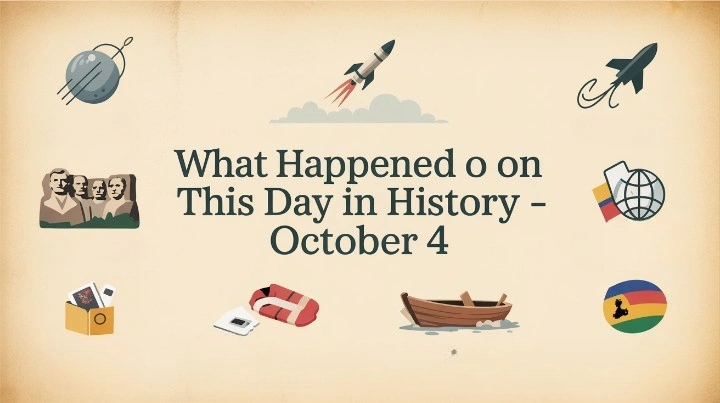
Across centuries, October 4 has witnessed turning points that shaped nations, science, and society. From the launch of Sputnik that began the space age to political upheavals and moments of human struggle, these events remind us how a single date can echo through time. When we ask What happened on this day in history October 4, the answer is a mix of triumphs, tragedies, and milestones that continue to define our world.
Major Events Happened On this Day in History October 4
AD 23 — Sack of Chang’an during a peasant rebellion
Rebels breached and sacked Chang’an, the Han capital, in a violent uprising that exposed deep rural discontent and administrative strain. The attack disrupted court life and highlighted weaknesses in imperial provisioning and taxation systems.
Such episodes of popular unrest often accelerated factional conflicts at court and regional instability. Later histories treat the sack as a landmark in the era’s cycle of rebellions and dynastic stress.
1190 — Richard I captures Messina en route to the Third Crusade
On his way to the Holy Land, King Richard I (the Lionheart) seized Messina, securing a strategic Mediterranean port and asserting his presence in southern Italy. The action affected local alliances and provided a staging ground for subsequent crusader movements.
It also illustrated how crusading expeditions intersected with regional power struggles and naval logistics. Messina’s capture left a footprint on Mediterranean politics and supply routes.
1209 — Coronation of Otto IV by Pope Innocent III
Otto IV received imperial coronation from Pope Innocent III, a ritual that reaffirmed papal-imperial relations even amid persistent power tensions. The coronation symbolized contested jurisdiction between papacy and empire and foreshadowed the political rivalries that would shape the early 13th century.
Otto’s reign was marked by shifting loyalties and conflicts with other imperial claimants. The event remains a key moment in the medieval negotiation of spiritual and temporal authority.
1302 — End of the Byzantine–Venetian War
The conflict between Byzantium and Venice wound down, reflecting Mediterranean diplomatic recalibrations that followed shifting commercial and maritime rivalries. Peace terms and treaties altered trade privileges and coastal control, affecting Venetian influence in eastern waters.
The war’s end eased some immediate pressures but left unresolved tensions about trade monopolies and naval dominance. Its diplomatic aftermath continued to shape Adriatic politics.
1363 — Battle of Lake Poyang — massive naval clash in China
At Lake Poyang, Zhu Yuanzhang’s fleet defeated Chen Youliang in one of history’s largest riverine battles, a decisive moment in the collapse of the Yuan dynasty. The victory paved the way for Zhu’s consolidation and eventual foundation of the Ming dynasty.
The fight showcased large-scale naval tactics, fire-ship use, and logistical coordination on inland waters. Its political consequences reordered regional power and accelerated dynastic change.
1511 — Formation of a Holy League against France
A coalition of Aragon, the Papal States and Venice coalesced to oppose French influence in Italy, illustrating the era’s shifting alliances in the Italian Wars. These leagues were pragmatic instruments of balance-of-power diplomacy among princes, city-states, and the papacy.
While temporarily effective, such coalitions often sowed fresh rounds of conflict and realignment. The 1511 league was one episode in a long, fractious half-century of Italian warfare.
1535 — Coverdale Bible published in English
Miles Coverdale’s English translation circulated widely and influenced later vernacular Bibles, helping to codify English religious language in a time of theological change. The book arrived during the Reformation’s spread of print culture, enabling broader lay engagement with scripture.
Its editorial choices and phrasing shaped subsequent translators and devotional practice. The Coverdale Bible stands as a milestone in the history of English-language Christianity.
1582 — Introduction of the Gregorian calendar
Pope Gregory XIII’s reform corrected the Julian calendar’s drift by skipping several days and revising leap-year rules, reshaping civic and liturgical timekeeping. Adoption was uneven across countries, producing local anomalies as states shifted dates at different moments.
The reform aimed to realign Easter calculations with astronomical reality and has since become the world’s dominant civil calendar. The change shows how technical astronomical corrections can have broad cultural effects.
1597 — Governor Gonzalo Méndez de Canço suppresses an uprising (colonial Georgia)
Colonial officials moved to quell indigenous resistance in the region that would later become Georgia, reflecting the violent dynamics of early colonial frontier control. Suppression campaigns altered local power structures and accelerated settler consolidation in contested spaces.
Such actions frequently produced cycles of reprisals, dispossession and demographic change among indigenous populations. The episode is an example of early colonial enforcement in North America’s southeastern frontier.
1602 — Spanish galleys defeated by English and Dutch galleons in the Channel
Naval action in the English Channel saw faster, heavily armed English and Dutch galleons overcome Spanish oared galleys, illustrating changing naval technologies and tactics. The engagement reflected wider maritime competition during the Eighty Years’ War and the Anglo-Spanish rivalry.
Outcomes emphasized the rising importance of broadside gunnery and oceangoing hulls over older galley warfare. The engagement foreshadowed naval developments that would dominate the Atlantic world.
1636 — Battle of Wittstock (Thirty Years’ War)
Swedish forces defeated Saxon and Imperial armies at Wittstock, sustaining Swedish influence in northern Germany and helping to maintain Protestant momentum. The victory displayed effective maneuvering and command in a complex, multi-front war that devastated central Europe.
Wittstock affected local political alignments and supply lines, shaping subsequent campaigning. The battle is remembered for tactical ingenuity in a conflict defined by shifting coalitions.
1693 — Piedmontese troops defeated by the French (Nine Years’ War)
French successes in Piedmont demonstrated Louis XIV’s military reach and the pressure his campaigns placed on Italy’s duchies and principalities. The conflict’s Italian theater was a stage for great-power rivalry, with local states suffering repeated incursions and diplomatic coercion.
The French advantage in this phase reinforced Bourbon ambitions but also provoked broader anti-French coalitions. The fighting reinforced the era’s pattern of continental contestation.
1777 — Battle of Germantown (American Revolutionary War)
George Washington launched an ambitious four-column attack against British forces near Philadelphia that was ultimately repelled amid fog and confusion. The battle showed the Continental Army boldness and evolving tactical proficiency despite the setback.
Strategic consequences included a demonstration of American resolve that helped secure foreign sympathy, even as tactical success eluded patriot forces that day. Germantown remains a study in complex coordination under battlefield stress.
1795 — Napoleon’s rise to prominence by suppressing rioters
Napoleon Bonaparte’s decisive action in suppressing counter-revolutionary rioters elevated his public standing and marked an early turning point in his career. The episode showed how military leaders could be propelled into political centrality by restoring order in turbulent times.
His success opened doors to further commands and political influence, foreshadowing his later emergence as the dominant figure in French public life. The moment links battlefield reputation with political opportunity.
1824 — Mexico adopts a federal constitution
The 1824 constitution established Mexico as a federal republic after independence, seeking to balance provincial autonomy with national governance. The charter reflected debates between centralists and federalists and set the legal terms for early republican politics.
Its adoption began a fragile, contested nation-building process amid regionalism and economic strains. Subsequent decades of coups and reforms showed the constitution’s limits and Mexico’s volatile political evolution.
1830 — Belgian Revolution formalizes secession from the Netherlands
Belgian provisional government declared separation, launching processes that produced international recognition and a new constitutional monarchy. The split responded to cultural, religious and economic grievances and reshaped the Low Countries’ geopolitics.
Belgium’s creation provided a model for negotiated nationhood and altered diplomatic alignments in 19th-century Europe. The revolution highlighted nationalism’s rising force in continental politics.
1853 — Crimean War begins
Conflict erupted as the Ottoman Empire, backed by Britain and France, confronted Russian pressures in the Black Sea region. The war revealed modern logistical and medical shortcomings and accelerated military reforms across Europe.
It also exposed the limits of diplomacy and foreshadowed new alliance patterns. The Crimean campaign’s human and political costs left a lasting imprint on mid-19th-century international relations.
1862 — Second Battle of Corinth (American Civil War)
Union forces repulsed Confederate attacks seeking control of Corinth’s vital rail junction, preserving a strategic logistics node in Mississippi. The battle signaled the importance of rail infrastructure to Civil War strategy and tightened Union control in the Western Theater.
Local communities suffered destruction and displacement as armies maneuvered for supply lines. Corinth’s defense constrained Confederate operational options in the region.
1876 — Agricultural & Mechanical College of Texas opens (later Texas A&M)
The institution opened as the state’s first public college under the land-grant ideal, aimed at improving agriculture and technical education. It embodied a national movement to expand practical higher education and boost economic development.
Over the decades, it grew into a major research university, shaping regional leadership and service. Its founding marks a milestone in American public-education expansion.
1883 — First run of the Orient Express; Boys’ Brigade first meeting
Europe saw two emblematic events: the luxury Orient Express began international rail service linking West and East, while Glasgow hosted the inaugural Boys’ Brigade meeting, sparking a movement for structured youth training. The Orient Express became a symbol of transcontinental travel and cultural exchange; the Boys’ Brigade influenced youth work and civic organization. Both reflect late-19th-century globalization of mobility and social institutions.
1895 — Horace Rawlins wins the first U.S. Open; Buster Keaton is born
The inaugural U.S. Open crowned Horace Rawlins, signaling the institutionalization of professional golf in America. The year also saw the birth of Buster Keaton, who would become a defining figure in silent-film comedy.
Together, sport and emerging cinema show how mass entertainment and celebrity were taking modern form at the century’s turn. These developments shaped cultural life and commercial leisure.
1917 — Battle of Broodseinde (World War I)
Part of the Third Battle of Ypres, Broodseinde involved heavy artillery, intricate coordination and horrific casualties along the Flanders front. The engagement demonstrated both tactical learning and the grinding cost of trench warfare.
Local gains were often temporary and bought at high human expense, contributing to the wear that shaped 1918’s final campaigns. The battle’s memory forms part of the larger commemoration of WWI’s devastation.
1918 — Explosion destroys a Shell Loading Plant (New Jersey)
A catastrophic industrial explosion leveled a munitions-loading plant, killing more than a hundred people and underscoring wartime production risks on the home front. The disaster prompted attention to industrial safety, storage practices and the human cost of wartime mobilization.
Such accidents highlighted the intersection of civilian industry and military demand in extended conflicts. The event left a legacy in safety reforms and local mourning.
1920 — Founding of the Mannerheim League for Child Welfare (Finland)
Initiated by Sophie Mannerheim, the organization aimed to promote child welfare and public health in a newly independent Finland. The NGO played an influential role in institutionalizing child protection and social services in the Nordic welfare model.
Its work reflected early 20th-century social reform currents emphasizing maternal and child health. The league remains part of Finland’s civic infrastructure.
1925 — Great Syrian Revolt: capture of Hama by rebels
Anti-French rebels led by Fawzi al-Qawuqji took Hama during a broader uprising against the Mandate authorities, reflecting local resistance to colonial rule and economic grievances. The revolt shaped Syrian nationalist identity and provoked harsh countermeasures that left long-term political scars.
Hama’s capture was a dramatic episode in the struggle for Syrian self-determination. The revolt’s suppression influenced subsequent independence movements.
1925 — Finnish torpedo boat S2 sinks off Pori
A fierce storm capsized the S2, costing the lives of its 53 crew members and underscoring the dangers naval forces faced even outside combat. The loss provoked national mourning and naval inquiries into safety and ship design.
Maritime disasters like S2’s sinking revealed vulnerabilities in coastal fleets and spurred reforms. The tragedy remained a somber chapter in Finland’s maritime history.
1927 — Gutzon Borglum begins carving Mount Rushmore
Work began on the monumental presidential faces carved into the Black Hills, a federally supported cultural project blending art, nationalism and engineering. Mount Rushmore became a potent national symbol but also generated controversy because of its location on land sacred to Native peoples.
The project’s scale, aesthetics and politics made it a lasting subject of American memory debates. Carving continued through the Depression era amid funding and design changes.
1936 — Battle of Cable Street (London anti-fascist resistance)
East London residents, trade unions and Jewish groups mobilized to block a march by the British Union of Fascists, leading to street clashes that became an emblem of grassroots resistance to fascism. The confrontation highlighted community solidarity and the limits of tolerance for extremist public displays.
Cable Street entered British popular memory as a stand against street-level authoritarianism and police-community conflict. It influenced subsequent anti-fascist organizing.
1941 — Debut of Norman Rockwell’s Willie Gillis on The Saturday Evening Post cover
Rockwell’s Willie Gillis character, capturing the everyday soldier’s life, appeared on the magazine cover and became an iconic image of American wartime culture. The art humanized service members and contributed to home-front narratives during WWII.
Rockwell’s work shaped visual notions of civic identity and domestic sacrifice. The popularity of the character reflected broader uses of popular art in morale-building.
1957 — Sputnik 1 launched; the Space Age begins
The Soviet Union’s Sputnik 1 became the first human-made satellite in orbit, astonishing global audiences and prompting a dramatic expansion of space research and military rocketry. Sputnik accelerated investments in science education, satellite technology, and strategic policy worldwide.
Its psychological impact reshaped national priorities and inaugurated a new era of orbital exploration. The small beeping sphere remains a symbol of modern technological competition and discovery.
1958 — Adoption of France’s current constitution (Fifth Republic)
France’s new constitution reorganized the political system with a stronger presidency, seeking to cure the instability of the Fourth Republic. Drafted under Charles de Gaulle, it aimed to stabilize governance and strengthen the executive without eliminating parliamentary institutions.
The constitution set the structure for modern French politics and foreign policy orientation. Its adoption reconfigured the state’s institutional balance.
1960 — Airliner crash at Boston Logan kills 62
A tragic aviation accident during takeoff at Logan International Airport cost many lives, highlighting the risks and evolving safety challenges of commercial air travel. The crash prompted investigations into procedural and mechanical causes and contributed to subsequent improvements in airport operations and aircraft design.
Aviation disasters like this spurred regulatory reforms and technological changes that gradually improved safety.
1963 — Hurricane Flora kills thousands in Cuba and Haiti
One of the deadliest storms of the region’s history, Hurricane Flora produced catastrophic loss of life, widespread infrastructure damage, and long recovery processes in both Cuba and Haiti. The hurricane underscored the vulnerability of vulnerable populations to extreme weather and the importance of disaster preparedness.
Recovery efforts revealed limits in emergency response capacity and long-term economic consequences for affected communities. Flora’s human toll shaped subsequent disaster planning.
1965 — Pope Paul VI begins the first papal visit to the Americas
Pope Paul VI’s voyage marked a historic outreach by the papacy to the Western Hemisphere, strengthening pastoral ties and global Catholic visibility. The visit underscored the Church’s evolving international role and its engagement with social and political issues on other continents.
The papal tour combined religious diplomacy with public liturgies that resonated with local Catholics. It set a pattern for modern papal travel.
1966 — Basutoland becomes independent Lesotho
Basutoland’s transition to the Kingdom of Lesotho marked a decolonization milestone in southern Africa as a constitutional monarchy within the Commonwealth. Independence confronted the new state with geographic and economic constraints, but established national institutions and identity.
Lesotho’s postcolonial trajectory has included tensions between monarchical and elected authority amid development challenges. The founding day remains central to national commemoration.
1967 — Sultan Omar Ali Saifuddien III of Brunei abdicates
The Sultan’s abdication in favor of his son represented a dynastic transition that maintained continuity in Brunei’s ruling dynasty as the state navigated postwar changes. The succession reflected internal governance choices and the monarchy’s central role in political stability.
Brunei’s later constitutional and economic transformations continued to shape the monarchy’s domestic and diplomatic posture. The abdication was an important royal moment in the sultanate’s modern history.
1970 — Death of Janis Joplin
Janis Joplin died of a drug overdose, cutting short the life of one of rock’s most distinctive vocal talents and intensifying public conversations about fame, mental health and substance abuse.
Her music and persona left a strong artistic legacy in blues-inflected rock and cultural memory of the late 1960s. Joplin’s death added to the era’s narrative of gifted artists lost young and prompted industry and social reflections on care for artists.
1983 — Richard Noble sets a new land-speed record
Richard Noble drove Thrust 2 to 633.468 mph at Black Rock Desert, Nevada, reclaiming records in high-speed engineering and pushing automotive boundary testing. The achievement showcased advances in aerodynamics, propulsion and safety engineering for land vehicles.
Records like Noble’s capture public imagination about human and machine limits. Such high-speed efforts also stimulated later projects pursuing even greater speeds.
1985 — Free Software Foundation founded
The foundation’s creation formalized an emerging movement advocating software freedom, open-source principles and shared development ethics. The FSF catalyzed debates over licensing, user rights and the political economy of software production.
Its influence reshaped software communities, encouraged collaborative models and prompted alternative governance of digital tools. The movement remains central to contemporary debates on digital commons and intellectual property.
1989 — Secretariat euthanized after laminitis
The great racehorse Secretariat, winner of the 1973 Triple Crown, was euthanized after suffering incurable laminitis, prompting international mourning among sports fans. Secretariat’s career transformed expectations about racehorse performance and breeding prospects.
His death highlighted veterinary challenges in equine care and reinforced public affection for sporting icons. Secretariat’s legacy endures in racing history and popular culture.
1991 — Protocol on Environmental Protection to the Antarctic Treaty opened for signature
Often called the Madrid Protocol, it expanded legal protections for Antarctica by establishing comprehensive environmental standards and prohibiting mining in the region. The protocol strengthened international governance for a fragile polar ecosystem and framed future scientific research and conservation efforts.
It represented a rare example of cooperative global environmental policymaking. The agreement shaped Antarctic stewardship into the 21st century.
1992 — Rome General Peace Accords end Mozambique’s civil war
The accords ended years of violent conflict between RENAMO rebels and the government, laying out disarmament, reintegration and political reforms that opened space for UN peacekeeping and reconstruction.
The peace process allowed Mozambique to begin recovery from famine and infrastructure collapse. Reconstruction remained difficult, but the accords were pivotal in shifting from war to a fragile peace and elections. The settlement stands as a notable post-Cold War peace process.
1992 — El Al Flight 1862 crashes into Amsterdam apartment buildings
A cargo aircraft crashed into residential buildings after an in-flight structural failure, killing dozens and devastating neighborhoods. The disaster prompted aviation safety investigations and raised concerns about cargo transport risks over urban areas.
The catastrophe spurred regulatory reviews, emergency-response changes and legal processes regarding airworthiness and oversight. Its urban toll remains a painful memory for affected communities.
1993 — Battle of Mogadishu and the end of a US-led intervention phase in Somalia
An operation against a Somali warlord turned into intense urban combat, producing heavy casualties and a sudden public shock to U.S. policy preferences on intervention. The battle’s visual impact and human cost influenced later restraint in similar operations and changed how future peace enforcement missions were planned.
The episode remains central to debates about intervention thresholds, intelligence and exit strategies.
1993 — Tanks bombard the Russian parliament during domestic unrest
Violent confrontations in Moscow saw armoured forces used against parliamentary resistance, signaling a brutal phase in post-Soviet Russian politics as institutional struggles over reform and authority erupted into force.
The events underscored the fragility of democratic transition and the potential for crisis in political consolidation. The episode affected Russia’s institutional trajectory and the region’s perception of post-communist stability.
1997 — Large cash robbery in North Carolina (one of the largest in U.S. history)
A brazen heist took place that would be recorded among the country’s largest cash robberies, revealing vulnerabilities in commercial cash handling and prompting law-enforcement investigations.
Such high-profile robberies often lead to improved security protocols for cash transport and bank operations. The event entered lists of notable criminal episodes for the period and spurred procedural reforms.
2001 — Siberia Airlines Flight 1812 struck by an errant missile and crashes
A commercial passenger flight was tragically downed after being struck by a missile during military exercises, killing dozens and prompting international scrutiny of safety measures around military training.
The disaster raised urgent questions about coordination between air traffic control and military operations. Families and investigators sought accountability and improved safeguards to prevent similar tragedies.
2003 — Maxim restaurant suicide bombing in Israel kills twenty-one
A suicide bomb attack struck a Tel Aviv restaurant, killing civilians and deepening cycles of violence and grief in the region. The attack reinforced urgent debates about security, counterterrorism measures, and the human toll of protracted conflict.
Responses included emergency medical mobilization and political condemnation, as well as intensified security measures. The bombing remains part of the conflict’s long casualty record.
2004 — SpaceShipOne wins the Ansari X Prize (private spaceflight milestone)
SpaceShipOne completed its qualifying flights and claimed the prize, demonstrating that private efforts could achieve suborbital human flight and opening new possibilities for commercial space ventures.
The achievement catalyzed investment in private aerospace and inspired entrepreneurs to pursue low-cost human space access. It marked a symbolic shift from exclusively state-driven programs to broader innovation ecosystems.
2006 — WikiLeaks launched, reshaping whistleblowing and transparency debates
The creation of an online leak-publishing platform introduced a disruptive model for releasing classified documents and ignited global controversies over secrecy, public interest and press freedom.
WikiLeaks challenged traditional gatekeepers and forced governments, media and legal systems to confront new forms of digital disclosure. Its activities have had lasting consequences for how information is leaked, reported and politically contested.
2010 — Ajka alumina sludge spill (Hungary)
A containment failure released a massive volume of caustic sludge, killing and injuring many and contaminating rivers and farmland, exposing regulatory and industrial-safety failures. The environmental cleanup and health response were long and costly, prompting legal action and renewed scrutiny of industrial oversight.
The disaster remains a cautionary example of industrial risk management and environmental remediation challenges.
2014 — Death of Jean-Claude Duvalier (“Baby Doc”) in Haiti during legal proceedings
The former president’s passing while facing human-rights and corruption allegations closed a controversial chapter of Haitian politics tied to dictatorship, exile and contested accountability.
Duvalier’s death left unresolved questions about justice for past abuses and the political legacies of authoritarian rule. His return to Haiti years earlier had already reopened debates about reconciliation and institutional remedy.
2017 — Ambush at Tongo Tongo (Niger) kills U.S. and Nigerien forces
Joint Nigerien-American patrols were ambushed by militants linked to the Islamic State, producing casualties and raising questions about counterterrorism posture in the Sahel. The attack underscored the region’s security challenges and the risks of partnered operations in remote areas.
It prompted operational reviews and adjustments in training, intelligence and force protection measures for expeditionary missions.
2019 — Knife attack at Paris police headquarters; Hong Kong protests continue
A violent intrusion at the Paris police headquarters shocked national security services and raised concerns about internal threats, while massive pro-democracy demonstrations in Hong Kong entered another phase of confrontation with authorities.
Both events reflected tensions over governance, public trust and institutional resilience in different political contexts. The juxtaposition highlights how the same date can hold both sudden violence and sustained civic mobilization.
2020 — President Trump and First Lady test positive for COVID-19; Nagorno-Karabakh fighting resumes
The U.S. president’s infection made global headlines and underlined how political leadership intersected with public-health crises, even as renewed heavy fighting broke out in Nagorno-Karabakh, showing how the pandemic year continued to intersect with longstanding geopolitical conflicts.
The twin stories demonstrated the pandemic’s interaction with governance, diplomacy and conflict dynamics. They shaped messaging, policy responses and diplomatic attention in fall 2020.
2021 — Huntington Beach oil spill and high-profile domestic news cycle items
A major oil spill temporarily closed parts of a California coastline, while the U.S. Supreme Court’s new term and revelations like the Pandora Papers kept the news agenda focused on environmental damage and institutional accountability.
The spill highlighted marine-environment vulnerability and the need for rapid coastal response. The broader journalistic and legal stories reflected pressures on transparency and regulation.
2022 — Ukraine counteroffensive developments; Colombia–ELN peace talks resume
Reports of Ukrainian advances in the south and renewed peace talks between Colombia’s government and the ELN illustrated continuing efforts to resolve or alter long-running conflicts.
Both stories showed the mix of battlefield dynamics and diplomatic engagement that define many modern crisis narratives. The items underscored the persistence of violent conflict even as diplomatic openings sometimes appear.
2023 — Severe flash flooding in Sikkim, India; political fallout in the U.S. after speaker removal
Flash floods devastated parts of Sikkim, causing deaths and mass evacuations and highlighting climate-driven disaster risks in mountain regions. In the U.S., political repercussions continued to unfold after the historic removal of a House speaker, revealing the instability and factional strife within contemporary partisan politics.
The entries illustrate how sudden natural disasters and institutional crises can define a single day in very different ways.
2024 — Ongoing Gaza war coverage and major storm/hurricane impacts
In a year marked by intense regional conflict, Israeli strikes and West Bank incursions made international headlines while hurricane and storm damage produced high death tolls and recovery operations in other parts of the world.
October’s news highlighted how war, protest and climate disasters continue to converge on global attention. The scale of these crises emphasized humanitarian and policy challenges facing multiple regions.
Read Here October 3 facts and events
Quick Sections
Earlier History
Gregorian reform (1582), Lake Poyang (1363), Germantown (1777), Napoleon’s rise (1795), Crimean War outbreak (1853).
Exploration & Foundations
Mount Rushmore carving begins (1927); Mexico’s 1824 constitution; Lesotho’s independence (1966); early computing roots (Atanasoff, born 1903).
Wars & Politics
Major military and political moments: Broodseinde and other WWI battles; Second Battle of Corinth (1862); Mozambican peace accords (1992); Mogadishu raid (1993); modern unrest and protests (Hong Kong, 2019).
Arts, Culture & Media
Notable cultural entries: births of Millet and Remington; Buster Keaton’s birth; Norman Rockwell’s Willie Gillis debut (1941); Janis Joplin’s death (1970); the Orient Express launch (1883).
Science, Technology & Media
Sputnik (1957) and SpaceShipOne/Ansari X Prize (2004) bookend public and private advances in space; Atanasoff’s computing legacy; Free Software Foundation founding (1985); WikiLeaks launch (2006) shifts digital-era transparency debates.
Disasters & Human Rights
Ajka alumina-spill (2010), El Al Flight 1862 crash (1992), Hurricane Flora (1963), Nickel Mines Amish school shooting (2006), and the human cost of conflict evident in Mogadishu, Tongo Tongo and other episodes.
Notable births — October 4
Jean-François Millet — French painter — Born 1814.
Frédéric Remington — American artist (Western art) — Born 1861.
John Vincent Atanasoff — American physicist and digital-computer pioneer — Born 1903.
Richard Rorty — American philosopher — Born 1931.
Richard Sorge — German journalist and Soviet spy — Born 1895.
Jóhanna Sigurðardóttir — Prime Minister of Iceland — Born 1942.
Mike Mullen — U.S. Navy admiral, former Chairman of the Joint Chiefs — Born 1946.
Vitaly Ginzburg — Russian physicist, Nobel laureate — Born 1916.
Kurt Wüthrich — Swiss chemist/biophysicist, Nobel laureate — Born 1938.
John B. Kelly — American Olympic rower and athlete — Born 1889.
Francisco Morales Bermúdez — President of Peru — Born 1921.
Edward Stratemeyer — American children’s-series publisher and writer — Born 1862.
Eliza Johnson — First Lady of the United States (Andrew Johnson) — Born 1810.
Aleksey A. Arakcheyev — Russian general and statesman — Born 1769.
Otto Ville Kuusinen — Finnish/Soviet politician — Born 1881.
György Kepes — Hungarian-American artist and design theorist — Born 1906.
Henri Gaudier-Brzeska — French sculptor (Vorticism) — Born 1891.
Lord George Murray — Scottish Jacobite general — Born 1694.
Nicolae Titulescu — Romanian diplomat and statesman — Born 1883.
Lennox Robinson — Irish playwright and theatre figure — Born 1886.
Rutherford B. Hayes — 19th U.S. president — Born 1822.
Buster Keaton — American film comedian and director — Born 1895.
Notable deaths — October 4
Gifford Pinchot — American conservationist and U.S. Forest Service chief — Died 1946.
Al Smith — American politician and New York governor — Died 1944.
Anne Sexton — American confessional poet — Died 1974.
Gordon Cooper — American astronaut (Mercury program) — Died 2004.
Frédéric-Auguste Bartholdi — French sculptor (Statue of Liberty) — Died 1904.
Aḥmad Ḥasan al-Bakr — President of Iraq — Died 1982.
Justin II — Byzantine emperor — Died 578.
Catherine Booth — Cofounder of the Salvation Army — Died 1890.
Otto Weininger — Austrian philosopher — Died 1903.
Barney Oldfield — American pioneering race-car driver — Died 1946.
Günther Rall — German WWII fighter ace — Died 2009.
Jill Bennett — British actress — Died 1990.
Kobayashi Masaki — Japanese film director — Died 1996.
Michael Smith — Canadian biochemist and Nobel laureate — Died 2000.
Liam Cosgrave — Taoiseach of Ireland — Died 2017.
Benozzo Gozzoli — Italian Renaissance painter — Died 1497.
Alexandros Papagos — Greek general and statesman — Died 1955.
Manuel de Godoy — Prime minister of Spain — Died 1851.
V. O. Key, Jr. — American political scientist — Died 1963.
John Rennie — Scottish civil engineer — Died 1821.
Observances & Institutional Dates
- Conclusion of Creationtide (Christian liturgical calendar).
- Feast days and Eastern Orthodox liturgics for October 4 (including commemorations such as Petronius of Bologna).
- Cinnamon Roll Day — Sweden and Finland (popular food observance).
- Day of Peace and Reconciliation — Mozambique (marks the end of civil conflict and reconciliation efforts).
- Independence Day — Lesotho (celebrates independence from the United Kingdom, 1966).
- World Space Week begins (international observance tied to the launch of Sputnik).
- World Animal Day (an international awareness day for animal welfare and rights).
Frequently asked questions (FAQs)
Why is October 4 often linked to the start of the Space Age?
The Soviet launch of Sputnik 1 on October 4, 1957, marked the first successful placement of a human-made satellite into Earth orbit. The event spurred global investment in rocketry, satellite communications, science education and strategic policy, and is widely considered the symbolic start of the Space Age.
What was unusual about October 4, 1582 — why were days skipped?
Pope Gregory XIII’s calendar reform removed ten days from October 1582 (so that October 4 was followed by October 15 in adopting regions) to correct the Julian calendar’s accumulated drift against the solar year and to realign liturgical dates. Different countries adopted the Gregorian calendar at different times, producing local inconsistencies.
Why is Mount Rushmore controversial even though it’s a national monument?
While Mount Rushmore is a highly visible national symbol, its location in the Black Hills—land sacred to Lakota and other Indigenous peoples—raises questions about consent, land rights and how national memory is constructed. The project’s artistic ambition and federal backing must be read alongside the dispossession of Indigenous communities.
How did the Rome General Peace Accords change Mozambique?
The 1992 accords ended a long civil war by setting out disarmament, demobilization and political reintegration measures and by opening space for UN-assisted reconstruction and elections.
While the peace did not solve every political or economic problem, it allowed Mozambique to move from conflict to a fragile but enduring peacetime reconstruction.