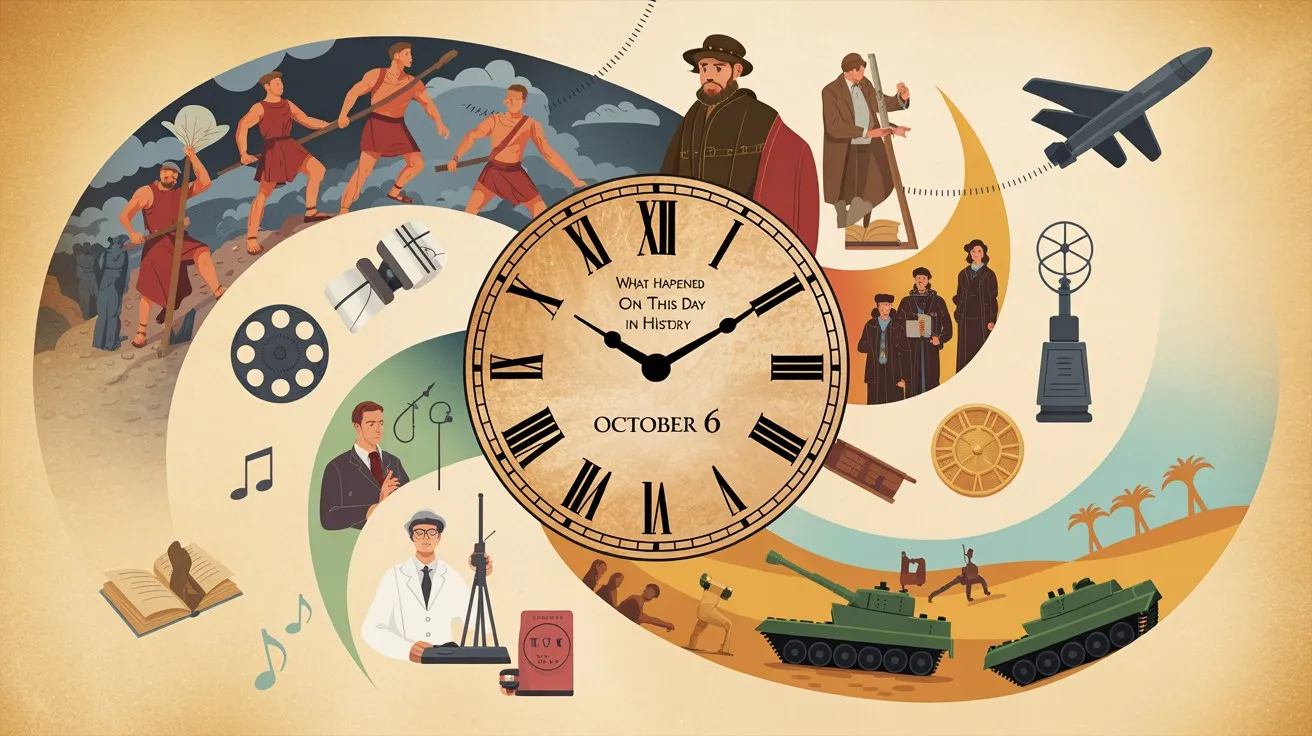
Throughout the centuries, October 6 has been marked by warfare, invention, and significant cultural turning points. From ancient Roman defeats to early aviation milestones, dramatic political upheavals, and modern media debuts, the date stitches together moments that reshaped politics, technology, and public life. Looking back at what happened on this day in history October 6 reveals a timeline filled with triumphs, tragedies, and innovations that continue to influence the world today.
Major Events On this Day in History October 6
105 BC — Battle of Arausio (Cimbrian War): Roman army defeated
In one of the Republic’s most disastrous defeats, Roman forces suffered a crushing loss at Arausio against migrating Cimbri and Teutones. The rout exposed severe weaknesses in Roman command and troop organization during the late Republic, provoking urgent military reforms. The disaster also helped set the stage for the rise of strong military leaders who would later transform Roman politics. Arausio’s scale and humiliation left a lasting imprint on Roman strategic thinking.
69 BC — Romans subdue Armenia (Third Mithridatic War context)
Roman military pressure in the East brought Armenia temporarily under Roman influence as campaigns against Mithridates and allied kingdoms reshaped regional balances. These operations reflected Rome’s expanding eastern commitments and the complex diplomacy of client kingship. The political outcomes affected trade routes and local dynastic fortunes across Anatolia and the Caucasus. The episode illustrates Rome’s prolonged effort to stabilize its eastern frontier.
AD 23 — Rebels execute Wang Mang after sack of capital
During the upheavals that ended Wang Mang’s Xin dynasty, rebels captured the capital and beheaded the usurper, ending an ambitious but destabilizing reform regime. Wang Mang’s policies and the ensuing peasant unrest reveal how radical reforms paired with environmental and economic stress can provoke violent collapse. The event reopened the Han imperial line and remains a dramatic example of dynastic rupture in Chinese history. It shows the fragility of centralized reform efforts in turbulent times.
404 — Death of Byzantine Empress Eudoxia (complications of pregnancy)
Empress Eudoxia’s death from complications following pregnancy underscores the high risks of childbirth even for ruling households in late antiquity. Her passing had personal and political consequences at Constantinople, touching imperial succession and court factionalism. When elite mortality intersected with political contestation, it could accelerate court intrigues and shifts in policy. The human cost of childbirth across historical eras affected dynastic stability in important ways.
618 — Battle of Yanshi: Wang Shichong defeats Li Mi (Sui–Tang transition)
As the Sui dynasty collapsed, the Battle of Yanshi marked a crucial power struggle in the north-China chaos, with Wang Shichong temporarily asserting control. The engagements of this period helped define the subsequent Tang consolidation and the map of post-Sui political order. Military fortunes at Yanshi contributed to the longer story of reunification under the Tang and the reshaping of regional elites. The period’s turbulence underlined how military entrepreneurs could pivot into state-building roles.
891 — Pope Formosus elected (prelude to an infamous posthumous trial)
Formosus’s papacy later became infamous because his corpse was exhumed and put on trial (the Cadaver Synod) in 897, an episode that exposed bitter factionalism within the papal curia. His election and the violent afterlife of his memory reflect medieval Rome’s volatile mixture of spiritual authority and temporal politics. The strange posthumous trial reveals the lengths to which rivals would go in delegitimizing opponents and controls over ecclesiastical legitimacy. It remains one of the papacy’s most notorious scandals.
1539 — De Soto expedition occupies Apalachee capital Anhaica for winter
Hernando de Soto’s expedition used Anhaica as a winter encampment, deepening early colonial encounters in the southeastern North American interior. The prolonged presence of Spanish forces affected indigenous polities through requisitioning, disease spread and political disruption. Anhaica’s occupation is one episode in the wider story of early European incursions that restructured native societies and environments. The De Soto voyage is remembered for exploration and its often-destructive impacts on indigenous communities.
1600 — Première of Euridice, earliest surviving opera (start of Baroque)
The staging of Euridice marks a turning point in Western musical history: early opera’s fusion of drama and music signalled new experiments in theatrical storytelling and the Baroque era’s aesthetic shifts. Patrons, composers and librettists sought ways to revive classical drama through music, producing a form that would dominate courtly and public entertainment for centuries. The work’s survival allows music historians to trace opera’s early stylistic contours and rhetorical aims. It helped inaugurate a longstanding theatrical tradition.
1683 — Germantown founded (major German immigration to North America)
Settlers established Germantown, Pennsylvania, as part of a broader migration that contributed German cultural, religious and agricultural influence to colonial America. The settlement became a focal point for immigrant communities, crafts and transatlantic networks of exchange. Germantown’s foundation illustrates how colonial demography shaped early American towns and economic patterns. Its later role in abolitionist history also highlights how immigrant communities intersected with social movements.
1762 — British capture of Manila (Seven Years’ War)
Britain’s occupation of Manila temporarily displaced Spanish governance in the Philippines and revealed the global scope of the Seven Years’ War. The capture affected trade, colonial administration and local elites, demonstrating how European conflicts reverberated in distant imperial provinces. Though temporary, British control disrupted long-standing commercial patterns and underscored the vulnerability of colonial holdings during great-power war. The episode foreshadowed later imperial contests in Asia.
1777 — British take Forts Clinton and Montgomery on the Hudson (Revolutionary War)
British forces captured strategic Hudson River forts, temporarily controlling river traffic and threatening Continental communications. The operations reflected British attempts to sever New England from the other colonies and to exploit interior waterways for maneuver. Though tactically significant, the broader campaign ultimately failed to secure lasting strategic advantage for the crown. The fall of the forts illustrates the contested geography of the war and the centrality of river control.
1789 — Louis XVI forced to move from Versailles to Tuileries Palace (French Revolution)
Popular pressure, including the Women’s March and popular unrest in Paris, compelled the king to relocate, symbolically bringing the monarchy under the capital’s watch and changing the revolution’s momentum. The relocation marked a decisive erosion of royal autonomy and strengthened revolutionary institutions in Paris. It demonstrated the capacity of urban popular movements to shape national politics. The event tightened Paris’s control over national governance and highlighted revolutionary popular agency.
1810 — Raahe fire destroys one-third of the town (Grand Duchy of Finland)
A devastating blaze razed much of Raahe, highlighting the vulnerability of wooden towns in the premodern period and prompting rebuilding efforts and new urban precautions. Fires such as this altered economic life, displaced populations and sometimes led to reform in urban planning and fire control. Raahe’s recovery illustrates local resilience and the long-term costs of catastrophic urban conflagration. Such disasters left marks on civic memory and municipal policy.
1849 — Execution of the “Martyrs of Arad” (Hungarian Revolution aftermath)
Thirteen Hungarian generals were executed after the failed 1848–49 uprising against Habsburg rule, becoming martyrs for the national liberation cause. Their deaths symbolized the costs of revolutionary struggle and fueled subsequent nationalist commemorations and political narratives. The repression demonstrated the empire’s determination to restore order and deter dissent. The martyrs’ memory played a role in later Hungarian identity and independence movements.
1854 — Great fire of Newcastle and Gateshead (England)
The conflagration damaged large swaths of the twin towns, producing deaths, injuries and economic disruption and prompting rebuilding and civic reform. Urban fires in this era often led to scrutiny of building materials, firefighting organization and municipal infrastructure. The Newcastle–Gateshead fire’s local recovery process reshaped urban design and emergency preparedness in the region. It stands among nineteenth-century urban disasters that stimulated modern municipal responses.
1884 — Founding of the U.S. Naval War College (Rhode Island)
The establishment of the Naval War College institutionalized professional naval education and strategic thought in the United States, shaping officer training and naval doctrine across the 20th century. The college became a hub for doctrinal development, wargaming and the intellectual cultivation of maritime strategy. Its founding reflects broader professionalization trends in modern armed forces and the growing importance of theory to military practice. The institution influenced naval policy and education worldwide.
1898 — Phi Mu Alpha Sinfonia founded (music fraternity)
The creation of Phi Mu Alpha signaled efforts to organize musical life and professional networks among American conservatory students, contributing to a culture of fraternity, performance and education. The organization played roles in sponsoring concerts, pedagogy and student leadership across campuses. Such associations helped institutionalize musical training and community building in the U.S. higher-education system. Its foundation reflects the cultural embedding of organized music-making.
1903 — High Court of Australia sits for first time
Australia’s High Court convened as the new federation’s apex judicial body, establishing principles of constitutional interpretation and federal adjudication. The court’s early judgments shaped federal-state relations and the judicial role in Australian governance. Its creation consolidated legal institutions necessary for a federated polity. The High Court remains central to Australia’s constitutional democracy and legal evolution.
1908 — Bosnian Crisis: Austria-Hungary annexes Bosnia and Herzegovina
The annexation inflamed Balkan and great-power tensions, provoking protests and destabilizing diplomatic alignments that later fed into the region’s radicalization. The crisis demonstrated the fragility of Austro-Hungarian multinational governance and the volatility of Ottoman successor spaces. It also presaged the alliances and grievances that would culminate in 1914. Bosnia’s annexation remains a key prelude to twentieth-century conflagrations in southeastern Europe.
1910 — Eleftherios Venizelos elected Prime Minister of Greece (first time)
Venizelos’s rise to power marked the emergence of a dominant figure in modern Greek politics who would drive constitutional reform, territorial ambition and modernization efforts in the early 20th century. His leadership would shape Greece’s trajectory through wars and diplomatic realignments. Venizelos’s influence exemplifies how transformative political personalities can steer small states through turbulent regional politics. His election began a long period of national reform and activism.
1915 — Central Powers launch new offensive against Serbia; Entente lands at Thessaloniki
Autumn offensives and Allied landings opened the Macedonian front in a complex Balkan theatre that would tie down troops and resources in a multi-year slog. The new campaigns reflected the war’s widening geography and the strategic significance of the Balkans as a gateway between Europe and the Near East. The front’s existence complicated supply and command for both sides and influenced later postwar borders. The operations underscore the conflict’s continental scale.
1920 — Starobilsk agreement in Ukrainian War of Independence (Makhnovshchina)
The Starobilsk accord represented tactical arrangements among Soviet and insurgent forces in a chaotic period of civil war and national struggle, reflecting the fluid alliances of post–World War I Eastern Europe. Agreements like Starobilsk illustrate the district-by-district bargaining that characterized attempts to stabilize contested spaces. The episode reveals how revolutionary movements negotiated short-term survival amidst larger geopolitical reorders. It is part of the complex map of postimperial state formation.
1923 — Turkish National Movement enters Constantinople
Mustafa Kemal’s movement effectively took control of the former Ottoman capital, cementing the end of the sultanate and the coming political order that would produce the Republic of Turkey. The entry signalled a decisive shift from imperial rule toward nationalist reform and secularization. It also marked a reorientation of political authority and the start of sweeping institutional transformation under Kemal Atatürk. The moment is central to modern Turkish founding narratives.
1927 — The Jazz Singer premieres, introducing sound cinema
The Al Jolson film’s success ushered in the sound era, revolutionizing motion pictures by integrating synchronized dialogue and music and transforming cinematic storytelling, performance and markets. The technological leap reshaped production, distribution and exhibition, forcing studios and artists to adapt rapidly. The film’s cultural impact included new forms of stardom and the internationalization of American cinema. The Jazz Singer stands as a technological and cultural watershed.
1934 — Catalan State proclaimed during the Revolution of 1934 (Lluís Companys)
The short-lived Catalan proclamation reflected deep social and political fractures in Spain and presaged the instability that would erupt into civil war later in the decade. The episode highlighted regional demands for autonomy and the sharp polarization between left and right across Spain. Companies’ actions and their suppression became touchstones for Catalan autonomy movements and republican memory. The revolt reflected wider European tensions of the interwar years.
1939 — Battle of Kock (final combat of the September Campaign in Poland)
As the Polish defensive campaign folded under German invasion, Kock represented the last organized resistance in 1939, symbolizing tenacious defense despite overwhelming odds. The battle’s conclusion marked the effective end of Poland’s regular field army in the opening phase of World War II. The fighting underscored both the valor and the strategic calamity that befell Polish forces confronted by superior mechanized power. Kock’s memory is part of Polish wartime commemoration.
1942 — Guadalcanal: U.S. forces push Japanese east of the Matanikau River
Hard-fought ground operations around the Matanikau helped consolidate Allied control on Guadalcanal and marked an important phase in the Solomon Islands campaign. The fighting demonstrated the logistical difficulty of jungle warfare and the strategic importance of denying Japanese bases in the South Pacific. Guadalcanal’s eventual Allied hold was a turning point in the Pacific, shifting momentum and enabling further offensive operations. The campaign’s human cost and tactical lessons were significant.
1943 — Mass atrocity in Crete: civilians burnt alive by paramilitaries during Nazi occupation
The murder of civilian populations during occupation highlighted the brutality of counterinsurgency and the extreme measures used by occupation forces and collaborators. Incidents like this intensified local resistance and produced deep, long-lasting trauma for the island’s communities. Postwar justice and memory debates have grappled with accountability and the moral weight of such crimes. The event remains a tragic example of occupation-era atrocity.
1944 — 1st Czechoslovak Army Corps enters Czechoslovakia via Dukla Pass
The Corps’ advance through the difficult Carpathian terrain signaled a major push of Allied-aligned forces into Czechoslovakia, contributing to its liberation and the shifting postwar political order. The Dukla Pass campaign involved heavy fighting and logistical complexity amid mountainous weather. Military gains there helped re-establish Czechoslovakia’s territorial sovereignty after Nazi occupation. The operation is remembered for both its strategic importance and heavy casualties.
1960 — Spartacus premieres (Kubrick) — a cultural landmark
Stanley Kubrick’s Spartacus became a major Hollywood spectacle and later a touchstone for themes of rebellion, slavery and cinematic epic. The film’s production and success reflected both Cold War-era studio politics and the star power of Kirk Douglas. Its awards recognition and cultural reach demonstrated how cinema could engage historical themes with mass audiences. Spartacus remains an emblem of mid-century American epic filmmaking.
1973 — Yom Kippur War begins (Egypt and Syria attack Israel)
On a holy day, coordinated attacks by Egypt and Syria initially achieved tactical surprise and heavy early gains, plunging the Middle East into a brutal war that reshaped territorial lines and superpower diplomacy. The conflict had immediate human costs, produced an energy crisis, and accelerated shifts in Cold War alignments and peacemaking efforts. Its aftermath influenced later negotiations and the geopolitics of the region. The war’s memory continues to inform regional security dynamics.
1976 — Cubana Flight 455 destroyed by bombs; Thammasat massacre and Gang of Four arrested (China)
October 6, 1976, gathers grim and decisive events: the terrorist bombing of Cubana Flight 455 killed all aboard and highlighted transnational political violence; in Thailand the Thammasat University massacre and subsequent coup showed the fragility of democratic movements; and in China the arrest of the Gang of Four marked the end of the Cultural Revolution’s most radical phase. Together these events demonstrate how political violence, terrorism and elite purges shaped the late-20th-century world.
1977 — MiG-29 prototype (9-01) maiden flight
The Mikoyan MiG-29’s first prototype flight introduced a new generation of Soviet air-combat capability, reflecting advancements in fighter design during the Cold War. The aircraft would become a mainstay of Soviet and later Russian air forces and was exported widely. Its debut showcased priorities in maneuverability, avionics and pilot survivability. The MiG-29’s development exemplified aerospace competition between superpowers.
1979 — Pope John Paul II visits the White House (first pontiff to do so)
The papal visit symbolized the Vatican’s renewed diplomatic engagement with the United States and the growing global stature of John Paul II as a moral and political actor. The trip reflected the pope’s broad pastoral outreach and the postwar transatlantic relationship between church and state. The visit also played into Cold War dynamics, given John Paul II’s Polish origins and influence on Eastern European dissidence. It was an historic moment in Vatican–U.S. relations.
1981 — Assassination of Egyptian President Anwar Sadat
Sadat’s killing by Islamist militants stunned Egypt and the world, provoking a security clampdown and political recalibration in a region already riven by conflict and ideological contest. The assassination underscored deep tensions over peace policies, domestic politics and the limits of authoritarian modernization. Sadat’s death opened a new chapter in Egyptian governance and regional diplomacy and had immediate implications for the Camp David framework and Arab politics.
1985 — Broadwater Farm riot and murder of PC Keith Blakelock (London)
Confrontations in Tottenham escalated into large-scale rioting and the killing of a police constable, spotlighting tensions between policing, race, and social marginalization in 1980s Britain. The aftermath produced controversial trials, public inquiry and debates about urban policy and law enforcement methods. The incident remains a complex touchstone in British social-policy history, reflecting difficulties in policing under strained social conditions.
1990 — Space Shuttle Discovery (STS-41) launches and deploys Ulysses probe
Discovery’s mission to deploy Ulysses extended solar science into polar regions, expanding humanity’s understanding of solar wind and heliospheric structure. The launch combined shuttle capabilities with robotic deep-space exploration, underscoring NASA’s dual roles in crewed and unmanned missions. Ulysses’s data later contributed to models of solar-terrestrial interaction important for space weather and astrophysics. The mission illustrates creative uses of shuttle payload capacity.
1995 — Discovery of 51 Pegasi b (first planet orbiting a Sun-like star)
The detection of 51 Pegasi b opened a new era in astronomy—exoplanetary science—demonstrating that planets orbiting other Sun-like stars could be observed and studied. The finding catalyzed a booming field of research that has since revealed thousands of exoplanets, transforming our understanding of planetary system formation and frequency. The discovery’s methods and implications reshaped observational astrophysics and the search for potentially habitable worlds.
2000 — Near Sakaiminato earthquake (magnitude 7.3)
A powerful quake struck off Japan’s west coast, notable as the strongest since Kobe’s 1995 temblor, though casualties were limited by the offshore epicenter. The event reminded planners and communities in earthquake-prone Japan of persistent seismic risk and the need for preparedness in coastal regions. It fed into ongoing engineering, warning-system and disaster-response improvements in a highly seismically active society. The quake’s limited damage nonetheless tested local resilience.
2007 — Jason Lewis completes first human-powered global circumnavigation
Lewis’s completion of a human-powered circumnavigation represented a feat of endurance and small-boat seamanship, capturing public imagination about exploration and human limits. The expedition combined cycling, rowing and sailing across oceans and continents, showcasing logistical ingenuity and sustained personal commitment. Such modern adventures revive older exploration motifs in a contemporary, environmentally aware context. Lewis’s accomplishment joined a small roster of extraordinary human-powered voyages.
2010 — Instagram founded (photo-sharing app mainstreams mobile visual culture)
Instagram’s launch helped popularize mobile-first, image-based social networking and transformed amateur photography, influencer culture and visual communication. The platform reshaped how people document daily life and how brands and media engage audiences, quickly becoming central to social-media ecosystems. Its rise also raised debates about attention economies, privacy and platform governance. Instagram was a pivotal step in the smartphone-era reshaping of media.
2017 — Harvey Weinstein allegations publicize and accelerate #MeToo movement
Public allegations triggered widespread revelations and a global movement addressing sexual harassment and abuse across industries, catalyzing legal, corporate and cultural reckoning. #MeToo prompted policy reforms, higher-profile investigations and shifts in workplace norms worldwide. The episode highlighted power dynamics in entertainment and other sectors and raised questions about accountability and restorative measures. The movement’s ripple effects continue to influence institutional behavior and public consciousness.
2018 — Brett Kavanaugh confirmed to U.S. Supreme Court (contentious process)
The Senate confirmation concluded a polarized, high-stakes process centered on allegations of sexual misconduct, intense media attention and major partisan mobilization. Kavanaugh’s confirmation had immediate legal and political ramifications and intensified public debate about judicial appointments, professional vetting, and the role of personal conduct in public-office confirmation. The episode underscored how Supreme Court nominations now catalyze mass political engagement and institutional scrutiny.
2022 — Annie Ernaux awarded Nobel Prize in Literature
The award recognized Ernaux’s penetrating, autobiographical explorations of memory, social structures and intimate experience, bringing renewed attention to modern European letters and autobiographical forms. Her recognition reflected the Nobel committee’s valuation of literature that interrogates personal and collective memory. The prize sparked broader readership and critical reassessment of her work internationally. Such honors often reshape authorial footprints and translation priorities.
2019–2024 — Protests, violence and climate-linked disasters (Iraq, al-Bab, Zaporizhzhia, Oaxaca, Beersheba)
Recent Octobers have brought a succession of protests, terrorist attacks, conflict-related shelling and natural disasters—ranging from mass demonstrations in Iraq to bombings in Syria, shelling in Ukraine, deadly bus crashes and storm-related disasters—that underscore the day’s continuing presence in modern headlines.
These entries show how October 6 can link civic mobilization, geopolitical violence and climate-vulnerable disasters in rapidly changing news cycles. Each event produces complex humanitarian and political consequences for affected communities.
Quick Sections
Earlier History
Roman defeats (Arausio, 105 BC), imperial coups (Wang Mang, AD 23) and medieval papal intrigue (Formosus, 891) stand out as early markers.
Exploration & Foundations
De Soto’s Anhaica wintering (1539), Germantown founding (1683) and early modern cartography (Martin Behaim) reflect exploration, settlement and knowledge projects.
Wars & Politics
From Revolutionary-era captures (Forts Clinton and Montgomery, 1777) to 20th-century world wars, Yom Kippur, and late-20th-century political transitions, October 6 carries many military and political inflection points.
Arts, Culture & Media
Euridice’s premiere (1600) and The Jazz Singer (1927) bookend developments in music and film; Spartacus (1960) and the Beatles/rock/pop-cultural moments mark modern cultural shifts.
Science, Technology & Media
Wright Flyer III milestones, the first transpacific flight, Ulysses probe deployment and the discovery of 51 Pegasi b chart a trajectory from early aviation to space and exoplanetary science.
Disasters & Human Rights
R101 airship crash (1930), the Wake Island and Crete atrocities, urban fires and modern mass-casualty events highlight safety failures and human-rights tragedies across eras.
If You Want To Read Facts from October 5, Click Here
Notable births — October 6
Carole Lombard — American actress — Born 1908 (d. 1942).
Thor Heyerdahl — Norwegian ethnologist & adventurer — Born 1914 (d. 2002).
Richie Benaud — Australian cricketer & broadcaster — Born 1930 (d. 2015).
Fannie Lou Hamer — American civil-rights activist — Born 1917 (d. 1977).
Reginald A. Fessenden — Radio pioneer — Born 1866 (d. 1932).
Riccardo Giacconi — Physicist, Nobel laureate — Born 1931 (d. 2018).
Meghnad N. Saha — Indian astrophysicist — Born 1893 (d. 1956).
Henry Christophe — Leader/ruler of Haiti — Born 1767 (d. 1820).
Richard Dedekind — German mathematician — Born 1831 (d. 1916).
Karol Szymanowski — Polish composer — Born 1882 (d. 1937).
Ernest T. S. Walton — Irish physicist, Nobel laureate — Born 1903 (d. 1995).
Meret Oppenheim — Swiss Surrealist artist — Born 1913 (d. 1985).
Mario R. Capecchi — Nobel laureate in Medicine — Born 1937 (living).
Helen Wills — American tennis champion — Born 1905 (d. 1998).
Walter Ray Williams Jr. — Athlete & bowler — Born 1959 (living).
Wenceslas III — King of Bohemia & Hungary — Born 1289 (d. 1306).
John Caius — British physician & humanist — Born 1510 (d. 1573).
Thomas G. Shaughnessy, 1st Baron Shaughnessy — Canadian railroad magnate — Born 1853 (d. 1923).
Adolf von Hildebrand — German sculptor — Born 1847 (d. 1921).
Martin Behaim — Navigator & geographer (earliest surviving globe) — Born 1459 (d. 1507).
Notable deaths — October 6
Charles II (the Bald) — Holy Roman emperor / King of West Francia — Died 877.
Alfonso VIII — King of Castile — Died 1214.
Samuel — Tsar of (western) Bulgaria — Died 1014.
Nelson Riddle — Arranger & composer — Died 1985.
Montserrat Caballé — Operatic soprano — Died 2018.
Elizabeth Bishop — American poet — Died 1979.
Charles Stewart Parnell — Irish nationalist leader — Died 1891.
Maurice Wilkins — Biophysicist (DNA researcher) — Died 2004.
W. K. Kellogg — Industrialist (Kellogg Company) — Died 1951.
Gilbert Ryle — Philosopher — Died 1976.
Tod Browning — Film director — Died 1962.
Benjamin Peirce — Mathematician & astronomer — Died 1880.
Bernard Berenson — Art historian/critic — Died 1959.
Ford Madox Brown — Painter — Died 1893.
Otto Meyerhof — Biochemist, Nobel laureate — Died 1951.
Buck O’Neil — Negro-league baseball figure — Died 2006.
Charles E. Merrill — Financier (Merrill Lynch) — Died 1956.
George Gaylord Simpson — Paleontologist — Died 1984.
Juan José Arévalo — President of Guatemala — Died 1990.
Gyula Gömbös — Hungarian premier — Died 1936.
Observances & Institutional Dates
- World Space Week (October 4–10) — international space outreach and education.
- Day of Commemoration and National Mourning (Turkmenistan).
- Dukla Pass Victims Day (Slovakia).
- German–American Day (United States).
- Memorial Day for the Martyrs of Arad (Hungary).
- Teachers’ Day (Sri Lanka).
- Yom Kippur War commemorations; Armed Forces Day (Egypt); Tishreen Liberation Day (Syria).
- Constitution Day (Vanuatu); Engineer’s Day (Bolivia); World Teachers’ Day (international).
Frequently asked questions (FAQs)
Why is October 6 associated with both early aviation and space milestones?
The date includes several milestones in transport and aerospace history—from early sustained flights by the Wright brothers and long-distance pioneering crossings to later space science missions such as Ulysses—showing a continuum of technological ambition that links powered flight to space exploration.
What was the international consequence of the Bosnian annexation in 1908?
Austria-Hungary’s formal annexation of Bosnia and Herzegovina intensified Balkan tensions and redirected alliance politics across Europe; it aggravated nationalist grievances and complicated relationships among great powers, contributing to the volatile pre–World War I diplomatic environment.
Why do some October 6 events (e.g., Yom Kippur War) still matter today?
Conflicts like the Yom Kippur War reshaped borders, military doctrines and diplomatic efforts in the Middle East, set off global energy shocks, and influenced long-term peace negotiations; their legacies continue to inform contemporary regional and international security considerations.
What is the significance of the Martyrs of Arad (1849) on this date?
Their execution after the Hungarian Revolution became a foundational commemorative moment in Hungarian national memory, symbolizing sacrifice in the struggle for autonomy and influencing later national celebrations and political identity.