From historic battles and groundbreaking inventions to urban disasters and political turning points, this date brings together moments that reshaped technology, society, and global affairs. What happened on this day in history October 8 highlights a powerful mix of progress, turmoil, and resilience that continues to echo through time.
Major Events on October 8
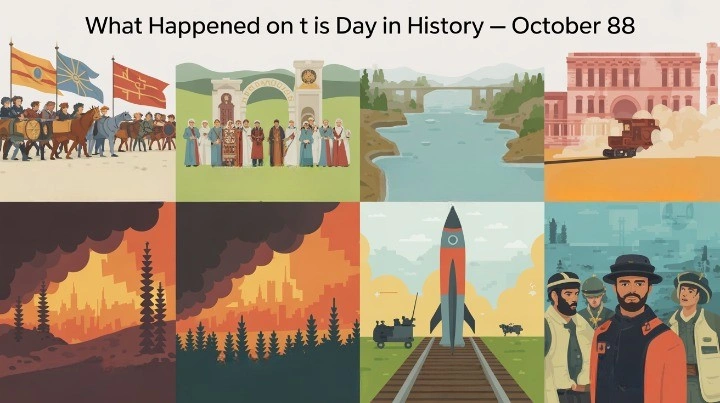
0316 — Constantine I defeats Licinius, reshaping imperial control
In a series of contests culminating in 316, Constantine I defeated Licinius and consolidated control over large parts of the Roman state, marking a decisive shift in imperial authority. The struggle between rival emperors influenced later governance, religious policy and the political geography of late antiquity. Constantine’s victories paved the way toward the eventual centralization of power and the Christianizing policies associated with his reign.
The military and political realignments of this period set the stage for the Late Roman Empire’s next phase.
0451 — First session of the Council of Chalcedon convenes
The Council of Chalcedon opened in 451 to settle Christological disputes that had split eastern and western Christianity. Its doctrinal formulations—especially the Chalcedonian Definition—sought to articulate how Christ’s human and divine natures coexisted, producing theological categories that shaped church organization and relations for centuries.
The council’s decisions had immediate political and ecclesial repercussions across the Byzantine world, contributing to ongoing debates and schisms in later Christian history. Chalcedon remains a cornerstone event in understanding Christian doctrinal development.
1480 — The Great Stand on the Ugra River ends Tatar domination over Moscow
The standoff on the Ugra River in 1480 effectively ended the so-called “Tatar yoke” over Moscow when Muscovite forces resisted the last major Tatar threat. The episode has been read as a landmark in the rise of Muscovy and the gradual consolidation of Russian princely power. Politically, the stand fostered Moscow’s claims to greater sovereignty and helped shape a narrative of liberation that fed into later state formation. Its symbolic importance in Russian historical memory has been significant into the modern era.
1573 — Siege of Alkmaar lifted — a Dutch turning point in the Eighty Years’ War
The relief of Alkmaar marked the first notable Dutch victory against Spanish forces during the protracted struggle for independence. The town’s survival provided a morale boost and practical breathing space for the nascent revolt, helping to galvanize wider resistance in the Low Countries.
Alkmaar’s defense became part of the heroic narrative of Dutch perseverance that contributed to the Republic’s eventual emergence. The siege’s outcome illustrates how local resistance could alter the strategic calculus in larger wars of religion and nation-building.
1645 — Jeanne Mance opens North America’s first lay hospital in Montreal
Jeanne Mance’s founding of a lay hospital in Montreal signaled early institutional growth in colonial healthcare and charitable work in New France. The facility provided care for settlers and indigenous patients and became a cornerstone of Montreal’s civic development. Mance’s initiative exemplifies how religiously motivated charity often became the practical seed for enduring public institutions in colonial contexts. The hospital’s founding is a touchstone in North American social and medical history.
1829 — Stephenson’s Rocket wins the Rainhill Trials, influencing rail design
Stephenson’s Rocket’s triumph at the Rainhill Trials provided practical proof for steam locomotive design and helped establish standards for early railway engineering. The competition’s outcome accelerated railway adoption across Britain and beyond, demonstrating the feasibility of reliable, mechanized rail traction for commercial transport. The Rocket’s design innovations influenced future locomotives and helped catalyze the rail-driven economic transformation of the 19th century. The Rainhill Trials are often cited as a foundational moment in railway history.
1862 — Battle of Perryville halts the Confederate Kentucky invasion (American Civil War)
The Union’s stand at Perryville checked Confederate ambitions in Kentucky and helped maintain Union control of the border state, which had strategic value for supplies and political legitimacy. Though tactically indecisive in some respects, the battle’s outcome helped frustrate Confederate operations in the western theater and shaped subsequent campaigns.
Perryville shows how contests over border territories could carry outsized strategic importance in a national civil war. The engagement is remembered as a critical episode in the 1862 campaign season.
1871 — Peshtigo fire and Great Chicago Fire: two catastrophic conflagrations
On the same date in 1871, the Peshtigo fire in Wisconsin and the Great Chicago Fire devastated communities with dramatic loss of life and property. Peshtigo remains the deadliest U.S. wildfire on record, while Chicago’s blaze destroyed large swaths of a rapidly growing city. Together, the disasters exposed urban and rural vulnerabilities—building practices, forest management and emergency response—and spurred changes in firefighting, planning and insurance. The twin tragedies prompted both local rebuilding and wider conversations about urban resilience.
1879 — Battle of Angamos: Chilean Navy defeats the Peruvian fleet (War of the Pacific)
The Chilean victory at Angamos removed the Peruvian ironclad Huáscar from action and secured Chilean naval dominance, allowing sustained operations along the Pacific coast. Control of the sea lane proved decisive in the War of the Pacific, shaping territorial outcomes and regional power balances that endured into the 20th century.
The battle is often studied for its tactical importance and as an example of how naval technology influenced continental conflicts. Angamos contributed materially to Chile’s eventual war aims.
1895 — Eulmi Incident: Queen Min (Empress Myeongseong) assassinated amid Japanese influence
The assassination of Queen Min in 1895, attributed to pro-Japanese agents, marked a violent intervention in Korean court politics and deepened anti-Japanese sentiment. The killing signalled the fragility of Korean sovereignty and the aggressive posture of neighboring imperial interests during the era. Queen Min’s death intensified domestic turmoil and contributed to later nationalist mobilization, becoming a painful symbol in Korea’s path toward modern statehood and resistance to colonization. The episode is widely remembered as a turning point in late Joseon politics.
1912 — First Balkan War begins as Montenegro declares war on the Ottoman Empire
Montenegro’s declaration opened a wider Balkan Coalition effort to push Ottoman authority out of Europe, initiating a war that would significantly alter southeastern Europe’s map. The Balkan Wars accelerated the breakup of Ottoman control in the region and fed the volatile nationalism that contributed to the outbreak of World War I. The 1912 campaign reshaped borders, population movements and rivalries among emergent nation-states in the Balkans. Its legacies persisted through the 20th century’s upheavals.
1916 — Georgia Tech defeats Cumberland University 222–0 (sports history oddity)
The lopsided scoreline remains the largest margin of victory in college football history and reflects early-era differences in scheduling, rules and institutional priorities in collegiate sports. Often cited as an example of competitive imbalance, the result prompted later reflections on sportsmanship and the organization of athletics. The game’s notoriety has made it a recurring reference in discussions about reforming match fixtures and ensuring fair play. It endures as a curious footnote in American sport.
1921 — KDKA broadcasts the first live radio broadcast of a football game
KDKA’s live radio transmission of a football match represented an early moment in mass electronic sports coverage, showing how radio could bring live events into homes and transform public engagement with athletics. The broadcast inaugurated a long relationship between sports and broadcasting industries, changing advertising, scheduling and fan culture. Radio’s capacity to create shared, real-time cultural moments was newly evident and would expand dramatically in subsequent decades. The KDKA broadcast is an origin point for live sports media.
1941 — German forces capture Mariupol, reach the Sea of Azov (WWII Eastern Front)
The fall of Mariupol signaled German advances in southern Soviet territories and illustrated the brutal dynamics of the Eastern Front, including occupation, civilian peril and strategic contests over industrial and transport centers. Control of littoral cities affected supply routes and operational maneuvering in the region. The episode formed part of the broader, devastating campaign that reshaped the Soviet Union’s wartime geography and produced vast human suffering. Mariupol’s capture is one episode in that wider tragedy.
1952 — Harrow and Wealdstone rail crash kills 112, prompting safety reforms
The multi-train collision at Harrow and Wealdstone remains one of Britain’s worst peacetime rail disasters, provoking public grief and technical inquiry. Investigations led to improvements in signalling, crew communication and rolling-stock standards, influencing later safety regulation and accident-prevention measures. The catastrophe highlighted the human cost of operational failures and the importance of systemwide safety culture. Its lessons fed into decades of railway modernization.
1956 — Don Larsen pitches the only perfect game in World Series history
Don Larsen’s flawless performance in Game 5 for the New York Yankees remains the only perfect game pitched in World Series play, an extraordinary athletic accomplishment in baseball lore. The feat’s rarity made it an instant cultural milestone, replayed in sports memory and celebrated for pitching excellence under high-stakes conditions. Larsen’s game has been analyzed for its composure, mechanics and historical resonance, becoming a signature moment in postseason baseball history. The perfect game is a durable piece of American sporting myth.
1967 — Che Guevara captured by Bolivian forces (later executed)
Ernesto “Che” Guevara was captured in Bolivia in October 1967 while attempting to foment guerrilla revolution; he was executed shortly afterward. The capture and death ended Guevara’s active revolutionary career but transformed him into an enduring global icon of rebellion and controversy. The episode influenced Latin American insurgency debates and became a flashpoint for both revolutionary movements and state counterinsurgency efforts. Guevara’s legacy remains deeply contested and symbolically potent.
1970 — Aleksandr Solzhenitsyn awarded the Nobel Prize in Literature
Solzhenitsyn’s Nobel recognized a body of work that exposed Soviet-era repression and told powerful human stories from Gulag experience to broader moral inquiry. The prize spotlighted dissident literature and the role of writers in challenging political authority. It also intensified debates about Cold War cultural politics and how Western institutions engaged with critics of the USSR. Solzhenitsyn’s award was consequential for his international stature and for conversations about literature and human rights.
1982 — Polish authorities outlaw Solidarity, pushing the movement underground
The ban on the independent trade union Solidarity came amid mounting political confrontation in Poland and pushed the movement into clandestine activity. Solidarity’s persistence despite repression helped sustain opposition networks that later contributed to the fall of communism in Poland and the emergence of post-1989 democratic politics.
The outlawing episode is an important chapter in Cold War civil-society resistance and in the long struggle for labor rights and political change.
1991 — Croatia and Slovenia sever official relations with Yugoslavia as Brioni Agreement expires
The expiration of the Brioni truce and subsequent breaks intensified the fragmentation of Yugoslavia, accelerating processes that led to protracted wars and humanitarian crises. Secessions created diplomatic and security challenges for neighboring states and the international community. The episode shows how ceasefires and short-term agreements can collapse when underlying political settlements are absent. The period marks a painful pivot from federal collapse to violent state dissolution in the Balkans.
2001 — Milan Linate air disaster and U.S. Office of Homeland Security established
On the same date the Linate Airport crash killed 118 people in Italy and underscored the continuing risks in aviation operations and ground control; that year also saw the U.S. announce the Office of Homeland Security in response to new threats after 9/11. The juxtaposition of a tragic accident and a major institutional security response captures how transport safety and national security issues can dominate public attention. Both events shaped policy and operational reforms in their respective domains.
2005 — Kashmir earthquake kills tens of thousands, triggering massive humanitarian response
The 2005 quake in the Pakistan-administered region of Kashmir caused catastrophic loss of life and displacement, exposing vulnerabilities in mountain-region infrastructure and prompting a large-scale international relief effort. Recovery required sustained reconstruction and long-term attention to seismic risk and building standards.
The disaster highlighted how natural hazards intersect with political boundaries and development challenges, demanding cross-border and multilateral humanitarian cooperation.
2014 — Thomas Eric Duncan dies — first U.S. Ebola case fatality
Thomas Eric Duncan’s death in an American hospital after contracting Ebola in West Africa brought the global epidemic into U.S. public consciousness and prompted intense debates about infection control, travel screening and health-system preparedness.
The case catalyzed new protocols for infectious-disease management and swift public-health responses, while exposing health inequities and communication challenges. The tragedy was a grim reminder of how global health threats cross borders in a connected era.
2016 — Hurricane Matthew aftermath: death toll approaches 900 in regional impacts
The storm’s devastation across the Caribbean and portions of the U.S. Southeast produced massive humanitarian needs and extensive infrastructure damage. The high death toll and displacement underscored the risks posed by powerful tropical cyclones and the uneven capacities for preparedness and response.
Matthew’s consequences prompted debates about disaster resilience, climate vulnerability and international aid prioritization. The event remains a major case study in modern disaster management.
2022–2023 — Crimean Bridge explosion, regional violence and humanitarian crises
Contemporary Octobers have included moments of acute regional violence and disaster: explosions on the Crimean Bridge (2022), and in 2023 a massive earthquake in northwestern Afghanistan and severe flooding in Myanmar produced large-scale displacement and urgent relief needs. These events highlight how geopolitical conflict and natural hazards can compound humanitarian risk across diverse settings. The recurring presence of such crises on October 8 reminds us of the date’s modern resonance in news cycles.
Read Also: What Happened on this day in history October 7
Quick sections
Earlier History
Constantine’s victories, Chalcedon and the Ugra stand illustrate how political-religious contests and sovereignty struggles recur in early October memory.
Exploration & Foundations
Stephenson’s Rocket (Rainhill), early hospitals and rail beginnings show practical innovations that reshaped transport and public services.
Wars & Politics
From the Balkan wars and revolutionary-era battles to 20th-century occupations and Cold War crackdowns, October 8 carries persistent military and political weight.
Arts, Culture & Media
Milestones such as the Rainhill-driven industrial revolution, early broadcasting and later cinematic openings reflect how media and culture evolved alongside technology.
Science, Technology & Media
Railway breakthroughs, aviation and later space- and broadcast-related firsts trace a line from industrial mechanics to modern information and exploration systems.
Disasters & Human Rights
Fires, earthquakes, aviation disasters and episodes of political violence—from Peshtigo/Chicago to Matthew and Linate—underscore vulnerabilities and spur reform in safety and rights protections.
Notable births — October 8
Dennis Kucinich — American politician — Born 1946.
Edward V. Rickenbacker — American WWI flying ace — Born 1890.
Ursula von der Leyen — President of the European Commission — Born 1958.
Otto Warburg — German biochemist, Nobel laureate (1931) — Born 1883.
Walther von Reichenau — German general (WWII) — Born 1884.
Marina Tsvetaeva — Russian poet — Born 1892.
Faith Ringgold — American artist & author — Born 1930.
César Milstein — Immunologist, Nobel laureate — Born 1927.
Betty Boothroyd — British politician, first female Speaker — Born 1929.
Gus Hall — U.S. Communist Party leader — Born 1910.
John Cowper Powys — British novelist — Born 1872.
Komitas (Soghomon Soghomonian) — Armenian composer & ethnomusicologist — Born 1869.
Neil Harvey — Australian cricketer — Born 1928.
Rouben Mamoulian — Film & theatre director — Born 1897.
Miyazawa Kiichi — Prime minister of Japan — Born 1919.
Jens C. Skou — Biophysicist, Nobel laureate — Born 1918.
Ejnar Hertzsprung — Astronomer (H–R diagram) — Born 1873.
John Henninger Reagan — U.S. political leader — Born 1818.
Henry-Louis Le Châtelier — Chemist (Le Châtelier’s principle) — Born 1850.
Ernest Kretschmer — German psychiatrist — Born 1888.
Notable deaths — October 8
Wendell L. Willkie — American politician — Died 1944.
Henry Fielding — English novelist/playwright — Died 1754.
John Cairncross — Cambridge spy-ring member — Died 1995.
Kathleen Ferrier — British contralto — Died 1953.
Henry Christophe — Leader in Haitian independence, later King Henry I — Died 1820.
Sir John Monash — Australian general & engineer — Died 1931.
Gabriel Marcel — French existentialist philosopher — Died 1973.
Philip Noel-Baker — British statesman & Nobel laureate — Died 1982.
Jean Giono — French novelist — Died 1970.
Mikhail V. Alekseyev — Russian general — Died 1918.
Félix Salten — Austrian novelist (author of Bambi) — Died 1945.
Cola di Rienzo — Italian popular leader — Died 1354.
Laszlo Sólyom — President of Hungary — Died 2023.
Théodore Chassériau — French painter — Died 1856.
William Mahone — Confederate general & railroad magnate — Died 1895.
Mongo Beti — Cameroonian novelist — Died 2001.
Naphtali Herz Imber — Hebrew poet (wrote “HaTikva”) — Died 1909.
Pierre-Simon Fournier — Typographer & engraver — Died 1768.
Adelaide Crapsey — American poet (cinquain inventor) — Died 1914.
Vernon Phillips Watkins — Welsh poet — Died 1967.
Observances & Institutional Dates
- Our Lady of the Rosary (Christian feast day) and related liturgics.
- World Space Week (runs October 4–10; events often overlap with this date).
- Air Force Day (India).
- Arbor Day (Namibia).
- Children’s Day (Iran).
- Navy Day (Peru).
- International Lesbian Day.
- National Fluffernutter Day (United States — cultural observance).
Frequently asked questions
Why was the Rainhill Trials of 1829 important?
The Rainhill Trials tested competing locomotive designs; Stephenson’s Rocket won and set technical standards that promoted railway expansion, enabling mass transport, industrial supply chains and the economic integration of regions in the 19th century.
How did the twin fires of 1871 shape urban policy?
The Peshtigo and Chicago fires exposed weaknesses in building materials, firefighting capacity and urban planning. Their aftermaths spurred new building codes, fire insurance reforms and investment in organized municipal fire services—shaping modern urban resilience.
What was the wider significance of Che Guevara’s capture in 1967?
Che’s capture in Bolivia ended his hands-on revolutionary campaigns but magnified his symbolic power; his death transformed him into an icon of global rebellion, influencing movements and debates about guerrilla politics and international solidarity in the Cold War era.
What lessons emerged from the 2001 Milan Linate air disaster?
The Linate crash highlighted the crucial importance of ground-control procedures, runway safety and navigation protocols in busy airports. Investigations led to tighter operational controls and reinforced the need for rigorous air-traffic and ground-movement coordination.