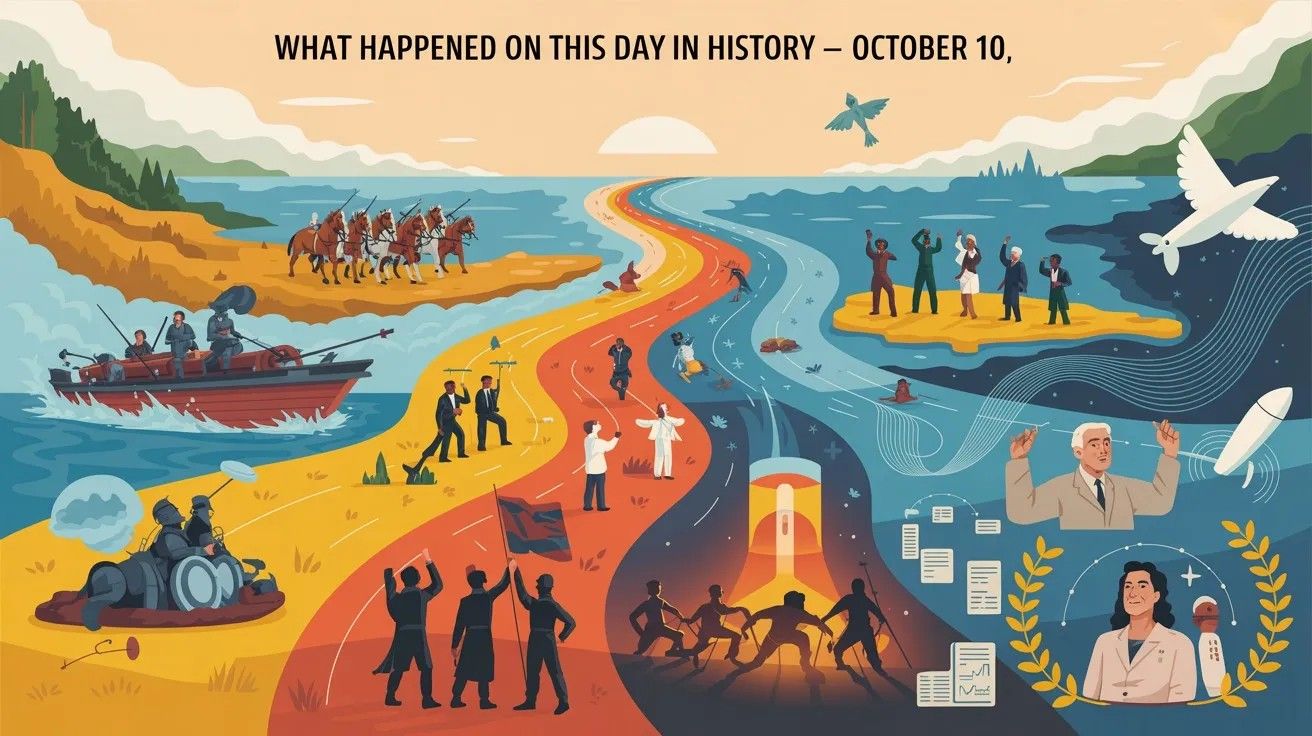
A compact chain of military clashes, scientific firsts, civic tragedies, and constitutional moments threads through October 10 across centuries. From ancient martyrdom and medieval crowns to the dawn of modern aviation, public health crises, and diplomatic blueprints for the postwar world, what happened on this day in history October 10 reflects how humanity’s triumphs and trials often recur in unexpected patterns. Those episodes—some celebrated, some mourned—show how recurring calendar dates can carry layered historical meanings.
Major Events on October 10
19 — Death of Germanicus (near Antioch)
Germanicus, a celebrated Roman general and popular heir-figure, died near Antioch in AD 19 under suspicious circumstances. Contemporary rumors and later historians suggested poisoning by the provincial governor Gnaeus Calpurnius Piso, a charge that sparked political drama in Rome. Germanicus’s death deepened tensions within the imperial family and fed public mourning and intrigue. The episode remains a dramatic example of imperial-era political rivalry and rumor.
680 — Battle of Karbala — martyrdom of Husayn ibn Ali
The Battle of Karbala ended in the killing of Husayn ibn Ali and many of his followers—an event that became central to Shia religious identity. Husayn’s death is commemorated annually during Muharram and is foundational for themes of sacrifice, legitimacy, and resistance in Islamic history. The battle’s symbolism shaped later sectarian memory and political mobilization across the Islamic world. Karbala remains a touchstone for theology and communal commemoration.
732 — Charles Martel defeats Umayyad forces near Tours
Charles Martel’s victory near Tours (Poitiers) checked an Umayyad advance into Frankish lands and reinforced Carolingian military prestige. The clash has been remembered as a decisive defense of Western Christendom in many later narratives, though modern historians stress regional politics and logistics as much as civilizational conflict. Martel’s strengthening of Frankish authority set the stage for Carolingian consolidation and his descendants’ rise. The battle influenced the medieval political map of Western Europe.
1471 — Sten Sture the Elder repels Danish attack (Sweden)
Sten Sture the Elder, supported by local farmers and miners, held Swedish defenses against King Christian I of Denmark. His success reinforced Sweden’s de facto independence from Danish crowns during a turbulent period in Scandinavian politics. The episode illustrates the importance of regional elites and peasant levies in late-medieval northern warfare. It remains a chapter in Sweden’s gradual path toward consolidated sovereignty.
1492 — Mutiny attempt aboard Columbus’s Santa María
During Columbus’s first voyage, discontent among crew led to a mutiny attempt on the Santa María; Columbus suppressed it and consolidated command. The episode underlines the hazards and human tensions of long voyages of exploration. It also highlights how leadership, discipline and the promise of land or plunder shaped early Atlantic explorations. Such incidents shaped later protocols for discipline at sea.
1575 — Duke of Guise defeats French Protestants (religious wars)
Catholic forces under Henry I, Duke of Guise won a major engagement against Huguenot forces and captured key figures such as Philippe de Mornay. The clash reflected the larger fracturing of French politics along confessional lines during the Wars of Religion. Military successes alternated with negotiated settlements, deepening the kingdom’s cycles of conflict. The Guise ascendancy shaped dynastic and sectarian politics for years.
1580 — Papal troops land in Ireland for the Second Desmond Rebellion
More than 600 Papal troops arrived to assist Irish rebels during the Second Desmond Rebellion, part of wider early modern contestation over Tudor rule in Ireland. The intervention underscored how continental Catholic powers intersected with local Gaelic resistance. The episode intensified the Tudor suppression efforts and contributed to long-term shifts in Irish landholding and governance. It is one early-modern example of internationalized rebellion on the periphery of England.
1760 — Ndyuka autonomy treaty with Dutch Suriname
In a treaty with Dutch colonial authorities the Ndyuka people (descended from enslaved Africans who escaped) secured territorial autonomy in Suriname. The agreement recognized a degree of self-rule and reflects the complex, negotiated outcomes of colonial frontier zones. It became a precedent for Maroon treaties and indigenous or fugitive communities’ legal statuses in the Americas. The arrangement shaped local governance and identity in the colony.
1780 — Great Hurricane of 1780 devastates the Caribbean
The Great Hurricane of 1780 remains the deadliest Atlantic hurricane on record, with estimated deaths between 20,000 and 30,000 across Caribbean islands. It struck amid the American War of Independence, compounding military and civilian hardship and disrupting shipping and colonial economies. The scale of loss forced colonial administrations to confront vulnerability in their ports and plantations. The storm remains a benchmark for Caribbean climatic catastrophe in the age of sail.
1814 — War of 1812: Royal Navy action vs. the cutter Eagle
During the War of 1812, U.S. Revenue Marine forces attempted to defend their cutter Eagle from Royal Navy capture. The conflict at sea illustrated the asymmetric naval pressures the young United States faced and the prominence of maritime enforcement vessels in coastal defense. Incidents like this shaped future U.S. naval organization and maritime law enforcement practices. The episode sits within a larger set of naval clashes across the war.
1845 — Founding of the U.S. Naval Academy (Annapolis)
George Bancroft established the Naval Academy to professionalize training for midshipmen in response to perceived weaknesses in instruction. The academy’s opening formalized officer education for the U.S. Navy and influenced naval professionalization worldwide. Over time Annapolis became a central institution for maritime leadership, technical instruction and naval culture. Its founding reflected 19th-century moves to institutionalize military education.
1846 — Discovery of Triton, Neptune’s largest moon
English astronomer William Lassell discovered Triton, the largest satellite of Neptune, expanding understanding of the outer solar system. The find added to 19th-century planetary astronomy and prompted later study of Triton’s peculiar retrograde orbit and geologic features. Observations of Triton contributed to evolving models of satellite capture, planetary formation and comparative planetary geology. The discovery remains a milestone in observational astronomy.
1868 — Ten Years’ War begins (Cuba’s independence struggle)
The Ten Years’ War marked the start of sustained Cuban resistance against Spanish colonial rule and launched a long struggle for autonomy. The conflict reshaped Caribbean geopolitics, colonial economics and Afro-Cuban participation in revolutionary movements. Though it did not immediately secure independence, it set political and military patterns that culminated in later wars and 20th-century independence processes. The uprising is a foundational moment in modern Cuban history.
1903 — Women’s Social and Political Union founded (UK suffrage movement)
The WSPU, launching militant activism for women’s suffrage in Britain, founded a new phase of suffrage tactics emphasizing direct action and publicity. Its slogan “Deeds, not words” and confrontational methods provoked debate and ultimately helped focus public attention on enfranchisement demands. The organization’s legacy is mixed—militant campaigning, state repression and shifting public sympathies—but it accelerated legislative reforms for women’s voting rights. The WSPU remains central to suffrage histories.
1911 — Wuchang Uprising (start of the 1911 Revolution)
Following a premature bomb explosion the previous day, revolutionaries in Wuchang rose against the Qing monarchy—sparking a chain of provincial uprisings that led to the 1911 Xinhai Revolution. The revolt undermined imperial authority and catalyzed the collapse of dynastic rule, paving the way for the Republic of China. The events are commemorated in Taiwan as Double Ten Day (October 10) and mark a critical transition in Chinese political history. The uprising illustrates how local incidents can trigger national transformations.
1913 — Panama Canal: President Wilson triggers Gamboa Dike explosion
President Woodrow Wilson activated major construction steps by triggering the Gamboa Dike blast, completing critical excavation on the Panama Canal. The canal’s construction reshaped global shipping, shortening maritime routes and transforming imperial and commercial geographies. The project also raised disputes about labor, health (tropical disease control) and U.S. strategic power in the hemisphere. The canal remains one of the great engineering and geopolitical achievements of the 20th century.
1918 — Sinking of RMS Leinster by UB-123 (Irish Sea)
German submarine UB-123 torpedoed RMS Leinster, causing the largest loss of life in the Irish Sea—some 564 people perished. The attack highlighted the continued hazards of submarine warfare even very late in World War I and produced national mourning in Ireland and Britain. Civilian losses in maritime zones intensified postwar debates about naval strategy, convoy systems and protections for noncombatants. Leinster’s sinking remains a grim wartime maritime tragedy.
1920 — Carinthian plebiscite sustains Austria’s claim
A plebiscite in Carinthia resulted in the majority of the disputed duchy choosing to remain part of Austria, shaping interwar boundaries in Central Europe. The vote reflected complex ethnic, economic and political loyalties in the borderlands after the Austro-Hungarian collapse. The settlement helped stabilize frontiers in southern Austria and shaped minority politics in the region. It stands as a case of self-determination mechanisms in the treaty-era rearrangement of Europe.
1928 — Chiang Kai-shek becomes Chairman of the Republic of China
Chiang’s ascendancy consolidated Nationalist Party leadership during a critical phase of state-building, military campaigns and rivalry with Communist forces. His chairmanship set the stage for the Northern Expedition and efforts to unify the republic under Kuomintang rule. Chiang’s rule would profoundly shape China’s politics through the Republican era, civil war and eventual relocation of the Nationalist government to Taiwan. His leadership remains central to 20th-century Chinese history.
1933 — Sabotage destroys a United Airlines Boeing 247
In one of the earliest proven cases of sabotage against a modern passenger airliner, a United Airlines Boeing 247 was destroyed in 1933—raising fears about aviation security. The incident spurred investigations and early policy responses to airline safety, insurance and criminality in the nascent commercial-aviation sector. As passenger air travel expanded, this case underscored the need for improved security and regulatory oversight. It stands as an early warning in civil aviation history.
1935 — Broadway premiere: Porgy and Bess opens (George Gershwin)
George Gershwin’s Porgy and Bess debuted on Broadway in 1935, a work that mixed opera and jazz idioms and became a landmark of American musical culture. The piece explored African-American life through a contested but influential artistic lens and has generated continuing debate about representation, performance and authorship. Its musical innovations influenced later American musical theater and concert repertoire. The opera remains a key cultural touchstone.
1938 — Czechoslovakia withdraws from the Sudetenland (Munich accords)
Following the Munich Agreement, Czechoslovakia completed withdrawal from the Sudetenland—an episode that became a symbol of failed appeasement toward Nazi Germany. The concession undermined Czechoslovakia’s defenses and political sovereignty and is widely viewed as a prelude to wider aggression in Europe. The episode reshaped interwar politics and continues to be invoked in debates about deterrence and diplomatic compromise. Munich remains a cautionary diplomatic case.
1945 — Double Tenth Agreement signed (China)
Chinese Communist and Kuomintang representatives signed an agreement on October 10 addressing China’s postwar future—part of complex wartime and postwar negotiations. Although the agreement did not resolve deeply rooted political contestation, it formed part of the wartime political choreography that preceded civil conflict. The Double Tenth negotiations show how wartime coalitions and compromises can be fragile. The date is commemorated in the Republic of China (Taiwan).
1954 — Oman: escalation of Jebel Akhdar conflict (note on local actors)
In the 1950s the contest over Oman’s interior involved external advisers and oil interests; on October 10 a signal by Sultanate authorities pushed operations into the Fahud/Jebel area, marking a phase in the Jebel Akhdar conflict. (A previously listed personal name in this entry appeared incorrect in the raw list; I’ve therefore described the action without asserting a misattributed individual.) The events reflect Cold War–era resource politics and local resistance to central authority. The conflict shaped modern Omani state consolidation.
1957 — Eisenhower apology after racial refusal of service (U.S.)
President Dwight D. Eisenhower intervened in a racial-incidents controversy after Ghanaian finance minister Komla Agbeli Gbedemah was refused service at a Delaware restaurant; Eisenhower apologized to him and signalled federal concern about racial discrimination affecting foreign guests. The episode highlighted Cold War optics—racial injustice at home complicated U.S. diplomacy in newly independent African states. It illustrates how civil-rights tensions had international as well as domestic ramifications.
1957 — Windscale nuclear fire (Britain)
The Windscale (now Sellafield) reactor fire was Britain’s worst nuclear accident: a graphite fire released radioactive contamination and prompted reviews of reactor safety and emergency response. The incident influenced nuclear-policy debates, compensation schemes and public perceptions of atomic power. Windscale’s lessons contributed to later safety culture and regulatory frameworks in nuclear industries. The accident remains central to UK nuclear history.
1963 — France cedes Bizerte naval base to Tunisia / Partial Test Ban Treaty entry into force
In 1963 France transferred control of the Bizerte naval base to Tunisia, marking further decolonization and reshaping Mediterranean naval politics. That same year the Partial Nuclear Test Ban Treaty came into force, slowing atmospheric testing and reshaping Cold War arms-control practice. Both actions reflect the 1960s’ dual trends of decolonization and cautious arms-management. Together they shaped strategic and political landscapes.
1964 — Tokyo Olympics opening ceremony relayed by satellite (first live)
The 1964 Tokyo Olympic opening was the first to be relayed live by satellite, a watershed for global broadcasting and the projection of modern Japan. Satellite transmission expanded the reach of mass spectacles and accelerated the globalization of live media events. The broadcast showcased telecommunications advances and reshaped expectations for international media coverage of sports and culture. It remains a landmark in broadcast history.
1967 — Outer Space Treaty comes into force
The Outer Space Treaty established legal principles for space activity—peaceful use, non-appropriation, and state responsibility—and entered force in 1967. The treaty framed subsequent agreements governing space behavior and remains the foundation of international space law. Its adoption reflected Cold War cooperation limits and the recognition that space required a shared legal architecture. The treaty continues to inform debates about militarization, resource use, and liability in space.
1969 — King Crimson releases debut album In the Court of the Crimson King
King Crimson’s 1969 debut became a landmark in progressive rock, combining jazz, classical and experimental influences to expand rock’s artistic vocabulary. The album influenced musicians across genres and stands as an early high-water mark of late-60s musical experimentation. While a cultural rather than geopolitical event, it typifies October 10’s mix of political and cultural milestones. The record endures in discussions of rock history and innovation.
1970 — Fiji independence from the United Kingdom
Fiji’s independence on October 10, 1970, transferred sovereignty from Britain to a new Commonwealth realm and marked the culmination of local constitutional processes. The transition placed Fiji within postwar decolonization waves and began its modern state trajectory, with long-term tensions over ethnicity and governance to follow. Independence ceremonies and institutions reflected local aspirations and global decolonization patterns. Fiji’s national day remains a central civic observance.
1970 — October Crisis escalation (Canada) — kidnapping of Pierre Laporte
Canada’s October Crisis deepened when FLQ members kidnapped Quebec Vice Premier Pierre Laporte, prompting a national security crisis and invoking extraordinary state responses. The episode raised questions about civil liberties, federal authority and political violence in democratic states. Laporte’s murder and the federal invocation of emergency powers remain controversial and formative in Canadian political memory. The crisis shaped later approaches to terrorism, separatism and law enforcement.
1971 — Aeroflot Flight 773 destroyed by bomb over Moscow Oblast
A bomb destroyed Aeroflot Flight 773, killing all aboard; the incident underscored aviation vulnerability and prompted security and criminal investigations. Effective responses to air terrorism gained urgency through such incidents, shaping aircraft security and international aviation law. The tragedy had domestic Soviet repercussions and is part of the broader history of in-flight sabotage in the 20th century. Aviation safety measures evolved in response to such threats.
1973 — Resignation of U.S. Vice President Spiro Agnew
Spiro Agnew resigned amid charges that included tax evasion, the first vice-president to do so; his departure forced an unprecedented use of the 25th Amendment and a new nomination for the vice presidency. The episode complicated the Nixon administration’s political standing and federal criminal accountability for high-office holders. Agnew’s resignation remains a landmark in U.S. executive-branch politics and legal precedent. It shaped later norms for political corruption cases.
1975 — Papua New Guinea joins the United Nations
Papua New Guinea’s UN admission reflected its recent independence and the expansion of international representation from newly decolonized states. The move integrated Pacific island states into global diplomacy and multilateral institutions. UN membership expanded the organization’s membership diversity and adjusted debates on development, decolonization and island-state diplomacy. The accession is part of the broader post-1945 decolonization arc.
1979 — Olkiluoto Nuclear Power Plant begins operations (Finland)
The Olkiluoto plant’s start-up contributed to Finland’s nuclear energy capacity and shaped the country’s energy mix. Nuclear commissioning events like Olkiluoto informed national debates on energy security, environmental trade-offs and technology choices. Over decades, nuclear plants affected grid stability and industrial policy in Finland and northern Europe. The plant’s start is a typical late-20th-century energy milestone.
1980 — El Asnam earthquake (Algeria) causes massive casualties
The 7.1 Mw El Asnam quake devastated northern Algeria, killing thousands and exposing vulnerabilities in building standards and disaster response. The catastrophe prompted international aid, reconstruction debates and long-term policy changes in urban planning and seismic preparedness. The disaster stands among the region’s most destructive modern earthquakes. Its human and institutional impacts shaped subsequent disaster management.
1980 — Founding of the Farabundo Martí National Liberation Front (El Salvador)
The FMLN’s founding consolidated various leftist guerrilla groups into a coalition that later fought a protracted civil war; its origins are rooted in long-term inequality and Cold War geopolitics. The FMLN later transformed into a political party after the 1990s peace accords. The group’s trajectory—from armed insurgency to mainstream politics—illustrates war-to-peace transitions in late 20th-century Latin America. Its foundation echoes regional patterns of revolutionary mobilization.
1985 — U.S. Navy intercepts plane carrying Achille Lauro hijackers; death of Orson Welles
U.S. naval interception of an airliner carrying Achille Lauro hijackers followed an international manhunt after the cruise-ship hijacking and murder of a passenger—an episode of international counterterrorism cooperation. (Separately, Orson Welles, an iconic filmmaker and stage personality, died in 1985; his passing marked the end of an influential cinematic career.) Both items reflect the day’s mix of security drama and cultural loss.
1986 — San Salvador earthquake kills thousands in El Salvador
A 5.7 Mw earthquake produced devastating loss of life and infrastructure damage in El Salvador, underscoring Central America’s seismic risk. The quake prompted emergency responses, international aid and later discussions about building resilience. Such disasters emphasize the intersection of natural hazards and socio-economic vulnerability. The event remains a central catastrophe in El Salvador’s modern history.
1997 — Austral Líneas Aéreas Flight 2553 crash (Uruguay)
Flight 2553’s fatal crash and explosion highlighted risks in regional aviation operations and contributed to ongoing improvements in safety oversight, pilot training and airline maintenance standards. Accidents like this prompt domestic and international investigations and often lead to policy and technical changes in aviation. The tragedy is remembered in Uruguay and Argentina’s aviation history. Victims’ families and regulators pressed for accountability and reforms.
1998 — Lignes Aériennes Congolaises jetliner shot down in Kindu (DRC)
A passenger jetdowning by rebel forces killed civilians and underscored the dangers of aviation in conflict zones. The incident reflected the Democratic Republic of Congo’s broader instability and the perils to noncombatants in contested airspaces. Such events spurred calls for greater protections and risk assessment for airlines operating in conflict areas. The Kindu incident remains one of many tragic examples of civil aviation in wartime.
2002 — U.S. congressional authorization for force against Iraq
The U.S. Congress approved the 2002 Authorization for Use of Military Force Against Iraq, providing legal backing for later military operations. The resolution shaped U.S. foreign policy decisions and debate about preemption, intelligence, and international law. Its passage remains central to discussions about the Iraq War’s origins and accountability. The authorization’s consequences reverberated across regional and global politics.
2007 — First Malaysian in space: Sheikh Muszaphar Shukor aboard Soyuz TMA-11
Sheikh Muszaphar’s flight marked Malaysia’s first astronaut in orbit and illustrated the rising participation of developing countries in human spaceflight programs. The mission reflected international partnerships in space and national aspirations for science, technology and prestige. Such flights stimulate STEM interest and national narratives about modernity. The milestone remains a point of pride in Malaysia’s space history.
2009 — Zurich Protocols signed between Armenia and Turkey (not ratified)
The Zurich Protocols aimed to normalize relations between Armenia and Turkey and address historical grievances; however, they were never ratified domestically by either side. The episode highlighted the complexities of reconciliation, border politics and memory in the South Caucasus. Diplomacy’s limitations here illustrate how deeply rooted historical and domestic political pressures shape bilateral normalization. The attempt remains a reference point in regional peace efforts.
2010 — Dissolution of the Netherlands Antilles
The Netherlands Antilles was formally dissolved as a single country; constituent islands received new constitutional statuses within the Kingdom of the Netherlands. The change reorganized local governance and citizenship arrangements in the Caribbean, affecting autonomy, fiscal relations and identity. It reflects late-20th/early-21st-century adjustments in postcolonial constitutional arrangements. The reform redefined political relationships in the Dutch Caribbean.
2015 — Ankara twin bomb blasts kill scores (Turkey)
Two bomb blasts in Ankara killed more than 100 people and injured many more, producing national grief and heightened security responses. The attacks underscored Turkey’s vulnerability to terrorism amid regional instability and domestic polarizations. They prompted debates about counterterrorism policy, civil liberties, and the responsibility for protecting public spaces. Ankara’s blasts remain among the most severe peacetime attacks in modern Turkish history.
2018 — Hurricane Michael strikes Florida as Category 5
Hurricane Michael made catastrophic landfall in the Florida Panhandle, causing dozens of deaths and multi-billion-dollar damage; it exposed planning, building-code and evacuation challenges in vulnerable coastal communities. The storm illustrated trends in extreme weather and its disproportionate impacts on infrastructure and low-lying communities. Recovery and resilience debates followed about insurance, rebuilding and coastal management. Michael is one of the most destructive storms of the late 2010s.
2018 — China reorganizes firefighting and rescue services
China formed the National Fire and Rescue Administration, consolidating fire services and related corps into a single agency to improve disaster response and management. The administrative reform aimed to professionalize rescue services, coordinate large-scale emergency responses and modernize equipment and training. It reflects global trends in centralizing emergency management for faster, integrated responses to disasters. The change has implications for domestic rescue capacity and civil protection.
2019 — UN Refugee Agency / World Bank joint data center opens (Copenhagen)
A joint Data Center on Forced Displacement was launched to improve evidence-based responses to refugee crises, combining UNHCR and World Bank data and analytic capacity. The initiative aimed to help governments and agencies design better policy and investment decisions for displaced populations. It maps a shift toward data-driven humanitarian planning and resilience building. The center is part of a policy turn toward linking humanitarianism and development economics.
2020 — WHO World Mental Health Day global online advocacy event
On World Mental Health Day (October 10) WHO held a major online advocacy event highlighting investment needs for mental health during the COVID-19 pandemic. The initiative emphasized pandemic-related mental-health burdens and urged policymakers to expand services and resources. Virtual events illustrated shifts in global advocacy during public-health emergencies. The day reinforced the growing priority of mental-health policy in global health agendas.
2022 — Nobel Memorial Prize in Economic Sciences awarded for financial-fragility research
Ben S. Bernanke, Douglas W. Diamond and Philip H. Dybvig shared the Sveriges Riksbank Prize for work clarifying banking fragility and systemic risk. Their research underpins modern understanding of bank runs, deposit insurance and regulatory frameworks for financial stability. The prize highlighted policy-relevant scholarship after the 2008 crisis and influenced ongoing debates about macroprudential regulation. The award spotlighted links between academic theory and crisis management.
2022 — Russian missile attacks on Ukrainian cities (October 10)
In a wave of missile strikes Russian forces struck multiple Ukrainian cities, causing civilian casualties and infrastructure damage; the attacks were part of the broader 2022 invasion and the war’s destructive toll. The strikes underscored the war’s humanitarian consequences and the international community’s continuing response through sanctions, aid and diplomacy. The pattern of attacks shaped wartime logistics, civilian protection strategies and reconstruction planning. The strikes remain part of the conflict’s grim record.
2024 — Pakistani weightlifter Nooh Dastgir Butt wins Commonwealth powerlifting gold
At the 2024 Commonwealth Powerlifting Championships Nooh Dastgir Butt lifted 370 kg in his debut, winning gold and marking a major athletic success for Pakistan. The achievement added to the country’s sporting milestones and spotlighted weightlifting as a rising discipline in regional competitions. Such performances can stimulate national interest and investment in athlete development programs. The win is a notable contemporary sporting highlight.
See here: What Happened On October 9
Quick sections
Earlier history
Karbala (680); Tours (732); early Renaissance & exploration moments (Columbus mutiny, 1492); Hangul and vernacular language shifts.
States & Revolutions
Wuchang Uprising (1911), Caribbean revolts and Ten Years’ War (1868), decolonization milestones (Fiji, 1970) and constitutional transitions.
Science, Tech & Exploration
Discovery of Triton (1846); early aviation and space milestones tied to later Octobers; Panama Canal works (1913) and later Nobel-recognized economic theory (2022).
Culture & Media
Gershwin’s Porgy and Bess (1935), King Crimson’s debut (1969) and television/broadcasting advances (satellite relays in 1964).
Disasters & Human Rights
Windscale nuclear fire (1957), El Asnam earthquake (1980), Ankara bombings (2015) and maritime wartime sinkings (RMS Leinster, 1918).
Notable births — October 10
Harold Pinter — British dramatist/playwright — born 1930.
Alberto Giacometti — Swiss sculptor & painter — born 1901.
Helen Hayes — American actress (“First Lady of the American Theatre”) — born 1900.
Henry Cavendish — British physicist & chemist — born 1731.
Fridtjof Nansen — Norwegian explorer, scientist & humanitarian — born 1861.
Antoine Watteau — French Rococo painter — born 1684.
Ivo Andrić — Yugoslav writer, Nobel Prize in Literature — born 1892.
Paul Kruger — South African statesman (Transvaal president) — born 1825.
Isabella II — Queen of Spain — born 1830.
Jacobus Arminius — Dutch theologian — born 1560.
Lin Yutang — Chinese author & public intellectual — born 1895.
Gerhard Ertl — German chemist, Nobel Prize (2007) — born 1936.
Claude Simon — French novelist, Nobel laureate — born 1913.
Franco Malerba — Italian biophysicist & astronaut — born 1946.
Yigal Allon — Israeli general & politician — born 1918.
Zhai Zhigang — Chinese astronaut, performed China’s first spacewalk — born 1966.
Jean Gottman — French geographer — born 1915.
Benjamin Wright — American engineer (Erie Canal “father”) — born 1770.
Rufus Daniel Isaacs, 1st Marquess of Reading — British statesman & jurist — born 1860.
Han van Meegeren — Dutch painter & art forger — born 1889.
Notable deaths — October 10
al-Ḥusayn ibn ʿAlī — Muslim leader and martyr (Karbala) — died 680.
William H. Seward — U.S. statesman, Secretary of State — died 1872.
Ludwig von Mises — Austrian economist — died 1973.
Germanicus — Roman general — died 19.
Joan Sutherland — Australian operatic soprano — died 2010.
Scott Carpenter — U.S. astronaut (Mercury) — died 2013.
Sirimavo Bandaranaike — Sri Lankan prime minister — died 2000.
Charles Fourier — French social thinker — died 1837.
Solomon Burke — American soul singer — died 2010.
Édouard Daladier — French statesman — died 1970.
James Buchanan Duke — American industrialist — died 1925.
Lorenzo Snow — LDS Church president — died 1901.
Sir Cyril Burt — British psychologist — died 1971.
John McCloskey — first American Catholic cardinal — died 1885.
Ralph Metcalfe — American sprinter & congressman — died 1978.
Adolphus Busch — cofounder of Anheuser-Busch — died 1913.
Antoine Coysevox — French sculptor — died 1720.
Maurice Martenot — inventor of the ondes Martenot — died 1980.
Simon Kimbangu — Congolese religious leader — died 1951.
Wayne C. Booth — American literary critic — died 2005.
Observances & institutional dates
Arbor Day (Poland).
Army Day (Sri Lanka).
Capital Liberation Day (Vietnam).
Constitution Day (Sint Maarten).
Curaçao Day (autonomy anniversary).
Double Ten Day (Republic of China — Wuchang Uprising / national day).
Fiji Day (independence, 1970).
Finnish Literature Day (Finland).
Cuba’s Independence Day / Ten Years’ War anniversary (1868).
Party Foundation Day (North Korea).
World Day Against the Death Penalty.
World Mental Health Day.
World Porridge Day.
Frequently asked questions (FAQs)
Why is October 10 (Double Ten) important in Chinese history?
The Wuchang Uprising—commemorated as Double Ten Day—sparked the 1911 Revolution that overthrew the Qing dynasty and led to the Republic of China. It marks the symbolic beginning of modern republicanism in China and is celebrated politically in Taiwan.
How did the Windscale fire influence nuclear policy in Britain?
Windscale prompted stricter safety standards, more conservative reactor management, and public debate about nuclear energy. It pushed regulators and operators to refine emergency protocols and transparency around contamination risks.
What was the global significance of the Panama Canal’s 1913 completion steps?
Completing the Gamboa dike and related works enabled canal connectivity that transformed maritime trade routes, shortened transit times between oceans, and shifted naval and commercial strategic calculations worldwide.
Why does the Carinthian plebiscite (1920) still matter?
The plebiscite settled a contested post-imperial border by local vote, shaping national identity and minority rights in the Alpine borderlands and offering an early example of plebiscitary conflict resolution in the post-WWI settlement.
What special day is today, October 10th?
It is Double Ten Day (National Day of the Republic of China), commemorating the Wuchang Uprising (10 October 1911). It is also observed as the Anniversary of the Xinhai Revolution in mainland China, and internationally October 10 is observed for causes like World Mental Health Day, World Day Against the Death Penalty, among others.
What happened on October 10, 1939?
The Soviet Union and Lithuania formalized the Soviet–Lithuanian Mutual Assistance Treaty, granting the USSR permission to station troops in Lithuania in exchange for the return of Vilnius and surrounding territory.
What happened on October 10, 1944?
At Unten, Okinawa, six Japanese midget submarines were destroyed during an air raid by F6F Hellcats from the carrier USS Bunker Hill. On the same day, Z Special Unit, an Allied commando force, launched Operation Rimau, a daring mission targeting Japanese ships in Singapore Harbor.
What happened on October 10, 1943?
Major John Egan commanded a U.S. bombing mission over Münster, Germany, aiming to cripple the city’s war industries and infrastructure — one of many intense air raids during World War II.
What happened on October 10, 1968?
A new firearms law was enacted in the United States, banning mail-order gun and ammunition sales and tightening restrictions on who could buy weapons — a direct response to the assassination of President John F. Kennedy by Lee Harvey Oswald, who had purchased his rifle through mail order.
What happened on October 10, 1971?
A bomb explosion destroyed Aeroflot Flight 773 shortly after takeoff from Moscow’s Vnukovo Airport, killing all 25 passengers and crew en route to Simferopol in the Ukrainian SSR.
What happened on October 10, 1945?
The British military fully reclaimed the Andaman Islands following Japanese occupation. On that same date, the Communist Party of Korea was officially founded — a moment later celebrated annually in North Korea as Party Foundation Day.
What happened on October 10, 1957?
A serious fire broke out at the Windscale nuclear facility in northern England, releasing radioactive materials such as iodine-131 into the surrounding environment — one of Britain’s worst nuclear accidents. Elsewhere, Ghanaian Finance Minister Komla Agbeli Gbedemah shared a historic White House breakfast with U.S. President Dwight D. Eisenhower.
What happened on October 10, 1942?
The British troopship Orcades was torpedoed by German submarine U-172 near Cape Town, sinking with 45 lives lost while over 1,000 people were rescued. Meanwhile, in Ontario, Canada, a violent uprising broke out at the Bowmanville POW camp, known as the Battle of Bowmanville, when German prisoners rebelled against their guards.