From ancient empires and medieval battles to declarations of independence, daring scientific milestones, and defining moments of modern politics, what happened on this day in history October 12 reflects the constant motion of human progress and conflict.
Across centuries, this date has marked both the rise and fall of powers — from Babylon’s conquest and Columbus’s voyage to revolutions, peace prizes, and acts of remembrance that continue to shape our shared world.
Major Events on October 12
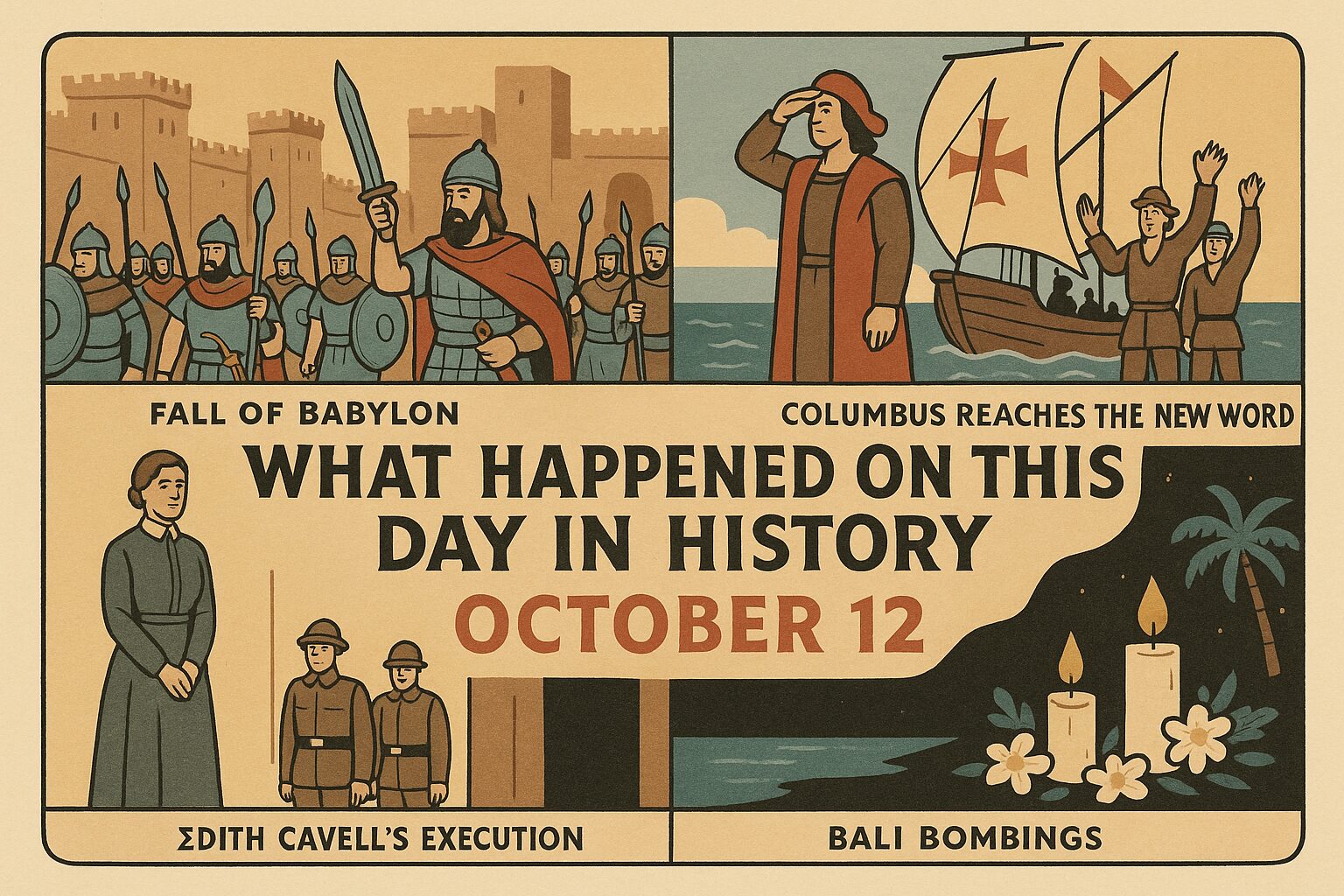
539 BC — Cyrus the Great conquers Babylon
Cyrus II of Persia completed his capture of Babylon on this date, bringing an end to the Neo-Babylonian Empire and absorbing its territories into the Achaemenid Empire. The conquest reshaped political control across Mesopotamia and marked a major transfer of imperial power in the ancient Near East. Its aftermath included administrative reforms and cultural exchange.
633 — Battle of Hatfield Chase; King Edwin killed
At Hatfield Chase King Edwin of Northumbria was defeated and slain by an alliance led by Penda of Mercia and Cadwallon of Gwynedd. The defeat fractured early Anglo-Saxon power in northern England, creating a period of political instability and shifting alliances among emerging English kingdoms during the 7th century.
1279 — Nichiren Shōshū branch founded (Japan)
On this date the Nichiren Shōshū branch of Buddhism is said to have been founded in Japan. The movement arises from Nichiren’s teachings emphasizing the Lotus Sutra and attracted followers who later formed distinct institutional lineages. Over centuries, it influenced Japanese religious life and spawned debates over doctrine and practice.
1398 — Treaty of Salynas; Samogitia ceded
In the Treaty of Salynas, the Grand Duchy of Lithuania ceded the region of Samogitia to the Teutonic Knights. The transfer altered the balance of power in the Baltic region, intensified local resistance to Teutonic rule, and fed into the protracted conflicts and negotiations that shaped Lithuanian–Teutonic relations.
1406 — Chen Yanxiang reaches Seoul from Java
Chen Yanxiang, recorded as the only known person from Indonesia to visit dynastic Korea, reached Seoul after setting out from Java four months earlier. His voyage underscores early long-distance maritime contacts across Southeast and East Asia and the unexpected human links recorded in medieval travel chronicles.
1492 — Land sighted from the Pinta (Columbus)
On this day in 1492 land—most likely the island later called San Salvador—was sighted from the Pinta during Christopher Columbus’s voyage. The sighting inaugurated sustained European contact with the Caribbean and triggered centuries of exploration, colonization, and dramatic consequences for Indigenous peoples.
1654 — The Delft Explosion devastates the city (Netherlands)
A massive explosion in Delft destroyed a gunpowder store and caused widespread damage across the city, killing over a hundred people. The blast had long-term local effects on urban rebuilding and public safety measures, and it left a deep mark on Dutch municipal history and collective memory.
1692 — Salem witch trials effectively end by governor’s letter
Governor William Phips issued an order that brought the Salem witch trials to a halt on this date, marking the decline of the prosecutions that had convulsed Massachusetts. The intervention signalled a shift in public opinion and legal caution about spectral evidence and mass hysteria in colonial jurisprudence.
1748 — Naval action off Havana during War of Jenkins’ Ear
A British squadron scored a tactical victory over a Spanish squadron off Havana during the War of Jenkins’ Ear. While not decisive strategically, such naval engagements were part of wider maritime contests between Britain and Spain that influenced trade routes, colonial security, and Caribbean power dynamics in the mid-18th century.
1773 — America’s first insane asylum opens
On this date America’s first institution, described as an “insane asylum,” opened, reflecting evolving attitudes toward mental illness, institutional care and public welfare in the late 18th century. The founding illustrates early moves to formalize psychiatric care, even as treatments and social responses remained rudimentary.
1792 — First celebration of Columbus Day in New York City
New York City staged what is reported as the first celebration honoring Christopher Columbus on this date. The observance exemplifies emergent public commemorations of exploration during the post-Revolutionary era and foreshadows later national and regional festivities tied to Columbus’s voyages.
1793 — Cornerstone of Old East laid at UNC Chapel Hill
The cornerstone of Old East, now the oldest state university building in the United States, was laid at the University of North Carolina at Chapel Hill. The event marks an early phase in state-supported higher education in the U.S. and the physical beginnings of a collegiate campus that persists today.
1798 — Peasants’ War begins against French rule (Flanders/Luxembourg)
Flemish and Luxembourgish peasants mounted a rebellion against French rule—known as the Peasants’ War—expressing resistance to new conscription, taxes, and administrative reforms. The uprising reflected rural discontent during Napoleonic-era reorganization of European territories and provoked repressive measures.
1799 — Jeanne Geneviève Labrosse jumps from a balloon with a parachute
Jeanne Geneviève Labrosse became the first woman recorded to jump from a balloon using a parachute. Her feat sits within the era’s fascination with aeronautics and public spectacles, marking an early woman’s role in pioneering aerial demonstrations and the development of parachuting technology.
1810 — First Oktoberfest celebrated in Munich (horse race)
The first Oktoberfest was held as a horse race in Munich to mark the marriage of Crown Prince Ludwig (later King Ludwig I) to Princess Therese von Sachsen-Hildburghausen. Originally a regional celebration, the festival evolved into a major Bavarian cultural event with broad public participation and longstanding traditions.
1822 — Pedro I proclaimed Emperor of Brazil
On this date Pedro I was proclaimed emperor, solidifying Brazil’s independence-era institutions after the breakup of Portuguese rule. His coronation established the new empire’s monarchical framework and shaped early 19th-century Brazilian politics and foreign relations.
1849 — Foundation of Manizales, Colombia
Manizales was founded by “The Expedition of the 20” on this date, part of the wave of 19th-century urban foundations and migrations in Colombia’s Andean regions. The city later became an important regional center for coffee production, trade and civic life.
1856 — Major earthquake off Crete damages wide region
A powerful earthquake, estimated around magnitude 7.7–8.3, struck off the Greek island of Crete and caused major damage reported as far away as Egypt and Malta. The event affected coastal settlements, maritime routes and prompted local relief and rebuilding efforts in the eastern Mediterranean.
1871 — British India enacts the Criminal Tribes Act
The colonial British government in India enacted the Criminal Tribes Act, formally labeling many communities as “criminal tribes.” The law institutionalized stigmatizing classifications, produced long-term social and legal discrimination, and fed later debates over colonial legal policy and postcolonial rehabilitation.
1890 — Uddevalla Suffrage Association formed
The Uddevalla Suffrage Association was established, part of broader late-19th-century movements in Scandinavia and elsewhere pushing for expanded political rights. Associations like this contributed to gradual franchise reforms and the political mobilization of previously excluded groups.
1892 — The Pledge of Allegiance first recited in many U.S. public schools
On this date the Pledge of Allegiance was first recited by students in numerous U.S. public schools, originating in period civic campaigns aimed at promoting national unity and patriotic education. The ritual later became a fixture of American school life and periodic public debate.
1898 — Virden, Illinois coal-mine riot over strikebreakers
A violent confrontation occurred at Virden, Illinois, when strikebreakers were brought into coal mines, producing a riot that became a landmark in U.S. labor struggles. The clash highlighted tensions between labor and management, the dangerous conditions of coal mining, and the rising organization of labor unions.
1901 — Executive Mansion renamed “the White House” by President Theodore Roosevelt
President Theodore Roosevelt officially adopted the name “the White House” for the presidential residence, replacing the older usage “Executive Mansion.” The naming reflected a maturing of American presidential symbolism and has endured in official and popular usage.
1909 — Foundation of Coritiba Foot Ball Club (Brazil)
Coritiba Foot Ball Club was founded on this date in Brazil, later becoming one of the country’s longstanding football institutions. The club’s origins reflect football’s spread in South America and the growth of organized sport as a social and cultural force.
1915 — Edith Cavell executed in German-occupied Belgium
English nurse Edith Cavell was executed for assisting Allied soldiers to escape, provoking international outrage and becoming a potent wartime symbol. Her death drew attention to humanitarian work under occupation, wartime legal practices, and propaganda campaigns in World War I.
1917 — First Battle of Passchendaele; New Zealand’s largest single-day loss
The First Battle of Passchendaele took place, producing catastrophic casualties including the largest single-day loss in New Zealand military history. The fighting exemplified the grinding attrition of World War I on the Western Front and left deep scars on participating nations’ memory.
1918 — Catastrophic forest fire kills hundreds in Minnesota
A massive forest fire in Minnesota on this date killed 453 people, devastating communities and underscoring the dangers of wildfire in heavily forested regions. The disaster prompted local and regional changes in forest management, emergency responses, and public safety measures.
1928 — First recorded use of an iron lung at Boston Children’s Hospital
An iron lung respirator was used for the first time at Boston Children’s Hospital, marking an important moment in the history of respiratory care. The development foreshadowed future mechanical ventilation technologies and had significant impact during later polio epidemics.
1933 — Alcatraz becomes a civilian federal penitentiary
The military Alcatraz Citadel was converted into the civilian Alcatraz Federal Penitentiary, later becoming infamous for housing high-security inmates. The island’s penitentiary years influenced debates over punishment, incarceration environments, and federal corrections policy in the United States.
1944 — Liberation: Axis occupation of Athens ends
The Axis powers’ occupation of Athens came to an end on this date, a pivotal moment in Greece’s wartime experience. Liberation opened the way to a tragic and complex postwar period for Greece that involved political divisions, civil conflict and reconstruction.
1945 — Desmond Doss receives the Medal of Honor; Lao Issara controls Laos government
Desmond Doss, a conscientious objector who served as a combat medic, was recognized as the first conscientious objector to receive the U.S. Medal of Honor for bravery in World War II. Meanwhile, the Lao Issara declared control of Laos’ government and reaffirmed independence, part of decolonization currents in Southeast Asia.
1959 — Leftist radicals expelled from Peruvian APRA form APRA Rebelde
At the national congress of the American Popular Revolutionary Alliance (APRA) in Peru a leftist faction was expelled and later formed APRA Rebelde. The split reflected ideological tensions within Latin American parties during the Cold War and shaped Peruvian political fragmentation.
1960 — Khrushchev pounds his shoe at the United Nations
Soviet Premier Nikita Khrushchev famously pounded his shoe on a desk at the United Nations to protest remarks made by a Filipino delegate, a widely reported incident that became emblematic—whether apocryphal in detail or not—of Cold War theatrics and personal diplomacy.
1962 — Columbus Day Storm devastates U.S. Pacific Northwest
The Columbus Day Storm struck the Pacific Northwest with record wind velocities, causing at least $230 million in damage and 46 deaths. The storm’s scale impacted forestry, infrastructure and disaster preparedness in the affected U.S. states and remains a reference storm in regional meteorological history.
1963 — Reverend Walter Ciszek released after nearly 23 years in Soviet prisons
Jesuit missionary Walter Ciszek was released from Soviet imprisonment after almost 23 years, concluding a prolonged period of incarceration and covert missionary activity. His case attracted attention to Cold War-era imprisonments and questions about religious workers behind the Iron Curtain.
1964 — Voskhod 1 launched: first multi-person crew, no pressure suits
The Soviet Union launched Voskhod 1 into Earth orbit, the first spacecraft carrying a multi-person crew and notable for flying without pressure suits. The flight represented a high-profile Soviet milestone in the space race and triggered technical and political reactions in the space community.
1967 — Bomb on Cyprus Airways Flight 284 kills 66
A bomb exploded on board Cyprus Airways Flight 284 while flying over the Mediterranean Sea, killing 66 people. The tragedy highlighted vulnerabilities in civil aviation security and contributed to later international efforts to improve airline safety and counter-terrorism measures.
1968 — Equatorial Guinea gains independence from Spain
Equatorial Guinea declared independence from Spain on this date, joining the wave of African decolonization. The new state faced immediate challenges of governance and development that shaped its subsequent political trajectory.
1970 — Nixon announces further U.S. troop withdrawals from Vietnam
President Richard Nixon announced that the United States would withdraw an additional 40,000 troops before Christmas as part of “Vietnamization.” The announcement reflected an ongoing shift in U.S. strategy and domestic pressure to reduce American combat involvement in Vietnam.
1971 — 2,500-year celebration of the Persian Empire begins
A lavish commemoration marking 2,500 years of the Persian Empire began, hosted by the Shah of Iran. The celebration sought to link contemporary statecraft with ancient monarchy symbolism, but it also provoked criticism for its expense and political tone amid broader social tensions.
1973 — Nixon nominates Gerald R. Ford to replace Spiro Agnew
President Nixon nominated House Minority Leader Gerald R. Ford as the successor to Vice President Spiro T. Agnew. The choice set the stage for constitutional and political procedures under the 25th Amendment and preceded Ford’s eventual accession to the presidency.
1976 — Indian Airlines Flight 171 crashes at Santacruz, killing 95
Indian Airlines Flight 171 crashed on approach to Santacruz Airport in Bombay (Mumbai), killing 95 people. The accident raised aviation safety concerns in India and prompted investigations and regulatory attention to aircraft operations and airport procedures.
1977 — Hua Guofeng succeeds Mao Zedong as paramount leader of China
Following Mao Zedong’s death and the immediate political shifts that followed, Hua Guofeng was announced as Mao’s successor and assumed paramount leadership. The transition marked a contested period in the Chinese Communist Party as different factions vied for influence in the post-Mao era.
1979 — Typhoon Tip recorded as largest and most intense tropical cyclone
Typhoon Tip became the largest and most intense tropical cyclone ever recorded, notable for its vast diameter and extremely low central pressure. The storm’s record-setting characteristics influenced meteorological study of tropical systems and the understanding of storm dynamics.
1983 — Former Japanese PM Tanaka Kakuei found guilty of taking a Lockheed bribe
Japan’s former Prime Minister Tanaka Kakuei was found guilty of taking a $2 million bribe from the Lockheed Corporation and sentenced to four years in prison. The conviction was a high-profile corruption case that influenced Japanese politics and corporate–government accountability debates.
1984 — Brighton hotel bombing: IRA assassination attempt on PM Thatcher
The Provisional Irish Republican Army’s bomb at the Grand Brighton Hotel was an attempt to assassinate Prime Minister Margaret Thatcher and her cabinet. The device killed five people and wounded dozens, producing national shock and heightened security measures in the U.K.
1988 — Walsh Street police shootings, Australia
Two Victoria Police officers were gunned down execution-style in the Walsh Street shootings, an event that provoked public outrage, intensified debates about organized crime and policing, and had lasting effects on law enforcement in Australia.
1992 — 5.8 magnitude earthquake in Cairo, heavy casualties reported
A 5.8 earthquake struck the Cairo region, with reports of at least 510 deaths. The disaster demonstrated seismic risk in northern Africa and the Middle East and prompted local emergency responses and rebuilding efforts.
1994 — Magellan spacecraft burns up in Venus’s atmosphere
NASA’s Magellan spacecraft re-entered Venus’s atmosphere and was destroyed, concluding a mission that had mapped Venusian topography using radar. The mission’s imaging and data contributed significantly to planetary science and understanding of Venus’s geology.
1994 — Iran Aseman Airlines Flight 746 crashes near Natanz, killing 66
Iran Aseman Airlines Flight 746 crashed near Natanz, Iran, killing all 66 people on board. The air disaster was one of the worst in the country’s aviation history and led to investigations into causes and airline safety standards.
1996 — New Zealand’s first general election under MMP system
New Zealand held its first general election using the mixed-member proportional (MMP) representation system, leading to a National–New Zealand First coalition government under Jim Bolger and Winston Peters. The change reshaped New Zealand’s electoral politics and party strategies.
1997 — Sidi Daoud massacre in Algeria kills 43
The Sidi Daoud massacre occurred when armed men set a fake roadblock and killed 43 people. The attack was part of the wider violence afflicting Algeria during the 1990s and contributed to the climate of fear and political turmoil in that period.
1998 — Matthew Shepard dies after brutal assault in Laramie
Matthew Shepard, a gay student at the University of Wyoming, died five days after being beaten and left tied to a fence near Laramie. His death became a catalyst for public debate and advocacy on hate crimes, LGBTQ rights, and legal protections in the United States.
1999 — Pervez Musharraf seizes power from Nawaz Sharif in Pakistan
General Pervez Musharraf took power in Pakistan in a bloodless coup that deposed Nawaz Sharif. The takeover altered Pakistan’s political trajectory, leading to military rule that influenced governance, civil–military relations and regional policy.
1999 — Abkhazia declares independence from Georgia (post-Soviet)
The former Autonomous Soviet Republic of Abkhazia declared independence from Georgia, a move that was part of wider post-Soviet territorial disputes. The declaration precipitated ongoing political contention, conflict and unresolved status issues in the Caucasus.
2000 — USS Cole attacked in Aden, Yemen; 17 sailors killed
While refueling in Aden, the U.S. Navy destroyer USS Cole was struck by suicide bombers associated with al-Qaeda; 17 sailors were killed and 39 wounded. The attack highlighted rising maritime terrorism threats and factored into subsequent counterterrorism planning.
2001 — Nobel Peace Prize awarded to the United Nations and Kofi Annan
The Nobel Peace Prize in 2001 recognized the United Nations and its Secretary-General Kofi Annan for their work for a better organized and more peaceful world. The award drew both praise and debate about the UN’s role in contemporary peacekeeping and global governance.
2002 — Bali nightclub bombings kill 202 and wound hundreds
Bombs detonated in two nightclubs in Kuta, Bali, killed 202 people and wounded more than 200, producing one of the deadliest terrorist attacks in Indonesian history. The bombings had severe local and international repercussions for security, tourism and counterterrorism cooperation.
2005 — China launches Shenzhou 6, second Chinese human spaceflight
China launched Shenzhou 6, carrying two taikonauts on a five-day mission, marking the country’s second human spaceflight. The flight deepened China’s human spaceflight program and demonstrated growing national capabilities in space exploration.
2010 — Finnish TV program “Homoilta” sparks mass church resignations
An episode of the Finnish current affairs program Ajankohtainen kakkonen titled “Homoilta” aired and precipitated the resignation of nearly 50,000 Finns from the Evangelical Lutheran Church, reflecting intense public debate about LGBT issues and church–society relations in Finland.
2012 — The European Union was awarded the Nobel Peace Prize
The Nobel Committee awarded the 2012 Peace Prize to the European Union, citing its contributions to peace, reconciliation and democracy in Europe. The decision provoked discussion over the EU’s role, achievements and the symbolic meaning of the prize.
2013 — Apartment building collapse in Medellín kills twelve
A building collapse in Medellín, Colombia, resulted in the deaths of twelve people and raised questions about urban safety, construction standards, and oversight in rapidly expanding cities.
2017 — United States announces its withdrawal from UNESCO; Israel follows
The United States announced its decision to withdraw from UNESCO, citing concerns about governance and alleged bias; Israel soon announced a similar move. The withdrawals affected international cultural and educational cooperation and led to debates about multilateral institutions.
2018 — Princess Eugenie marries Jack Brooksbank
Princess Eugenie married Jack Brooksbank at St. George’s Chapel, Windsor Castle, an event covered widely by media and observed as part of modern royal ceremony and public fascination with contemporary monarchy.
2018 — American pastor Andrew Brunson released by Turkish court
A Turkish court ordered the release of American pastor Andrew Brunson after two years in detention, resolving a high-profile diplomatic dispute between Turkey and the United States and affecting bilateral relations.
2019 — Typhoon Hagibis makes landfall in Japan; deaths and mass evacuations
Typhoon Hagibis struck Japan with severe force, killing at least ten people and forcing the evacuation of one million residents. The storm underscored Japan’s vulnerability to powerful typhoons and prompted large-scale emergency response and recovery planning.
2019 — Eliud Kipchoge runs under two hours in INEOS 1:59 Challenge (Vienna)
Kenyan runner Eliud Kipchoge completed an organized attempt to run a marathon distance in under two hours with a time of 1:59:40. While not eligible for official record status under standard conditions, the effort was widely celebrated as a landmark achievement in endurance running.
2019 — Hard Rock Hotel construction collapse in New Orleans kills three workers
A partially constructed Hard Rock Hotel collapsed in New Orleans, killing three workers and injuring dozens. The accident prompted investigations into construction safety, oversight and enforcement in urban building projects.
2020 — British Airways CEO Álex Cruz fired amid pandemic criticism
Amid the COVID-19 pandemic and steep declines in passenger numbers, British Airways dismissed CEO Álex Cruz, reflecting pressure on airline leadership over crisis management, labor relations and public communication during an unprecedented industry downturn.
2021 — Small plane crashes into California neighborhood, at least two killed
A private small aircraft crashed into a residential neighborhood in California, killing at least two people and raising renewed safety questions about private aviation, flight paths and urban risk from small-craft accidents.
2022 — Bratislava shooting outside a gay bar kills two (excluding perpetrator)
A shooter attacked outside a gay bar in Bratislava known as Tepláreň, killing two people (excluding the perpetrator) and injuring another; the perpetrator was later found dead by an apparent self-inflicted gunshot. The incident prompted local grief and discussion about targeted violence against LGBT communities.
2022 — Moldova urges electricity savings after Ukraine suspends power exports
Moldovan authorities called on citizens to reduce electricity use following disruptions after Ukraine suspended power exports due to missile damage to energy infrastructure, illustrating the regional energy vulnerabilities caused by the wider conflict.
2023 — Syria reports Israeli airstrikes on Damascus and Aleppo airports
Syria announced that Israeli airstrikes had temporarily taken Damascus and Aleppo international airports out of service, reflecting escalating regional military tensions and the recurring pattern of cross-border strikes in the Middle East.
2024 — Israel orders evacuations in southern Lebanon amid wider Israel–Lebanon/Gaza conflicts
During the broader Israel–Lebanon/Gaza conflicts in 2024, Israel ordered evacuations of dozens of villages in southern Lebanon, and UNIFIL’s Naqoura headquarters was reported struck by an Israeli airstrike, contributing to heightened humanitarian and diplomatic concerns in the region.
Read Also: What Happened On this Day in History October 11: Epic Events
Quick sections
Earlier History
From Cyrus’s conquest of Babylon (539 BC) to medieval Baltic treaties, October 12 gathers moments of territorial transfer and dynastic change that shaped regional orders across eras.
States & Revolutions
The date includes independence and regime changes—from Brazil’s empire to Equatorial Guinea’s independence and 20th-century coups—illustrating state formation and abrupt political transitions.
Science, Tech & Media
Significant technical firsts appear: early aeronautics (balloon parachute jumps), the first iron lung use, and space milestones like Voskhod 1 and Shenzhou 6 highlight scientific progress and public spectacle.
Arts & Culture
Births and deaths on this date touch music, literature and visual art—Vaughan Williams, Montale, Hiroshige and Piero della Francesca—underlining October 12’s cultural footprint.
Disasters & Human Rights
The list contains tragic events—massive fires, earthquakes, bombings, aviation crashes and hate-crime deaths—reminding readers that the day also marks losses that spurred legal and social responses.
Notable births — October 12
Ralph Vaughan Williams — English composer — born 1872.
Ramsay MacDonald — first Labour prime minister (UK) — born 1866.
Bode Miller — American Olympic alpine skier — born 1977.
Edith Stein — German nun, philosopher (Saint Teresa Benedicta) — born 1891.
Konoe Fumimaro — Prime Minister of Japan — born 1891.
Eugenio Montale — Italian poet, Nobel laureate — born 1896.
Lyman Trumbull — U.S. senator (Illinois) — born 1813.
Cipriano Castro — Venezuelan soldier and dictator — born 1858.
Ole-Johan Dahl — Norwegian computer scientist (Simula) — born 1931.
Ned Jarrett — American stock-car driver — born 1932.
Ann Petry — American novelist & journalist — born 1908.
Alice Childress — American playwright, novelist, actress — born 1916.
Arthur Nikisch — Hungarian conductor — born 1855.
Theodor Heinrich Boveri — German cytologist — born 1862.
Sir Arthur Harden — British biochemist, Nobel laureate — born 1865.
William J. Hardee — Confederate general — born 1815.
Isaac Newton Lewis — U.S. Army officer & inventor (Lewis gun) — born 1858.
Frances Dana Barker Gage — U.S. social reformer & writer — born 1808.
Dorothy Livesay — Canadian poet — born 1909.
Robert Fitzgerald — American poet & translator — born 1910.
Notable deaths — October 12
Roger B. Taney — 5th Chief Justice of the U.S. (Dred Scott) — died 1864.
Gene Vincent — American rockabilly singer — died 1971.
Sonja Henie — Norwegian figure skater & actress — died 1969.
Edith Cavell — English nurse, World War I heroine — died 1915.
Tom Mix — American silent-film cowboy star — died 1940.
Hiroshige — Japanese ukiyo-e master — died 1858.
Piero della Francesca — Italian Renaissance painter — died 1492.
Dean Acheson — U.S. Secretary of State — died 1971.
Maximilian II — Holy Roman Emperor — died 1576.
Joseph W. Stilwell — U.S. general (China–Burma–India theater, WWII) — died 1946.
Anatole France — French writer, Nobel laureate — died 1924.
Robert Stephenson — British civil engineer — died 1859.
Ram Manohar Lohia — Indian socialist leader — died 1967.
Alf (Alfred M.) Landon — American politician — died 1987.
René Lacoste — French tennis champion & businessman — died 1996.
Max Wertheimer — Gestalt psychologist — died 1943.
Carel Fabritius — Dutch painter — died 1654.
Kurokawa Kishō — Japanese architect (Metabolist) — died 2007.
Frederick IV — King of Denmark & Norway — died 1730.
Sir Ian Hamilton — British general (Gallipoli) — died 1947.
Observances & institutional dates — October 12
Our Lady of the Pillar (Fiestas del Pilar).
Our Lady of Aparecida (Brazil).
Children’s Day (Brazil).
Discovery of America / Columbus-related observances: Columbus Day (Honduras); Día de la Hispanidad / Fiesta Nacional de España (Spain) and Armed Forces Day; Día de la Raza (El Salvador, Uruguay); Día de la Resistencia Indígena (Venezuela); Día de las Américas (Belize); Día de las Culturas (Costa Rica); Día del Respeto a la Diversidad Cultural (Argentina).
Discovery Day (The Bahamas).
Feast for Life of Aleister Crowley, celebrated as “Crowleymas” (Thelema).
Hafez Day (Iran).
Independence Day (Equatorial Guinea) — independence from Spain, 1968.
International Day Against DRM.
Frequently asked questions (FAQs)
Why is October 12 associated with Columbus Day and national holidays in Spain and Latin America?
October 12 is traditionally linked to Columbus’s 1492 landfall in the Caribbean; many countries developed commemorations around that date, later reframed in different national narratives (e.g., Día de la Raza, Día de la Hispanidad).
What happened to Nurse Edith Cavell on October 12, 1915?
Edith Cavell, who helped Allied soldiers escape from German-occupied Belgium, was executed by firing squad on October 12, 1915. Her death provoked international condemnation and became a notable symbol of wartime humanitarian sacrifice.
Is Eliud Kipchoge’s sub-2-hour marathon on October 12 an official world record?
Eliud Kipchoge’s 1:59:40 run in Vienna on October 12, 2019, was part of the INEOS 1:59 Challenge with controlled conditions and pacing; it is celebrated as a monumental athletic achievement but is not recognized as an official world record under standard race rules.
What was the USS Cole attack and why is it significant?
On October 12, 2000, the USS Cole was attacked by suicide bombers while refueling in Aden, Yemen, killing 17 sailors. The incident highlighted the growing threat of maritime terrorism and was a precursor to later major al-Qaeda attacks.
How did the Brighton hotel bombing on October 12, 1984, affect British politics?
The IRA bombing at the Grand Brighton Hotel was an assassination attempt on Prime Minister Margaret Thatcher and her cabinet. Though Thatcher survived, the attack intensified security for political leaders and had a powerful emotional and political impact in the U.K.