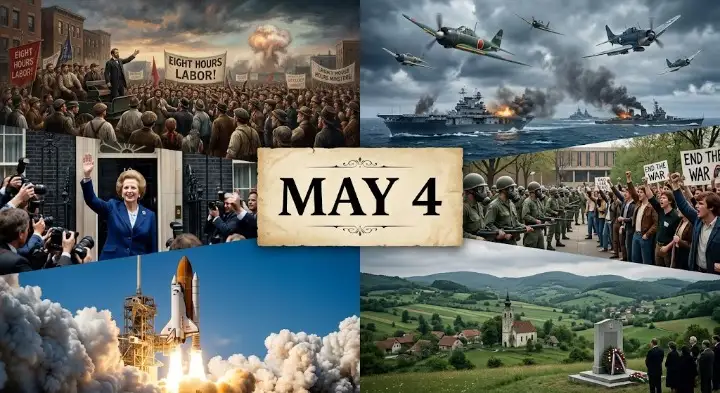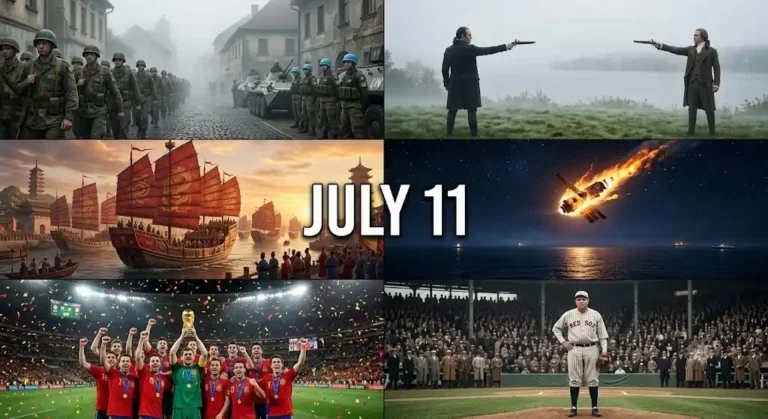
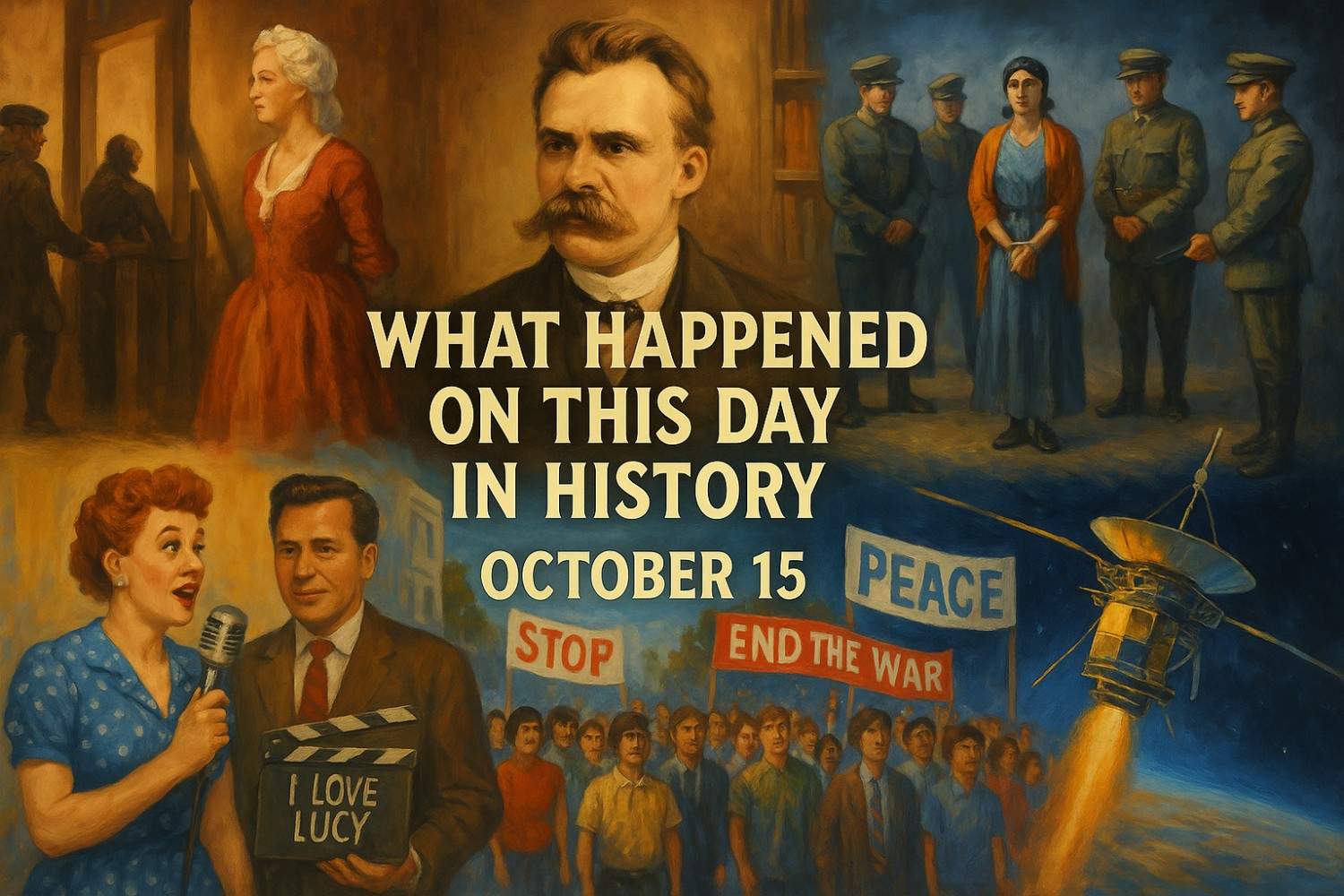
From ancient empires and royal exiles to modern inventions and space achievements, what happened on this day in history October 15 traces a timeline of courage, creativity, and change. Across centuries, this date has witnessed poetic births, political upheavals, and scientific breakthroughs. Each moment—whether born of conflict or discovery—has left its mark on the human story. Together, they reveal how October 15 continues to link innovation, resilience, and history itself.
Quick sections
Earlier history
70 BCE — Virgil born; 1211 — Rhyndacus; 1399-era transitions and early modern sieges show continuity of dynastic and cultural formation.
Exploration & foundations
1783 — Montgolfier ascent; 1910 — America airship launch; 1932 — Tata Airlines first flight; 1997 — Cassini launch underline transport and exploration leaps.
Wars & politics
1793 — Marie Antoinette trial; 1815 — Napoleon’s exile; 1934 — Long March; 1979 — El Salvador coup; 1993–94 — South Africa peace steps and Haitian return show regime change and settlement.
Arts & culture
70 BCE — Virgil; 1888 — Jack the Ripper letters and press culture; 1940 — The Great Dictator premiere; 1951 — I Love Lucy debut; births including Wodehouse and Calvino mark literary and media heritage.
Science, technology & media
1878 — Edison company; 1928 — Graf Zeppelin transatlantic flight; 1956 — FORTRAN; 2003 — Shenzhou 5 orbital flight; 1991 — “Oh-My-God” particle detection represent technological and scientific milestones.
Disasters & human rights
1954 — Hurricane Hazel; 1970 — West Gate Bridge collapse; 2013 — Bohol earthquake; multiple political executions and coups underline both natural and human-made tragedies.
Major Events on October 15
70 BCE — Birth of Virgil, Roman poet
Publius Vergilius Maro, known to history as Virgil, was born near Mantua and grew to write the Aeneid, Rome’s foundational epic. His verse shaped Roman self-image, literary education and later European literary traditions; Virgil’s lines would be quoted by statesmen and poets for generations as touchstones of empire, piety and destiny.
879 — Boso proclaims himself king after convoking bishops of Provence
Boso gathered Provence’s bishops and had them acknowledge him as king, an act that illustrates the blurred boundaries between ecclesiastical sanction and royal ambition in the fragmented politics of post-Carolingian Francia. Such local assertions of authority reflected the era’s shifting loyalties and the slow crystallization of regional polities.
1066 — Edgar the Ætheling proclaimed king (uncrowned) after Hastings
Following Harold II’s death at Hastings, the Witan proclaimed Edgar the Ætheling king of England; he was never crowned and soon yielded to William the Conqueror. Edgar’s brief proclamation exposes the unsettled succession politics of 11th-century England and the rapid consolidation of Norman rule after conquest.
1211 — Battle of the Rhyndacus: Henry of Flanders defeats Theodore I Laskaris
The Latin Emperor Henry of Flanders routed the Nicaean forces under Theodore I Laskaris at Rhyndacus, a confrontation in the aftermath of the Fourth Crusade that reshaped control in western Anatolia. The clash underlined the fragmented Byzantine successor states’ competition for territory and influence.
1529 — Siege of Vienna ends; Habsburgs halt Ottoman advance into Central Europe
The lifting of the Ottoman siege of Vienna in 1529 marked a decisive check on Ottoman expansion into Central Europe. The failure to capture Vienna halted Suleiman’s westward push and set the stage for a prolonged military, diplomatic and cultural frontier between Habsburg and Ottoman realms.
1582 — Adoption of the Gregorian calendar begins
The papal bull implementing the Gregorian calendar took effect in 1582, initiating a reform to correct Julian-calendar drift and re-align ecclesiastical dates with the solar year. Adoption proceeded unevenly across countries and confessions, but the reform ultimately established the calendar system used by most of the world today.
1651 — Qing capture Zhoushan; Prince Zhu Yihai flees to Kinmen
Qing forces took the island of Zhoushan, forcing Zhu Yihai, regent of the Southern Ming, to retreat to Kinmen. The event highlights the Qing consolidation of maritime and coastal territories and the last phases of Ming loyalist resistance during China’s dynastic transition.
1781 — Battle of Raft Swamp: last North Carolina engagement before Yorktown
The skirmish at Raft Swamp—one of the last Revolutionary War actions in North Carolina—ended in a Patriot victory four days before Cornwallis’s surrender at Yorktown. The engagement underlined the final unraveling of British control in the southern colonies and the local dimensions of a wider strategic collapse.
1783 — First manned hot-air balloon ascent by Pilâtre de Rozier (Montgolfier brothers)
Jean-François Pilâtre de Rozier became one of the first humans to ascend in a Montgolfier hot-air balloon, launching an era of human flight experiments. The spectacle captured public imagination across Europe and inaugurated systematic inquiry into aerostatics and early aeronautics.
1793 — Trial and conviction of Marie Antoinette for treason
Queen Marie Antoinette was tried, convicted of treason and later executed in the revolutionary tribunals that transformed France’s monarchy into republican justice. The trial reflected revolutionary politics’ redefinition of monarchy, scandal, and public culpability in a turbulent reconfiguration of authority.
1815 — Napoleon begins exile on Saint Helena
After Waterloo and final surrender, Napoleon was transported to Saint Helena in the South Atlantic, beginning an enforced exile that ended with his death. The island exile curtailed Napoleonic ambitions but allowed the emperor’s legend to grow through memoirs, debates about legacy and political symbolism.
1839 — Queen Victoria proposes to Prince Albert (encouraged by Leopold)
Encouraged by her uncle, King Leopold I of Belgium, Queen Victoria formalized a proposal to Prince Albert; their marriage shaped the Victorian era’s dynastic and cultural profile. The union influenced British court life, arts patronage and the construction of a domestic image of monarchy.
1844 — Friedrich Nietzsche was born (Prussia)
Friedrich Nietzsche was born in 1844 and later became one of modern philosophy’s most provocative figures, challenging morality, religion and metaphysics. His critique of modern values and literary aphorisms would seed wide intellectual debate across literature, philosophy and political thought.
1864 — Glasgow, Missouri, surrenders to Confederate forces (American Civil War)
Union forces at Glasgow, Missouri, surrendered to Confederates during the complex guerrilla and conventional operations in the trans-Mississippi theater. The incident highlights the local struggles and contested loyalties that defined border-state wartime experience.
1878 — Edison Electric Light Company begins operation
Thomas Edison’s electric company commenced operations, an early institutional step in the commercialization of electric lighting. The corporate organization supported technological diffusion, urban electrification and the eventual transformation of industrial and domestic life through electric power.
1888 — “From Hell” letter allegedly from Jack the Ripper received by police
Investigators received the notorious “From Hell” letter—one of the documents tied to the Jack the Ripper case that haunts Victorian criminology—intensifying public fear and press sensationalism around the unsolved Whitechapel murders and the period’s policing challenges.
1910 — Airship America launched in first Atlantic crossing attempt by powered aircraft
The dirigible America set out from New Jersey attempting the first powered-aircraft crossing of the Atlantic, an early quest to span oceans by air that foreshadowed later transatlantic aviation achievements and the technological ambition of the era.
1917 — Mata Hari executed near Paris, charged with spying for Germany
The dancer and courtesan Margaretha Zelle, known as Mata Hari, was executed by French firing squad after being convicted of espionage for Germany. Her trial and death became entangled in wartime anxieties, gendered tropes about female spies, and contested evidence amid World War I’s intelligence wars.
1923 — German Rentenmark introduced to stabilize the Weimar economy
To counter hyperinflation, Germany introduced the Rentenmark as a temporary currency in late 1923, halting runaway price rises and restoring a measure of monetary stability. The reform paved the way for economic recovery and a new currency regime under the Weimar Republic.
1928 — Airship Graf Zeppelin completes first transatlantic flight, lands at Lakehurst
The Graf Zeppelin finished a transatlantic voyage, touching down at Lakehurst, New Jersey, after a pioneering flight that highlighted the potential of lighter-than-air travel for long-distance passenger and postal services in the interwar years.
1932 — Tata Airlines (future Air India) makes inaugural flight
Tata Airlines carried out its first flight, laying the foundation for India’s later national carrier, Air India. The event intersects with early commercial aviation’s expansion, colonial-era entrepreneurship and the eventual role of air transport in connecting subcontinental markets.
1934 — The Long March begins; communists relocate and Mao rises to prominence
Chinese Communist forces began the Long March, a strategic retreat of thousands over thousands of miles that reconstituted revolutionary leadership and helped elevate Mao Zedong to undisputed leadership within the party. The trek became foundational to Communist myth and narrative.
1939 — LaGuardia Airport (then New York Municipal Airport) dedicated
New York Municipal Airport, later LaGuardia, was dedicated—part of interwar civic investments in aviation infrastructure that expanded urban air services, municipal pride, and modern transportation networks feeding metropolitan growth.
1940 — Lluís Companys executed by the Francoist government (Catalonia)
Catalan president Lluís Companys was captured and executed by Francoist authorities, a stark instance of repression after the Spanish Civil War that left deep scars in Catalonia and symbolized the broader persecution of Republican leaders and regional autonomy movements.
1940 — The Great Dictator premieres in New York City
Charlie Chaplin’s satire The Great Dictator premiered in New York, using comedy to ridicule Hitler and Nazism and to condemn anti-Semitism. The film’s blend of political satire and moral appeal made it both controversial and influential in wartime cultural politics.
1944 — Germany deposes Hungary’s government after an armistice announcement
Following Hungary’s armistice with the Soviets, German forces replaced the Hungarian government in a move to retain control over the country and its resources, intensifying wartime repression and complicating late-war resistance dynamics on the Eastern Front.
1951 — Luis E. Miramontes completes synthesis of norethisterone (basis of early oral contraceptive)
Mexican chemist Luis E. Miramontes synthesized norethisterone, a compound foundational to early oral contraceptives. The discovery advanced pharmaceutical chemistry and later fueled debates about reproductive health, social change and women’s autonomy.
1951 — I Love Lucy debuts on American television (first episode airs)
Lucille Ball and Desi Arnaz premiered I Love Lucy in a landmark television moment that reshaped sitcom format, production techniques and celebrity culture. The program’s popularity set standards for comedy writing, domestic representation and television’s commercial model.
1954 — Hurricane Hazel devastates the eastern seaboard and Toronto, 95 killed
Hurricane Hazel struck the U.S. East Coast and reached into Ontario, Canada, producing 95 deaths and catastrophic flooding as far north as Toronto. The storm prompted reevaluations of floodplain planning, emergency management and cross-border disaster response.
1956 — FORTRAN shared publicly, an early modern programming language
FORTRAN (Formula Translation) was distributed to the programming community, enabling scientific computing through higher-level language constructs and triggering the wider professionalization of programming and computational science.
1959 — Final conference on the Antarctic Treaty; 12 nations sign to preserve the continent for science
Delegates concluded negotiations and signed the Antarctic Treaty, setting aside the continent for peaceful, scientific purposes and halting sovereign claims—an early example of multilateral governance for a global commons.
1965 — Anti-war rally draft-card burning leads to first arrest under new law
An antiwar demonstration by the Catholic Worker Movement featured draft-card burning, producing the first arrest under laws criminalizing the act and signaling the conflicts between protest tactics and legal boundaries during the Vietnam War era.
1966 — Black Panther Party founded by Huey P. Newton and Bobby Seale
Huey Newton and Bobby Seale established the Black Panther Party in Oakland to combat police brutality and to advance community-based programs; the organization quickly became both a symbol of militant Black activism and a target of state surveillance and repression.
1969 — Assassination of Somali President Abdirashid Ali Sharmarke
President Abdirashid Ali Sharmarke of Somalia was assassinated, triggering political crisis and instability in the Horn of Africa as the young republic grappled with leadership transitions and regional pressures.
1970 — West Gate Bridge collapse in Australia kills 35 construction workers
During construction a span of Melbourne’s West Gate Bridge collapsed, killing 35 workers in Australia’s worst industrial disaster to that date. The catastrophe provoked reforms in engineering oversight, workplace safety and project management.
1979 — Malta Labour supporters ransack Times of Malta building amid political violence
Supporters of Malta’s Labour Party attacked the Times of Malta and other Nationalist-linked sites in a wave of politically motivated violence, reflecting the island’s deep partisan fractures and the volatility of late-1970s Maltese politics.
1979 — Coup in El Salvador overthrows President Carlos Humberto Romero
A military coup ousted President Romero and inaugurated a period of civil conflict that escalated into a 12-year civil war, with profound human costs, ideological polarization and regional interventions shaping El Salvador’s late-20th-century history.
1987 — Aero Trasporti Italiani Flight 460 crashes near Conca di Crezzo, killing 37
Flight 460 crashed near Conca di Crezzo in Italy, causing the loss of all passengers and crew. The accident spurred investigations into aviation safety and operational causes in regional air services.
1987 — Coup in Burkina Faso overthrows and kills President Thomas Sankara
A violent coup removed and assassinated Thomas Sankara, a revolutionary leader noted for social reform and anti-imperialist rhetoric, setting Burkina Faso on a markedly different political course under new leadership.
1989 — Wayne Gretzky becomes NHL all-time leading points scorer
Hockey star Wayne Gretzky surpassed the previous record to become the NHL’s all-time leader in points, a milestone that underscored his dominance of the sport and reshaped public expectations of athletic achievement and sports celebrity.
1990 — Mikhail Gorbachev awarded the Nobel Peace Prize
Soviet leader Mikhail Gorbachev received the Nobel Peace Prize for policies that reduced Cold War tensions, introduced reform (perestroika and glasnost), and initiated processes that would transform the Soviet state and Europe’s political order.
1991 — “Oh-My-God” particle observed at University of Utah HiRes observatory
Scientists recorded an ultra-high-energy cosmic ray—dubbed the “Oh-My-God” particle—at energies far beyond accelerator reach, challenging astrophysicists to explain sources and propagation of such extreme cosmic radiation.
1991 — Baltic leaders sign OSCE Final Act in Helsinki
Leaders of Estonia, Latvia and Lithuania signed the OSCE Final Act in Helsinki, a diplomatic step in the Baltics’ re-establishment of statehood and integration into European security and cooperative frameworks after Soviet rule.
1993 — Nelson Mandela and F. W. de Klerk awarded Nobel Peace Prize
Nelson Mandela and F. W. de Klerk shared the Nobel Peace Prize for negotiating the end of apartheid and laying groundwork for democratic transition in South Africa, recognizing a fraught, negotiated pathway from repression to majority rule.
1994 — United States returns Jean-Bertrand Aristide to Haiti
Under the Clinton administration, the U.S. facilitated the return of Haiti’s first democratically elected president, Jean-Bertrand Aristide, marking a contested re-engagement with Haitian democratic restoration after military rule.
1997 — Cassini probe launches from Cape Canaveral bound for Saturn
NASA launched Cassini from Cape Canaveral on a long mission to study Saturn and its moons, a centerpiece of planetary exploration that later returned transformative data on ring dynamics, moon geology and Saturnian atmosphere.
2001 — Galileo spacecraft makes a close pass of Jupiter’s moon Io
NASA’s Galileo probe passed within 180 km of Io, collecting data on the most volcanically active body in the Solar System and advancing understanding of tidal heating, volcanism and planetary geophysics.
2003 — China launches Shenzhou 5; Yang Liwei orbits Earth 14 times
China became the third nation to send a human into orbit when Yang Liwei piloted Shenzhou 5 around Earth 14 times, a major national milestone that signaled China’s entry into crewed spaceflight and a new era of space competition.
2006 — 6.7 Mw Kiholo Bay earthquake damages Hawaii, triggers landslides
A magnitude 6.7 quake near Kiholo Bay caused property damage, landslides and power outages in Hawaii and resulted in airport closures—reminding authorities of the islands’ seismic risks and the need for resilient infrastructure.
2007 — New Zealand arrests 17 activists in post-9/11 anti-terrorism raids
Seventeen people were detained in New Zealand in the country’s first major post-9/11 anti-terrorism raids, generating national debate over security law, civil liberties and the balance between prevention and individual rights.
2008 — Dow Jones falls 733.08 points (7.87%), second-worst percentage drop
Markets plunged as the Dow Jones Industrial Average recorded a sharp one-day loss of 7.87%, a dramatic sign of the unfolding global financial crisis and its cascading effects on banking, credit and investor confidence.
2013 — 7.2 Mw Bohol earthquake in the Philippines kills at least 215
A powerful quake struck Bohol province, causing widespread destruction, hundreds of deaths, and damage to heritage churches—prompting large-scale relief efforts and highlighting the Philippines’ earthquake vulnerability.
2016 — Nations amend Montreal Protocol to phase out hydrofluorocarbons
Representatives from 197 parties agreed to extend the Montreal Protocol to include HFCs, committing to a global phase-down of potent greenhouse gases—an environmental diplomacy milestone linking ozone protection to climate mitigation.
2018 — Cologne main station attack: gunman firebombs restaurant, takes hostage
An attacker set a fast-food restaurant on fire and took a hostage at Cologne’s central station; counter-terrorism teams intervened and rescued the hostage, underscoring urban terrorism risks and rapid security responses in European transport hubs.
2018 — Pakistan and Afghan forces exchange fire near Chaman border; gate closed
Troops from Pakistan and Afghanistan clashed near the Chaman border during disputes over fencing work; Pakistan closed the Chaman “Friendship Gate,” illustrating persistent cross-border tensions and the sensitivity of frontier construction in the region.
2019 — Duke and Duchess of Cambridge continue state visit to Pakistan; tributes to terrorism victims
The UK royal visit included public engagements honoring Pakistanis affected by terrorism, a diplomatic moment in bilateral relations that combined ceremonial protocol with acknowledgement of security-related sacrifices.
2019 — Russian and Syrian forces move in Manbij amid Turkish offensive in northeast Syria
As Turkey launched operations in northeastern Syria, shifts by Russian and Syrian forces around Manbij reflected the patchwork of local arrangements intended to deter further Turkish advances and to reconfigure control on the ground.
2020 — U.S. Commission on Presidential Debates cancels second Trump–Biden debate
Following controversy over debate formats and President Trump’s COVID-19 diagnosis, organizers canceled the second presidential debate and sought alternatives—an episode that shifted campaign communications and public exposure in a high-stakes election season.
2021 — Suicide bombing at Shiite mosque in Kandahar kills dozens
A suicide attack during Friday prayers at a Shiite mosque in Kandahar killed many worshippers and injured dozens, fueling sectarian tensions and underlining continued insurgent violence and civilian vulnerability in Afghanistan.
2022 — Russian missile and drone strikes hit multiple Ukrainian cities, damage energy facility near Kyiv
Russian strikes targeted Ukrainian cities and critical energy infrastructure near Kyiv amid full-scale invasion, exacerbating humanitarian crises, infrastructure collapse and international condemnation during a prolonged war.
2023 — Israel–Hamas war intensifies after October 7; heavy Israeli airstrikes on October 15 reported
Following the October 7 attacks, heavy Israeli air operations and preparations for ground action were reported on October 15, deepening humanitarian crises in Gaza and prompting international alarm over civilian casualties and displacement.
2024 — Intense Israel–Gaza operations and cross-border incidents continue; grave regional escalation
On October 15, 2024, strikes and ground actions linked to the Israel–Lebanon/Gaza escalation caused further fatalities and damage, widening regional impacts and raising urgent humanitarian and diplomatic concerns.
Want to read October 14 facts click here
Notable births — October 15
P. G. Wodehouse — comic novelist (creator of Jeeves) — born 1881.
John Kenneth Galbraith — economist & public intellectual — born 1908.
Italo Calvino — Italian novelist & short-story writer — born 1923.
John L. Sullivan — heavyweight boxing champion — born 1858.
Yitzhak Shamir — prime minister of Israel — born 1915.
Edith Wilson — First Lady of the United States — born 1872.
Frederick William IV — King of Prussia — born 1795.
Marie Stopes — birth-control advocate & botanist — born 1880.
Mikhail Lermontov — Russian Romantic poet & novelist — born 1814.
James Tissot — French painter & illustrator — born 1836.
Evangelista Torricelli — inventor of the mercury barometer — born 1608.
Helen Hunt Jackson — American author & Indigenous-rights activist — born 1830.
Mervyn LeRoy — Hollywood director & producer — born 1900.
David Trimble — Northern Irish politician & statesman — born 1944.
Evan Hunter (Ed McBain) — crime novelist — born 1926.
Paul Reynaud — French premier (1940) — born 1878.
Moshe Sharett — prime minister of Israel — born 1894.
Jim Palmer — Hall of Fame baseball pitcher — born 1945.
José Quintero — theatrical director (Circle in the Square) — born 1924.
Peter C. Doherty — Australian Nobel laureate immunologist — born 1940.
Notable deaths — October 15
Carlo Gambino — New York crime-family boss — died 1976.
Pierre Laval — Vichy French politician (executed) — died 1945.
Raymond Poincaré — French statesman (president) — died 1934.
ʿAbd al-Raḥmān III — Umayyad caliph of Córdoba — died 961.
W. Eugene Smith — photojournalist — died 1978.
Delphine Seyrig — French actress — died 1990.
Urban VI — pope whose election sparked the Western Schism — died 1389.
Johann Ludwig Burckhardt — Swiss explorer (Petra, Abu Simbel) — died 1817.
Andrés Bello — poet, scholar, Latin American intellectual — died 1865.
Friedrich Ludwig Jahn — “father of gymnastics” — died 1852.
Konrad E. Bloch — biochemist, Nobel laureate — died 2000.
Theodor Heinrich Boveri — cytologist (chromosome theory) — died 1915.
Stanley Ketchel — American middleweight boxing great — died 1910.
Antoine Laumet de La Mothe Cadillac — founder of Detroit — died 1730.
John Taverner — English Renaissance composer — died 1545.
James Phillip McAuley — Australian poet — died 1976.
Rudolf (antiking of Germany) — opponent of Henry IV — died 1080.
Alfred Moore — U.S. Supreme Court associate justice — died 1810.
Yordan Yovkov — Bulgarian author — died 1937.
Antonio Skármeta — Chilean novelist and diplomat — died 2024.
Observances & institutional dates — October 15
Breast Health Day (Europe).
October 15 (Eastern Orthodox liturgics).
National Latino AIDS Awareness Day (United States).
Shwmae Su’mae Day (Wales).
White Cane Safety Day.
World Students’ Day.
Frequently asked questions (FAQs)
Why is October 15 so special?
October 15, 1965, marked a pivotal moment in American history when antiwar activists organized nationwide protests against the Vietnam War. Over 100,000 people participated across 40 cities, and one symbolic act — the public burning of a draft card — led to the first legal consequences for such defiance, cementing the day as a milestone in the peace movement.
What happened on October 15th in history?
On October 15, 1793, Marie Antoinette, the queen consort of Louis XVI, met her fate at the guillotine in Paris. Once a symbol of royal luxury, she became a target of revolutionary anger during the French Revolution, marking this date as one of the most dramatic moments in French history.
Why is the Long March (1934) important in Chinese history?
The Long March preserved Communist forces, enabled leadership reorganization—most importantly elevating Mao Zedong—and became the foundational myth of the Chinese Communist Party’s revolutionary narrative.
What was the significance of the Rentenmark in 1923?
The Rentenmark stabilized Germany’s hyperinflation by restoring confidence in currency and allowing for economic recovery under difficult post-war conditions, paving the way for later monetary reforms.
Who was Mata Hari and why was she executed in 1917?
Mata Hari, a Dutch dancer accused of spying for Germany, was executed by France after a controversial trial. Her life and death became emblematic of wartime intrigue, gendered stereotypes and contested intelligence cases.
How did Cassini’s 1997 launch advance planetary science?
Cassini’s long voyage to Saturn enabled decades of close study of the planet, rings and moons, providing groundbreaking data on planetary processes, atmospheres, and potential astrobiological environments.