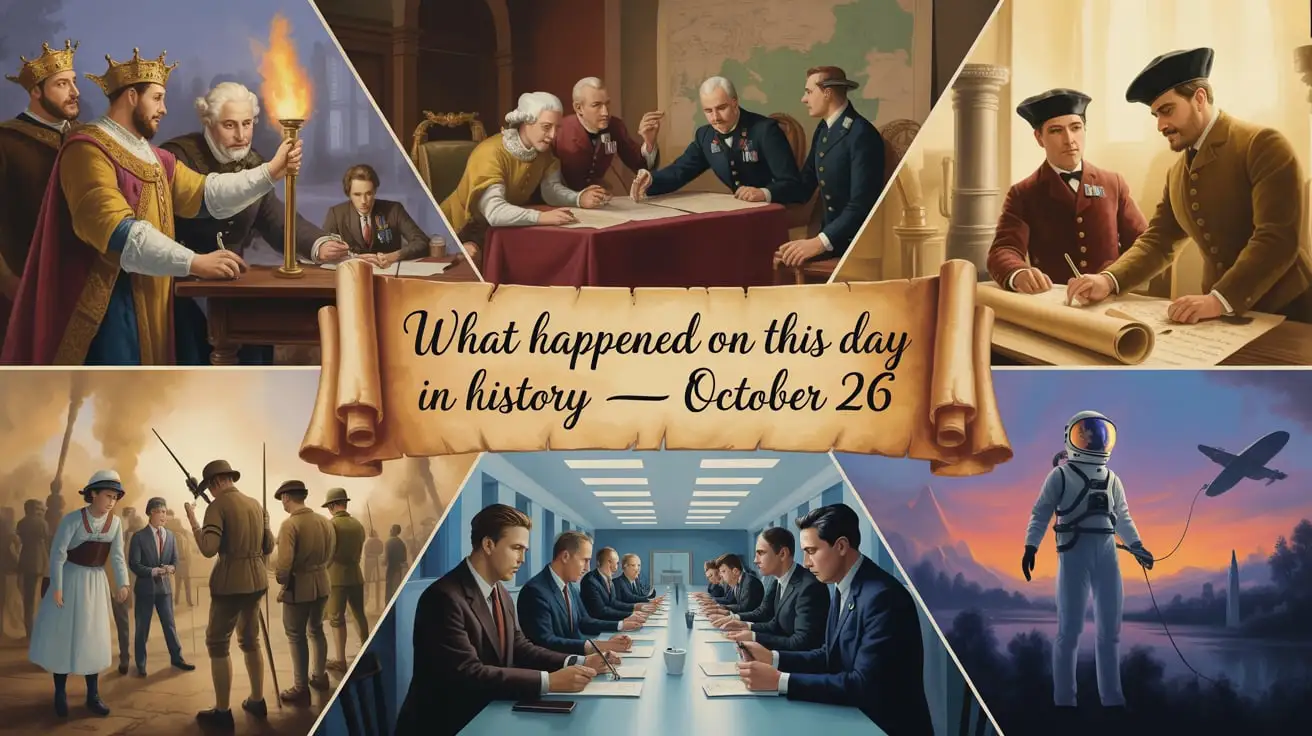
Councils, battles, early flights and modern crises recur on the calendar; What happened on this day in history October 26 collects hinge moments that altered power, practice and daily life. Across centuries the date links dynastic change, scientific firsts, bold explorations and wrenching disasters that reshaped communities and institutions.
Quick sections
Earlier history
Medieval revolts and dynastic transitions (Asen & Peter, 1185; Tvrtko’s coronation, 1377) and imperial coronations (Charles V, 1520) show how leadership contests and state-making shaped regional orders.
Exploration & foundations
Infrastructure and firsts—the Erie Canal (1825), early flights and telescopic discoveries (Lassell’s moons, 1851)—connect transport, science and the founding of modern institutions.
Wars & politics
From battles (Myeongnyang, Chateauguay, Vittorio Veneto) to partitions and insurgencies (Poland 1795; Kashmir accession 1947), the date recurrently features conflicts that redefined borders and regimes.
Arts & culture
Cultural landmarks and popular culture—from Scarlatti and Hogarth to Houdini, The Terminator, and landmark videogames—demonstrate the date’s recurring ties to creative milestones and mass media.
Science, technology & media
Milestones include telegraph and dam power generation, early rocketry photography of Earth, Soyuz rendezvous, Chang’e lunar missions and modern computing/OS launches—events that track accelerating technical reach.
Disasters & human rights
Natural and human-made tragedies (Royal Charter Storm, Flateyri avalanche, Cedar Fire) and human-rights ruptures (lynching, expulsions, theater siege) underscore persistent safety and justice challenges.
Read about: What Happened On This Day In History October 25: Inspiring Facts
Major Events on October 26
AD 1185 — Uprising of Asen and Peter begins (Second Bulgarian Empire)
On the feast of St. Demetrius the Asen and Peter uprising erupted against Byzantine control, ultimately leading to the creation of the Second Bulgarian Empire. The revolt combined military pressure and popular mobilization, enabling a revived Bulgarian polity that reasserted local rule in the Balkans and shaped regional medieval politics for generations.
1341 — Byzantine civil war formally begins with John VI Kantakouzenos proclaimed emperor
The proclamation of John VI Kantakouzenos opened a fractious civil war that would last into 1347, pitting rival aristocratic factions and foreign mercenaries against each other. The conflict weakened imperial authority, accelerated decentralizing tendencies, and left Byzantium vulnerable to later internal strife and external pressure from rising Turkish powers.
1377 — Tvrtko I crowned first king of Bosnia
Tvrtko’s coronation marked the elevation of Bosnia from a regional principality to a kingdom with enhanced royal prestige and political ambition. His reign expanded territorial reach and cultivated royal institutions, contributing to a distinct Bosnian medieval identity and linking Balkan politics to wider Central European dynamics.
1520 — Charles V crowned Holy Roman Emperor
Charles’s imperial coronation consolidated Habsburg dynastic stature across Europe, formalizing a realm that combined Spanish, Burgundian and Austrian inheritances. His accession reconfigured continental power balances, setting the stage for imperial rivalry, religious strife and long-term Habsburg involvement in European geopolitics.
1597 — Battle of Myeongnyang: Admiral Yi Sun-sin routs the Japanese fleet
Admiral Yi Sun-sin’s bold tactics at Myeongnyang defeated a vastly larger Japanese armada using only 13 ships, showcasing exceptional coastal seamanship and strategic acumen. The victory reversed Japanese naval momentum during the Imjin War, protected Korean sea lanes, and cemented Yi’s reputation as a master naval commander in East Asian military history.
1640 — Treaty of Ripon restores peace between Covenanters and Charles I
The Treaty of Ripon temporarily settled armed conflict between Scottish Covenanters and the English crown, requiring concessions and payments that shaped subsequent negotiations. The settlement highlighted the monarchy’s fiscal and political strains and presaged further constitutional crises that would convulse the British Isles in the mid-17th century.
1689 — Skopje burned to prevent cholera spread; commander dies of the disease
A desperate act to curb a deadly epidemic saw General Enea Silvio Piccolomini burn parts of Skopje; the measure reflected contemporaneous public-health thinking and the high human cost of contagion control. Piccolomini’s own death from the disease underscored epidemics’ reach into military and civic leadership in early modern conflicts.
1774 — First Continental Congress adjourns in Philadelphia
After a month of deliberation colonial delegates closed their session having set collective resistance measures, including the Continental Association, and forged intercolonial cooperation. The Congress’s work consolidated colonial public opinion, institutionalized networks of enforcement and prepared a political infrastructure that would sustain revolutionary mobilization.
1795 — National Convention dispersed during revolutionary France’s turbulent rearrangements
The dispersal of the National Convention reflected the volatile institutional reconfigurations of revolutionary France, where assemblies rose and fell amid factional struggles. Such disruptions influenced the revolutionary trajectory, affecting governance, political rights and the eventual consolidation of new regimes in the Directory and beyond.
1813 — Battle of the Chateauguay: British–Canadian–Mohawk forces repel U.S. advance
A combined force of British regulars, Canadian militia and Mohawk allies defeated a U.S. column aiming on Montreal, halting an American incursion during the War of 1812. The victory demonstrated effective local defense, underscored Indigenous alliances’ military importance, and helped secure Canada’s northern frontier during the war.
1825 — Erie Canal officially opens, transforming commerce and transport
After years of construction the Erie Canal linked the Great Lakes with New York City, dramatically lowering transport costs and accelerating western settlement and commercial integration. Its opening propelled New York into a commercial metropolis and inspired canal-building across the young United States, reshaping national economic geography.
1859 — Royal Charter Storm devastates the British Isles
A ferocious storm system known as the Royal Charter Storm wrecked shipping and coastal communities, causing at least eight hundred deaths and catastrophic maritime losses. The disaster spurred improvements in meteorological awareness, lighthouse and lifesaving services, and highlighted the vulnerability of seafaring communities to intense weather in the age of sail and steam.
1860 — Garibaldi presents conquests to Victor Emmanuel, ending the Expedition of the Thousand
Giuseppe Garibaldi’s military campaign in southern Italy culminated in a symbolic transfer of conquered territories to King Victor Emmanuel, advancing Italian unification. The episode melded popular campaigning and statecraft, accelerating the Risorgimento and altering the peninsula’s political map through the consolidation of new national institutions.
1863 — The Football Association is founded, formalizing association football rules
The foundation of the Football Association established standardized rules for the growing pastime, creating a blueprint for organized play that would spread globally. By codifying regulations, the association fostered competitive clubs, national competitions, and the social diffusion of football as a mass spectator and participatory sport.
1871 — Liberian President Edward James Roye deposed in coup d’état
Roye’s overthrow revealed fissures in Liberian politics tied to economic strain and factional rivalries, destabilizing governance in a young republic founded by former American slaves. The coup’s aftermath shaped Liberian state development and reflected the complex interactions of domestic politics and external economic pressures in African states of the era.
1881 — Gunfight at the O.K. Corral escalates Earp–Clanton feud in Tombstone
The famed shootout in Tombstone became emblematic of frontier law, vigilantism and the mythology of the American West. The clash between the Earp brothers and an outlaw faction crystallized local disputes into a widely retold episode, influencing popular narratives about justice, gun culture and settlement-era violence.
1890 — Malleco Viaduct inaugurated in Chile as the world’s highest railroad bridge at the time
The opening of the Malleco Viaduct represented engineering ambition in Latin America, connecting regions and facilitating resource transport. Its inauguration by President Balmaceda symbolized state-led modernization projects that aimed to integrate national markets and project technological prestige in the late 19th century.
1892 — Ida B. Wells publishes Southern Horrors: Lynch Law in All Its Phases
Wells’s investigative pamphlet exposed lynching’s brutality and mobilized early anti-lynching activism, combining reportage and moral argument to challenge systemic racial violence. Her work contributed to emerging civil-rights discourse and demonstrated journalism’s capacity to press for legal and social reforms amid entrenched injustice.
1905 — King Oscar II recognizes the dissolution of the union between Norway and Sweden
The formal acknowledgment of the union’s dissolution ended a long-running constitutional and political arrangement, enabling Norway’s independent monarchy and parliamentary development. The peaceful separation reflected negotiated national self-determination processes in a European context increasingly shaped by nationalist aspirations.
1905 — St. Petersburg soviet formed during the 1905 Russian Revolution
Workers’ councils or soviets emerged in St. Petersburg as new forms of urban political organization during the 1905 unrest, providing loci for labor coordination and radical politics. The soviets foreshadowed organizational practices that would later become central to 20th-century revolutionary movements in Russia.
1909 — An Jung-geun assassinates Japan’s Resident-General of Korea
The assassination of Ito Hirobumi by An Jung-geun marked a dramatic act of anti-colonial resistance against Japanese imperial presence in Korea, reverberating through East Asian diplomacy and nationalist movements. The killing highlighted contested sovereignty and the political violence associated with imperial occupation.
1912 — First Balkan War: Ottomans lose Thessaloniki and Skopje
The fall of these key cities to Balkan League forces signalled Ottoman retreat from much of Europe, accelerating territorial reconfiguration in the Balkans and raising nationalist aspirations that would contribute to the region’s volatile politics in the lead-up to World War I.
1917 — Brazil declares war on the Central Powers (World War I)
Brazil’s entry into the war on the Allied side reflected global reach of the conflict and naval concerns tied to submarine warfare. While Brazil’s direct military engagement was limited, the declaration aligned Latin American diplomacy with Allied maritime security efforts and international wartime realignment.
1918 — Erich Ludendorff dismissed after refusing to cooperate in peace negotiations
Ludendorff’s removal signaled internal military and political fractures as Germany faced collapsing fronts and mounting pressure to negotiate an armistice. The dismissal marked a turning point in German wartime leadership and the unraveling of imperial wartime governance near the war’s end.
1936 — First electric generator at Hoover Dam begins operation
The Hoover Dam’s first generator produced power that would electrify the American Southwest, enabling irrigation, industrial expansion and urban growth. The dam’s electrification embodied New Deal-era infrastructure ambition and reshaped regional economic development through large-scale public works.
1937 — Nazi Germany begins expulsions of 18,000 Polish Jews
The expulsions were an escalatory step in Nazi persecution, foreshadowing more systematic measures that would culminate in the Holocaust. Forced removals and discriminatory state practices intensified Jewish vulnerability, undermining legal protections and accelerating statelessness for many.
1942 — Battle of the Santa Cruz Islands: major carrier losses in the Guadalcanal campaign
A fierce carrier engagement in the Pacific war saw both sides suffer significant damage; the battle illustrated carrier warfare’s intensity and the high cost of securing air-sea control around Guadalcanal. The encounter formed part of broader attritional operations that shaped the Pacific campaign’s trajectory.
1944 — Battle of Leyte Gulf ends with overwhelming American victory
Leyte Gulf decisively degraded Japanese naval power and facilitated Allied landings to liberate the Philippines, marking one of the largest naval engagements in history. The victory reasserted sea control in the western Pacific and significantly impaired Japan’s capacity to conduct large-scale maritime operations.
1947 — Maharaja of Kashmir signs the Instrument of Accession to India, beginning the Kashmir conflict
The accession decision brought contested sovereignty into sharp relief, precipitating the Indo-Pakistani War of 1947–48 and a protracted territorial dispute. The move set the terms for a long-standing international conflict that remains central to South Asian geopolitics.
1955 — Austria declares permanent neutrality after Allied withdrawal
Following the end of occupation, Austria’s constitutional commitment to perpetual neutrality sought to anchor sovereign independence and avoid bloc entanglement during the Cold War. The pledge shaped Austria’s foreign policy identity and contributed to its role as a site for diplomacy and international organizations.
1955 — Ngô Đình Diệm proclaims himself President of the Republic of Vietnam
Diệm’s declaration formalized leadership in the newly constituted South Vietnamese state, setting the stage for complex U.S. involvement and escalating political contestation during the Vietnam conflict. His tenure would become a focal point for Cold War interventions in Southeast Asia.
1956 — Hungarian Revolution: massacres in Mosonmagyaróvár and Esztergom as unrest spreads
Brutal suppression and mass killings in provincial towns underscored the revolution’s nationwide reach and the harsh reprisals by state security forces. The events illustrated both the depth of Hungarian resistance to Soviet control and the tragic human cost of contested liberalization in 1956.
1958 — Pan Am inaugurates first commercial Boeing 707 transatlantic service (NY–Paris)
The 707’s commercial operation ushered in the jet age for passenger aviation, drastically shortening travel times and transforming international mobility, tourism and business travel. Jetliners redefined airline economics and global connectivity in the postwar era.
1967 — Mohammad Reza Pahlavi crowns himself Emperor of Iran
The Shah’s coronation consolidated monarchical authority with elaborate ceremonial display, symbolizing his modernization agenda and imperial aspiration. The event also highlighted tensions between autocratic symbolism and emerging domestic political discontent that would intensify in subsequent decades.
1968 — Soyuz 3 achieves first Soviet space rendezvous
The Soyuz 3 mission accomplished a key test in orbital maneuvering and rendezvous capability, advancing Soviet crewed-space techniques and contributing to later docking architectures. Such achievements were integral to evolving plans for long-duration missions and international space cooperation.
1970 — Muhammad Ali returns to boxing after three-year absence
Ali’s ring comeback after refusing military induction marked a major cultural and sporting moment, restoring a star power that interwove athletic excellence with civil-rights and antiwar symbolism. His victory signalled personal vindication and renewed global attention to his complex public role.
1977 — Last natural case of smallpox recorded (Ali Maow Maalin) in Somalia
The infection of Ali Maow Maalin is internationally remembered as the anniversary of smallpox eradication efforts—the culmination of a global vaccination campaign that eliminated naturally occurring smallpox and remains a landmark in public-health achievement and cooperative disease control.
1979 — Assassination of Park Chung Hee of South Korea
The killing of President Park by his intelligence chief precipitated political turmoil and marked the violent end of authoritarian rule that had overseen rapid economic modernization. Park’s death opened a turbulent period of succession that influenced South Korea’s subsequent democratization trajectory.
1984 — Release of The Terminator, launching a major film franchise
James Cameron’s science-fiction thriller introduced an iconic cinematic figure and showcased effects-driven storytelling that reshaped Hollywood genre filmmaking. The film’s success propelled Arnold Schwarzenegger to stardom and launched a franchise with lasting popular culture resonance.
1985 — Australian government returns Uluru to Pitjantjatjara Aboriginal people
The transfer of land back to its traditional owners marked a significant step in recognition of Indigenous land rights and cultural restoration in Australia, initiating a new model of joint management and symbolic national reconciliation around sacred places.
1989 — China Airlines Flight 204 crashes, killing 54
The fatal airliner crash after takeoff from Hualien highlighted aviation safety vulnerabilities and prompted investigations into mechanical, procedural, and operational causes to improve flight safety and emergency response procedures in civil aviation.
1991 — Last Yugoslav People’s Army soldier leaves Slovenia after Ten-Day War
The final withdrawal completed Slovenia’s brief successful defense of independence, marking a critical early moment in the dissolution of Yugoslavia and demonstrating how swift, localized conflicts could alter national borders at the end of the Cold War.
1994 — Jordan and Israel sign a peace treaty
The bilateral treaty normalized relations, resolved aspects of the 1948–1967 era disputes and opened diplomatic, economic and security cooperation between the two states—representing a rare formal peace agreement in the Arab–Israeli conflict and reshaping regional relations.
1995 — Assassination of Fathi Shaqaqi by Mossad in Malta
The killing of the Palestinian Islamic Jihad leader in Malta illustrated the transnational dimensions of intelligence operations and the fraught security environment of the 1990s Middle East, amplifying tensions between militant groups and regional counterterrorism efforts.
1995 — Avalanche at Flateyri, Iceland kills 20
A devastating avalanche demolished homes and killed residents in a coastal village, provoking national mourning and leading to reassessments of avalanche defenses, land-use planning, and community relocation policies in avalanche-prone regions.
1999 — House of Lords votes to end most hereditary peers’ right to sit and vote
The reform reduced the hereditary principle’s role in Britain’s upper chamber, part of broader constitutional modernization efforts that altered parliamentary composition and stimulated debate about democratic legitimacy and the Lords’ future role.
2000 — Protests force Robert Guéï to step down after contested Ivorian election
Mass mobilization following electoral dispute produced a rapid political collapse, illustrating how civic protest and contested succession can catalyze regime change in fragile electoral contexts and influence West African democratic trajectories.
2001 — USA PATRIOT Act enacted in the United States
Passed in the wake of the September 11 attacks, the Act expanded surveillance and law-enforcement authorities to counter terrorism, provoking ongoing debate about civil liberties, national security tradeoffs, and statutory protections in counterterrorism policy.
2002 — Moscow theater siege ends with heavy casualties during special-forces assault
The storming of the Dubrovka Theater, where Chechen separatists had held hostages, concluded with numerous deaths among hostages and militants; the incident raised contentious questions about hostage-rescue tactics, use of incapacitating agents, and state responsibility in counterterrorist operations.
2003 — Cedar Fire devastates San Diego region, kills 15 and destroys thousands of homes
One of California’s largest wildfires caused major fatalities and property loss, stressing emergency response, land-management policies and the need for community preparedness in wildfire-prone areas. The fire contributed to evolving approaches to fire science and suburban planning near wildland interfaces.
2004 — Grand Theft Auto: San Andreas released, becoming a best-selling PS2 title
The game’s commercial success reflected the growing cultural and economic power of interactive entertainment, while its content controversies also sparked debates about media effects, age ratings and creative freedom in digital game production.
2012 — Microsoft publicly releases Windows 8 on new PCs
Windows 8’s launch introduced a radically redesigned interface aimed at touch devices, provoking mixed reactions and discussions about user experience, platform transitions and software ecosystem disruption during the personal-computing era.
2015 — 7.5 Mw earthquake in the Hindu Kush kills hundreds and injures thousands
A powerful quake caused extensive loss of life and injury in mountainous terrain, prompting major humanitarian relief efforts and highlighting the vulnerability of remote communities to seismic hazards and the difficult logistics of aid delivery in rugged regions.
2022 — Russian strikes on Ukrainian cities continue; Dnipro and other population centres hit
Renewed missile and drone strikes caused civilian casualties and infrastructure damage, reflecting the conflict’s ongoing humanitarian toll and the strategic targeting of urban areas; such attacks intensified calls for protection of civilians and international diplomatic pressure.
2023 — Israel–Hamas war dominates headlines with severe humanitarian impacts in Gaza
The conflict’s escalation and attendant civilian suffering drove global attention, emergency response needs and complex diplomatic activity; the crisis highlighted challenges in conflict mediation, humanitarian access and the protection of noncombatants in dense urban settings.
2024 — Pakistan defeats England in third Test at Rawalpindi to win series 2–1
A major sporting story that day, Pakistan’s Test series victory over England generated national celebration and underscored cricket’s continuing cultural significance and international sporting rivalries.
Notable births — October 26 (compact list)
Georges Danton — French revolutionary leader — Born 1759.
Domenico Scarlatti — Italian composer — Born 1685.
Helmuth von Moltke — Prussian/German general — Born 1800.
Jackie Coogan — American actor (child star) — Born 1914.
Julian Schnabel — American painter & filmmaker — Born 1951.
Beryl Markham — British aviator & author — Born 1902.
Primo Carnera — Italian heavyweight boxer — Born 1906.
Paul Farmer — American physician & anthropologist — Born 1959.
Benjamin Guggenheim — American industrialist (Titanic passenger) — Born 1865.
Don Siegel — American film director — Born 1912.
Edward Brooke — U.S. senator — Born 1919.
Shiing-shen Chern — Chinese-American mathematician — Born 1911.
Lars Peter Hansen — American economist & Nobel laureate — Born 1952.
Vasily Vereshchagin — Russian painter — Born 1842.
Charles Pinckney — American statesman & Founding Father — Born 1757.
Andrew Motion — British poet (Poet Laureate) — Born 1952.
Karin Boye — Swedish poet & novelist — Born 1900.
Hans Leo Hassler — German composer — Born 1564.
Warne Marsh — American jazz saxophonist — Born 1927.
Henry Deringer — American gunsmith (Derringer pistol) — Born 1786.
Notable deaths — October 26 (compact list)
William Hogarth — English artist — Died 1764.
Níkos Kazantzákis — Greek writer — Died 1957.
Alfred Tarski — Polish-American logician & mathematician — Died 1983.
William S. Paley — Broadcasting executive (CBS) — Died 1990.
Louise Beavers — American actress — Died 1962.
John Graves Simcoe — British soldier & statesman — Died 1806.
Charles Proteus Steinmetz — Electrical engineer & inventor — Died 1923.
Oliver O. Howard — Union general & Freedmen’s Bureau head — Died 1909.
Roh Tae-Woo — President of South Korea — Died 2021.
Andrew II — King of Hungary — Died 1235.
César Ritz — Hotelier — Died 1918.
Sir Aurel Stein — Archaeologist — Died 1943.
Enomoto Takeaki — Japanese naval officer & statesman — Died 1908.
William Temple — Archbishop of Canterbury — Died 1944.
Thomas Johnson — U.S. Supreme Court justice — Died 1819.
Víctor Galíndez — Argentine boxer — Died 1980.
Marcel Minnaert — Belgian astronomer & solar physicist — Died 1970.
Charles Van Lerberghe — Belgian poet — Died 1907.
Susan Shelby Magoffin — Diarist of the Santa Fe Trail — Died 1855.
Laurentius Petri — First Protestant archbishop of Uppsala — Died 1573.
Observances & institutional dates — October 26
- October 26 (Eastern Orthodox liturgics)
- Accession Day (Jammu & Kashmir, India)
- Angam Day (Nauru)
- Armed Forces Day (Benin)
- National Day (Austria — anniversary of Declaration of Neutrality)
- Intersex Awareness Day
Frequently asked questions (FAQs)
Why is October 26 associated with smallpox eradication?
October 26 is marked by the last naturally occurring smallpox case (Ali Maow Maalin, 1977), a milestone in the global vaccination campaign that led to certified eradication—an unparalleled public-health success.
How did the Erie Canal change 19th-century America?
The Erie Canal linked the Great Lakes to the Atlantic via the Hudson, cutting transport costs, fueling westward settlement, and transforming New York City into a commercial hub—effects that catalyzed national economic integration.
Why is October 26 notable for space and aviation firsts?
The date features diverse aeronautical and space events—from early powered flights and telescopic discoveries to Soyuz rendezvous and Chang’e missions—showing how experimentation and exploration recur across eras on this calendar day.