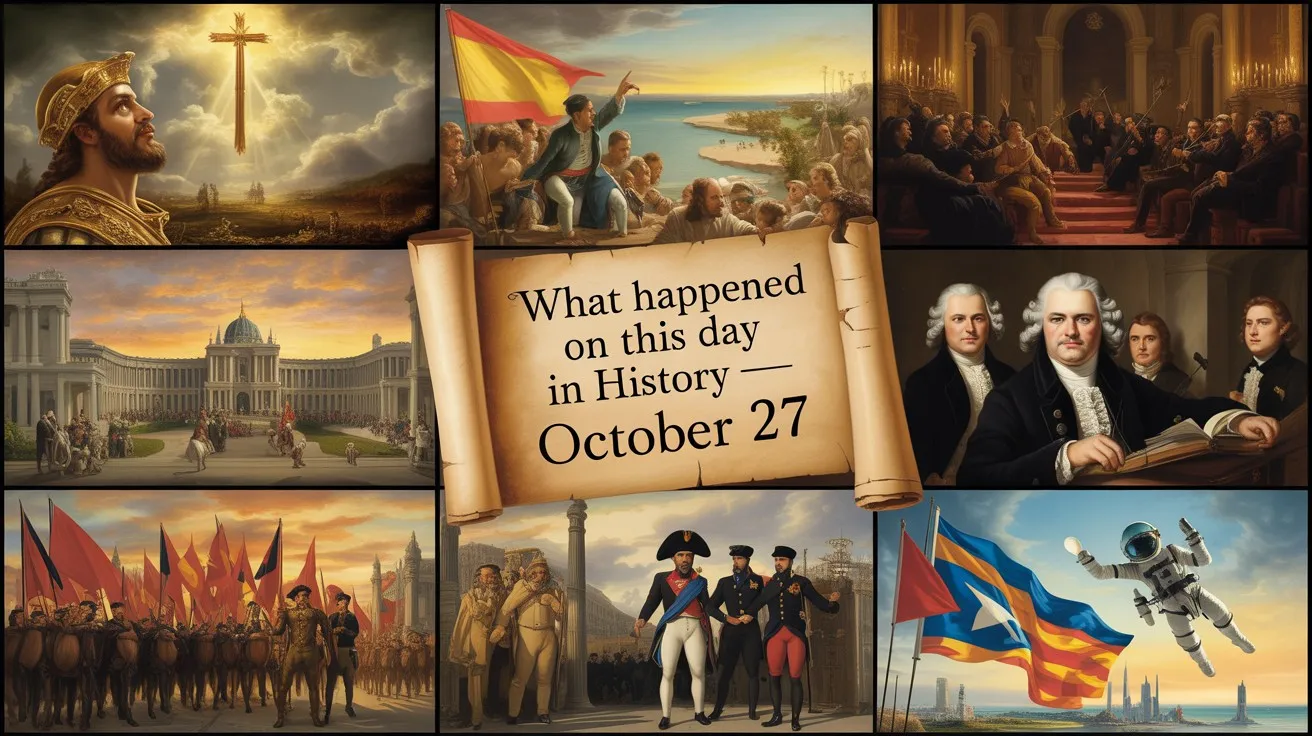
From imperial visions and contested thrones to seaside landings, wartime surrenders and late-century uprisings, the date ties ritual, statecraft and sudden reversals of fortune. What happened on this day in history October 27 sits in the centre of those shifts, marking moments that altered borders, belief and technology across centuries.
Quick Sections
Earlier history
312 — Constantine’s vision; 939 — death of Athelstan; 1275 — Amsterdam founded — early medieval and late-antique moments shaping rulership and urban origins.
States & revolutions
1795 — Treaty of Madrid; 1924 — Uzbek SSR founded; 1991 — Turkmenistan independence — boundary-setting, national formation and Soviet breakup.
Science, technology & media
1961 — Saturn I test; 1994 — Gliese 229B identified; 2000 — Wagner concert in Israel noted — milestones in rocketry, astronomy and contested cultural memory.
Arts & culture
1726 — Bach cantata premiere; 1936 — Wallis Simpson’s divorce (monarchy crisis); births and deaths of major writers and artists — cultural production and its political entanglements.
Disasters & human rights
1948 — Donora smog disaster; 1907 — Hungarian church shooting; 2018 — Pittsburgh synagogue atrocity — episodes highlighting environmental harm, state violence, and hate crime.
Read Also: What happened on this day in history October 26: Celebrating Milestones
Major Events on October 27
312 — Constantine’s Vision of the Cross
Traditional accounts hold that Constantine the Great experienced a vision of the cross before battle in 312, a moment tied to his later conversion and the empire’s evolving relationship with Christianity. Whether legendary or literal, the episode became a foundational story for Constantine’s religious policy and the imperial appropriation of Christian symbols in statecraft.
939 — Death of Athelstan, first king over all England
Athelstan, credited as the first ruler to unite the English kingdoms, died in 939. His reign consolidated royal institutions and laws that helped shape a nascent English kingdom; his death marked the transition to contested succession politics among the Anglo-Saxon elite and set patterns for later regional rivalries.
1275 — Traditional founding of Amsterdam
The traditional founding date of Amsterdam points to its early emergence as a trading settlement on the Amstel. Over subsequent centuries the town grew into a commercial and maritime hub, its origin story anchoring later civic identity and legal charters that enabled urban expansion throughout the late medieval and early modern periods.
1492 — Columbus sails to Cuba and claims the island for Spain
On this voyage Christopher Columbus reached and claimed parts of Cuba for the Spanish crown. The event formed part of the broader pattern of European voyages across the Atlantic that rapidly transformed Atlantic politics, initiated colonial claims, and set the stage for profound demographic, economic and cultural consequences in the Americas.
1524 — Siege of Pavia: French troops lay siege
French military operations around Pavia in 1524 were part of the Italian Wars, a long sequence of campaigns for dominance on the peninsula. Sieges such as Pavia exemplified the period’s contest between France, Spain and various Italian states, contributing to shifting alliances and the eventual Habsburg ascendancy in Italy.
1553 — Michael Servetus executed as a heretic near Geneva
Michael Servetus, condemned for theological views that challenged both Catholic and emerging Protestant orthodoxy, was burned at the stake outside Geneva in 1553. His execution reflected sharp confessional tensions during the Reformation and has since been debated as an example of limits on religious dissent in early modern Europe.
1644 — Second Battle of Newbury (English Civil War)
The Second Battle of Newbury saw Royalist and Parliamentarian forces contest supply lines and regional control. Though inconclusive in decisive terms, the fighting typified the English Civil War’s attritional campaigns and the political fragmentation that eventually led to broader constitutional crisis and military intervention in governance.
1674 — French garrison surrenders Grave to Dutch forces
After a difficult siege the French garrison in Grave capitulated to a Dutch army. The action formed part of the wars and border contests of seventeenth-century Europe, reflecting the protracted struggle for fortified towns that shaped the Low Countries’ political geography and military engineering of the era.
1682 — Founding of Philadelphia
Philadelphia’s founding in 1682 in William Penn’s Pennsylvania colony established an urban and administrative centre intended for trade, settlement and a degree of religious toleration. The city later became a major colonial hub and played central roles in North American political formation and revolutionary-era institutions.
1726 — Bach conducts the cantata BWV 56
Johann Sebastian Bach led the first performance of the cantata Ich will den Kreuzstab gerne tragen (BWV 56), one of the few works he explicitly called a cantata. The piece illustrates Bach’s liturgical role in Leipzig and his blending of theological text with sophisticated musical architecture, influencing later performance traditions.
1775 — King George III’s speech widening his Proclamation of Rebellion
In a parliamentary speech King George III expanded on his Proclamation of Rebellion, framing colonial resistance as unlawful. Such royal rhetoric hardened metropolitan perceptions of the American crisis and contributed to the political ruptures that produced armed conflict and eventual independence movements in North America.
1775 — Pinckney’s Treaty gives U.S. Mississippi navigation rights (note: listed as same day)
Pinckney’s Treaty with Spain, noted here as linked to navigation rights on the Mississippi, reflected early U.S. diplomatic efforts to secure commercial access and boundary arrangements in the Gulf-Atlantic corridor, influencing western trade, settlement and relations with Spanish colonial authorities.
1795 — Treaty of Madrid between the United States and Spain
The 1795 Treaty of Madrid established boundary lines and diplomatic terms between Spain’s colonies and the United States. It resolved lingering territorial frictions after independence, clarifying imperial and republican claims that shaped settlement and international law in North America.
1806 — Napoleon’s French army enters Berlin after Jena–Auerstedt
Following decisive Prussian defeats at Jena–Auerstedt, French troops entered Berlin in 1806, underscoring Napoleon’s sweeping reordering of German states. The occupation accelerated legal and administrative reforms imposed in the Napoleonic era and catalysed nationalist and reformist responses throughout Central Europe.
1810 — United States annexes West Florida
The U.S. annexation of the former Spanish colony of West Florida in 1810 reflected early American expansionist pressure and contested colonial boundaries. The incorporation influenced later territorial negotiations and the expansionist politics that characterized early nineteenth-century U.S. statecraft.
1838 — Missouri’s Extermination Order against Mormons
Missouri governor Lilburn Boggs issued the Extermination Order in 1838, ordering Mormons to leave the state or be killed. The decree institutionalized violent forced removal and persecution, prompting deep migration, ongoing martyr narratives within Latter-day Saint history, and eventual judicial and political consequences for state action against religious minorities.
1863 — Battle of Brown’s Ferry opens supply line to Chattanooga
Union forces under General William F. Smith secured Brown’s Ferry, opening a supply route to besieged Chattanooga. The operation contributed to Union strategic advantage in the southern theatre, facilitating subsequent offensives and illustrating the logistics-driven nature of Civil War campaigns.
1870 — Surrender of Marshal Bazaine at Metz (Franco-Prussian War)
Marshal François-Achille Bazaine’s surrender at Metz with a large corps marked a major French capitulation in the Franco-Prussian War. The loss weakened French defenses, accelerated the war’s conclusion, and helped pave the way for German unification under Prussian leadership.
1907 — Gendarmes fire on crowd at a church consecration in Hungary
A violent crackdown in Hungary in 1907, when gendarmes opened fire on a congregation gathered for a church consecration, resulted in multiple deaths. The incident exposed tensions in local governance and law enforcement and contributed to social and political unrest in the region.
1914 — HMS Audacious sunk by minefield in World War I
The British battleship HMS Audacious struck a minefield laid by the armed German merchant-cruiser Berlin and sank in 1914. The loss demonstrated the early naval hazards of twentieth-century warfare, including hidden maritime mines and the vulnerability of capital ships to irregular naval tactics.
1916 — Defeat of Negus Mikael secures Empress Zewditu’s throne (Ethiopia)
Negus Mikael’s defeat by Fitawrari Habte Giyorgis ended a bid to place Iyasu V on the Ethiopian throne and secured Empress Zewditu’s position. The episode reflected internal dynastic contestations and the role of military leaders in shaping Ethiopia’s modern imperial succession.
1919 — Makhnovshchina regional congress at Oleksandrivsk
The Fourth Regional Congress of Peasants, Workers and Insurgents convened by the Makhnovshchina at Oleksandrivsk represented an attempt at anarchist-influenced local organization during the Ukrainian revolutionary period. The congress showcased competing visions for social order amid civil war and foreign interventions.
1922 — Rhodesian referendum rejects annexation to South African Union
Voters in Rhodesia rejected a proposal to join the South African Union in 1922, choosing instead a distinct political trajectory under British colonial oversight. The decision shaped subsequent settler politics, constitutional arrangements and the region’s long-term nationalist pathways.
1924 — Foundation of the Uzbek SSR in the Soviet Union
The creation of the Uzbek Soviet Socialist Republic in 1924 formalized Soviet national-territorial policy in Central Asia, reorganizing local administration and integrating the region into the USSR’s federation of republics. The change had lasting effects on national identity, language policy and governance.
1930 — London Naval Treaty ratifications go into effect
Ratifications exchanged in London brought the first London Naval Treaty into force, limiting certain naval armaments among signatory powers. The agreement aimed to curb naval arms races of the interwar years, though enforcement and loopholes later tested its stabilizing ambitions.
1936 — Wallis Simpson obtains divorce, enabling Edward VIII’s later marriage
Wallis Simpson’s divorce in 1936 removed a legal impediment to her eventual marriage to Edward VIII, a union that precipitated constitutional crisis and led to Edward’s abdication. The personal affair had outsized political consequences for the British monarchy and succession.
1944 — German forces capture Banská Bystrica, ending Slovak National Uprising
The German capture of Banská Bystrica suppressed the Slovak National Uprising, a major anti-fascist resistance effort. Its defeat illustrated the violent limits of local resistance under occupation and the wider dynamics of wartime repression in Central Europe.
1948 — Ecological disaster in Donora, Pennsylvania
A severe pollution episode in Donora resulted from industrial smog and led to widespread illness and several deaths. The disaster became an early American case linking industrial emissions to public health, influencing later air-quality regulation and environmental awareness.
1954 — Benjamin O. Davis Jr. becomes first African-American USAF general
Benjamin O. Davis Jr.’s promotion to the first African-American general in the United States Air Force marked a milestone in military integration and recognition of African-American service. The advancement symbolized incremental racial progress within U.S. armed forces amid broader civil-rights struggles.
1958 — Deposition of Iskander Mirza by General Ayub Khan in Pakistan
Iskander Mirza’s removal by General Ayub Khan in 1958, shortly after Mirza had installed martial law, marked the end of a turbulent early republican period in Pakistan and initiated a decade-long military-led governance that reshaped political institutions and civilian rule.
1961 — NASA tests the first Saturn I rocket (Mission Saturn-Apollo 1)
The Saturn I rocket test marked a developmental step in the U.S. Saturn family that later supported Apollo missions. Early Saturn tests signalled progress in heavy-lift rocketry and spaceflight engineering during the intensifying space-race era.
1962 — U-2 pilot Rudolf Anderson is shot down in the Cuban Missile Crisis
Major Rudolf Anderson’s U-2 reconnaissance aircraft was downed over Cuba in 1962, making him the only direct military casualty of the Cuban Missile Crisis. His death escalated tensions and highlighted the kinetic risks of high-pressure nuclear standoff diplomacy during the crisis.
1962 — Vasily Arkhipov refuses to agree to fire a nuclear torpedo, averting wider war
Soviet submarine officer Vasily Arkhipov’s refusal to authorize the firing of a nuclear torpedo under tense Cuban Missile Crisis circumstances is credited with preventing an escalatory exchange. The episode emphasises how individual judgment can alter high-stakes strategic outcomes.
1964 — Ronald Reagan’s “A Time for Choosing” speech launches political career
Ronald Reagan’s televised speech on behalf of Barry Goldwater articulated a conservative critique of liberal policy and propelled Reagan into national political prominence. The address is often cited as the beginning of Reagan’s ideological ascent and later electoral successes.
1971 — Democratic Republic of the Congo renamed Zaire
The renaming of the country to Zaire reflected President Mobutu’s national-identity program and political rebranding, a change tied to broader post-colonial governance strategies and symbolic efforts to consolidate authority through cultural and toponymic shifts.
1978 — Nobel Peace Prize for Sadat and Begin (Camp David accords) noted on this date
Anwar Sadat and Menachem Begin shared the Nobel Peace Prize in recognition of their roles in negotiating the Camp David Accords and the Israel–Egypt peace treaty. The award acknowledged an exceptional diplomatic breakthrough that reshaped Middle Eastern diplomacy and bilateral relations.
1979 — Saint Vincent and the Grenadines gains independence from the UK
Saint Vincent and the Grenadines achieved independence in 1979, part of a late-twentieth-century wave of decolonization in the Caribbean. Independence inaugurated national institutions and international recognition, while raising questions about economic development and postcolonial governance.
1981 — Soviet submarine S-363 runs aground off Sweden (Cold War incident)
The grounding of Soviet submarine S-363 near Sweden produced a diplomatic embarrassment and security alarm, highlighting the persistent risks of submarine operations near neutral or territorial waters during the Cold War and prompting public and governmental scrutiny.
1986 — London’s “Big Bang” deregulates British financial markets
The sudden deregulation of UK financial markets — the so-called Big Bang — transformed trading, clearing and market structures in the City of London. The reform accelerated financial innovation and globalization, restructuring Britain’s role in international finance and altering sectoral employment patterns.
1988 — U.S. suspends construction of Moscow embassy over listening devices
In 1988 the U.S. halted work on a new embassy building in Moscow after discovering Soviet listening devices embedded in the structure. The incident intensified Cold War suspicions and raised security concerns about diplomatic infrastructure.
1991 — Turkmenistan declares independence from the Soviet Union
Turkmenistan’s declaration of independence was part of the USSR’s disintegration, establishing a new post-Soviet state with implications for regional resources, border management and the reconfiguration of Central Asian geopolitics.
1992 — Murder of Allen R. Schindler Jr. prompts debate on gays in the U.S. military
The murder of Navy radioman Allen R. Schindler Jr. by a shipmate because of Schindler’s sexual orientation provoked widespread public debate and contributed to the political process that produced the U.S. military’s “Don’t ask, don’t tell” policy on gay service members.
1993 — Widerøe Flight 744 crashes in Norway, killing six
The crash of Widerøe Flight 744 in Overhalla Municipality resulted in six fatalities and initiated aviation investigations. Such regional airline accidents prompted scrutiny of approach procedures, aircraft maintenance and local air-safety protocols in challenging terrain and weather.
1994 — Gliese 229B identified as first unquestioned substellar-mass object
Astronomers confirmed Gliese 229B as a substellar-mass object — a brown dwarf — marking a milestone in stellar and substellar detection that refined understanding of star formation and the lower mass limits for sustained hydrogen fusion.
1997 — Asian financial crisis triggers Dow Jones crash
The 1997 Asian financial crisis produced global market contagion, contributing to a sharp decline in the Dow Jones Industrial Average and revealing interconnected risks in international capital flows, currency pegs and regional banking vulnerabilities.
1999 — Armenian Parliament shooting kills prime minister and others
Gunmen opened fire in the Armenian Parliament in 1999, assassinating the prime minister and several officials. The attack underscored domestic political volatility and prompted national mourning, security reassessments and legal repercussions for political violence.
2000 — Wagner’s music played publicly in Israel for first known time near Tel Aviv (concert noted)
A concert near Tel Aviv featured music by Richard Wagner, a composer widely associated with Nazi cultural appropriation; the public performance marked a controversial cultural moment and stimulated debate in Israeli society over memory, culture and historical sensitivities.
2014 — Britain ends Operation Herrick, withdraws from Afghanistan
The formal withdrawal of British combat forces marked the end of Operation Herrick after over a decade, closing a major chapter of UK military engagement in Afghanistan and initiating transitions to diplomatic and development roles amid contested security legacies.
2016 — Mike Pence campaign plane skids off LaGuardia runway (no serious injuries)
A campaign aircraft carrying Mike Pence skidded off the runway at LaGuardia Airport in 2016; while there were no serious injuries, the incident attracted attention during the U.S. presidential campaign and raised routine questions about aviation safety and political travel.
2016 — Pakistan observes “Kashmir Black Day” events on Oct 27 (national commemorations)
Pakistani institutions and public bodies marked “Kashmir Black Day” with seminars and observances to express solidarity with Kashmiris; the event reflects enduring regional disputes and the use of commemorative dates in diplomatic and public advocacy.
2017 — Catalonia declares independence from Spain (regional declaration)
Catalonia’s unilateral declaration of independence intensified constitutional conflict with Spain and triggered emergency legal, political and constitutional responses in Madrid; the episode highlighted tensions in European regionalism and questions over self-determination within modern states.
2018 — Pittsburgh synagogue mass shooting kills eleven and wounds several
A gunman opened fire at a Pittsburgh synagogue in 2018, killing eleven worshippers and wounding others. The attack produced national shock, prompted investigations into antisemitic motivations, and led to policy debates on hate crimes, security and gun laws.
2018 — Helicopter crash kills Leicester City owner Vichai Srivaddhanaprabha and four others
Following a Premier League match a helicopter carrying Leicester City’s owner crashed, killing the owner and four passengers. The tragedy reverberated across sports and business communities, prompting safety inquiries and an outpouring of public grief.
2019 — Abu Bakr al-Baghdadi dies by suicide during U.S. raid in Syria
Abu Bakr al-Baghdadi, leader of ISIL, detonated a suicide vest during a U.S. special-operations raid in northwestern Syria, killing himself and three children. The operation was a significant counter-terrorism event with diplomatic and security reverberations in regional and global policy circles.
Notable births — October 27
John Gotti — American organized-crime boss — born 1940.
Ruby Dee — American actress & activist — born 1922.
Francis Fukuyama — American political theorist & writer — born 1952.
Zadie Smith — British author — born 1975.
Isaac Singer — American inventor (sewing machine) — born 1811.
Kocheril Raman Narayanan — President of India — born 1920.
Lee Krasner — American painter (Abstract Expressionism) — born 1908.
H. R. Haldeman — U.S. presidential adviser (Nixon) — born 1926.
Maxine Hong Kingston — Chinese-American author — born 1940.
Nawal El Saadawi — Egyptian physician, author, feminist — born 1931.
Carlos Andrés Pérez — President of Venezuela — born 1922.
Benjamin F. Wade — U.S. senator (Civil War era) — born 1800.
Roscoe Pound — American jurist & educator — born 1870.
Enid Bagnold — British author & playwright — born 1889.
Owen D. Young — American lawyer, businessman & diplomat — born 1874.
Raymond VI — Count of Toulouse (medieval) — born 1156.
August Neidhardt von Gneisenau — Prussian field marshal — born 1760.
Peter Martins — Danish dancer & choreographer — born 1946.
Patty Sheehan — American professional golfer — born 1956.
Albert Wendt — Samoan novelist & poet — born 1939.
Notable deaths — October 27
Lise Meitner — Austrian physicist (nuclear fission research) — died 1968.
David Bohm — Theoretical physicist — died 1992.
Michael Servetus — Physician & theologian (executed as heretic) — died 1553.
Ivan III — Grand Prince of Moscow — died 1505.
Ulūgh Beg — Timurid ruler, astronomer & scholar — died 1449.
James M. Cain — American novelist — died 1977.
Jacques Demy — French film director — died 1990.
Enrico Mattei — Italian businessman (ENI) — died 1962.
Marcel Cerdan — Boxer — died 1949.
Charles E. Coughlin — Radio priest & commentator — died 1979.
Georges Carpentier — French boxer — died 1975.
Hans Werner Henze — German composer — died 2012.
John H. Van Vleck — Nobel-winning physicist — died 1980.
Ntozake Shange — American playwright & poet — died 2018.
Roy DeCarava — American photographer — died 2009.
Itō Jakuchū — Japanese painter — died 1800.
André De Toth — Film director — died 2002.
Susan L. Lindquist — Molecular biologist — died 2016.
Hallgrímur Pétursson — Icelandic religious poet — died 1674.
Jean Hélion — French painter — died 1987.
Observances & institutional dates — October 27
Černová Tragedy Day (Slovakia).
Flag Day (Greece).
Independence Day (Saint Vincent and the Grenadines).
International Religious Freedom Day (United States).
National Black Cat Day (United Kingdom).
World Day for Audiovisual Heritage.
Frequently asked questions (FAQs)
Who was Michael Servetus and why is his 1553 execution notable?
Michael Servetus was a polymath whose theological views challenged established Christian doctrines; his execution outside Geneva in 1553 signalled the intolerance for certain heterodox beliefs in Reformation Europe and is often cited in discussions of conscience, heresy and the limits of doctrinal dissent.
Why is Rudolf Anderson’s death on October 27, 1962 important?
Major Rudolf Anderson was shot down during the Cuban Missile Crisis; his death represented the only direct human casualty of that confrontation and underscored the real, immediate risks of military incidents amid nuclear standoffs between superpowers.
What was the immediate significance of Saint Vincent and the Grenadines’ independence in 1979?
Independence in 1979 ended colonial rule and launched Saint Vincent and the Grenadines as a sovereign state within the Commonwealth, creating new institutions and diplomatic status while placing the country on a path of post-colonial development and nation-building.