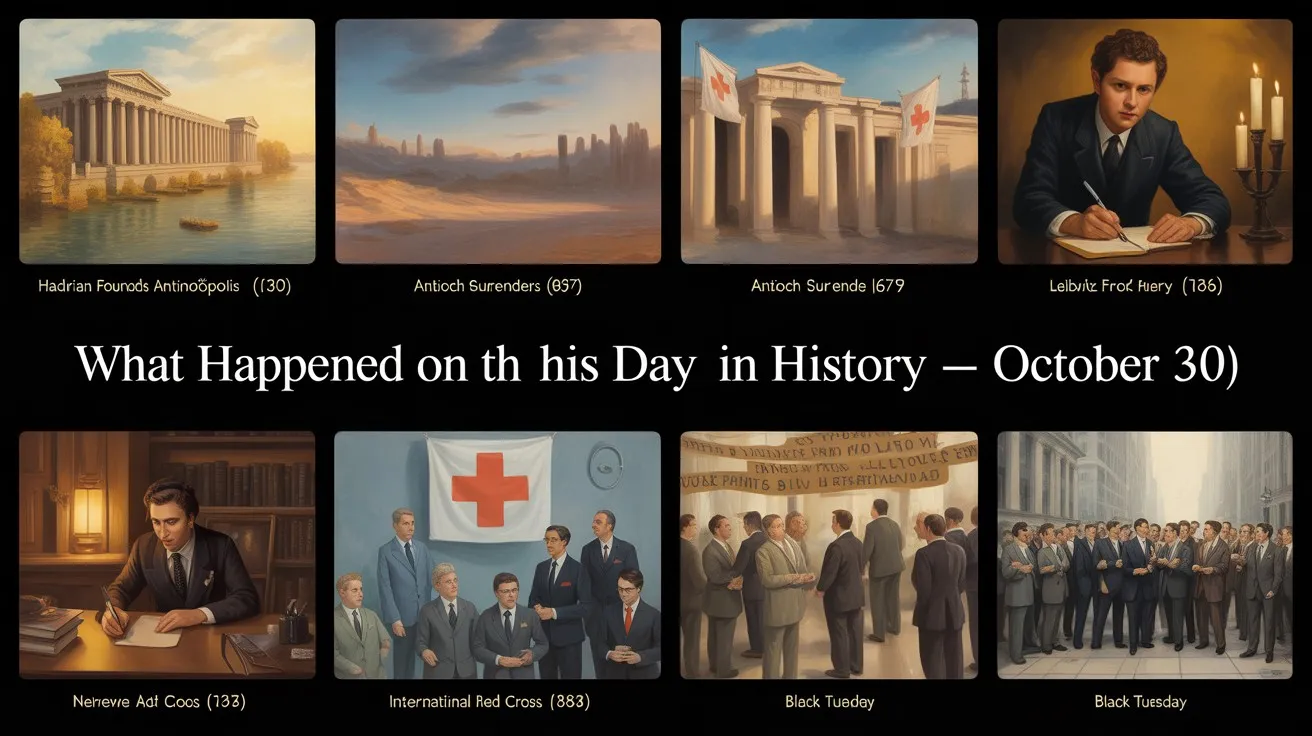
Antinoöpolis rose on the Nile and empires clashed at distant bridges — the date keeps returning to sudden turns of fate. What happened on this day in history October 30 threads military surprises, political breakthroughs and startling technological steps. Poets, rebels, inventors and diplomats all leave marks here, from carved cities to modern rescue efforts.
These moments show how a single date can hold founding acts, brutal reckonings and quieter institutional change.
Quick sections
Earlier history
Imperial foundations and medieval sieges stand out: Hadrian’s Antinoöpolis, Antioch’s fall and Iberian frontline battles illustrate how imperial politics and military contests shaped regional orders.
Exploration & foundations
From colonial concessions in Africa to the naming of landmarks and the careers of explorers and engineers, the date links commercial expansion, infrastructure and colonial administration across centuries.
Wars & politics
October 30 repeats with mutinies, declarations and armistices (Ottoman armistice, German naval mutinies, revolutions and Cold War crises), showing how military rupture often precipitates political reconfiguration.
Arts & culture
Orson Welles’s radio drama, Graham’s Appalachian Spring premiere, and the careers of painters, composers and writers tied to the date show the cultural pulse that runs alongside political events.
Science, technology & media
From Leibniz’s notation to the Tsar Bomba test, ARPANET beginnings and later space/communications advances, the date collects landmarks in scientific notation, networks and technological power.
Disasters & human rights
Transport disasters, mass killings during wartime, catastrophic storms and industrial accidents on this date underline persistent human vulnerabilities and ongoing demands for safety, justice and remembrance.
Major Events on October 30
130 — Hadrian founds Antinoöpolis
In 130 CE, Emperor Hadrian established the city of Antinoöpolis on the Nile in honour of his companion Antinous, creating a new Hellenizing foundation in Roman Egypt. The city served as an imperial cult centre and a focal point for Greco-Roman architecture and learning in the region, symbolizing Roman urban patronage and the intimate links between imperial memory and urban planning.
637 — Antioch surrenders to the Rashidun Caliphate
Following the Battle of the Iron Bridge, Antioch capitulated to Arab forces, marking a major step in the early Muslim conquests that reshaped Syria and the eastern Mediterranean. The city’s fall shifted regional administrative structures and opened new channels for cultural and commercial exchange under successive caliphal administrations, accelerating the transformation of Late Antique urban life.
758 — Guangzhou sacked by Arab and Persian pirates
A catastrophic raid on Guangzhou by seafaring raiders from the Persian Gulf region exposed vulnerabilities in maritime trade and coastal defense in Tang China. The sack disrupted international commerce centered on the southern port, affecting Silk Road maritime routes and prompting Chinese officials to reassess naval patrols and coastal fortifications in response to long-distance piracy.
1137 — Battle of Rignano consolidates Ranulf of Apulia
Ranulf’s victory over Roger II strengthened his ducal position in southern Italy for the remainder of his short rule. The clash was one episode in the fractious Norman politics of the Mezzogiorno, where competing claims to territory and prestige produced shifting alliances between itinerant magnates, local bishops and emerging centralizing princes.
1270 — Eighth Crusade ends with agreement in Tunis
After Louis IX’s death, Charles of Anjou negotiated terms with the Hafsid rulers that effectively ended the Eighth Crusade. The settlement underlined the limits of crusading ventures in North Africa and illustrated how dynastic successors converted costly expeditions into political bargaining—a pattern that limited later large-scale European military intervention in the region.
1340 — Battle of Río Salado halts Muslim invasion of Iberia
At Río Salado, Castilian and Portuguese forces turned back a major Muslim incursion, reinforcing Christian dominance along much of the Iberian frontier. The victory reduced the immediate threat to western peninsular kingdoms, strengthening the momentum of Reconquista campaigns and influencing subsequent territorial consolidation in late-medieval Spain and Portugal.
1485 — Henry Tudor crowned King Henry VII of England
Henry Tudor’s coronation ended the Wars of the Roses and inaugurated the Tudor dynasty, which pursued dynastic consolidation, administrative reform and calculated marriage alliances. Henry VII’s accession launched decades of state-building that stabilized the monarchy, reformed royal finances and set the stage for Tudor cultural and religious shifts in the early modern era.
1657 — Battle of Ocho Rios: Spanish fail to retake Jamaica
Spanish attempts to dislodge English settlers in Jamaica were repulsed, confirming England’s foothold in the Caribbean. The engagement signaled the shift from Spanish maritime hegemony toward more plural imperial competition in the Caribbean, with long-term implications for plantation economies, slave labor systems and transatlantic trade networks.
1806 — Stettin surrenders to a smaller French force
Prussian General von Romberg surrendered Stettin after being convinced he faced overwhelming odds, despite commanding a larger force. The episode illustrated the psychological effects of Napoleon’s reputation and the uneven command decisions that helped the French secure territorial gains during the War of the Fourth Coalition.
1817 — Simón Bolívar becomes President of the Third Republic of Venezuela
Bolívar’s presidency marked a moment in the long process of South American independence and republican formation. His leadership sought to stabilize territories freed from Spanish rule and to craft new institutional frameworks, even as regional fragmentation and competing visions of governance complicated the postcolonial transition.
1831 — Nat Turner arrested after slave rebellion in Virginia
The capture of Nat Turner, leader of a violent 1831 insurrection, precipitated harsh reprisals and tightened slave-holding laws across the American South. Turner’s revolt forced national debates over slavery’s security, reform and moral justification—debates that intensified sectional tensions leading toward civil war.
1858 — Arsenic poisoning in Bradford sweets causes multiple deaths
A tragic accident in Bradford, England, where sweets were inadvertently adulterated with arsenic trioxide, resulted in fatal poisonings and public alarm about food safety. The disaster highlighted the need for stronger public-health measures, improved manufacturing oversight and the emergence of consumer-protection concerns in industrializing societies.
1863 — Prince Vilhelm arrives to become George I of the Hellenes
Danish Prince Vilhelm’s arrival and accession as King George I initiated a new royal house in Greece and reflected the common nineteenth-century practice of bringing European princes to newly independent or reorganized states. His long reign helped stabilize the emergent Greek monarchy and steered foreign and domestic policy in an era of nation-building.
1864 — Treaty of Vienna ends the Second War of Schleswig (territorial concessions)
The treaty formalized Danish territorial losses to Prussia and Austria, reshaping northern European borders and accelerating Prussian ascendancy. The settlement exemplified mid-nineteenth-century realpolitik, where military success translated into diplomatic and territorial gains that reconfigured German–Danish relations and contributed to later unification processes.
1888 — Rudd Concession granted in Matabeleland
Agents of Cecil Rhodes secured mineral rights in Matabeleland through the Rudd Concession, enabling subsequent British expansion and economic penetration in southern Africa. The agreement exposed asymmetries in colonial negotiations and paved the way for chartered-company rule, resource exploitation and escalated tensions with indigenous polities.
1905 — October Manifesto issued by Tsar Nicholas II
The October Manifesto promised civil liberties and the creation of a Duma in response to revolutionary unrest, offering a limited constitutional concession by the Russian autocracy. The document temporarily eased pressures but did not resolve deeper political and social grievances, setting the stage for continuing revolutionary ferment that culminated in 1917.
1918 — Ottoman Empire signs the Armistice of Mudros
The armistice ended Ottoman participation in World War I and initiated occupation and partitioning processes that dissolved imperial authority. The agreement triggered domestic upheavals and diplomatic bargaining that would lead to the Turkish national movement and the eventual founding of the Republic of Turkey.
1920 — Communist Party of Australia founded in Sydney
Leftist activists established the Communist Party, reflecting broader postwar labour radicalism and international socialist currents. The party’s founding contributed to debates about workers’ rights, political representation and the place of socialist ideas in Australian political life throughout the twentieth century.
1938 — Orson Welles’s radio War of the Worlds broadcast causes panic in parts of the U.S.
Welles’s dramatic adaptation, presented in realistic news-bulletin style, sparked public panic in some regions and provoked debates about media responsibility, broadcasting regulation and the persuasive power of mass media entertainment. The episode became a touchstone for studying media effects and public reaction to simulated crisis narratives.
1941 — Roosevelt approves $1 billion in Lend-Lease aid to Allies
President Roosevelt’s authorization reinforced U.S. material support to Britain, the Soviet Union and other Allied powers before formal U.S. entry into the war, significantly bolstering the Allies’ capacity. Lend-Lease reshaped wartime production priorities, transatlantic industrial cooperation and postwar economic arrangements.
1941 — Holocaust: 1,500 Jews from Pidhaytsi deported to Bełżec extermination camp
Nazi occupation forces deported and murdered large numbers of Jewish residents from Pidhaytsi, a tragic instance of the exterminatory policies implemented in occupied Eastern Europe. The mass deportations and killings were part of the systematic machinery of genocide that decimated Jewish communities across the continent.
1942 — HMAS crew recover codebooks from sinking U-559 (Fasson & Grazier drown)
Crewmen risking their lives to retrieve codebooks from U-559 materially aided Allied cryptanalytic efforts, even as Lt. Tony Fasson and Able Seaman Colin Grazier drowned in the attempt. Their actions helped Allied codebreakers intercept and exploit Axis naval communications, contributing to the broader intelligence war at sea.
1944 — Anne and Margot Frank deported from Auschwitz to Bergen-Belsen
The transfer to Bergen-Belsen presaged both sisters’ deaths from typhus in early 1945, and their fate has become emblematic of the Holocaust’s human tragedies. Anne Frank’s diary preserved a personal voice that has shaped public memory and education about Nazi persecution and the plight of civilian victims.
1944 — Martha Graham’s Appalachian Spring premieres with Copland score
The debut of Appalachian Spring, choreographed by Martha Graham to Aaron Copland’s score, created a major American ballet that fused modern dance with distinctly national themes. The work’s critical acclaim and later Pulitzer Prize reflected mid-century efforts to develop a vernacular American performing-arts idiom.
1945 — Jackie Robinson signed by Brooklyn Dodgers, breaking baseball’s color line
Robinson’s signing marked a decisive challenge to racial segregation in professional sports, paving the way for wider integration and contributing to the civil-rights zeitgeist. His entry into Major League Baseball had social as well as athletic consequences, symbolizing a key step toward dismantling formal racial barriers in American public life.
1947 — GATT founded, precursor to the WTO
The General Agreement on Tariffs and Trade established a multilateral framework to lower trade barriers and resolve commercial disputes after World War II. GATT’s institutional framework laid foundations for the postwar global trading system, promoting tariff reduction and economic cooperation across Western-led blocs.
1948 — Gozo Channel ferry capsizes off Qala, Malta — 23 dead
A tragic ferry accident off Gozo resulted in significant loss of life and underscored maritime safety concerns for local transport. The sinking prompted investigations and calls for improved vessel capacity standards, emergency procedures and island-state transportation regulation.
1953 — NSC 162/2 approved, formalizing U.S. nuclear deterrence policy
President Eisenhower’s approval of secret guidance formalized reliance on strategic nuclear deterrence as a central tenet of U.S. Cold War posture, shaping force structure, alliance strategy and doctrines of containment through the subsequent decades. The document influenced the allocation of defense budgets and crisis signaling practices.
1956 — Hungarian Revolution: revolutionary councils recognized; fighting spreads
The Nagy government initially conceded to revolutionary workers’ councils while armed resistance and Soviet intervention continued, reflecting a volatile interplay of domestic reform aspirations and superpower geopolitics. The Hungarian uprising dramatized the limits of Soviet tolerance for systemic liberalization in Eastern Europe.
1959 — Piedmont Airlines Flight 349 crashes near Charlottesville — 26 dead
The fatal airliner crash highlighted aviation safety and navigational challenges of the era, prompting inquiry into approach procedures and aircraft maintenance. The tragedy added to the mid-century record of commercial-aviation accidents that eventually led to stronger regulatory standards and improved air-traffic control systems.
1961 — Tsar Bomba detonated, world’s most powerful nuclear device
The Soviet Union tested the thermonuclear Tsar Bomba over Novaya Zemlya, producing unparalleled blast yield and global shock. The test underscored the extreme destructive potential of nuclear arsenals and fed international concern about arms control, contributing to later diplomatic arms-limitation dialogues.
1961 — Stalin’s body removed from Lenin’s tomb and reburied near the Kremlin wall
As part of de-Stalinization policies, Soviet authorities decreed the removal of Joseph Stalin’s embalmed body from central honor, signalling a symbolic rupture with cult-of-personality excesses and an effort to recalibrate official memory and legitimacy. The reburial manifested changing ideological priorities in the Khrushchev era.
1968 — North Korean commando raid on South Korea fails to overthrow Park Chung Hee
A large-scale amphibious infiltration aimed at sparking insurrection and reunification failed, resulting in heavy losses and intensifying inter-Korean tensions. The operation illustrated the continuing volatility on the peninsula and the high-stakes contest between regimes backed by different Cold War patrons.
1973 — Bosphorus Bridge completed, linking Europe and Asia by road
The opening of the Bosphorus Bridge symbolized Turkey’s infrastructural modernization and the literal and figurative linking of continents in Istanbul. The crossing facilitated commerce, transit and urban development, altering traffic patterns and reinforcing the city’s role as a transcontinental hub.
1974 — Muhammad Ali defeats George Foreman in “Rumble in the Jungle”
Ali’s upset victory in Kinshasa, where he reclaimed the heavyweight title, became a global sporting and cultural moment—combining athletic strategy, political symbolism and mass spectator fascination. The fight illuminated how sport can carry geo-cultural resonance beyond the ring, especially amid decolonization-era pride.
1975 — Juan Carlos I becomes acting head of state in Spain
As Franco’s health declined, Juan Carlos assumed authority and later steered Spain toward constitutional monarchy and democratic transition. His early role was pivotal in navigating the post-dictatorship settlement and framing the political architecture that would guide Spain’s late-twentieth-century transformation.
1980 — Honduras and El Salvador refer border dispute to the ICJ after the Football War
The decision to submit a longstanding frontier conflict to international adjudication reflected a desire to prevent renewed hostilities and stabilize bilateral relations through legal mechanisms. It underscored the role of international law in resolving asymmetrical interstate tensions born of earlier paramilitary clashes.
1983 — Argentina holds first democratic elections after military rule
Elections marked a return to civilian governance after a period of authoritarian control, initiating a fragile democratic consolidation and confronting legacies of repression. The vote opened political space for contestation and institutional rebuilding, crucial for human-rights reckoning and economic policy debates.
1983 — Erzurum–Kars earthquake kills ~1,340 people in Turkey
A powerful natural disaster devastated eastern Turkish provinces, producing widespread destruction and high fatalities. The quake highlighted seismic risk in the region and spurred disaster-response reforms, longer-term reconstruction challenges and renewed attention to building standards in earthquake-prone zones.
1991 — Madrid Conference on Middle East peace begins
An international diplomatic effort convened Israeli, Palestinian and regional delegations to pursue a negotiated settlement framework. The conference represented a multilateral attempt to move peace talks forward and to establish procedural pathways that would later inform bilateral and multilateral negotiations.
1995 — Quebec votes narrowly to remain in Canada (referendum)
A razor-close referendum rejected sovereignty, demonstrating the depth of national identity debates within Canada and prompting constitutional, political and linguistic discussions about accommodation and federal reform. The result shaped subsequent federal-provincial relations and the political calculus around nationalist movements.
2005 — Dresden Frauenkirche reconsecrated after reconstruction
The rebuilt baroque church, destroyed in World War II, was reconsecrated after a painstaking restoration project that combined historical fidelity with civic reconciliation. The reconstruction symbolized cultural recovery and became a locus for memory, tourism and city identity in post-Cold War Germany.
2013 — Fatal bus fire in Mahabubnagar, India, kills 45
A devastating vehicle fire highlighted transport safety deficits, emergency medical readiness and enforcement responsibilities in rapidly motorizing regions. Tragedies of this kind spur questions about regulatory oversight, vehicle maintenance and public-safety culture in densely travelled corridors.
2014 — Sweden recognizes the State of Palestine (first EU member to do so)
Sweden’s unilateral recognition reflected shifting European diplomatic stances and added pressure on international debates about Palestinian statehood and bilateral negotiation strategies. The decision prompted varied diplomatic responses and signalled a new posture among certain EU members on longstanding Middle East issues.
2015 — Bucharest nightclub fire kills 64 and injures many
A deadly blaze at a crowded club raised urgent questions about venue licensing, emergency exits, law enforcement oversight and public-safety standards—issues repeated in similar tragedies worldwide. The incident led to legal investigations and debates about enforcement and accountability in public-entertainment venues.
2019 — Washington Nationals clinch 2019 World Series (Oct 30)
The Nationals’ victory delivered the franchise’s first World Series title, capping a dramatic postseason run and becoming a major sporting milestone for Washington, D.C. The championship had local civic significance and entered the team into broader narratives of contemporary baseball success and resilience.
2020 — Aegean Sea earthquake (Mw 7.0) triggers tsunami, many fatalities
A powerful earthquake between Greece and Turkey caused catastrophic building collapses and a subsequent tsunami, with heavy loss of life and massive infrastructure damage. The disaster underscored regional seismic vulnerability and the complexities of cross-border emergency response in Mediterranean coastal zones.
2022 — Morbi pedestrian suspension bridge collapse kills at least 135 in Gujarat, India
The sudden collapse of a tourist footbridge revealed structural and maintenance failures, prompting criminal investigations, public outrage and demands for stronger safety protocols at public attractions. The tragedy highlighted governance gaps in inspection, construction oversight and crowd safety measures.
2023 — First hostage rescue from Gaza reported during Iron Swords war operations
A reported successful rescue of a hostage amid intense conflict underscored the fraught dynamics of urban and cross-border operations, the role of intelligence and tactical forces, and the human stakes of contemporary warfare. Such incidents feed broader humanitarian and legal scrutiny of combat methods.
Notable births — October 30
Clifford Brown — American jazz trumpeter — Born Oct 30, 1930.
Mario Testino — Peruvian photographer — Born Oct 30, 1954.
Günther von Kluge — German field marshal — Born Oct 30, 1882.
Charles Atlas — Bodybuilder & fitness icon — Born Oct 30, 1892.
Francisco I. Madero — President of Mexico — Born Oct 30, 1873.
Alfred Sisley — Impressionist painter — Born Oct 30, 1839.
William Graham Sumner — Sociologist — Born Oct 30, 1840.
Angelica Kauffmann — Neoclassical painter — Born Oct 30, 1741.
Peter Warlock (Philip Heseltine) — Composer — Born Oct 30, 1894.
William Thurston — Mathematician — Born Oct 30, 1946.
Timothy Findley — Canadian author — Born Oct 30, 1930.
Leland H. Hartwell — Biologist, Nobel laureate — Born Oct 30, 1939.
Gerhard Domagk — Bacteriologist, Nobel laureate — Born Oct 30, 1895.
Daniel Nathans — Microbiologist, Nobel laureate — Born Oct 30, 1928.
Antoine Bourdelle — Sculptor — Born Oct 30, 1861.
Néstor Almendros — Cinematographer — Born Oct 30, 1930.
Edward (Duarte) — King of Portugal — Born Oct 30, 1391.
Ismāʿīl al-Azhari — Sudanese politician — Born Oct 30, 1900.
Sol Tax — Anthropologist — Born Oct 30, 1907.
Elizabeth Madox Roberts — Novelist — Born Oct 30, 1886.
Notable deaths — October 30 (compact list)
Robert Fisk — Journalist — Died Oct 30, 2020.
Clifford Geertz — Anthropologist — Died Oct 30, 2006.
Ella Wheeler Wilcox — Poet — Died Oct 30, 1919.
Barnes Wallis — Engineer — Died Oct 30, 1979.
Samuel Fuller — Film director — Died Oct 30, 1997.
Henri Dunant — Red Cross founder, Nobel laureate — Died Oct 30, 1910.
Bonar Law — British prime minister — Died Oct 30, 1923.
George Brassens — Singer-songwriter — Died Oct 30, 1981.
Joan Mitchell — Painter — Died Oct 30, 1992.
Wilbur Shaw — Race-car driver — Died Oct 30, 1954.
Emmerich Kálmán — Composer — Died Oct 30, 1953.
Gustav Hertz — Physicist, Nobel laureate — Died Oct 30, 1975.
Jean Mouton — Composer — Died Oct 30, 1522.
Robert Lansing — U.S. statesman — Died Oct 30, 1928.
Allan Cunningham — Poet — Died Oct 30, 1842.
Ferdinando Galiani — Economist — Died Oct 30, 1787.
Charles Despiau — Sculptor — Died Oct 30, 1946.
Peter I (Prince-Bishop of Montenegro) — Died Oct 30, 1830.
Paul Methuen, 3rd Baron Methuen — Military officer — Died Oct 30, 1932.
Wincenty Witos — Polish statesman — Died Oct 30, 1945.
Observances & institutional dates — October 30
- Anniversary of the Declaration of the Slovak Nation (Slovakia)
- Serapion of Antioch (Eastern Orthodox liturgics)
- Day of Remembrance of the Victims of Political Repressions (former Soviet republics, except Ukraine)
- Thevar Jayanthi (Thevar community, India)
- Mischief Night (popular observance in parts of the Anglophone world)
Frequently asked questions
Why is October 30 linked to the Red Cross?
On October 30, 1863, representatives met in Geneva and agreed to create what became the International Red Cross—an institutional innovation focused on neutral humanitarian aid and protection for wounded combatants that shaped later humanitarian law.
What was the significance of Jackie Robinson’s signing?
Robinson’s 1945 signing with the Brooklyn Dodgers organization broke baseball’s segregated color line, becoming a landmark civil-rights moment that helped advance integration in U.S. public life and sports.
How did the 1929 Black Tuesday affect global economies?
The Wall Street crash catalyzed bank failures, collapsed commodity prices and mass unemployment worldwide, triggering economic crises that led to major changes in fiscal policy, financial regulation and the growth of welfare-state institutions.