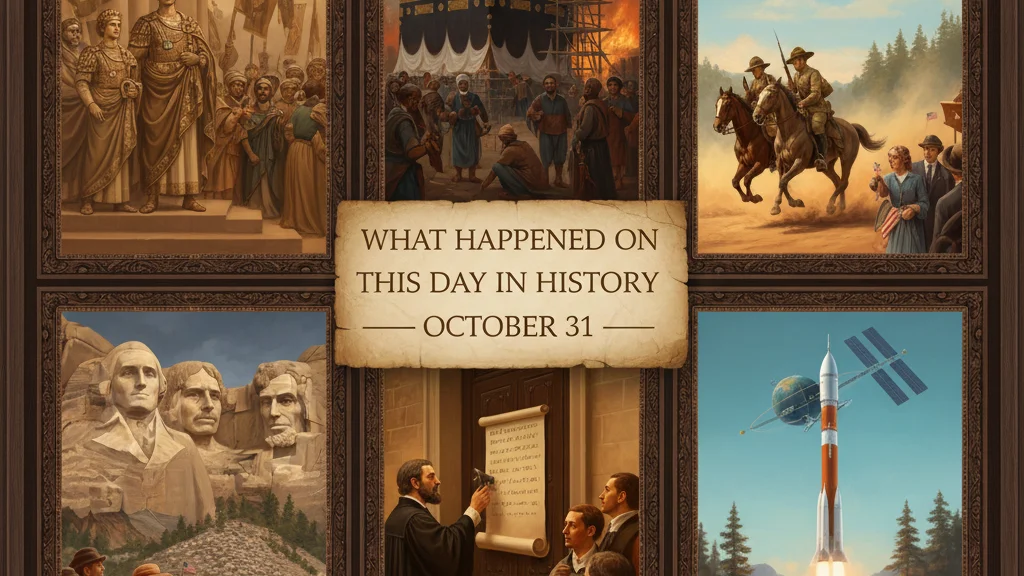
Spanning eras of empire, reform, and innovation, What happened on this day in history October 31 reflects how power, faith, and creativity have continually redefined the human story.
From the twilight of ancient rule and the spark of the Reformation to the rise of modern industry and exploration, the date weaves together the enduring rhythm of change and discovery in world history.
Quick sections
Earlier history
Imperial transitions and medieval politics stand out: Romulus Augustulus’ proclamation, dynastic coups, and siege incidents illustrate how imperial legitimacy and religious authority shaped early institutional patterns.
Exploration & foundations
Infrastructure and founding moments recur: Lincoln Highway dedication, Mount Rushmore’s completion, and state admissions like Nevada reflect transportation, nation-building and civic projects.
Wars & politics
From the Battle of Beersheba to Mussolini’s rise, the date links decisive military actions and political turnovers that reshaped national borders and governance systems.
Arts & culture
Orson Welles’s dramatic broadcast legacy and Martha Graham’s ballet premieres sit alongside painters and composers born or celebrated on this date, showing the date’s cultural breadth.
Science, technology & media
Advances from early photography of Earth to the Soyuz/ISS milestones and the origins of modern broadcasting and computing are threaded through the day’s events.
Disasters & human rights
Transport crashes, bombings and mass casualties—Monmouth, airline disasters, explosions and communal violence—underscore persistent vulnerabilities that drive later reforms in safety and accountability.
Read Also: What Happened On This Day In History October 30: Important Facts
Major Events on October 31
475 — Romulus Augustulus proclaimed Western Roman Emperor
The elevation of Romulus Augustulus as a youthful ruler in the crumbling West marks a dramatic late chapter in Rome’s long imperial story. His name is often used to mark the symbolic end of the Western Empire, as central authority fragmented and barbarian federates asserted local control. The episode captures the political fragility of late-antique institutions.
Although Romulus’s reign was brief and largely ceremonial, the event highlights how imperial legitimacy persisted as a legitimizing fiction even as real power shifted to military strongmen and regional rulers. Historians see the moment as emblematic of imperial transformation rather than a single decisive collapse.
683 — Siege of Mecca: the Kaaba burns during conflict
During the Second Fitna — a violent civil war between the Umayyad caliphate and supporters of Abdullah ibn al-Zubayr — the Kaaba caught fire and was severely damaged during the siege of Mecca in 683. The event shocked the early Islamic world, as Umayyad catapults struck the sacred site, causing immense destruction and outrage.
The shrine’s burning had deep ceremonial and political consequences, symbolizing how Muslim divisions had reached even Islam’s holiest ground. Afterward, Ibn al-Zubayr rebuilt the Kaaba with modifications, while later Umayyad rulers restored it again, leaving the episode as a lasting reminder of how power struggles could engulf faith itself.
802 — Empress Irene deposed and exiled to Lesbos; Nikephoros installed
The removal and banishment of Empress Irene marked a dramatic palace coup in Constantinople, ending a controversial regency and placing Nikephoros—previously finance chief—on the Byzantine throne. The episode reflected elite factionalism, tensions over imperial legitimacy and the limits of female rule in the period.
Irene’s deposition changed court politics and succession questions, with echoes in later debates over dynastic authority and the role of powerful ministers. Her exile to Lesbos signalled both humiliation and the volatility of imperial favour in Byzantium’s complex polity.
932 — Caliph al-Muqtadir killed; al-Qahir chosen as successor
Violent palace conflict culminated in the death of the Abbasid caliph al-Muqtadir and the elevation of his brother al-Qahir, a moment that exposed the Abbasid caliphate’s internal military and factional pressures. Assassinations and rapid successions had become part of the court’s pattern, weakening the caliph’s authority.
The episode accelerated decentralizing tendencies and increased the political leverage of military commanders and provincial governors, contributing to the caliphate’s long-term fragmentation and the rise of regional dynasties across the Islamic world.
1517 — Martin Luther posts his 95 Theses in Wittenberg
Luther’s posting (or wider circulation) of his theses challenged clerical practices and ignited debates over indulgences, authority and reform—sparking the Protestant Reformation. The theses spread rapidly in print, catalysing theological disputation that reconfigured European Christendom.
The event’s importance lies less in a single act than in the social, technological and intellectual conditions—print culture, university networks and political receptivity—that amplified reformist charges into broad confessional realignment across the continent.
1587 — Leiden University Library opens to readers
Following the university’s founding in 1575, the opening of its library provided a durable institutional resource for scholarship in the Dutch Republic. Libraries like Leiden’s were central to early modern intellectual life, supporting law, theology, natural philosophy and the humanities as the Republic became a hub of printing and scholarly exchange.
The library’s collections and patronage fostered the Republic’s scientific and cultural achievements, and it remained an important site for international students and researchers throughout the early modern period.
1632 — Johannes Vermeer baptized (early life of a master)
The baptism of the painter Johannes Vermeer marks an early life milestone for an artist whose later small-scale, light-soaked domestic interiors would become iconic in the history of European painting. Vermeer’s oeuvre—though limited in number—has been celebrated for its technique, quiet composition and luminous surfaces.
His later reputation grew markedly in the 19th and 20th centuries; the baptismal record anchors the life of a figure whose posthumous fame now ranks him among the Dutch Golden Age’s most revered masters.
1822 — Agustín de Iturbide attempts to dissolve Mexico’s Congress
Emperor Agustín de Iturbide’s move to dissolve the new imperial legislature reflected the fraught politics of post-independence Mexico, where monarchic pretensions and regional rivalries clashed with republican aspirations. The attempt to centralize authority provoked resistance that ultimately undermined Iturbide’s brief imperial experiment.
This crisis is part of the broader pattern of early nineteenth-century Latin America, where nascent states navigated the balance between centralized rule and local political mobilization in the wake of decolonization.
1837 — Monmouth steamboat disaster kills ~300 Muscogee on the Trail of Tears
A catastrophic boiler explosion and sinking during the forced removal of Native Americans compounded the human toll of the Trail of Tears; the Monmouth disaster added to the mortality and suffering of removal policies. The incident is a stark instance of transportation hazards layered atop state-coerced displacement.
Such tragedies highlight the intersections of frontier infrastructure, coerced migration and wartime or forced-relocation logistics that intensified vulnerability among displaced indigenous communities.
1863 — British begin Invasion of the Waikato (New Zealand Wars)
General Duncan Cameron’s campaign reopened large-scale hostilities in the New Zealand Wars as British imperial and settler forces advanced into Waikato territories. The invasion aimed to suppress Māori resistance and to secure land for settler encroachment, marking a decisive phase in colonial conquest.
The campaign produced enduring land dispossession, political marginalization and social disruption for Māori communities, with long-term legal and cultural repercussions that remain contested in New Zealand’s historical memory.
1864 — Nevada admitted as the 36th U.S. state
Nevada’s rapid admission—formalized during the Civil War era—reflected political, mineral and strategic interests in joining the Union. The decision accelerated statehood processes for western territories tied to resource booms and wartime political calculus.
Nevada’s entry into the Union also shaped later patterns of western settlement, mineral exploitation and federal-territorial governance as the United States consolidated continental authority.
1895 — Charleston, Missouri earthquake, Midwest’s strongest since 1812
A powerful temblor near Charleston struck a region less accustomed to frequent earthquakes, causing structural damage and fatalities. The event underscored the presence of seismic risk even within central North America and influenced later geological studies that sought to understand intraplate earthquakes.
Local damage and societal response contributed to awareness of engineering and planning needs in regions outside well-known seismic belts.
1903 — Purdue Wreck kills 17, including 14 Purdue football players
A fatal train collision in Indianapolis decimated a college team and shocked American collegiate athletics, forcing questions about team travel safety and railroad regulation. The disaster had immediate human costs and longer-term effects on sports logistics and event planning for university athletics.
Commemorations and institutional reforms followed; the wreck remains a somber episode in the history of American sports travel and public safety.
1913 — Lincoln Highway dedicated, first coast-to-coast U.S. auto route
The Lincoln Highway’s dedication symbolized the new age of automobile travel and sought to link Atlantic and Pacific through road-building and civic boosterism. The route encouraged tourism, commerce and automotive culture while pressuring state and local governments to improve road infrastructure.
The highway’s promotion catalysed early twentieth-century debates about federal roles in infrastructure, paving, and the modernization of American mobility.
1917 — Battle of Beersheba: last great cavalry charge
Allied mounted troops undertook a dramatic charge at Beersheba that captured key wells and positions, a tactical event that combined traditional cavalry shock with modern firepower logistics. The action is often portrayed as one of the last successful large-scale cavalry operations in the age of mechanized warfare.
The victory aided British advances in Palestine and reshaped operational possibilities on the southern Levantine front, demonstrating adaptive use of mounted forces amid modern war conditions.
1918 — Aster Revolution ends Austro-Hungarian compromise; Hungary gains sovereignty
The revolutionary wave and political reconfiguration in Hungary dissolved the Habsburg-era state union, signaling the end of imperial structures in Central Europe. The Aster Revolution contributed to Austro-Hungary’s disintegration and the emergence of successor nation-states after World War I.
The political rupture complicated postwar negotiations over borders and minority rights, leaving legacies that shaped interwar Central Europe.
1922 — Benito Mussolini becomes Prime Minister of Italy
Mussolini’s ascent initiated a fascist regime that would consolidate power through paramilitary force, political suppression and ideological transformation of the Italian state. His appointment signalled a broader European trend of populist-authoritarian movements exploiting postwar instability.
Fascism’s consolidation reshaped Italian institutions and foreign policy, with consequences that reverberated through the interwar period and World War II.
1938 — NYSE unveils 15-point program to restore investor confidence
In response to the Depression’s legacy and market volatility, the Exchange proposed reforms to improve transparency and protect the investing public. The program was part of broader regulatory and institutional efforts—alongside New Deal legislation—to stabilize financial markets and rebuild trust after 1929’s collapse.
Measures like these influenced subsequent securities regulation and public expectations about market oversight.
1940 — Battle of Britain ends; Nazi Germany abandons Operation Sea Lion
British air-defence successes and RAF resilience forced Hitler to postpone and then abandon plans for an amphibious invasion of Britain, shifting the strategic course of the early war. The campaign underscored air power’s centrality in modern defense and bolstered British morale and international support.
The outcome preserved a British base for future Allied operations and shaped wartime propaganda narratives about national resistance.
1941 — Mount Rushmore completed after 14 years of work
The sculpted presidential faces completed in the Black Hills symbolized a monumental national project blending art, tourism and American civic identity. While celebrated as an engineering and artistic achievement, the monument also sits amid contested histories of indigenous land dispossession and cultural claims.
Mount Rushmore’s completion capped a long period of New Deal-era and private patronage involvement in large-scale public art and landscape modification.
1941 — USS Reuben James torpedoed; over 100 U.S. sailors killed
The destroyer’s sinking by a German U-boat near Iceland was the first U.S. naval loss to enemy action in WWII, highlighting the Atlantic’s escalating ferocity prior to full American entry into the war. The event intensified public debate over neutrality and naval protection for convoys.
Allied anti-submarine efforts and convoy systems adapted in response, and American public sentiment moved toward greater support for material and naval aid to Britain.
1943 — First successful radar-guided interception by a U.S. Corsair
A Navy/Marine Corsair achieving a radar-guided interception represented a technical and tactical advance in naval aviation, integrating airborne radar with fighter control to locate and engage targets in limited visibility. The innovation contributed to evolving night-fighting and all-weather intercept capabilities.
Such developments improved fleet protection and showed rapid wartime innovation in avionics, sensors and tactics across the Pacific theatre.
1956 — UK and France begin bombing Egypt in Suez Crisis operations
The Anglo-French intervention sought to force a resolution to the Suez Canal seizure, reflecting Cold War geopolitics, decolonization tensions and the limits of old imperial power. The military campaign provoked international condemnation and showcased the diplomatic constraints that constrained unilateral interventions.
The crisis accelerated shifts in global influence—particularly U.S. and Soviet diplomatic pressure—and highlighted the rising assertiveness of post-colonial states in international affairs.
1961 — Stalin’s body removed from Lenin’s Mausoleum as part of de-Stalinization
The reburial of Joseph Stalin’s embalmed remains signalled official repudiation of cult-of-personality excesses in the Khrushchev era and a symbolic trim of Soviet memory. The act formed part of broader political and ideological recalibration after the 20th Party Congress.
Removing Stalin’s physical presence from the mausoleum both redefined public ritual and served as a visible marker of policy shifts within the Soviet Union.
1963 — Indiana State Fairgrounds Coliseum gas explosion kills 81, injures hundreds
A sudden blast during a public event caused mass casualties and exposed hazards of concealed gas accumulations within large venues. The tragedy prompted safety reviews, engineering inspections and legal scrutiny over venue maintenance and emergency response planning.
Public memorials and policy changes followed, and the event remains a somber reminder of the systemic risks at crowded public gatherings.
1968 — U.S. bombing of North Vietnam ordered halted by President Johnson
President Johnson’s decision to end bombing represented a political recalibration in the Vietnam conflict and reflected growing domestic and international pressure to de-escalate. Policy shifts around aerial campaign tactics influenced later peace negotiations and the evolving U.S. strategy in Southeast Asia.
The cessation marked a moment in the long, contested debate over military means, public opinion and the limits of coercive diplomacy in protracted wars.
1973 — Mountjoy Prison helicopter escape (IRA) dramatizes political unrest in Ireland
The dramatic helicopter-assisted breakout of imprisoned Provisional IRA members captured global attention and revealed vulnerabilities in prison security while energizing militant narratives of resistance. The escape deepened partisan tensions and complicated legal and law-enforcement responses to paramilitary activity.
The episode became emblematic of the period’s high-stakes confrontation between state institutions and extralegal republican groups in Northern Ireland and the Republic.
1979 — Western Airlines Flight 2605 crashes on landing in Mexico City — 73 dead
A fatal landing accident at a major international airport underscored the persistent safety challenges of commercial aviation, from air-traffic control and runway conditions to cockpit decision-making under stress. Investigations sought technical causes and procedural reforms to prevent similar tragedies.
Such disasters cumulatively contributed to evolving global safety standards, crew training, and airport infrastructure upgrades.
1984 — Indian Prime Minister Indira Gandhi assassinated; widespread anti-Sikh riots follow
The killing of Indira Gandhi by her Sikh bodyguards triggered large-scale communal violence across India, with thousands of deaths and deep political consequences. The assassination and the subsequent pogroms revealed fault lines in Indian politics, accountability challenges, and long-standing grievances within plural societies.
The episode altered electoral politics, legal responses to minority protection, and India’s domestic security posture for years to come.
1999 — Yachtsman Jesse Martin completes solo, non-stop circumnavigation, returns to Melbourne
Martin’s round-the-world solo, nonstop voyage—completed at age 18—demonstrated the endurance, seamanship and technological support that characterize modern solo sailing feats. His voyage joined a lineage of maritime adventurers who pushed small-boat capabilities and inspired interest in solo ocean racing.
The achievement received wide public attention and highlighted the globalized culture of extreme individual endurance challenges at the century’s end.
2000 — Soyuz TM-31 launches, first resident crew to the International Space Station
The launch inaugurated the ISS’s continuous human presence, beginning a new chapter in international cooperation in low-Earth orbit. Continuous crewing enabled long-term scientific research, station maintenance and an unprecedented cooperative habitat for astronauts from multiple nations.
The ISS program reshaped human spaceflight priorities and provided a platform for multinational scientific collaboration and technology demonstration.
2011 — World population reaches seven billion (UN Day of Seven Billion)
The UN-marked milestone drew attention to demographic trends, resource demands, urbanization and development challenges across the global South and North. The symbolic milestone focused policy discussions on food security, health care, urban planning and environmental sustainability for the coming decades.
Population debates prompted renewed policy attention to family planning, education and poverty reduction as elements of sustainable development strategies.
2014 — VSS Enterprise test flight breakup; fatal crash in Mojave Desert
The catastrophic in-flight breakup of Virgin Galactic’s experimental spaceplane highlighted the risks inherent in commercial suborbital flight testing and prompted regulatory, engineering and operational reviews across the nascent private spaceflight sector. The accident forced industry reflection on design margins, test protocols and crew safety.
Safety culture and certification debates intensified as commercial human spaceflight matured, with implications for future commercial space tourism ventures.
2015 — Metrojet Flight 9268 bombed over Sinai; 224 killed
The downing of a passenger jet over Sinai with large loss of life raised urgent questions about aviation security, overflight routing, and militant threats to civil aviation. The tragedy prompted international investigative cooperation and renewed emphasis on cargo screening, airport security and intelligence sharing.
The incident became a grim reminder of how geopolitical violence can reach civilian transport systems and affect global aviation policies.
2017 — Lower Manhattan truck attack kills eight
A vehicle-ramming and stabbing attack in New York’s Chelsea district underscored the continuing risk of low-technology mass-casualty tactics in urban public spaces. The incident prompted discussion of street-level security, counterterrorism measures and the limits of architectural and policing responses to public-venue threats.
City resilience planning and rapid emergency interventions were highlighted as essential components of urban public safety strategies.
2020 — Berlin Brandenburg Airport opens after nearly 10 years of delay
The long-delayed airport opening capped a controversial, over-budget infrastructure project with lessons about large-scale construction, procurement oversight and governance of major civic investments. The facility’s arrival reshaped regional air transport capacity while feeding debates on project management and transparency.
The airport’s opening was a high-profile case study in public infrastructure governance and the political consequences of protracted delivery timelines.
2023 — Israel–Hamas war and regional fallout continue to dominate headlines on Oct 31
Ongoing conflict dynamics around Gaza, regional strikes and humanitarian consequences formed the central international story, with cross-border incidents and diplomatic responses shaping global news agendas. The intense fighting generated urgent humanitarian concerns, refugee flows, and calls for ceasefire and protection of civilians.
The conflict’s trajectories triggered broad international diplomatic engagement, humanitarian relief appeals, and sustained media attention to civilian suffering and wartime law questions.
Notable births — October 31
Michael Landon — American actor, director & producer — Born Oct 31, 1936.
Karl Weierstrass — German mathematician — Born Oct 31, 1815.
Ethel Waters — American singer & actress — Born Oct 31, 1896/1900.
Alexander Alekhine — World chess champion — Born Oct 31, 1892.
Joseph Swan — English physicist & inventor — Born Oct 31, 1828.
Herman Van Rompuy — Belgian politician, EU statesman — Born Oct 31, 1947.
Tom Paxton — American folk singer — Born Oct 31, 1937.
Dick Francis — Jockey & novelist — Born Oct 31, 1920.
Sir Basil Liddell Hart — Military historian/strategist — Born Oct 31, 1895.
John Evelyn — English diarist — Born Oct 31, 1620.
Juliette Gordon Low — Founder, Girl Scouts (USA) — Born Oct 31, 1860.
Joan Robinson — Economist — Born Oct 31, 1903.
Richard Morris Hunt — Architect — Born Oct 31, 1827.
Władysław III Warneńczyk — King of Poland & Hungary — Born Oct 31, 1424.
Clement XIV — Pope — Born Oct 31, 1705.
Ferdinand I — King of Portugal — Born Oct 31, 1345.
Marie Laurencin — Painter & printmaker — Born Oct 31, 1883.
Carlos Drummond de Andrade — Brazilian poet — Born Oct 31, 1902.
Galileo Ferraris — Physicist — Born Oct 31, 1847.
William H. McNeill — Historian — Born Oct 31, 1917.
Notable deaths — October 31 (compact list)
George Halas — Football pioneer & Chicago Bears founder — Died Oct 31, 1983.
Charles Taze Russell — Religious leader (Jehovah’s Witness precursor) — Died Oct 31, 1916.
John Houseman — Actor & producer — Died Oct 31, 1988.
P. W. Botha — South African leader — Died Oct 31, 2006.
Qian Xuesen — Chinese aerospace scientist — Died Oct 31, 2009.
Studs Terkel — Author & oral historian — Died Oct 31, 2008.
Joseph Hooker — Union general — Died Oct 31, 1879.
Thomas Cochrane, 10th Earl of Dundonald — Admiral & politician — Died Oct 31, 1860.
Dan Leno — Music-hall entertainer — Died Oct 31, 1904.
Jacques-Pierre Brissot — Revolutionary leader (Girondin) — Died Oct 31, 1793.
Marcel Carné — Film director — Died Oct 31, 1996.
Victor Amadeus II — First king of Sardinia-Piedmont — Died Oct 31, 1732.
Joseph Papp — Theatrical producer — Died Oct 31, 1991.
Max Reinhardt — Theatrical director — Died Oct 31, 1943.
John VIII Palaeologus — Byzantine emperor — Died Oct 31, 1448.
Willie McCovey — Baseball great — Died Oct 31, 2018.
Gaetana Aulenti — Architect — Died Oct 31, 2012.
Observances & institutional dates — October 31
- Día de la Canción Criolla (Peru)
- Halloween / Allantide / Hop-tu-Naa / Samhain (various countries & traditions)
- Earliest day for All Saints Day (Finland, Sweden)
- First day of Day of the Dead observance period (Mexico; until Nov 2)
- Girl Scouts Founders Day (United States)
- National Unity Day (India)
- Reformation Day (some Lutheran/Reformed communities)
Frequently asked questions
Why is October 31 associated with Martin Luther and the Reformation?
Martin Luther’s 95 Theses were published or publicly circulated on October 31, 1517, launching theological debate and reform movements that developed into the Protestant Reformation—transforming church structures, liturgy and European politics.
What was the importance of the Battle of Beersheba on this date in 1917?
Beersheba’s capture opened the southern Palestine front to Allied advances, combined mounted tactics with modern logistics, and helped undermine Ottoman defensive lines—contributing to wider campaign successes in the region.
How did the 1961 removal of Stalin’s body change Soviet public memory?
Removing Stalin’s body from Lenin’s Mausoleum symbolized a political rejection of the cult of personality and signalled Khrushchev-era efforts to reform Stalin-era excesses, thereby altering official ritual and historical narratives.