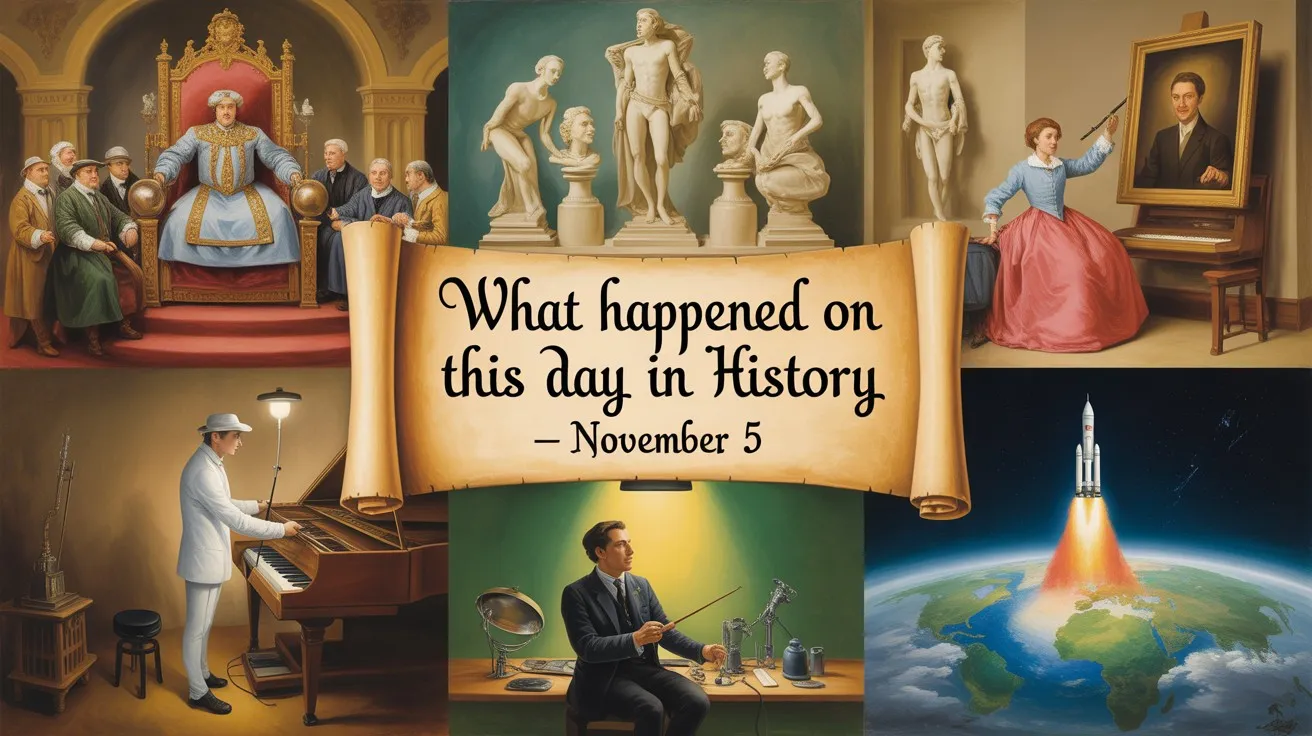
From palace assassinations and naval losses to revolutionary calls and modern tragedies, What happened on this day in history November 5, gathers episodes where politics, belief, and technology collided—moments that reshaped administrations, stirred mass movements and left lasting institutional legacies.
Important Events That Happened on November 5 in History
1009 — Battle of Qantish: Berber victory in Córdoba
Berber forces led by Sulayman ibn al-Hakam routed the Umayyad caliph Muhammad II at Qantish, marking a decisive moment in the Iberian caliphate’s internal struggles. The defeat weakened centralized Umayyad control in al-Andalus, intensified regional factionalism and accelerated the political fracturing that would shape Iberian Muslim polities in the following decades.
1138 — Child emperor in Thanh: Lý Anh Tông enthroned
At age two Lý Anh Tông was enthroned as emperor of Đại Việt (Vietnam), beginning a reign that would last thirty-seven years under regents and court factions. His accession illustrates medieval succession practices in Southeast Asia, where court politics and regency often determined real authority behind a youthful sovereign.
1499 — The Catholicon published: Breton and French lexicography
Jehan Lagadeuc’s Catholicon—written in 1464 and published in 1499—appeared as an early dictionary for Breton and the first printed dictionary of French. Its release marks a milestone in vernacular scholarship and lexical standardization, offering evidence of late-medieval linguistic self-awareness and the growing administrative need for reference works.
1556 — Mughal restoration after Panipat
Following the turbulent aftermath of the second Battle of Panipat, Bayram Khān’s victory restored Mughal authority in northern India. The outcome reinforced imperial structures that allowed the Mughal state to reassert control over fractious nobles and reestablish the court’s capacity to project military and fiscal power across the subcontinent.
1605 — Gunpowder Plot foiled: Guy Fawkes arrested
Guy Fawkes was seized in the cellars beneath the Houses of Parliament after a plan to detonate gunpowder intended to kill King James I and many members of the English political elite was discovered. The plot’s failure reverberated through English politics and confessional tensions—hardening surveillance, accelerating anti-Catholic legislation and entering popular memory through ritualised remembrance.
1688 — William of Orange lands at Brixham
Prince William III’s landing with a Dutch fleet at Brixham set the military and political stage for the Glorious Revolution. His arrival precipitated the flight of James II, the transfer of sovereignty, and constitutional shifts that would limit monarchical prerogative and deepen parliamentary supremacy in the British Isles.
1757 — Battle of Rossbach: Frederick secures a decisive win
Frederick the Great’s victory over French and Imperial forces at Rossbach was a striking demonstration of Prussian maneuver and discipline in the Seven Years’ War. The triumph enhanced Prussian military reputation, undermined the coalition arrayed against it and influenced eighteenth-century balance-of-power calculations in central Europe.
1768 — Treaty of Fort Stanwix adjusts frontier lines
The Treaty of Fort Stanwix adjusted territorial boundaries between Native American lands and colonial settlers, reaffirming a line drawn after the Royal Proclamation of 1763. The settlement attempted to regularize competing claims but also contributed to continued friction as settler expansion and indigenous dispossession persisted.
1780 — LaBalme defeated by Miami leader Little Turtle
Colonel Augustin LaBalme’s expedition—composed of French-American volunteers aiming to stir anti-British sentiment in the Ohio country—was routed by Native forces under the Miami war leader Little Turtle.
The defeat halted LaBalme’s advance and reinforced indigenous resistance on the trans-Appalachian frontier, underscoring how local militias and Native military skill shaped control of the western borderlands.
1811 — Salvadoran bell rings a call to insurrection
José Matías Delgado’s ringing of the bells at La Merced in San Salvador signalled the start of local insurrection and the 1811 independence movement. The gesture became a symbolic opening of organized anti-colonial agitation in Central America and a precursor to later independence campaigns across Spanish America.
1828 — French expedition ends Ottoman rule in the Morea
French forces completed the Morea expedition, overseeing the withdrawal of Ottoman troops from the Peloponnese and consolidating Greek liberation efforts. The operation illustrated European intervention’s decisive role in shaping the outcomes of nineteenth-century nationalist struggles in the Balkans.
1834 — Free University of Brussels founded
Pierre-Théodore Verhaegen founded the Free University of Brussels, establishing an institution intended to promote secular, liberal education. The foundation reflects nineteenth-century currents linking higher education, civic renewal and emergent national cultural institutions in Europe.
1838 — Honduras declared its absolute independence
On November 5, 1838, Honduras declared its absolute independence from the Federal Republic of Central America, becoming a fully sovereign nation. This followed its initial independence from Spain on September 15, 1821, and membership in the Mexican Empire and Central American Federation. The day marks a key milestone in Honduras’ journey to complete nationhood.
1862 — Lincoln removes McClellan as Union commander
President Abraham Lincoln relieved George B. McClellan of command of the Army of the Potomac, a consequential personnel change in the American Civil War. The dismissal reflected frustrations over perceived timidity, the conduct of campaigns in the east, and the broader interplay between civilian political leadership and military strategy in wartime governance.
1862 — Dakota trials and mass sentences in Minnesota
Following the US-Dakota War, 303 Dakota warriors were convicted of rape and murder in military trials; thirty-eight were ultimately hanged while others were reprieved. The episode stands as one of the largest mass death sentences in American history and illustrates the fraught, often summary nature of frontier justice and settler-indigenous violence.
1872 — Susan B. Anthony votes in defiance of law
Suffragist Susan B. Anthony deliberately cast a ballot in defiance of statutes barring women from voting; her subsequent arrest and fine became a galvanising act for the U.S. women’s suffrage movement. The incident focused public attention on legal exclusion and helped sustain organized campaigns for enfranchisement into the twentieth century.
1895 — Selden patent and the motor age
George B. Selden received a pioneering U.S. patent for an automobile design; while contested in later litigation, the patent signposted emerging legal-technical frameworks for motor vehicles and commercial innovation that would accelerate automobile industrialization.
1898 — Republic of Negros proclaimed after anti-Spanish revolt
Negrese nationalists rose against Spanish colonial authorities on Negros Island and briefly established the Republic of Negros, an assertion of local autonomy amid the wider upheavals of the Spanish–American War era.
Although short-lived and soon incorporated into American colonial arrangements, the revolt reflected Filipino island-level nationalism and the collapse of Spanish rule in the archipelago.
1911 — Italy annexes Tripoli and Cyrenaica
Italian forces completed annexation of Tripoli and Cyrenaica during the Italo-Turkish War, formalizing colonial control over Ottoman provinces in North Africa. The acquisition demonstrated early twentieth-century imperial competition and altered the political map of the Mediterranean and Maghreb.
1912 — Woodrow Wilson elected 28th President of the United States
Democrat Woodrow Wilson defeated incumbent William Howard Taft to win the U.S. presidency, taking office on a platform of progressive reform and “New Freedom” policies.
Wilson’s victory signalled a partisan and policy shift that would influence domestic regulation, tariff policy and later wartime leadership during the First World War.
1913 — King Otto of Bavaria deposed; Ludwig III assumes the crown
King Otto, long incapacitated by illness, was formally deposed in favour of his cousin, Prince Regent Ludwig, who then assumed the title Ludwig III.
The change concluded a prolonged regency period and adjusted Bavarian constitutional arrangements on the eve of wider political ruptures in Europe.
1914 — France and Britain declare war on the Ottoman Empire
As the First World War expanded to new fronts, France and the British Empire declared hostilities against the Ottoman Empire—shutting the Dardanelles and opening military operations in the eastern Mediterranean. This step transformed the Ottoman front into a major theatre of the global conflict.
1916 — Kingdom of Poland proclaimed
By the Act of 5th November the Central Powers proclaimed a Kingdom of Poland—an instrument of wartime statecraft intended to reorganize occupied territories. The declaration reflected wartime diplomatic maneuvering and foreshadowed the complex national reconfigurations that followed in 1918–20.
1916 — Everett massacre: labor confrontation escalates to bloodshed
A confrontation between Industrial Workers of the World organizers and local police in Everett, Washington, erupted into a deadly shoot-out known as the Everett massacre.
The violence exposed deep tensions in early-twentieth-century labor struggles, union organizing, and municipal responses to radical labor activism in the Pacific Northwest.
1917 — Lenin’s call for revolution
Vladimir Lenin publicly urged an immediate insurrection, crystallizing Bolshevik strategy in the months that led to the October (November) Revolution. The call shaped revolutionary timing, party discipline and the seizure of state power that remade Russia and much of Eurasian politics.
1920 — KDKA airs the first commercial radio broadcast
KDKA in Pittsburgh transmitted what is widely recognized as the first commercial radio broadcast—anchored to the 1920 U.S. presidential election returns—ushering in a new era of mass electronic communication and transforming how publics received political and cultural information.
1930 — Sinclair Lewis wins the Nobel Prize in Literature
American novelist Sinclair Lewis became the first U.S. writer to win the Nobel Prize in Literature, recognized for his satirical examination of American culture and institutions.
1940 — HMS Jervis Bay sunk defending convoy
The armed merchant cruiser HMS Jervis Bay engaged the German pocket battleship Admiral Scheer while covering a convoy and was sunk in action. The ship’s captain’s sacrificial defence allowed many convoy vessels to escape and became a storied example of convoy-duty courage during the Battle of the Atlantic.
1940 — Franklin D. Roosevelt re-elected for a third term
FDR won an unprecedented third presidential term, breaking the two-term precedent and reflecting public continuity demands during wartime uncertainty; the result later prompted constitutional reform limiting presidents to two terms.
1943 — Bombing of the Vatican during World War II
Bomb damage struck Vatican property in an episode that heightened concerns about neutrality, civilian protection and the vulnerability of even sacred spaces during total war. The incident provoked diplomatic sensitivity and intensified scrutiny of aerial operations near Rome.
1956 — Suez Crisis: British and French paratroopers land in Egypt
Following an intense bombing campaign, British and French forces executed airborne landings in Egypt as part of the Suez intervention, an operation that exposed post-imperial military limits and accelerated political realignments with the United States and the Soviet Union in the Middle East.
1950 — Battle of Pakchon: Commonwealth troops hold the line
British and Australian units of the 27th British Commonwealth Brigade halted a major Chinese advance at Pakchon in Korea, demonstrating infantry tenacity and coalition coordination during critical phases of the Korean War’s 1950–51 campaigns.
1955 — Vienna State Opera reopens after wartime destruction
The rebuilt Vienna State Opera reopened with Beethoven’s Fidelio, symbolizing cultural reconstruction and the resumption of civic artistic life in a city still recovering from wartime destruction and occupation.
1968 — Richard Nixon elected U.S. president
Richard Nixon’s election signalled a conservative shift in U.S. politics amid the social turmoil of the 1960s, reshaping domestic policy debates and foreign-policy strategies that would mark the Nixon era.
1983 — Byford Dolphin diving bell accident
An accident on the Byford Dolphin platform claimed five lives and left one survivor critically injured; the tragedy exposed the hazards of deep-water diving operations and spurred reviews of offshore safety practices in the North Sea industry.
1986 — U.S. naval visit to Qingdao: a first since 1949
The destroyers USS Rentz, USS Reeves and USS Oldendorf made a port visit to Qingdao—reported as the first U.S. naval visit to the People’s Republic of China since 1949—marking a modest thaw in naval-to-naval contacts.
The call reflected gradual diplomatic openings and the complicated choreography of military-to-military engagement amid larger Sino-American normalization efforts.
1990 — Meir Kahane assassinated after speech in New York
Rabbi Meir Kahane, founder of the far-right Kach movement, was shot dead after delivering a speech at a Manhattan hotel.
His killing aggravated bitter political divides around extremism, Jewish politics and security debates in both the United States and Israel.
1991 — Tropical Storm Thelma causes catastrophic Ormoc floods
Thelma’s torrential rains produced flash floods around Ormoc in the Philippines, killing thousands and revealing vulnerabilities in urban planning and disaster preparedness in rapidly growing coastal cities.
1995 — Assassination attempt on Canada’s prime minister foiled at Blair House
André Dallaire attempted to assassinate Canadian Prime Minister Jean Chrétien at Blair House; the attempt was thwarted when Chrétien’s wife locked the door, preventing the assailant from reaching the prime minister.
The incident prompted reviews of official residence security and raised concerns about lone-actor threats to public officials in Canada.
1996 — Farooq Leghari dismisses Benazir Bhutto’s government
President Farooq Leghari dismissed Prime Minister Benazir Bhutto and dissolved the National Assembly, invoking powers that precipitated a political crisis and reshaped Pakistan’s unstable civilian rule.
The removal highlighted persistent tensions between Pakistan’s civilian executives and powerful security and judicial actors during the 1990s.
1996 — Bill Clinton re-elected President of the United States
Incumbent Bill Clinton won a second term as U.S. president, securing continued Democratic control of the executive branch and consolidating policy agendas begun in his first term.
Clinton’s reelection influenced domestic economic and social policy directions in the late 1990s and impacted the U.S. role in emerging post–Cold War international affairs.
2006 — Saddam Hussein sentenced to death in the Dujail trial
Former Iraqi president Saddam Hussein and co-defendants were sentenced to death for their roles in the 1982 massacre in Dujail, a verdict reflecting the transitional Iraqi judiciary’s efforts to prosecute former-regime crimes.
The sentence intensified domestic and international debate over accountability, legality and reconciliation in post-Saddam Iraq.
2007 — Chang’e-1 enters lunar orbit
China’s Chang’e-1 lunar orbiter reached orbit around the Moon, inaugurating the country’s national lunar exploration programme and signalling China’s growing ambitions in robotic planetary science and space technology.
2007 — Google unveils the Android operating system
Google publicly introduced the Android mobile operating system, a software platform that would come to underpin a broad ecosystem of smartphones and applications.
Android’s launch accelerated smartphone competition, lowered barriers to entry for handset makers and reshaped mobile computing and app markets globally.
2009 — Fort Hood mass shooting
A gunman at Fort Hood, Texas killed thirteen people and wounded dozens more in the deadliest attack on a U.S. military installation, provoking national debate about insider threats, workplace violence and the security of military sites.
2010 — JS Air Flight 201 crashes after takeoff from Karachi
JS Air Flight 201 crashed shortly after departure from Jinnah International Airport in Karachi, killing all 21 people aboard and prompting investigations into aircraft operation and safety oversight.
The accident underscored ongoing aviation safety challenges in the region and triggered regulatory and procedural scrutiny.
2013 — India launches the Mars Orbiter Mission
India placed its Mars Orbiter Mission into space on this date, a landmark achievement for the Indian Space Research Organisation and for cost-effective robotic planetary exploration—boosting the country’s scientific standing and demonstrating new entry points to interplanetary missions.
2015 — Bento Rodrigues dam collapse: environmental and human catastrophe
A tailings dam rupture in Minas Gerais, Brazil released toxic mudflows that devasted Bento Rodrigues and surrounding villages, causing fatalities, displacements and long-term ecological damage. The disaster sparked litigation and intensified scrutiny of mining regulation and corporate responsibility.
2015 — Rona Ambrose becomes interim leader of Canada’s Conservative Party
Following Stephen Harper’s departure as party leader, Rona Ambrose was chosen to lead the Conservative Party on an interim basis, steering the party through a period of transition after electoral defeat.
Her leadership signalled an organizational pause for the Conservatives as they prepared for a formal leadership contest and strategic recalibration.
2017 — Sutherland Springs church mass shooting
A gunman killed twenty-six people at a church in Sutherland Springs, Texas, one of the deadliest mass shootings in recent U.S. history. The attack renewed debates over gun access, mental-health screening and institutional emergency preparedness.
2019 — Riyadh power-sharing deal eases fighting around Aden, Yemen
Yemen’s internationally recognised government and the Southern Transitional Council signed a Riyadh agreement intended to share power and reduce open conflict around Aden, aiming to stabilise a fractious theatre in the civil war.
The deal represented an externally mediated attempt at local accommodation, though implementation and its effects on broader hostilities remained contested.
2021 — Astroworld crowd crush
A crowd surge at the Astroworld Festival in Houston resulted in multiple deaths and scores of injuries, prompting investigations into event planning, crowd control, venue safety standards and legal accountability for large public spectacles.
2024 — U.S. presidential milestone: first non-consecutive second term since 1892
The 2024 election returned a president to a non-consecutive second term—an outcome not seen in 132 years—raising immediate questions about political polarization, constitutional norms and the practical implications for governance and judicial appointments.
Check Also: What Happened On This Day In History November 4: Surprising Facts
Famous People Born On November 5
Hans Sachs — German meistersinger and poet. (Nov 5, 1494 – Jan 19, 1576)
Giovanni Battista Belzoni — Explorer/archaeologist in Egypt. (Nov 5, 1778 – Dec 3, 1823)
Washington Allston — American Romantic painter and poet. (Nov 5, 1779 – Jul 9, 1843)
Ruy Barbosa — Brazilian jurist, statesman, and orator. (Nov 5, 1849 – Mar 1, 1923)
Paul Sabatier — French chemist, Nobel laureate (1912). (Nov 5, 1854 – Aug 14, 1941)
Komura Jutarō — Japanese diplomat of the Meiji era. (Nov 5, 1855 – Nov 26, 1911)
Léon Teisserenc de Bort — French meteorologist who helped identify the stratosphere. (Nov 5, 1855 – Jan 2, 1913)
Ida Tarbell — American investigative journalist, muckraker. (Nov 5, 1857 – Jan 6, 1944)
Will H. Hays — American politician, head of the MPPDA (Hays Code). (Nov 5, 1879 – Mar 7, 1954)
Raymond Duchamp-Villon — French sculptor associated with Cubism. (Nov 5, 1876 – Oct 7, 1918)
Raymond Loewy — French-born American industrial designer. (Nov 5, 1893 – Jul 14, 1986)
Charles MacArthur — American playwright and screenwriter. (Nov 5, 1895 – Apr 21, 1956)
Douglass C. North — American economist, Nobel laureate (1993). (Nov 5, 1920 – Nov 23, 2015)
Jaime Roldós Aguilera — President of Ecuador. (Nov 5, 1940 – May 24, 1981)
William D. Phillips — American physicist, Nobel laureate (1997). (Nov 5, 1948 – )
Jeffrey D. Sachs — American economist and policy adviser. (Nov 5, 1954 – )
Lester Piggott — Champion British jockey. (Nov 5, 1935 – May 29, 2022)
Abedi Ayew “Abedi Pelé” — Ghanaian footballer and three-time African Player of the Year. (Nov 5, 1964 – )
Joel McCrea — American film actor. (Nov 5, 1905 – Oct 20, 1990)
Famous People Died On November 5
- Casimir III (“the Great”) — King of Poland. (Apr 30, 1310 – Nov 5, 1370)
- Angelica Kauffmann — Swiss Neoclassical painter. (Oct 30, 1741 – Nov 5, 1807)
- August Weismann — German biologist and foundational evolutionary theorist. (Jan 17, 1834 – Nov 5, 1914)
- Christiaan Eijkman — Dutch physician, Nobel laureate (1929). (Aug 11, 1858 – Nov 5, 1930)
- Alexis Carrel — French surgeon and Nobel laureate (1912). (Jun 28, 1873 – Nov 5, 1944)
- Maurice Utrillo — French painter noted for Montmartre scenes. (Dec 26, 1883 – Nov 5, 1955)
- Art Tatum — American jazz piano virtuoso. (Oct 13, 1909 – Nov 5, 1956)
- Edward L. Tatum — American geneticist and Nobel laureate (1958). (Dec 14, 1909 – Nov 5, 1975)
- Lionel Trilling — American literary critic. (Jul 4, 1905 – Nov 5, 1975)
- Guy Lombardo — Canadian-American bandleader and New Year’s Eve tradition. (Jun 19, 1902 – Nov 5, 1977)
- René Goscinny — French comic-strip writer (Asterix). (Aug 4, 1926 – Nov 5, 1977)
- Al Capp — American cartoonist, creator of Li’l Abner. (Sep 28, 1909 – Nov 5, 1979)
- Jacques Tati — French filmmaker and comic actor. (Oct 9, 1908 – Nov 5, 1982)
- Jan Oort — Dutch astronomer, major figure in galactic astronomy. (Apr 28, 1900 – Nov 5, 1992)
- Sir Isaiah Berlin — British philosopher and historian of ideas. (Jun 6, 1909 – Nov 5, 1997)
- Bülent Ecevit — Prime Minister of Turkey. (May 28, 1925 – Nov 5, 2006)
- Elliott Carter — American avant-garde composer. (Dec 11, 1908 – Nov 5, 2012)
- Nancy Friday — American author on women’s sexuality. (Aug 27, 1933 – Nov 5, 2017)
- Ernest J. Gaines — American novelist (A Lesson Before Dying). (Jan 15, 1933 – Nov 5, 2019)
- Meir Kahane — American-born Israeli political extremist and rabbi. (Aug 1, 1932 – Nov 5, 1990)
Observances & institutional dates — November 5
Guy Fawkes Night / Bonfire Night (United Kingdom and related observances).
Bank Transfer Day (United States).
Colón Day (Panama).
Cinco de noviembre (Negros, Philippines).
Kanakadasa Jayanthi (Karnataka, India).
All Souls’ Day (observed by many Christian denominations, date varies by tradition).
Frequently asked questions
Why is Guy Fawkes still remembered on November 5?
Guy Fawkes’s arrest and the foiling of the Gunpowder Plot became a ritualised national memory in Britain: public commemorations, bonfires and political symbolism have kept November 5 prominent as a mark of thwarted insurrection and the era’s confessional conflict.
How did the 1956 Suez landings affect colonial influence?
The Anglo-French landings failed to secure lasting advantage: international pressure—especially from the United States and the Soviet Union—forced a withdrawal, accelerating the decline of European colonial power projection in the Middle East and strengthening nationalist claims.
What made India’s Mars Orbiter Mission notable?
India’s mission combined low cost, rapid development and scientific ambition; its success showcased effective engineering, strengthened national prestige, and demonstrated that smaller space agencies could mount deep-space missions with high impact.
How do modern mass-casualty events change policy?
Large tragedies—whether industrial, environmental or criminal—often produce new safety regulations, legal inquiries and political scrutiny. Responses vary, but recurring outcomes include tighter oversight, litigation and public debate over prevention and accountability.