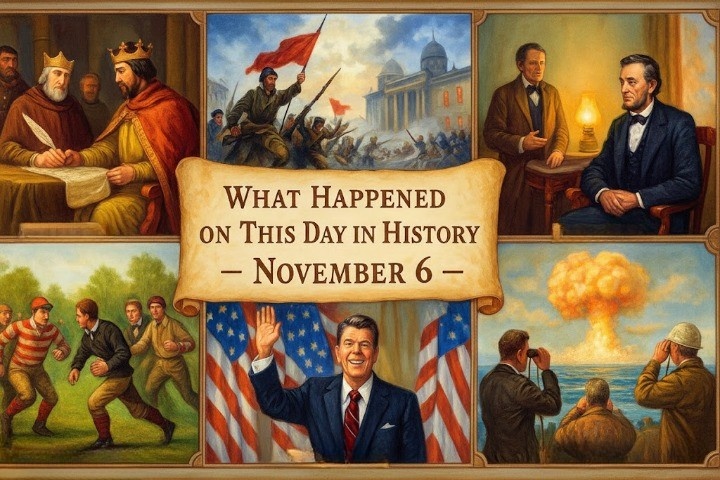
November 6 brings together turning points of power, discovery, and renewal. What happened on this day in history November 6— reveals how humanity has constantly reshaped its destiny, from medieval charters restoring lost rights to revolutions redefining nations.
Important Events That Happened on November 6 in History
447 — Earthquake in Constantinople
A devastating earthquake strikes Constantinople, toppling 57 towers and large stretches of the city’s defensive walls. The disaster prompts urgent repairs ordered by Emperor Theodosius II, underscoring both the city’s vulnerability and the Byzantine Empire’s determination to preserve its capital.
963 — Synod of Rome Deposes Pope John XII
Emperor Otto I convenes a council at St. Peter’s Basilica in Rome that deposes Pope John XII on charges of rebellion. The move reflects the emperor’s growing authority over the papacy and signals a major shift in the balance between church and imperial power.
1217 — Charter of the Forest Sealed
King Henry III of England, under the regency of William Marshal, issues the Charter of the Forest at St. Paul’s Cathedral. It restores the rights of free men to use royal forests for grazing and resources—reversing centuries of encroachment since William the Conqueror.
1577 — The Great Comet Observed
Aztec astronomers in Mexico make the earliest recorded sighting of the Great Comet of 1577. Observations soon spread worldwide, inspiring European astronomers like Tycho Brahe to study its path and challenge traditional ideas about celestial motion.
1792 — Battle of Jemappes
During the French Revolutionary Wars, French forces under General Charles Dumouriez defeat the Austrians near Jemappes, in present-day Belgium. The victory helps secure Belgium for revolutionary France and bolsters republican morale at home.
1860 — Abraham Lincoln Elected President
Abraham Lincoln wins the U.S. presidency with just 40 percent of the popular vote in a four-way race. His election deepens sectional divides over slavery, setting in motion the chain of events that would lead to the American Civil War.
1869 — First Intercollegiate Football Game
Rutgers College defeats Princeton University 6–4 in New Brunswick, New Jersey. The game becomes recognized as the first official intercollegiate American football match, marking the birth of a national sporting tradition.
1888 — Benjamin Harrison Wins Presidency
Republican Benjamin Harrison wins the U.S. presidency despite losing the popular vote to Grover Cleveland by more than 90,000 ballots. The result sparks renewed debate about the role and fairness of the Electoral College.
1900 — McKinley Re-elected
President William McKinley secures a second term alongside running mate Theodore Roosevelt. Their victory affirms public support for economic growth and American expansionism at the dawn of the 20th century.
1917 — Bolshevik Revolution Begins
On November 6 (October 25, Old Style), the Bolsheviks launch their uprising in Petrograd, seizing key government sites. The event marks the beginning of the second phase of the Russian Revolution and the rise of Soviet power.
1936 — Spanish Civil War: Madrid Defense Council Formed
As the republican government flees Madrid for Valencia, a defense council is created to coordinate resistance against the advancing Nationalists. The move underscores the growing desperation of the republic during the brutal civil war.
1943 — Liberation of Kyiv
Soviet forces of the 1st Ukrainian Front liberate Kyiv from German occupation after fierce urban fighting. The victory marks a turning point in the Eastern Front and restores one of the USSR’s most important cities.
1947 — ‘Meet the Press’ Debuts
NBC airs the first episode of Meet the Press, which would become the longest-running television program in history. Its enduring focus on politics and public affairs reshaped broadcast journalism.
1971 — Cannikin Nuclear Test
The United States conducted its largest underground hydrogen bomb test, codenamed Cannikin, on Amchitka Island in Alaska. The massive explosion raises global environmental concerns and fuels the anti-nuclear movement.
1976 — Forced Sterilizations in India
During India’s Emergency, nearly 800 men in Uttawar village are subjected to forced sterilizations under government population-control policies. The incident remains one of the darkest episodes in modern Indian political history.
1977 — Kelly Barnes Dam Disaster
The Kelly Barnes Dam near Toccoa Falls, Georgia, collapses suddenly, sending a deadly flood through a nearby college campus. Thirty-nine people are killed, and the tragedy prompts new scrutiny of small dam safety across the U.S.
1984 — Reagan Re-elected
President Ronald Reagan wins a landslide re-election over Walter Mondale, carrying 49 of 50 states. His victory solidifies the conservative movement’s dominance in U.S. politics through the 1980s.
1985 — Colombian Palace of Justice Siege
Leftist guerrillas of the 19th of April Movement seize Colombia’s Palace of Justice in Bogotá. The ensuing two-day battle with government forces leaves more than 100 people dead, including 11 Supreme Court justices.
1988 — Lancang–Gengma Earthquakes
Twin earthquakes strike Yunnan Province along the China–Myanmar border, killing over 730 people. The disaster devastates local communities and highlights regional seismic risks.
1995 — Cleveland Browns Relocation Announced
Owner Art Modell shocks fans by announcing plans to move the Cleveland Browns to Baltimore. The controversy leads to legal battles and eventually the creation of the Baltimore Ravens franchise.
2002 — Luxembourg Plane Crash
A Fokker 50 commuter plane crashes near Luxembourg Airport, killing 20 people. The tragedy becomes one of the country’s deadliest aviation disasters.
2004 — Ufton Nervet Rail Crash
An express train collides with a car at a level crossing in Berkshire, England, killing seven people and injuring over 120. The event prompts calls for stronger railway safety measures.
2012 — Tammy Baldwin Elected
Tammy Baldwin of Wisconsin becomes the first openly gay politician elected to the U.S. Senate. Her victory marks a major milestone for LGBTQ+ political representation in America.
2016 — Offensive to Capture Raqqa
The Syrian Democratic Forces begin their offensive to retake Raqqa, the de facto capital of ISIS. The operation signals the beginning of the end for the group’s control in Syria.
Check This Also: What Happened On This Day In History November 5
Famous People Born On November 6
Glenn Frey — American musician, founding member of the Eagles. (Nov 6, 1948 – Jan 18, 2016)
John Philip Sousa — American bandmaster and composer of military marches. (Nov 6, 1854 – Mar 6, 1932)
Adolphe Sax — Belgian instrument maker; inventor of the saxophone. (Nov 6, 1814 – Feb 7, 1894)
Walter Johnson — American baseball pitcher, one of the game’s all-time greats. (Nov 6, 1887 – Dec 10, 1946)
Charles Garnier — French Beaux-Arts architect, designer of the Paris Opera. (Nov 6, 1825 – Aug 3, 1898)
Vuk Stefanović Karadžić — Serbian language reformer and folklorist. (Nov 6, 1787 – Feb 6, 1864)
François Englert — Belgian theoretical physicist, Nobel laureate (2013). (Nov 6, 1932 – )
Laurent Lafforgue — French mathematician, Fields Medalist (2002). (Nov 6, 1966 – )
Nelson W. Aldrich — U.S. senator and finance leader. (Nov 6, 1841 – Apr 16, 1915)
Alois Senefelder — German inventor of lithography. (Nov 6, 1771 – Feb 26, 1834)
Joseph Smith III — Religious leader of the Reorganized Latter Day Saints. (Nov 6, 1832 – Dec 10, 1914)
Tony Canzoneri — American boxer; multi-division world champion. (Nov 6, 1908 – Dec 9, 1959)
Seymour Lipton — American abstract sculptor known for metal works. (Nov 6, 1903 – Dec 5, 1986)
Richard Jefferies — English nature writer and novelist. (Nov 6, 1848 – Aug 14, 1887)
Ernest von Koerber — Austrian statesman and prime minister. (Nov 6, 1850 – Mar 5, 1919)
Colley Cibber — English actor, playwright and Poet Laureate. (Nov 6, 1671 – Dec 11, 1757)
Knut Johannesen — Norwegian Olympic speed skater. (Nov 6, 1933 – )
Bowen Yang — Chinese-American comedian and actor (SNL). (Nov 6, 1990 – )
Cesare Lombroso — Italian criminologist. (Nov 6, 1835 – Oct 19, 1909)
Robert Musil — Austrian novelist, author of The Man Without Qualities. (Nov 6, 1880 – Apr 15, 1942)
Famous People Died On November 6
- Arnold Rothstein — American gambler and crime figure of the 1920s. (1882/1883 – Nov 6, 1928)
- Charles X — King of France (restoration Bourbon monarch). (Oct 9, 1757 – Nov 6, 1836)
- José P. Laurel — President of the Philippines (Japanese occupation era). (Mar 9, 1891 – Nov 6, 1959)
- Edgard Varèse — French-born American composer. (Dec 22, 1883 – Nov 6, 1965)
- George G. Meade — Union general who won Gettysburg. (Dec 31, 1815 – Nov 6, 1872)
- Erich Raeder — German naval commander, Großadmiral in WWII. (Apr 24, 1876 – Nov 6, 1960)
- Heinrich Schütz — Leading German composer before Bach. (Oct 8, 1585 – Nov 6, 1672)
- Ishida Mitsunari — Japanese samurai and commander at Sekigahara. (1563 – Nov 6, 1600)
- William II, Prince of Orange — Dutch leader. (May 27, 1626 – Nov 6, 1650)
- Maximilian, Prince of Baden — German chancellor at end of WWI. (Jul 10, 1867 – Nov 6, 1929)
- Kate Greenaway — English illustrator and designer. (Mar 17, 1846 – Nov 6, 1901)
- Maurice Leblanc — French author, creator of Arsène Lupin. (Dec 11, 1864 – Nov 6, 1941)
- Charles Munch — French conductor. (Sep 26, 1891 – Nov 6, 1968)
- Adolf Wölfli — Swiss outsider artist and writer. (Feb 29, 1864 – Nov 6, 1930)
- William J. Hardee — Confederate general and drill-book author. (Oct 12, 1815 – Nov 6, 1873)
- Adolphe Max — Mayor of Brussels. (Dec 30, 1869 – Nov 6, 1939)
- Bernard de Jussieu — French botanist. (Aug 17, 1699 – Nov 6, 1777)
- William Hone — English satirist and defender of press freedom. (Jun 3, 1780 – Nov 6, 1842)
- Mario Savio — U.S. free-speech activist. (Dec 8, 1942 – Nov 6, 1996)
- Richard F. Gordon Jr. — American astronaut. (Oct 5, 1929 – Nov 6, 2017)
Holidays and Observances
- Gustavus Adolphus Day (Sweden, Finland, Estonia)
- Finnish Swedish Heritage Day (Finland)
- International Day for Preventing the Exploitation of the Environment in War and Armed Conflict
- Obama Day (Kenya)
Frequently asked questions
What happened on November 6 in history?
November 6 marks a series of pivotal world events—from medieval charters like the 1217 Charter of the Forest restoring rights to citizens, to revolutions, elections, and scientific breakthroughs that reshaped nations and societies across centuries.
How did the Charter of the Forest (1217) affect ordinary people?
The Charter restored traditional rights such as grazing and gathering wood in royal forests, reversing long-standing restrictions. It eased economic hardship for commoners and became an early symbol of environmental and legal fairness.
What exactly occurred on November 6, 1917, during the Bolshevik uprising?
On that day (October 25 Old Style), Bolshevik revolutionaries captured government buildings and communication centers in Petrograd. Their swift success toppled the Provisional Government and led directly to the establishment of Soviet power.
Why was the Cannikin nuclear test (1971) so controversial?
The Cannikin test on Amchitka Island was the largest underground U.S. nuclear detonation. It triggered earthquakes, raised ecological fears, and sparked global protests—becoming a catalyst for the modern environmental and anti-nuclear movements.
What holidays and observances fall on November 6?
November 6 includes national and cultural commemorations such as Gustavus Adolphus Day in Sweden and Finland, Finnish Swedish Heritage Day, and Obama Day in Kenya, among others marking leadership, heritage, and civic pride.