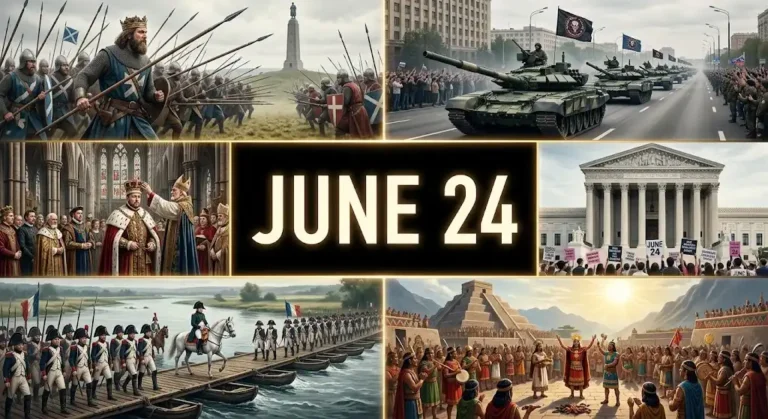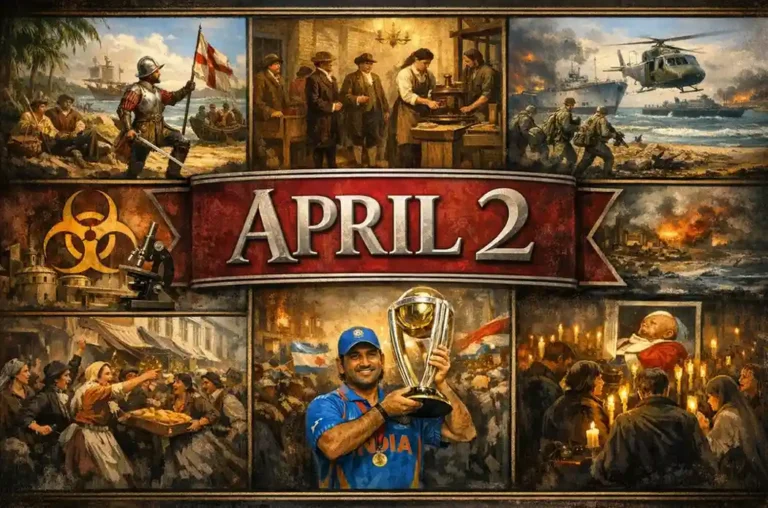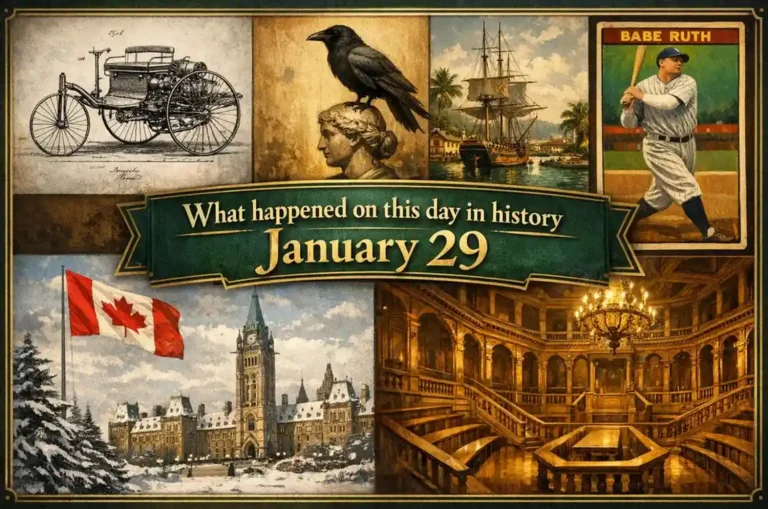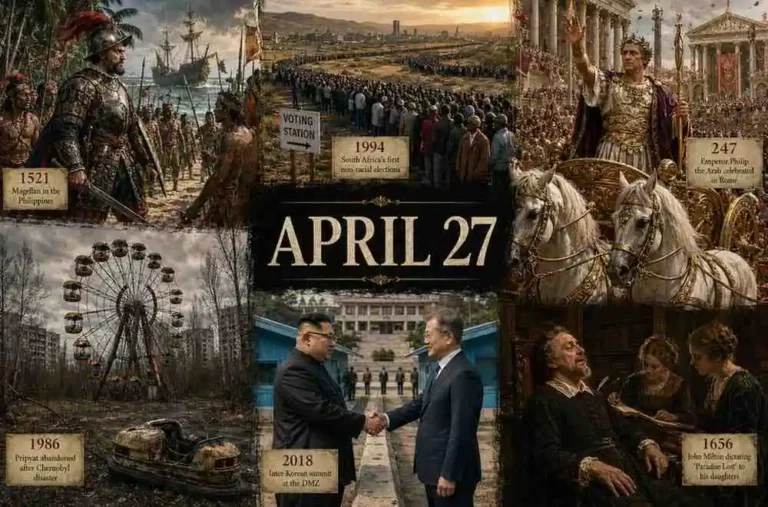
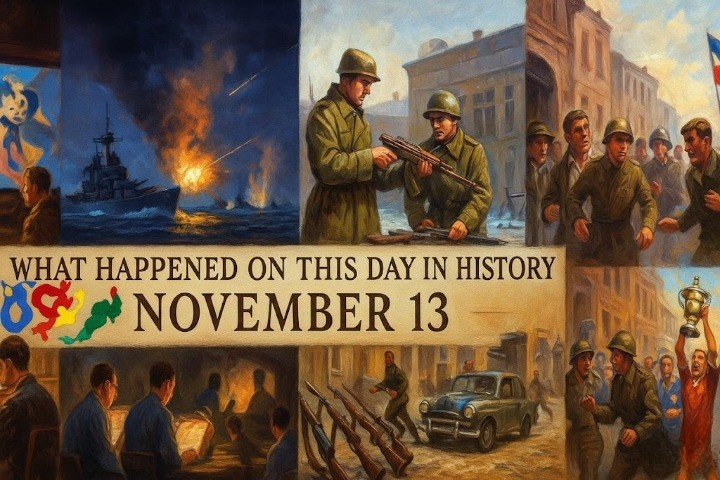
History often puts sudden violence, civic change and scientific firsts on the same calendar date — What happened on this day in history November 13 gathers medieval massacres and coronations, tragic disasters, pioneering discoveries and modern political turns into a compact guide.
Important Events That Happened On November 13 In History
1002 — St. Brice’s Day Massacre Ordered By Æthelred II
King Æthelred II’s decree to kill Danes living in England—remembered as the St. Brice’s Day massacre—triggered violent purges and deepened mistrust between Anglo-Saxons and Scandinavian settlers. The episode intensified cross-channel reprisals and helped set the stage for renewed Viking incursions and later political instability in early medieval England.
1093 — Battle of Alnwick: Malcolm III and son killed
At Alnwick, an English force surprised and routed a Scottish army; King Malcolm III of Scotland and his son Edward were killed. The defeat removed leading Scottish commanders, affected Scottish succession politics and temporarily shifted the border balance, underscoring the period’s brutal, often-personal dynastic warfare.
1160 — Louis VII marries Adela of Champagne
King Louis VII’s marriage to Adela of Champagne reinforced Capetian dynastic ties and produced heirs that mattered for French succession. Royal marriages like this combined political alliance, inheritance strategy and courtly ritual, helping consolidate centralized monarchy during the high medieval period.
1642 — Battle of Turnham Green; Royalists withdraw from London
Parliamentarian forces blocked the Royalist advance at Turnham Green and forced King Charles I’s army to withdraw, sparing London from occupation. The setback checked Royalist momentum early in the First English Civil War, bolstered Parliament’s strategic position and helped shape the next phase of the conflict.
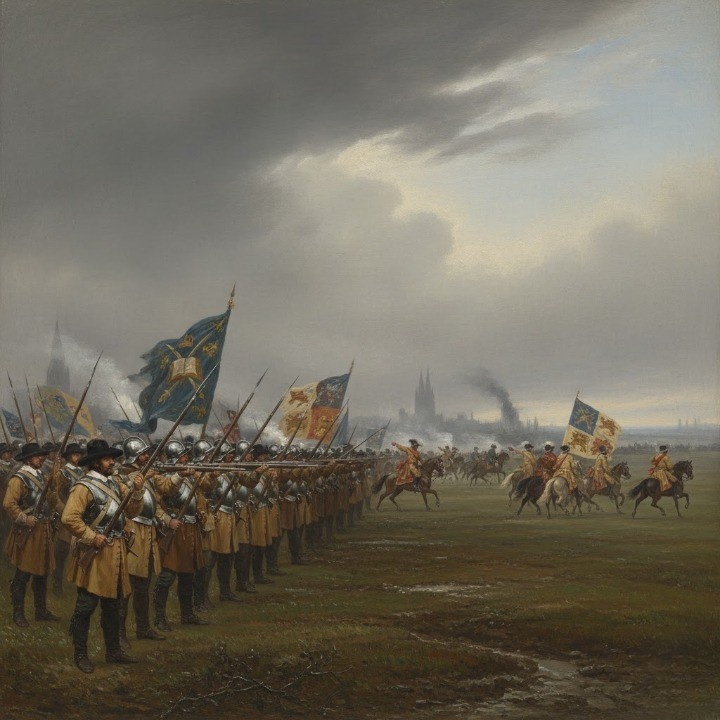
1715 — Battle of Sheriffmuir halts Jacobite advance
The inconclusive Battle of Sheriffmuir stopped the Jacobite momentum in Scotland, producing no decisive victor but stalling efforts to restore the Stuart line. The clash illustrated how local loyalties and terrain could blunt restoration attempts, leaving the 1715 rising politically stalemated.
1775 — Montgomery’s forces occupy Montreal (American Revolutionary War)
Patriot troops under General Richard Montgomery took Montreal as part of the invasion of Canada, briefly extending rebel operations beyond the Thirteen Colonies. The occupation showed early revolutionary ambition but ultimately failed to secure Canada as a rebel ally, altering the northern dimension of the war.
1841 — James Braid witnesses animal magnetism; later studies hypnotism
After seeing Charles Lafontaine demonstrate “animal magnetism,” surgeon James Braid began investigating suggestibility and focused attention, eventually developing what he termed “hypnotism.” Braid’s experimental approach moved the phenomena toward clinical and scientific inquiry, influencing later psychology and therapeutic practice.
1851 — Denny Party lands at Alki Point (Seattle origins)
The Denny Party’s landing at Alki Point represents an early colonial foothold that would later shift to the site of present-day Seattle. Their settlement activity, surveying and urban decisions set the groundwork for Pacific Northwest urbanization and maritime commerce.
1864 — Battle of Bull’s Gap ends in Union rout
The three-day action at Bull’s Gap ended with a Confederate pursuit that routed Union forces, illustrating the localized but intense cavalry and infantry campaigning in the Civil War’s western theatre. Such engagements affected supply lines and regional control in Tennessee and the Appalachians.
1887 — Bloody Sunday clashes in central London
Mass demonstrations and violent clashes occurred as workers and activists protested social and political grievances; the day signalled rising popular mobilisation in late-Victorian Britain and contributed to later reform agendas and labour organisation.
1893 — 13 November stabbing by Léon Léauthier (Era of atentats)
Léauthier’s assassination attempt in Paris was one of the high-profile violent acts in the Era des attentats (1892–1894), drawing attention to political anarchism and the birth of modern political terrorism as an urban security challenge.
1901 — Caister lifeboat disaster
A lifeboat tragedy at Caister-on-Sea cost lives of rescuers and passengers alike, prompting local mourning and later scrutiny of sea-rescue practices; such disasters contributed to improving lifeboat design and coastal safety provisioning.
1914 — Battle of El Herri: Berber forces defeat French column (Zaian War)
In Morocco, Berber tribesmen inflicted a heavy defeat on French colonial troops at El Herri, highlighting the durability of local resistance and complicating France’s efforts to pacify and administer the interior during early twentieth-century imperial expansion.
1916 — Australian PM Billy Hughes expelled from Labor Party over conscription
Billy Hughes’s departure from the Labor Party after backing conscription revealed deep wartime political schisms and realigned Australian politics, contributing to new party formations and the fracturing of wartime coalitions.
1917 — First Battle of Monte Grappa begins (Italian Front, WWI)
The Austro-Hungarian offensive that began at Monte Grappa met stout Italian defense—despite enemy material and elite units—helping stabilize Italy’s line after costly attritional fighting and shaping mountain warfare’s grim, strategic calculus on the Piave front.
1918 — Allied troops occupy Constantinople after World War I
Allied occupation of Constantinople marked imperial collapse and the enforcement of armistice terms, accelerating the Ottoman world’s political disintegration and opening the path to nationalist politics that would reconfigure Anatolia and the Near East.
1918 — Saad Zaghloul forms the Wafd Party (Egyptian nationalist politics)
Saad Zaghloul’s creation of Al-Wafd catalyzed organized Egyptian nationalism that would press for independence from Britain. Wafd’s mass politics and diplomatic campaigns became central to Egypt’s interwar constitutional and anti-colonial struggles.
1922 — Zucht v. King: U.S. Supreme Court upholds mandatory vaccinations for schoolchildren
The Court’s decision affirmed state authority to require vaccinations as a condition of school attendance, a key precedent balancing public-health regulation and individual liberties and cited in later public-health jurisprudence.
1927 — Holland Tunnel opens linking New Jersey and New York City
The opening of the Holland Tunnel created the first vehicular Hudson River crossing of its kind, facilitating automobile traffic and metropolitan integration while showcasing engineering solutions to underwater tunnelling and ventilation problems.
1940 — Fantasia’s first public screening (Disney)
Fantasia debuted as an ambitious fusion of classical music and animated imagery; its artistic boldness divided critics while expanding animation’s expressive possibilities and cultural reach beyond standard feature storytelling.
1941 — HMS Ark Royal torpedoed by U-81
The carrier Ark Royal was torpedoed in the Mediterranean and sank the next day, a significant Royal Navy loss that impacted escort and convoy operations and highlighted the submarine threat to capital ships in World War II’s naval war.
1942 — Naval Battle of Guadalcanal begins (three-day surface actions)
Close-quarters night fighting around Guadalcanal produced decisive tactical outcomes, with U.S. surface forces blunting Japanese attempts to reinforce and resupply, marking a turning point that consolidated Allied initiative in the Solomons.
1947 — Soviet Union completes development of the AK-47
The adoption and development of the AK-47 represented a defining moment in small-arms design—reliable, mass-producible and widely exported—shaping post-war warfare and insurgency armaments worldwide.
1950 — President of Venezuela Carlos Delgado Chalbaud assassinated
Delgado Chalbaud’s assassination in Caracas was a dramatic political rupture reflecting Cold War–era instability and factional violence in Latin American politics, with significant implications for Venezuelan governance.
1954 — Great Britain wins inaugural Rugby League World Cup in Paris
The first Rugby League World Cup final victory for Great Britain consolidated the sport’s international competition framework and promoted rugby league’s global profile in the mid-twentieth century.
1956 — U.S. Supreme Court ruling effectively ends Montgomery bus segregation (Boycott legal aftermath)
A federal ruling affirmed lower-court judgments invalidating segregation statutes on public transit, cementing legal victories that followed the Montgomery bus boycott and advancing civil-rights litigation strategy.
1965 — SS Yarmouth Castle fire and sinking, 87 dead
The Yarmouth Castle disaster raised urgent questions about passenger-ship safety, fire precautions and maritime regulation, catalysing reforms in vessel construction, fire suppression systems and emergency procedures.
1966 — Israel’s attack on As-Samu in response to Fatah raids
Israel’s cross-border raid into the West Bank village of As-Samu represented a period of heightened cross-border violence and reprisals, shaping Jordanian-Israeli tensions and local security dynamics in a volatile era.
1966 — All Nippon Airways Flight 533 crashes near Matsuyama, Japan
The fatal crash of Flight 533 underscored risks in civil aviation and prompted investigations into operational, mechanical and procedural causes, contributing to incremental safety improvements.
1969 — March Against Death: Washington, D.C. anti-war protest
Mass symbolic demonstrations against the Vietnam War—such as the March Against Death—expressed mounting public opposition, drew media attention and influenced political discourse on the war’s costs and legitimacy.
1970 — Bhola cyclone devastates East Pakistan (now Bangladesh)
The catastrophic storm killed hundreds of thousands and shattered infrastructure, triggering a humanitarian catastrophe that fed political grievances and was a factor in the region’s subsequent upheavals and the birth of Bangladesh.
1980s — Raging Bull premiere and cultural resonance (1980)
Martin Scorsese’s Raging Bull premiered and quickly secured a reputation as a modern masterpiece, anchored by Robert De Niro’s acclaimed performance. The film reshaped boxing cinema and filmic portrayals of violence, masculinity and art-house aesthetics. Its influence endures in both popular and scholarly film discourse.
1982 — Fatal bout: Ray Mancini vs. Duk Koo Kim (Las Vegas)
Boxer Ray Mancini defeated Duk Koo Kim in a match that ended tragically when Kim later died from his injuries; the incident prompted sweeping safety reforms in professional boxing, including shorter schedules and changes to medical protocols. The fight had a profound impact on sport governance and athlete care.
1982 — Vietnam Veterans Memorial dedicated (Washington, D.C.)
After a long campaign by veterans and activists, the Vietnam Veterans Memorial was dedicated, providing a stark, contemplative place of names to honor those who served and died. The memorial reshaped public commemoration and created a focal point for national reflection. Its minimalist design provoked debate but became a central site of mourning and reconciliation.
1985 — Nevado del Ruiz eruption and Armero lahar disaster
The volcanic eruption melted summit glaciers and sent a deadly lahar that buried the town of Armero, producing massive fatalities and exposing the dangers of inadequate hazard zoning and early-warning systems.
1985 — Xavier Suárez sworn in as Miami’s first Cuban-born mayor
Suárez’s election reflected Miami’s demographic and political transformation, illustrating how diasporic communities reshaped local leadership in U.S. cities.
1986 — Late, Late Breakfast Show accident leads to death and cancellation
A live-television stunt went tragically wrong, resulting in a performer’s death and the program’s cancellation—an event that prompted regulatory scrutiny and debate over TV spectacle and safety protocols.
1989 — Hans-Adam II begins reign as Prince of Liechtenstein
The accession of Hans-Adam II marked a dynastic transition and continuity in Liechtenstein’s constitutional monarchy, with implications for the principality’s governance and international identity.
1990 — Aramoana massacre shocks New Zealand
A mass shooting in the small town of Aramoana produced multiple deaths and prompted national reflection on gun violence, police response, and community trauma in New Zealand.
1991 — Republic of Karelia formed within Russian Federation
The reconstitution of Karelia as an autonomous republic reflected USSR dissolution’s territorial adjustments and the reorganization of federal and regional structures in post-Soviet Russia.
1992 — Dietrich v The Queen (High Court of Australia) clarifies legal aid and fair trial standards
The ruling shaped criminal procedure by addressing circumstances where an accused lacks representation, guiding judges on adjournments and fairness under resource constraints in serious trials.
1993 — China Northern Airlines Flight 6901 crash in Ürümqi, 12 dead
The crash on approach highlighted aviation safety issues in rapidly expanding Chinese civil aviation and led to investigations into operational and procedural improvements.
1994 — Sweden votes to join the European Union
A popular referendum approved EU membership, altering Sweden’s economic and political orientation and integrating the country more deeply into European institutions and policymaking.
1995 — Mozambique joins the Commonwealth as non-former-British member
Mozambique’s admission as the first state to join the Commonwealth without British colonial history broadened the organization’s post-colonial identity and demonstrated the group’s evolving diplomatic scope.
1995 — Nigeria Airways Flight 357 crash at Kaduna, casualties and injuries
The accident contributed to Nigeria’s aviation safety record concerns and prompted scrutiny of maintenance, operational standards and regulatory oversight.
1996 — GIMPS finds first Mersenne prime in project (Joel Armengaud)
The Great Internet Mersenne Prime Search’s discovery marked a milestone in distributed computing and collaborative mathematics, demonstrating the power of networked volunteer computation to address large numeric problems.
2000 — Philippine House Speaker Manny Villar files impeachment articles against President Estrada
The impeachment move intensified the Philippine political crisis and contributed to mass mobilization that culminated in President Estrada’s ouster and a turbulent transition in Filipino politics.
2001 — Bush signs an executive order authorizing military tribunals for some terrorism suspects
The order created a legal framework for military commissions to try certain foreign terrorism suspects, raising complex constitutional and human-rights debates about due process, national security, and jurisdiction.
2002 — Iraq agrees to the terms of UN Security Council Resolution 1441
The Iraqi agreement under UNSC Resolution 1441 set a new inspection regime for suspected weapons of mass destruction and became a focal diplomatic prelude to later enforcement actions and the 2003 Iraq War.
2002 — Prestige tanker damaged during storm (early incident in spill sequence)
Storm damage to the oil tanker Prestige led to its eventual sinking and one of Europe’s worst oil spills, highlighting vulnerabilities in maritime regulation, salvage policy and coastal environmental protection.
2012 — Total solar eclipse observed in parts of Australia and South Pacific
A widely observed solar eclipse produced scientific and public interest, offering opportunities for astronomy outreach and precise observations of solar coronal phenomena.
2013 — Hawaii legalizes same-sex marriage
Hawaii’s legalization represented another step in the U.S. states’ patchwork trajectory toward marriage equality, affecting families, legal rights and the national policy conversation.
2013 — 4 World Trade Center officially opens
The opening of 4 WTC in Lower Manhattan was part of the broader rebuilding of the World Trade Center site, symbolizing urban recovery, memorialization and the revival of commercial life after 9/11.
2015 — Coordinated ISIS attacks in Paris kill 130
A series of coordinated, large-scale terrorist attacks struck multiple Paris locations, producing massive casualties and global condemnation; the attacks had far-reaching impacts on European security policy and counter-terrorism measures.
2022 — Mass stabbing in Moscow, Idaho kills four University of Idaho students
A deadly stabbing at off-campus housing shocked the community, prompting law enforcement response, campus safety reviews and local mourning for the victims.
2024 — Israeli strikes across Gaza reported (Nov 13)
Reports of deadly strikes and deepening ground operations heightened humanitarian concern in Gaza, illustrating the enduring human cost of armed conflict and prompting urgent international diplomatic and aid responses.
Read Also: What Happened On This Day In History November 12
Famous People Born On November 13
George Shultz — American government official, economist, and business executive. (Nov 13, 1920 – )
Louis Brandeis — Associate Justice, U.S. Supreme Court. (Nov 13, 1856 – Oct 5, 1941)
John Montagu, 4th Earl of Sandwich — British statesman. (Nov 13, 1718 – Apr 30, 1792)
Joseph Hooker — United States general. (Nov 13, 1814 – Oct 31, 1879)
Lon Nol — President of Cambodia. (Nov 13, 1913 – Nov 17, 1985)
Peter Brabeck-Letmathe — Austrian business executive. (Nov 13, 1944 – )
George Carey — Archbishop of Canterbury. (Nov 13, 1935 – )
Sir John Moore — British lieutenant general. (Nov 13, 1761 – Jan 16, 1809)
Kishi Nobusuke — Prime Minister of Japan. (Nov 13, 1896 – Aug 7, 1987)
Mary Wigman — German dancer. (Nov 13, 1886 – Sep 18, 1973)
Albert, Prince of Monaco — Royal figure. (Nov 13, 1848 – Jun 26, 1922)
Peter II — Prince-bishop of Montenegro. (Nov 13, 1813 – Oct 31, 1851)
Joseph F. Smith — American religious leader (LDS). (Nov 13, 1838 – Nov 19, 1918)
Philip, Landgrave of Hesse — German noble. (Nov 13, 1504 – Mar 31, 1567)
Buck O’Neil — American baseball player and manager. (Nov 13, 1911 – Oct 6, 2006)
C. Vann Woodward — American historian and educator. (Nov 13, 1908 – Dec 17, 1999)
Abraham Flexner — American educator (Flexner Report). (Nov 13, 1866 – Sep 21, 1959)
Eva Zeisel — Hungarian-American designer and ceramicist. (Nov 13, 1906 – Dec 30, 2011)
Lene Hau — Danish scientist. (Nov 13, 1959 – )
Gunnar Björnstrand — Swedish actor. (Nov 13, 1909 – May 24, 1986)
Famous People Died On November 13
Camille Pissarro — French Impressionist painter. (Jul 10, 1830 – Nov 13, 1903)
Gioachino Rossini — Italian composer. (Feb 29, 1792 – Nov 13, 1868)
William Etty — English painter. (Mar 10, 1787 – Nov 13, 1849)
Vittorio De Sica — Italian film director. (Jul 7, 1901 – Nov 13, 1974)
Elsa Schiaparelli — Fashion designer. (Sep 10, 1890 – Nov 13, 1973)
Margaret Wise Brown — American children’s author. (May 23, 1910 – Nov 13, 1952)
Maurice Denis — French artist. (Nov 25, 1870 – Nov 13, 1943)
Saint Nicholas I — Pope. (d. c.800 – Nov 13, 867)
Lois Weber — Filmmaker and actress. (Jun 13, 1881 – Nov 13, 1939)
Bruno Maderna — Italian composer. (Apr 21, 1920 – Nov 13, 1973)
Antal Doráti — Conductor. (Apr 9, 1906 – Nov 13, 1988)
R. C. Sherriff — British playwright. (Jun 6, 1896 – Nov 13, 1975)
Gerhard Marcks — German sculptor and artist. (Feb 18, 1889 – Nov 13, 1981)
August Karl von Goeben — Prussian general. (Dec 10, 1816 – Nov 13, 1880)
Cornelius Warmerdam — American pole-vaulter. (Jun 22, 1915 – Nov 13, 2001)
Ed Bullins — American playwright. (Jul 2, 1935 – Nov 13, 2021)
Roark Bradford — American author. (Aug 21, 1896 – Nov 13, 1948)
Babette Deutsch — American poet, critic and novelist. (Sep 22, 1895 – Nov 13, 1982)
Gottfried Kinkel — German poet. (Aug 11, 1815 – Nov 13, 1882)
Arthur Giry — French historian. (Feb 28, 1848 – Nov 13, 1899)
Observances & institutional dates — November 13
Stanislaus Kostka (Feast Day)
A day in some Christian calendars commemorating Saint Stanislaus Kostka, often marked by devotional observances and parish remembrances in communities that venerate the saint.
The Hundred Thousand Martyrs of Tbilisi (Georgian Orthodox Church)
A commemorative observance in the Georgian Orthodox tradition remembering many victims; services and liturgical acts mark the solemn memory of historical martyrdom in the region.
Sadie Hawkins Day (United States)
A light-hearted mid-November cultural observance inspired by a comic-strip idea, often celebrated in school dances and social events where traditional dating roles are playfully reversed.
Charles Simeon (Church of England commemoration)
A church remembrance of evangelical cleric Charles Simeon, observed in Anglican calendars with readings and reflections on pastoral ministry and preaching.
World Kindness Day
An international day promoting kindness as a cultural value and encouraging small acts that build social cohesion; NGOs, schools and civic groups run campaigns and activities to highlight compassion and community service.
Frequently Asked Questions
What was the significance of the Bhola cyclone of 1970?
The Bhola cyclone’s enormous death toll and social disruption intensified humanitarian and political crises in East Pakistan, contributing to regional grievances that played into later movements for independence and statehood.
How did the Holland Tunnel change New York–New Jersey travel?
Opening in 1927, the Holland Tunnel provided the first direct automobile link under the Hudson River, facilitating commerce, commuting and regional integration while demonstrating novel engineering solutions to ventilation and tunnelling.
Why does the AK-47 matter historically?
The AK-47’s combination of reliability, simplicity and mass producibility made it a defining small arm of the postwar era, widely disseminated across state and non-state actors and profoundly shaping modern asymmetric warfare.