
November 16 gathers episodes of military turning points, scientific firsts, and civic foundations that shaped nations, knowledge, and society. What happened on this day in history November 16 links decisive battles, groundbreaking discoveries, and the lives of leaders, artists, and activists, showing how a single date can reveal the breadth of human achievement and change.
Important Events That Happened On November 16 In History
951 — Southern Tang absorbs the Chu kingdom
Emperor Li Jing sends a Southern Tang expeditionary force of 10,000 under Bian Hao to subdue the Chu kingdom. The mission succeeds: the ruling family of Chu is removed to Nanjing and control is folded into the Southern Tang administration. The absorption marks the end of an independent Chu polity and further consolidates Southern Tang power during the Ten Kingdoms era.
1272 — Prince Edward becomes King of England (while abroad)
While travelling on the Ninth Crusade, Prince Edward inherits the English crown on the death of Henry III, becoming King Edward I in name. He does not return immediately — political and military commitments delay his voyage home for nearly two years. The episode underlines medieval monarchs’ transnational duties and the slow transmission of succession news across Europe.
1491 — Auto-da-fé at Ávila concludes La Guardia case
A public auto-da-fé at Brasero de la Dehesa outside Ávila ends the long-running “Holy Child of La Guardia” case with executions of Jewish and converso suspects. The spectacle reflects the period’s combustible mix of superstition, judicial theatre and the Inquisition’s growing authority in late-15th-century Spain. Its aftermath contributed to heightened persecution of conversos and Jews.
1532 — Capture of Atahualpa at Cajamarca
Spanish forces under Francisco Pizarro, aided by mounted shock and firearm technology, seize the Inca emperor Atahualpa at the Battle of Cajamarca. The capture breaks the political centre of Inca authority and sets off a rapid sequence of conquest, ransom, and ultimately the Spanish occupation of vast Andean territories. Cajamarca is often read as the moment when European arms decisively disrupted Andean sovereignty.
1632 — Death of Gustavus Adolphus at Lützen
King Gustavus Adolphus of Sweden, a battlefield innovator, is killed at the Battle of Lützen during the Thirty Years’ War. His death deprived Protestant forces of a charismatic leader who had reshaped infantry and artillery tactics; the strategic balance shifted even as his earlier victories had already altered continental warfare. Lützen remains a dramatic example of how a single leader’s loss reshaped a multi-state conflict.
1776 — British and Hessian capture Fort Washington
British and Hessian troops take Fort Washington after fierce fighting, forcing the Americans to abandon northern Manhattan and precipitating the loss of a large contingent of Continental troops. The fall of Fort Washington deepened Washington’s strategic crisis in late 1776 and pushed the Revolutionary cause into a period of retreat and reorganisation. It underscored both Continental inexperience and British operational reach.
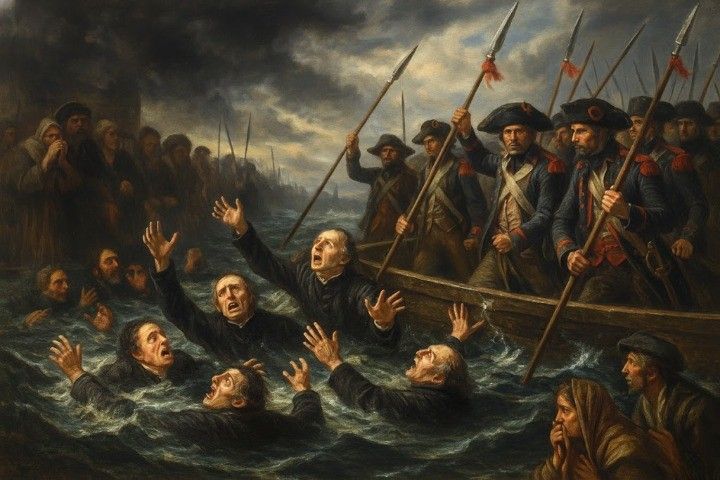
1793 — Execution of dissident priests at Nantes
During the radical phase of the French Revolution, ninety dissident Roman Catholic priests are executed by drowning at Nantes, part of the so-called “republican terror” directed at perceived counter-revolutionaries. The Nantes atrocities highlight the Revolution’s descent into political violence and the ways ideological zeal produced systematic repression. The event remains a stark chapter in the Revolution’s moral controversies.
1797 — Frederick William III becomes King of Prussia
The Prussian heir apparent, Frederick William, ascends as Frederick William III. His long reign would later face Napoleonic defeat and eventual restoration; the accession signals continuity in Prussian monarchy at a fraught moment of European upheaval. Early in his rule Prussia still juggled reform, coalition politics and the pressures unleashed by Revolutionary France.
1805 — Battle of Schöngrabern (Dürenstein theatre)
Russian forces under General Pyotr Bagration stall a pursuing French corps under Marshal Joachim Murat in the Napoleonic campaigns. The action at Schöngrabern (near Dürenstein) delays the French pursuit and allows Allied columns to regroup. The clash exemplifies the cat-and-mouse manoeuvres of coalition warfare and the high human cost of Napoleonic campaigning.
1822 — William Becknell opens the Santa Fe Trail
Missouri trader William Becknell reaches Santa Fe, opening a trade route that later becomes known as the Santa Fe Trail. Becknell’s passage turns into a commercial artery connecting the U.S. interior with northern Mexico, reshaping regional trade and encouraging migration westward. The trail’s creation accelerated economic links and foreshadowed later territorial contests.
1828 — London Protocol and the framework for Greece
The London Protocol establishes the outline for an autonomous Greek polity under Ottoman suzerainty, including the Morea and Cyclades. The agreement represents European powers’ early role in designing a post-Ottoman settlement and marks a step toward full Greek independence. The protocol is part of the long diplomatic process that would reshape the eastern Mediterranean.
1849 — Dostoyevsky sentenced to death (later commuted)
Writer Fyodor Dostoyevsky is condemned to death for alleged involvement with a radical intellectual circle; his sentence is commuted at the last moment to hard labour and exile. The trauma and experience profoundly influence his later fiction, which explores guilt, redemption and the psychological costs of Russian society’s tensions. The episode illustrates Tsarist repression of dissenting ideas.
1855 — Livingstone beholds Victoria Falls
Explorer David Livingstone becomes the first European recorded to see the great waterfall later named Victoria Falls. His report introduced a mesmerising natural landmark to global audiences and fed European interest in African geography and eventual colonisation. The sighting combined scientific curiosity with the imperial impulses that would follow.
1857 — Second relief of Lucknow and mass VC awards
During the Indian Rebellion, the Second Relief of Lucknow sees intense fighting and bravery; twenty-four Victoria Crosses are awarded that day — the most given in a single engagement. The relief underscores the severe colonial contest over control of the subcontinent and the brutal reprisals and heroics that marked the rebellion’s suppression.
1860 — Fisgard Lighthouse first lights in British Columbia
The Fisgard Lighthouse in the Colony of Vancouver Island shines its first light, becoming the first permanent lighthouse in what is now British Columbia. The beacon marks increasing maritime traffic and colonial infrastructure in the Pacific Northwest. It later served navigators entering Esquimalt and exemplified 19th-century efforts to make seaborne trade safer.
1863 — Battle of Campbell’s Station secures Knoxville
Union forces under Ambrose Burnside secure Knoxville after Confederate attacks at Campbell’s Station are repulsed. The action helps consolidate Union control in eastern Tennessee and denies Confederate manoeuvre space in the region. It is a tactical episode with broader strategic effect in the western theatre of the American Civil War.
1871 — The NRA chartered in New York State
The National Rifle Association of America receives a formal charter from New York State, institutionalising a body initially created by Union veterans to promote marksmanship. The organisation’s founding reflects post-Civil War civic life and later becomes a major political player in American debates over firearms and rights.
1885 — Execution of Louis Riel
Métis leader Louis Riel, regarded by some as the “Father of Manitoba,” is executed for treason after leading resistance and political movements in Canada. Riel’s death polarises public opinion and becomes a lasting fault line between English and French Canada and over Indigenous rights and federal authority.
1904 — Fleming patents the thermionic valve (vacuum tube)
English engineer John Ambrose Fleming obtains a patent for the thermionic valve — a device that would become fundamental for early radio, amplification and electronics. Fleming’s invention helped lay foundations for 20th-century communications and signal processing, preceding later solid-state revolutions by decades.
1907 — Oklahoma statehood: Indian + Oklahoma territories join
Indian Territory and Oklahoma Territory are combined and admitted to the Union as the State of Oklahoma, the 46th U.S. state. Statehood remade regional governance, with deep consequences for Indigenous nations whose lands and authority were reshaped by federal policy and settler institutions.
1914 — Federal Reserve opens
The Federal Reserve Bank of the United States officially opens, inaugurating the nation’s central banking system with regional Reserve Banks. The Fed’s birth reshaped American monetary policy, financial stability mechanisms and government-bank relations that would prove vital in the 20th century.
1920 — Qantas founded (Queensland and NT Aerial Services)
Qantas is founded in Australia as Queensland and Northern Territory Aerial Services Limited, later evolving into the nation’s flagship carrier. Its origins in remote air transport reflect aviation’s early role linking colonial outposts and shaping national connectivity across vast distances.
1933 — U.S.–Soviet diplomatic relations established
Formal diplomatic relations are established between the United States and the Soviet Union, marking a pragmatic turn in interwar foreign policy as both powers recognised mutual interest in official channels despite ideological distance. The opening of relations allowed for later complex interactions across trade, espionage and alliance politics.
1938 — LSD first synthesised by Albert Hofmann
Swiss chemist Albert Hofmann synthesises lysergic acid diethylamide (LSD) at Sandoz — a compound that would later have outsized cultural, psychiatric and legal ramifications. Initially a laboratory curiosity, LSD’s later psychotropic effects shaped countercultural movements and psychiatric research in the post-war era.
1940 — RAF bombing of Hamburg after Coventry
In response to the devastating German bombing of Coventry, the Royal Air Force attacks Hamburg, signalling the escalating aerial strategic campaign and the terrible civilian toll of World War II’s bombing offensives. The raids foreshadowed the destructive urban air campaigns that defined much of the aerial war in Europe.
1940 — Warsaw Ghetto closed off by Nazi occupiers
Nazi authorities seal the Warsaw Ghetto from the outside world, beginning a stage of extreme isolation, deprivation and later mass deportation. The closing of the ghetto was an early step in the genocidal policies that would culminate in the Holocaust’s industrialised murder of European Jews.
1940 — “Mad Bomber” places first bomb in Manhattan
New York’s so-called “Mad Bomber,” George Metesky, plants his first explosive device at a Consolidated Edison office building — the start of a long-running campaign of bombings and letters that terrified the city for decades. The case later became an infamous criminal-psychological investigation.
1944 — Allied destruction of Düren during Hürtgen Forest support
To support Allied operations in the Hürtgen Forest, air attacks destroy the town of Düren, reflecting the grim arithmetic of attrition on the Western Front in late 1944. The action illustrates how tactical needs led to severe damage to civilian towns during the final year of war.
1944 — First Jussi Awards held in Helsinki
The Jussi Awards, Finland’s prominent film awards, are held for the first time at Restaurant Adlon in Helsinki — a sign of national cinema’s institutionalisation even amid wartime conditions. The ceremony would develop into a recurring celebration of Finnish filmmaking.
1945 — UNESCO founded
The United Nations Educational, Scientific and Cultural Organization (UNESCO) is established to promote international collaboration in education, science and culture after World War II. UNESCO’s founding aimed to build institutional safeguards against the ignorance and intolerance that had fuelled global conflict.
1958 — National Airlines Flight 967 explodes over Gulf of Mexico
National Airlines Flight 967 suffers a mid-air explosion, killing all 42 aboard; the disaster remains a tragic and puzzling chapter of mid-20th-century civil aviation safety. Investigations and memory of such crashes shaped later improvements in technology, regulation and investigative techniques.
1959 — Aeroflot Flight 315 crashes approaching Lviv
Aeroflot Flight 315 crashes on approach to Lviv Airport, killing all 40 passengers and crew; the accident adds to aviation’s continuing safety challenges during the jet and turboprop expansion era. Each crash informed later operational and air-traffic enhancements.
1965 — Venera 3 launched toward Venus (Soviet program)
The Soviet Venera 3 probe launches on a mission that will later reach Venus; it becomes the first human-made object to impact another planet’s surface (though contact was lost). Venera 3 marks early planetary exploration’s mixture of bold ambition and technological risk.
1967 — Aeroflot Flight 2230 crashes, major loss of life
Aeroflot Flight 2230 crashes near Koltsovo Airport with 107 fatalities — another sobering aviation disaster in Soviet civil flight history. Such accidents were part of the broader global push to improve passenger safety and accident investigation standards.
1973 — Skylab 4 launched for long-duration mission
NASA launches Skylab 4, the last crewed Skylab mission, for an 84-day scientific stay in low Earth orbit, expanding human knowledge about long stays in microgravity. The mission’s scientific and operational lessons helped shape later long-duration flights and the International Space Station era.
1973 — Trans-Alaska Pipeline Act signed into law
President Richard Nixon signs the Trans-Alaska Pipeline Authorization Act, authorising construction of a major energy project with deep economic and environmental implications. The decision accelerated resource extraction in Alaska and sparked long debates about pipelines, native lands and environmental protection.
1974 — Arecibo message broadcast from Puerto Rico
A wide-angle radio message — the Arecibo message — is broadcast from the Arecibo Observatory toward the globular cluster M13 as a symbolic attempt at interstellar communication. The message combined scientific data and cultural signalling, emblematic of 20th-century curiosity about extraterrestrial life.
1979 — Bucharest Metro first line opens (Line M1)
Romania opens the first line of the Bucharest Metro, improving urban mobility and reflecting post-war urban modernisation projects across Eastern Europe. Public transit expansion changed commuting patterns and shaped late-century urban development.
1981 — Aeroflot Flight 3603 crashes at Norilsk
Aeroflot Flight 3603 crashes while landing at Norilsk, killing 99 people in one of the Soviet Union’s deadlier aviation accidents. Each such catastrophe helped prompt changes in navigational aids, air-traffic control and aircraft maintenance procedures.
1988 — Estonian Supreme Soviet declares sovereignty (stops short of independence)
The Supreme Soviet of the Estonian SSR proclaims Estonia’s sovereignty — a decisive legal step toward full independence that would come later in 1991. The declaration is part of the broader late-Gorbachev-era loosening that enabled Baltic republics to reclaim statehood.
1988 — Benazir Bhutto elected prime minister in Pakistan
In Pakistan’s first open multi-party election in more than a decade, Benazir Bhutto is elected prime minister — a historic moment as she became the first woman to head a Muslim-majority state. Her election opened a new chapter of civilian politics in Pakistan’s turbulent governance history.
1989 — El Salvador: Jesuit priests murdered at Universidad José Simeón Cañas
Salvadoran military forces kill six Jesuit priests and two others at the university — a shocking massacre that drew international condemnation and highlighted the brutality of the Salvadoran civil conflict. The incident intensified pressure on El Salvador’s government and on foreign patrons to seek resolution.
1990 — Milli Vanilli stripped of Grammy
Pop duo Milli Vanilli are stripped of their Grammy Award after it becomes public that they had not sung on their hit album; the scandal raised questions about authenticity, production practices and the music industry’s manufactured stardom.
1992 — Discovery of the Hoxne Hoard in Suffolk, England
Metal detectorist Eric Lawes uncovers the Hoxne Hoard, a major Roman treasure trove; the find enriches understanding of late Roman Britain and the circulation of wealth. The hoard’s discovery spurred archaeological interest and debates about treasure law and heritage protection.
1997 — Release of Wei Jingsheng from Chinese prison for medical reasons
After nearly 18 years incarcerated, dissident Wei Jingsheng is released for medical reasons — a moment that attracted international human rights attention. Wei’s case symbolised long-running tensions between Chinese political control and global advocacy for dissidents.
2002 — Early cases traced for 2002–2004 SARS outbreak
Health authorities trace the first cases of the Severe Acute Respiratory Syndrome (SARS) outbreak to Foshan, Guangdong Province, China — an event that presaged a global public-health crisis. SARS highlighted modern vulnerabilities in disease surveillance, travel networks and rapid response needs.
2004 — Release of Half-Life 2 (video game)
The video game Half-Life 2 is released to critical acclaim and wide commercial success, later winning dozens of Game of the Year awards. Its narrative, physics engine and design influenced decades of interactive storytelling and game development.
2005 — Australia qualifies for 2006 FIFA World Cup after penalty shootout vs Uruguay
In a dramatic playoff decided by penalties, Australia defeats Uruguay and secures its first World Cup qualification since 1974. The result transformed Australian football (soccer) prospects and encouraged national investment in the sport’s development.
2009 — Space Shuttle Atlantis launches STS-129 to ISS
Space Shuttle Atlantis lifts off on STS-129 for a logistics mission to the International Space Station, part of the final years of the Shuttle programme supporting long-term orbital assembly and maintenance. The launch continued international cooperation in low Earth orbit.
2020 — Vega rocket mission fails after liftoff (SEOSat-Ingenio & TARANIS)
A Vega rocket carrying SEOSat-Ingenio and TARANIS fails after liftoff, an expensive setback for earth observation and scientific communities. The crash prompted technical investigations and underscored risks inherent in expanding small-satellite missions.
2022 — Artemis I (SLS) first flight launches
NASA launches Artemis I — the maiden flight of the Space Launch System — marking the start of a new program aimed at returning humans to the Moon and enabling future lunar-cislunar exploration. Artemis I’s success in reaching trajectory milestones revitalised plans for crewed lunar missions.
Missed the earlier dates? See what happened on November 15
Famous People Born On November 16
Robert Nozick — American philosopher known for libertarian political theory. (Nov 16, 1938 – Jan 23, 2002)
José Saramago — Portuguese novelist and Nobel laureate. (Nov 16, 1922 – Jun 18, 2010)
Paul Hindemith — German composer and music theorist. (Nov 16, 1895 – Dec 28, 1963)
Aleksandr V. Kolchak — Russian naval officer and White movement leader. (Nov 16, 1874 – Feb 7, 1920)
Oksana Baiul — Ukrainian Olympic figure skater and champion. (Nov 16, 1977 – )
Thomas H. Ince — Early American film director and producer. (Nov 16, 1882 – Nov 19, 1924)
W. C. Handy — Composer and bandleader, often called the “Father of the Blues.” (Nov 16, 1873 – Mar 28, 1958)
Kalakaua — King of the Hawaiian Kingdom and cultural patron. (Nov 16, 1836 – Jan 30, 1891)
Nnamdi Azikiwe — First president of independent Nigeria and nationalist leader. (Nov 16, 1904 – May 11, 1996)
George S. Kaufman — American playwright, theatre director and critic. (Nov 16, 1889 – Jun 2, 1961)
John Bright — British politician and champion of parliamentary reform. (Nov 16, 1811 – Mar 27, 1889)
Lawrence Tibbett — American operatic baritone and film actor. (Nov 16, 1896 – Jul 15, 1960)
Tazio Nuvolari — Legendary Italian racing driver. (Nov 16, 1892 – Aug 10, 1953)
Rodolphe Kreutzer — French violinist, composer and teacher. (Nov 16, 1766 – Jan 6, 1831)
Luigi Facta — Italian politician, last prime minister before Mussolini. (Nov 16, 1861 – Nov 5, 1930)
Anatoly F. Dobrynin — Longtime Soviet ambassador to the United States. (Nov 16, 1919 – Apr 6, 2010)
Jean Chardin — French traveller and chronicler of Persia and the Near East. (Nov 16, 1643 – Dec 25, 1713)
Aleksandr D. Menshikov — Russian statesman and close associate of Peter the Great. (Nov 16, 1673 – Nov 23, 1729)
George Seldes — American investigative journalist and media critic. (Nov 16, 1890 – Jul 2, 1995)
Ernest Nagel — Philosopher of science noted for work on scientific explanation. (Nov 16, 1901 – Sep 20, 1985)
Karel Hynek Mácha — Czech Romantic poet and literary figure. (Nov 16, 1810 – Nov 5, 1836)
Michael Arlen — Novelist and essayist of Armenian-British background. (Nov 16, 1895 – Jun 23, 1956)
Jónas Hallgrímsson — Icelandic poet and naturalist. (Nov 16, 1807 – May 26, 1845)
Léon Daudet — French journalist and polemicist. (Nov 16, 1867 – Jul 1, 1942)
Arthur B. Krock — American political journalist for The New York Times. (Nov 16, 1886 – Apr 12, 1974)
Mary Margaret McBride — American radio interviewer and broadcaster. (Nov 16, 1899 – Apr 7, 1976)
Louis-Honoré Fréchette — Canadian poet, playwright and political figure. (Nov 16, 1839 – May 31, 1908)
Jules Violle — French physicist notable for solar constant measurements. (Nov 16, 1841 – Sep 12, 1923)
Egor Frantsevich, Count Kankrin — Russian minister of finance of the 19th century. (Nov 16, 1774 – Sep 10, 1845)
Aimable-Jean-Jacques Pélissier, duc de Malakoff — Marshal of France. (Nov 16, 1794 – May 22, 1864)
Famous People Died On November 16
Frederick William II — King of Prussia. (Sep 25, 1744 – Nov 16, 1797)
Jack Sheppard — Notorious English criminal and prison-escapee. (Dec 1702 – Nov 16, 1724)
Sam Rayburn — Influential Speaker of the U.S. House of Representatives. (Jan 6, 1882 – Nov 16, 1961)
A. S. Byatt — British scholar, critic and novelist. (Aug 24, 1936 – Nov 16, 2023)
Jay Wright Forrester — American engineer and computing pioneer. (Jul 14, 1918 – Nov 16, 2016)
Siobhán McKenna — Irish stage and film actress. (May 24, 1923 – Nov 16, 1986)
Daniel Nathans — Microbiologist and Nobel laureate. (Oct 30, 1928 – Nov 16, 1999)
Ralph Edwards — American radio and TV personality and producer. (Jun 13, 1913 – Nov 16, 2005)
Carl von Linde — Engineer whose refrigeration and gas liquefaction work transformed industry. (Jun 11, 1842 – Nov 16, 1934)
Jennie Lee, Baroness Lee of Asheridge — British politician and arts advocate. (Nov 3, 1904 – Nov 16, 1988)
Camillo Sitte — Urban planner and architectural theorist. (Apr 17, 1843 – Nov 16, 1903)
Jean-Lambert Tallien — French Revolutionary political actor. (Jan 23, 1767 – Nov 16, 1820)
St. Hugh of Lincoln — Bishop and canonised saint. (c.1140 – Nov 16, 1200)
Henry Taube — Chemist and Nobel laureate. (Nov 30, 1915 – Nov 16, 2005)
Pierre Nicole — Jansenist theologian and moral philosopher. (Oct 19, 1625 – Nov 16, 1695)
Pierre Charron — Catholic moralist and philosopher. (1541 – Nov 16, 1603)
Wynn Bullock — Influential American photographer. (Apr 18, 1902 – Nov 16, 1975)
Clark Gable — Iconic Hollywood film actor. (Feb 1, 1901 – Nov 16, 1960)
William T. Cosgrave — Leader of the Irish Free State. (Jun 5, 1880 – Nov 16, 1965)
Harry Blackstone, Sr. — Renowned American magician and entertainer. (Sep 27, 1885 – Nov 16, 1965)
Alan Watts — Philosopher and populariser of Eastern thought. (Jan 6, 1915 – Nov 16, 1973)
Víctor Jara — Chilean singer-songwriter and activist. (Sep 28, 1932 – Nov 16, 1973)
Otis Dudley Duncan — Sociologist known for social stratification work. (Dec 2, 1921 – Nov 16, 2004)
Albert Francis Blakeslee — Botanist and geneticist. (Nov 9, 1874 – Nov 16, 1954)
Carlo Filangieri, prince di Satriano — Italian general and statesman. (May 10, 1784 – Nov 16, 1867)
Karl Klič — Czech graphic artist and photogravure inventor. (Mar 31, 1841 – Nov 16, 1926)
John Hawkesworth — English writer and editor. (c.1715 – Nov 16, 1773)
Wilhelm Heinrich Riehl — German social historian and journalist. (May 6, 1823 – Nov 16, 1897)
Frederick Gardner Cottrell — Inventor and environmental chemist. (Jan 10, 1877 – Nov 16, 1948)
William Broome — Classical scholar and poet. (May 3, 1689 – Nov 16, 1745)
Observances & Institutional Dates — November 16
Statia Day (Sint Eustatius, Caribbean Netherlands)
A civic commemoration marking the island’s role in early Atlantic trade and its historical connections with the American Revolution; events often highlight local history and heritage.
Volkstrauertag (Germany)
A national day of mourning observed in Germany for victims of war and tyranny; ceremonies emphasize remembrance for civilians and soldiers and foster reflection on peace.
Intergenerational Fairness Day (informal)
A symbolic observance encouraging policy discussion about economic and social fairness across generations, often promoted by civic groups and think tanks.
Icelandic Language Day / Dagur íslenskrar tungu (Iceland)
A cultural day celebrating the Icelandic language and literature with readings, education programmes and events that promote linguistic continuity.
(Estonia) Day of Declaration of Sovereignty
Marks a key step in Estonia’s path to independence — ceremonies typically recall legal acts that asserted Estonian sovereignty during the late 20th century.
International Day for Tolerance (United Nations)
An annual UN observance promoting education and public policy aimed at reducing intolerance and protecting cultural diversity worldwide; activities include school programmes and public campaigns.
Frequently Asked Questions
What major events make November 16 notable?
November 16 gathers a wide array of turning points: imperial conquests and royal successions, decisive battles (like Lützen), early exploration and trade routes (Santa Fe Trail), scientific and technological firsts (Fleming’s vacuum tube, Venera 3), and landmark cultural and institutional foundations (Qantas, the Federal Reserve). Each event shaped politics, knowledge or public life in its region.
Who was captured at Cajamarca and why does it matter?
At the Battle of Cajamarca (1532) Spanish forces under Francisco Pizarro seized the Inca emperor Atahualpa. The capture dismantled Inca central authority, triggered a ransom-and-conquest cycle, and accelerated Spanish domination of the Andes — a pivotal moment in the colonisation of South America.
Why is Gustavus Adolphus’s death at Lützen important?
Gustavus Adolphus was a military innovator whose tactics and leadership strengthened Protestant forces in the Thirty Years’ War. His death at Lützen (1632) deprived those forces of a charismatic commander and changed the war’s strategic momentum, even as his reforms permanently influenced European military practice.
What was the significance of Venera 3 and other space missions on this day?
Venera 3 (launched November 16, 1965) was among the earliest probes aimed at another planet; it became the first human-made object to impact another planet’s surface. Later missions listed for this date (Skylab 4, Artemis I launches, etc.) show how November 16 repeatedly intersects with milestones in planetary and human spaceflight.
How did the Santa Fe Trail begin and why is it historically relevant?
Trader William Becknell reached Santa Fe in 1822, opening what became the Santa Fe Trail — a major commercial and migration artery linking the U.S. interior with northern Mexico. The trail reshaped regional trade networks, encouraged westward movement, and set the stage for later territorial and economic change.
What were the social or political consequences of Louis Riel’s execution?
The 1885 execution of Louis Riel for treason intensified divisions in Canada — especially between English and French communities — and enshrined Riel as both a controversial figure and a martyr for Métis rights. The event influenced Canadian politics and debates about Indigenous and minority rights for decades.