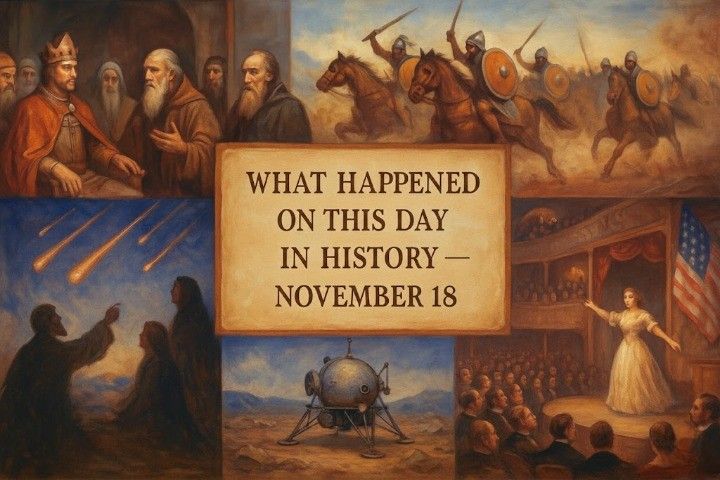
November 18 carries a sweeping trail of political shifts, daring explorations, and defining public moments. What happened on this day in history November 18, is part of a broad narrative linking imperial ambitions and revolutionary movements, early polar discoveries and space-age missions, experimental legal reforms and violent street struggles
Important Events That Happened On November 18 In History
326 — Consecration of the old St. Peter’s Basilica
The ancient basilica on Vatican Hill is consecrated by Pope Sylvester I, establishing a major liturgical and pilgrimage centre for Western Christianity. Over centuries the site will anchor papal ceremonial life and inspire successive architectural programmes that shape Rome’s religious geography and Christian devotional practice.
401 — Visigothic invasion of northern Italy
Led by King Alaric I, the Visigoths cross the Alps into northern Italy, pressing on the late-Roman frontier. These incursions intensify the pressures on imperial authority and foreshadow the larger pattern of Germanic settlement and political transformation across the Western Roman territories.
1095 — Council of Clermont opens (First Crusade)
Pope Urban II convenes the Council of Clermont and urges armed pilgrimage to Jerusalem, launching what becomes the First Crusade. The call mobilises knights and lay supporters across Europe and sets in motion a series of religiously framed expeditions that will reshape Mediterranean politics, trade and interfaith relations for generations.
1105 — Maginulfo elected Antipope Sylvester IV
A faction installs Maginulfo as Antipope Sylvester IV in opposition to Pope Paschal II, illustrating the deep entanglement of local politics, imperial influence and ecclesiastical rivalry. The rival claim underscores tensions that repeatedly fractured medieval Christendom and complicated papal authority.
1210 — Pope Innocent III excommunicates Otto IV
Pope Innocent III excommunicates Holy Roman Emperor Otto IV for invading the Kingdom of Sicily in breach of prior commitments to papal authority. The move exemplifies how excommunication functioned as both spiritual penalty and political instrument in medieval struggles between empire and church.
1302 — Boniface VIII issues Unam sanctam
Pope Boniface VIII proclaims Unam sanctam, a sweeping papal bull asserting papal supremacy over temporal rulers. The declaration intensifies conflict between papacy and monarchs, marking a high point in medieval assertions of spiritual jurisdiction that will provoke sustained resistance from secular powers.
1421 — St. Elizabeth’s flood devastates the Netherlands
A catastrophic dike failure in the Grote Hollandse Waard triggers a massive flood, with contemporaries estimating around 10,000 fatalities. The disaster alters regional settlement patterns, forces large-scale land reclamation and becomes a formative episode in Dutch water-management history and communal memory.
1493 — Columbus sights Puerto Rico
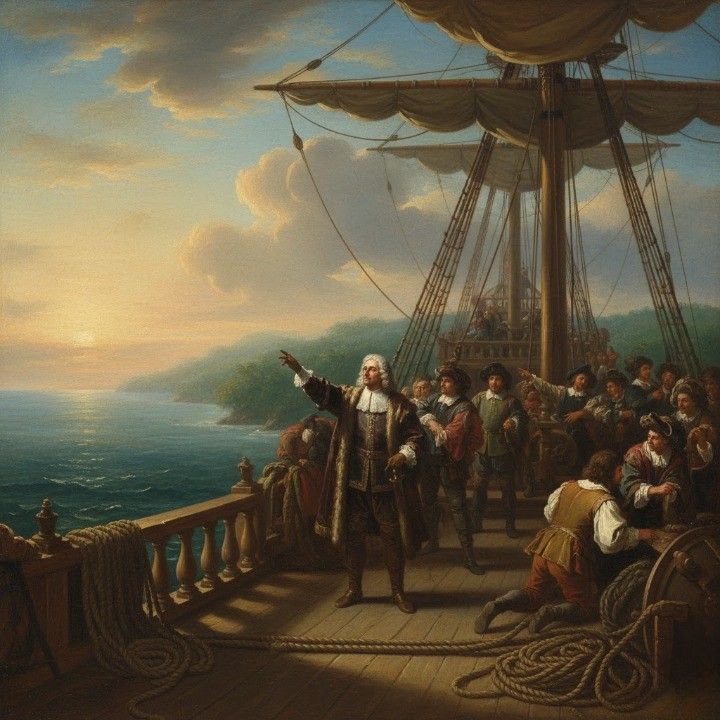
On his second transatlantic voyage, Christopher Columbus records the sighting of the island later called Puerto Rico. This landfall expands European mapping of the Caribbean and marks another step in the intensifying contact and subsequent colonisation that will profoundly affect indigenous societies.
1601 — Tiryaki Hasan Pasha defeats Habsburg besiegers at Nagykanizsa
Ottoman commander Tiryaki Hasan Pasha routs Habsburg forces under Archduke Ferdinand II that were besieging Nagykanizsa, preserving Ottoman hold on the frontier. The victory illustrates the ongoing Habsburg–Ottoman contest in Central Europe and the tactical volatility of early modern siege warfare.
1626 — Consecration of the new St. Peter’s Basilica in Rome
The rebuilt St. Peter’s Basilica is consecrated, completing a monumental programme of Renaissance and Baroque patronage. Its consecration signals both the papacy’s cultural ambitions and the emergence of an architectural icon that will dominate Rome’s religious and civic landscape.
1730 — Frederick the Great pardoned and released
The young Frederick of Prussia is pardoned by his father and freed from confinement after a dynastic crisis, an episode that shapes his relationship with paternal authority. The event preludes the reign of a ruler who will profoundly influence eighteenth-century Prussian and European politics.
1760 — Castellania in Valletta receives first prisoners
Valletta’s rebuilt Castellania, functioning as a debtors’ prison, begins receiving inmates. The opening formalises colonial penal practice in Malta and reflects how legal institutions and civic architecture operated within the island’s imperial administration.
1803 — Battle of Vertières concludes the Haitian Revolution’s major fighting
At Vertières, Haitian forces defeat the final French attempts to reassert control; the engagement paves the way for Haiti’s independence and the establishment of the first Black republic in the Americas. The battle reverberates through Atlantic politics and challenges the global order of slavery.
1809 — French frigates defeat British East Indiamen in the Bay of Bengal
During the Napoleonic Wars, French frigates engage and defeat British East Indiamen in the Bay of Bengal, striking at the maritime commerce that sustained imperial economies. The action underscores the global reach of Napoleonic naval conflict and its consequences for trade routes.
1812 — Battle of Krasnoi concludes with French retreat
Near the end of Napoleon’s Russian campaign, the Battle of Krasnoi ends with French forces in retreat; Marshal Ney’s conduct under fire earns him praise even as the Grande Armée disintegrates under logistical strain and enemy action. The episode highlights the campaign’s brutal attrition.
1863 — King Christian IX signs November constitution over Schleswig
King Christian IX of Denmark signs a constitution declaring Schleswig part of Denmark, a move the German Confederation regards as violating prior agreements and that contributes to the outbreak of the 1864 Danish–German war. The act illustrates how nationalist constitutions could trigger international crisis.
1867 — Virgin Islands earthquake and tsunami
An earthquake strikes the Virgin Islands, producing what contemporaries describe as the largest tsunami seen in the Caribbean; dozens are killed and coastal communities heavily damaged. The disaster is a grim reminder of the region’s seismic vulnerability and the human toll of sudden natural catastrophe.
1872 — Susan B. Anthony and fellow suffragettes arrested for voting
Susan B. Anthony and fourteen other women are arrested after illegally voting in the U.S. presidential election of 1872. Their arrests become a galvanising moment for the American women’s suffrage movement and a public test of voting laws and civil rights.
1883 — North American railways institute standard time zones
American and Canadian rail companies adopt four standard continental time zones in the “day of two noons,” ending a patchwork of local times and greatly improving scheduling for rail travel and commerce. The reform is a practical innovation driven by industrial-era transport demands.
1889 — Elisha P. Ferry inaugurated as first governor of Washington
Elisha P. Ferry takes office as the first governor of the newly admitted state of Washington, marking the political organisation of the Pacific Northwest within the United States and the administrative beginnings of state-level governance for the region.
1901 — Hay–Pauncefote Treaty signed (US–Britain)
Britain and the United States sign the Hay–Pauncefote Treaty, nullifying the Clayton–Bulwer Treaty and removing British objections to an American-controlled interoceanic canal in Panama — a key diplomatic step toward U.S. dominance in canal policy and hemispheric influence.
1903 — Hay–Bunau-Varilla Treaty grants U.S. rights over Panama Canal Zone
The Hay–Bunau-Varilla Treaty, signed by the United States and the new Republic of Panama, grants the U.S. extensive control over the Panama Canal Zone, shaping twentieth-century geopolitics, regional sovereignty debates and the canal’s strategic role in global shipping.
1905 — Prince Carl of Denmark becomes King Haakon VII of Norway
Prince Carl accepts the Norwegian crown as Haakon VII, marking Norway’s consolidation as an independent constitutional monarchy after separation from Sweden. The accession stabilises the new kingdom’s political institutions and national identity.
1909 — U.S. warships sent to Nicaragua after executions
Following the execution of hundreds of revolutionaries by order of José Santos Zelaya, including two Americans, the United States dispatches warships to Nicaragua, a show of force reflecting early twentieth-century U.S. interventions in Central America and concerns over citizens abroad.
1910 — Black Friday suffragette march in London
Hundreds of suffragettes march on the British Parliament demanding votes for women; police and bystander violence produces scandal when protesters are beaten and publicly manhandled. The events, dubbed Black Friday, intensify debate over militant tactics and state responses to suffrage campaigning.
1916 — Douglas Haig calls off the First Battle of the Somme operations
After months of grinding combat on the Somme, British Expeditionary Force commander Douglas Haig announces an end to the summer offensive. The battle’s human cost and limited territorial gains leave a contested legacy within military history and public memory.
1918 — Latvia declares independence from Russia
With the collapse of imperial structures in World War I’s aftermath, Latvia proclaims independence from Russia, initiating state-building processes and diplomatic efforts that will encounter subsequent conflict, occupation and eventual international recognition.
1928 — Release of Steamboat Willie, Mickey Mouse’s breakthrough
The animated short Steamboat Willie is released as the first fully synchronized sound cartoon, introducing Mickey Mouse and marking a watershed moment in animation history and modern entertainment technology that will transform popular culture.
1929 — Grand Banks earthquake severs transatlantic cables and triggers tsunami
A magnitude-7.2 submarine earthquake on the Grand Banks breaks multiple transatlantic telegraph cables and produces a tsunami that devastates communities on Newfoundland’s Burin Peninsula. The disaster disrupts communications and underscores the vulnerability of undersea infrastructure.
1940 — Hitler meets Ciano to discuss Italy’s Greek invasion
Adolf Hitler and Italian Foreign Minister Galeazzo Ciano meet to address Mussolini’s faltering campaign in Greece, highlighting axis strategic coordination and the operational strains of co-belligerent planning during the Second World War.
1943 — RAF raid on Berlin (Battle of Berlin)
Four hundred and forty RAF bombers attack Berlin, causing limited physical damage but incurring aircraft and crew losses; the raid is one episode in the sustained air campaign that increasingly shaped civilian experience and strategic calculation in the European air war.
1944 — Popular Socialist Youth founded in Cuba
The Popular Socialist Youth, the youth wing aligned with Cuba’s Communist movement, is founded, contributing to political organisation among workers and students that later feeds into mid-century Caribbean political currents and revolutionary ferment.
1947 — Ballantyne’s Department Store fire in Christchurch
A catastrophic fire at Ballantyne’s Department Store kills 41 people, becoming New Zealand’s worst commercial fire disaster. The tragedy prompts national mourning and leads to reforms in fire safety and building regulation.
1949 — Iva Valley shooting in Enugu, Nigeria
During a miners’ strike over withheld wages at the Iva Valley colliery, British colonial police open fire, killing 21 miners and wounding many others. The massacre becomes a rallying point in Nigerian anti-colonial politics and labour mobilisation.
1961 — Kennedy sends 18,000 military advisors to South Vietnam
President John F. Kennedy approves the deployment of 18,000 U.S. military advisors to South Vietnam, deepening American involvement in the conflict and marking a significant escalation that presages larger military commitments in the following decade.
1963 — First push-button telephone enters service
The debut of the first push-button telephone marks a small but notable step in telecommunications technology, shifting user interfaces away from rotary dials and paving the way for later digital telephony developments.
1970 — Nixon requests supplemental aid for Cambodia
President Richard Nixon asks Congress for $155 million in supplemental assistance to the Cambodian government, reflecting U.S. policy efforts to stabilise allied regimes amid intensifying conflict in Indochina during the Vietnam War era.
1971 — Oman declares independence from the United Kingdom
Oman formally gains full independence from British protectorate arrangements, consolidating modern sovereignty under Sultanate rule and reshaping the political map of the Arabian Peninsula in the late twentieth century.
1978 — First flight of the McDonnell Douglas F/A-18 Hornet
The F/A-18 Hornet makes its maiden flight at the Naval Air Test Center in Maryland, inaugurating a multi-role combat aircraft that will become a mainstay of carrier aviation and international defence exports in the following decades.
1978 — Jonestown massacre (Peoples Temple mass murder–suicide)
In a catastrophic mass murder–suicide at Jonestown, Guyana, more than 900 people die under the direction of cult leader Jim Jones. The event shocks global public opinion, prompts inquiries into cult dynamics and state oversight, and remains a sombre touchstone in discussions of coercive movements.
1983 — Aeroflot Flight 6833 hijacking and raid in Tbilisi
Aeroflot Flight 6833 is hijacked en route from Tbilisi to Leningrad; after the aircraft returns to Tbilisi it is stormed by security forces, resulting in several deaths. The incident reveals Cold War tensions, civil unrest and the Soviet state’s security responses.
1985 — First Calvin and Hobbes comic published
Bill Watterson’s Calvin and Hobbes debuts in ten newspapers, introducing a beloved comic strip that blends childlike imagination, philosophical humour and social observation, and that will achieve wide cultural resonance internationally.
1987 — King’s Cross fire in London
A devastating fire at London’s King’s Cross St Pancras station kills 31 people, prompting major public inquiry and sweeping reforms to underground fire safety, emergency response protocols and station management practices.
1991 — Terry Waite and Thomas Sutherland released by kidnappers in Lebanon
Anglican envoy Terry Waite and academic Thomas Sutherland are freed by Shiite captors in Lebanon after long detentions, an episode tied to the complex geopolitics and factional kidnappings that afflicted the region during the civil war period.
1991 — Vukovar falls after 87-day siege
Following an 87-day siege, the Croatian city of Vukovar capitulates to the Yugoslav People’s Army and allied Serb paramilitaries, a brutal episode that leaves the city devastated and becomes a focal point of wartime atrocity investigations and memory in the Balkans.
1991 — Autonomous Croatian Community of Herzeg-Bosnia established
The creation of the Croatian Community of Herzeg-Bosnia marks a contested political reorganisation amid Bosnia and Herzegovina’s fracturing, a development that will later feed into the region’s wartime territorial disputes and complex peace negotiations.
1993 — NAFTA approved by the U.S. House of Representatives
The U.S. House passes legislation approving the North American Free Trade Agreement, clearing the way for trilateral trade liberalisation among the United States, Canada and Mexico and initiating decades of debate about trade, labour and investment impacts.
1993 — South African political parties approve a new constitution
Twenty-one parties in South Africa approve a new interim constitution that expands voting rights and ends formal white minority rule — a crucial legal step in the country’s negotiated transition from apartheid toward democratic governance.
1996 — Channel Tunnel train fire damages tunnel infrastructure
A fire aboard a train transiting the Channel Tunnel causes injuries and damages roughly 500 metres of tunnel, prompting safety reviews and operational changes in the engineering and management of the cross-Channel link.
1999 — Texas A&M Aggie Bonfire collapses
The university bonfire structure collapses at Texas A&M, killing 12 students and injuring many others; the disaster sparks investigations into student traditions, institutional responsibility and engineering safety in large-scale informal constructions.
2002 — UN weapons inspectors led by Hans Blix arrive in Iraq
United Nations weapons inspection teams under Hans Blix return to Iraq amid international disputes over alleged weapons of mass destruction, setting a tense diplomatic backdrop that will culminate in the 2003 invasion.
2003 — Goodridge v. Department of Public Health (Massachusetts)
Massachusetts’ highest court rules that denying marriage to same-sex couples is unconstitutional, giving the legislature a deadline to alter law and making Massachusetts the first U.S. state to recognise same-sex marriage, a landmark in legal and civil-rights history.
2012 — Pope Tawadros II becomes Coptic Pope of Alexandria
Tawadros II is installed as the 118th Pope of the Coptic Orthodox Church of Alexandria, marking a leadership transition within one of Christianity’s ancient Eastern traditions and signalling continuity amid regional religious and political challenges.
2013 — NASA launches MAVEN to Mars
NASA’s MAVEN probe launches to study the Martian upper atmosphere and its loss to space, advancing scientific understanding of planetary evolution and Mars’ climate history and contributing to the broader programme of robotic exploration.
2020 — Utah monolith discovered by state biologists
A mysterious metallic monolith built sometime in 2016 is rediscovered in the Utah desert by state biologists, briefly captivating global social media and prompting reflection on public art, authorship and the viral circulation of enigmatic objects online.
Check Also: What happened on this day in history November 17: Powerful Facts
Famous People Born On November 18
Qaboos bin Said — Sultan of Oman. (Nov 18, 1940 – Jan 10, 2020)
Louis Daguerre — French painter and physicist (inventor of the daguerreotype). (Nov 18, 1787 – Jul 10, 1851)
Johnny Mercer — American lyricist, vocalist, and composer. (Nov 18, 1909 – Jun 25, 1976)
Carl Maria von Weber — German composer and opera director. (Nov 18, 1786 – Jun 5, 1826)
Ted Stevens — United States senator (Alaska). (Nov 18, 1923 – Aug 10, 2010)
Wilma Mankiller — Native American leader, first woman chief of a major tribe (Cherokee). (Nov 18, 1945 – Apr 6, 2010)
Howard Thurman — American theologian and civil-religious leader. (Nov 18, 1899 – Apr 10, 1981)
W. S. Gilbert — British playwright (of Gilbert & Sullivan). (Nov 18, 1836 – May 29, 1911)
Wyndham Lewis — British artist and writer, founder of Vorticism. (Nov 18, 1882 – Mar 7, 1957)
Jacques Maritain — French Catholic philosopher. (Nov 18, 1882 – Apr 28, 1973)
Pierre Bayle — French philosopher and critic. (Nov 18, 1647 – Dec 28, 1706)
George Wald — American biochemist, Nobel laureate (Physiology or Medicine). (Nov 18, 1906 – Apr 12, 1997)
Roberto C. Goizueta — Cuban-born American businessman, chairman & CEO of Coca-Cola. (Nov 18, 1931 – Oct 18, 1997)
Sir Alec Issigonis — British automobile designer (Mini). (Nov 18, 1906 – Oct 2, 1988)
Eugene Ormandy — Hungarian-born American conductor. (Nov 18, 1899 – Mar 12, 1985)
George Gallup — American pollster (Gallup Poll). (Nov 18, 1901 – Jul 26, 1984)
J. C. Watts — American politician and former U.S. congressman. (Nov 18, 1957 – )
Asa Gray — American botanist. (Nov 18, 1810 – Jan 30, 1888)
Arthur Cecil Pigou — British economist (welfare economics). (Nov 18, 1877 – Mar 7, 1959)
Joris Ivens — Dutch documentary filmmaker. (Nov 18, 1898 – Jun 28, 1989)
Sir David Wilkie — British genre and portrait painter. (Nov 18, 1785 – Jun 1, 1841)
Jules Bastien-Lepage — French painter (naturalist). (Nov 18, 1848 – Dec 10, 1884)
Máximo Gómez y Báez — Cuban revolutionary commander. (Nov 18, 1836 – Jun 17, 1905)
Adolf Erik Nordenskiöld — Swedish explorer and scientist. (Nov 18, 1832 – Aug 12, 1901)
Gio Ponti — Italian architect and designer. (Nov 18, 1891 – Sep 15, 1979)
Luis Somoza Debayle — President of Nicaragua. (Nov 18, 1922 – Apr 13, 1967)
Elizabeth Meriwether Gilmer — American journalist and columnist. (Nov 18, 1870 – Dec 16, 1951)
Lamoraal, graaf van Egmond — Dutch noble and statesman. (Nov 18, 1522 – Jun 5, 1568)
Amelita Galli-Curci — Italian-born American operatic soprano. (Nov 18, 1882 – Nov 26, 1963)
Famous People Died On November 18
Joseph P. Kennedy — American businessman and U.S. ambassador; father of President John F. Kennedy. (Sep 6, 1888 – Nov 18, 1969)
Henry A. Wallace — 33rd Vice President of the United States. (Oct 7, 1888 – Nov 18, 1965)
Philip John Schuyler — American soldier and statesman (Continental Congress). (Nov 11, 1733 – Nov 18, 1804)
Ernest Augustus — King of Hanover. (Jun 5, 1771 – Nov 18, 1851)
Paul Bowles — American composer, translator, and novelist. (Dec 30, 1910 – Nov 18, 1999)
Paul Éluard — French poet, influential Surrealist. (Dec 14, 1895 – Nov 18, 1952)
Kurt von Schuschnigg — Chancellor of Austria before the Anschluss. (Dec 14, 1897 – Nov 18, 1977)
Naim Süleymanoğlu — Turkish Olympic weightlifter. (Jan 23, 1967 – Nov 18, 2017)
Gustav Fechner — German philosopher and founder of psychophysics. (Apr 19, 1801 – Nov 18, 1887)
Lennie Tristano — American jazz pianist and teacher. (Mar 19, 1919 – Nov 18, 1978)
Walther Nernst — German chemist and physical chemist (Nernst heat theorem). (Jun 25, 1864 – Nov 18, 1941)
Denton Cooley — American heart surgeon. (Aug 22, 1920 – Nov 18, 2016)
Conn Smythe — Canadian hockey executive and owner (Toronto Maple Leafs). (Feb 1, 1895 – Nov 18, 1980)
Louis-Philippe, duke d’Orléans — French duke. (May 12, 1725 – Nov 18, 1785)
James J. Walker — Mayor of New York City. (Jun 19, 1881 – Nov 18, 1946)
John Christian Watson — Prime Minister of Australia (first Labour PM). (Apr 9, 1867 – Nov 18, 1941)
Ruth Crawford Seeger — American modernist composer. (Jul 3, 1901 – Nov 18, 1953)
William II — King of Sicily (William the Good). (1154 – Nov 18, 1189)
Wilhelm Hauff — German poet and novelist. (Nov 29, 1802 – Nov 18, 1827)
Ivan Albright — American painter known for detailed macabre realist works. (Feb 20, 1897 – Nov 18, 1983)
Bessarion — Byzantine scholar and later Roman cardinal. (Jan 2, 1403 – Nov 18, 1472)
Émile Nelligan — French-Canadian poet. (Dec 24, 1879 – Nov 18, 1941)
John E. W. Keely — American inventor (fraudulent claims). (Sep 3, 1827 – Nov 18, 1898)
Miklós Zrínyi — Hungarian statesman, soldier, and poet. (Jan 5, 1620 – Nov 18, 1664)
Aleijadinho — Brazilian sculptor and architect (Rococo). (Aug 9, 1738? – Nov 18, 1814)
Edward Forbes — British naturalist and biogeographer. (Feb 12, 1815 – Nov 18, 1854)
Pietro Gasparri — Italian cardinal and jurist (Code of Canon Law). (May 5, 1852 – Nov 18, 1934)
Cuthbert Tunstall — English bishop and scholar. (1474 – Nov 18, 1559)
Mikhail Semyonovich (Prince Vorontsov) — Russian statesman and general. (May 30, 1782 – Nov 18, 1856)
Gerardus van der Leeuw — Dutch theologian and historian of religion. (Mar 18, 1890 – Nov 18, 1950)
Observances & Institutional Dates — November 18
Proclamation Day of the Republic of Latvia (Latvia)
Marks Latvia’s formal declaration of independence in 1918. The day is observed with ceremonies, official addresses and public remembrance of the state’s founding amid the upheavals of the post-World War I era.
Day of Army and Victory (Haiti)
A national observance honouring Haiti’s military history and victories, tied to the nation’s revolutionary origins and the long memory of its fight for sovereignty and freedom.
Independence Day (Morocco)
A national holiday commemorating Morocco’s reclamation of sovereignty; observed with official ceremonies, public parades and reflections on the modern state’s emergence from colonial arrangements.
National Day (Oman)
Celebrates Oman’s modern national identity, including the birthday and legacy of the ruling dynasty that guided the country’s twentieth-century transformation.
Remembrance Day of the Sacrifice of Vukovar (Croatia)
A solemn commemoration of the city’s suffering during the early 1990s conflict and a day to honour the civilian and military victims of the siege; public rituals emphasise remembrance and national resilience.
Frequently Asked Questions
What is special about November 18 in history?
November 18 stands out for its long chain of political, military and cultural turning points — from papal decrees and medieval floods to independence movements, aviation milestones and landmark social-rights rulings. It’s a date where religion, empire, revolution and technology all leave strong marks across centuries.
What happened on this day in history November 18?
A wide range of events occurred on November 18: councils that sparked the First Crusade, the final battles of the Haitian Revolution, the release of Steamboat Willie, Black Friday suffragette protests, the Jonestown tragedy, the approval of NAFTA, and even NASA’s MAVEN launch to Mars. Each moment reveals how institutions and societies shift over time.
Why is November 18 an important date internationally?
Multiple countries link November 18 with nation-shaping milestones — Latvia’s independence, Haiti’s Day of Army and Victory, Morocco’s Independence Day, and Oman’s National Day. These observances highlight struggles for sovereignty, identity and political renewal.
Which disasters are remembered on November 18?
The St. Elizabeth’s flood of 1421, the 1929 Grand Banks earthquake and tsunami, the 1947 Ballantyne’s fire, and the 1987 King’s Cross fire all occurred on this date. These events shaped engineering standards, emergency responses and long-term community memory.
Are there any important scientific or technological firsts on November 18?
Yes — the first synchronized-sound cartoon (Steamboat Willie, 1928), the debut of the push-button telephone (1963), the first flight of the F/A-18 Hornet (1978), and the MAVEN Mars mission launch (2013). November 18 often marks innovation across entertainment, communication and aerospace.