
Today, December 20, is a date etched into the annals of history for dramatic political power shifts, the launch of an American icon, and moments that shaped modern nations. From the tumultuous end of the Roman Empire and the fall of a Byzantine emperor to the birth of the Viet Cong and the completion of the monumental Louisiana Purchase, exploring what happened on this day in history December 20 reveals a long tradition of upheaval, transformation, and conflict across the globe.
Important Events That Happened On December 20 In History
AD 69 – The Rise of Vespasian and the Year of Four Emperors
In a decisive move during the chaotic “Year of the Four Emperors,” Antonius Primus marched into Rome to claim the title of Emperor for Vespasian, who was Nero’s former general. This event solidified Vespasian’s power and brought a measure of stability back to the Roman Empire after a period of intense civil war and rapid regime change.
944 – A Byzantine Emperor is Forced to Abdicate
In a dramatic internal power struggle, Byzantine Emperor Romanos I Lekapenos was suddenly arrested by two of his own sons. They then forced him to abdicate his throne, compelling him to live the remainder of his life as a monk. This family betrayal underscores the ruthless politics often at play within the imperial courts of Constantinople.
1046 – Emperor Henry III Mediates a Papal Dispute
Emperor Henry III took action to resolve a deep crisis within the Catholic Church by convening the Synod of Sutri. The purpose of the synod was to mediate and decide between several rival claimants to the papacy, ultimately leading to the deposition of three competing popes and the election of a German candidate, Pope Clement II.
1192 – Richard the Lionheart is Captured in Austria
Returning home to England after leading the Third Crusade, Richard I (The Lionheart) was unexpectedly captured and imprisoned by Leopold V of Austria. This act violated the sacred protection afforded to crusaders and required a massive ransom to secure the release of one of Europe’s most famous monarchs.
1334 – Cardinal Jacques Fournier is Elected Pope
On this day, Cardinal Jacques Fournier, a respected Cistercian monk, was elected to lead the Catholic Church, taking the name Pope Benedict XII. His papacy was marked by efforts to reform the monastic orders and an unsuccessful attempt to return the Papacy from Avignon to Rome.
1803 – The Louisiana Purchase is Officially Completed
In one of the most significant land acquisitions in American history, the Louisiana Purchase was formally completed during a ceremony in New Orleans. This transaction with France effectively doubled the size of the United States, giving the young nation control over the vast Mississippi River and spurring westward expansion.
1808 – The Siege of Zaragoza Begins During the Peninsular War
The long and brutal Siege of Zaragoza commenced as French forces began their attack on the Spanish city during the Peninsular War. The defense of Zaragoza became a symbol of Spanish resistance and tenacity against Napoleon’s conquering army, though the city ultimately fell after a prolonged and desperate fight.
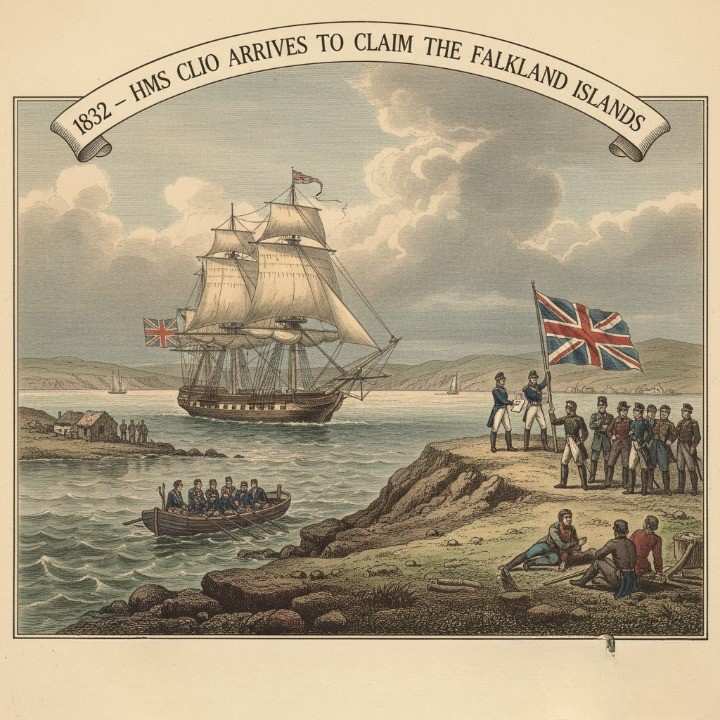
1832 – HMS Clio Arrives to Claim the Falkland Islands
Under the command of Captain Onslow, HMS Clio arrived at Port Egmont, under direct orders from the British Crown to officially take possession of the Falkland Islands. This action reinforced Britain’s long-standing claim to the islands and set the stage for future disputes over sovereignty.
1848 – Louis Napoleon Bonaparte is Inaugurated as President
Following a landslide victory in the first-ever French presidential election, Louis Napoleon Bonaparte was inaugurated in the National Assembly chamber. He became the first (and only) President of the French Second Republic, a position he later used as a stepping stone to proclaim himself Emperor Napoleon III.
1860 – South Carolina Secedes from the United States
In a foundational event leading directly to the Civil War, South Carolina became the first state to formally attempt to secede from the Union by adopting the South Carolina Declaration of Secession. This action was a direct protest against federal authority and the perceived threat to the institution of slavery.
1915 – The Last Australians Evacuate Gallipoli
As part of the withdrawal from the disastrous Gallipoli campaign during World War I, the last remaining Australian troops were successfully evacuated. This marked the end of a long and costly campaign that had resulted in heavy losses but also forged a significant part of the national identity for Australia and New Zealand.
1917 – The Cheka, the Soviet Secret Police, is Established
Shortly after the Bolshevik Revolution, the first Soviet secret police force, known as the Cheka (All-Russian Extraordinary Commission), was officially founded. This organization was created with the mandate to suppress counter-revolution and dissent, quickly becoming a feared instrument of state power and laying the groundwork for future Soviet intelligence agencies.
1924 – Adolf Hitler is Released from Prison
After serving just nine months of his five-year sentence for treason following the failed Beer Hall Putsch, Adolf Hitler was released from Landsberg Prison. During his confinement, he had dictated Mein Kampf, and his early release allowed him to immediately recommence his political activities, eventually leading to his rise to power.
1940 – The Debut of Captain America Comics #1
The first issue of Captain America Comics #1 was published, introducing the world to the patriotic superhero, Captain America. Created by Joe Simon and Jack Kirby, the character, originally shown punching Adolf Hitler, became an instant symbol of American idealism and anti-Axis sentiment during the early days of World War II.
1941 – The “Flying Tigers” See Their First Action
During World War II, the American Volunteer Group (AVG), popularly known as the “Flying Tigers,” engaged in their first battle over Kunming, China. These American pilots, fighting under contract to the Chinese Air Force, quickly gained fame for their distinctive shark-faced fighter planes and their success against the Japanese aerial forces.
1942 – Japanese Air Forces Bomb Calcutta, India
In a significant act of aggression in the South-East Asian theatre of World War II, Japanese air forces bombed Calcutta, India. This attack demonstrated the reach of the Japanese military and caused considerable damage and disruption in one of British India’s largest and most vital cities.
1946 – It’s a Wonderful Life Premieres
The classic holiday film It’s a Wonderful Life premiered at the Globe Theatre in New York. While today it is universally cherished, the film initially received only mixed reviews and was not a major box office success, though its enduring popularity was secured in the following decades.
1946 – A Deadly Earthquake and Tsunami Hit Japan
A powerful earthquake struck the Nankaidō region of Japan, triggering a devastating tsunami. The catastrophe resulted in the deaths of at least one thousand people and the destruction of approximately 36,000 homes, underscoring Japan’s vulnerability to seismic activity.
1948 – Dutch Forces Capture Yogyakarta
During the Indonesian National Revolution, Dutch military forces launched a major offensive and successfully captured Yogyakarta, which was then serving as the temporary capital of the newly formed Republic of Indonesia. This aggressive action led to the capture of several key Indonesian leaders and intensified international pressure on the Netherlands.
1951 – EBR-1 Becomes the First Nuclear Plant to Generate Electricity
A pivotal moment in energy history occurred when the Experimental Breeder Reactor I (EBR-1) in Arco, Idaho, became the world’s first nuclear power plant to successfully generate electricity. The initial output was modest—enough to power just four light bulbs—but it heralded the dawn of the nuclear power era.
1952 – US Air Force C-124 Crash Kills 87
A tragic military aviation accident occurred when a United States Air Force C-124 Globemaster II cargo plane crashed and burned at Moses Lake, Washington. The disaster resulted in the deaths of 87 out of the 115 people on board, making it one of the deadliest military air crashes of the time.
1955 – Cardiff is Proclaimed the Capital of Wales
The city of Cardiff was formally proclaimed the capital city of Wales, part of the United Kingdom. This recognition marked a significant institutional and cultural milestone for the city and the nation, confirming its status as the administrative and commercial heart of Wales.
1957 – The Boeing 707 Makes its First Production Flight
The initial production version of the Boeing 707, a four-engine jet airliner that would revolutionize commercial air travel, made its first successful flight. The 707 marked the beginning of the Jet Age for many airlines, making long-distance travel faster and more accessible.
1960 – The Viet Cong is Formally Established
The National Liberation Front of South Vietnam, better known as the Viet Cong, was formally established in a village in what is now Tây Ninh province. This political organization and military force was created to oppose the South Vietnamese government and played a central role in the ensuing Vietnam War.
1967 – A Pennsylvania Railroad Metroliner Sets a Speed Record
A Pennsylvania Railroad Budd Metroliner achieved a high-speed benchmark, exceeding 249 kilometers per hour (155 mph) on the railroad’s New York Division (now part of Amtrak’s Northeast Corridor). This demonstration showcased the potential for high-speed rail travel in the United States.
1968 – The Zodiac Killer Claims First Official Victims
In the chilling beginning of a notorious crime spree, the Zodiac Killer murdered his first two officially confirmed victims, David Arthur Faraday and Betty Lou Jensen, on Lake Herman Road in Benicia, California. The killer would go on to torment the police and media with taunting letters and ciphers.
1970 – Koza Riot Protests U.S. Occupation in Okinawa
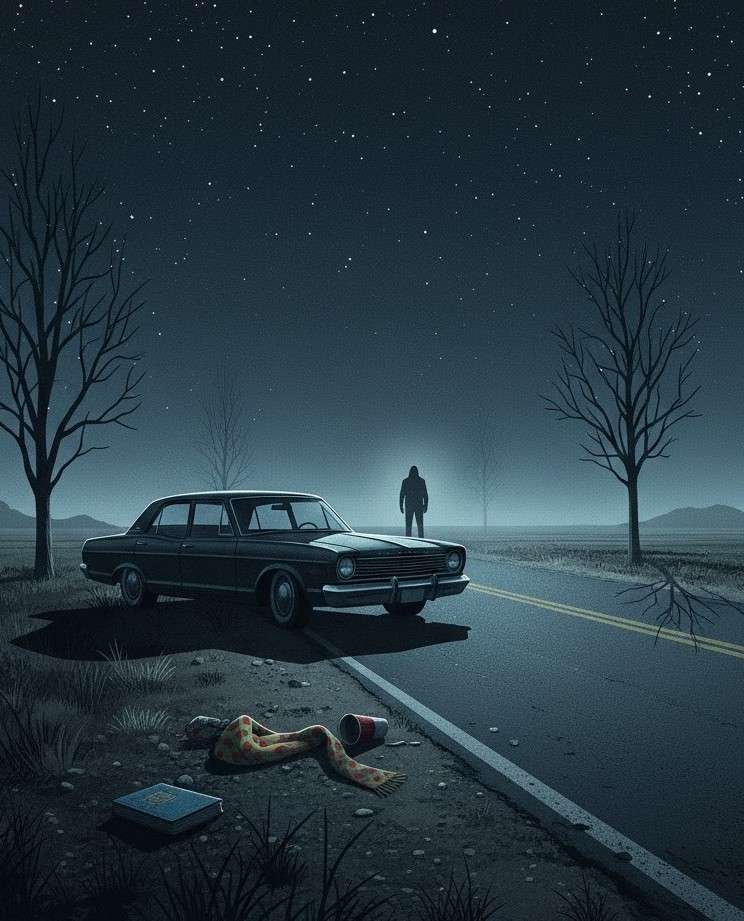
Following a series of vehicular incidents involving American military personnel, approximately 5,000 angry Okinawans took to the streets in protest, clashing with American law enforcement during the Koza riot. The unrest was a potent expression of frustration and resentment over the long-standing U.S. occupation of Okinawa.
1971 – Zulfikar Ali Bhutto Takes Power in Pakistan
In a major political transition following the conclusion of the 1971 war with India and the secession of Bangladesh, Pakistani President Agha Mohammad Yahya Khan transferred power to Zulfikar Ali Bhutto. Bhutto assumed the roles of President and Chief Martial Law Administrator, marking a new chapter in Pakistan’s political history.
1973 – Spanish Prime Minister Luis Carrero Blanco is Assassinated
Spain’s Prime Minister, Admiral Luis Carrero Blanco, was assassinated in Madrid by a car bomb planted by the Basque separatist group ETA. The explosive force of the blast lifted his car over a five-story building, and his death was a destabilizing blow to the final years of the Francoist regime.
1977 – China Publishes New Character Simplification Scheme
With the approval of the State Council, China’s two largest newspapers, the People’s Daily and the Guangming Daily, published the full details of the Second Chinese Character Simplification Scheme. The scheme aimed to further standardize and simplify the writing system, though it was later withdrawn.
1984 – Summit Tunnel Fire Causes Major Transportation Disaster
One of the largest transportation tunnel fires in history, the Summit Tunnel fire, erupted after a freight train carrying over a million liters of gasoline derailed near Todmorden, England. The blaze caused extensive damage to the tunnel and forced a prolonged closure of the railway line.
1984 – Disappearance of Jonelle Matthews
Jonelle Matthews, a young girl from Greeley, Colorado, mysteriously disappeared, becoming a major missing person case. Her remains were tragically discovered on July 23, 2019, nearly 35 years later, with the cause of death being confirmed as a gunshot wound to the head.
1985 – Pope John Paul II Institutes World Youth Day
Pope John Paul II formally announced the institution of World Youth Day, an international event designed to celebrate the Catholic faith among young people. The event has since grown into one of the largest regular gatherings in the Catholic Church.
1987 – Doña Paz Ferry Disaster Causes Mass Loss of Life
In the worst peacetime sea disaster on record, the passenger ferry MV Doña Paz sank after colliding with the oil tanker MT Vector in the Tablas Strait of the Philippines. While the official count was 1,749, the estimated death toll was tragically close to 4,000 people due to the ship being severely overloaded.
1988 – United Nations Agrees on Drug Control Treaty
The United Nations successfully agreed upon and promulgated the United Nations Convention Against Illicit Traffic in Narcotic Drugs and Psychotropic Substances. This treaty is one of the three primary international agreements currently in force governing the global control of drugs and narcotics.
1989 – United States Invasion of Panama Begins
The United States launched a full-scale invasion of Panama, code-named Operation Just Cause, with the primary goal of deposing the country’s de facto leader, dictator Manuel Noriega. The invasion quickly achieved its objectives, leading to Noriega’s capture and subsequent trial.
1991 – Honor Killing Trial Ends in Death Sentence
A Missouri court delivered a death sentence to Palestinian militant Zein Isa and his wife Maria for the shocking “honor killing” of their daughter, Palestina. The high-profile case drew attention to the brutal practice of honor violence within immigrant communities.
1995 – NATO Begins Peacekeeping in Bosnia
The North Atlantic Treaty Organization (NATO) officially began its peacekeeping operations in Bosnia and Herzegovina following the signing of the Dayton Accords. This mission was critical for enforcing the peace agreement and preventing the resumption of hostilities in the region.
1995 – American Airlines Flight 965 Crash
American Airlines Flight 965, a Boeing 757, tragically crashed into a mountain approximately 50 kilometers north of Cali, Colombia. The accident resulted in the deaths of 159 out of the 163 people on board, attributed primarily to a combination of pilot error and confusion over navigational data.
1999 – Macau is Handed Over to China
Following 442 years of Portuguese administration, the territory of Macau was formally handed over to the People’s Republic of China. This event followed a similar handover for Hong Kong and completed the return of China’s historical coastal enclaves to Chinese sovereignty.
2004 – Northern Bank Robbery in Belfast
One of the largest bank robberies in British history took place when a gang of thieves stole a staggering £26.5 million worth of currency from the Northern Bank headquarters in Donegall Square West, Belfast, Northern Ireland. The robbery caused significant economic and political turmoil in the region.
2004 – Cave Story Video Game Releases
The seminal independent video game Cave Story was released to the public. Developed entirely by a single person, Daisuke “Pixel” Amaya, the freeware platformer gained a massive cult following and is credited with influencing the rise of the modern indie game movement.
2007 – Elizabeth II Becomes the Oldest UK Monarch
Queen Elizabeth II surpassed the record set by Queen Victoria to become the oldest monarch in the history of the United Kingdom. At the time, she was 81 years and 243 days old, highlighting her remarkable longevity and long reign.
2007 – Picasso and Portinari Paintings Stolen in Brazil
A high-profile art heist occurred at the São Paulo Museum of Art in Brazil when two immensely valuable paintings were stolen: the Portrait of Suzanne Bloch (1904) by Pablo Picasso and O Lavrador de Café by Brazilian modernist painter Cândido Portinari. Both were recovered by authorities a few weeks later.
2019 – The U.S. Space Force is Established
U.S. President Donald Trump signed the National Defense Authorization Act, which included the formal establishment of the Space Force. This creation designated the Space Force as a new, independent branch of the U.S. military, focused on space warfare and operations.
2024 – Vehicular Attack at Christmas Market in Magdeburg, Germany
A tragic incident occurred at a Christmas market in Magdeburg, Germany, when an anti-Islam activist drove a car into a crowd. The attack resulted in the deaths of six people and left over 200 injured, shocking the nation just days before Christmas.
2024 – Mass Stabbing in Zagreb, Croatia Primary School
A mass stabbing incident took place at a primary school in Zagreb, Croatia. A 7-year-old pupil was tragically killed and six others were injured by a 19-year-old knife-wielding male, leading to a wave of grief and calls for increased school security.
See what happened On Decmber 19
Famous People Born On December 20
| Name | Role / short description | Dates |
|---|---|---|
| Irene Dunne | American actress & singer | December 20, 1898 – September 4, 1990 |
| Billy Bragg | British singer-songwriter & activist | December 20, 1957 – |
| David Bohm | American-born theoretical physicist | December 20, 1917 – October 27, 1992 |
| Branch Rickey | American baseball executive | December 20, 1881 – December 9, 1965 |
| Sir Robert Menzies | Prime minister of Australia | December 20, 1894 – May 15, 1978 |
| Bob Hayes | American sprinter & football player | December 20, 1942 – September 18, 2002 |
| Mitsuko Uchida | Pianist & conductor | December 20, 1948 – |
| W. Eugene Smith | American photojournalist | December 20, 1918 – October 15, 1978 |
| William Julius Wilson | American sociologist | December 20, 1935 – |
| Dan Leno | British music-hall entertainer | December 20, 1860 – October 31, 1904 |
| Harvey S. Firestone | American industrialist (Firestone) | December 20, 1868 – February 7, 1938 |
| Tom Tancredo | American politician | December 20, 1945 – |
| Elsie de Wolfe | American interior designer | December 20, 1865 – July 12, 1950 |
| Susanne K. Langer | American philosopher & educator | December 20, 1895 – July 17, 1985 |
| Knut Wicksell | Swedish economist | December 20, 1851 – May 3, 1926 |
| Sidney Hook | American philosopher & educator | December 20, 1902 – July 12, 1989 |
| Robert J. Van de Graaff | American physicist & inventor | December 20, 1901 – January 16, 1967 |
| Jaroslav Heyrovský | Czech chemist (Nobel laureate) | December 20, 1890 – March 27, 1967 |
| Fred Merkle | American baseball player | December 20, 1888 – March 2, 1956 |
| Max Lerner | American educator & author | December 20, 1902 – June 5, 1992 |
| Amara Essy | Ivorian diplomat | December 20, 1944 – April 7, 2025 |
| Malcolm Cooper | British Olympic shooter | December 20, 1947 – June 9, 2001 |
| Yamini Krishnamurthy | Indian classical dancer | December 20, 1940 – August 3, 2024 |
| Ferdinand-Édouard Buisson | French educator & Nobel Peace laureate | December 20, 1841 – February 16, 1932 |
| Arturo Alessandri Palma | President of Chile | December 20, 1868 – August 24, 1950 |
| Pudge Heffelfinger | American football player & coach | December 20, 1867 – April 2, 1954 |
| Calvert Vaux | Architect & landscape designer | December 20, 1824 – November 19, 1895 |
| James Thomson | Biologist (stem-cell pioneer) | December 20, 1958 – |
| Tom R. Ferguson | Professional rodeo cowboy | December 20, 1950 – |
| Jean Marchand | Canadian politician & labour leader | December 20, 1918 – August 28, 1988 |
Famous People Died On December 20
| Name | Role / short description | Dates |
|---|---|---|
| Artur Rubinstein | Polish-American virtuoso pianist | January 28, 1887 – December 20, 1982 |
| Aulus Vitellius | Roman emperor | 15 – December 20, 69 |
| Rickey Henderson | American baseball player | December 25, 1958 – December 20, 2024 |
| Richard J. Daley | Mayor of Chicago | May 15, 1902 – December 20, 1976 |
| Dean Rusk | United States secretary of state | February 9, 1909 – December 20, 1994 |
| Léopold Sédar Senghor | President of Senegal & poet | October 9, 1906 – December 20, 2001 |
| Ambroise Paré | French surgeon (Renaissance) | 1510 – December 20, 1590 |
| Moss Hart | American playwright | October 24, 1904 – December 20, 1961 |
| Stefan Dušan | Emperor of Serbia | 1308 – December 20, 1355 |
| William Miller | American religious leader (Millerism) | February 15, 1782 – December 20, 1849 |
| Junior Johnson | American NASCAR driver & influencer | June 28, 1931 – December 20, 2019 |
| Max Brod | German-language novelist & editor | May 27, 1884 – December 20, 1968 |
| Itami Jūzō | Japanese film director & screenwriter | May 15, 1933 – December 20, 1997 |
| Dmitry F. Ustinov | Soviet defence minister & statesman | October 30, 1908 – December 20, 1984 |
| Hossein Ali Montazeri | Iranian cleric & dissident | 1922 – December 20, 2009 |
| Denise Levertov | English-born American poet | October 24, 1923 – December 20, 1997 |
| Emil Artin | Mathematician (algebra & number theory) | March 3, 1898 – December 20, 1962 |
| Grote Reber | Radio astronomer & engineer | December 22, 1911 – December 20, 2002 |
| Roland Matthes | East German Olympic swimmer | November 17, 1950 – December 20, 2019 |
| Cardinal Bernard Law | American prelate (Boston archdiocese) | November 4, 1931 – December 20, 2017 |
| Robert Mulligan | American film director | August 23, 1925 – December 20, 2008 |
| William W. Howells | American anthropologist | November 27, 1908 – December 20, 2005 |
| Peter (Metropolitan) | Russian Orthodox metropolitan of Kiev & Moscow | – December 20, 1326 |
| Samuel Hopkins | American theologian & abolitionist | September 17, 1721 – December 20, 1803 |
| Edvard Brandes | Danish author & politician | October 21, 1847 – December 20, 1931 |
| Msiri | 19th-century Central African ruler | – December 20, 1891 |
| John Maurice of Nassau | Count of Nassau-Siegen, colonial governor | June 17, 1604 – December 20, 1679 |
| Irving Rapper | Film director (Hollywood) | January 16, 1898 – December 20, 1999 |
| Félix-Jules Méline | Premier of France | May 20, 1838 – December 20, 1925 |
| Henry Horatio Dixon | Irish botanist (sap ascent theory) | May 19, 1869 – December 20, 1953 |
Observances & Institutional Dates
- Macau Special Administrative Region Establishment Day (Macau): This public holiday marks the 1999 transfer of sovereignty over Macau from Portugal to the People’s Republic of China. It is celebrated with cultural events and official ceremonies recognizing the new governmental structure.
- Abolition of Slavery Day, also known as Fête des Cafres (Réunion, French Guiana): This date commemorates the official end of slavery in the French territories of Réunion and French Guiana. It is a day for honoring the memory of those who endured slavery and celebrating freedom and cultural identity.
- International Human Solidarity Day (International): Designated by the United Nations General Assembly, this day promotes the importance of global unity in tackling international challenges and achieving development goals. It emphasizes the collective responsibility for building a better world.
- Bo Aung Kyaw Day (Myanmar): This date commemorates the death of student activist Bo Aung Kyaw, who was killed by colonial police during a student protest in Yangon in 1938. He is remembered as a martyr for the cause of Burmese independence and student rights.
Frequently Asked Questions
Which major American territory was acquired on December 20?
The Louisiana Purchase, which dramatically expanded the territory of the United States westward, was formally completed on this day in 1803.
What is the significance of the event in South Carolina in 1860?
On December 20, 1860, South Carolina was the first state to issue its Declaration of Secession, directly leading to the formation of the Confederacy and the outbreak of the American Civil War.
What institution did Pope John Paul II found on this date?
Pope John Paul II announced the creation of World Youth Day on December 20, 1985, an event that gathers young Catholics globally for prayer and celebration.