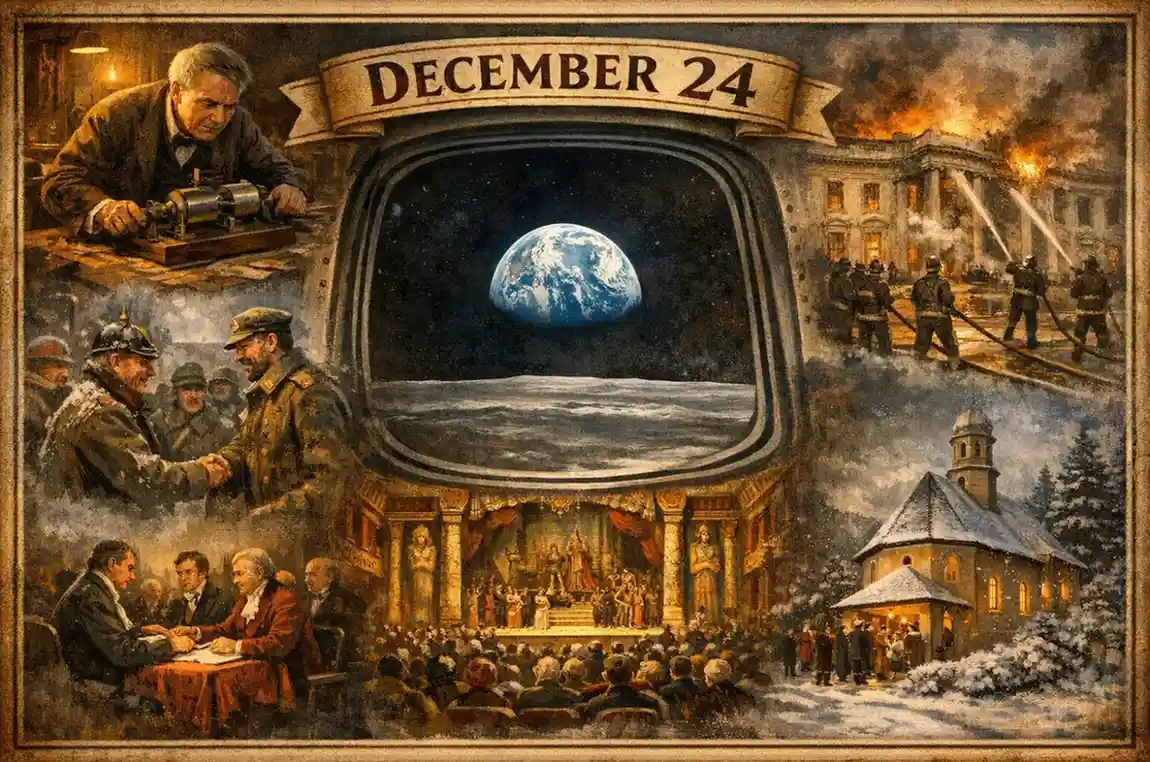
December 24 is widely recognized as a night of anticipation, yet throughout history, it has served as a backdrop for both miraculous peace and devastating conflict. By looking at what happened on this day in history December 24, we discover a date where the first human voices reached across radio waves, the War of 1812 found its end, and the crew of Apollo 8 gave humanity its first glimpse of “Earthrise” from the moon.
Important Events That Happened On December 24 In History
502 – Xiao Yan Names His Successor
In the early years of the Liang dynasty, Emperor Wu (Xiao Yan) formally designated his son, Xiao Tong, as the heir apparent to the Chinese throne. Xiao Tong would become famously known for his literary contributions, specifically the “Wen Xuan,” one of the most important anthologies of Chinese literature. This move was intended to secure the lineage and intellectual legacy of a dynasty that deeply valued both Buddhist philosophy and the arts.
640 – Pope John IV Assumes the Papacy
After a lengthy vacancy following the death of Pope Severinus, Pope John IV was officially elected as the leader of the Catholic Church. A native of Dalmatia, his brief reign was characterized by his firm opposition to Monothelitism and his efforts to provide relief to his homeland following Slavic invasions. His election brought a sense of ecclesiastical continuity to Rome during a period of significant theological and regional instability.
759 – Poet Du Fu Journeys to Chengdu
The legendary Tang dynasty poet Du Fu departed for Chengdu, seeking refuge from the chaos of the An Lushan Rebellion that had ravaged northern China. He was hosted by his close friend and fellow poet Pei Di, eventually settling in the famous “Thatched Cottage” where he would compose some of his most influential works. This journey proved to be a pivotal moment in literary history, providing Du Fu the solitude necessary to document the human cost of war.
971 – Fatimids Defeat Qarmatians at Cairo
In the Battle of Ayn Shams, the Fatimid Caliphate’s forces, led by the brilliant general Jawhar, secured a decisive victory over the Qarmatian invaders at the gates of Cairo. This triumph effectively ended the first Qarmatian attempt to seize Egypt and consolidated Fatimid control over their newly established capital. The victory was essential for the survival of the dynasty and the long-term prosperity of Islamic Cairo.
1144 – The Fall of the County of Edessa
The capital of the Crusader County of Edessa was captured by Imad ad-Din Zengi, the atabeg of Mosul and Aleppo, after a month-long siege. This was the first of the Crusader States to fall to Muslim forces, sending shockwaves through Europe and the Christian world. The loss of Edessa directly triggered the launch of the Second Crusade, marking a major turning point in the history of the Crusades in the Levant.
1294 – Election of Pope Boniface VIII
Following the unprecedented resignation of the elderly hermit-pope St. Celestine V, Benedetto Caetani was elected to the papacy as Pope Boniface VIII. His reign would become one of the most controversial in Church history, marked by intense power struggles with the European monarchs, specifically Philip IV of France. His election signaled a shift toward a more politically assertive and legally focused papacy that would eventually lead to the “Avignon Captivity.”
1500 – Capture of the Castle of St. George
A combined fleet of Venetian and Spanish forces successfully captured the Castle of St. George on the Greek island of Cephalonia from Ottoman control. This military success was a rare bright spot for the Christian alliance during the Ottoman–Venetian War, helping to secure the Ionian Islands for Western interests. The victory demonstrated the effectiveness of joint naval operations against the expanding reach of the Ottoman Empire in the Mediterranean.
1737 – The Marathas Triumph at the Battle of Bhopal
The Maratha Empire, led by Peshwa Baji Rao I, secured a massive victory over a coalition that included the Mughal Empire, the Nizam of Hyderabad, and the Nawabs of Bengal and Awadh. This battle showcased the superior mobile warfare tactics of the Marathas and significantly weakened Mughal authority in Central India. The Treaty of Bhopal that followed granted the Marathas control over the Malwa region, cementing their status as India’s premier power.
1777 – James Cook Discovers Christmas Island
During his third and final voyage of discovery, Captain James Cook arrived at a remote coral atoll in the central Pacific Ocean, which he named Christmas Island (Kiritimati). Cook and his crew stopped at the uninhabited island to observe a solar eclipse and replenish their supplies before continuing their search for the Northwest Passage. Today, the island is part of the Republic of Kiribati and remains one of the largest coral atolls in the world.
1800 – The Plot of the rue Saint-Nicaise
A group of royalist conspirators attempted to assassinate Napoleon Bonaparte by detonating a “machine infernale” (a barrel of explosives) as his carriage passed through the rue Saint-Nicaise in Paris. While the blast killed and injured dozens of innocent bystanders, Napoleon escaped unharmed, as his coachman was driving faster than the plotters anticipated. Napoleon used the failed attempt to justify a harsh crackdown on his political enemies, both on the left and the right.
1814 – The Signing of the Treaty of Ghent
Representatives from the United Kingdom and the United States signed the Treaty of Ghent in Belgium, officially ending the War of 1812. The treaty largely restored the status quo ante bellum, returning occupied territories and establishing commissions to settle boundary disputes. However, because news traveled slowly, the famous Battle of New Orleans was fought weeks later before word of the peace reached North America.
1818 – The First Performance of “Silent Night”
In the Nikolauskirche of Oberndorf, Austria, the world-famous Christmas carol “Stille Nacht” (Silent Night) was performed for the very first time. The lyrics were written by Father Joseph Mohr and the melody composed by Franz Xaver Gruber, who accompanied the choir on guitar because the church organ was reportedly broken. From this humble parish beginning, the song grew to become the most iconic and translated Christmas carol in human history.
1826 – The Eggnog Riot at West Point
A group of cadets at the United States Military Academy at West Point engaged in a drunken mutiny known as the “Eggnog Riot” after smuggling whiskey into the barracks for a Christmas party. The chaos involved the assault of officers and significant property damage, lasting through the night and into the following morning. The incident resulted in the court-martial of twenty cadets and remains one of the most infamous disciplinary lapses in the academy’s history.
1846 – Britain Acquires Labuan from Brunei
Through a treaty signed with the Sultan of Brunei, Great Britain officially acquired the island of Labuan off the coast of Borneo. The British intended to use the island as a coaling station for steamships and a base to combat piracy in the region. Labuan eventually became a Crown Colony and served as an important administrative and commercial hub for British interests in Southeast Asia for over a century.
1865 – The Formation of the Ku Klux Klan
In Pulaski, Tennessee, six former Confederate officers met to form a social club that rapidly evolved into the Ku Klux Klan, a violent white supremacist insurgent group. The organization used terrorism, murder, and intimidation to oppose Reconstruction and strip formerly enslaved people of their newly won civil rights. This founding marked the beginning of a dark era of systemic racial violence and domestic terrorism in the American South.
1868 – Establishment of the Greek Presidential Guard
King George I of Greece issued a decree establishing the royal escort, which would eventually become the modern Greek Presidential Guard, or the Evzones. Originally a combat unit, they are now a ceremonial elite force known for their distinctive traditional uniforms, including the kilt-like fustanella. They remain a powerful symbol of Greek national identity and are famously stationed at the Tomb of the Unknown Soldier in Athens.
1871 – The Premiere of Aida in Cairo
Giuseppe Verdi’s operatic masterpiece, Aida, received its world premiere at the Khedivial Opera House in Cairo, Egypt. Commissioned to celebrate the opening of the Suez Canal and the new opera house, the performance was a grand spectacle featuring lavish costumes and sets. The opera, telling a story of love and betrayal in ancient Egypt, was an immediate international triumph and remains a cornerstone of the global operatic repertoire.
1877 – Thomas Edison Patents the Phonograph
The U.S. Patent Office received an application from Thomas Edison for his “Phonograph or Speaking Machine,” a device capable of recording and reproducing sound. Edison had demonstrated the machine weeks earlier, famously recording himself reciting “Mary Had a Little Lamb” onto a piece of tinfoil. This invention revolutionized the world, birthing the entire recording industry and forever changing how humans experience music and speech.
1906 – The First Radio Broadcast in History
Reginald Fessenden made history by transmitting the first-ever radio broadcast from Brant Rock, Massachusetts, which was picked up by ships at sea. The program featured Fessenden playing “O Holy Night” on the violin, reading a passage from the Bible, and delivering a short speech. This milestone proved that radio could be used for more than just Morse code, laying the groundwork for the modern age of mass communication.
1913 – The Italian Hall Disaster
During a Christmas party for striking copper miners and their families in Calumet, Michigan, a false cry of “fire” triggered a panicked stampede in the crowded Italian Hall. Seventy-three people, including 59 children, were crushed to death in the narrow stairwell as they tried to escape the non-existent blaze. The tragedy left a permanent scar on the local community and became a rallying cry for labor rights across the United States.
1914 – The Christmas Truce of World War I
In a remarkable display of shared humanity, German and British soldiers along the Western Front initiated an unofficial “Christmas Truce.” Men who had been trying to kill each other hours before emerged from their trenches to exchange gifts, sing carols, and even play football in “No Man’s Land.” While high commands on both sides eventually banned such fraternization, the truce remains a legendary symbol of peace amidst the horrors of war.
1918 – Međimurje Joins the Kingdom of the South Slavs
Following the collapse of the Austro-Hungarian Empire at the end of World War I, the region of Međimurje was captured by forces of the Kingdom of Serbs, Croats, and Slovenes. The local Croatian population had long sought to break away from Hungarian rule, and the military action solidified the region’s inclusion in the new Yugoslav state. This annexation was later formally recognized by international treaties, shaping the modern borders of Croatia.
1920 – D’Annunzio Surrenders Fiume
The flamboyant Italian poet and nationalist Gabriele D’Annunzio was forced to surrender the “Italian Regency of Carnaro” in the city of Fiume to the Italian Armed Forces. D’Annunzio had seized the city in defiance of post-WWI treaties, establishing a proto-fascist state that lasted for over a year. His surrender followed a naval bombardment known as the “Bloody Christmas,” ending his experimental and controversial regime.
1924 – Albania Proclaims Itself a Republic
Following years of internal turmoil and power struggles, Albania was officially proclaimed a republic by its national assembly. This shift in governance was led by Ahmet Zogu, who would serve as the republic’s first president before later declaring himself King Zog I. The transition to a republic was an attempt to modernize the nation and secure its sovereignty in the face of pressure from neighboring Balkan powers.
1929 – Assassination Attempt on Hipólito Yrigoyen
Argentine President Hipólito Yrigoyen narrowly escaped an assassination attempt when a gunman opened fire on his motorcade in Buenos Aires. Yrigoyen, a popular but increasingly controversial populist leader, was unharmed, though the incident highlighted the growing political polarization in Argentina. This climate of violence and instability eventually contributed to the military coup that overthrew him the following year.
1929 – Fire Breaks Out in the White House
On Christmas Eve, a four-alarm fire erupted in the West Wing of the White House during a holiday party hosted by President Herbert Hoover. The blaze began in the attic of the executive offices, causing extensive damage to the building and destroying many official records. Hoover and his guests were evacuated safely, and the President famously watched the firefighting efforts from the lawn as crews worked to save the historic structure.
1939 – Pope Pius XII Issues a Christmas Peace Appeal
With Europe already plunged into the early stages of World War II, Pope Pius XII used his Christmas Eve radio broadcast to make a desperate plea for a “just and honorable peace.” He outlined a five-point plan for global stability, which included the right of small nations to independence and the end of the arms race. Despite the Pope’s moral authority, his words did little to halt the march of the Axis and Allied powers.
1941 – Japanese and British Conquests in WWII
In a day of significant territorial shifts during World War II, Japanese forces conquered the city of Kuching in Sarawak (Borneo). Meanwhile, on the North African front, the British Eighth Army successfully captured the strategic port city of Benghazi from Axis forces. These events illustrated the global scale of the conflict, with major military operations simultaneously unfolding in the jungles of Southeast Asia and the deserts of Libya.
1942 – Assassination of Admiral François Darlan
Vichy French Admiral François Darlan was assassinated in Algiers by Fernand Bonnier de La Chapelle, a young French monarchist. Darlan had recently defected to the Allied side following the invasion of North Africa, a move that was highly controversial among both French factions and the Allies. His death removed a complicated political figure from the board and allowed General Henri Giraud to take command of French forces in North Africa.
1943 – Eisenhower Named Supreme Allied Commander
U.S. President Franklin D. Roosevelt officially named General Dwight D. Eisenhower as the Supreme Allied Commander for Operation Overlord—the planned invasion of Nazi-occupied Europe. Eisenhower’s appointment was based on his proven ability to manage complex coalitions and his successful leadership in North Africa and Italy. This decision placed the weight of the war’s most critical operation on his shoulders, leading directly to the D-Day landings.
1944 – The Sinking of the SS Leopoldville
On Christmas Eve, the Belgian troopship SS Leopoldville was torpedoed by a German U-boat just miles off the coast of Cherbourg, France. The disaster resulted in the deaths of 763 American soldiers and 56 crew members, many of whom drowned or died of hypothermia in the freezing English Channel. The sinking was largely kept secret by the military for decades, making it one of the most tragic and least-known maritime disasters of World War II.
1945 – The Disappearance of the Sodder Children
A mysterious fire destroyed the home of George and Jennie Sodder in Fayetteville, West Virginia, while five of their nine children were still inside. Curiously, no skeletal remains were ever found in the ashes, leading the parents to believe that their children had been kidnapped before or during the fire. The case became one of America’s most enduring and baffling mysteries, fueled by strange sightings and unhelpful investigations.
1951 – Libya Gains Independence
Libya officially declared its independence from colonial rule, becoming the first African nation to achieve sovereignty through a United Nations resolution. Idris I, who had led the resistance against Italian and later Allied administration, was proclaimed the first King of the United Kingdom of Libya. This milestone was a significant step in the post-war decolonization movement that would soon sweep across the African continent.
1952 – First Flight of the Handley Page Victor
The Handley Page Victor, a British jet-powered strategic bomber, successfully completed its first test flight. It was the third and final of the “V-bombers” designed to carry the UK’s nuclear deterrent during the Cold War. With its distinctive crescent wing and sleek design, the Victor was a marvel of mid-century aviation engineering and eventually served a long career as a high-altitude aerial refueler.
1953 – The Tangiwai Disaster in New Zealand
In New Zealand’s worst rail disaster, a bridge at Tangiwai collapsed into the Whangaehu River just as a passenger train was crossing. The bridge had been weakened by a massive “lahar”—a flood of mud and debris—from the nearby Mount Ruapehu. The accident killed 151 people on Christmas Eve, devastating the nation and leading to significant improvements in railway safety and geological monitoring.
1955 – Massive Floods Devastate Northern California
Following weeks of torrential rain, Northern California was hit by catastrophic flooding that resulted in the deaths of 74 people. The Feather and Yuba Rivers burst their banks, inundating towns like Yuba City and causing hundreds of millions of dollars in property damage. The disaster led to a massive overhaul of the state’s levee and dam systems to prevent such a wide-scale tragedy from occurring again.
1964 – The Brinks Hotel Bombing in Saigon
Viet Cong operatives successfully detonated a massive car bomb at the Brinks Hotel in Saigon, which served as a residence for American military officers. The attack was intended to demonstrate the Viet Cong’s ability to strike at the heart of the heavily guarded capital and to pressure the U.S. to withdraw. Two Americans were killed and dozens were injured, prompting a significant escalation in American retaliatory airstrikes.
1964 – Flying Tiger Line Flight 282 Crash
A Flying Tiger Line Lockheed Constellation cargo plane crashed into a hill shortly after taking off from San Francisco International Airport in heavy fog. All three crew members on board were killed in the accident. The investigation determined that the pilots had deviated from their prescribed departure path, highlighting the extreme dangers of flying in low-visibility conditions during that era of aviation.
1966 – Military Charter Crash in South Vietnam
A Canadair CL-44 cargo aircraft, chartered by the United States military, crashed into a small village in South Vietnam while attempting to land in poor weather. The accident resulted in the deaths of 111 people, most of whom were villagers on the ground. It remains one of the deadliest aviation accidents of the Vietnam War, illustrating the heavy collateral damage often suffered by civilians during the conflict.
1968 – Apollo 8 Enters Lunar Orbit
In one of the most profound achievements in human history, the crew of Apollo 8—Frank Borman, Jim Lovell, and Bill Anders—became the first humans to enter orbit around the moon. During their mission, they captured the iconic “Earthrise” photograph and performed a live television broadcast where they read the first ten verses of Genesis. Their mission proved that a lunar landing was possible and offered humanity a new perspective on its home planet.
1969 – Nigerian Forces Capture Umuahia
Nigerian federal troops successfully captured Umuahia, the third and final capital of the breakaway Republic of Biafra during the Nigerian Civil War. The fall of the city signaled the imminent collapse of the Biafran resistance, which had been crippled by blockade and famine. The capture of Umuahia effectively ended the dream of Biafran independence and led to the reintegration of the region into Nigeria.
1971 – The Crash of LANSA Flight 508
While flying through a severe thunderstorm over the Peruvian Amazon, LANSA Flight 508 was struck by lightning and disintegrated in mid-air. The only survivor was 17-year-old Juliane Koepcke, who fell two miles while still strapped to her seat and survived eleven days in the jungle before finding help. Her story of survival against all odds remains one of the most incredible tales in the history of aviation.
1973 – DC Home Rule Act is Passed
U.S. President Richard Nixon signed the District of Columbia Home Rule Act into law, granting the residents of Washington, D.C., the right to elect their own local government for the first time in a century. This allowed for the creation of an elected mayor and a city council, returning a measure of self-governance to the nation’s capital. While Congress retained final authority over the city’s budget and laws, the act was a major victory for local civil rights.
1974 – Cyclone Tracy Devastates Darwin
On Christmas Eve and Christmas morning, Cyclone Tracy struck the city of Darwin, Australia, with catastrophic force. The storm destroyed nearly 70% of the city’s buildings and killed 71 people, leaving the population without power, water, or communication. The disaster led to one of the largest evacuations and reconstruction projects in Australian history, resulting in much stricter building codes for tropical regions.
1979 – The First Launch of the Ariane 1 Rocket
The European Space Agency successfully launched the first Ariane 1 rocket from the Guiana Space Centre in Kourou, French Guiana. This launch marked the beginning of Europe’s independent access to space, providing a reliable vehicle for placing commercial satellites into orbit. The Ariane program would go on to become a major competitor in the global space launch market, ensuring Europe’s status as a space power.
1983 – Aeroflot Flight 601 Takeoff Crash
An Aeroflot Antonov An-24 crashed shortly after taking off from Leshukonskoye Airport in Russia during a heavy snowstorm. Of the 49 people on board, 44 were killed in the accident. The crash was attributed to the pilots attempting to take off with excessive snow and ice accumulation on the wings, which prevented the aircraft from gaining enough lift to clear obstacles near the runway.
1994 – Hijacking of Air France Flight 8969
Four members of the Armed Islamic Group (GIA) hijacked Air France Flight 8969 on the ground in Algiers, intending to fly the plane into the Eiffel Tower. After two days of negotiations and the killing of three passengers, the plane was allowed to fly to Marseille, where it was stormed by French GIGN commandos. In a dramatic televised rescue, all passengers were saved, and all four terrorists were killed.
1996 – Learjet 35 Crash in New Hampshire
A Learjet 35 cargo plane disappeared from radar and crashed into the side of Smarts Mountain in New Hampshire during a night flight in poor weather. Both pilots on board were killed instantly. The wreckage was not located for several days due to the rugged terrain and deep snow, and the investigation eventually pointed to pilot disorientation and controlled flight into terrain (CFIT).
1997 – The Sid El-Antri Massacre in Algeria
During the height of the Algerian Civil War, armed insurgents attacked the village of Sid El-Antri, killing between 50 and 100 civilians in a single night. The attackers used knives and axes to slaughter entire families, a hallmark of the brutal “Dark Decade” in Algeria. This massacre was one of many that terrified the rural population and drew international condemnation for the senseless violence against non-combatants.
1999 – Hijacking of Indian Airlines Flight 814
Indian Airlines Flight 814 was hijacked by five militants shortly after taking off from Kathmandu, Nepal, and was eventually forced to land in Kandahar, Afghanistan. The hostage crisis lasted for seven days and ended when the Indian government agreed to release three high-profile militants in exchange for the passengers. One passenger was tragically killed, but 190 survivors were released on New Year’s Eve.
2003 – Thwarted ETA Bombing at Chamartín Station
Spanish police successfully intercepted a plot by the separatist group ETA to detonate two large suitcases filled with 50 kg of explosives inside Madrid’s busy Chamartín Station. The bombs were timed to go off during the afternoon rush hour on Christmas Eve, which would have resulted in massive casualties. The arrests and seizure of the explosives prevented a major national tragedy and dealt a significant blow to the militant group.
2005 – Chad Declares Belligerence Against Sudan
The government of Chad officially declared a “state of belligerence” against neighboring Sudan following a cross-border attack by rebels on the town of Adré. Chad accused the Sudanese government of supporting the insurgents, leading to a significant breakdown in diplomatic relations between the two nations. This escalation contributed to the growing regional instability fueled by the ongoing conflict in Darfur.
2008 – Lord’s Resistance Army Massacres in the DRC
The Lord’s Resistance Army (LRA), led by Joseph Kony, launched a series of brutal coordinated attacks against civilians in the Democratic Republic of the Congo. Known as the “Christmas Massacres,” the raids resulted in the deaths of over 400 people and the abduction of hundreds of children. The violence highlighted the inability of regional governments and UN peacekeepers to protect vulnerable populations from the mobile and ruthless rebel group.
2018 – Helicopter Crash Kills Mexican Governors
Martha Érika Alonso, the first female Governor of Puebla, and her husband, Senator Rafael Moreno Valle, were killed when their helicopter crashed shortly after takeoff. The sudden death of the prominent political couple shocked the nation and led to widespread speculation and conspiracy theories. The official investigation eventually concluded that the crash was caused by a mechanical failure in the aircraft’s stability system.
2021 – The Mo So Massacre in Burma
In a horrific display of violence during the ongoing civil conflict in Myanmar, military forces carried out a massacre of at least 44 civilians in Mo So village. The victims, including women and children, were reportedly shot and their bodies burned in their vehicles as they tried to flee the fighting. The incident drew international outrage and remains a symbol of the atrocities committed by the military junta against its own people.
Read Also: What Happened On This Day In History December 23: Miracles & Milestones
Famous People Born On December 24
| Name | Role / short description | Dates |
|---|---|---|
| Mohammad Rafi | Indian playback singer | December 24, 1924 – July 31, 1980 |
| James Prescott Joule | English physicist (energy, Joule) | December 24, 1818 – October 11, 1889 |
| Emanuel Lasker | German chess champion | December 24, 1868 – January 11, 1941 |
| Joseph Cornell | American assemblage artist & filmmaker | December 24, 1903 – December 29, 1972 |
| Juan Ramón Jiménez | Spanish poet; Nobel laureate | December 24, 1881 – May 29, 1958 |
| Fritz Leiber | American author (fantasy & SF) | December 24, 1910 – September 5, 1992 |
| Harry Warren | American songwriter & composer | December 24, 1893 – September 22, 1981 |
| Ad Reinhardt | American abstract painter | December 24, 1913 – August 30, 1967 |
| Charles Hermite | French mathematician | December 24, 1822 – January 14, 1901 |
| Carl O. Sauer | American geographer | December 24, 1889 – July 18, 1975 |
| I. F. Stone | American investigative journalist | December 24, 1907 – June 18, 1989 |
| Andrew Chi-Chih Yao | Computer scientist; Turing Award laureate | December 24, 1946 – |
| Georges-Marie Guynemer | French WWI flying ace | December 24, 1894 – September 11, 1917 |
| Silas Deane | American diplomat (Revolutionary era) | December 24, 1737 – September 23, 1789 |
| Louis Jouvet | French actor & theatre director | December 24, 1887 – August 16, 1951 |
| Robert Joffrey | American choreographer; Joffrey Ballet founder | December 24, 1930 – March 25, 1988 |
| Joseph R. Smallwood | Newfoundland politician; premier | December 24, 1900 – December 17, 1991 |
| Stipe Mesić | President of Croatia | December 24, 1934 – |
| William Paterson | U.S. jurist; Constitutional framer | December 24, 1745 – September 9, 1806 |
| Charles Wakefield Cadman | American composer (inc. Native American themes) | December 24, 1881 – December 30, 1946 |
| Sir Horace Curzon Plunkett | Irish agricultural reformer | December 24, 1854 – March 26, 1932 |
| William Hayward Pickering | Engineer; led Explorer 1 mission | December 24, 1910 – March 15, 2004 |
| Juan Linz | Political scientist (democracy & authoritarianism) | December 24, 1926 – October 1, 2013 |
| Tevfik Fikret | Turkish modernist poet | December 24, 1867 – August 18, 1915 |
| Adam Rapacki | Polish politician & economist | December 24, 1909 – October 10, 1970 |
| Pietro Carnesecchi | Italian humanist & reformer | December 24, 1508 – October 1, 1567 |
| Otto Ender | Chancellor of Austria | December 24, 1875 – June 25, 1960 |
| John V, Duke of Brittany | Medieval duke of Brittany | December 24, 1389 – August 28, 1442 |
| Walter Abish | Austrian-born American experimental writer | December 24, 1931 – May 28, 2022 |
| Dana Gioia | American poet & arts advocate | December 24, 1950 – |
Famous People Died On December 24
| Name | Role / short description | Dates |
|---|---|---|
| Harold Pinter | British playwright & Nobel laureate | October 10, 1930 – December 24, 2008 |
| Samuel P. Huntington | American political scientist | April 18, 1927 – December 24, 2008 |
| William Makepeace Thackeray | British novelist (Vanity Fair) | July 18, 1811 – December 24, 1863 |
| Bernard Herrmann | American composer (film scores) | June 29, 1911 – December 24, 1975 |
| Alban Berg | Austrian composer (atonal/12-tone) | February 9, 1885 – December 24, 1935 |
| Johns Hopkins | American philanthropist (university & hospital) | May 19, 1795 – December 24, 1873 |
| Charles Atlas | Italian-American bodybuilder & fitness icon | October 30, 1892 – December 24, 1972 |
| Frédéric Bastiat | French economist & free-trade advocate | June 30, 1801 – December 24, 1850 |
| John Osborne | British playwright (Look Back in Anger) | December 12, 1929 – December 24, 1994 |
| Richard Adams | British author (Watership Down) | May 9, 1920 – December 24, 2016 |
| William John Macquorn Rankine | Scottish engineer & thermodynamicist | July 5, 1820 – December 24, 1872 |
| Joel Barlow | American poet, diplomat & statesman | March 24, 1754 – December 24, 1812 |
| Lev Ivanov | Russian ballet choreographer | February 18, 1834 – December 24, 1901 |
| Ian Barbour | Theologian & physicist (science-religion dialogue) | October 5, 1923 – December 24, 2013 |
| Nguyễn Hữu Thọ | Vietnamese political leader (NLF chairman) | July 10, 1910 – December 24, 1996 |
| Jean, sire de Joinville | Medieval chronicler (life of St. Louis) | c.1224 – December 24, 1317 |
| Hugh Miller | Scottish geologist & writer | October 10, 1802 – December 24, 1856 |
| Frank Stanton | CBS executive & broadcasting innovator | March 20, 1908 – December 24, 2006 |
| Maurice Couve de Murville | French foreign minister & prime minister | January 24, 1907 – December 24, 1999 |
| João Baptista de Oliveira Figueiredo | President of Brazil | January 15, 1918 – December 24, 1999 |
| Juan Velasco Alvarado | President of Peru | June 16, 1910 – December 24, 1977 |
| Pushmataha | Choctaw chief & leader | c.1765 – December 24, 1824 |
| Robert Parker Parrott | Inventor (Parrott rifle cannon) | October 5, 1804 – December 24, 1877 |
| Vladimir Bekhterev | Russian neurologist & psychiatrist | February 1, 1857 – December 24, 1927 |
| Noël Coypel | French Baroque painter | December 25, 1628 – December 24, 1707 |
| Philip Henry Stanhope, 5th Earl Stanhope | Politician & founder (National Portrait Gallery) | January 30, 1805 – December 24, 1875 |
| George of Cappadocia | Controversial Arian bishop of Alexandria | – December 24, 361 |
| Mikhail Loris-Melikov | Russian statesman & reformer | January 1, 1826 – December 24, 1888 |
| Kathy Whitworth | American golf champion | September 27, 1939 – December 24, 2022 |
| Marcantonio Franceschini | Italian Baroque painter | April 5, 1648 – December 24, 1729 |
Observances & Institutional Dates
- Independence Day (Libya): Celebrates the nation’s declaration of sovereignty in 1951, marking the end of colonial and foreign administration.
- Kūčios (Lithuania): A traditional Christmas Eve dinner and celebration in Lithuania, characterized by 12 meatless dishes and the gathering of family.
- Day of Military Honour (Russia): Commemorates the successful 1790 siege of the Turkish fortress of Izmail by Russian troops under Alexander Suvorov.
Frequently Asked Questions
When was the first radio broadcast?
Reginald Fessenden performed the first-ever radio broadcast of music and speech on Christmas Eve, December 24, 1906.
What did the crew of Apollo 8 do on Christmas Eve?
On December 24, 1968, the Apollo 8 crew became the first humans to orbit the moon, taking the “Earthrise” photo and reading from Genesis on live TV.
What was the Christmas Truce of 1914?
It was an unofficial ceasefire during World War I where British and German soldiers met in No Man’s Land to share gifts and sing carols.